Every successful interview starts with knowing what to expect. In this blog, we’ll take you through the top Artillery Platoon Operations interview questions, breaking them down with expert tips to help you deliver impactful answers. Step into your next interview fully prepared and ready to succeed.
Questions Asked in Artillery Platoon Operations Interview
Q 1. Explain the fire control process for an artillery system.
The fire control process for an artillery system is a precise, multi-step procedure ensuring accurate and effective fire support. It involves several key stages:
- Target Acquisition and Location: This begins with identifying the target’s location using coordinates (grid, UTM, or geographic) obtained from Forward Observers (FOs), intelligence, or other sources. Accuracy here is paramount.
- Data Input: The target’s coordinates, along with meteorological data (wind speed, direction, temperature, air pressure), are inputted into the Fire Direction Center (FDC). This data is crucial for compensating for environmental factors that affect projectile trajectory.
- Ballistic Computation: The FDC uses sophisticated software and algorithms to calculate the necessary firing data, including the firing angle, powder charge, and fuse settings. This computation considers the gun’s characteristics, projectile type, and range to the target.
- Firing Data Transmission: The calculated firing data is transmitted to the artillery pieces (guns or howitzers). This is often done electronically, reducing errors and speeding up the process. Modern systems use sophisticated digital communication networks.
- Firing Execution: The gun crew loads and fires the artillery rounds according to the received firing data. Precise adherence to the data is key to hitting the target.
- Post-Mission Analysis: After firing, the FDC analyzes the results, including any observed impacts (via spotters or other sensors) to fine-tune future firing solutions. This feedback loop improves accuracy over time.
Imagine trying to hit a target a few miles away with a projectile subject to wind. The fire control process is essentially a sophisticated aiming system, compensating for all these unpredictable variables.
Q 2. Describe the different types of artillery ammunition and their applications.
Artillery ammunition varies widely, each type designed for a specific purpose. Key types include:
- High-Explosive (HE): The workhorse of artillery, designed for blast and fragmentation effects. Used against personnel, lightly armored vehicles, and fortifications.
- High-Explosive, Anti-Tank (HEAT): Uses a shaped charge to penetrate armor. Effective against tanks and heavily armored vehicles.
- White Phosphorus (WP): Creates a smokescreen, illuminates targets, or can be used as an incendiary weapon. Useful for obscuring movement, marking targets, or creating distractions.
- Illumination (ILLUM): Contains a flare that lights up the battlefield at night, assisting in target acquisition and observation.
- Smoke: Generates a thick smoke screen to obscure troop movements or positions from enemy observation.
- Cluster Munitions: Contain multiple smaller bomblets or submunitions, dispersing over a wide area. Controversial due to potential for civilian casualties.
The choice of ammunition depends entirely on the target and the desired effect. Attacking a tank requires HEAT, while suppressing enemy fire might utilize HE or smoke rounds.
Q 3. What are the key elements of a successful fire mission?
A successful fire mission hinges on several key elements:
- Accurate Target Location: Precise coordinates are essential. Errors in target location lead to missed shots.
- Clear Communication: Efficient and unambiguous communication between the FDC, FO, and artillery crews is critical to avoid misunderstandings and delays.
- Accurate Meteorological Data: Wind speed, direction, temperature, and air pressure significantly affect projectile trajectory. Inaccurate data compromises accuracy.
- Proper Ammunition Selection: The correct type of ammunition must be chosen based on the target and the desired effect.
- Effective Fire Control System: A well-maintained and properly functioning fire control system ensures accurate calculations and data transmission.
- Well-Trained Personnel: Skilled and experienced gun crews and FDC personnel are essential to carry out the fire mission flawlessly.
Think of it like baking a cake – each ingredient (accurate data, communication, ammunition selection) is crucial for a successful outcome (hitting the target).
Q 4. How do you ensure the safety of your personnel during artillery operations?
Ensuring personnel safety during artillery operations is paramount. This involves a multi-layered approach:
- Strict Safety Procedures: Adherence to established safety procedures, including proper handling of ammunition, clear communication protocols, and designated safety zones, is mandatory.
- Ammunition Safety: Safe storage, handling, and transportation of ammunition are critical to prevent accidents. This includes regular inspections and maintenance of storage areas.
- Protective Equipment: Using appropriate hearing and eye protection is crucial to protect against noise and flying debris.
- Proper Training: Thorough training on safety procedures, emergency response plans, and equipment usage is essential for all personnel.
- Risk Assessment: Conducting thorough risk assessments before, during, and after each mission helps identify and mitigate potential hazards.
- Emergency Response Plans: Having well-rehearsed emergency response plans for accidents, malfunctions, or other unexpected events ensures swift and effective action.
Safety is not just a set of rules; it’s a culture. Every action should be informed by a commitment to safety.
Q 5. Explain the role of a Forward Observer in coordinating artillery fire.
The Forward Observer (FO) is the eyes and ears of the artillery system, acting as the crucial link between the target and the artillery unit. Their role includes:
- Target Acquisition and Location: The FO identifies and precisely locates targets using various methods, such as map reading, GPS, and laser rangefinders. This is often done under challenging conditions.
- Communication: The FO maintains constant communication with the Fire Direction Center (FDC), relaying target information, adjustments, and observations.
- Adjusting Fire: Based on the observed effects of fire, the FO provides adjustments to the FDC to improve accuracy. This requires a keen understanding of ballistics and terrain effects.
- Target Confirmation: The FO confirms target destruction or neutralization.
- Battle Damage Assessment (BDA): The FO assesses the damage inflicted on the target.
The FO is essentially the ‘sniper’ guiding the artillery’s ‘heavy artillery’ fire, ensuring its effectiveness and minimizing collateral damage.
Q 6. Describe the process of surveying a firing position.
Surveying a firing position is crucial for accurate artillery fire. This involves:
- Reconnaissance: Identifying a suitable location considering factors like concealment, terrain, and accessibility.
- Orientation: Determining the location’s azimuth (direction) and elevation (height).
- Measurement: Accurately measuring the distance and direction to known reference points using surveying equipment like theodolites or GPS.
- Data Recording: Meticulously documenting all measurements and observations, creating a detailed survey report.
- Coordinate Determination: Using the collected data to determine the precise coordinates of the firing position.
- Obstacle Clearance: Ensuring the area is free of obstacles that might impede firing.
Think of this as laying the foundation for a building. A poorly surveyed firing position will lead to inaccurate fire, just as a poorly laid foundation will lead to structural problems.
Q 7. What are the common malfunctions of an artillery system, and how are they addressed?
Artillery systems, like any complex machinery, are susceptible to malfunctions. Common issues include:
- Breech Malfunctions: Problems with the breech mechanism, which seals the gun barrel and facilitates loading and firing, can prevent firing.
- Firing Mechanism Malfunctions: Issues with the firing pin or other components of the firing mechanism can prevent the round from detonating.
- Hydraulic System Malfunctions: Problems with the hydraulic system, used for traversing (rotating) and elevating (raising) the gun, can limit maneuverability.
- Communication System Malfunctions: Failures in the communication systems, which transmit firing data to the gun crews, halt operations.
- Ammunition Malfunctions: Defective ammunition can fail to fire or detonate, leading to misfires or premature explosions.
Addressing these malfunctions requires a combination of preventative maintenance, troubleshooting skills, and access to spare parts. Trained technicians are crucial for resolving such problems quickly and safely. Often, a malfunction can be addressed by the gun crew, while others may require the assistance of more experienced personnel.
Q 8. How do you calculate range and deflection for an artillery piece?
Calculating range and deflection for an artillery piece involves a combination of mathematical formulas, map reading, and understanding the ballistic characteristics of the specific weapon system. It’s like aiming a very powerful, long-range slingshot – you need precision!
Range is determined primarily by the elevation of the barrel. Higher elevation leads to a longer range. We use firing tables – essentially a look-up chart based on projectile type, charge weight, and meteorological conditions (temperature, wind, air pressure) – to find the correct elevation for a given target range. Think of it as a recipe: specific ingredients (data) yield a specific result (range).
Deflection accounts for the direction. This is calculated using the direction to the target (obtained through map coordinates or observation) and the weapon’s orientation. It’s adjusted by turning the weapon left or right. The correction is often done in terms of mils or degrees, taking into account wind drift and earth’s rotation (Coriolis effect) for long-range shots.
Example: Let’s say the firing table shows that with a specific charge, to hit a target 10,000 meters away requires an elevation of 45 degrees. If the target’s azimuth (direction) is 30 degrees, the gunner will set the weapon to 30 degrees deflection and 45 degrees elevation.
Q 9. What are the limitations of different types of artillery systems?
Different artillery systems have various limitations. These constraints primarily revolve around range, mobility, accuracy, rate of fire, and ammunition type.
- Range: Howitzer systems, while versatile, generally have shorter ranges than guns. Rocket artillery sacrifices accuracy for range and volume of fire.
- Mobility: Self-propelled howitzers are highly mobile, while towed artillery needs a separate transport vehicle, limiting their deployment speed and flexibility. Mortars, though portable, have limited range and maneuverability.
- Accuracy: The accuracy of artillery is influenced by many factors, including the weapon system’s design, the quality of the ammunition, and the environmental conditions. GPS-guided munitions significantly improve accuracy but are generally more expensive.
- Rate of Fire: The rate of fire differs greatly, from the high rate of fire of some rocket systems to the comparatively slower rate of large caliber howitzers. This impacts the ability to saturate a target area or suppress enemy fire.
- Ammunition Type: Different artillery pieces utilize specific ammunition types (high-explosive, smoke, illumination, etc.). The available ammunition directly affects the mission’s type and success.
Example: A towed howitzer might have a longer range than a mortar but lacks the mobility of a self-propelled howitzer. Choosing the right system depends on the specific mission requirements.
Q 10. Explain the importance of communication in artillery operations.
Communication is absolutely paramount in artillery operations, acting as the nervous system of the entire process. Without efficient communication, the precise coordination needed for accurate and effective fire support is impossible.
Importance:
- Target Acquisition: Precise target location information, often from forward observers or drones, must be rapidly and accurately relayed to the fire direction center (FDC).
- Fire Mission Execution: The FDC calculates firing data and sends this information (range, deflection, fuse settings) to the gun crews. Clear, concise communication prevents errors that could lead to inaccurate or even dangerous shots.
- Coordination: Artillery often operates alongside other units (infantry, armor). Clear communication prevents friendly fire incidents and ensures coordinated actions.
- Ammunition Resupply: Maintaining a steady supply of ammunition necessitates constant communication between the firing unit and the logistics team.
- Safety: Communication of safety procedures, emergency protocols, and weather updates is essential to ensure the safety of personnel and equipment.
Example: During a fast-paced engagement, a delay in communicating a crucial target adjustment could render the subsequent artillery strike ineffective or result in unintended casualties.
Q 11. How do you manage ammunition supply and logistics in an artillery platoon?
Managing ammunition supply and logistics for an artillery platoon demands meticulous planning, tracking, and proactive measures. It’s a delicate dance of supply and demand, ensuring that the guns never go silent.
Key aspects:
- Ammunition Tracking: A detailed inventory system must be maintained to know the quantity and type of ammunition available at any given time.
- Supply Chain Management: Maintaining continuous communication with higher headquarters or logistic units is essential to ensure timely resupply.
- Storage and Security: Ammunition must be stored safely and securely, following all safety regulations and protocols.
- Transportation: Appropriate vehicles and equipment are needed to transport ammunition from storage points to the firing positions.
- Waste Management: Procedures for handling and disposing of unexploded ordnance or spent casings are vital.
Example: Prior to a major offensive operation, we would conduct a detailed ammunition forecast, predicting the expected expenditure based on the mission profile, and arrange for the necessary resupply in advance to prevent shortages.
Q 12. Describe different artillery fire missions (e.g., suppressive, neutralizing, etc.)
Artillery fire missions are categorized based on their objectives. Each mission type requires different tactics, ammunition choices, and coordination.
- Suppressive Fire: Aims to pin down or reduce the effectiveness of enemy units. Usually involves a high volume of fire over a wide area. Think of it as a hail of fire to keep the enemy’s head down.
- Neutralizing Fire: Targets specific enemy assets like artillery pieces, fortifications, or vehicles, aiming to destroy or render them ineffective. This is more precise than suppressive fire and typically uses higher-explosive rounds.
- Interdiction Fire: Disrupts enemy movement and supply lines. This often involves placing fire along avenues of approach.
- Illumination Fire: Uses illuminating rounds to light up the battlefield at night, providing visibility for friendly forces.
- Smoke Fire: Employs smoke munitions to screen friendly movements, obscure enemy observation, or mask troop deployments.
Example: During an advance, suppressive fire would be used to soften up enemy positions, followed by neutralizing fire to destroy key defensive structures, creating an opening for friendly troops.
Q 13. What are the different types of artillery systems used in your experience?
My experience encompasses a range of artillery systems, each with its strengths and limitations. The specific systems vary by country and military branch.
- Towed Howitzers: These are relatively inexpensive and versatile systems, but their mobility is dependent on a separate transport vehicle.
- Self-Propelled Howitzers (SPHs): Offer high mobility and firepower, making them ideal for rapid deployment and fire support on the move.
- Multiple Launch Rocket Systems (MLRS): Capable of delivering a massive volume of fire in a short amount of time, ideal for area suppression but generally less precise than howitzers.
- Mortars: Lightweight and highly mobile, but with a shorter range and lower accuracy compared to other systems. Well-suited for close-range support.
Specific examples would include the M109 Paladin SPH, the M777 towed howitzer, and the HIMARS (High Mobility Artillery Rocket System) — all offering distinct capabilities and tactical roles within a combined arms battle.
Q 14. Describe the process of conducting a live fire exercise.
Conducting a live fire exercise is a meticulously planned and executed operation, prioritizing safety above all else. It’s a chance to test training, hone skills, and validate procedures.
Process:
- Planning & Preparation: This phase involves selecting a suitable range, defining the exercise objectives, preparing the artillery pieces, and ensuring sufficient ammunition and support personnel.
- Range Safety: A comprehensive range safety plan is crucial, including detailed safety briefings, designating safety officers, and establishing clear communication channels.
- Target Setup: Appropriate targets are set up, considering their type, size, and the desired engagement parameters.
- Fire Mission Execution: The exercise proceeds according to a pre-determined schedule, with each mission carefully planned and executed.
- Post-Exercise Analysis: Following the exercise, a thorough review is undertaken to evaluate performance, identify areas for improvement, and draw lessons learned.
Safety: Safety is the top priority. Strict adherence to safety protocols, thorough checks of equipment, and clear communication are essential to ensure a safe and successful exercise. Every participant understands their role and responsibilities.
Q 15. How do you maintain accurate records and documentation in artillery operations?
Maintaining accurate records in artillery operations is paramount for mission success and post-mission analysis. It ensures accountability, facilitates future planning, and allows for continuous improvement. This involves a multi-layered approach.
Fire Mission Records: Every fire mission, from initial request to final rounds fired, is meticulously documented. This includes target coordinates, ammunition type and quantity, firing unit, weather conditions, and observed effects. We use standardized forms and digital systems like the Advanced Field Artillery Tactical Data System (AFATDS) to ensure consistency and accuracy.
Logistics Records: Ammunition expenditure, fuel consumption, and maintenance logs are meticulously kept. This is crucial for resupply planning and predicting operational readiness. We use both paper-based logs and digital inventory management systems.
Personnel Records: We maintain accurate records of personnel assignments, training, and performance evaluations. This information is vital for tracking qualifications and ensuring the right people are in the right roles. This is often managed through a combined paper and digital system.
Data Security and Archiving: Protecting sensitive data is crucial. This involves secure storage, proper access control, and regular archiving. We follow stringent protocols to safeguard classified information.
For example, during a recent exercise, meticulous record-keeping allowed us to pinpoint a slight miscalculation in atmospheric conditions that affected range prediction. This feedback improved our future targeting accuracy.
Career Expert Tips:
- Ace those interviews! Prepare effectively by reviewing the Top 50 Most Common Interview Questions on ResumeGemini.
- Navigate your job search with confidence! Explore a wide range of Career Tips on ResumeGemini. Learn about common challenges and recommendations to overcome them.
- Craft the perfect resume! Master the Art of Resume Writing with ResumeGemini’s guide. Showcase your unique qualifications and achievements effectively.
- Don’t miss out on holiday savings! Build your dream resume with ResumeGemini’s ATS optimized templates.
Q 16. How do you manage personnel during stressful situations in combat?
Managing personnel during stressful combat situations requires a blend of strong leadership, clear communication, and well-defined procedures. Maintaining morale and operational effectiveness under pressure is critical.
Clear Communication: Consistent, concise updates on the situation are vital. I ensure my team understands their roles, the mission objectives, and the current tactical situation. This reduces uncertainty and anxiety.
Delegation and Trust: I delegate tasks based on individual capabilities and experience, fostering a sense of responsibility and ownership. Trusting my team is critical; micromanagement only increases stress.
Stress Management Techniques: We implement strategies for managing stress, such as short breaks, opportunities for personal communication, and encouraging teamwork. Maintaining a positive team dynamic is essential.
Breaks and Rest: Rotating personnel and allowing for rest periods as situation permits is crucial for preventing burnout and maintaining focus. It’s also important to recognize early signs of fatigue and stress in others.
Maintaining Discipline and Standards: Even under pressure, maintaining discipline and adherence to standard operating procedures is essential for safety and effectiveness. This includes ensuring safety measures are followed and weapons are handled correctly.
During a real-world deployment, we faced intense shelling. By maintaining clear communication, delegating effectively, and prioritizing rest when possible, we were able to maintain our operational effectiveness and prevent significant issues stemming from stress and exhaustion.
Q 17. Explain the impact of weather conditions on artillery fire.
Weather significantly impacts artillery fire. Factors like wind, temperature, humidity, and air pressure affect projectile trajectory and impact point. Ignoring these factors can lead to significant errors.
Wind: Wind affects the projectile’s flight path, causing drift. Strong winds require significant adjustments to aim points.
Temperature: Temperature affects air density, which impacts projectile velocity and range. Hotter temperatures reduce air density, leading to increased range, and vice versa.
Humidity: Humidity also affects air density, creating similar impacts as temperature changes, but the effect is typically less significant.
Air Pressure: Changes in air pressure affect air density, which will also influence the projectile’s range. Lower air pressure results in increased range.
Visibility: Poor visibility from rain, fog, or smoke greatly limits observation, impacting the ability to adjust fire and assess the impact of strikes. This requires reliance on other sensor and targeting data.
We utilize meteorological data, typically from weather balloons or automated systems, to input corrections into our fire control systems. For example, a strong headwind might require us to aim further left and adjust the elevation to compensate for the reduced range.
Q 18. Describe the process of integrating artillery fire with other combat arms.
Integrating artillery fire with other combat arms is crucial for combined arms maneuver. It involves close coordination, clear communication, and a shared understanding of the overall tactical plan.
Joint Fire Support Coordination: We work closely with the ground commanders, infantry, armor, and aviation units to establish targets of opportunity and prioritize requests based on the overall battle plan. The use of joint fire support teams are essential.
Target Acquisition: Identifying, locating, and assessing targets often involves collaboration with other units. We use forward observers, unmanned aerial vehicles (UAVs), and intelligence gathering from other sources to validate targets.
Communication Networks: Secure and reliable communication networks are crucial for efficient exchange of information between artillery units and other arms. Digital communication systems are increasingly relied upon.
Synchronization of Actions: Timely and synchronized actions are critical. We coordinate artillery strikes to support maneuvers, suppress enemy defenses, or create opportunities for advancing friendly forces.
In one operation, we coordinated a barrage with an armor advance, using artillery fire to suppress enemy positions while the armor moved forward. This resulted in a successful capture of a key objective.
Q 19. How do you respond to a casualty during artillery operations?
Responding to a casualty during artillery operations involves prioritizing immediate medical attention while maintaining operational security. The response is dictated by the specific situation.
Immediate Action: First responders are sent to the casualty’s location for immediate medical aid. This involves securing the area to prevent further harm.
Evacuation: Casualties are evacuated as quickly and safely as possible, considering the nature of the injuries and the operational environment. This often involves medical evacuation helicopters (MEDEVAC).
Reporting Procedures: The incident is reported through the appropriate channels, documenting the location, circumstances, nature of injuries and treatment rendered. This aids in determining the cause of the incident and reviewing safety protocols.
Maintaining Operational Security: While providing casualty care, procedures are followed to maintain operational security and avoid jeopardizing the mission and the safety of other personnel.
In a training exercise, a soldier sustained an injury during a live-fire operation. Our immediate response, utilizing training-specified protocols, quickly stabilized the casualty and safely evacuated them to receive advanced medical care.
Q 20. Describe your experience with artillery targeting systems.
My experience with artillery targeting systems is extensive. I am proficient in using both traditional methods and advanced digital systems.
Traditional Methods: I’m skilled in map reading, compass work, and using manual computations to determine firing solutions. This provides a valuable backup should digital systems fail.
Digital Systems: I have significant experience with advanced fire control systems such as the AFATDS and various digital fire direction centers. This includes proficiency in target acquisition, data input, and firing solution computations. My experience extends to different data input methods and analysis of the system’s output.
Sensor Integration: I am proficient in integrating data from various sensors, such as forward observer reports, UAV imagery, and other intelligence sources, to enhance targeting accuracy.
Coordinate Systems: I possess a deep understanding of different map projections and coordinate systems, ensuring accurate target location and firing solution calculation.
In a recent deployment, the use of AFATDS and UAV integration significantly improved our targeting accuracy, enabling us to neutralize enemy artillery positions with limited rounds.
Q 21. What are your skills in using artillery fire support software?
My skills in using artillery fire support software are advanced. I am proficient in multiple systems, and I regularly engage in both simulations and real-world applications.
AFATDS Proficiency: I’m highly proficient in using the AFATDS, including all aspects of fire mission processing, target acquisition, and data management. This encompasses both the command and control functions, as well as the fire direction center operation.
Data Analysis: I can effectively analyze data from multiple sources, including meteorological information, terrain data, and sensor inputs, to refine targeting parameters and ensure optimal mission outcomes. I understand the limitations of data and interpret results with due diligence.
Troubleshooting and Maintenance: I have experience troubleshooting software issues and performing basic maintenance to ensure the system is operational. This includes both software and hardware related problems.
Software Updates: I am also familiar with the ongoing updates and upgrades to fire support software and maintain an understanding of any new features or changes in functionality.
During a large-scale exercise, my proficiency in AFATDS allowed us to quickly process multiple fire mission requests, coordinating the support for multiple units simultaneously and efficiently.
Q 22. Explain your understanding of artillery ballistics.
Artillery ballistics is the science of projectile motion, specifically applied to artillery shells. It involves understanding the factors that influence a projectile’s trajectory, including muzzle velocity, angle of elevation, air resistance, and the Earth’s rotation (Coriolis effect). Accurate ballistics calculations are crucial for hitting targets precisely.
Think of it like throwing a baseball – the harder you throw (muzzle velocity), the higher the angle you throw it at (elevation), and the further it will go. However, wind (air resistance) and the Earth’s rotation will slightly alter its path. In artillery, we use sophisticated computers and meteorological data to account for these variables, ensuring accurate targeting even at long ranges.
Understanding ballistics allows us to determine the correct firing data – the angle of elevation, the amount of propellant to use (influencing muzzle velocity), and the necessary corrections for factors like wind and atmospheric conditions – so the shell lands where it needs to.
Q 23. Describe the process of conducting a pre-fire check.
A pre-fire check is a critical procedure conducted before each firing mission to ensure the safety and accuracy of the artillery system. It’s a meticulous process that involves several steps, designed to catch any potential problems before they lead to malfunction or danger. We’re checking every component of the firing process to make sure everything is prepared and will function reliably.
- Weapon Inspection: This includes checking the gun tube for any obstructions or damage, verifying the elevation and traverse mechanisms are functioning correctly, and inspecting the breech mechanism for proper operation.
- Ammunition Check: We verify the type and quantity of ammunition matches the firing mission, ensuring proper fuse setting and that rounds aren’t damaged or deteriorated.
- Fire Control System Check: We verify the fire control computer is functioning correctly, including its internal diagnostics, and all input devices (such as meteorological sensors) are providing accurate data.
- Communications Check: Clear communication links with the fire direction center (FDC) and other elements are verified to ensure timely and accurate information exchange.
- Safety Procedures: Finally, we confirm all safety protocols are in place. This includes ensuring the gun is pointed in a safe direction during the check and that the crew is using the correct safety equipment.
A thorough pre-fire check is crucial for mission success and safety, preventing incidents and ensuring our equipment operates reliably under pressure.
Q 24. How do you maintain the operational readiness of your artillery systems?
Maintaining operational readiness of artillery systems is an ongoing process requiring a multi-faceted approach. It involves regular preventative maintenance, thorough inspections, crew training, and readiness exercises.
- Preventative Maintenance: We adhere to strict maintenance schedules, lubricating moving parts, inspecting for wear and tear, and replacing components as needed. This prevents major failures and extends the lifespan of our systems.
- Inspections: Routine and post-mission inspections identify and rectify any malfunctions early, minimizing downtime.
- Crew Training: Regular training keeps the crew proficient in all aspects of artillery operation, from gunnery skills to maintenance procedures. Simulators and live-fire exercises are crucial parts of this.
- Readiness Exercises: Simulated and live-fire exercises test our ability to respond to various scenarios, identify weaknesses, and refine our operational procedures.
- Spare Parts Management: A robust supply of spare parts is essential to keep our systems running. Maintaining an adequate supply chain is a vital component.
Operational readiness is not just about having functioning equipment; it’s about having a well-trained, highly skilled crew capable of deploying and employing that equipment effectively and safely.
Q 25. How do you assess the effectiveness of artillery fire?
Assessing the effectiveness of artillery fire involves several methods, all aimed at determining whether the mission objectives were achieved. It’s not just about hitting the target; it’s about inflicting the desired effect.
- Forward Observer Reports: Forward observers (FOs) on the ground provide real-time feedback on the effects of artillery fire, reporting on target damage, enemy casualties, and suppression of enemy activity. Their observations are crucial in evaluating immediate impact.
- Post-Strike Reconnaissance: After the firing mission, ground reconnaissance teams verify the effects of the artillery fire, visually assessing target damage, examining debris fields, and collecting intelligence on enemy actions.
- Aerial Reconnaissance: Aerial platforms, such as drones or manned aircraft, provide broader views of the target area, assessing the overall effect of the barrage and identifying any adjustments that may be necessary.
- Intelligence Reports: Intelligence reports, including signals intelligence (SIGINT) and human intelligence (HUMINT), can provide additional information on the impact of the artillery fire on enemy capabilities and operations.
By combining these methods, we get a comprehensive picture of the artillery fire’s effectiveness, allowing us to adjust tactics and refine future firing missions.
Q 26. How do you conduct post-fire analysis and adjust tactics as needed?
Post-fire analysis is a systematic process to improve future missions. We review what went well, what could have been better, and how to improve our procedures. This is a critical part of learning from each mission and improving our capabilities.
The process typically involves reviewing all available data from the mission, including:
- Firing Data: We examine the accuracy of the firing data, comparing the intended target coordinates with the actual impact points.
- Meteorological Data: We analyze the accuracy and relevance of the meteorological data used in the firing solution, noting any discrepancies.
- FO Reports and Reconnaissance Data: We assess the FOs’ reports on observed effects and compare them to the intended effects.
- Weapon System Performance: We analyze the performance of the artillery systems, identifying any malfunctions or issues that need attention.
Based on this analysis, we adjust our tactics to improve the effectiveness of future firing missions. This might include refining targeting techniques, improving communication protocols, or adjusting fire control procedures.
Q 27. Explain your experience with different artillery sighting systems.
My experience encompasses several artillery sighting systems, ranging from older, manual systems to modern, computerized ones. The evolution in sighting systems reflects a clear trend towards increased accuracy and automation.
- Optical Sighting Systems: These older systems use optical instruments for aiming, requiring skilled gunners to manually adjust the elevation and azimuth. They’re less precise than modern systems and are highly dependent on the gunner’s skill.
- Digital Fire Control Systems: Modern systems incorporate computerized fire control systems that automate many aspects of the aiming process, using advanced algorithms to calculate the firing solution based on input from various sensors. These systems significantly improve accuracy and reduce the time required to engage targets.
- Laser Rangefinders: Integrated laser rangefinders accurately measure the distance to the target, providing more precise aiming data.
- Inertial Navigation Systems (INS): Some advanced systems include INS, enhancing the accuracy of positioning data and improving the overall precision of the firing solution.
The transition to computerized systems has drastically improved the speed, accuracy, and effectiveness of artillery fire, even in challenging conditions.
Q 28. Describe your knowledge of different artillery aiming techniques.
Artillery aiming techniques depend heavily on the available technology and the complexity of the mission. However, several core principles remain consistent.
- Direct Lay: This involves aiming the weapon directly at the visible target, typically used at shorter ranges with clear lines of sight.
- Indirect Lay: The most common method, indirect lay involves aiming the weapon at a calculated angle, based on the target’s coordinates relative to the gun’s position. This is essential for longer-range engagements and when the target is not directly visible.
- Map Lay: Using maps and coordinate systems, the gun crew accurately positions the weapon and aims at the computed firing data.
- Digital Fire Control Systems: These systems automate the aiming process, significantly improving accuracy and speed. They use input from various sensors and sophisticated algorithms to compute and adjust the firing solution.
- Observed Fire: This involves employing a forward observer to adjust fire based on the observed impact of rounds. The FO provides corrections to the firing solution to achieve accuracy on the target.
The choice of aiming technique depends on factors such as range, terrain, visibility, and the sophistication of available technology. A skilled artillery crew must be proficient in all of these techniques.
Key Topics to Learn for Artillery Platoon Operations Interview
- Fire Support Coordination: Understanding the process of requesting, coordinating, and executing fire missions, including the roles of different personnel and communication protocols. Consider practical scenarios involving different target types and environmental factors.
- Ammunition and Weapon Systems: Deep knowledge of various artillery systems, their capabilities, limitations, and the types of ammunition used. Think about how different ammunition choices affect mission effectiveness and safety.
- Ballistics and Trajectory: A solid grasp of the principles governing projectile flight, including factors influencing accuracy and range. Practical application could involve calculating adjustments for wind and elevation.
- Meteorological Influences: Understanding how weather conditions impact fire missions and the methods used to compensate for these impacts. Explore real-world scenarios where weather significantly alters mission planning.
- Surveying and Target Acquisition: Proficiency in utilizing surveying techniques and equipment to accurately locate targets and determine firing data. Consider practical challenges such as limited visibility or difficult terrain.
- Safety Procedures and Risk Management: Thorough knowledge of safety regulations, emergency procedures, and risk mitigation strategies within an artillery platoon environment. Explore how to identify and address potential hazards.
- Platoon Leadership and Teamwork: Demonstrate understanding of effective leadership, communication, and teamwork within the context of an artillery platoon. Think about how to manage personnel, resources, and stress during high-pressure situations.
- Mission Planning and Execution: Comprehending the entire process from initial mission briefing to post-mission analysis, including the roles and responsibilities of each member of the platoon. Analyze how to adapt to changing circumstances effectively.
Next Steps
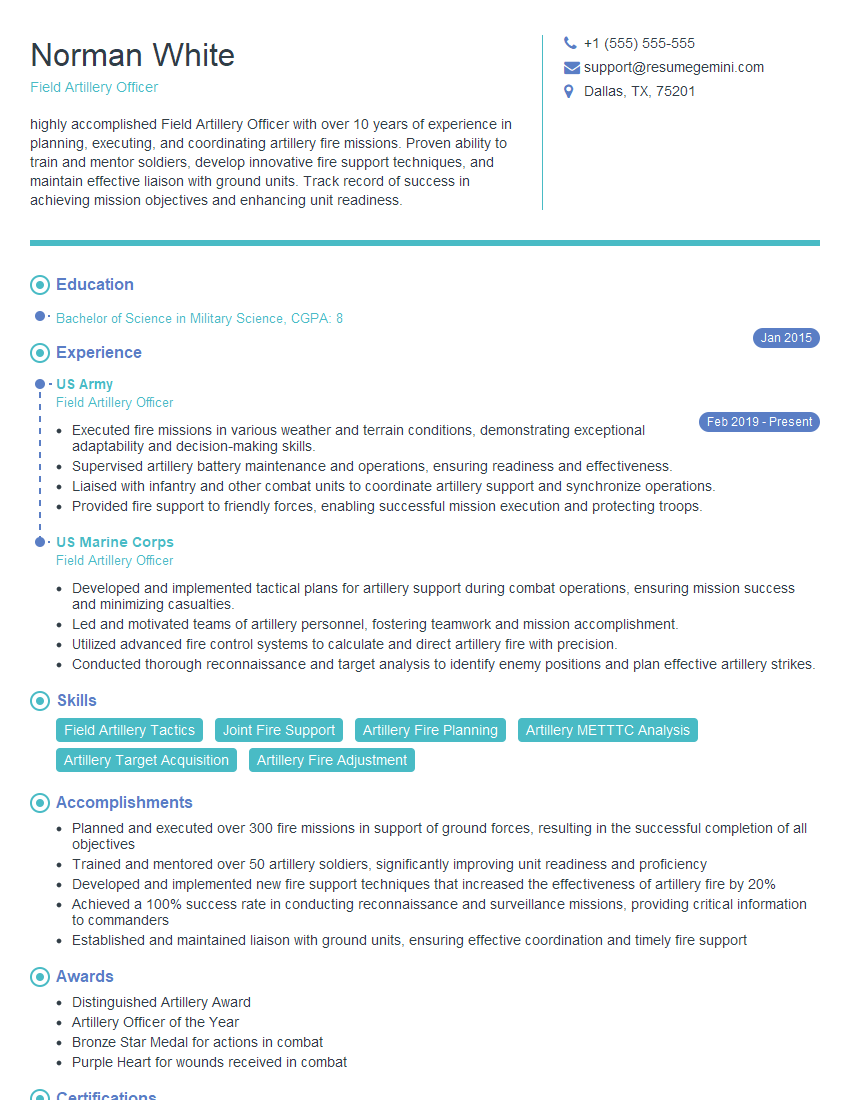
Mastering Artillery Platoon Operations is crucial for career advancement within the military and opens doors to leadership roles and specialized training opportunities. A strong resume is your first impression – ensure yours is ATS-friendly to maximize your chances of landing your dream job. ResumeGemini is a trusted resource to help you craft a compelling and effective resume tailored to the specific demands of the Artillery Platoon Operations field. We provide examples of resumes specifically designed for this career path to help guide your process.
Explore more articles
Users Rating of Our Blogs
Share Your Experience
We value your feedback! Please rate our content and share your thoughts (optional).
What Readers Say About Our Blog
Very informative content, great job.
good