The right preparation can turn an interview into an opportunity to showcase your expertise. This guide to Artistic Interpretation interview questions is your ultimate resource, providing key insights and tips to help you ace your responses and stand out as a top candidate.
Questions Asked in Artistic Interpretation Interview
Q 1. Define artistic interpretation and its significance in art analysis.
Artistic interpretation is the process of analyzing and explaining the meaning and significance of a work of art. It’s not just about describing what’s depicted, but delving into the artist’s intentions, the artwork’s cultural context, and the emotional or intellectual impact it has on the viewer. In art analysis, interpretation is crucial because it bridges the gap between the artwork and the audience, allowing us to understand and appreciate the artist’s creative vision and the work’s lasting influence.
Think of it like reading a complex novel – the words are there, but true understanding comes from interpreting the themes, symbolism, character motivations, and the author’s underlying message. Similarly, artistic interpretation helps unpack the layers of meaning embedded within a visual artwork.
Q 2. Explain the difference between subjective and objective interpretation of art.
The difference between subjective and objective interpretation lies in the perspective taken. Objective interpretation focuses on verifiable facts and evidence related to the artwork. This might include the artist’s biography, historical context, the materials used, and stylistic features easily observable in the artwork. It aims for a factual and neutral understanding.
Subjective interpretation, on the other hand, acknowledges the inherent influence of individual experiences and perspectives. It considers the emotional response of the viewer, their cultural background, and their personal understanding of the artwork. While still grounded in evidence, it embraces the multitude of meanings a piece of art can evoke.
For example, objectively, we can analyze the brushstrokes in a Van Gogh painting, noting their impasto texture and vibrant color. Subjectively, we might interpret the swirling brushstrokes as expressions of intense emotion or mental turmoil.
Q 3. How do you identify and analyze the stylistic elements in a given artwork?
Identifying and analyzing stylistic elements requires a systematic approach. First, I would carefully observe the artwork, noting aspects such as:
- Line: How are lines used – are they bold, delicate, curved, straight? Do they create a sense of movement or stillness?
- Shape and Form: What shapes and forms dominate the composition? Are they geometric, organic, or abstract? How do they interact with each other?
- Color: What colors are used? How are they arranged? Do they create a harmonious or contrasting effect? Consider the use of hue, saturation, and value.
- Texture: What is the perceived texture of the artwork? Is it smooth, rough, or layered? How does texture contribute to the overall effect?
- Composition: How are the elements arranged in the artwork? Is there a clear focal point? How does the composition guide the viewer’s eye?
By systematically analyzing these elements, I can identify the artwork’s style – be it Impressionism, Cubism, Surrealism, or any other style – and understand how these elements work together to create its unique visual impact. This analysis can be aided by comparing the artwork to other works from the same period or by the same artist.
Q 4. Describe the process of interpreting symbolic imagery within an artistic context.
Interpreting symbolic imagery involves understanding the cultural and historical context in which the artwork was created, as well as the artist’s intentions (where known). This is a multi-step process:
- Identify the Symbols: Begin by carefully observing the artwork and noting any recurring motifs, objects, figures, or colors that seem to hold deeper meaning.
- Research Cultural Contexts: Investigate the historical and cultural background surrounding the artwork. Consider relevant myths, religious beliefs, social conventions, and artistic traditions that might shed light on the symbols’ meanings.
- Consider Artistic Conventions: Certain symbols have established meanings within particular artistic movements or traditions. Familiarity with these conventions is essential for a comprehensive understanding.
- Analyze Symbol Relationships: Examine how the symbols interact with each other. Their placement, size, and juxtaposition can significantly impact their overall meaning.
- Synthesize Findings: Based on your research and analysis, formulate interpretations of the symbolic imagery. It’s important to acknowledge multiple possible interpretations, while supporting your conclusions with evidence.
For instance, interpreting a recurring apple in a painting might require researching its symbolic significance throughout art history and within the specific cultural context of the artist. It could represent knowledge, temptation, or even mortality, depending on the artwork’s overall narrative.
Q 5. How do you determine the historical and cultural influences on a piece of art?
Determining the historical and cultural influences on a piece of art is a crucial aspect of interpretation. This involves several steps:
- Research the Artist’s Life and Times: Understanding the artist’s biography, including their education, social background, and experiences, provides insights into their artistic perspective and influences.
- Examine the Historical Context: Researching the historical period in which the artwork was created helps identify prevalent social, political, and economic factors that might have shaped the artist’s work.
- Investigate Cultural Influences: Exploring the cultural landscape of the time, including religious beliefs, philosophical ideas, and artistic movements, sheds light on the specific influences at play.
- Analyze Stylistic Comparisons: Comparing the artwork to other works from the same period or by other artists helps identify common stylistic trends and influences.
- Consider Patronage and Commissioning: If known, investigating who commissioned the artwork or who patronized the artist offers additional insight into the artwork’s purpose and potential influences.
For example, studying the art of the Renaissance requires understanding the rise of humanism, the patronage of the Church and wealthy families, and the rediscovery of classical art. These factors deeply impacted the style and subject matter of Renaissance art.
Q 6. Explain how context impacts the interpretation of artwork.
Context plays a crucial role in shaping our interpretation of artwork. The context encompasses various factors, including:
- Historical Context: The time period in which the artwork was created, including significant events and social trends.
- Cultural Context: The artist’s cultural background, beliefs, and societal norms.
- Artistic Context: The artist’s style, artistic movement, and influences from other artists.
- Physical Context: The location where the artwork is displayed, the surrounding environment, and how it is presented to the viewer.
- Biographical Context: The artist’s personal experiences and intentions (if known).
Consider a portrait. Knowing the sitter’s social standing, the artist’s relationship with them, and the prevailing fashion trends of the era will drastically affect how we understand the painting’s meaning. Removing the context reduces our ability to accurately appreciate the nuances and subtleties of the artwork.
Q 7. How do you approach the interpretation of abstract art?
Interpreting abstract art requires a shift from literal representation to a focus on formal elements and emotional impact. Instead of searching for a narrative or recognizable subject, we analyze:
- Composition: How are the elements arranged? How does the composition create a sense of balance, tension, or movement?
- Color and Texture: What emotional responses do the colors and textures evoke? How do they interact to create a specific mood or atmosphere?
- Form and Shape: How do the shapes and forms interact? Do they suggest any underlying structures or patterns?
- Line: How do lines create direction and movement within the artwork?
- Emotional Response: What emotions or feelings does the artwork evoke in the viewer? How do the formal elements contribute to this emotional response?
Approaching abstract art requires an openness to subjective interpretation. There’s no single ‘correct’ interpretation. Instead, the focus is on exploring the artwork’s visual language and its potential to elicit a wide range of emotional and intellectual responses.
Think of it as experiencing music without lyrics – the melody, rhythm, and harmony evoke feelings and create an emotional experience without explicitly stating a narrative.
Q 8. Discuss the role of the artist’s intent in your interpretation.
The artist’s intent plays a significant, yet nuanced role in interpretation. While it’s tempting to believe the artist’s statement definitively explains the work, it’s crucial to remember that art is a conversation, not a dictation. The artist’s intention provides valuable context, a starting point for understanding their choices—materials, composition, subject matter. However, the artwork itself, once released into the world, takes on a life of its own. Viewers bring their own experiences, cultural backgrounds, and perspectives, leading to diverse interpretations that can even contradict the artist’s original vision. For example, consider Picasso’s Guernica. While Picasso intended to depict the horrors of war, interpretations extend far beyond that initial statement, exploring themes of suffering, violence, and the consequences of political conflict. Therefore, the artist’s intent is a crucial element, but not the sole determinant, of meaning in a work of art.
Q 9. How do you reconcile conflicting interpretations of the same artwork?
Reconciling conflicting interpretations is central to the dynamism of art. There’s no single ‘correct’ reading. Instead, the task becomes one of acknowledging the validity of multiple perspectives. I employ a method that involves identifying the underlying arguments within each interpretation. What evidence from the artwork supports each claim? Are these interpretations based on factual inaccuracies, misinterpretations of historical context, or are they fundamentally different readings, each valid in its own way? For example, consider a painting with ambiguous symbolism. One viewer might focus on the color palette to interpret feelings of melancholy, while another might center on the composition to suggest a narrative of movement and dynamism. Instead of dismissing either, I analyze how both interpretations engage with the work’s visual elements, showcasing the rich layers of meaning possible. The key is to create a dialogue between interpretations, enriching our understanding of the artwork’s complexity.
Q 10. Describe your approach to interpreting performance art.
Interpreting performance art requires a holistic approach. It transcends the visual; it incorporates the temporal, the physical, and the ephemeral. My approach begins with meticulous observation of the performance itself – documenting the actions, sounds, interactions, and the overall atmosphere. Then, I investigate the artist’s statement, if available, to understand the conceptual framework. Critical analysis considers the context of the performance: the location, the audience, and the socio-political climate. Consider Marina Abramović’s endurance performances. A simple analysis of the physical act itself only scratches the surface. A deeper interpretation dives into the exploration of themes like the limits of the body, the relationship between the performer and the audience, and the implications of vulnerability and self-expression. The audience’s reaction and its impact on the performer are also significant elements to consider.
Q 11. How would you explain the artistic merit of a piece to a non-expert audience?
Explaining artistic merit to a non-expert audience requires connecting the work to their own experiences and emotions. I avoid technical jargon. Instead, I focus on the impact of the artwork. Does it evoke a strong emotional response? Does it make you think differently about something? Does it showcase exceptional skill or innovation in its execution? For instance, if discussing a landscape painting, I might emphasize the artist’s ability to capture a sense of place, evoking memories of nature or inspiring awe. If discussing abstract art, I would focus on how the interplay of colors, shapes, and textures creates a visual rhythm and emotion. The key is to show how the art engages the senses and stimulates thought, ultimately making it relevant and meaningful to a broader audience. Ultimately, artistic merit is subjective, but the goal is to highlight those aspects that connect with human experience.
Q 12. How do you approach interpreting installations and multimedia art?
Interpreting installations and multimedia art requires a multi-sensory approach. It’s about understanding how the artist uses space, light, sound, and other elements to create an immersive experience. My approach starts by carefully experiencing the artwork in its entirety. This might involve moving through the space, engaging with interactive elements, and listening to the soundscape. I then analyze the interplay of these elements – how they contribute to the overall narrative, theme, or emotional impact. For example, an installation might use projections, sculptures, and sound to create a narrative about climate change. The interpretation involves not just analyzing each element individually but understanding their collective effect, how the artist uses them to create a cohesive and meaningful whole. The physical experience of the installation is often just as crucial as the conceptual aspects.
Q 13. What are the ethical considerations in interpreting art?
Ethical considerations in art interpretation are paramount. We must be mindful of the power dynamics inherent in the process. Avoiding cultural appropriation, misrepresentation, and the imposition of our own biases are critical. For instance, interpreting Indigenous art requires deep respect and engagement with the culture’s own interpretations and knowledge. Similarly, understanding the historical context of the artwork, including its creation and reception, helps avoid imposing contemporary values that might not be relevant. Interpretation should be informed, nuanced, and avoid perpetuating harmful stereotypes. It’s essential to acknowledge the limitations of one’s perspective and engage in critical self-reflection to ensure that interpretations are sensitive, responsible, and respectful.
Q 14. How does your personal experience influence your art interpretation?
My personal experience undeniably shapes my interpretations, although I strive for objectivity. My background, cultural upbringing, and lived experiences all color my perspective. However, I believe this isn’t necessarily a negative thing. It brings a unique lens, enriching the understanding of the artwork. For example, my own experience with loss might heighten my sensitivity to themes of grief in a particular painting. However, this personal resonance is always balanced with rigorous analysis of the work itself and its historical and artistic context. It’s about acknowledging the influence of personal experience while ensuring that it doesn’t overshadow the objective analysis and avoid imposing my own narrative onto the artwork.
Q 15. How do you handle disagreements with colleagues over artistic interpretations?
Disagreements in artistic interpretation are inevitable, given the subjective nature of art. My approach prioritizes respectful dialogue and a collaborative spirit. Instead of viewing differing interpretations as conflicts, I see them as opportunities for enriched understanding.
Firstly, I ensure everyone involved clearly articulates their reasoning. This might involve examining specific elements within the artwork – the brushstrokes, the composition, the use of light and shadow, the historical context – and explaining how these elements contribute to their individual interpretations. We might even consider the artist’s intent, if known, but always acknowledging that the artwork transcends its creator’s original vision.
Secondly, I encourage active listening and a willingness to consider alternative perspectives. We may find common ground, even if our final interpretations differ. If a consensus cannot be reached, I strive for a nuanced understanding of the multiple valid interpretations, acknowledging the richness and complexity of the artwork itself. Ultimately, the goal is not to find one ‘correct’ answer, but to develop a deeper collective understanding of the piece.
Career Expert Tips:
- Ace those interviews! Prepare effectively by reviewing the Top 50 Most Common Interview Questions on ResumeGemini.
- Navigate your job search with confidence! Explore a wide range of Career Tips on ResumeGemini. Learn about common challenges and recommendations to overcome them.
- Craft the perfect resume! Master the Art of Resume Writing with ResumeGemini’s guide. Showcase your unique qualifications and achievements effectively.
- Don’t miss out on holiday savings! Build your dream resume with ResumeGemini’s ATS optimized templates.
Q 16. Describe a time you had to interpret a complex or ambiguous artwork.
Interpreting Salvador Dalí’s The Persistence of Memory presented a fascinating challenge. The melting clocks, the desolate landscape, the ambiguous figures – all contribute to a sense of unease and surrealism. Initially, I focused on the symbolic representation of time’s fluidity and the subconscious mind, drawing upon Dalí’s known interest in Freudian psychoanalysis.
However, a closer examination revealed other layers. The hard, geometric forms contrast with the soft, melting clocks, suggesting a tension between rigidity and fluidity in life. The ants, a recurring symbol in Dalí’s work, suggest decay and the passage of time. The ocean, a recurring motif for him, indicates the subconscious. By researching Dalí’s personal life and artistic influences at the time, I found that the painting seemed to reflect his struggles with both his own sense of time and his father’s death, enriching my interpretation beyond the common interpretations of surrealism and dream imagery.
Q 17. How do you use art historical research to inform your interpretation?
Art historical research is crucial for informed artistic interpretation. It provides the context necessary to understand an artwork’s creation, its cultural significance, and its place within the broader artistic movement. For example, if interpreting a Renaissance painting, examining the prevalent artistic conventions, the patronage system, and the religious context of the period is essential.
Research may involve exploring the artist’s biography, studying their other works, examining contemporary writings about the art, and understanding the social and political conditions of the time. This allows for a more nuanced understanding of the symbolism, iconography, and techniques employed by the artist. It helps move beyond a purely subjective interpretation towards a more informed and historically grounded one. It also highlights the connections and dialogues between artworks from different periods and artistic movements.
Q 18. Explain the relationship between artistic interpretation and art criticism.
Artistic interpretation and art criticism are closely intertwined but distinct processes. Artistic interpretation involves analyzing an artwork to understand its meaning and significance, while art criticism involves evaluating its artistic merit, style, and impact. Interpretation seeks to understand *what* the artwork is communicating, whereas criticism seeks to assess *how well* it communicates and its overall value.
However, a strong interpretation invariably informs good criticism. A sophisticated understanding of the artwork’s context, techniques, and possible meanings allows a critic to provide a more insightful and meaningful evaluation. For instance, a critic might use a detailed interpretation of the symbolism in a painting to support their argument about the artist’s skill in conveying a particular emotion or message. Essentially, interpretation provides the foundation upon which informed and critical assessment can be built.
Q 19. How do different art movements influence interpretive approaches?
Different art movements significantly influence interpretive approaches. For example, interpreting a Cubist painting requires understanding the movement’s emphasis on fragmented perspectives and geometric forms, leading to an interpretation focused on the deconstruction of reality and the exploration of multiple viewpoints simultaneously. In contrast, interpreting a Romantic painting necessitates considering the movement’s focus on emotion, imagination, and the sublime, leading to interpretations emphasizing the artwork’s emotional impact and its reflection of the artist’s inner world.
Understanding the historical context, key figures, and core principles of each movement – be it Impressionism, Surrealism, Pop Art, or Abstract Expressionism – shapes how we approach the artwork. The theoretical framework of each movement provides a lens through which to understand the artist’s choices and the meaning conveyed.
Q 20. What are the key elements to consider when interpreting a sculpture?
Interpreting a sculpture involves considering several key elements. First, the material itself is crucial – bronze suggests permanence and weight, while wood implies fragility and organic growth. The form and composition are equally important; is it a realistic representation, an abstraction, or something in between? The scale of the sculpture also matters, impacting its perceived impact and the viewer’s relationship to it.
Beyond form, we should consider the texture (smooth, rough, polished), the use of light and shadow (how the form interacts with light), and the sculpture’s posture and dynamism (how it interacts with its surroundings, and even the viewer’s movement around it). Understanding the historical and cultural context – what the material represented, its place in a tradition of sculpture making, the symbolism and references – will enrich the interpretation. For example, the stylistic choices in a classical Greek statue would differ from a modern abstract piece, so our interpretive lens must adapt accordingly.
Q 21. How do you identify and interpret the use of color in a painting?
Color in painting is not simply decorative; it’s a powerful tool for conveying emotion, symbolism, and narrative. To interpret color, we consider its hue (the basic color), its saturation (its intensity or purity), and its value (its lightness or darkness). A vibrant, saturated red might suggest passion or danger, while a muted, desaturated blue might convey calmness or melancholy.
The juxtaposition of colors is also crucial. Complementary colors (those opposite each other on the color wheel) create visual tension, while analogous colors (those adjacent to each other) create harmony. The overall color palette – warm or cool, bright or dark – contributes to the painting’s mood and atmosphere. Furthermore, understanding the historical and cultural associations of colors is important; for instance, white’s association with purity in Western art contrasts with its symbolic meaning in other cultures. A thorough analysis of color must combine formal analysis with cultural and historical context to develop a complete understanding.
Q 22. How do you analyze the composition and arrangement of elements in a piece of art?
Analyzing the composition and arrangement of elements in a piece of art involves a systematic approach to understanding how the artist uses visual elements to create meaning and impact. This goes beyond simply observing; it requires critical thinking.
Line: Consider the direction, weight, and texture of lines. Do they create a sense of movement, stability, or tension? For instance, strong vertical lines might suggest strength and stability, while diagonal lines can convey dynamism.
Shape and Form: Examine the shapes (2D) and forms (3D) used. Are they geometric or organic? How do they interact with each other? Consider the positive and negative space created by the shapes.
Value and Contrast: Analyze the light and dark areas in the artwork. High contrast can create drama, while subtle gradations can evoke calmness. The use of chiaroscuro (the interplay of light and shadow) is a prime example of how value creates depth and mood.
Color: Evaluate the color palette. What are the dominant colors? How do they relate to each other in terms of temperature, harmony, or contrast? The use of complementary colors might create vibrancy, while analogous colors can create a sense of unity.
Texture: Consider the implied or actual texture. Does the artist create a sense of roughness, smoothness, or other tactile qualities? Think about how this relates to the overall emotional impact.
Space: How does the artist use space to create depth and perspective? Is it shallow or deep? Linear perspective, atmospheric perspective, and overlapping forms are techniques used to achieve this.
Balance: Is the composition symmetrical or asymmetrical? Does it feel balanced or unbalanced? The placement and weight of elements impact the overall balance.
For example, consider Leonardo da Vinci’s The Last Supper. The composition is meticulously balanced around the central figure of Christ. The lines of perspective converge towards him, emphasizing his importance. The use of color and light further enhances the dramatic effect.
Q 23. Explain the difference between formal analysis and thematic analysis in art.
Formal analysis and thematic analysis are two distinct yet complementary approaches to interpreting art. Formal analysis focuses on the artwork’s visual elements and how they are arranged, while thematic analysis explores the underlying meaning and message communicated by the artwork.
Formal Analysis: This approach examines the composition, color palette, brushstrokes, use of light and shadow, and other visual elements. It’s a descriptive and objective process, aiming to understand the artwork’s structure and aesthetic qualities. Think of it like dissecting the artwork to understand its technical aspects.
Thematic Analysis: This approach seeks to uncover the broader meaning and message conveyed by the artwork. It considers the historical context, the artist’s intentions (if known), and the cultural or social implications of the work. It’s often more interpretive and subjective, acknowledging the viewer’s perspective and cultural background.
For instance, a formal analysis of Picasso’s Guernica might focus on the use of fragmented forms, stark black and white palette, and the dynamic composition. A thematic analysis, however, would also consider the political message about the horrors of war and the suffering of innocent civilians.
Q 24. Describe your experience with different interpretive methodologies.
My experience encompasses various interpretive methodologies, each offering unique insights into artworks. These include:
Iconography: Identifying and interpreting symbols, motifs, and visual allusions within the artwork. For example, understanding the symbolism of a recurring image in a series of paintings.
Psychoanalytic Criticism: Examining the artwork through the lens of psychological theories, exploring the artist’s subconscious and the emotional responses evoked in the viewer. This can include Freudian or Jungian approaches.
Feminist Criticism: Analyzing how gender roles, power dynamics, and societal expectations are represented in the artwork. This approach is particularly useful in examining how women are portrayed in art history.
Marxist Criticism: Interpreting artworks within a socio-economic context, considering issues of class, power, and ideology. It’s relevant for understanding how social structures influence art production and reception.
Post-colonial Criticism: Examining how colonial and post-colonial experiences and power dynamics shape artistic expression. This lens is crucial for understanding art from formerly colonized nations.
I adapt my approach based on the specific artwork and the research questions at hand. A combination of methods is often the most effective way to achieve a comprehensive understanding.
Q 25. How do you approach the interpretation of art from diverse cultures?
Interpreting art from diverse cultures requires sensitivity, humility, and a deep understanding of the historical and cultural contexts. It’s crucial to avoid imposing one’s own cultural biases and assumptions on the artwork.
Research: Extensive research is fundamental. This involves understanding the historical period, the artistic traditions, the socio-political environment, and the symbolism prevalent in that culture.
Consult Sources: Engage with scholarly work and consult with experts from the relevant culture. Their insights are invaluable in avoiding misinterpretations.
Avoid Ethnocentrism: Recognize that aesthetic standards vary across cultures. Judge the artwork based on its own cultural values and standards, rather than comparing it to one’s own cultural norms.
Engage with the Community: If possible, engage with members of the community that the artwork originates from. This offers valuable firsthand perspectives and avoids stereotypes.
For example, when interpreting traditional Aboriginal Australian art, it’s vital to understand the significance of storytelling, the connection to land, and the complex system of symbolism used within the artwork. Ignoring these crucial elements would lead to a fundamentally flawed interpretation.
Q 26. Explain the role of visual literacy in artistic interpretation.
Visual literacy is essential for artistic interpretation. It’s the ability to understand, interpret, and evaluate visual information. Without it, our understanding of art is severely limited.
Decoding Visual Language: Visual literacy allows us to decode the visual language used by the artist – the composition, color, line, and other elements – and understand how they contribute to the artwork’s meaning.
Recognizing Symbols and Motifs: It helps us recognize recurring symbols, motifs, and visual allusions and understand their cultural and historical significance.
Critical Analysis: It enables critical analysis of the artwork, allowing us to formulate informed opinions and interpretations, rather than relying solely on subjective impressions.
Comparison and Contextualization: Visual literacy helps us place the artwork within a broader artistic context, comparing it to other works and understanding its historical evolution.
Think of it like learning a new language. Visual literacy is the grammar and vocabulary needed to understand the visual communication used in art.
Q 27. How do you evaluate the authenticity and originality of artwork?
Evaluating the authenticity and originality of artwork is a complex process that requires expertise in art history, materials science, and connoisseurship. It often involves a multi-faceted approach.
Provenance Research: Tracing the artwork’s ownership history through documentation, such as sales records, exhibition catalogs, and archival materials. Gaps in provenance can raise red flags.
Stylistic Analysis: Comparing the artwork’s style and technique to the artist’s known works and the artistic trends of the period. Discrepancies can indicate a forgery.
Material Analysis: Scientific methods such as pigment analysis, radiocarbon dating, and X-ray fluorescence can be used to analyze the materials used in the artwork and determine its age.
Expert Opinion: Consulting with recognized experts in the field, such as art historians, conservators, and museum curators, is essential for informed judgment. Their expertise plays a vital role in determining authenticity.
Authenticity is determined through a combination of art historical evidence and scientific analysis. The process can be intricate, and it often involves considering numerous factors to reach a well-supported conclusion.
Q 28. Describe your process for writing an art critique or analysis.
My process for writing an art critique or analysis follows a structured approach, ensuring a clear and well-supported argument.
Description: Begin with a detailed description of the artwork, noting its formal elements – composition, color, line, texture, etc. This section should be objective and factual.
Analysis: Analyze how the formal elements are used and how they relate to each other. Explore the use of space, light, color, and other elements to create meaning and impact. This involves both formal and thematic analysis.
Interpretation: Offer an interpretation of the artwork’s meaning and significance. This is where you connect the formal analysis to the thematic content. Support your interpretation with evidence from the artwork and relevant historical and cultural context.
Judgment: Conclude with a considered judgment, assessing the artwork’s strengths and weaknesses. This is where you offer your overall evaluation, but make sure your judgment is well-supported by your analysis and interpretation.
Throughout the process, I maintain objectivity, backing my claims with evidence and avoiding subjective statements unsupported by analysis. The goal is to provide a nuanced and well-supported evaluation of the artwork that stimulates further thought and discussion.
Key Topics to Learn for Artistic Interpretation Interview
- Semiotics and Symbolism: Understanding how artists utilize symbols and signs to convey meaning and evoke emotion. Consider the cultural and historical contexts influencing these choices.
- Contextual Analysis: Developing the ability to analyze artworks within their historical, social, and artistic movements. Explore how understanding the artist’s biography and intentions informs interpretation.
- Formal Analysis: Mastering the critical vocabulary to describe the formal elements of an artwork (line, color, composition, texture) and how these elements contribute to the overall meaning.
- Critical Theories and Approaches: Familiarize yourself with various critical lenses (feminist, Marxist, psychoanalytic, etc.) and how they shape the interpretation of art. Practice applying these different perspectives.
- Comparative Analysis: Developing skills in comparing and contrasting artworks across different styles, periods, and cultures. This demonstrates your ability to synthesize information and form nuanced interpretations.
- Oral Communication and Presentation Skills: Practice articulating your interpretations clearly and persuasively, both verbally and in writing. Prepare to support your claims with evidence from the artwork and relevant scholarship.
- Visual Literacy and Observation Skills: Hone your ability to meticulously observe details within an artwork and identify significant patterns or anomalies. Practice close reading of both visual and textual materials.
Next Steps
Mastering artistic interpretation is crucial for career advancement in fields like art history, museum studies, art criticism, and curatorial work. A strong understanding of these concepts not only enhances your analytical skills but also demonstrates your passion and expertise within the field. To increase your job prospects, invest time in creating an ATS-friendly resume that effectively showcases your skills and accomplishments. ResumeGemini is a trusted resource that can help you build a professional and impactful resume. We provide examples of resumes tailored to Artistic Interpretation to guide you through the process.

Collections Manager Resume Sample
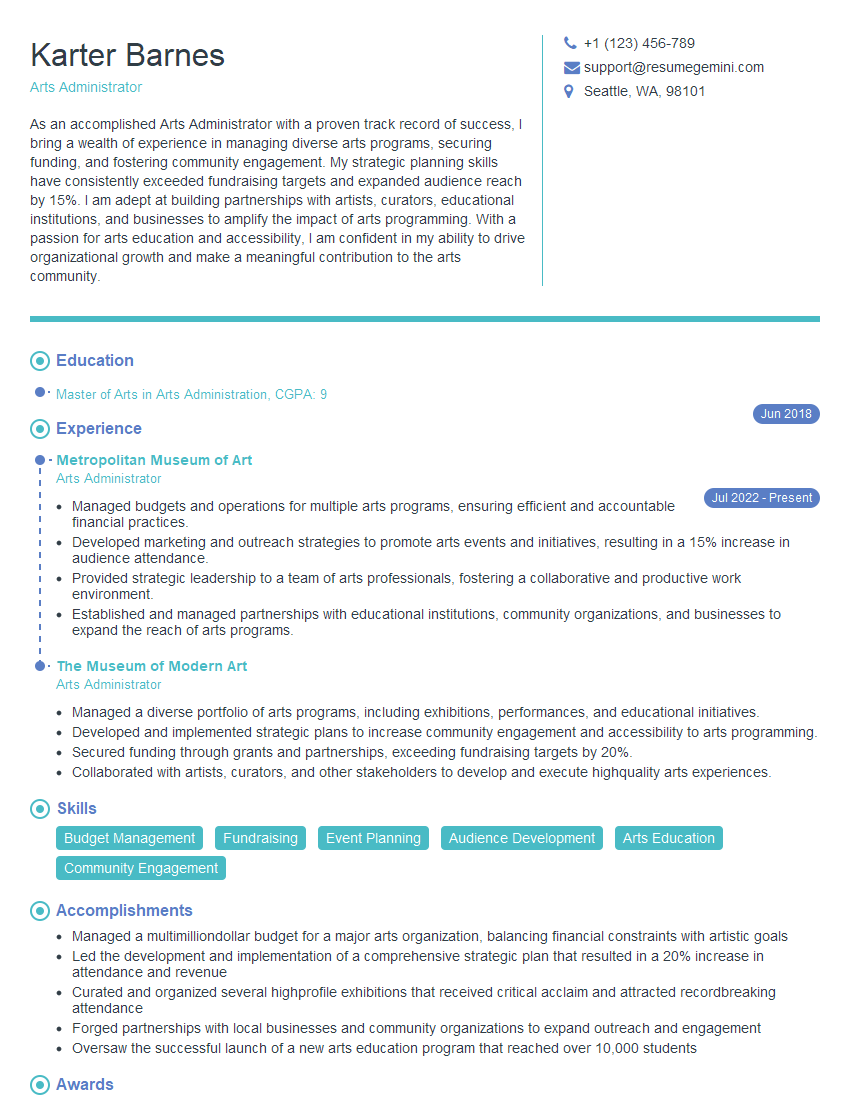
Arts Administrator Resume Sample
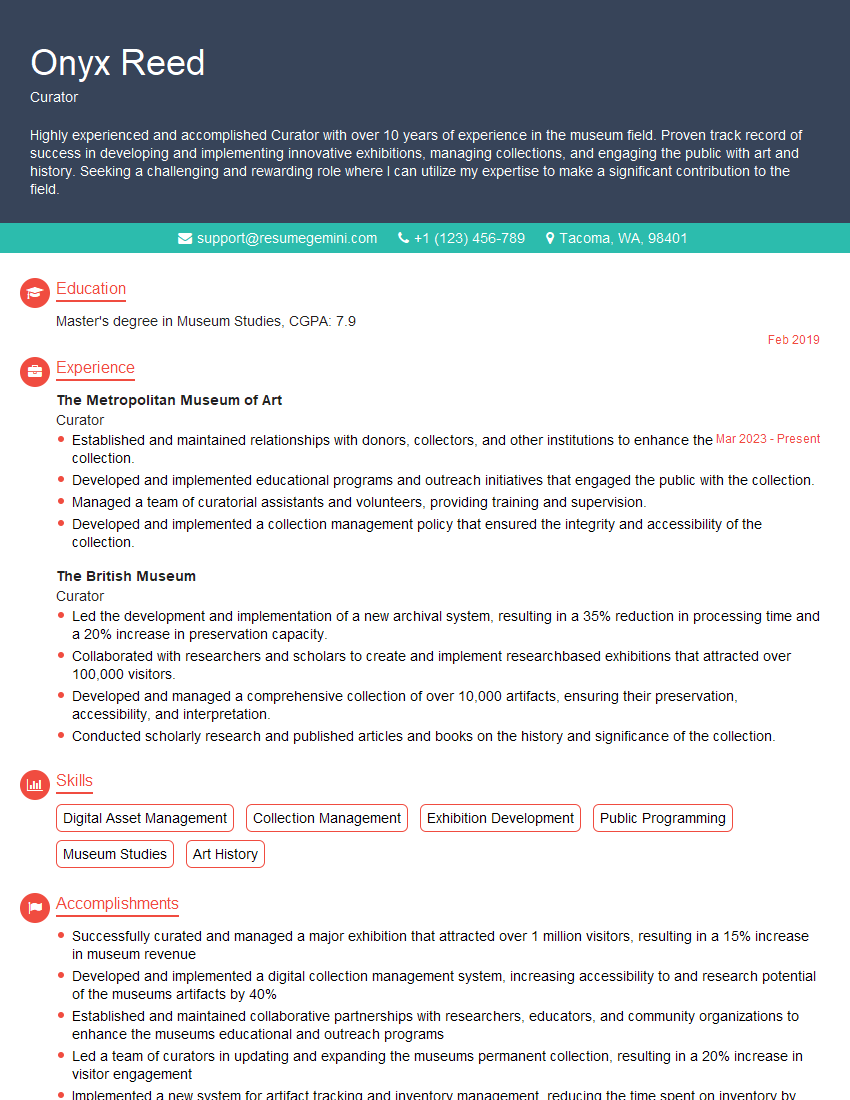
Curator Resume Sample
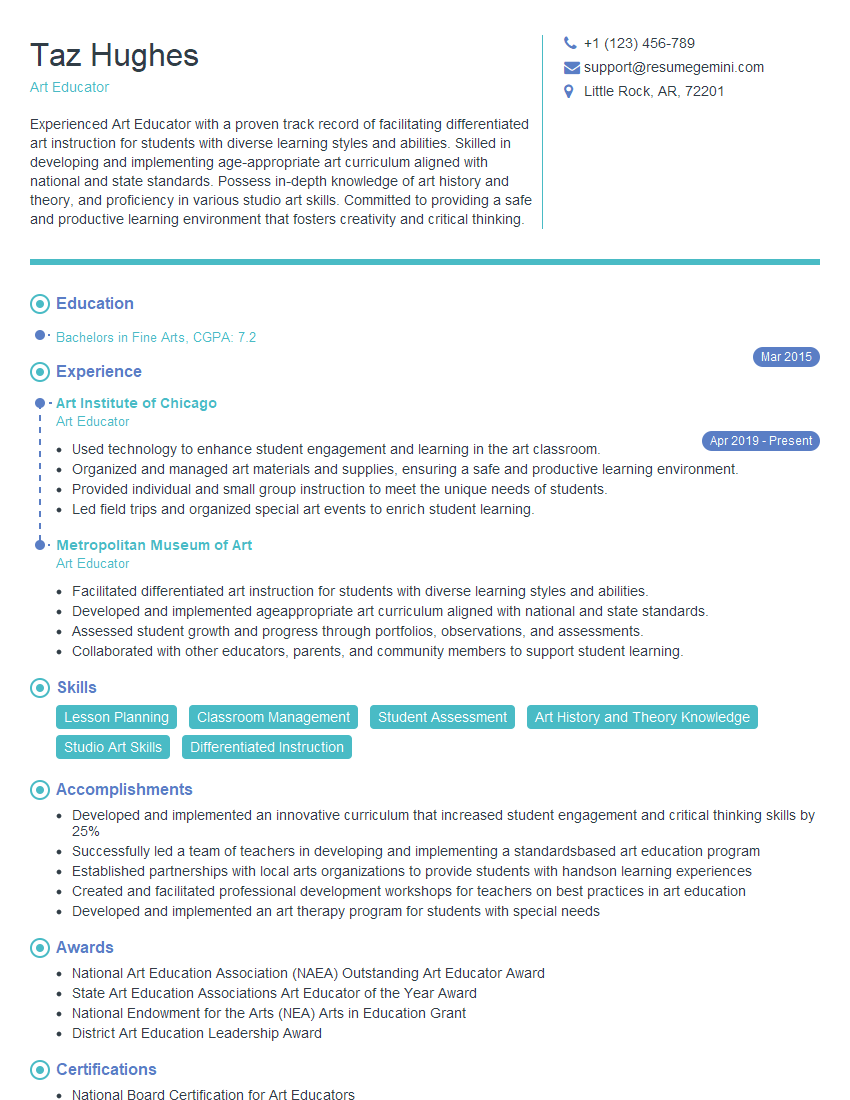
Art Educator Resume Sample
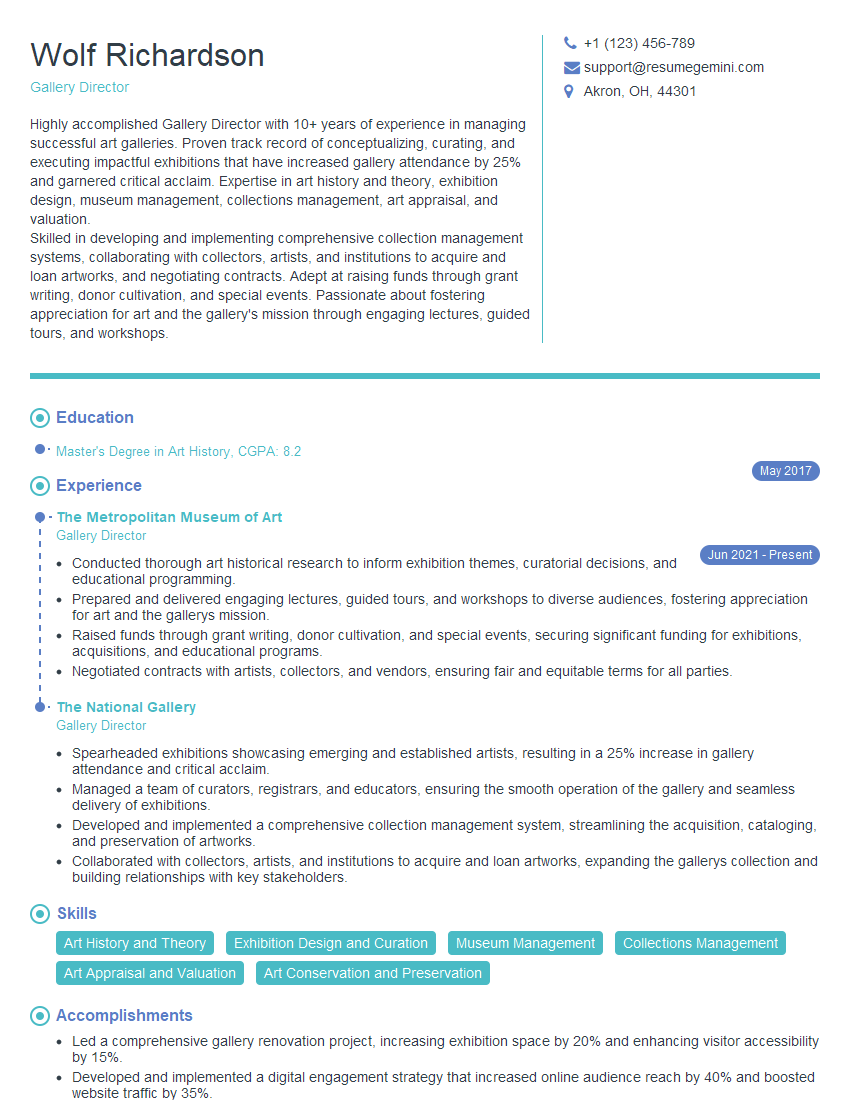
Gallery Director Resume Sample
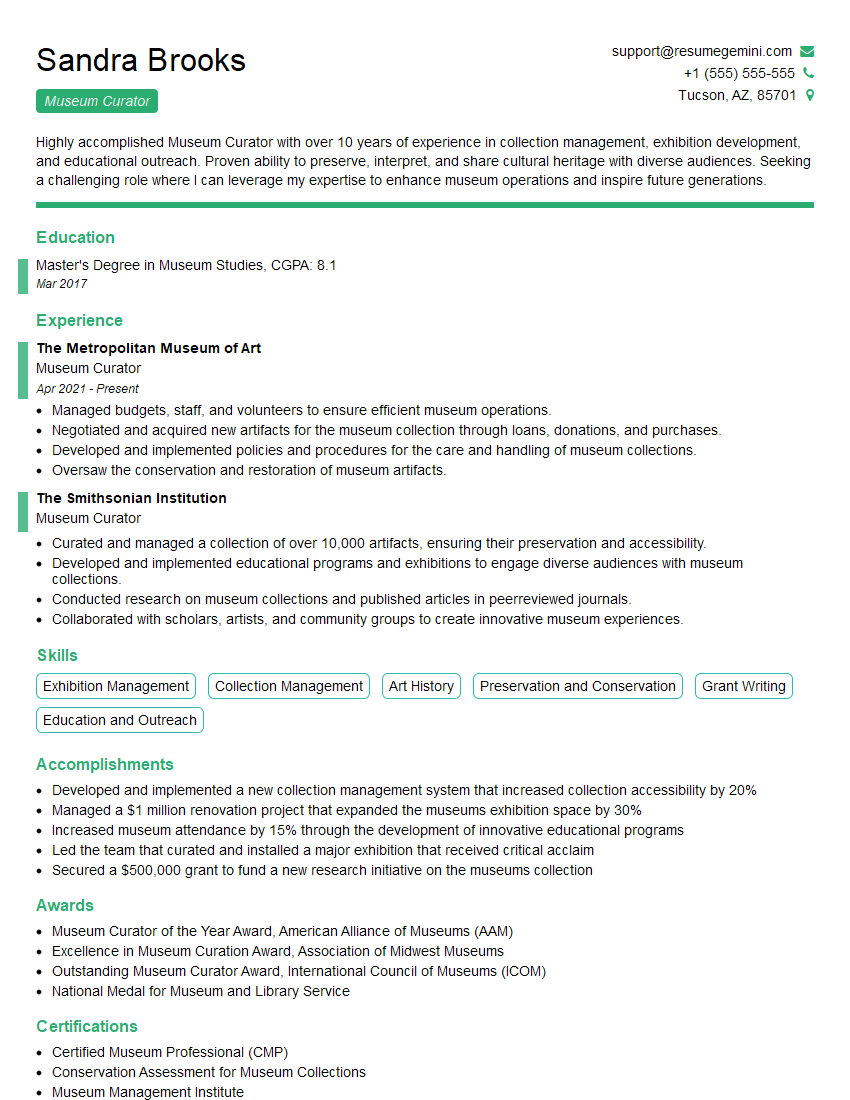
Museum Curator Resume Sample
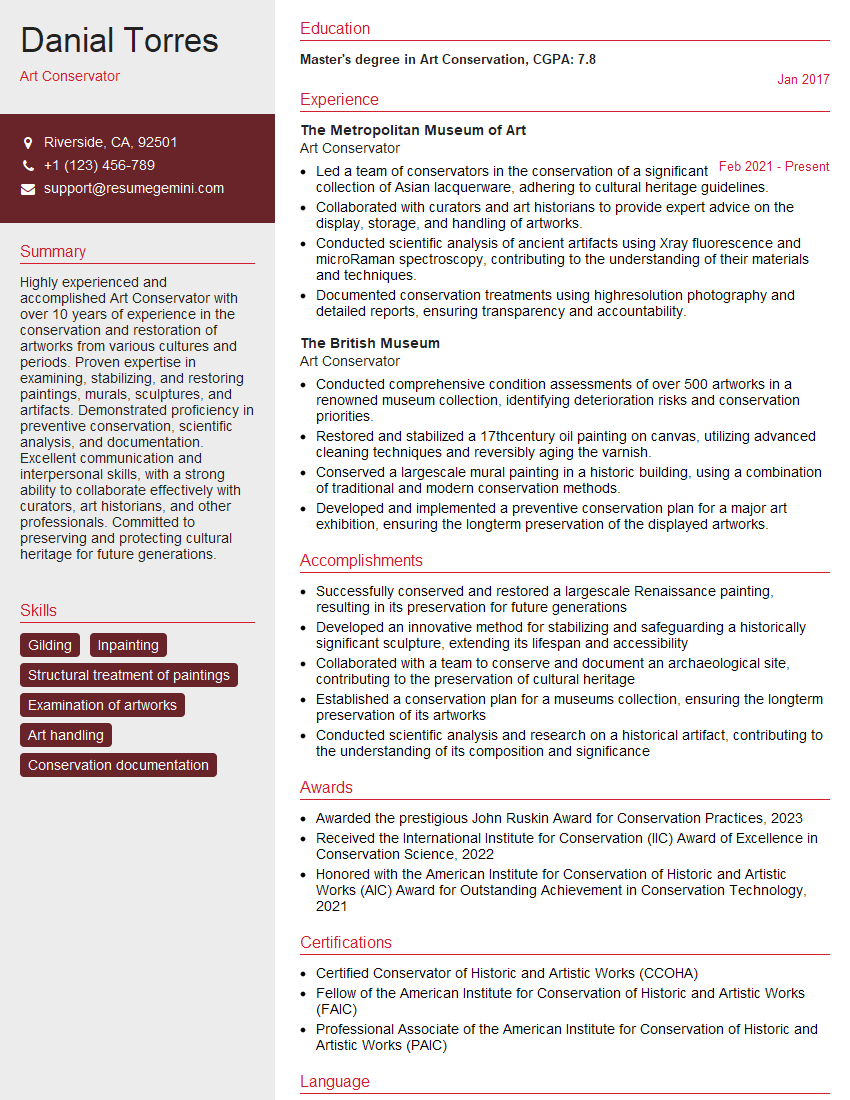
Art Conservator Resume Sample

Exhibition Designer Resume Sample
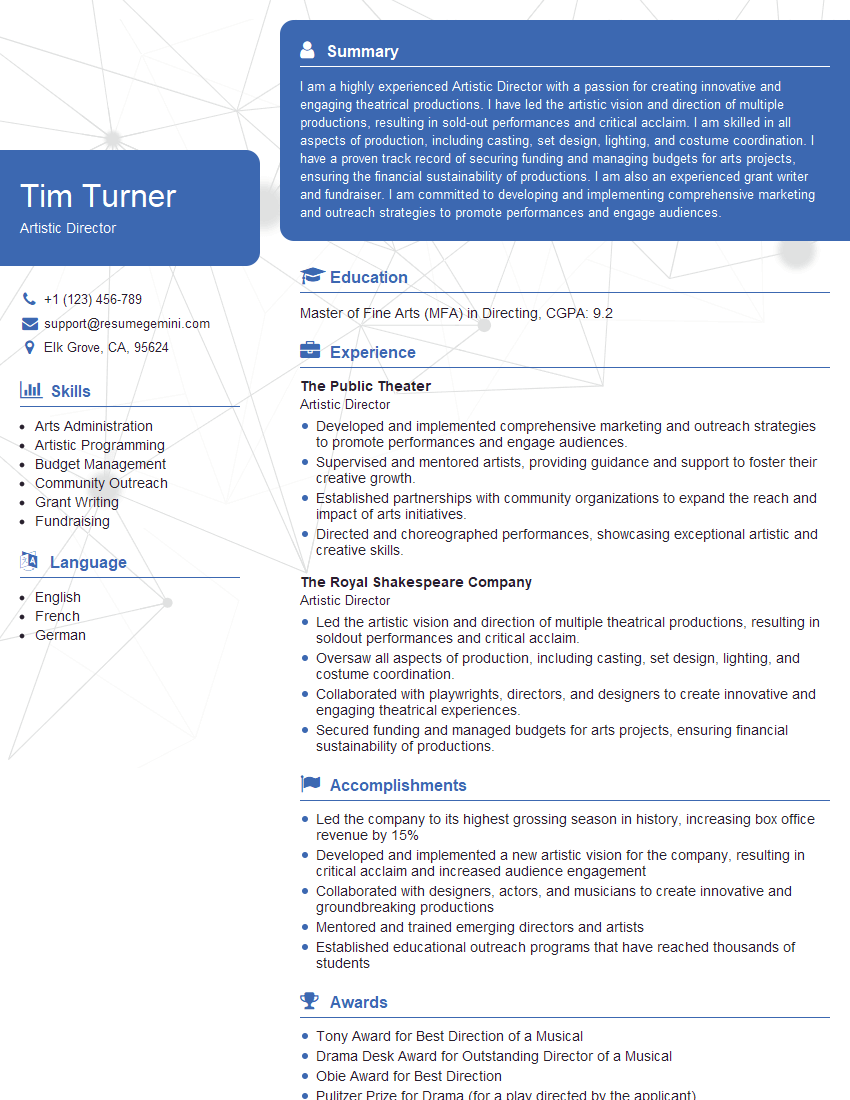
Artistic Director Resume Sample
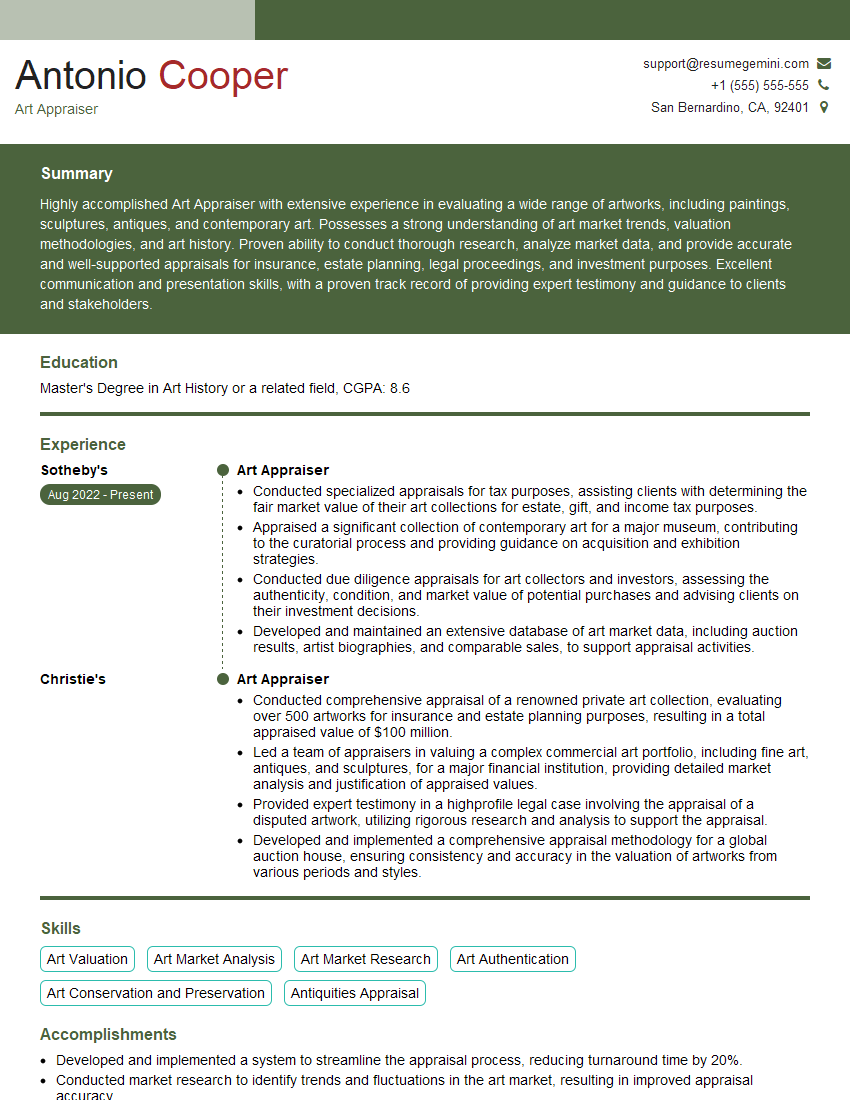
Art Appraiser Resume Sample

Art Consultant Resume Sample
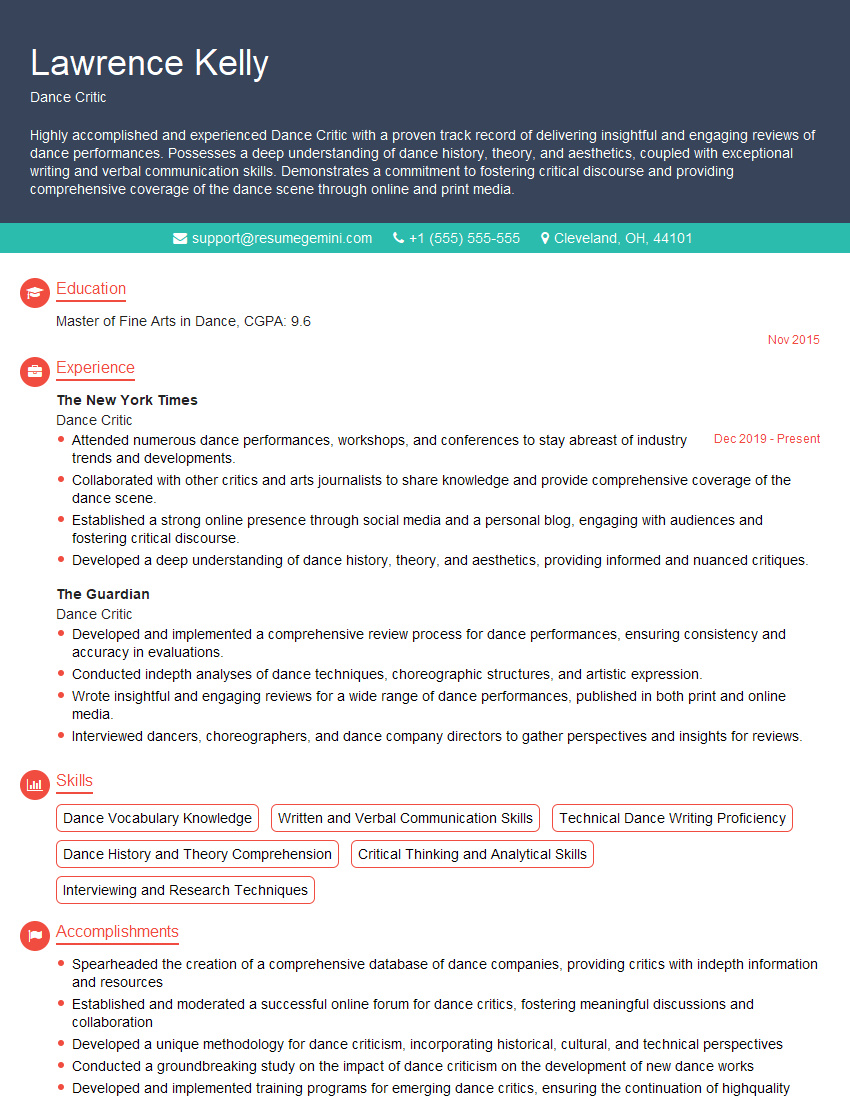
Dance Critic Resume Sample
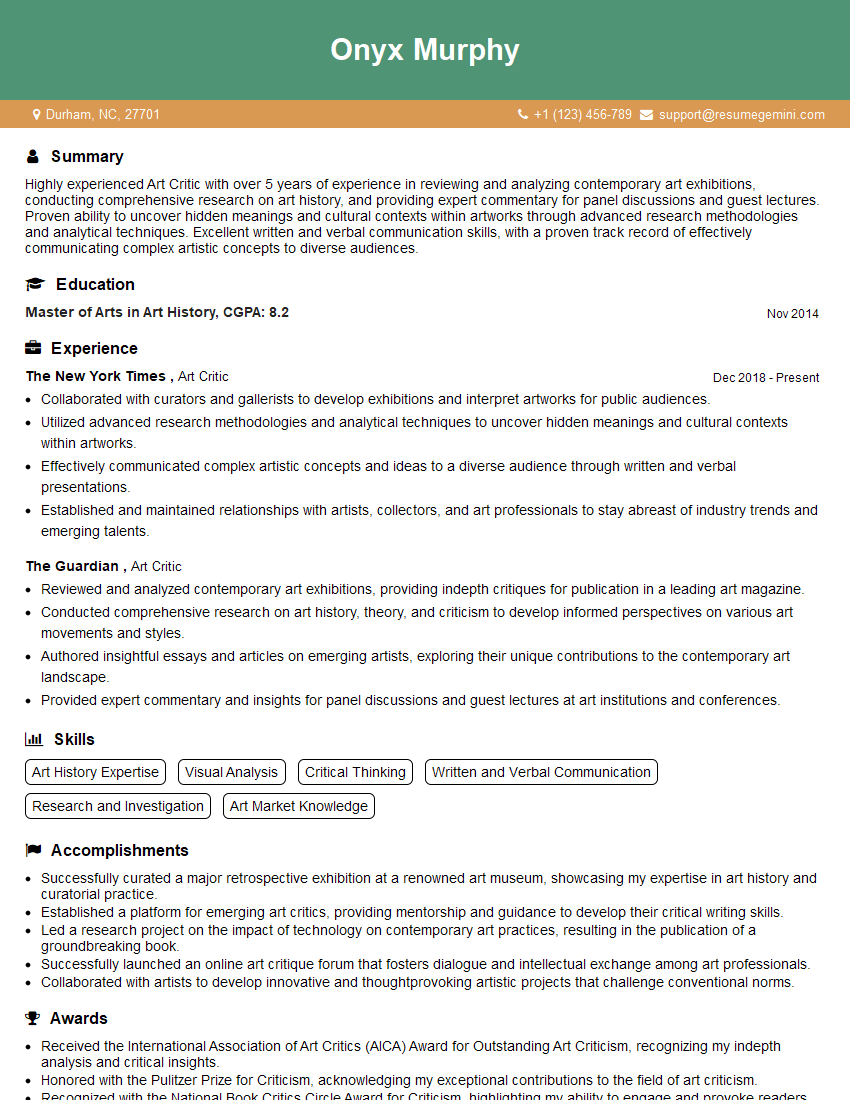
Art Critic Resume Sample
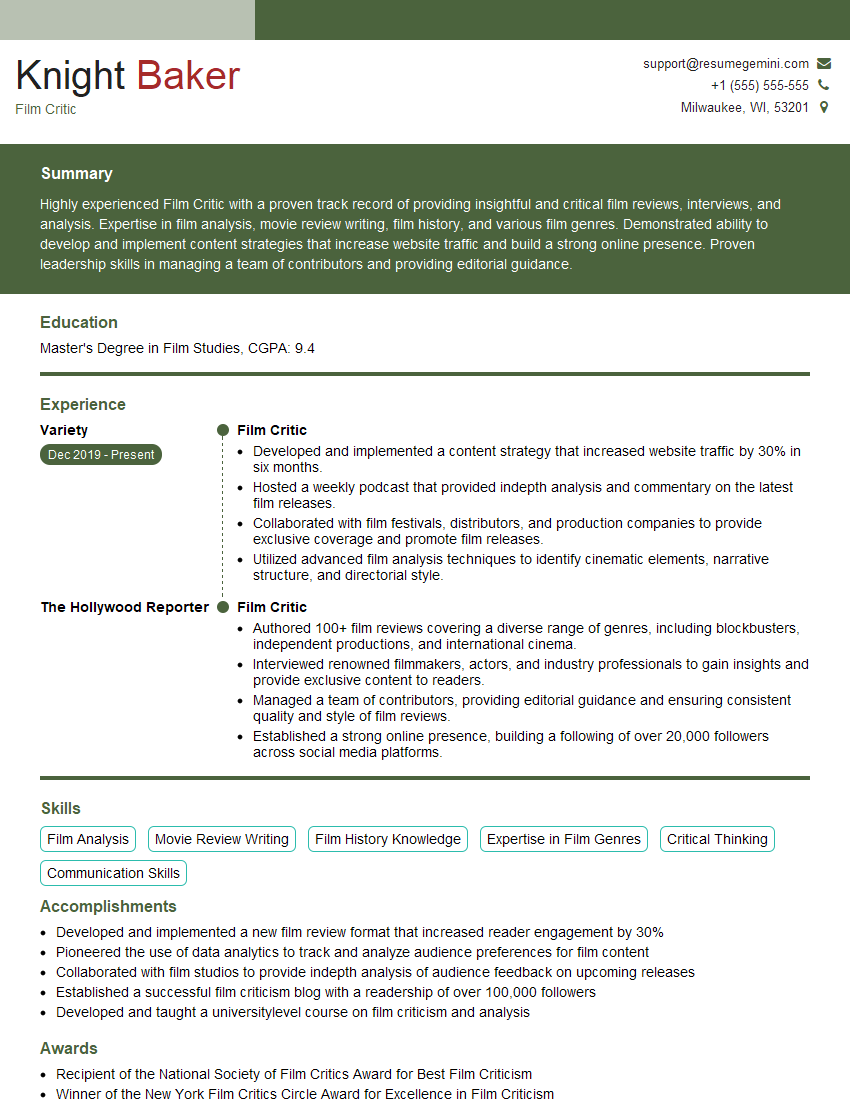
Film Critic Resume Sample
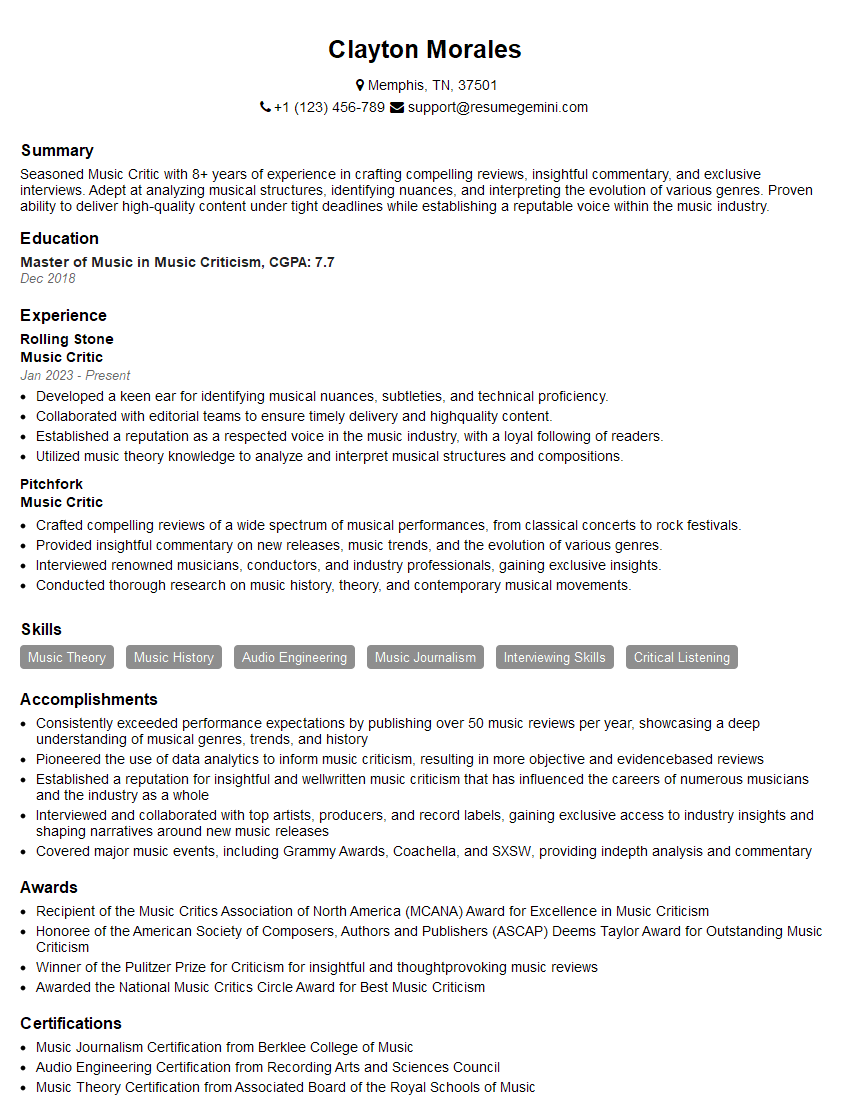
Music Critic Resume Sample

Art Therapist Resume Sample
Explore more articles
Users Rating of Our Blogs
Share Your Experience
We value your feedback! Please rate our content and share your thoughts (optional).
What Readers Say About Our Blog
Very informative content, great job.
good