Unlock your full potential by mastering the most common Assistant Casting interview questions. This blog offers a deep dive into the critical topics, ensuring you’re not only prepared to answer but to excel. With these insights, you’ll approach your interview with clarity and confidence.
Questions Asked in Assistant Casting Interview
Q 1. Describe your experience with scheduling auditions.
Scheduling auditions is the backbone of a successful casting process. It requires meticulous planning and coordination to ensure efficient use of everyone’s time. My approach involves first understanding the project’s timeline and budget constraints. Then, I collaborate closely with the director and production team to identify key audition dates, considering actor availability and potential conflicts.
For instance, I might create a detailed schedule in a spreadsheet or dedicated casting software, noting audition slots, location, and the specific roles being cast. I’ll also send out automated email reminders to actors with clear instructions regarding audition materials and arrival times. Flexibility is key; I always build in buffer time to accommodate unforeseen delays, and I proactively manage communication to keep everyone informed of any changes.
In a recent project, we had a tight deadline for a commercial. By using a shared online calendar and sending out automated reminders, I managed to schedule over 50 auditions efficiently, minimizing scheduling conflicts and ensuring a smooth process for both actors and the production team.
Q 2. How familiar are you with different casting software and databases?
I’m proficient in several casting software and databases, including industry-standard platforms such as Casting Networks, Breakdown Services, and Actors Access. My familiarity extends beyond simply using the interface; I understand how to leverage their features for efficient searching, filtering, and communication. For instance, I understand the power of using keywords and specific criteria to narrow down searches for ideal candidates. I also know how to utilize reporting features to track submissions, callbacks, and overall casting statistics.
Beyond these industry-standard tools, I’m comfortable working with various other database systems. This adaptability allows me to manage information seamlessly, regardless of the client’s preferred platform. This means that whether I’m working on a large-scale film project or a smaller independent production, I can quickly adapt and utilize the tools to achieve maximum efficiency.
Q 3. Explain your process for tracking actor submissions and callbacks.
Tracking actor submissions and callbacks is critical for maintaining an organized and efficient casting process. I typically use a combination of software and manual tracking methods to ensure complete oversight. My process begins with clearly defined submission guidelines, specifying required materials and deadlines. Once received, submissions are logged into the chosen database (often a dedicated casting software) where I can tag them with relevant keywords like ‘role,’ ‘ethnicity,’ ‘experience,’ etc. to facilitate efficient searching.
For callback tracking, I use a color-coded system within the database, marking actors based on their callback status (e.g., invited, confirmed, declined). This system allows me to keep a real-time overview of the casting process. A personalized email is sent to each actor, providing them with specific details about the callback. This thorough approach minimizes errors and streamlines communication, ensuring the process is smooth for all involved.
Q 4. How would you handle a conflict between the director’s vision and available talent?
Conflicts between the director’s vision and available talent are common challenges in casting. My approach involves collaborative problem-solving. First, I try to understand the director’s specific needs and priorities. Is there room for flexibility in the casting criteria? Sometimes, a minor adjustment in character traits or backstory can help bridge the gap between the ideal and available actors.
If a compromise isn’t possible, I propose alternative solutions. This might involve expanding the search criteria, suggesting creative direction changes to accommodate the available talent, or suggesting a casting call for a wider pool of actors. Open communication with the director and production team throughout the process is essential. The goal is to find a solution that retains the essence of the director’s vision while also ensuring a strong cast.
In one instance, the director had a very specific vision for a character’s physical appearance. After an extensive search, we realized that we might need to adjust the script’s description to better reflect the talent pool available. This slight modification allowed us to cast a fantastic actor who brought a lot of depth and nuance to the role, while still preserving the core essence of the character.
Q 5. Describe your experience with preparing casting breakdowns.
Preparing casting breakdowns is a crucial first step in the casting process. It’s essentially a detailed description of each character’s role, including their personality traits, physical characteristics, and any special skills required. My process involves close collaboration with the director and script supervisor to ensure the breakdown accurately reflects the character’s essence. I pay close attention to detail, including age ranges, ethnicity, and any specific vocal requirements.
For example, a breakdown for a ‘lead female detective’ might include specifics about the character’s age (30-40), physical attributes (athletic build), personality (sharp, observant, independent), and required skills (martial arts experience).
I ensure the breakdown is clear, concise, and visually appealing. The clearer the breakdown, the easier it is for actors to understand if they are a good fit. The breakdown often serves as the first point of contact for actors seeking to audition, so it is important that it attracts the right talent.
Q 6. How do you maintain organized records of auditions and casting decisions?
Maintaining organized records is fundamental to effective casting. I use a combination of digital and physical methods to ensure easy access to all audition materials and casting decisions. My primary tool is a dedicated casting database, where I meticulously log every actor’s submission, including their headshots, resumes, audition tapes, and any notes or feedback from the director or producers. I tag each entry with key information for easy retrieval. This approach makes it easy to filter submissions, track progress, and quickly reference past auditions.
For instance, using the database’s filtering options, I can quickly locate all actors who are 25-35 years old with experience in stage combat if this is required for a role. In addition to this, I maintain a comprehensive physical filing system for hard copies of essential documents as a backup and for easy access to certain materials that might not be readily digitized.
Q 7. What strategies do you use to find actors who fit specific roles?
Finding actors who perfectly fit specific roles requires a multifaceted strategy. I leverage a combination of online casting platforms, actor databases, talent agencies, and my own network. For example, if I need an actor with a specific dialect, I might search specifically within those casting sites that use dialect as a filter option. I also proactively attend theater performances and film festivals to discover new and emerging talent.
Beyond using conventional methods, I utilize creative strategies such as social media outreach and attending industry events. Understanding the nuances of each platform is critical; I know how to effectively use keywords and search filters to identify potential candidates who fit the role. Ultimately, successful casting often involves a blend of digital efficiency and old-fashioned networking.
Q 8. How would you handle a last-minute change to the casting schedule?
Last-minute schedule changes are a common occurrence in casting. My approach is systematic and prioritizes clear communication. First, I’d immediately acknowledge the change and confirm the new details with the casting director. This involves clarifying the nature of the change (e.g., time shift, location change, actor unavailability), its impact on existing arrangements, and any necessary adjustments to the schedule. Then, I would quickly assess the ripple effect. This might involve contacting affected actors, crew members, or venues to inform them and arrange alternative schedules. I use a project management tool to update the schedule in real-time, ensuring everyone has access to the most current information. If there’s a potential conflict, I’ll proactively explore solutions, such as rescheduling sessions, finding replacement actors, or renegotiating contracts if necessary. Throughout the process, maintaining transparent and open communication is vital to mitigate any disruptions and ensure a smooth workflow.
For example, if an actor suddenly cancels due to illness just hours before a scheduled audition, I’d immediately contact the casting director, then reach out to the next few actors on the waiting list, confirming availability and sending updated call times. If no suitable replacements are immediately available, I’d discuss alternative options with the casting director, such as rescheduling the audition or adjusting the casting criteria.
Q 9. Describe your experience with working with casting directors and other production staff.
I have a strong track record of collaborating effectively with casting directors and production staff. My experience includes working directly with casting directors to understand their vision for the project, manage actor submissions, coordinate auditions, and provide feedback on talent. I’ve assisted with various aspects of production, such as background casting, assisting with wardrobe and makeup decisions, and managing the flow of actors on set. I consistently strive to build strong working relationships based on trust, mutual respect, and open communication. I treat everyone on the team with professionalism, recognizing the importance of teamwork in achieving the overall production goals. I thrive in collaborative environments and am adept at adapting my approach to work effectively with diverse personalities and production styles.
In one instance, I worked closely with a casting director who had a very specific vision for a character. We collaborated extensively, reviewing hundreds of headshots and audition tapes, and I even helped scout locations that would reflect the character’s personality. The close collaboration resulted in a successful casting decision and contributed significantly to the film’s overall success.
Q 10. How do you ensure confidentiality with sensitive actor information?
Confidentiality is paramount in assistant casting. I adhere to strict confidentiality protocols and handle sensitive actor information with the utmost care. This involves using secure data storage methods, limiting access to sensitive information to authorized personnel only, and never sharing actor data outside the context of the project. I always obtain consent before collecting, using, or sharing any personal data and inform actors of how their data will be utilized. I am well-versed in relevant data protection regulations and actively strive to implement best practices to prevent any data breaches or unauthorized disclosures. I understand the importance of protecting an actor’s privacy, professional reputation, and career prospects, and I treat their personal information with the same respect I would expect for my own.
For example, I’d never share an actor’s contact details or audition materials with anyone outside of the authorized production team. All actor data is stored securely on password-protected drives and cloud-based platforms that meet industry security standards. I always destroy or securely delete any sensitive information once the project is completed.
Q 11. What is your experience with background checks for actors?
My experience with background checks for actors varies depending on project requirements and client specifications. I’m familiar with the procedures involved in conducting background checks, which may include verifying identities, confirming employment history, and conducting criminal record checks. I understand the importance of adhering to relevant legal and ethical guidelines during the background check process and will always work within the boundaries of applicable laws. The specific checks will be done only with the express consent of the actor and in compliance with data protection laws. I typically work with specialized background check services to ensure efficiency and compliance with regulations. I also carefully document the results of background checks and maintain secure records to protect both the actor’s privacy and the integrity of the hiring process.
In a recent project, for example, a background check was required for a lead actor due to the sensitivity of the role. I coordinated the background check through a reputable third-party provider, ensured all necessary permissions were obtained, and promptly communicated the results to the casting director while maintaining the utmost confidentiality.
Q 12. Explain your proficiency with different communication methods (email, phone, in-person).
Effective communication is crucial in my role. I am proficient in various methods, including email, phone, and in-person communication. I tailor my communication style based on the context and recipient. Email is ideal for formal communications, providing written records of agreements and instructions. Phone calls are effective for quick updates, addressing urgent matters, or building rapport with actors. In-person interactions are invaluable for building relationships, networking, and resolving complex issues that require nuanced discussions. I always strive for clear, concise, and professional communication, confirming understanding whenever necessary. I’m also adept at managing multiple communication channels simultaneously and prioritizing tasks effectively to ensure timely responses and avoid delays.
For instance, I often use email to send audition reminders and casting calls, while phone calls are reserved for clarifying actor availability or addressing urgent scheduling conflicts. In-person meetings, particularly during auditions, allow for direct feedback and a more personal connection with the actors. I’ve found that a combination of these methods fosters the most effective and efficient communication throughout the casting process.
Q 13. How do you prioritize tasks in a fast-paced environment?
Prioritizing tasks in a fast-paced environment requires a structured approach. I typically utilize a combination of techniques, including time management tools, task lists, and prioritization matrices. I start by identifying all tasks, then assessing their urgency and importance. Time-sensitive tasks, such as last-minute casting calls or addressing urgent actor inquiries, take precedence. I delegate tasks when appropriate, and I consistently monitor progress, readjusting priorities as needed. My ability to multitask and maintain focus under pressure enables me to manage competing deadlines effectively. I avoid procrastination and regularly review my workload to ensure I stay on track.
For example, I might use a Kanban board to visualize my workflow, categorize tasks by priority (urgent/important, important/not urgent, etc.), and track progress. This allows me to easily identify bottlenecks and adjust my workload as needed. I also use calendar reminders and scheduling apps to manage deadlines and appointments effectively.
Q 14. How do you handle feedback from casting directors?
I view feedback from casting directors as invaluable for improving my performance and the casting process. I actively seek feedback and listen attentively, aiming to understand their perspectives and preferences. I treat feedback constructively, considering its implications and making necessary adjustments to my approach. I document feedback and reflect on my performance to identify areas for improvement and implement changes in future projects. If there are any areas of disagreement or misunderstanding, I initiate a dialogue to clarify concerns and seek a resolution that benefits the overall production. I aim to establish a strong professional rapport with casting directors built on mutual respect and open communication, making it easier to incorporate feedback effectively.
For example, if a casting director provides feedback on a particular aspect of the casting process (e.g., the selection of background actors), I would make adjustments to ensure the process aligns with their preferences in future projects. I may review my selection criteria, consult additional resources or revise my communication strategy to address the feedback constructively. This ongoing refinement helps me improve my skills and contribute more effectively to future projects.
Q 15. What is your understanding of talent contracts and agreements?
Talent contracts and agreements are the legal backbone of any casting project. They define the terms of employment between the production company and the actors, including crucial details like payment, usage rights, and responsibilities. A well-drafted contract protects both parties and prevents misunderstandings down the line.
For instance, a standard contract will specify the actor’s compensation (day rate, residuals, etc.), the duration of their involvement, the geographical limitations of use, and the specific roles they’re allowed to perform. It will also often include clauses relating to image rights, exclusivity, and potential modifications to the initial agreement. It’s essential to have a legal professional review all contracts to ensure compliance with local regulations and industry best practices. I have extensive experience reviewing and negotiating contracts to ensure fair compensation and the protection of all involved parties.
Failure to have a well-defined contract can lead to disputes, unpaid wages, copyright infringements, or legal battles, which can cause major disruptions and financial losses to the production.
Career Expert Tips:
- Ace those interviews! Prepare effectively by reviewing the Top 50 Most Common Interview Questions on ResumeGemini.
- Navigate your job search with confidence! Explore a wide range of Career Tips on ResumeGemini. Learn about common challenges and recommendations to overcome them.
- Craft the perfect resume! Master the Art of Resume Writing with ResumeGemini’s guide. Showcase your unique qualifications and achievements effectively.
- Don’t miss out on holiday savings! Build your dream resume with ResumeGemini’s ATS optimized templates.
Q 16. How do you manage your time effectively when juggling multiple projects?
Managing multiple projects simultaneously in assistant casting requires meticulous organization and prioritization. I utilize a combination of digital tools and tried-and-true methods. I rely heavily on project management software to track deadlines, tasks, and communication for each project. Each project has its own dedicated folder with sub-folders for auditions, contracts, and communications. I also use color-coded calendars and set daily/weekly priorities to ensure I’m addressing the most time-sensitive tasks first.
For example, I might allocate specific days for reviewing auditions for one project, while other days are devoted to contract negotiations for another. Regularly reviewing my to-do list and adapting to unexpected delays are key to success. Clear communication with the casting director and the production team is paramount to prevent scheduling conflicts and keep everyone informed of my progress.
Thinking of my time as a valuable resource that needs to be managed effectively, and not just a thing to be ‘filled’, is a crucial aspect of my approach.
Q 17. Describe your experience with budgeting and expense tracking related to casting.
Budgeting and expense tracking are critical components of efficient casting. My experience involves meticulous record-keeping of all expenses related to the casting process. This includes travel costs for auditions, background check fees, talent agency fees, and any other related expenditures. I maintain detailed spreadsheets or utilize specialized budgeting software to track these expenses against the allocated budget. I regularly reconcile my records with the production’s financial department to ensure transparency and accuracy.
For example, I will create a budget breakdown at the outset of a project, anticipating costs associated with various phases of the casting process. This budget is then used as a benchmark to ensure that expenses remain within the allocated funds. I’ve often found that careful planning and proactive expense tracking help avoid overspending and contribute to the overall success of the production.
Regular reporting and analysis of expenses help in identifying areas for potential cost savings in future projects, improving efficiency and accountability.
Q 18. How do you stay updated on industry trends and best practices in casting?
Staying abreast of industry trends and best practices is crucial for remaining competitive and efficient in casting. I actively participate in professional organizations like the Casting Society of America (CSA), attend industry conferences and workshops, and follow industry publications and online resources. I also maintain a professional network of casting directors, agents, and industry professionals to stay informed about emerging technologies and methodologies.
For example, I regularly read publications like Backstage and The Hollywood Reporter, and I’ve attended workshops on diversity and inclusion in casting, as well as seminars on new technologies for audition management. Networking at industry events helps me learn from experienced professionals and stay updated on the latest trends, making me more effective in my role.
Continuous learning ensures I’m equipped with the latest tools and knowledge to enhance my performance and the success of my casting projects.
Q 19. How would you identify potential conflicts of interest in the casting process?
Identifying potential conflicts of interest is crucial to maintaining the integrity and fairness of the casting process. Conflicts can arise in various ways, such as personal relationships with potential candidates, financial interests in a specific talent agency, or prior commitments that might influence decision-making. I follow a strict protocol to mitigate any potential conflict.
For instance, if I have a personal connection with a prospective candidate, I disclose this to the casting director and recuse myself from the decision-making process for that particular individual. If an agency with whom I have a personal or financial relationship submits a candidate, I ensure that all candidates from that agency are assessed impartially and transparently.
Maintaining transparent communication with the casting director and production team is key to handling potential conflicts ethically and effectively, guaranteeing a fair and unbiased casting process.
Q 20. What is your understanding of diversity and inclusion in casting?
Diversity and inclusion are paramount in casting. It’s not just about meeting quotas; it’s about ensuring representation that accurately reflects the world around us. This involves actively seeking out and considering actors from diverse backgrounds, including race, ethnicity, gender, sexual orientation, age, and ability. It requires a conscious effort to expand the casting net beyond typical casting pools.
For example, I proactively seek out and work with casting directors that specialize in diverse talent pools. I use inclusive language in casting calls and actively encourage submissions from underrepresented groups. I also participate in workshops and training sessions that focus on building inclusive casting practices and combating unconscious bias.
Beyond meeting representation targets, fostering a truly inclusive casting environment requires actively working against systemic biases that might otherwise disadvantage certain groups of individuals.
Q 21. How familiar are you with different union regulations related to casting?
Familiarity with union regulations is crucial, especially when working with union actors. This includes understanding the rules and regulations of SAG-AFTRA, Actors’ Equity Association (AEA), and other relevant unions, depending on the production’s location and scope. It involves knowing the required compensation, working conditions, and other legal stipulations that apply to union actors.
For example, I understand the different contract types used for union actors (e.g., theatrical contracts, television contracts), the requirements for obtaining union waivers, and how to ensure compliance with minimum wage and overtime laws. Navigating union regulations requires meticulous attention to detail and often involves working closely with the union’s representatives to ensure adherence to all relevant rules.
In short, navigating union regulations is critical for ethical and legal compliance. It requires a deep understanding of union contracts and the willingness to engage with union representatives to ensure all rules are followed properly.
Q 22. Describe your experience with using social media for casting research.
Social media is an invaluable tool for casting research, significantly expanding the talent pool beyond traditional methods. I leverage platforms like Instagram, Facebook, TikTok, and even LinkedIn to discover actors. My approach is multifaceted. First, I utilize targeted searches based on specific physical characteristics, acting styles, and skills mentioned in the casting brief. For example, if I’m casting for a period drama, I’d search for actors with relevant historical costuming experience, indicated by their posts. I also actively engage with relevant hashtags, such as #actorslife #auditions #castingcall #[specific genre/location], to find potential candidates. Second, I carefully review actor profiles, looking at headshots, reels or demo videos demonstrating their range, and personal branding to gauge their suitability. I prioritize profiles showing professionalism, high-quality media, and a good understanding of their target market. Finally, I use these platforms to network with casting directors, agents, and acting coaches, who often have access to emerging talent. Essentially, social media helps build a comprehensive overview of the acting landscape, connecting me with actors I might not find through conventional casting sites.
Q 23. How comfortable are you working independently with minimal supervision?
I’m highly comfortable working independently with minimal supervision. My experience has instilled in me a strong sense of self-reliance and initiative. I thrive in environments where I can take ownership of projects and manage my workload effectively. I set clear goals, prioritize tasks based on deadlines and importance, and proactively seek solutions to any challenges that arise. For example, during a recent independent film project, I single-handedly managed the casting process from initial brief analysis to final callback selections, requiring strong organizational skills and independent decision-making. I regularly check in with stakeholders to ensure alignment, but I don’t require constant oversight to maintain focus and efficiency.
Q 24. How would you handle a situation where an actor is late for an audition?
Promptness is crucial in a professional setting, so if an actor is late for an audition, my response would depend on the context. First, I’d ascertain the reason for the lateness; traffic, technical difficulties, etc. However, regardless of the excuse, professionalism is paramount. If their tardiness significantly impacts the audition schedule, I would communicate professionally but firmly that lateness is unacceptable and impacts their overall impression. I might offer a shortened audition if possible, to not disrupt others. If their behavior is a pattern, it might warrant removal from consideration. However, I always strive to maintain a fair and considerate approach while upholding the importance of time management in the industry. For example, once an actor was 15 minutes late due to a car accident. I still gave them a chance to audition while making it clear the punctuality expectation for future collaborations.
Q 25. What are your salary expectations for this position?
My salary expectations are commensurate with my experience and skills, and the specifics of the role. I’m open to discussing compensation based on a competitive industry standard and a detailed job description. I’m confident that my contributions will deliver significant value, exceeding expectations.
Q 26. What are your long-term career goals in the casting field?
My long-term career goals involve becoming a highly respected and influential casting director known for discovering and developing exceptional talent. I aspire to work on a wide range of high-profile projects, spanning film, television, and theatre, and contribute to creating compelling narratives. I also envision myself mentoring emerging casting professionals and utilizing my expertise to help build an inclusive and diverse industry. Ultimately, I aim to make a lasting contribution to the art of storytelling by connecting exceptional actors with inspiring roles.
Q 27. Describe a time you had to solve a challenging problem during a casting process.
During the casting for a period drama, we faced a significant challenge. The casting brief required actors of a specific ethnicity with impeccable period-appropriate dialect coaching. The initial pool was limited, and the deadline was fast approaching. To overcome this, I employed a multifaceted approach. Firstly, I expanded the search parameters to include actors with demonstrated dialect proficiency who could convincingly portray the required ethnicity, even if not of that background. Secondly, I collaborated closely with the dialect coach to develop a comprehensive training program, allowing us to broaden the casting net. Thirdly, I proactively reached out to niche acting schools and organizations focused on diverse performers and period piece acting. This multi-pronged strategy resolved the issue, ultimately leading to a successful cast that exceeded expectations.
Q 28. How would you improve the efficiency of a casting process?
Improving casting process efficiency involves a combination of technological advancements and streamlined workflows. First, implementing a robust and user-friendly casting software can automate many tasks, reducing manual effort and minimizing errors. This includes features like automated scheduling, digital audition submissions, and integrated communication tools. Second, a well-defined and clear casting brief with precise criteria will expedite the selection process. Third, a clear organizational structure for managing submissions, actor profiles, and communication will prevent delays and miscommunication. I also highly recommend collaborating closely with the production team from the beginning, to ensure the casting process is aligned with their needs and timelines. Finally, embracing digital tools for initial screening and preliminary auditions can drastically reduce the time spent on in-person callbacks for unsuitable candidates.
Key Topics to Learn for Assistant Casting Interview
- Understanding the Casting Process: Familiarize yourself with the entire casting process, from initial breakdown to final selection. This includes understanding different casting methods and their applications.
- Production Workflow & Scheduling: Learn how assistant casting fits into the broader production workflow. Practice visualizing schedules and understanding the impact of scheduling changes on the casting process.
- Actor Communication & Management: Develop strategies for effectively communicating with actors, agents, and other casting professionals. Practice your approach to managing actor availability and expectations.
- Database Management & Organization: Understand the importance of meticulous record-keeping and database management in casting. Explore different methods for organizing actor information and submissions.
- Audition Coordination & Logistics: Learn the practical aspects of coordinating auditions, including scheduling, location management, and ensuring smooth audition processes. This includes understanding different audition formats.
- Legal & Ethical Considerations: Familiarize yourself with relevant legal and ethical standards within the casting industry, including issues related to confidentiality and equal opportunity.
- Software Proficiency (if applicable): Depending on the role, demonstrate familiarity with casting software, scheduling tools, and other relevant technologies.
- Problem-Solving & Adaptability: Prepare examples showcasing your ability to quickly adapt to unexpected challenges and resolve issues within the casting process.
Next Steps
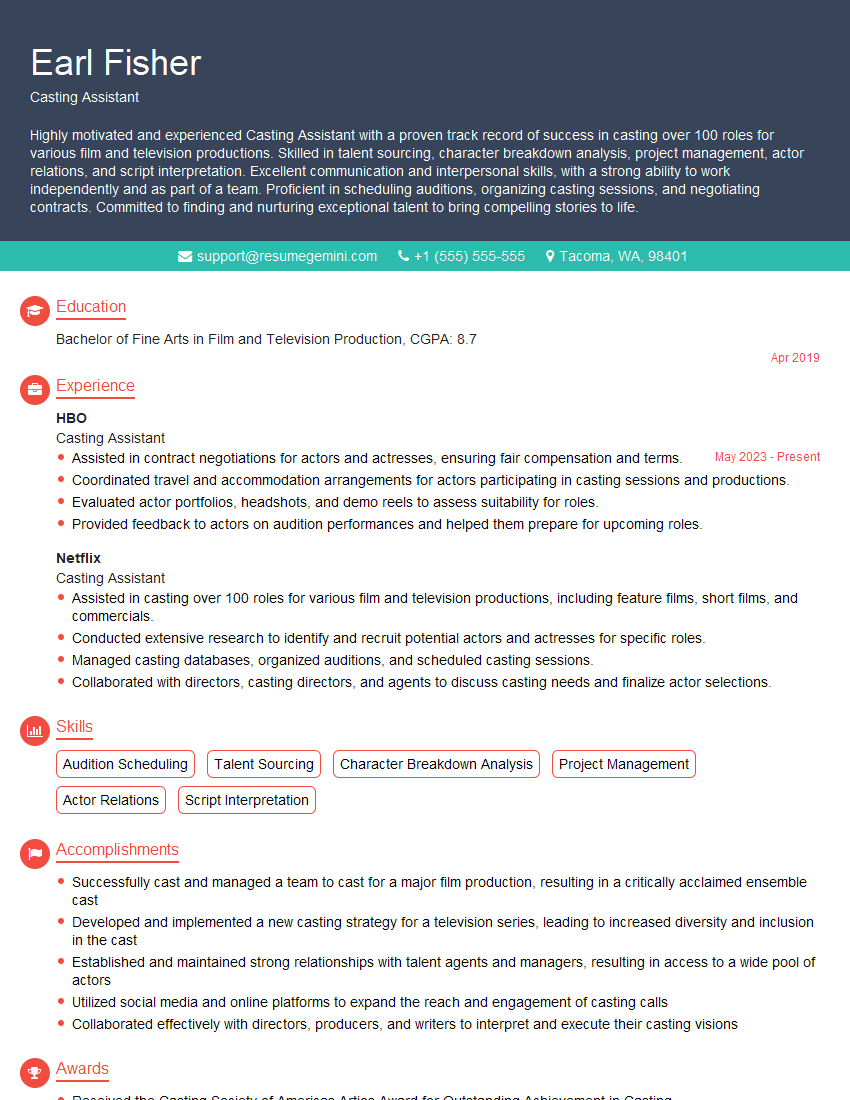
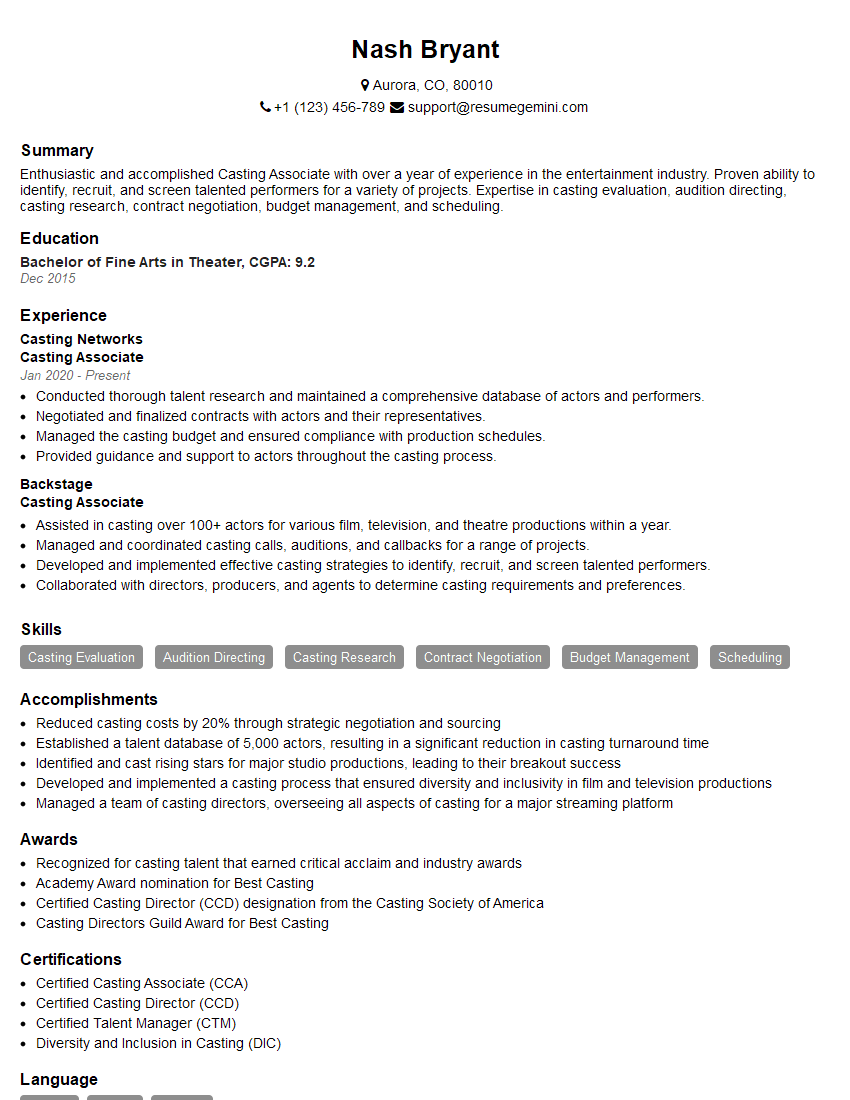
Mastering the skills of an Assistant Casting professional opens doors to exciting career opportunities in film, television, and theatre, offering valuable experience and a pathway to advancement within the industry. To significantly increase your chances of landing your dream role, creating an ATS-friendly resume is crucial. This ensures your application gets noticed by the right people. We highly recommend leveraging ResumeGemini to build a professional and impactful resume tailored to the Assistant Casting field. Examples of resumes specifically designed for Assistant Casting positions are available to guide you.
Explore more articles
Users Rating of Our Blogs
Share Your Experience
We value your feedback! Please rate our content and share your thoughts (optional).
What Readers Say About Our Blog
Very informative content, great job.
good