Every successful interview starts with knowing what to expect. In this blog, we’ll take you through the top Association of Energy Engineers (AEE) interview questions, breaking them down with expert tips to help you deliver impactful answers. Step into your next interview fully prepared and ready to succeed.
Questions Asked in Association of Energy Engineers (AEE) Interview
Q 1. Explain the different types of energy audits.
Energy audits are systematic assessments of a building’s energy consumption to identify areas for improvement. They come in several types, each with a different level of detail and depth.
- Level I Audits (Walk-Through Audits): These are the most basic, involving a visual inspection of the building and its systems. They are relatively quick and inexpensive, providing a preliminary assessment of potential energy savings. Think of it like a quick health check-up for your building. A Level I audit might identify obvious issues like outdated lighting or poorly sealed windows.
- Level II Audits (Energy Use Intensity Audits): These audits delve deeper, analyzing historical energy consumption data to pinpoint specific energy-consuming equipment and systems. This involves analyzing utility bills, reviewing building plans, and potentially using simple calculations to estimate energy use. This is like a more detailed physical exam, looking at specific systems’ performance.
- Level III Audits (Detailed Energy Audits): These are the most comprehensive, incorporating on-site measurements, advanced building energy modeling software, and detailed analysis to identify specific energy-saving opportunities. They often include recommendations for specific upgrades and cost-benefit analysis. This is equivalent to a full diagnostic workup, identifying and quantifying specific areas needing improvement, with detailed recommendations and cost estimates.
The choice of audit type depends on the building’s age, size, and the client’s budget and objectives. For example, a small office building might only need a Level II audit, while a large industrial facility might require a Level III audit.
Q 2. Describe your experience with building energy modeling software (e.g., EnergyPlus, eQUEST).
I have extensive experience using building energy modeling software, particularly EnergyPlus and eQUEST. EnergyPlus is a powerful, whole-building simulation program capable of highly detailed modeling, offering great precision but with a steeper learning curve. eQUEST provides a more user-friendly interface, ideal for quicker assessments and simpler models.
In my previous role, I used EnergyPlus to model a large university campus, simulating various scenarios for energy-efficient renovations. We were able to analyze the impact of different HVAC system upgrades, lighting retrofits, and building envelope improvements on overall energy consumption and greenhouse gas emissions. We used the detailed results to optimize the design and justify the financial investment in the project to the university administration. For a smaller project, involving a retrofit of a small commercial building, eQUEST was used to quickly evaluate different lighting options and their impact on the building’s energy performance. The speed and ease of use of eQUEST helped us stay within the project’s tight timeline and budget.
Q 3. How would you identify and prioritize energy-saving opportunities in a building?
Identifying and prioritizing energy-saving opportunities requires a systematic approach. I typically follow these steps:
- Data Collection and Analysis: Gather data on energy consumption, utility bills, building systems, and operating schedules. Analyze this data to identify high-energy-use areas and equipment.
- Site Survey and Assessment: Conduct a thorough site visit to visually inspect the building and its systems, looking for inefficiencies such as air leaks, inadequate insulation, or outdated equipment. This often involves using specialized equipment to measure air flows, temperatures, and other relevant parameters.
- Energy Modeling (if applicable): Utilize building energy modeling software to simulate the impact of various energy-efficiency measures. This helps refine the prioritization process by providing quantitative data on potential savings.
- Prioritization: Based on the data analysis and energy modeling results, prioritize energy-saving opportunities based on factors such as cost-effectiveness, feasibility, and environmental impact. I often employ a matrix prioritizing measures based on payback period, energy savings, and implementation difficulty.
- Recommendation Development: Based on the prioritization, develop detailed recommendations for energy-saving measures, including specific technologies, implementation plans, and estimated costs.
For example, if analysis reveals that the HVAC system is consuming a significant portion of the energy, prioritizing improvements to the system (like upgrading controls or improving efficiency) would be a logical step.
Q 4. What are the key performance indicators (KPIs) used to measure energy efficiency improvements?
Key Performance Indicators (KPIs) are crucial for measuring the effectiveness of energy efficiency improvements. Some common KPIs include:
- Energy Use Intensity (EUI): Measures energy consumption per unit area (e.g., kBtu/ft²/year). A decrease in EUI signifies improved energy efficiency.
- Energy Consumption Reduction Percentage: Tracks the percentage decrease in energy consumption compared to a baseline period. This is easy to understand and communicate.
- Return on Investment (ROI): Calculates the return on investment for implemented energy-efficiency measures. A higher ROI indicates a better investment.
- Simple Payback Period: The time it takes for energy savings to offset the initial cost of an improvement. Shorter payback periods are desirable.
- Greenhouse Gas Emission Reductions: Measures the reduction in greenhouse gas emissions resulting from energy efficiency improvements. This shows the environmental impact of the work done.
- Cost Savings (Dollars): The actual dollar amount saved as a result of energy efficiency improvements.
Using a combination of these KPIs provides a comprehensive picture of the success of energy efficiency measures. For instance, a project might show a 15% reduction in EUI, a 3-year payback period, and a $20,000 annual cost savings along with substantial GHG reductions, all pointing to a highly successful upgrade.
Q 5. Describe your experience with commissioning and retro-commissioning projects.
Commissioning (Cx) and Retro-commissioning (RCx) are crucial processes for ensuring building systems operate as designed and efficiently. Commissioning is done during the construction or renovation phase, verifying that systems are installed and operating correctly. Retro-commissioning is performed on existing buildings to optimize the performance of existing systems.
I’ve been involved in numerous Cx and RCx projects, from small office buildings to large industrial complexes. In one RCx project, we identified significant inefficiencies in a large office building’s HVAC system. Through detailed testing and analysis, we discovered faulty sensors, improper control sequences, and air leaks in the ductwork. By implementing corrective actions and optimizing the control sequences, we achieved a 20% reduction in energy consumption and improved occupant comfort.
My experience encompasses all phases of Cx/RCx, including pre-design review, system testing, operational training, and post-commissioning evaluation. I understand the importance of detailed documentation and close collaboration with contractors, engineers, and building owners to ensure project success.
Q 6. Explain the concept of Life Cycle Cost Analysis (LCCA).
Life Cycle Cost Analysis (LCCA) is a method for evaluating the total cost of ownership of a building system or component over its entire lifespan. It considers not only the initial purchase price but also ongoing operational costs (energy, maintenance, repairs), replacement costs, and potential salvage value. Think of it like comparing the total cost of owning a car, not just the initial purchase price, but including fuel, maintenance, and eventual resale value.
LCCA is essential for making informed decisions about energy-efficiency investments. While a high-efficiency HVAC system might have a higher initial cost than a standard system, it can lead to lower operational costs over its lifetime, resulting in lower overall life cycle costs. By considering all costs, LCCA helps determine the most cost-effective solution, ensuring that long-term savings outweigh the initial investment.
Performing an LCCA involves estimating the costs associated with each system over its useful life. This frequently involves using discounted cash flow analysis to bring all costs to their present value, for easier comparison of alternative options. Software tools are often employed to simplify the calculations and model uncertainty.
Q 7. What are the benefits of using renewable energy sources?
Renewable energy sources offer numerous benefits, including:
- Reduced Greenhouse Gas Emissions: Renewable energy sources, such as solar, wind, and geothermal, produce little to no greenhouse gas emissions during operation, contributing to mitigating climate change.
- Energy Independence: Reliance on renewable energy reduces dependence on fossil fuels, enhancing energy security and reducing vulnerability to price fluctuations.
- Cost Savings: While initial investments can be significant, renewable energy sources can lead to long-term cost savings through reduced electricity bills.
- Improved Air and Water Quality: Reducing reliance on fossil fuels improves air and water quality, resulting in public health benefits.
- Job Creation: The renewable energy sector creates jobs in manufacturing, installation, maintenance, and research.
- Resource Sustainability: Unlike fossil fuels, many renewable resources are naturally replenished and will not run out.
For example, installing solar panels on a building can significantly reduce its reliance on the grid, lowering energy costs and reducing its carbon footprint. The combination of these benefits makes renewable energy sources an increasingly attractive option for building owners and operators.
Q 8. Describe your understanding of different renewable energy technologies (solar, wind, etc.).
Renewable energy technologies harness naturally replenishing resources to generate power. Let’s explore some key examples:
- Solar Energy: Photovoltaic (PV) systems convert sunlight directly into electricity using solar panels. Concentrated solar power (CSP) uses mirrors to focus sunlight onto a receiver, generating heat to drive a turbine. The efficiency of PV systems is constantly improving, with advancements in materials and cell design leading to higher energy yields.
- Wind Energy: Wind turbines capture kinetic energy from wind, converting it into rotational energy that drives a generator. Offshore wind farms are becoming increasingly significant due to higher and more consistent wind speeds. Advances in turbine design are improving their capacity and lifespan.
- Hydropower: This technology utilizes the energy of flowing water to generate electricity. It can range from large-scale hydroelectric dams to smaller run-of-river systems. Hydropower is a reliable source but can have significant environmental impacts, particularly on aquatic ecosystems.
- Geothermal Energy: Geothermal energy harnesses heat from the Earth’s interior. This heat can be used directly for heating and cooling or to generate electricity using geothermal power plants. Geothermal energy is sustainable and relatively reliable, but its geographical limitations restrict its widespread adoption.
- Biomass Energy: This involves burning organic matter like wood, crops, or waste to generate heat and electricity. While a renewable resource, its sustainability depends on responsible forestry and agricultural practices. Concerns exist regarding greenhouse gas emissions if not managed properly.
The choice of renewable technology depends on factors like site-specific resources, environmental impact considerations, economic feasibility, and grid integration capabilities. A comprehensive assessment is crucial for successful implementation.
Q 9. How would you approach a project to reduce a building’s carbon footprint?
Reducing a building’s carbon footprint requires a holistic approach that integrates various strategies. My approach would involve these key steps:
- Energy Audit: Conduct a thorough energy audit to identify areas of energy waste and pinpoint opportunities for improvement. This involves analyzing energy consumption patterns, identifying inefficiencies in building systems (HVAC, lighting, etc.), and assessing the building envelope for thermal losses.
- Prioritization: Prioritize energy efficiency measures based on their cost-effectiveness and potential impact. Quick wins, like replacing inefficient lighting fixtures, should be tackled first, followed by larger-scale investments.
- Implementation: Implement identified energy efficiency measures. This might involve upgrades to HVAC systems, installation of energy-efficient windows and insulation, adoption of smart building technologies, and the integration of renewable energy sources (solar panels, for instance).
- Monitoring and Verification: Continuously monitor energy consumption post-implementation to verify the effectiveness of the measures taken. Utilize building automation systems and energy management software to track performance and identify any additional areas for improvement.
- Reporting and Documentation: Maintain comprehensive records of all energy efficiency initiatives and the resulting carbon footprint reduction. This documentation is crucial for tracking progress, demonstrating compliance with regulations, and showcasing the environmental benefits.
For example, in a recent project, we reduced a building’s carbon footprint by 30% by implementing a combination of LED lighting upgrades, HVAC system optimization, and the addition of solar panels. The success hinged on a detailed energy audit, careful project planning, and rigorous post-implementation monitoring.
Q 10. What are the various energy efficiency standards and certifications (e.g., LEED, ASHRAE)?
Several energy efficiency standards and certifications exist to evaluate and recognize buildings’ environmental performance. Here are some prominent examples:
- LEED (Leadership in Energy and Environmental Design): A globally recognized green building rating system that assesses a building’s sustainability performance across various categories, including energy efficiency, water conservation, and material selection. LEED certification demonstrates a commitment to environmentally responsible design and construction.
- ASHRAE (American Society of Heating, Refrigerating and Air-Conditioning Engineers): ASHRAE develops standards and guidelines for HVAC systems, building energy codes, and energy efficiency measures. Their standards are widely adopted in building design and construction, influencing energy consumption and performance.
- Energy Star: A program that certifies energy-efficient products and buildings. Energy Star ratings help consumers and businesses identify energy-efficient appliances, equipment, and buildings.
- BREEAM (Building Research Establishment Environmental Assessment Method): A widely used sustainability assessment method for infrastructure projects, similar to LEED but with its own set of criteria.
- Green Globes: Another green building rating system that provides a comprehensive assessment of a building’s environmental performance.
These standards provide frameworks for designing, constructing, and operating energy-efficient buildings. Compliance with these standards demonstrates a commitment to sustainability and often results in lower operating costs and improved environmental performance.
Q 11. Explain your understanding of energy management systems (EMS).
Energy Management Systems (EMS) are computerized systems that monitor, control, and optimize the energy usage of a building or industrial facility. They integrate data from various building systems, such as HVAC, lighting, and power, to provide a comprehensive overview of energy consumption.
A typical EMS includes:
- Sensors and Meters: Collect data on energy usage, temperature, humidity, and other relevant parameters.
- Data Acquisition System (DAS): Gathers data from sensors and meters.
- Central Processing Unit (CPU): Processes the data and executes control algorithms.
- Human-Machine Interface (HMI): Provides a user-friendly interface for monitoring and controlling the system.
- Control Logic: Implements algorithms to optimize energy consumption based on real-time data and pre-defined rules.
EMS offers several benefits, including reduced energy consumption, improved occupant comfort, enhanced building performance, and detailed energy data for analysis and reporting. The sophistication of an EMS can vary greatly depending on the size and complexity of the building and the specific needs of the owner. For example, a simple EMS might only control lighting, while a more advanced system might integrate with the HVAC system, power management, and even security systems.
Q 12. Describe your experience with energy data analysis and reporting.
My experience with energy data analysis and reporting involves collecting, cleaning, analyzing, and visualizing energy consumption data to identify trends, pinpoint areas for improvement, and create reports for stakeholders. I’m proficient in using various software tools to achieve this, such as spreadsheets, data visualization software, and specialized energy management software.
A typical workflow includes:
- Data Collection: Gathering energy consumption data from various sources, such as utility bills, smart meters, and building management systems.
- Data Cleaning and Preprocessing: Cleaning the data to remove errors and inconsistencies, handling missing values, and transforming data into a suitable format for analysis.
- Data Analysis: Analyzing the data to identify trends, patterns, and anomalies in energy consumption. This often involves statistical methods and data visualization techniques.
- Reporting: Creating reports that summarize the key findings and recommendations for energy efficiency improvements. This may involve creating charts, graphs, and tables to effectively communicate the results.
For instance, in one project, I analyzed energy consumption data from a large office building to identify opportunities for energy savings. My analysis revealed that inefficient HVAC operation accounted for a significant portion of the energy costs. This finding led to the implementation of an energy management system, resulting in a substantial reduction in energy consumption.
Q 13. How do you ensure compliance with relevant building codes and regulations related to energy efficiency?
Ensuring compliance with building codes and regulations related to energy efficiency is crucial for any energy efficiency project. This involves a multi-step process:
- Identifying Applicable Codes: Determining the specific building codes and regulations that apply to the project location and building type. This often involves consulting local, state, and national codes and standards.
- Design Compliance: Ensuring that the design of the energy efficiency measures aligns with the relevant codes and regulations. This might involve using energy modeling software to demonstrate compliance with energy performance standards.
- Construction Compliance: Monitoring the construction process to ensure that the implemented measures are installed and operated according to the specifications and standards. This often involves regular site inspections and quality control checks.
- Commissioning: Commissioning the energy efficiency measures to verify that they are operating as designed and meeting the required performance standards. This typically involves a series of tests and inspections.
- Documentation: Maintaining thorough documentation to demonstrate compliance with all relevant codes and regulations. This documentation might include design plans, installation records, testing results, and commissioning reports.
Failure to comply with energy codes can result in penalties, delays, and potential legal issues. Proactive compliance ensures a smooth project execution and minimizes risks.
Q 14. What is your experience with energy savings performance contracts (ESPCs)?
Energy Savings Performance Contracts (ESPCs) are financing mechanisms that allow building owners to implement energy efficiency upgrades without upfront capital costs. Under an ESPC, an energy service company (ESCO) finances, designs, installs, and maintains energy efficiency improvements. The ESCO is then repaid from a portion of the resulting energy savings.
My experience with ESPCs includes:
- Project Development: Assisting in the development of ESPC proposals, including conducting energy audits, identifying energy savings opportunities, developing cost estimates, and structuring financing arrangements.
- Contract Negotiation: Negotiating contracts with ESCOs to ensure favorable terms and conditions for the building owner.
- Project Management: Overseeing the implementation of the energy efficiency measures, including managing contractors, monitoring progress, and ensuring compliance with project requirements.
- Performance Verification: Verifying that the implemented measures deliver the promised energy savings and that the ESCO meets its contractual obligations.
ESPCs can be a valuable tool for building owners who lack the upfront capital to invest in energy efficiency upgrades. However, it’s crucial to carefully evaluate the terms of the contract to ensure that it is financially advantageous and protects the interests of the building owner. A thorough understanding of energy modeling and financial analysis is essential in the successful implementation of an ESPC.
Q 15. Describe your knowledge of different types of energy metering technologies.
Energy metering technologies are crucial for understanding and managing energy consumption. They range from simple mechanical meters to sophisticated smart meters capable of providing granular data. Let’s explore some key types:
- Mechanical Meters: These older technologies, like electromechanical kilowatt-hour (kWh) meters, measure energy consumption by rotating a disc proportional to the current flow. They are inexpensive but provide limited data – essentially just total kWh usage.
- Electronic Meters: These offer a step up, digitally recording energy consumption. They often provide data on peak demand and potentially some time-of-use information.
- Smart Meters: These advanced meters communicate consumption data wirelessly, usually through cellular or power line communication. They allow for real-time monitoring, time-of-use billing, and remote troubleshooting, significantly improving energy management capabilities. This allows for detailed analysis of energy usage patterns, identifying peak demand periods and energy waste.
- Submetering: This involves installing separate meters to monitor energy consumption of individual appliances, equipment, or building zones. It’s essential for pinpointing energy hogs and optimizing energy use within a facility. For example, we might submeter individual HVAC units in a large office building to optimize their operation and identify malfunctioning units.
The choice of metering technology depends on factors like budget, the level of detail required, and the building’s infrastructure. For instance, a small business might suffice with electronic meters, while a large campus would benefit from a comprehensive smart metering system with submetering capabilities. In my experience, implementing a smart metering system provides a significant return on investment through improved energy efficiency and better data-driven decision making.
Career Expert Tips:
- Ace those interviews! Prepare effectively by reviewing the Top 50 Most Common Interview Questions on ResumeGemini.
- Navigate your job search with confidence! Explore a wide range of Career Tips on ResumeGemini. Learn about common challenges and recommendations to overcome them.
- Craft the perfect resume! Master the Art of Resume Writing with ResumeGemini’s guide. Showcase your unique qualifications and achievements effectively.
- Don’t miss out on holiday savings! Build your dream resume with ResumeGemini’s ATS optimized templates.
Q 16. How would you develop an energy conservation plan for a commercial building?
Developing an energy conservation plan for a commercial building requires a systematic approach. I typically follow these steps:
- Energy Audit: This is the foundation. A thorough audit identifies energy consumption patterns, pinpoints energy waste areas, and assesses the building’s systems. This involves reviewing utility bills, conducting on-site inspections, and using specialized equipment like infrared cameras to detect heat loss.
- Baseline Establishment: Once the audit is complete, we establish a baseline energy consumption. This provides a benchmark to measure the success of implemented measures.
- Prioritization of Measures: Based on the audit findings, we prioritize energy conservation measures based on their cost-effectiveness and potential impact. Low-cost, high-impact measures, such as replacing inefficient lighting fixtures with LEDs, often get tackled first.
- Implementation Plan: A detailed plan is created, outlining the specific measures, timelines, responsible parties, and associated budgets.
- Implementation & Monitoring: We implement the plan, carefully monitoring energy consumption and making adjustments as needed. Regular monitoring ensures measures are effective and identifies any unforeseen challenges.
- Reporting & Evaluation: Regular reports demonstrate the effectiveness of the plan, highlighting energy savings, return on investment, and areas for further improvements.
For example, I recently worked on a project where we implemented a comprehensive energy management system in a large office building. This included LED lighting upgrades, HVAC system optimization, and building automation system (BAS) enhancements. The result was a 20% reduction in energy consumption within the first year.
Q 17. What are the common barriers to implementing energy efficiency measures?
Implementing energy efficiency measures often faces numerous obstacles. Some of the most common include:
- Upfront Costs: The initial investment for energy efficiency upgrades can be substantial, acting as a major barrier for many building owners. Financing options can be crucial in mitigating this.
- Lack of Awareness/Knowledge: Building occupants may not understand the importance of energy conservation or the simple changes they can make to reduce their energy footprint. Education and training are crucial.
- Payback Period Concerns: Some building owners focus solely on short-term financial returns, overlooking the long-term cost savings achievable through energy efficiency upgrades. A thorough cost-benefit analysis can help alleviate this concern.
- Technical Complexity: Implementing certain energy efficiency measures, particularly those involving building automation systems, can be complex and require specialized expertise.
- Occupant Behavior: Employee actions, like leaving lights on or neglecting to properly adjust thermostats, can undermine the effectiveness of energy conservation efforts. Behavioral interventions and awareness campaigns are needed.
- Regulatory Hurdles: Permitting processes and regulatory compliance can be time-consuming and potentially expensive, adding to the overall cost and complexity.
Overcoming these barriers requires a holistic approach involving financial incentives, education, technical expertise, and effective communication across stakeholders.
Q 18. Explain your understanding of the role of building automation systems (BAS) in energy management.
Building Automation Systems (BAS) play a critical role in modern energy management. A BAS is a centralized control system that monitors and controls various building systems, including HVAC, lighting, security, and fire safety. Its impact on energy management is significant:
- Real-Time Monitoring: BAS provides real-time data on energy consumption, allowing for immediate identification of anomalies and potential problems.
- Automated Control: The system can automatically adjust building systems based on occupancy, weather conditions, and other parameters, optimizing energy use and reducing waste.
- Demand Response: BAS can participate in demand response programs, reducing energy consumption during peak demand periods to lower utility costs.
- Fault Detection and Diagnostics (FDD): The system can detect and diagnose equipment malfunctions, enabling timely repairs and preventing energy loss.
- Data Analysis & Reporting: BAS generates detailed reports on energy consumption, providing valuable insights for identifying further improvement opportunities.
For example, a BAS can automatically dim lighting levels in unoccupied spaces, optimize HVAC operation based on occupancy sensors, and schedule equipment operation for off-peak hours. This results in significant energy savings and improved building efficiency. A well-designed BAS significantly reduces energy consumption and operational costs.
Q 19. How do you stay updated on the latest advancements in energy efficiency technologies?
Staying current in the rapidly evolving field of energy efficiency requires a multi-pronged approach:
- Professional Organizations: Active membership in organizations like the Association of Energy Engineers (AEE) provides access to conferences, webinars, publications, and networking opportunities with industry experts. The AEE’s certifications also enhance my credibility and knowledge base.
- Industry Publications & Journals: I regularly read industry publications, journals, and online resources to stay informed about the latest technologies and best practices. This includes publications from ASHRAE, IEEE, and other relevant organizations.
- Conferences & Workshops: Attending industry conferences and workshops allows for direct interaction with leading experts, exposure to new technologies, and the opportunity to learn from practical case studies.
- Online Courses & Webinars: Numerous online platforms offer specialized courses and webinars covering various aspects of energy efficiency, from renewable energy integration to building automation systems.
- Networking: Building relationships with professionals in the field is crucial for sharing knowledge and staying abreast of the latest developments.
Continual learning is crucial in this dynamic field. My commitment to ongoing professional development ensures I remain at the forefront of energy efficiency advancements.
Q 20. Describe your experience with different energy financing options.
Energy financing options are essential for overcoming the initial investment barrier to energy efficiency upgrades. Various options exist, each with its own advantages and disadvantages:
- Utility Rebates & Incentives: Many utility companies offer rebates and incentives for energy efficiency improvements, significantly reducing upfront costs. These incentives vary by location and program.
- Energy Performance Contracts (EPCs): EPCs involve private financing where the contractor finances the upgrades, and the savings generated pay for the investment over time. This eliminates upfront costs for the building owner.
- Property Assessed Clean Energy (PACE) Financing: PACE financing allows for low-interest, long-term loans specifically for energy efficiency and renewable energy upgrades. The loan is assessed against the property, not the owner’s credit.
- Loans & Leases: Traditional bank loans or equipment leases can provide funding for energy upgrades. However, these require credit approval and may have higher interest rates than other options.
- Grants & Tax Credits: Government grants and tax credits can provide financial assistance for specific energy efficiency projects. Eligibility varies depending on the project and location.
The optimal financing option depends on various factors, including project size, building owner’s financial situation, and available incentives. My experience involves selecting and negotiating the best financing solutions for each project, ensuring that the financial aspects align with the project’s objectives.
Q 21. Explain your understanding of demand-side management (DSM) strategies.
Demand-Side Management (DSM) strategies aim to influence customer energy consumption patterns to reduce peak demand and overall energy use. It’s a proactive approach focused on managing energy demand, rather than solely increasing supply. Here’s a breakdown:
- Energy Efficiency Programs: These encourage customers to adopt energy-efficient technologies and practices, such as high-efficiency appliances, LED lighting, and better insulation.
- Time-of-Use (TOU) Pricing: TOU rates charge different prices for electricity based on the time of day, incentivizing customers to shift energy consumption to off-peak hours.
- Demand Response Programs: These encourage customers to reduce their energy use during periods of peak demand, usually through financial incentives or automated control systems. This helps utilities avoid building expensive new power plants.
- Load Shifting: This involves scheduling energy-intensive tasks, such as charging electric vehicles or running laundry, to off-peak hours.
- Load Management: This utilizes technology to automatically control energy consumption in various devices, such as smart thermostats or load controllers.
DSM strategies are implemented by utilities, governments, and other organizations to reduce peak electricity demand, improve grid reliability, and lower overall energy consumption. For example, I’ve worked on projects implementing demand response programs in commercial buildings, leading to reduced energy costs and improved grid stability.
Q 22. How do you handle conflicting priorities in energy efficiency projects?
Handling conflicting priorities in energy efficiency projects requires a structured approach. It’s like juggling multiple balls – you need to keep them all in the air, but some might be more important than others at any given moment. My strategy involves a three-step process: prioritization, communication, and adaptation.
Prioritization: I utilize a weighted scoring system, considering factors such as project ROI (Return on Investment), environmental impact, regulatory compliance deadlines, and client needs. This allows me to objectively rank projects based on their overall value and urgency. For example, a project mandated by a looming EPA regulation would likely take precedence over a less urgent, though still beneficial, energy audit.
Communication: Open and transparent communication with stakeholders is crucial. I proactively explain the prioritization rationale, ensuring everyone understands the decisions behind project sequencing. This fosters buy-in and minimizes misunderstandings. This could involve regular project status meetings or reports clearly illustrating the rationale behind decisions.
Adaptation: Unexpected challenges are inevitable. I build in flexibility and contingency plans. If unforeseen circumstances necessitate a shift in priorities, I immediately communicate the change and adjust the project timeline accordingly. A good example is a sudden equipment failure during a project. This would necessitate re-prioritizing to address this critical issue before returning to previously scheduled tasks.
By combining objective analysis with clear communication and adaptive planning, I ensure that even with competing demands, we achieve maximum impact and efficiency in our energy efficiency efforts.
Q 23. Describe a time you had to troubleshoot a complex energy-related problem.
During a recent retrofit project for a large commercial building, we experienced unexpectedly high energy consumption post-installation of new HVAC systems. Initial readings indicated a significant discrepancy from our projected energy savings. This wasn’t a simple fix; it required a systematic troubleshooting approach.
Data Analysis: We first meticulously reviewed the building’s energy consumption data, comparing pre- and post-retrofit readings to pinpoint the areas of concern. We used specialized software to analyze hourly energy usage and correlate this to the building’s operational patterns.
System Checks: We systematically checked each component of the new HVAC system – examining sensors, valves, control systems, and airflow. We used calibrated measuring equipment to ensure all components were operating within their specified parameters.
Building Envelope Assessment: Recognizing that the HVAC system interacts with the building envelope, we performed a thorough investigation of the building’s insulation and air sealing. We discovered several areas with significant air leakage, defeating some of the benefits of the new HVAC system. This was identified via infrared thermography and blower-door testing.
Solution Implementation: Once identified, we implemented solutions to address the air leakage issues. This involved sealing gaps and cracks, and adding insulation in critical areas. We also re-calibrated and adjusted several aspects of the HVAC control system to optimize performance based on the corrected data.
Through this rigorous approach, we resolved the issue, achieving the projected energy savings and learning valuable lessons about the interconnectedness of building systems.
Q 24. What are your salary expectations for this role?
My salary expectations for this role are in the range of $X to $Y annually. This range is based on my experience, education (including my AEE certifications), and the responsibilities outlined in the job description. I am confident that my skills and contributions will provide significant value to your organization, and I am open to discussing this further based on a more detailed understanding of the compensation and benefits package.
Q 25. What are your long-term career goals in the energy sector?
My long-term career goals in the energy sector center around leveraging my expertise to contribute to a sustainable and efficient energy future. I envision myself in a leadership position, leading and mentoring teams on large-scale energy efficiency and renewable energy projects. I am particularly interested in exploring advanced technologies like smart grids and building automation systems, and I aim to become a recognized expert in this field, possibly through further professional certifications or advanced education.
Q 26. Why are you interested in this specific position?
I’m highly interested in this specific position because of [Company Name]’s commitment to sustainability and its reputation for innovation in the energy sector. The opportunity to work on [mention specific projects or aspects of the job description] aligns perfectly with my skills and career aspirations. The collaborative work environment you’ve described is also very appealing, and I am confident that I can make a significant contribution to your team’s success.
Q 27. What are your strengths and weaknesses related to this job?
My strengths include a strong analytical and problem-solving approach, coupled with excellent communication and teamwork skills. My experience in energy auditing and project management, combined with my AEE certifications, provides a solid foundation for success in this role. One area I’m working to improve is my proficiency in [mention a specific software or skill], which I’m actively addressing through online courses and self-study. I believe this continuous learning is essential for staying current in this rapidly evolving field.
Key Topics to Learn for Association of Energy Engineers (AEE) Interview
- Energy Efficiency and Conservation: Understand various techniques and technologies for improving energy efficiency in buildings and industrial processes. Consider practical applications like LEED certification, building energy modeling, and retro-commissioning.
- Renewable Energy Technologies: Become familiar with solar, wind, geothermal, and other renewable energy sources. Explore their applications, limitations, and the economic and environmental impacts of their implementation. Consider case studies of successful renewable energy projects.
- Energy Auditing and Management: Master the process of conducting energy audits, identifying energy waste, and developing energy management plans. Understand the use of energy monitoring and data analysis tools. Practice developing cost-effective solutions.
- Sustainability and Environmental Impact: Develop a strong understanding of environmental regulations, carbon footprint reduction strategies, and sustainable building practices. Prepare to discuss the role of energy engineers in achieving sustainability goals.
- Energy Modeling and Simulation: Familiarize yourself with various energy modeling software and techniques used for predicting energy performance and optimizing designs. Be prepared to discuss the importance of accurate data and model validation.
- Life Cycle Assessment (LCA) and Cost-Benefit Analysis: Learn how to conduct life cycle assessments to evaluate the environmental impact of energy projects throughout their entire lifecycle. Master the skills to perform cost-benefit analyses to justify energy-efficient investments.
- Building Codes and Standards: Gain proficiency in understanding relevant building codes and energy efficiency standards (e.g., ASHRAE, IECC). Discuss how these standards influence design and construction practices.
Next Steps
Mastering these key areas significantly enhances your career prospects in the dynamic field of energy engineering. A strong understanding of Association of Energy Engineers (AEE) principles and practices is highly valued by employers. To make your application stand out, focus on building an ATS-friendly resume that clearly highlights your skills and experience. ResumeGemini is a trusted resource that can help you craft a professional and impactful resume, ensuring your qualifications are effectively communicated to potential employers. Examples of resumes tailored to the Association of Energy Engineers (AEE) are available to guide you.
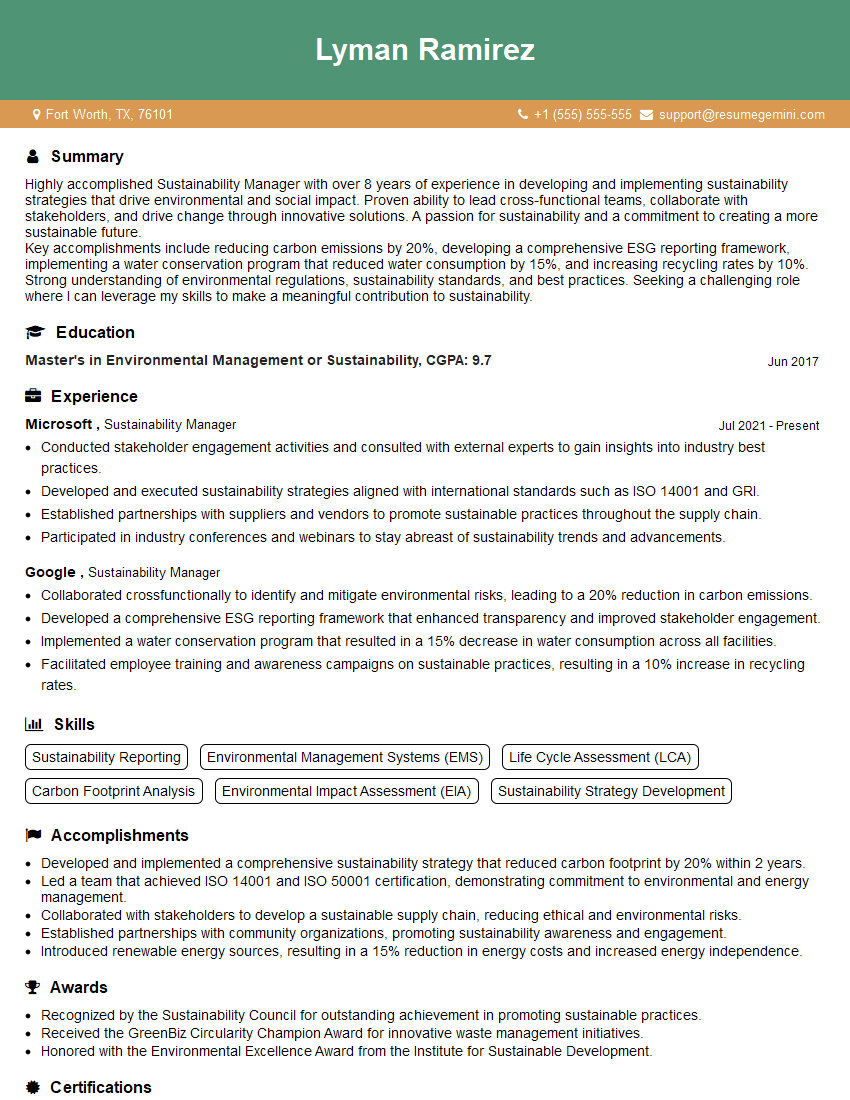
Sustainability Manager Resume Sample
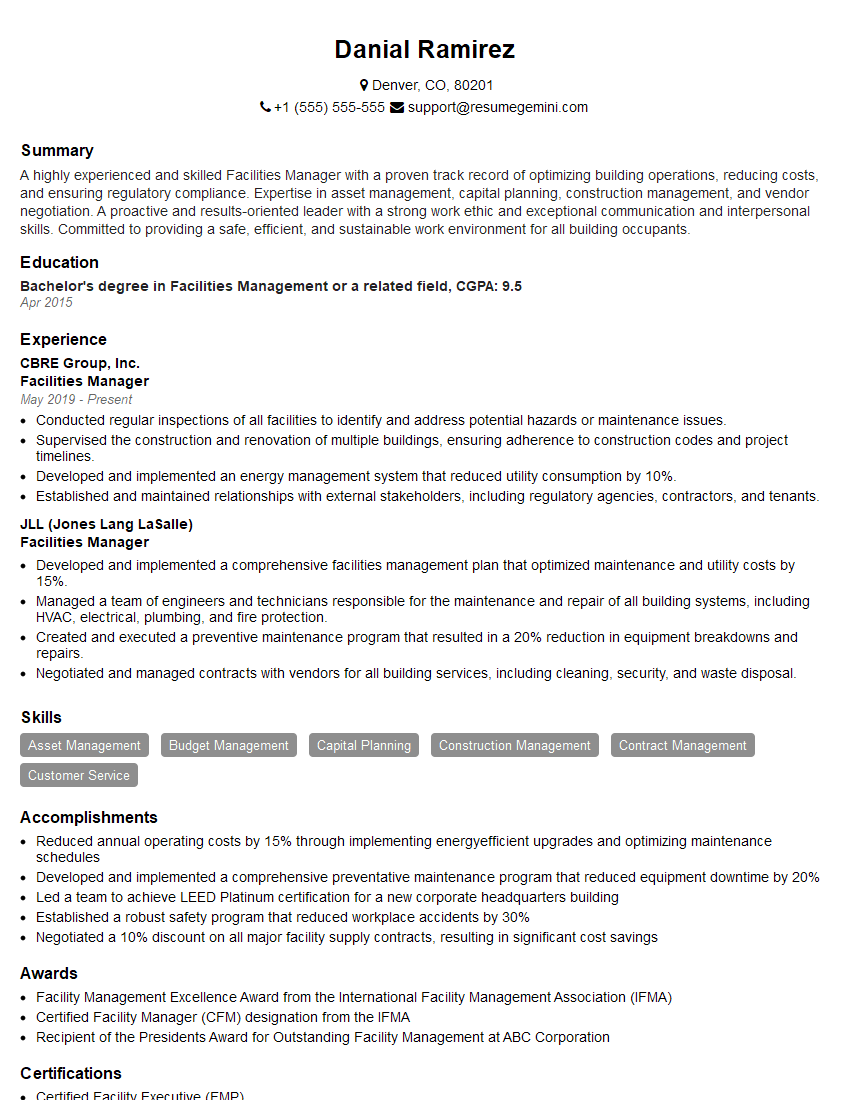
Facilities Manager Resume Sample
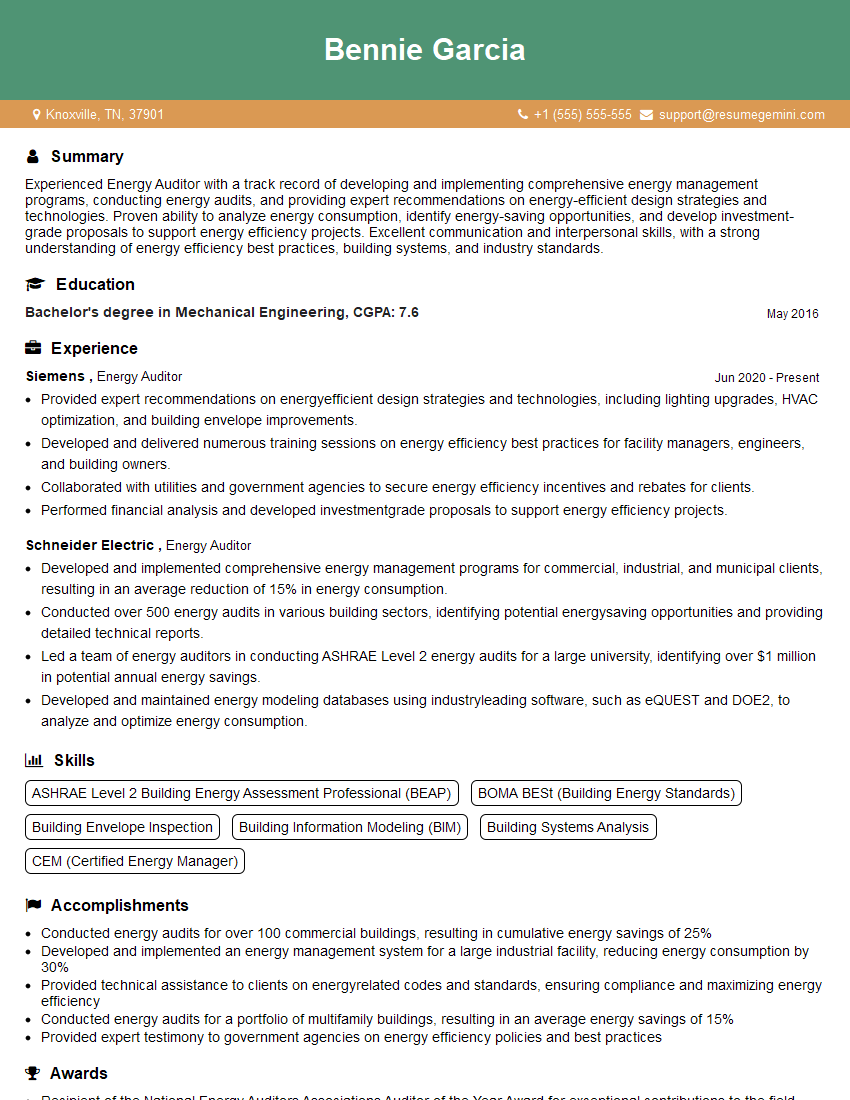
Energy Auditor Resume Sample
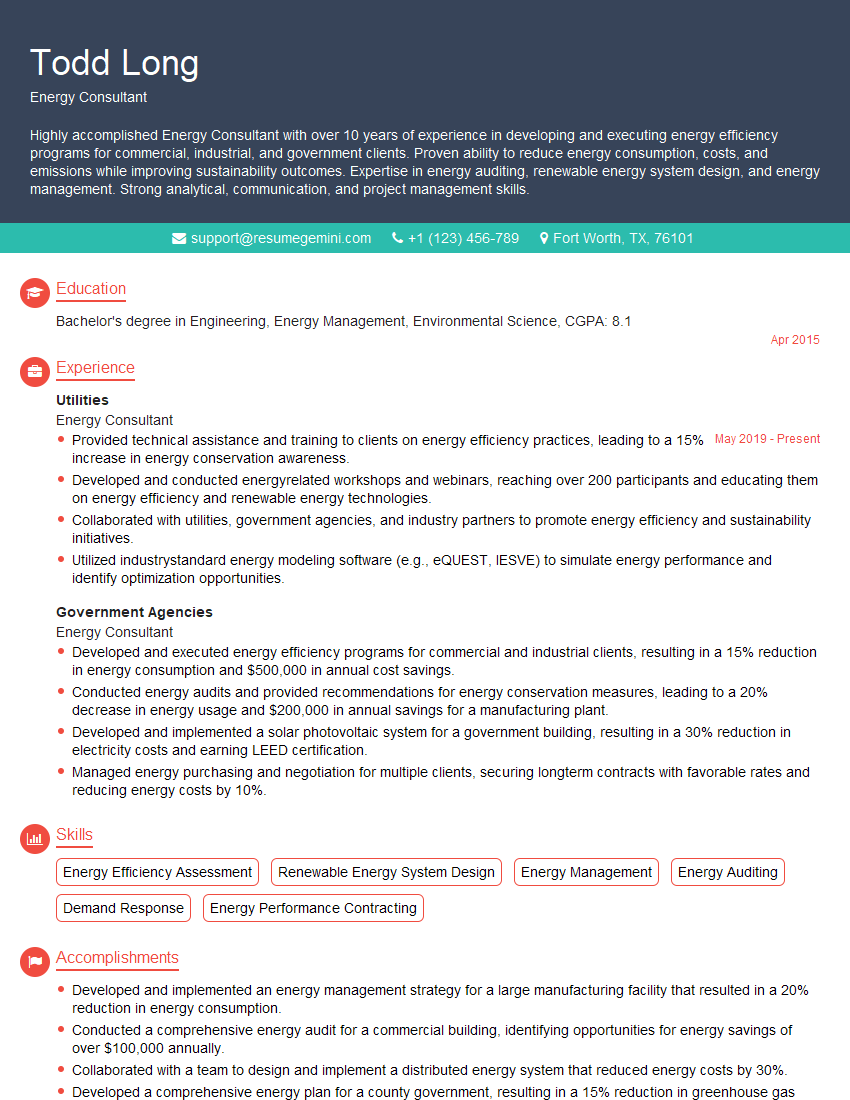
Energy Consultant Resume Sample

Sustainability Consultant Resume Sample
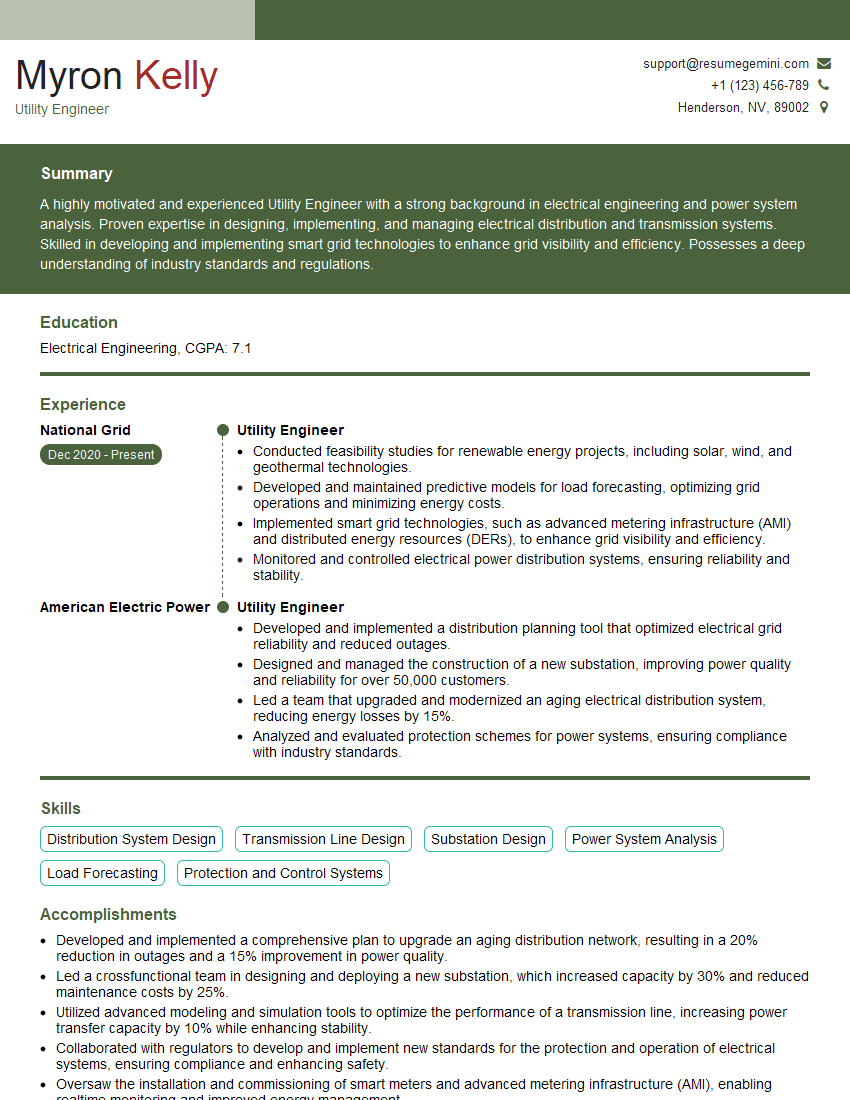
Utility Engineer Resume Sample
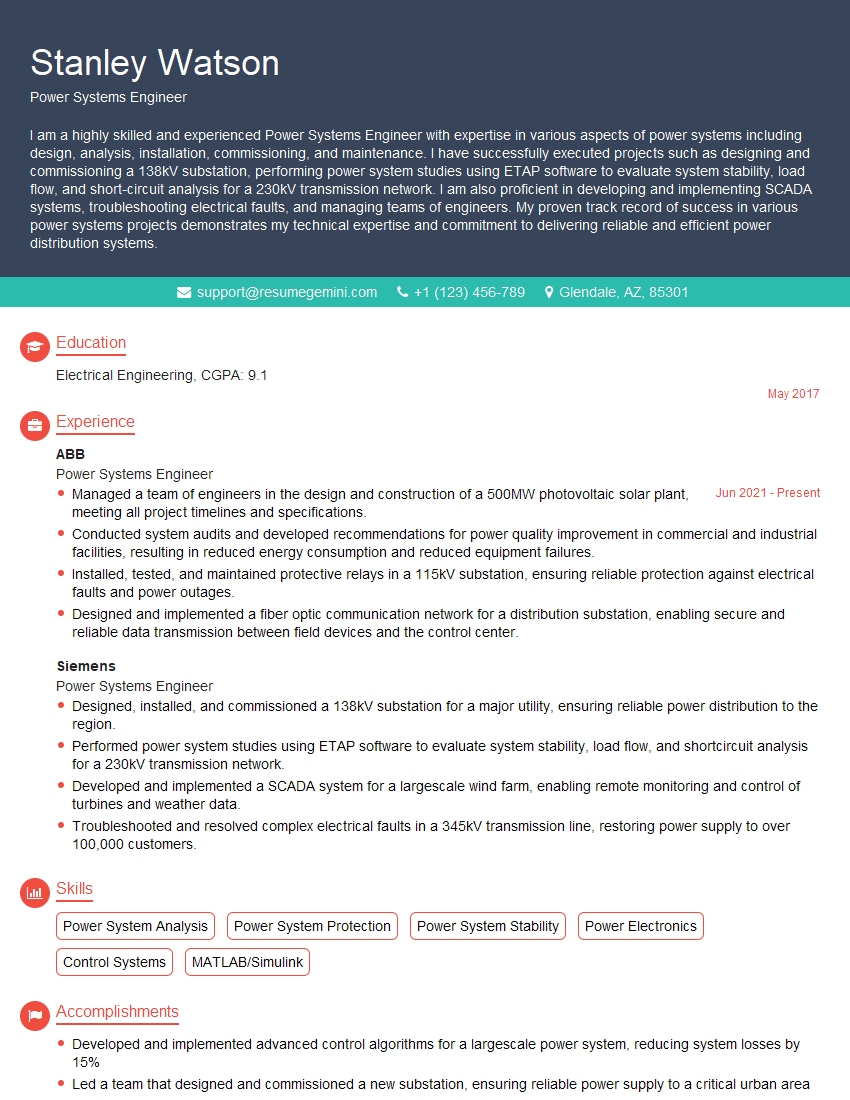
Power Systems Engineer Resume Sample
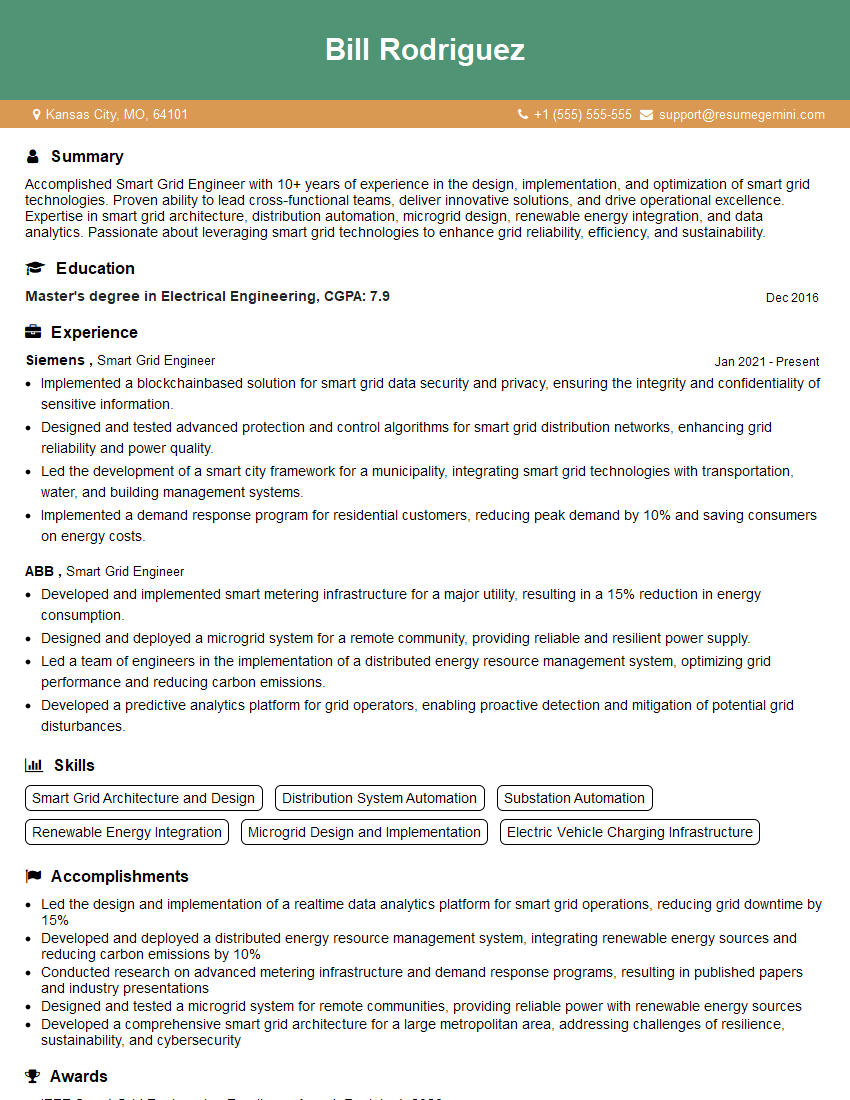
Smart Grid Engineer Resume Sample
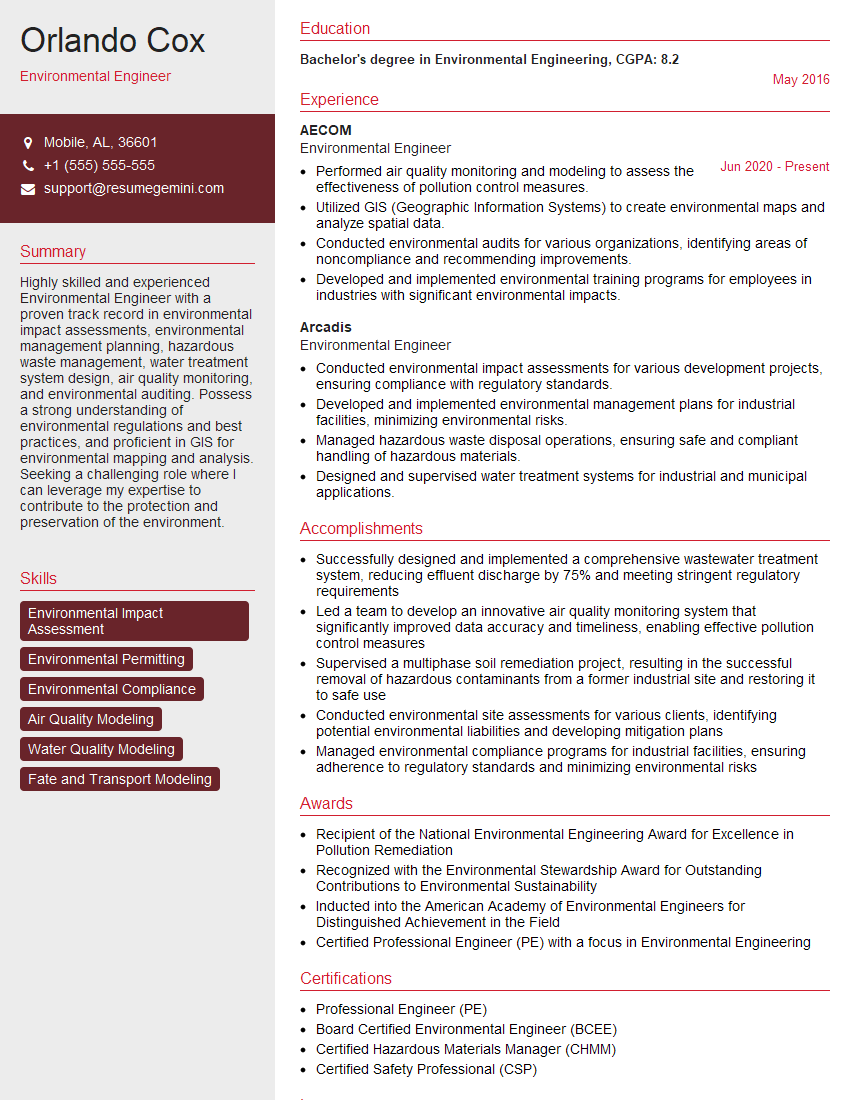
Environmental Engineer Resume Sample
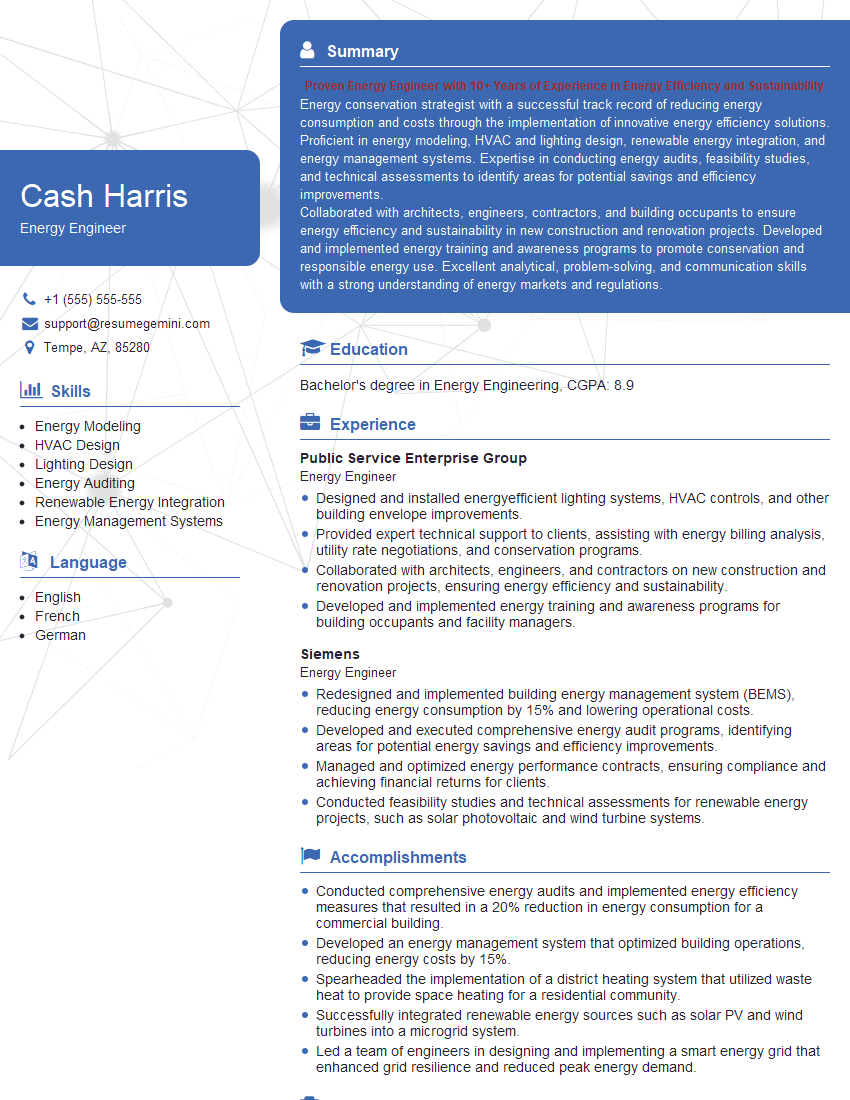
Energy Engineer Resume Sample
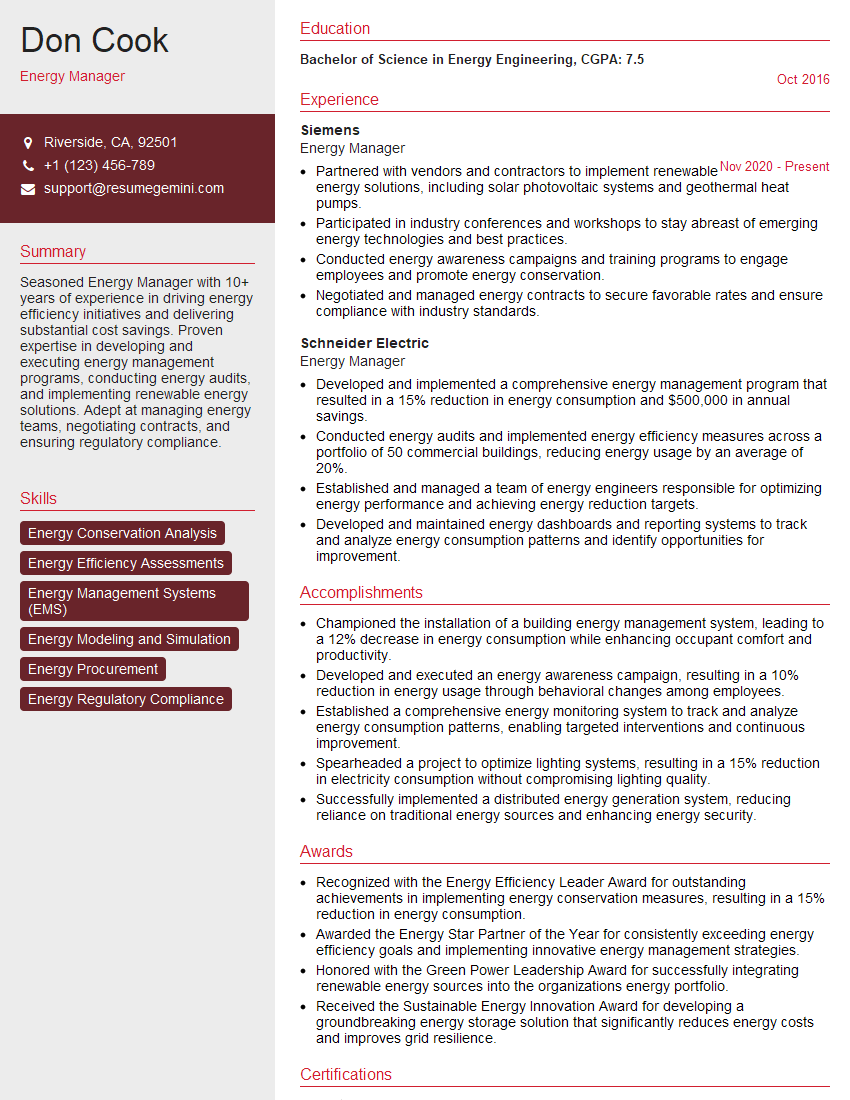
Energy Manager Resume Sample
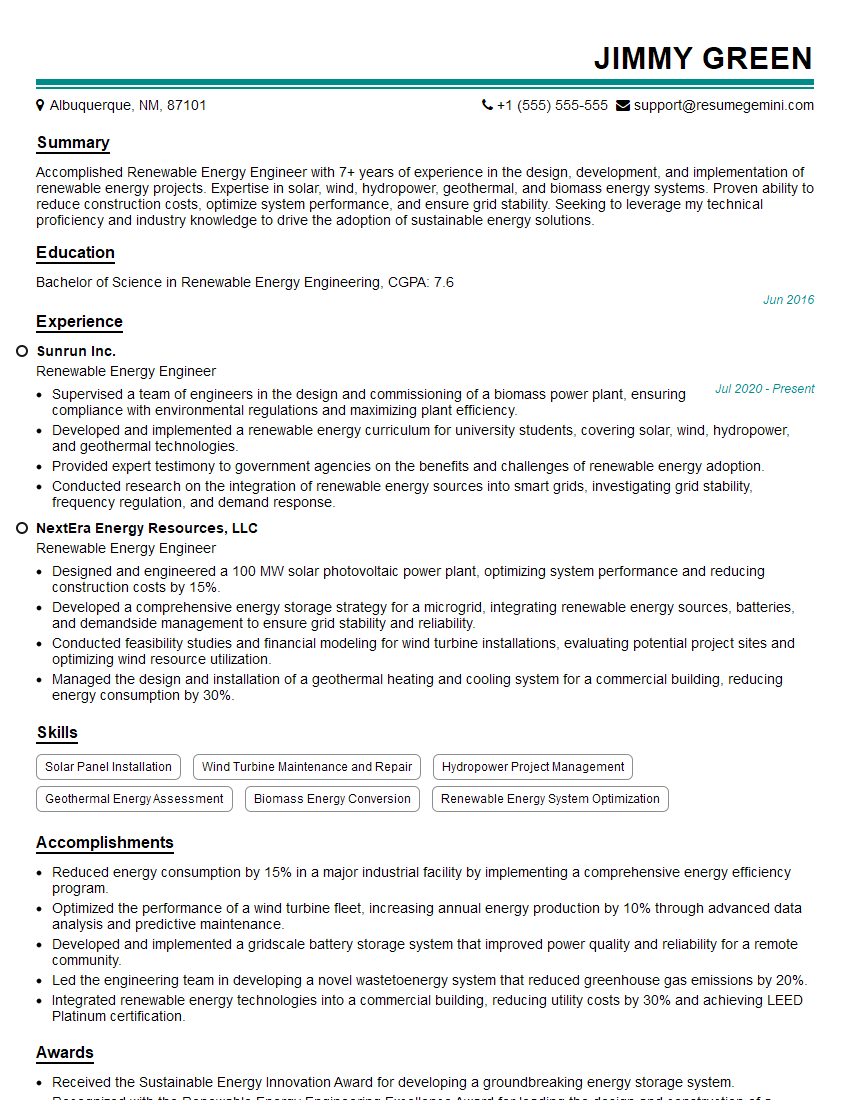
Renewable Energy Engineer Resume Sample
Explore more articles
Users Rating of Our Blogs
Share Your Experience
We value your feedback! Please rate our content and share your thoughts (optional).
What Readers Say About Our Blog
Very informative content, great job.
good