Are you ready to stand out in your next interview? Understanding and preparing for Automotive Engineering Fundamentals interview questions is a game-changer. In this blog, we’ve compiled key questions and expert advice to help you showcase your skills with confidence and precision. Let’s get started on your journey to acing the interview.
Questions Asked in Automotive Engineering Fundamentals Interview
Q 1. Explain the difference between a differential and a transmission.
While both the differential and the transmission are crucial parts of a vehicle’s drivetrain, they serve distinct purposes. The transmission is responsible for changing the gear ratio, allowing the engine to operate within its optimal speed range while the vehicle travels at varying speeds. Think of it as a gearbox that modifies the rotational speed and torque from the engine. For example, in first gear, the transmission provides high torque for acceleration, while in fifth gear, it allows for high speed at lower engine RPM. The differential, on the other hand, allows the wheels on an axle to rotate at different speeds, which is essential when cornering. When a car turns, the outer wheels travel a greater distance than the inner wheels. The differential ensures that this difference in rotational speed is accommodated without causing wheel slippage or binding. Imagine driving around a roundabout – the differential allows the inner wheel to turn slower than the outer wheel, preventing any damage or strain to the drivetrain.
Q 2. Describe the function of an engine’s cooling system.
An engine’s cooling system is vital for maintaining its optimal operating temperature. Internal combustion engines generate significant heat during operation; excessive heat can lead to engine damage, reduced efficiency, and premature wear. The cooling system works by circulating a coolant (typically a mixture of water and antifreeze) through the engine block and cylinder head. This coolant absorbs the heat generated by combustion and transfers it to a radiator, where it’s dissipated into the atmosphere via airflow or a fan. Key components include the water pump, radiator, thermostat, coolant reservoir, and hoses. The thermostat regulates the coolant flow, preventing the engine from cooling down too quickly during cold starts and ensuring sufficient cooling under high loads. A malfunctioning cooling system can lead to engine overheating, potentially causing catastrophic failure. For instance, a clogged radiator can severely restrict the flow of coolant leading to overheat.
Q 3. What are the key components of an ABS (Anti-lock Braking System)?
An Anti-lock Braking System (ABS) prevents wheel lockup during braking, maintaining steering control and reducing stopping distances. The key components are:
- Wheel speed sensors: These sensors monitor the rotational speed of each wheel.
- Electronic control unit (ECU): This ‘brain’ of the ABS processes the sensor data and controls the braking system.
- Hydraulic control unit: This unit modulates the brake pressure to individual wheels.
- Hydraulic valves: These valves, controlled by the ECU, regulate brake fluid flow to each wheel, preventing lockup.
Q 4. How does a catalytic converter reduce emissions?
A catalytic converter significantly reduces harmful emissions from an internal combustion engine by using a chemical process. It contains a catalyst, typically platinum, palladium, and rhodium, which promotes chemical reactions that convert harmful gases into less harmful substances. The main reactions are:
- Oxidation: Carbon monoxide (CO) and unburnt hydrocarbons (HC) are oxidized to carbon dioxide (CO2) and water (H2O).
- Reduction: Nitrogen oxides (NOx) are reduced to nitrogen (N2) and oxygen (O2).
Q 5. Explain the principles of vehicle stability control.
Vehicle Stability Control (VSC), also known as Electronic Stability Control (ESC), enhances vehicle stability and prevents loss of control, particularly during emergency maneuvers. It works by monitoring various parameters, including steering angle, wheel speed, and yaw rate (the rate at which the vehicle rotates around its vertical axis). If the system detects a difference between the driver’s intended direction and the vehicle’s actual path, it intervenes by selectively applying brakes to individual wheels and/or reducing engine power. Imagine driving around a corner too fast – VSC can sense the impending skid and automatically apply the brakes to specific wheels to help you regain control and maintain your trajectory. This system substantially reduces the risk of skidding and rollover accidents, improving safety for drivers and passengers.
Q 6. What is the significance of the four-stroke engine cycle?
The four-stroke engine cycle is the fundamental process by which most internal combustion engines operate. It consists of four distinct strokes: intake, compression, power, and exhaust.
- Intake: The piston moves downwards, drawing a mixture of air and fuel into the cylinder.
- Compression: The piston moves upwards, compressing the air-fuel mixture.
- Power: The compressed mixture is ignited by a spark plug, causing combustion and forcing the piston downwards.
- Exhaust: The piston moves upwards, pushing the exhaust gases out of the cylinder.
Q 7. Describe different types of fuel injection systems.
Fuel injection systems precisely meter and deliver fuel into the engine’s cylinders, replacing older carburetor systems. Several types exist:
- Single-point injection: Fuel is injected into the intake manifold, where it mixes with air before entering the cylinders.
- Multi-point injection (MPI): Fuel is injected directly into each intake port, providing more precise fuel delivery.
- Direct injection (DI): Fuel is injected directly into the combustion chamber, offering improved fuel efficiency and power.
Q 8. Explain the role of a crankshaft and connecting rod.
The crankshaft and connecting rod are crucial components in an internal combustion engine’s reciprocating mechanism, responsible for converting the linear motion of the pistons into rotational motion that powers the wheels. Imagine them as a sophisticated system of levers.
The connecting rod acts like a lever, connecting the piston (which moves up and down) to the crankshaft. As the piston moves, it pushes or pulls on the connecting rod, causing the crankshaft to rotate. This rotational motion is then transferred to the transmission and ultimately, the wheels.
The crankshaft is a precisely balanced, rotating shaft with offset cranks (or throws). Each crank is connected to a connecting rod. The offset design is key—it’s what transforms the linear piston movement into rotational movement. The crankshaft’s smooth rotation is critical for engine performance and longevity. An unbalanced or poorly designed crankshaft will lead to vibrations and premature wear.
In essence, the connecting rod translates the piston’s reciprocating motion into rotational power at the crankshaft, the engine’s power source.
Q 9. What are the different types of suspension systems and their applications?
Suspension systems are vital for ensuring a comfortable and safe ride, maintaining tire contact with the road, and handling various road conditions. They act as shock absorbers, preventing harsh impacts from transferring to the vehicle’s body.
- Independent Suspension: Each wheel moves independently of the others. This provides better handling and comfort, especially on uneven surfaces. Examples include MacPherson struts (common in front-wheel-drive cars) and double wishbone suspensions (often found in sports cars). Imagine a bicycle’s front fork – that’s a simple form of independent suspension.
- Dependent Suspension: The wheels on an axle are linked. This design is simpler and often cheaper to manufacture, but it compromises handling and ride comfort. A common example is a solid axle, often found in older trucks and SUVs. Think of a wagon with a single axle – the wheels move together.
- Air Suspension: Uses air springs instead of conventional springs or coils. This allows for adjustable ride height and damping, offering exceptional comfort and handling adaptability. Luxury cars and some heavy-duty vehicles utilize this system.
- Hydro-pneumatic Suspension: Employs hydraulic fluid to provide suspension and damping. Known for its excellent ride comfort and self-leveling capabilities. Historically prominent in Citroën vehicles.
The choice of suspension system depends heavily on the vehicle’s intended use, cost constraints, and desired handling characteristics. Sports cars prioritize handling, favoring independent suspensions, while trucks might prioritize load-carrying capacity, favoring simpler dependent systems.
Q 10. How does a CVT (Continuously Variable Transmission) work?
A Continuously Variable Transmission (CVT) offers a seemingly infinite range of gear ratios, unlike traditional transmissions with fixed gear ratios. Instead of discrete gears, a CVT uses a system of pulleys and a belt (or chain) to vary the transmission ratio smoothly.
The system typically consists of two pulleys, each with a variable diameter. The belt runs between these pulleys. By changing the diameter of the pulleys, the effective gear ratio changes continuously. A larger diameter on the input pulley and a smaller diameter on the output pulley results in a lower gear ratio (more torque, less speed), while the opposite configuration results in a higher gear ratio (less torque, more speed).
This allows the engine to operate at its most efficient RPM range across a wide spectrum of speeds. The result is improved fuel economy and smoother acceleration, though some drivers find the continuous change in engine speed less engaging than the distinct shifts of a traditional automatic transmission. Many modern CVTs use sophisticated electronic controls to simulate gear changes, providing a more traditional driving experience.
Q 11. Explain the concept of torque and horsepower.
Torque and horsepower are both crucial measures of an engine’s performance, but they represent different aspects of its capabilities.
Torque is a measure of rotational force. Think of it as the engine’s twisting power – its ability to turn a shaft. Higher torque means better acceleration from a standstill and better ability to pull heavy loads. It’s often measured in pound-feet (lb-ft) or Newton-meters (Nm).
Horsepower is a measure of the rate at which work is done. It considers both torque and engine speed. A higher horsepower rating usually indicates a higher top speed potential and faster acceleration at higher speeds. It’s a combination of torque and speed.
The relationship between the two can be summarized as: Horsepower = (Torque x RPM) / 5252 (for units in lb-ft and RPM). An engine with high torque will accelerate quickly from a stop, while an engine with high horsepower will reach higher speeds.
Think of it this way: a truck needs high torque to pull heavy loads, while a sports car might need high horsepower to achieve high speeds.
Q 12. Describe the different types of brakes commonly used in automobiles.
Several brake types are used in automobiles, each with its strengths and weaknesses:
- Disc Brakes: These are the most common type in modern vehicles. They use calipers to squeeze brake pads against a rotating disc, creating friction that slows the wheel. Disc brakes offer excellent stopping power, good fade resistance (ability to maintain stopping power under heavy use), and relatively easy maintenance.
- Drum Brakes: Older vehicles often used drum brakes, where brake shoes press against a rotating drum. While simpler and cheaper to manufacture, they are less effective than disc brakes, particularly in wet conditions, and are more prone to brake fade.
- Anti-lock Braking System (ABS): This isn’t a brake type itself but a safety system that prevents wheel lockup during braking. ABS allows the driver to maintain steering control during hard braking, improving stability and reducing stopping distance.
- Electronic Stability Control (ESC): Another safety system that works in conjunction with the brakes and other systems to enhance vehicle stability and prevent skidding.
Many modern vehicles use a combination of disc brakes on the front wheels (for better handling) and disc or drum brakes on the rear wheels. The choice depends on the vehicle’s design and cost considerations.
Q 13. Explain the function of an alternator and starter motor.
The alternator and starter motor are essential electrical components in a vehicle.
The alternator is a generator that produces electrical power to charge the battery and supply power to the vehicle’s electrical systems while the engine is running. It’s essentially a small power plant for the car, converting mechanical energy from the engine’s rotation into electrical energy.
The starter motor is an electric motor that cranks the engine to start it. It’s a high-torque motor that briefly provides the rotational force needed to turn the engine over until it ignites and begins running on its own power. Once the engine starts, the starter motor disengages.
These two components work together to keep the vehicle’s electrical systems operational. The alternator maintains the battery charge, while the starter motor provides the initial power needed to start the engine.
Q 14. What are the key considerations for designing a lightweight vehicle?
Designing a lightweight vehicle is crucial for improving fuel efficiency, handling, acceleration, and overall performance. Several key considerations are involved:
- Material Selection: Using lightweight yet strong materials is paramount. Aluminum alloys, high-strength steels, carbon fiber composites, and magnesium alloys are commonly used, each offering unique strength-to-weight ratios and cost implications.
- Design Optimization: Employing advanced computer-aided design (CAD) and simulation tools to optimize the vehicle’s structure and reduce unnecessary weight. This can involve optimizing component shapes, reducing material thickness where possible, and improving manufacturing processes.
- Component Weight Reduction: Focusing on reducing the weight of individual components. This might involve using lightweight materials, hollowing out components where possible, or adopting more efficient designs.
- Manufacturing Processes: Employing advanced manufacturing techniques such as casting, forging, and extrusion to produce components with optimized shapes and minimum material waste.
- Subsystem Integration: Designing components and subsystems to work efficiently together, reducing redundancies and unnecessary weight.
The optimal strategy often involves a combination of these factors, carefully balancing material cost, manufacturing feasibility, and performance targets. A lightweight design is a complex engineering challenge, requiring a holistic approach that considers all aspects of the vehicle’s design and manufacturing.
Q 15. Describe different types of engine management systems.
Engine management systems (EMS) are sophisticated electronic control units (ECUs) that optimize engine performance, fuel efficiency, and emissions. They control various aspects of the engine’s operation, constantly adjusting parameters to achieve optimal performance under different driving conditions. Different types exist, ranging from simple systems to highly complex ones found in modern vehicles.
- Carbureted Systems (Older Technology): These rely on a carburetor to mix air and fuel, with limited electronic control. Think of older classic cars – these are very basic and offer minimal control over engine parameters.
- Electronic Fuel Injection (EFI): These systems use sensors to measure parameters like air flow, engine speed, and throttle position to precisely control fuel injection. This provides better fuel efficiency and reduced emissions compared to carburetors. Most modern vehicles utilize some form of EFI.
- Sequential Fuel Injection: An advanced form of EFI where each cylinder receives fuel precisely timed for optimal combustion. This improves efficiency and reduces emissions further.
- Engine Control Units (ECUs) with Advanced Algorithms: Modern ECUs use complex algorithms and multiple sensors (like knock sensors, oxygen sensors, and mass airflow sensors) to continually optimize fuel delivery, ignition timing, and other engine parameters. They can adapt to varying conditions, including altitude and fuel quality. Examples include systems with closed-loop feedback control continuously monitoring and adjusting fuel/air mixture for optimal emissions.
- Direct Injection Systems: Fuel is injected directly into the combustion chamber, rather than into the intake manifold. This provides more precise fuel control, leading to improved efficiency and power. Both gasoline and diesel engines can employ direct injection.
The choice of EMS depends on factors such as engine type, desired performance, emissions regulations, and cost.
Career Expert Tips:
- Ace those interviews! Prepare effectively by reviewing the Top 50 Most Common Interview Questions on ResumeGemini.
- Navigate your job search with confidence! Explore a wide range of Career Tips on ResumeGemini. Learn about common challenges and recommendations to overcome them.
- Craft the perfect resume! Master the Art of Resume Writing with ResumeGemini’s guide. Showcase your unique qualifications and achievements effectively.
- Don’t miss out on holiday savings! Build your dream resume with ResumeGemini’s ATS optimized templates.
Q 16. What are the challenges related to electric vehicle battery technology?
Electric vehicle (EV) battery technology faces several significant challenges, hindering widespread adoption. These challenges encompass energy density, lifespan, safety, charging infrastructure, and cost.
- Energy Density: The amount of energy a battery can store relative to its weight and volume is crucial for driving range. Current EV batteries lack the energy density needed for long-range travel comparable to gasoline vehicles.
- Lifespan and Degradation: EV batteries degrade over time, losing capacity and performance. Factors like temperature, charging cycles, and depth of discharge affect degradation rate. Extending battery life while maintaining performance is a major focus of research.
- Safety: Lithium-ion batteries are prone to thermal runaway, a dangerous condition leading to fire or explosion. Ensuring battery safety through robust design, thermal management, and safety systems is critical.
- Charging Infrastructure: The availability of reliable and fast-charging infrastructure is essential for widespread EV adoption. Currently, the charging infrastructure lags behind the demand, especially in many parts of the world.
- Cost: Battery production costs remain relatively high, significantly influencing the overall cost of EVs. Reducing production costs through economies of scale and technological advancements is crucial for mass-market appeal.
- Raw Material Availability and Sustainability: The production of EV batteries requires significant amounts of rare earth minerals, raising concerns about supply chain security and environmental sustainability.
Addressing these challenges requires innovative approaches in materials science, battery chemistry, thermal management, and manufacturing processes.
Q 17. Explain the principles of aerodynamics and their impact on fuel efficiency.
Aerodynamics is the study of how air flows around objects. In automotive engineering, it plays a crucial role in fuel efficiency, vehicle stability, and high-speed performance. The principle is simple: a streamlined shape reduces drag, allowing the vehicle to move more efficiently through the air.
Principles: Drag is the force resisting the vehicle’s motion through the air. It’s composed of two main components: pressure drag (caused by air pressure differences around the vehicle) and friction drag (caused by air friction on the vehicle’s surface). Lift is another aerodynamic force that can reduce tire contact with the road at high speeds. Minimizing drag and managing lift is key to enhancing performance.
Impact on Fuel Efficiency: Reducing aerodynamic drag significantly improves fuel efficiency. A more aerodynamic vehicle requires less power to overcome air resistance, resulting in lower fuel consumption. This is achieved through features like:
- Streamlined Body Shape: A smooth, teardrop-like shape minimizes air disruption.
- Underbody Aerodynamics: Reducing air flow under the vehicle reduces pressure drag.
- Spoilers and Air Dams: These manage airflow to reduce lift and drag at high speeds.
Example: The difference in fuel economy between a boxy SUV and a sleek sedan highlights the impact of aerodynamics. The sedan, with its lower drag coefficient, will almost always have better fuel efficiency at highway speeds.
Q 18. Describe different methods for reducing vehicle noise and vibration.
Reducing noise and vibration (NVH) in vehicles is crucial for enhancing passenger comfort and perceived quality. Various methods are employed, addressing both the source and transmission paths of noise and vibration.
- Source Control: This focuses on reducing noise and vibration at their origin. Examples include:
- Engine Mounting: Using flexible engine mounts to isolate engine vibrations from the chassis.
- Noise-dampening Materials: Using materials like sound-absorbing foams and acoustic barriers in the engine compartment to reduce noise propagation.
- Improved Gear Design: Optimizing gear teeth profiles to reduce noise generation.
- Path Control: This involves minimizing the transmission of noise and vibration through the vehicle’s structure. Methods include:
- Damping Materials: Applying damping materials to vehicle panels to absorb vibration energy.
- Structural Stiffening: Strengthening the vehicle body to reduce vibrations.
- Acoustic Insulation: Using sound-insulating materials (e.g., thicker glass, specialized carpet) to block noise transmission.
- Absorption and Cancellation:
- Active Noise Cancellation: Using microphones to detect noise and generate opposing sound waves to cancel it out.
- Sound Absorption: Utilizing porous materials to absorb sound energy.
The specific methods used depend on the frequency and intensity of the noise and vibration sources, as well as the target NVH performance levels.
Q 19. What are the safety regulations and standards relevant to automotive design?
Automotive safety regulations and standards are critical for ensuring vehicle safety and protecting occupants. These regulations vary globally, but common themes include crashworthiness, braking performance, emission controls, and occupant protection.
- Crashworthiness Standards: Regulations dictate minimum performance requirements in crash tests (e.g., frontal impact, side impact, rollover). These tests assess the structural integrity of the vehicle and the protection offered to occupants. Examples include FMVSS (Federal Motor Vehicle Safety Standards) in the US and ECE Regulations in Europe.
- Braking Performance Standards: Regulations specify minimum braking distances and stopping power, ensuring vehicles can stop safely under various conditions. This involves testing braking system performance and stability.
- Emission Standards: Regulations limit the amount of pollutants vehicles can emit, contributing to cleaner air. Examples include EURO standards in Europe and CAFE (Corporate Average Fuel Economy) standards in the US.
- Occupant Protection Standards: These standards mandate the use of safety features like airbags, seatbelts, and child safety restraints. Regulations also specify requirements for seat strength, head restraint design, and energy absorption during a crash.
- Lighting Standards: Regulations set standards for headlight intensity, visibility, and location, ensuring proper road illumination.
- Electronic Stability Control (ESC): Many countries now mandate ESC, which helps prevent loss of control by automatically adjusting braking and engine torque.
Compliance with these regulations is mandatory for vehicle manufacturers, and failure to meet standards can lead to penalties and recalls. These standards continuously evolve to incorporate advancements in safety technology and reflect changing safety priorities.
Q 20. Explain the concept of vehicle dynamics and its impact on handling.
Vehicle dynamics is the study of a vehicle’s motion and how it responds to driver inputs and external forces. Understanding vehicle dynamics is essential for designing vehicles with good handling, stability, and ride comfort. Key aspects include:
- Steering Response: How quickly and accurately the vehicle responds to steering wheel input.
- Stability: The vehicle’s ability to maintain its intended path, especially during maneuvers.
- Handling: A combination of factors that contribute to a vehicle’s maneuverability and responsiveness, including steering feel, grip, and balance.
- Ride Comfort: The vehicle’s ability to absorb road irregularities and provide a smooth ride for passengers.
- Braking Performance: The ability of the vehicle to decelerate safely and effectively under various conditions.
Impact on Handling: Vehicle dynamics significantly impacts handling. Factors like suspension geometry, tire characteristics, weight distribution, and center of gravity influence a vehicle’s handling characteristics. A well-balanced vehicle with proper suspension tuning and tire grip will offer responsive and predictable handling, while a poorly designed vehicle may exhibit unpredictable behavior, making it unsafe to drive. For instance, a vehicle with a high center of gravity is more prone to rollover, while a vehicle with poor weight distribution may understeer or oversteer unexpectedly.
Example: A sports car is designed with a low center of gravity and precise steering response to achieve superior handling, while a family SUV prioritizes ride comfort and stability over sharp handling.
Q 21. How are engine emissions measured and regulated?
Engine emissions are measured and regulated to control air pollution. The process involves measuring the concentration of various pollutants in the exhaust gases and comparing them to regulatory limits.
Measurement: Emissions are measured using specialized equipment like dynamometers and emission analyzers. The vehicle is operated under standardized test conditions (speed, load, temperature) to ensure consistent and comparable results. Analyzers measure the concentration of pollutants like:
- Carbon Monoxide (CO): A toxic gas produced by incomplete combustion.
- Hydrocarbons (HC): Unburnt fuel components.
- Nitrogen Oxides (NOx): Gases formed at high combustion temperatures.
- Particulate Matter (PM): Fine soot particles, especially relevant for diesel engines.
- Carbon Dioxide (CO2): A greenhouse gas contributing to climate change.
Regulation: Government agencies set emission standards specifying maximum allowable limits for each pollutant. These standards vary by region and vehicle type. Manufacturers must design engines and emission control systems that meet these standards. Testing and certification procedures are in place to verify compliance. Non-compliance can result in fines and penalties.
Emission Control Systems: Various technologies are employed to reduce emissions, including:
- Catalytic Converters: Convert harmful gases into less harmful substances.
- Diesel Particulate Filters (DPFs): Trap soot particles from diesel exhaust.
- Selective Catalytic Reduction (SCR): Reduces NOx emissions using a reducing agent.
- Exhaust Gas Recirculation (EGR): Reduces NOx formation by recirculating exhaust gases back into the engine.
Continuous monitoring and improvements in emission control technology are essential for reducing vehicle emissions and protecting air quality.
Q 22. What is the role of sensors and actuators in an automotive system?
Sensors and actuators are the eyes and hands of an automotive system, respectively. Sensors constantly monitor various parameters within the vehicle, converting physical quantities into electrical signals. Actuators, on the other hand, receive these signals and perform actions to control the system. They act as the effectors, converting electrical signals into mechanical actions.
- Sensors: Examples include oxygen sensors (measuring oxygen in exhaust gases), crankshaft position sensors (determining engine speed and position), wheel speed sensors (for ABS and traction control), and temperature sensors (for engine coolant and oil).
- Actuators: Examples include fuel injectors (controlling fuel delivery), throttle body (controlling air intake), brake calipers (applying braking force), and power steering actuators.
Think of a cruise control system: speed sensors constantly monitor the vehicle’s speed, and this information is fed to an actuator, which adjusts the throttle to maintain the set speed. Without this sensor-actuator interplay, automatic functions wouldn’t be possible.
Q 23. Describe your experience with automotive simulation software (e.g., MATLAB, Simulink).
I have extensive experience using MATLAB/Simulink for automotive system modeling and simulation. I’ve used it to create models of engine control systems, designing control algorithms to optimize fuel efficiency and emissions. I’ve also used it for developing and testing advanced driver-assistance systems (ADAS) including various simulations for autonomous driving scenarios.
For example, in one project, I developed a Simulink model of a hybrid powertrain to simulate different driving cycles and optimize energy management strategies. This involved modeling the engine, electric motor, battery, and power electronics. The simulations helped in identifying potential issues and optimizing parameters for improved performance and efficiency before physical prototyping. I am also proficient in using the model verification and validation tools available within Simulink to ensure the accuracy and reliability of my models.
%Example Simulink code snippet (Illustrative): %Defining a transfer function sys = tf([1],[1 2 1]); %Simulating the system response step(sys);Q 24. Explain the process of engine calibration and its importance.
Engine calibration is the process of adjusting various parameters within an engine’s control system to optimize its performance and emissions across a range of operating conditions. It’s a crucial step in ensuring the engine meets regulatory requirements and delivers the desired power output, fuel efficiency, and driveability.
The process typically involves using specialized calibration tools and software to modify parameters such as fuel injection timing, air-fuel ratio, ignition timing, and valve timing. These adjustments are based on extensive testing and data analysis, typically involving engine dynamometer testing and on-road driving.
The importance of engine calibration lies in its impact on several key areas:
- Emissions Control: Proper calibration is essential for meeting stringent emission regulations.
- Fuel Efficiency: Optimized calibration can significantly improve fuel economy.
- Performance: Calibration affects engine power, torque, and responsiveness.
- Driveability: Smooth operation, minimal vibrations, and quick response are all affected by calibration.
For instance, a poorly calibrated engine might produce excessive emissions, have poor fuel economy, and exhibit rough idling or hesitation.
Q 25. What is your understanding of lean manufacturing principles in the automotive industry?
Lean manufacturing principles, such as Just-in-Time (JIT) inventory management, Kaizen (continuous improvement), and value stream mapping, are critical for efficiency and competitiveness in the automotive industry. These principles aim to eliminate waste in all forms – be it excess inventory, unnecessary steps in production, or defects in the final product.
In a JIT system, parts and materials arrive at the assembly line precisely when needed, minimizing storage costs and the risk of obsolescence. Kaizen involves continuous incremental improvements across all areas of the manufacturing process, fostering a culture of innovation and problem-solving. Value stream mapping helps identify and eliminate non-value-added steps in the production process, streamlining operations and increasing efficiency.
Implementing these principles can lead to reduced lead times, lower inventory holding costs, improved quality, and increased customer satisfaction. Think of it like a well-oiled machine – every part works smoothly and efficiently, leading to a high-quality final product.
Q 26. How would you approach troubleshooting a malfunctioning engine system?
Troubleshooting a malfunctioning engine system requires a systematic and methodical approach. I would begin by:
- Gathering Information: What are the symptoms? (e.g., rough idling, lack of power, unusual noises, warning lights). When did the problem start? What were the conditions at the time?
- Diagnostic Tools: Using an OBD-II (On-Board Diagnostics) scanner to retrieve diagnostic trouble codes (DTCs) from the engine control unit (ECU). These codes provide valuable clues about potential problems.
- Visual Inspection: Carefully examining the engine compartment for any visible damage, leaks, loose connections, or unusual wear and tear.
- Data Acquisition: If necessary, using more advanced diagnostic tools to analyze sensor data, fuel pressure, and other key parameters.
- Systematic Testing: Based on the information gathered, I would systematically test components that are likely suspects (e.g., sensors, actuators, fuel system, ignition system).
- Component Replacement/Repair: Once the faulty component is identified, it would be repaired or replaced.
- Verification: After repair, I would conduct thorough testing to ensure the problem has been resolved.
Throughout the process, detailed documentation would be maintained, including the symptoms, diagnostic steps, findings, and corrective actions. This ensures traceability and helps in future troubleshooting.
Q 27. Describe different types of testing methodologies used in automotive engineering.
Automotive engineering employs various testing methodologies to ensure safety, reliability, and performance. These can be broadly classified as:
- Component Testing: Individual components (e.g., sensors, actuators, modules) are tested to verify their functionality and meet specifications. This often involves environmental testing (temperature, humidity, vibration) and endurance testing.
- System Testing: Integrated systems (e.g., engine control system, braking system, ADAS) are tested to ensure that all components work together seamlessly. This can involve simulations and real-world testing.
- Vehicle Testing: Complete vehicles are subjected to rigorous testing, including performance evaluations, durability testing, crash testing, and emissions testing.
- Validation & Verification (V&V): Formal methods are used to confirm that the design, development, and manufacturing processes meet specified requirements. This includes documentation review, inspections, audits, and traceability matrices.
Examples include bench testing of fuel injectors, simulated crash tests using finite element analysis (FEA) software, and real-world road tests for vehicle dynamics and handling. Each type of test plays a critical role in ensuring the quality and safety of automotive products.
Q 28. What is your understanding of current trends in automotive technology?
The automotive industry is undergoing a rapid transformation, driven by several key trends:
- Electrification: The shift towards electric vehicles (EVs) and hybrid electric vehicles (HEVs) is reshaping the industry, requiring expertise in battery technology, electric powertrains, and charging infrastructure.
- Autonomous Driving: The development of self-driving cars is progressing rapidly, requiring advancements in sensor technology, artificial intelligence, and software engineering.
- Connectivity: Vehicles are becoming increasingly connected, with features like in-car entertainment systems, remote diagnostics, and over-the-air updates.
- Sustainability: There is growing focus on reducing the environmental impact of vehicles, through the use of lightweight materials, efficient powertrains, and renewable energy sources.
- Advanced Materials: The use of advanced materials like carbon fiber and composites is increasing to improve vehicle performance, fuel efficiency, and safety.
These trends present both challenges and opportunities for automotive engineers, requiring a continuous learning process and adaptation to new technologies and methodologies.
Key Topics to Learn for Automotive Engineering Fundamentals Interview
- Internal Combustion Engines (ICE): Understanding engine cycles (Otto, Diesel), fuel systems (injection, carburation), emission control systems, and engine performance parameters. Practical application: Analyzing engine efficiency and identifying potential areas for improvement.
- Vehicle Dynamics and Control: Exploring topics like steering, braking, suspension systems, and vehicle stability. Practical application: Designing a suspension system for optimal handling and ride comfort.
- Powertrain Systems: Knowledge of transmissions (manual, automatic, CVT), drivetrain components (axles, differentials), and their integration into the vehicle. Practical application: Evaluating the efficiency and performance of different transmission types.
- Automotive Electronics and Controls: Familiarity with Electronic Control Units (ECUs), sensors, actuators, and communication protocols (CAN bus). Practical application: Troubleshooting issues within an automotive electronic system.
- Vehicle Safety Systems: Understanding active and passive safety features such as airbags, anti-lock braking systems (ABS), electronic stability control (ESC), and advanced driver-assistance systems (ADAS). Practical application: Evaluating the effectiveness of different safety systems in various driving scenarios.
- Materials Science in Automotive Engineering: Knowledge of materials used in vehicle construction (steels, aluminum alloys, composites) and their properties. Practical application: Selecting appropriate materials for specific components based on strength, weight, and cost considerations.
- Manufacturing Processes: Understanding common manufacturing techniques used in automotive production, such as casting, forging, machining, and welding. Practical application: Optimizing manufacturing processes for improved efficiency and quality.
Next Steps
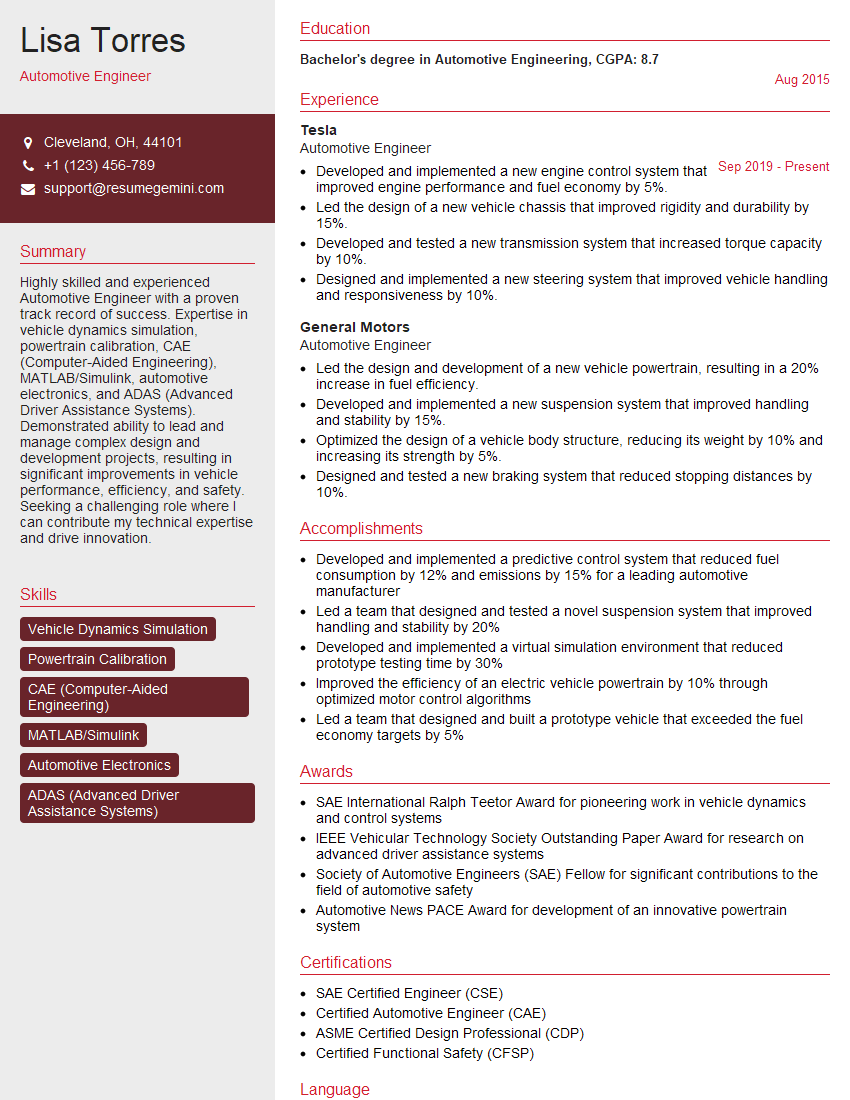
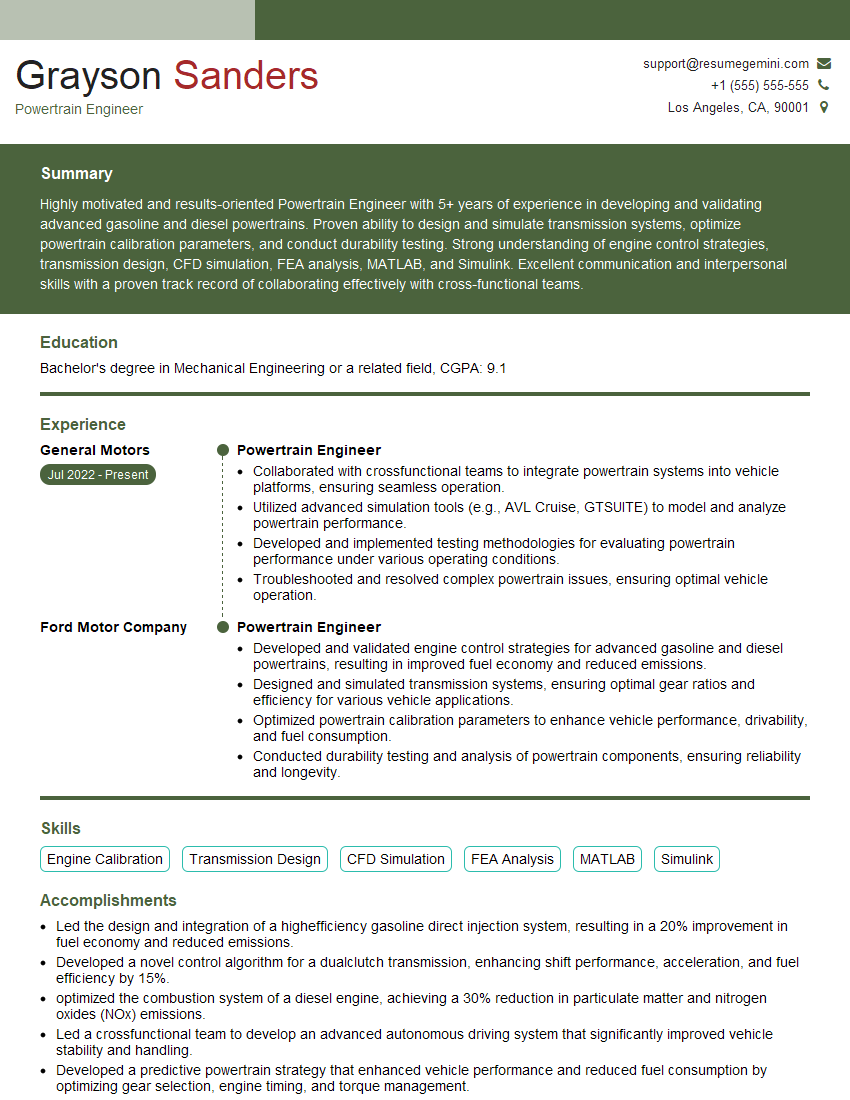
Mastering Automotive Engineering Fundamentals is crucial for a successful and rewarding career in this dynamic field. A strong understanding of these core principles will set you apart from other candidates and significantly increase your job prospects. To further enhance your application, crafting an ATS-friendly resume is essential. This ensures your qualifications are effectively identified by applicant tracking systems used by many employers. We highly recommend using ResumeGemini to build a professional and impactful resume. ResumeGemini provides a user-friendly platform and offers examples of resumes tailored to Automotive Engineering Fundamentals to help guide you. Invest time in creating a compelling resume – it’s your first impression with potential employers.

Explore more articles
Users Rating of Our Blogs
Share Your Experience
We value your feedback! Please rate our content and share your thoughts (optional).
What Readers Say About Our Blog
Very informative content, great job.
good