Feeling uncertain about what to expect in your upcoming interview? We’ve got you covered! This blog highlights the most important Background in Product Development interview questions and provides actionable advice to help you stand out as the ideal candidate. Let’s pave the way for your success.
Questions Asked in Background in Product Development Interview
Q 1. Describe your experience in defining and prioritizing product features.
Defining and prioritizing product features is a crucial aspect of product development, balancing user needs with business goals and technical feasibility. It’s like choosing the ingredients for a recipe – you need the right mix to create a delicious and successful product.
My process typically involves:
- Understanding User Needs: This starts with thorough market research, user interviews, surveys, and analyzing existing user data to identify pain points and unmet needs. For example, in developing a new project management software, I’d conduct user interviews with current project managers to understand their workflows and frustrations with existing tools.
- Defining Features: Based on user needs and research, I create a detailed list of potential features, documenting their purpose, benefits, and potential impact. Each feature is described using a user story format (e.g., “As a project manager, I want to be able to assign tasks to team members so that I can track progress efficiently”).
- Prioritization: This is where frameworks like MoSCoW (Must have, Should have, Could have, Won’t have) or RICE (Reach, Impact, Confidence, Effort) come into play. I use these to score features based on factors like business value, user impact, technical feasibility, and risk. High-scoring features get prioritized for development.
- Roadmapping: Finally, the prioritized features are incorporated into a product roadmap, outlining the release schedule and dependencies. This helps to ensure a focused and iterative development process.
Throughout the entire process, I ensure close collaboration with stakeholders – including engineering, marketing, and sales – to ensure alignment and avoid scope creep.
Q 2. How do you measure the success of a product launch?
Measuring the success of a product launch goes beyond just looking at download numbers or initial sales. It requires a holistic approach that considers various key performance indicators (KPIs) aligned with the product’s goals. Think of it as assessing whether your ‘recipe’ is actually delicious and fulfilling its intended purpose.
Key metrics I typically monitor include:
- Acquisition Metrics: Number of downloads, registrations, or users acquired. This tells us about the effectiveness of our marketing and outreach efforts.
- Engagement Metrics: Daily/monthly active users, session duration, feature usage, and user retention rates. These metrics indicate how engaged users are with the product and its features.
- Conversion Metrics: Conversion rates for key actions (e.g., free trial to paid subscription, purchase completion). These show how well the product is driving desired user behavior.
- Customer Satisfaction: Net Promoter Score (NPS), customer reviews, and feedback surveys help gauge user satisfaction and identify areas for improvement.
- Business Metrics: Revenue generated, customer lifetime value (CLTV), and return on investment (ROI) are crucial for demonstrating the product’s overall business success.
By tracking these metrics over time and comparing them against pre-defined goals, I can gain a clear understanding of the product’s performance and identify areas requiring attention.
Q 3. Explain your process for gathering and analyzing user feedback.
Gathering and analyzing user feedback is an ongoing iterative process that’s vital for continuous product improvement. It’s like constantly tasting your recipe to make sure it’s getting better.
My process involves:
- Multiple Channels: I utilize various methods to gather feedback, including in-app surveys, feedback forms, user interviews, focus groups, social media monitoring, and analyzing app store reviews. Each channel provides unique insights.
- Qualitative and Quantitative Data: I collect both qualitative (open-ended feedback, opinions) and quantitative (numerical data, usage statistics) data to gain a comprehensive understanding of user experiences.
- Data Analysis: This involves identifying patterns and trends in the feedback. For example, if many users report a specific bug or express dissatisfaction with a particular feature, it’s a clear signal to prioritize addressing those issues.
- Prioritization and Action: Not all feedback is created equal. I prioritize feedback based on its impact, frequency, and feasibility of implementation. This involves triaging feedback and creating actionable items for the development team.
- Communication: It’s important to communicate back to users, letting them know their feedback has been heard and what actions are being taken (even if it’s just to explain why a specific request isn’t feasible at this time).
This cyclical process ensures that the product constantly evolves to better meet user needs.
Q 4. How do you handle conflicting priorities among stakeholders?
Handling conflicting priorities among stakeholders requires strong communication, negotiation, and decision-making skills. It’s like being an orchestra conductor, making sure all the instruments play in harmony.
My approach involves:
- Understanding Stakeholder Needs: I begin by carefully listening to and understanding the concerns and priorities of each stakeholder. Why are they prioritizing what they are? What are their underlying goals?
- Data-Driven Decision Making: I leverage data and analytics to present a clear picture of the situation and the potential impact of different decisions. This helps to move discussions beyond subjective opinions.
- Prioritization Framework: Employing a prioritization framework (like the ones mentioned earlier) helps to objectively evaluate features based on business value, user impact, and feasibility.
- Negotiation and Compromise: Facilitating open communication and finding common ground is critical. Sometimes, compromise is necessary, but it’s essential to document the trade-offs and ensure all stakeholders understand the reasoning.
- Documentation and Transparency: Keeping detailed records of decisions, rationale, and trade-offs ensures transparency and accountability. This minimizes future conflicts and misunderstandings.
Ultimately, the goal is to arrive at a decision that balances the needs of all stakeholders while still aligning with the overall product vision and goals.
Q 5. Describe a time you had to make a difficult product decision under pressure.
During the development of a mobile e-commerce app, we were facing a critical deadline with a major feature – the in-app payment gateway – not yet fully integrated. The initial solution was unstable and risked a poor user experience, potentially damaging our reputation. We were under immense pressure from stakeholders who wanted to launch on schedule.
The difficult decision was to delay the launch by two weeks to ensure the payment gateway was robust and reliable. This meant disappointing marketing and sales teams who had already invested significant resources in the launch campaign. However, I presented a data-driven case illustrating the long-term cost of launching with a flawed payment system (loss of users, negative reviews, potential financial losses).
The delay allowed us to thoroughly test and stabilize the payment system. The subsequent launch was successful, resulting in positive user reviews and a significantly higher conversion rate. This demonstrated the importance of prioritizing quality and user experience over meeting arbitrary deadlines.
Q 6. What methodologies have you used in product development (Agile, Scrum, Waterfall)?
I have extensive experience with various methodologies in product development, tailoring my approach to suit the project’s needs and context. Each methodology has strengths and weaknesses, making them suitable for different situations.
- Agile (Scrum): I’ve used Scrum extensively for projects requiring flexibility and iterative development. Its emphasis on sprints, daily stand-ups, and continuous feedback allows for adapting to changing requirements and quickly delivering value. For instance, I used Scrum to develop a minimum viable product (MVP) for a new SaaS application, enabling us to gather early user feedback and iterate quickly.
- Waterfall: While less common in my current role, I’ve utilized the Waterfall methodology for projects with well-defined requirements and minimal anticipated changes. It’s suitable when the scope is clear and the risk of changes is low. For example, I used a modified waterfall approach to build a simple internal tool with a clearly specified set of requirements.
Often, a hybrid approach combining elements from different methodologies proves most effective. This allows for leveraging the benefits of each while mitigating potential drawbacks. Flexibility and adaptability are key to successful product development.
Q 7. How do you create and manage a product roadmap?
Creating and managing a product roadmap is a crucial process for outlining the product vision and guiding the development team. It’s like the navigation system for your product’s journey.
My approach typically involves:
- Defining the Vision: Starting with a clear and concise vision statement that articulates the product’s long-term goals and target audience.
- Identifying Key Themes: Grouping related features and initiatives under overarching themes to provide a structured overview.
- Prioritizing Features: Using prioritization frameworks (as discussed earlier) to sequence features based on their impact, feasibility, and alignment with the vision.
- Setting Timelines: Establishing realistic timelines for each phase, considering dependencies and resource availability. I often use Gantt charts or other visual tools to track progress.
- Regular Review and Updates: The roadmap is not a static document. Regularly reviewing and updating the roadmap based on market changes, user feedback, and unforeseen circumstances is critical. This ensures the roadmap remains relevant and adaptable.
- Communication and Collaboration: Sharing the roadmap with stakeholders to ensure alignment and foster collaboration. Regular communication ensures everyone is on the same page and any deviations are addressed promptly.
By employing this structured approach, the product roadmap becomes a dynamic tool that guides product development, facilitates informed decision-making, and enables efficient resource allocation.
Q 8. Explain your experience with A/B testing and data analysis.
A/B testing is a crucial method for data-driven decision-making in product development. It involves comparing two versions of a product feature (A and B) to determine which performs better based on a predefined metric, like click-through rate or conversion rate. My experience encompasses designing experiments, selecting appropriate metrics, analyzing results, and iterating based on findings.
For example, in a previous role, we A/B tested two different call-to-action buttons on our landing page. Version A used a green button with the text “Sign Up Now,” while Version B used a blue button with the text “Get Started.” By analyzing the click-through rates and conversion rates, we discovered that Version B significantly outperformed Version A, leading us to implement the blue button across the platform. Data analysis here included using tools like Google Analytics, conducting statistical significance testing (e.g., t-tests or chi-squared tests), and visualizing results through clear and concise dashboards to communicate findings to the team effectively. Beyond click-through rates, we also considered factors like bounce rate and time spent on the page to gain a holistic understanding of user behavior.
Q 9. How do you balance user needs with business goals?
Balancing user needs and business goals is a delicate act, but essential for product success. It’s not about choosing one over the other; rather, it’s about finding the sweet spot where both are satisfied. I approach this by employing a user-centric design process, coupled with a robust understanding of the business objectives.
For instance, imagine we are developing a new mobile app feature. User research might reveal that users value simplicity and speed. However, the business goal might be to increase user engagement and in-app purchases. The solution isn’t to simply make the app faster (neglecting engagement) or cram it with features (neglecting simplicity). Instead, I would prioritize features that enhance the user experience while aligning with business objectives. We might introduce gamification elements, personalized recommendations, or a streamlined checkout process to improve both engagement and ease of use. This requires constant communication and collaboration between the design, development, and marketing teams, ensuring everyone is aligned on the priorities and how to achieve them.
Q 10. How do you identify and mitigate product risks?
Identifying and mitigating product risks is an ongoing process throughout the product lifecycle. My approach involves proactive risk assessment, using tools and frameworks like SWOT analysis and risk matrices. These allow for systematic identification of potential issues, from technical challenges to market risks.
For instance, a high-risk scenario might involve developing a new feature requiring a significant amount of coding, thereby increasing the potential for bugs and delays. Mitigation strategies could include breaking down the feature into smaller, manageable components, conducting thorough testing at each stage, and establishing clear contingency plans in case of setbacks. Market risks, such as competition introducing similar products, can be mitigated through continuous market research, early adopter feedback, and a flexible product roadmap that allows for adjustments based on market dynamics. Detailed documentation of risks, mitigation plans, and contingency plans ensures the whole team is informed and can respond effectively.
Q 11. Describe your experience with market research and competitive analysis.
Market research and competitive analysis are fundamental to informed product development. My experience involves employing a range of methods to understand the market landscape, including customer surveys, focus groups, competitor analysis, and market trend analysis.
In a past project, we used a combination of techniques to evaluate the market for a new productivity app. We conducted surveys to understand user needs and pain points, analyzed competitor apps to identify their strengths and weaknesses, and examined market trends to assess the overall potential of the app. This data-driven approach provided a comprehensive picture of the market landscape, enabling us to create a product that not only met user needs but also had a competitive edge. We documented our findings in a comprehensive market research report, which served as a key reference throughout the product development process.
Q 12. How do you handle negative user feedback?
Negative user feedback is invaluable; it’s an opportunity for improvement. I approach it systematically, focusing on understanding the root cause of the dissatisfaction and finding constructive solutions. The process typically involves careful review and categorization of the feedback, identifying common themes, and prioritizing issues based on severity and frequency.
For example, if a significant number of users report difficulty navigating a specific feature, we would investigate the user interface and user experience design. This could involve user testing to pinpoint usability problems, followed by design iterations and further testing to validate the solutions. It’s crucial to respond to users directly, acknowledging their feedback and outlining the steps being taken to address the issue. Transparency builds trust and demonstrates a commitment to improvement. This whole process contributes to an iterative improvement cycle, making future products more robust and user-friendly.
Q 13. What is your approach to product iteration and improvement?
My approach to product iteration and improvement is rooted in the agile methodology. This means embracing a continuous cycle of development, testing, and refinement based on user feedback and data analysis. I advocate for short, iterative development cycles, frequent releases, and a culture of experimentation and learning.
We might use a Minimum Viable Product (MVP) approach, releasing a basic version of the product early to gather user feedback before investing heavily in full development. This allows us to rapidly adapt to user needs and avoid building features that aren’t valuable. Post-release, we actively monitor usage patterns and user feedback through analytics dashboards, in-app feedback mechanisms, and user interviews to identify areas for improvement. This iterative approach ensures the product continuously evolves to meet changing user needs and market demands. This constant feedback loop makes sure our product remains relevant and competitive.
Q 14. Explain your experience with prototyping and user testing.
Prototyping and user testing are fundamental elements of my product development process. Prototyping allows for early validation of design concepts, reducing the risk of building the wrong product. User testing provides crucial feedback on the usability and desirability of the product, leading to informed design improvements.
I’ve used various prototyping tools, ranging from low-fidelity paper prototypes to high-fidelity interactive prototypes built using tools like Figma or Adobe XD. User testing typically involves recruiting representative users, observing their interaction with the prototype, and collecting their feedback through interviews, surveys, or think-aloud protocols. For example, during the prototyping phase of a new e-commerce website, we used paper prototypes to test the checkout flow with users. This revealed several usability issues that were addressed in subsequent iterations. By involving users early and often, we ensured the final product was intuitive, efficient and met the needs of our target audience.
Q 15. How do you manage and motivate a product development team?
Managing and motivating a product development team requires a multifaceted approach focusing on both individual needs and team cohesion. It’s not just about assigning tasks; it’s about fostering a collaborative and productive environment.
- Clear Communication and Transparency: Regular team meetings, transparent communication about project goals, progress, and challenges are crucial. This ensures everyone is on the same page and feels valued.
- Empowerment and Ownership: I empower team members by giving them ownership over their tasks and projects. This fosters a sense of responsibility and encourages them to take initiative.
- Recognition and Appreciation: Regularly acknowledging individual and team accomplishments, both big and small, significantly boosts morale and motivation. This can be through verbal praise, written feedback, or small rewards.
- Skill Development and Growth: Investing in team members’ professional development through training, mentorship, or opportunities to work on challenging projects keeps them engaged and motivated. It shows that I’m invested in their long-term success.
- Constructive Feedback and Mentorship: Providing regular, constructive feedback, both positive and negative, helps individuals improve and grow. Mentoring junior team members fosters a supportive learning environment.
- Team Building Activities: Engaging in team-building exercises outside of work can improve team dynamics and build stronger relationships, leading to improved collaboration.
For example, on a recent project, recognizing a team member’s extra effort in troubleshooting a complex issue led to increased engagement and improved team morale. It showed that their contributions were valued and appreciated.
Career Expert Tips:
- Ace those interviews! Prepare effectively by reviewing the Top 50 Most Common Interview Questions on ResumeGemini.
- Navigate your job search with confidence! Explore a wide range of Career Tips on ResumeGemini. Learn about common challenges and recommendations to overcome them.
- Craft the perfect resume! Master the Art of Resume Writing with ResumeGemini’s guide. Showcase your unique qualifications and achievements effectively.
- Don’t miss out on holiday savings! Build your dream resume with ResumeGemini’s ATS optimized templates.
Q 16. Describe your experience with agile sprints and daily stand-ups.
Agile sprints and daily stand-ups are fundamental to my product development process. They provide structure, promote collaboration, and allow for continuous improvement.
Agile Sprints: I’ve extensively used 2-week sprints, breaking down large projects into smaller, manageable tasks. Each sprint focuses on delivering a specific set of features or functionalities. This iterative approach allows for flexibility and minimizes the risk of significant deviations from the product vision.
Daily Stand-ups: These brief, daily meetings (typically 15 minutes) help maintain momentum. Team members answer three key questions: 1) What did I accomplish yesterday? 2) What will I work on today? 3) Are there any roadblocks preventing me from completing my tasks? This ensures early identification and resolution of any issues that could impede progress.
For instance, in a previous project, daily stand-ups helped us quickly identify a critical dependency issue between two teams. Addressing this early prevented a potential delay of several days in the sprint.
Q 17. How do you prioritize user stories in a sprint backlog?
Prioritizing user stories in a sprint backlog is crucial for maximizing value and efficiency. I typically use a combination of methods to ensure the most impactful stories are tackled first.
- MoSCoW Method: This involves categorizing stories as Must have, Should have, Could have, and Won’t have. This helps clearly define priorities and manage expectations.
- Value vs. Effort Matrix: Plotting user stories on a matrix with value on one axis and effort on the other allows for quick identification of high-value, low-effort stories which should be prioritized.
- Business Value: Aligning stories with overall business goals and measuring their potential impact on key metrics (e.g., revenue, customer satisfaction) guides prioritization.
- Risk Assessment: Prioritizing stories with higher risk factors, such as those with uncertain technical feasibility or those with significant dependencies, ensures early mitigation of potential problems.
- Dependency Analysis: Understanding dependencies between stories is important. Stories with fewer dependencies are generally prioritized to avoid blocking other tasks.
For example, in a recent project, using the MoSCoW method helped us focus on the ‘Must have’ features in the initial sprint, ensuring a minimum viable product (MVP) was delivered on time.
Q 18. What tools and technologies are you proficient in for product development?
My proficiency in product development tools and technologies spans several areas.
- Project Management: Jira, Asana, Trello
- Version Control: Git, GitHub, Bitbucket
- Collaboration Tools: Slack, Microsoft Teams
- Prototyping Tools: Figma, Adobe XD, InVision
- Development Languages/Frameworks: (List relevant languages and frameworks based on your actual experience. Examples: Java, Python, React, Node.js)
- Data Analysis Tools: SQL, Excel, Tableau (If applicable)
I am also comfortable working with various databases (e.g., MySQL, PostgreSQL) and cloud platforms (e.g., AWS, Azure, GCP).
Q 19. How do you handle technical debt in a product?
Technical debt is the implied cost of rework caused by choosing an easy (limited) solution now instead of using a better approach that would take longer. Managing it effectively is critical for long-term product health.
- Identification and Tracking: Regularly identify and document technical debt, using tools and processes to track its accumulation.
- Prioritization: Prioritize addressing technical debt based on its impact on product performance, maintainability, and future development. High-impact, low-effort debt should be addressed first.
- Allocation of Resources: Allocate time in each sprint to address technical debt. This can be through dedicated sprints or by including small tasks within existing sprints.
- Refactoring: Regularly refactor code to improve its structure, readability, and maintainability. This helps prevent future accumulation of technical debt.
- Preventative Measures: Implement robust coding standards, conduct code reviews, and utilize automated testing to minimize the creation of new technical debt.
In a past project, we dedicated a sprint specifically to addressing performance-related technical debt. This resulted in a significant improvement in website loading times, leading to better user experience and increased conversion rates.
Q 20. Describe a time you had to pivot a product strategy.
Pivoting a product strategy is sometimes necessary to adapt to changing market conditions or user feedback. I experienced this on a project where we initially focused on a niche market with a very specific feature set. Early user feedback and market research revealed that the target market was smaller than anticipated and our feature set wasn’t as compelling as we initially thought.
We recognized the need for a pivot. We conducted further market research to identify a broader target audience. Then, we streamlined the core features, focusing on solving a more fundamental user need, while still retaining some of the original unique aspects. This involved re-evaluating our design, marketing approach, and development roadmap. This shift required open communication with the team, stakeholders, and investors. The result was a more successful product with a wider appeal and better market fit.
Q 21. Explain your process for developing a product specification document.
Developing a comprehensive Product Specification Document (PSD) is crucial for aligning the team and stakeholders on the product vision, features, and requirements. My process typically follows these steps:
- Market Research & Analysis: Begin with thorough market research to understand the target audience, competitive landscape, and market opportunities.
- Define Target Audience & User Personas: Create detailed user personas to represent the key user groups and their needs.
- Identify Core Problem & Solution: Clearly define the core problem the product aims to solve and how it will provide a solution.
- Feature Definition & Prioritization: List all proposed features, prioritizing them based on business value and user needs. Use techniques like the MoSCoW method.
- User Stories & Acceptance Criteria: Create user stories (e.g., “As a user, I want to be able to log in securely so that I can access my account”) and define clear acceptance criteria for each feature.
- Technical Specifications: Outline the technical architecture, platform, technologies, and infrastructure requirements.
- Design Specifications (optional): Include details about the user interface (UI) and user experience (UX) design, potentially with mockups or wireframes.
- Release Criteria & Metrics: Define the criteria for successful product launch and key performance indicators (KPIs) for monitoring post-launch success.
The final document serves as a living document, regularly updated throughout the development process to reflect changes and learnings.
Q 22. How do you ensure product quality throughout the development lifecycle?
Ensuring product quality throughout the development lifecycle is a holistic process that requires proactive planning and meticulous execution. It’s not just about testing at the end; it’s about building quality in from the very beginning. I approach this using a multi-pronged strategy:
- Requirement Definition and Validation: Thoroughly defining and validating requirements upfront is crucial. This involves collaborating closely with stakeholders to ensure everyone is on the same page and that the requirements are feasible, testable, and aligned with business goals. We use techniques like user stories and use case diagrams to clarify these requirements.
- Design Reviews and Prototyping: Regular design reviews involving cross-functional teams allow for early detection of potential flaws and inconsistencies. Prototyping helps to visualize and test the design before significant resources are invested in development. This iterative approach allows for early feedback and adjustments.
- Code Reviews and Testing: Rigorous code reviews are vital for identifying bugs and ensuring adherence to coding standards. We employ a combination of unit testing, integration testing, system testing, and user acceptance testing (UAT) to ensure thorough coverage. Automated testing is a key component to accelerate the process and improve efficiency.
- Continuous Integration and Continuous Delivery (CI/CD): Implementing CI/CD pipelines automates the build, testing, and deployment processes, enabling faster feedback loops and quicker identification of issues. This also reduces the risk of human error during manual processes.
- Monitoring and Feedback: Post-launch monitoring is essential to track product performance, identify potential issues, and collect user feedback. This feedback loop informs future iterations and improvements.
For example, in a previous project developing a mobile banking app, we implemented automated UI tests alongside manual testing to ensure seamless functionality across different devices and operating systems. This proactive approach helped us identify and fix critical bugs before release, leading to a significantly higher customer satisfaction rate.
Q 23. Describe your understanding of different product lifecycle stages.
My understanding of the product lifecycle encompasses several key stages, each with its own set of activities and deliverables:
- Idea Generation and Market Research: This initial phase focuses on identifying opportunities and understanding market needs. It often involves competitive analysis, customer surveys, and brainstorming sessions to define potential product concepts.
- Requirements Gathering and Analysis: This stage involves translating the initial idea into concrete requirements, specifying features, functionalities, and performance targets. User stories and use cases are typically created here.
- Design and Prototyping: This involves creating detailed designs, including wireframes, mockups, and prototypes. These help visualize the product and gather feedback before development begins.
- Development and Testing: This is the core development phase, where the actual product is built and rigorously tested using various testing methodologies (unit, integration, system, UAT).
- Deployment and Launch: This involves deploying the product to the chosen environment and launching it to the market. This could include beta testing or a phased rollout.
- Maintenance and Support: This ongoing phase involves addressing bugs, providing support, and implementing feature enhancements based on user feedback and market demands.
- Product Retirement: Eventually, a product might reach its end-of-life, requiring a plan for decommissioning and archiving.
These stages are not always linear; often, there’s iteration and feedback loops between stages. For instance, user feedback gathered during testing might lead to changes in the design or even requirements.
Q 24. How do you identify and track key performance indicators (KPIs)?
Identifying and tracking KPIs is crucial for measuring the success of a product. The specific KPIs will vary depending on the product and its goals, but some common examples include:
- Acquisition KPIs: These measure how effectively the product attracts new users, such as website traffic, conversion rates, and customer acquisition cost (CAC).
- Engagement KPIs: These track user activity and interaction, including daily/monthly active users (DAU/MAU), session duration, feature usage, and customer churn rate.
- Retention KPIs: These focus on maintaining user engagement over time, such as customer lifetime value (CLTV) and retention rate.
- Monetization KPIs: If applicable, these measure the financial performance of the product, such as revenue, average revenue per user (ARPU), and customer lifetime value (CLTV).
- Quality KPIs: These focus on product performance and stability, including bug reports, crash rates, and customer satisfaction scores.
We use data analytics tools and dashboards to track these KPIs. For example, we might use Google Analytics to track website traffic and user behavior or a dedicated business intelligence platform to monitor financial performance. Regularly reviewing these KPIs allows us to identify trends, assess the effectiveness of our strategies, and make data-driven decisions.
Q 25. How do you stay current with industry trends and technologies?
Staying current with industry trends and technologies is paramount in product development. I employ several strategies:
- Industry Publications and Conferences: I regularly read industry publications, attend conferences, and participate in webinars to learn about the latest advancements and best practices.
- Online Courses and Learning Platforms: Platforms like Coursera, Udemy, and LinkedIn Learning provide access to a wealth of educational resources, allowing me to deepen my knowledge in specific areas.
- Networking and Collaboration: Engaging with other professionals through online communities, professional organizations, and networking events allows me to share knowledge and learn from others’ experiences.
- Experimentation and Proof-of-Concept Projects: Hands-on experience with new technologies is crucial. I often dedicate time to experimenting with new tools and frameworks through personal projects or proof-of-concept implementations within my work.
- Competitive Analysis: Analyzing competitor products and their strategies provides insights into current trends and market demands.
For example, recently I completed a course on machine learning to enhance my ability to incorporate AI-powered features into future projects. This proactive approach helps me remain competitive and adapt to the ever-evolving technological landscape.
Q 26. Describe a time you failed in product development and what you learned.
One time, we launched a new feature in a software product without conducting thorough user testing. We were under pressure to meet a deadline and mistakenly believed our internal testing was sufficient. The result was a significant number of bug reports and negative customer feedback immediately after launch. The feature was ultimately unusable for many users.
The failure taught me the critical importance of comprehensive user testing, regardless of time constraints. We implemented a stricter testing process in subsequent projects, incorporating beta testing and gathering feedback from diverse user groups before launch. We learned that a rushed launch, while seemingly cost-effective in the short-term, can be significantly more expensive and damaging to reputation in the long run. We prioritized quality and user experience above all else after this experience.
Q 27. How do you communicate complex technical concepts to non-technical audiences?
Communicating complex technical concepts to non-technical audiences requires clear and concise language, avoiding jargon as much as possible. I use several techniques:
- Analogies and Metaphors: Relating technical concepts to everyday experiences makes them easier to grasp. For example, explaining network latency using the analogy of a crowded highway.
- Visual Aids: Diagrams, charts, and other visuals can significantly improve understanding. A simple flowchart can illustrate a complex process much more effectively than a lengthy explanation.
- Storytelling: Framing technical details within a narrative can make them more engaging and memorable.
- Active Listening and Feedback: Regularly checking for understanding and addressing questions helps to ensure the message is effectively communicated.
- Tailoring the Message: Adjusting the level of detail based on the audience’s knowledge level is crucial.
For instance, when explaining the architecture of a complex system to a group of investors, I would use a high-level overview focusing on key components and their interactions, avoiding technical details unless specifically requested. Conversely, when explaining the same system to a development team, I would provide far more granular detail.
Q 28. What are your salary expectations for this role?
My salary expectations for this role are in the range of $[Lower Bound] to $[Upper Bound] annually, depending on the specifics of the compensation package and the overall responsibilities of the position. This range is based on my experience, skills, and the market rate for similar roles in this industry and location. I am open to discussing this further and am confident that we can reach a mutually agreeable compensation arrangement.
Key Topics to Learn for Your Product Development Interview
Ace your next interview by mastering these key areas of Product Development. We’ve focused on the core concepts and practical applications to help you shine.
- Product Strategy & Vision: Defining target audiences, market analysis, competitive landscape research, and articulating a compelling product vision. Consider how you’ve contributed to strategic planning in past roles.
- Product Design & Development Process: Understanding Agile methodologies (Scrum, Kanban), user-centered design principles, prototyping, and iterative development. Think about specific projects where you applied these processes and the results you achieved.
- Requirements Gathering & Prioritization: Techniques for gathering user needs, translating them into actionable requirements, and prioritizing features based on value and feasibility. Reflect on how you’ve handled conflicting priorities or stakeholder needs.
- Technical Proficiency (depending on the role): Depending on the specific role, you may need to demonstrate proficiency in relevant technologies or platforms. This could include software development, data analysis, or specific industry tools. Prepare examples showcasing your skills.
- Product Launch & Marketing: Understanding go-to-market strategies, marketing plans, and post-launch analysis. Consider how you’ve contributed to successful product launches in the past.
- Data Analysis & Metrics: Tracking key performance indicators (KPIs), analyzing data to identify areas for improvement, and using data to inform product decisions. Prepare examples of how you’ve used data to drive product decisions.
- Problem-Solving & Critical Thinking: Demonstrate your ability to analyze complex problems, identify root causes, and develop effective solutions. Prepare examples that highlight your problem-solving skills within a product development context.
Next Steps: Unlock Your Career Potential
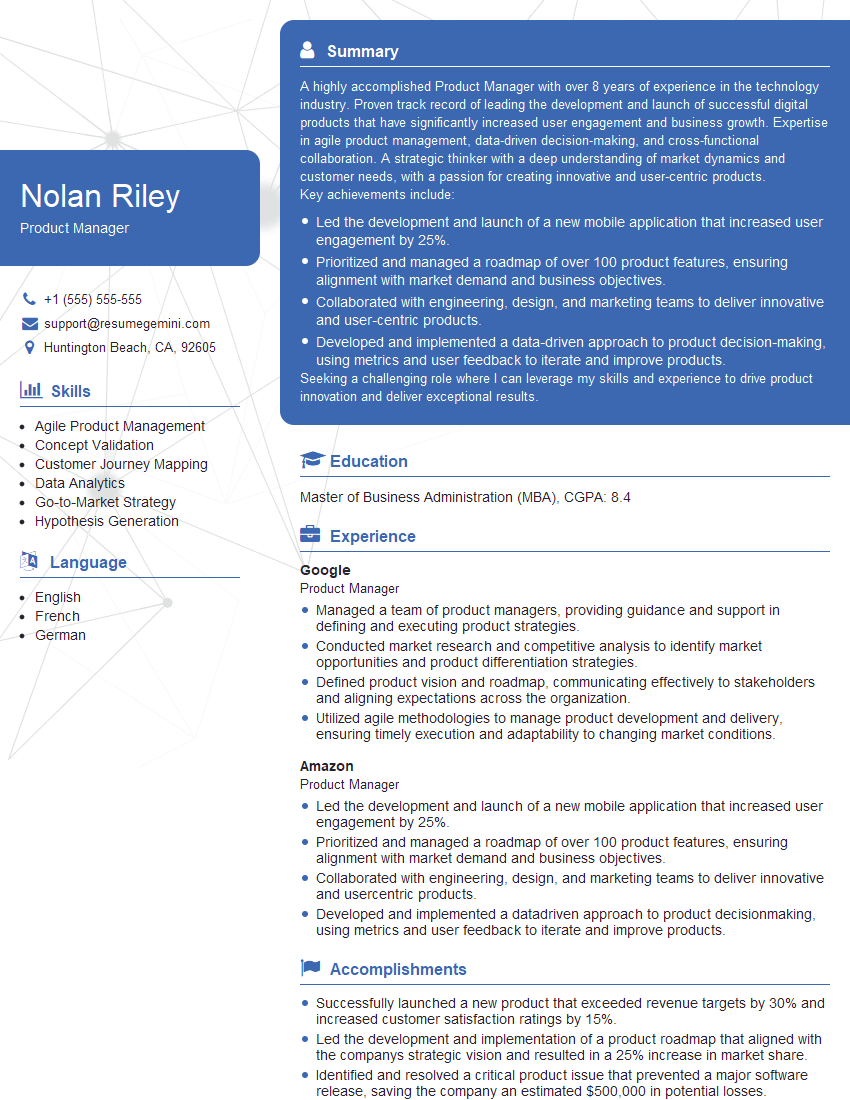
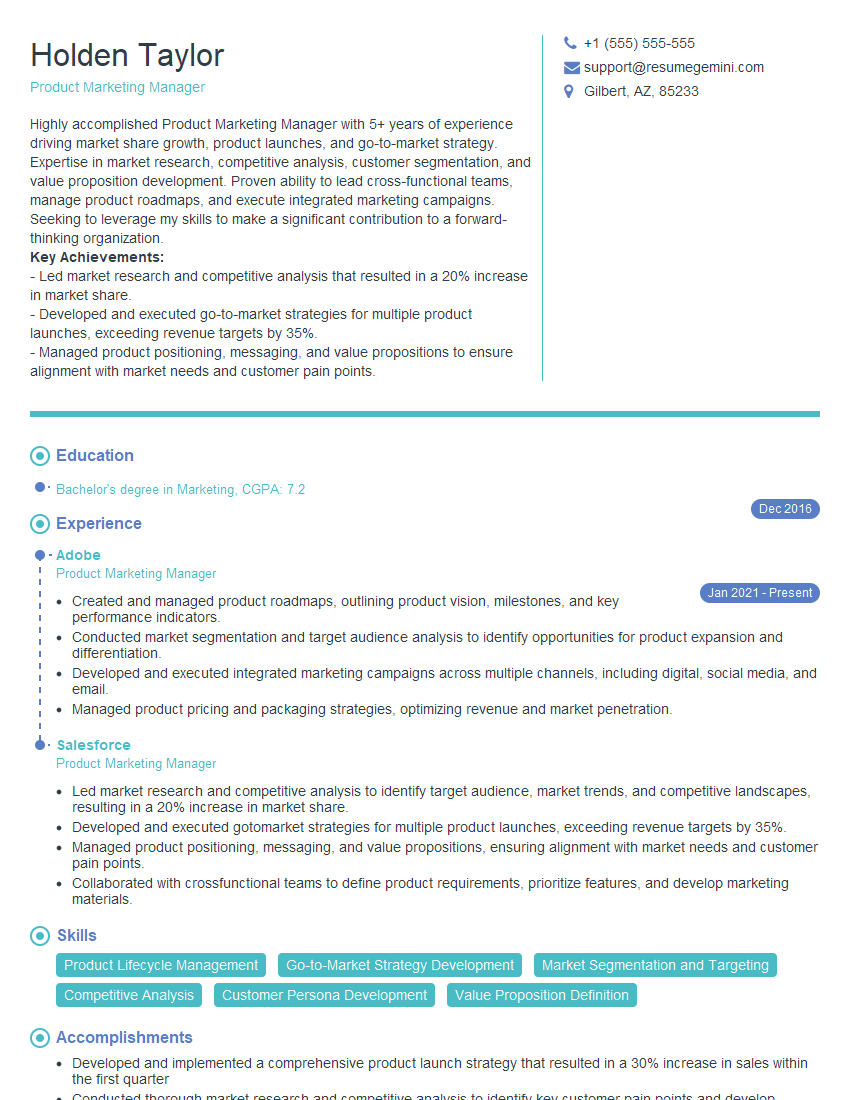
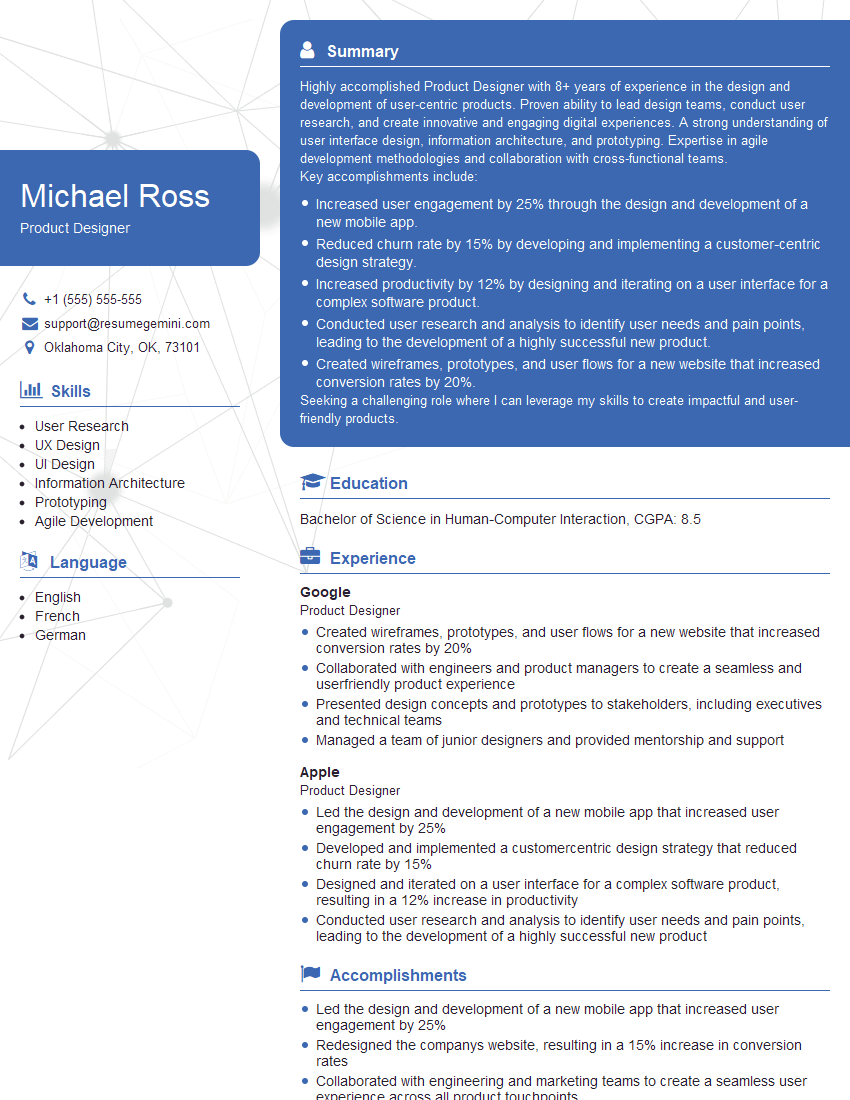
Mastering these key areas of Product Development will significantly enhance your career prospects. A strong understanding of these concepts, combined with a well-crafted resume, will open doors to exciting opportunities. To make sure your skills and experience shine, focus on creating an ATS-friendly resume that highlights your achievements and quantifies your impact. ResumeGemini is a trusted resource that can help you build a professional, impactful resume tailored to the Product Development field. We offer examples of resumes specifically designed for Product Development professionals to help you get started. Invest in your future – build the resume that gets you noticed.

Explore more articles
Users Rating of Our Blogs
Share Your Experience
We value your feedback! Please rate our content and share your thoughts (optional).
What Readers Say About Our Blog
Very informative content, great job.
good