Preparation is the key to success in any interview. In this post, we’ll explore crucial Musical Direction interview questions and equip you with strategies to craft impactful answers. Whether you’re a beginner or a pro, these tips will elevate your preparation.
Questions Asked in Musical Direction Interview
Q 1. Describe your experience conducting rehearsals for diverse musical ensembles.
My experience conducting rehearsals for diverse musical ensembles spans over fifteen years, encompassing everything from symphony orchestras and chamber groups to jazz combos and choral societies. My approach is always tailored to the specific ensemble’s needs and the nature of the music. For example, with a symphony orchestra, rehearsals emphasize precision, intonation, and a unified interpretation of the score. This might involve focused work on individual sections, followed by bringing the full ensemble together for a cohesive performance. With a jazz combo, the focus shifts towards improvisation, spontaneity, and dynamic interplay between musicians. Rehearsals are more like workshops, fostering creativity and exploration within a given harmonic and rhythmic framework. With a choral group, vocal technique, blend, and diction take precedence, often supplemented with breath control and posture exercises. The common thread across all these groups is fostering a collaborative and supportive environment where every musician feels heard and valued.
For instance, during a recent rehearsal with a university chamber choir, we spent considerable time perfecting the articulation of a particularly challenging passage in a Renaissance motet. This involved individual coaching of specific voices followed by group work to achieve a balanced and resonant sound. Contrast this with a rehearsal for a contemporary jazz group where the emphasis was on creating interesting variations and spontaneous solos within a clearly defined improvisational structure. The ability to adapt my approach is key to effective rehearsal management.
Q 2. How do you handle conflicts between musicians during rehearsals?
Conflict resolution is a crucial skill for any musical director. My approach involves creating a safe and respectful environment where musicians feel comfortable expressing their concerns. I believe in addressing issues promptly and directly, but always with empathy. The first step is to actively listen to each party involved, trying to understand the root cause of the disagreement – perhaps it’s a misinterpretation of a musical cue, a clash of artistic vision, or a personality conflict. Once the issue is understood, I facilitate a dialogue, encouraging compromise and mutual understanding. Sometimes, a simple clarification or a slight adjustment in the arrangement can resolve the issue. Other times, a more sensitive negotiation might be needed to find a solution that respects everyone’s artistic contribution.
In one instance, a disagreement arose between the first violinist and the oboist regarding a subtle rhythmic nuance. Instead of imposing a solution, I facilitated a discussion where both musicians were able to explain their interpretations. We experimented with different approaches, and finally found a compromise that satisfied both their artistic sensibilities and the overall musical integrity of the piece. The process itself reinforced a collaborative environment.
Q 3. Explain your process for selecting and preparing repertoire for a performance.
Selecting and preparing repertoire involves careful consideration of several factors. First, the artistic vision for the performance needs definition. What message or emotion do I want to convey? The musical style, the skill level of the ensemble, and the available performance time are all crucial considerations. I delve into research, looking for pieces that align with the artistic vision while challenging the musicians appropriately. The accessibility of the score, the availability of quality recordings for reference, and even the logistical aspects of obtaining performance rights are all practical matters I must consider. Once the repertoire is chosen, the preparation phase begins. This includes securing scores, studying the music in detail, identifying challenging sections, and preparing rehearsal plans that address any potential technical or interpretative hurdles.
For example, when selecting pieces for a youth orchestra concert, I opted for a mix of classical standards and contemporary works, ensuring a balance between familiar melodies and pieces that introduced them to diverse musical styles and techniques. This included providing them with historical context, analyzing the composition’s structure and style, and encouraging them to explore the composer’s intent. The preparation involved detailed analysis of the score, creating practice materials tailored to different skill levels, and individual coaching of challenging passages.
Q 4. What software or technology are you proficient in for musical direction?
My proficiency in music technology extends to various software and platforms. I’m adept at using Digital Audio Workstations (DAWs) such as Sibelius and Finale for score editing, notation, and creating custom arrangements. I use audio editing software like Audacity for sound manipulation and recording. Furthermore, I’m comfortable utilizing cloud-based collaboration tools such as Google Drive and Dropbox for efficient sharing of scores and rehearsal materials with musicians. Finally, I employ presentation software like PowerPoint or Keynote to create visually engaging program notes and rehearsal plans.
For example, during a recent project, I used Sibelius to create a custom arrangement of a piece for a smaller ensemble, adapting the orchestration to match the available instrumentation. Then, I used Audacity to edit recordings of rehearsals, isolating sections that needed further attention and sharing those with individual musicians via Dropbox for targeted practice. This streamlined workflow increased efficiency and facilitated collaboration.
Q 5. How do you adapt your conducting style to different musical genres?
Adapting my conducting style hinges on understanding the inherent characteristics of each genre. Classical music often demands precise articulation, controlled dynamics, and a clear sense of structure. My conducting will be more formal and precise. Jazz, however, requires a more relaxed and improvisational style, emphasizing rhythmic feel, phrasing, and interaction with the musicians. Similarly, conducting a gospel choir involves incorporating the emotional expression and physicality characteristic of that genre, using broader gestures and responding dynamically to the musicians’ energy levels. The key is to listen actively to the music and the ensemble, adjusting my gestures to support the musical expression effectively.
For instance, while conducting a string quartet playing a Beethoven piece, my gestures will be precise and refined, emphasizing bow direction and articulation. In contrast, when conducting a jazz band playing a bebop tune, my movements would be looser, focusing on rhythmic phrasing and allowing space for the musicians’ improvisations.
Q 6. Describe your approach to working with a composer or arranger.
Collaborating with a composer or arranger is a rewarding process requiring open communication and mutual respect. I begin by understanding their artistic vision, delving into their compositional techniques, and learning their preferred methods of communication and feedback. I then offer my insights as a conductor, highlighting potential challenges or suggesting improvements that enhance the piece’s effectiveness for the specific ensemble. This might involve discussions around instrumentation, dynamic range, or rhythmic complexity. The process of collaboration isn’t about imposing my perspective, but rather about contributing expertise that enriches the final product. The goal is to create a performance that is both faithful to the composer’s intent and optimized for the intended performers.
For example, while working with a composer on a new orchestral work, I identified a passage that presented a significant challenge for the brass section. I suggested a slight alteration in the orchestration, which streamlined the passage without compromising its musical integrity. The composer appreciated this practical feedback, leading to a smoother performance.
Q 7. How do you manage the budget and resources for a musical production?
Budget management is an essential part of musical direction. It involves developing a comprehensive budget that accounts for all aspects of the production, including venue rental, musician fees, printing scores, equipment rental, marketing and publicity, and any other related expenses. This process starts with creating a realistic estimate of anticipated costs, followed by securing funding through sponsorships, ticket sales, or grants. Once the budget is established, diligent tracking of expenses is paramount to ensure the production stays within the allocated funds. Effective communication with stakeholders, transparent financial reporting, and seeking cost-effective solutions are crucial for managing resources effectively.
For example, when directing a small-scale opera production, we carefully negotiated musician fees based on their experience and the complexity of their roles. We secured a lower-cost venue that still met our technical needs, and we explored options for cost-effective score printing. Through meticulous planning and proactive resource management, we successfully delivered a high-quality production while staying within our budgetary constraints.
Q 8. Explain your strategies for motivating and inspiring musicians.
Motivating musicians is about fostering a shared passion and creating a supportive environment. It’s less about wielding authority and more about inspiring collaboration. My strategies involve:
Clear Communication: I ensure everyone understands the musical goals, their individual roles, and how their contributions fit into the bigger picture. This involves clear explanations of the style, interpretation, and technical aspects of the piece.
Positive Reinforcement: I actively praise individual and collective achievements, highlighting specific successes rather than focusing on mistakes. A simple ‘that phrasing was beautiful’ can go a long way.
Individual Attention: I take the time to understand each musician’s strengths and weaknesses. This allows me to offer tailored feedback and support, ensuring everyone feels valued and challenged appropriately. This might involve spending extra time with a struggling musician or giving advanced challenges to others.
Shared Ownership: I encourage musicians to contribute ideas and participate in shaping the musical interpretation. This fosters a sense of ownership and commitment.
Creating a Fun and Supportive Atmosphere: Rehearsals should be challenging, yet engaging and enjoyable. A good atmosphere boosts morale and encourages risk-taking, which is crucial for artistic growth. I often incorporate humor and breaks to maintain energy levels.
For instance, during a rehearsal for a particularly challenging piece of contemporary music, I noticed one violinist struggling with a complex rhythmic passage. Instead of criticizing, I spent time with them individually, breaking down the passage into smaller sections and providing alternative fingerings that would help them.
Q 9. How do you resolve timing or rhythmic discrepancies within an ensemble?
Addressing timing and rhythmic discrepancies requires a multi-faceted approach. It’s crucial to diagnose the root cause before applying a solution.
Careful Listening: I first identify the source of the problem. Is it a section-specific issue? Is one instrument consistently ahead or behind? Is it a lack of rhythmic precision or a misunderstanding of the meter?
Individual Practice: If the problem is an individual’s rhythmic accuracy, I’ll suggest targeted practice exercises, like rhythmic dictation or working with a metronome.
Ensemble Work: We might focus on a specific section, using techniques like conducting only the problematic rhythmic figures, isolating the problematic instruments to play together, or clapping the rhythm together before playing.
Counting: Clear and consistent counting is essential. I might employ vocal counting or use a click track, adjusting the tempo as needed. Subdivision practice is also invaluable here.
Re-evaluation of interpretation: Sometimes rhythmic discrepancies stem from differing interpretations. We will discuss the score’s intended phrasing and ensure we’re all in sync.
For example, in a recent orchestral rehearsal, I identified a persistent timing issue in the strings during a fast passage. By using a click track and isolating the second violins who were consistently slightly ahead, we were able to address the problem effectively.
Q 10. What is your approach to interpreting a musical score?
Interpreting a score is more than just reading the notes; it’s about understanding the composer’s intentions and bringing their vision to life. My approach involves several stages:
Historical Context: I research the composer, their style, and the historical period in which the piece was written. This provides essential context for understanding the musical language and intentions.
Structural Analysis: I examine the form, harmony, melody, and rhythm of the piece to identify its underlying structure and organization. This provides a framework for the interpretation.
Textural Analysis: I consider the interplay of different instrumental and vocal lines to understand the texture and balance of the music. This informs decisions on dynamics, articulation, and phrasing.
Stylistic Considerations: I carefully study the musical style of the piece, taking into account performance practices of the time and the genre. This dictates aspects such as tempo, articulation, and ornamentation.
Collaborative Discussion: I encourage open discussion with the musicians, sharing my interpretation and welcoming their insights. A shared understanding is crucial for a cohesive performance.
For instance, preparing a Baroque concerto demands a different approach than a contemporary minimalist piece. The Baroque piece requires a deep understanding of historical performance practice, including ornamentation and articulation, while the contemporary piece requires an understanding of its unique compositional techniques.
Q 11. Describe your experience in score preparation and editing.
Score preparation and editing are crucial for a successful performance. My experience encompasses:
Part Extraction and Editing: I’m proficient in using music notation software like Sibelius or Finale to create accurate and well-formatted parts for each musician. This includes making necessary adjustments for specific instruments or vocal ranges.
Cue Sheets: I prepare detailed cue sheets for all instrumentalists and singers, outlining their entrances and cues. This is particularly important for large-scale works.
Dynamic Markings and Articulations: I often add or refine dynamic markings, articulations, and phrasing suggestions based on my interpretation, ensuring clarity and consistency throughout the score.
Instrumental Adjustments: I’m adept at making adjustments based on the instrumentation. If there is a missing part in the score, or there are instrumental doubling issues, I will correct the score as needed.
Collaboration with Composers: I’ve worked closely with composers to resolve ambiguities or make minor adjustments to the score to improve its practicality for performance.
For a recent production, I had to prepare a score with some ambiguous notation for a string quartet. I collaborated with the composer to clarify passages and adjusted the phrasing to ensure better flow and balance between the instruments. I also created detailed cue sheets to make sure each musician was ready and confident for their entrances.
Q 12. How do you address performance issues during a live performance?
Addressing performance issues during a live performance requires quick thinking and adaptability. My approach prioritizes minimizing disruption to the audience and maintaining the flow of the music.
Non-Verbal Communication: I use subtle cues like conducting gestures or facial expressions to guide musicians through minor mistakes or tempo fluctuations.
Flexibility: If a major issue arises, such as a missed entrance, I may subtly adjust the tempo or phrasing to cover it seamlessly. The goal is to keep the performance moving smoothly.
Preparedness: Having backup plans and contingency strategies in place for potential problems is crucial. This might include having extra copies of scores or having alternate musicians on standby.
Calm Demeanor: Maintaining a calm and confident demeanor reassures the musicians and minimizes the impact of the issue on the audience.
Post-Performance Analysis: After the performance, I review any issues that occurred and address them during the next rehearsal to prevent recurrence.
For example, during a live performance, one singer missed their entrance due to a technical difficulty with their microphone. By quickly adjusting the tempo and conducting a few measures of silent accompaniment, we were able to cover this seamlessly and keep the performance flowing smoothly.
Q 13. Explain your experience with score analysis and interpretation.
Score analysis and interpretation are the foundation of my work. My experience includes:
Formal Analysis: I dissect a score to understand its structure, harmony, counterpoint, and form. This involves identifying themes, variations, and development, providing a deep structural understanding.
Harmonic Analysis: I analyze the harmonic progressions and chord structures to understand the emotional impact and tonal direction of the music. This informs decisions about dynamics and phrasing.
Melodic Analysis: I study the melodic lines to understand their character, contour, and function within the overall composition. This informs decisions about articulation and expression.
Rhythmic Analysis: I analyze the rhythmic patterns and meters to understand the pulse and energy of the music. This is essential for precise tempo and rhythmic execution.
Contextual Analysis: I consider the historical, social, and cultural context in which the music was composed, to better understand its meaning and emotional content.
For example, analyzing the harmonic language of a Romantic-era symphony helps in understanding the emotional arc of the piece and informing choices about tempo and dynamics to support its dramatic structure. Similarly, analyzing the rhythmic complexities of a piece by Stravinsky provides essential insight into the composer’s unique musical language.
Q 14. How do you create a collaborative and positive rehearsal environment?
Creating a positive and collaborative rehearsal environment is paramount. It’s about fostering trust, respect, and open communication among all participants.
Clear Goals and Expectations: I set clear goals for each rehearsal, outlining the specific aspects of the music we’ll be working on. This provides direction and helps everyone stay focused.
Constructive Feedback: I provide constructive feedback, focusing on solutions rather than criticism. I encourage musicians to offer feedback to each other in a supportive way.
Active Listening: I actively listen to the musicians, paying attention to both their musical contributions and their concerns. This ensures everyone feels heard and valued.
Encouraging Questions: I foster a culture of curiosity and encourage musicians to ask questions about the music or the rehearsal process. This helps ensure everyone fully understands the material.
Celebrating Successes: I acknowledge and celebrate both individual and collective achievements. This reinforces positive behavior and boosts morale.
For example, in one rehearsal, a disagreement arose about the interpretation of a particular phrase. Rather than imposing my own view, I facilitated a discussion among the musicians, encouraging them to explore different possibilities and arrive at a shared understanding. This resulted in a more nuanced and compelling performance.
Q 15. What are your strategies for effective communication with musicians?
Effective communication with musicians is the bedrock of successful musical direction. It’s not just about conveying instructions; it’s about building trust and fostering a collaborative environment where everyone feels heard and valued. My strategy involves a multi-faceted approach.
Clear and Concise Communication: I prioritize clear, concise instructions, avoiding jargon unless absolutely necessary. I always ensure everyone understands their role and how it contributes to the overall performance.
Active Listening: I actively listen to musicians’ concerns and suggestions. This demonstrates respect and opens the door for constructive feedback. For example, during rehearsals, if a musician suggests an alternative phrasing, I’ll carefully consider it and discuss its implications for the overall piece.
Positive Reinforcement: I focus on positive reinforcement, celebrating successes and offering constructive criticism in a supportive manner. This creates a more positive and productive rehearsal atmosphere. Praising a musician’s precise intonation or rhythmic accuracy boosts confidence and encourages continued improvement.
Individualized Approach: I recognize that every musician is unique. I tailor my communication style to suit individual needs and personalities, understanding that some may respond better to direct instruction while others prefer a more collaborative approach.
Open Dialogue: I encourage open dialogue and facilitate discussions to resolve any conflicts or misunderstandings. A well-functioning team needs to be able to freely express concerns without fear of judgment.
Career Expert Tips:
- Ace those interviews! Prepare effectively by reviewing the Top 50 Most Common Interview Questions on ResumeGemini.
- Navigate your job search with confidence! Explore a wide range of Career Tips on ResumeGemini. Learn about common challenges and recommendations to overcome them.
- Craft the perfect resume! Master the Art of Resume Writing with ResumeGemini’s guide. Showcase your unique qualifications and achievements effectively.
- Don’t miss out on holiday savings! Build your dream resume with ResumeGemini’s ATS optimized templates.
Q 16. Describe your experience with vocal coaching and training.
My experience with vocal coaching and training is extensive. I’ve worked with singers across various genres and skill levels, from beginners to seasoned professionals. My approach is holistic, encompassing technical aspects, interpretive skills, and performance practice.
Technical Training: This includes breath support, vocal placement, resonance, and diction. I use a combination of vocal exercises and personalized feedback to help singers improve their technique and expand their vocal range.
Interpretive Coaching: I work with singers to understand the emotional and narrative content of a piece, encouraging them to find their own unique interpretation while staying true to the composer’s intentions. I often use storytelling techniques to help singers connect with the music on a deeper level.
Performance Practice: I guide singers on stage presence, microphone technique, and performance etiquette, ensuring they are confident and comfortable on stage. For example, I might work with a singer on controlling their breath and projecting their voice effectively in a large venue.
Collaborative Workshops: I’ve also led vocal workshops and masterclasses, sharing my knowledge and experience with a wider community of singers.
Q 17. How do you maintain artistic integrity while adhering to production constraints?
Maintaining artistic integrity while adhering to production constraints is a constant balancing act. It requires creative problem-solving and a willingness to adapt without compromising the core artistic vision. My strategy involves:
Prioritization: I identify the essential elements that cannot be compromised and prioritize them. For instance, in a theatre production with budget constraints, I may prioritize the quality of the instrumentalists while finding creative solutions to limit the elaborate set design.
Creative Compromises: I explore alternative solutions that achieve a similar effect within the given constraints. For example, if a specific instrument is unavailable, I might explore an alternative instrumentation that effectively maintains the musical essence.
Open Communication: I maintain open communication with the production team to ensure everyone understands the artistic vision and the production limitations. This prevents misinterpretations and allows for collective problem-solving.
Strategic Adaptation: I adapt the musical arrangements, if necessary, to work within the given time or budget limitations without sacrificing musical quality.
Q 18. How do you handle last-minute changes or unexpected challenges during a performance?
Handling last-minute changes or unexpected challenges during a performance requires quick thinking, adaptability, and a cool head. My approach involves:
Assessment: Quickly assess the nature and scope of the problem. Is it a minor technical issue, a cast member’s absence, or a more significant production problem?
Problem-Solving: Develop a solution in collaboration with the relevant team members. This could involve substituting a musician, adapting a musical passage, or finding a quick technical fix.
Communication: Communicate the changes clearly and calmly to the performers, ensuring everyone understands their role in the revised plan.
Flexibility: Remain flexible and adaptable. Be prepared to deviate from the planned performance, if necessary, to ensure a smooth and successful show.
Post-mortem analysis: After the performance, I review the situation to identify lessons learned and implement preventive measures to minimize similar occurrences in the future.
Q 19. Explain your experience with working with different types of microphones and audio equipment.
My experience with microphones and audio equipment is extensive. I am proficient in working with a wide range of microphones, including dynamic, condenser, and ribbon microphones, and understand their different characteristics and applications. I am also experienced with various audio equipment, including mixers, equalizers, compressors, and digital audio workstations (DAWs).
Microphone Selection: I can select appropriate microphones based on the acoustic environment, the instrument or voice being amplified, and the desired sound quality. For example, I might choose a dynamic microphone for a loud instrument like a drum kit and a condenser microphone for a quieter instrument like a violin.
Signal Processing: I am skilled in using signal processing tools to enhance the sound quality and create a balanced mix. This includes adjusting gain, equalization, compression, and reverb to optimize the audio signal.
Troubleshooting: I am experienced in troubleshooting audio problems and resolving technical issues quickly and efficiently. I know how to identify the source of a problem and take appropriate corrective action.
DAW Proficiency: My familiarity with DAWs allows me to record, edit, and mix audio effectively, ensuring a high-quality final product. I have practical experience with software like Pro Tools, Logic Pro, and Ableton Live.
Q 20. How do you balance the artistic vision with the technical aspects of a production?
Balancing artistic vision with the technical aspects of a production is crucial for creating a successful performance. It requires strong organizational skills, effective communication, and a keen understanding of both the creative and technical sides of production.
Collaborative Planning: I work closely with the technical team (sound engineers, lighting designers, stage managers) from the early stages of planning to ensure that the technical elements align with the artistic vision. For example, I might work with the lighting designer to coordinate lighting changes with specific musical cues.
Compromise and Adaptation: Sometimes, compromises must be made. If the technical requirements conflict with the artistic vision, I’m prepared to explore creative solutions or adaptations to find a balance.
Technical Proficiency: I maintain a good working knowledge of technical aspects to better understand the possibilities and limitations. This enables me to communicate effectively with the technical team and ensure the technical aspects enhance the performance, rather than detract from it.
Prioritization: I prioritize the elements essential for maintaining the integrity of the artistic vision while still adhering to the technical and logistical constraints of the production.
Q 21. What are your strengths and weaknesses as a musical director?
As a musical director, my strengths lie in my ability to communicate effectively with musicians, foster a collaborative environment, and adapt to changing circumstances. I am adept at balancing artistic vision with technical constraints, and I have a deep understanding of music theory, arranging, and conducting. I am also highly organized and possess strong leadership skills.
However, like anyone, I also have areas for development. While I’m proficient in many areas, I constantly strive to enhance my knowledge of specific software and technologies and improve my skills in managing very large-scale orchestral productions. Continuous professional development is essential in this ever-evolving field.
Q 22. Describe a time you had to make a difficult decision as a musical director.
One of the most challenging decisions I faced was during a production of Sweeney Todd. We were a week away from opening night, and our leading baritone, playing Sweeney Todd, suddenly lost his voice due to illness. Replacing him with someone equally skilled in such a short time seemed impossible. The understudy was talented but lacked the specific vocal timbre and acting experience needed for the role.
My solution involved a multi-pronged approach. First, I worked intensively with the understudy, focusing on specific arias that required the most vocal power, adjusting the tempo and key slightly to accommodate their voice. Second, I collaborated with the stage director to subtly adjust some stage blocking to minimize the understudy’s vocal strain and to highlight their strengths. Third, I leveraged pre-recorded backing vocals where technically feasible, allowing the understudy to focus on their acting and vocal projection. This was a calculated risk, but it resulted in a successful opening night, proving the value of creative problem-solving under immense pressure.
Q 23. How familiar are you with music theory and notation software?
My familiarity with music theory is comprehensive. I’m proficient in all aspects, from basic harmony and counterpoint to advanced concepts like twelve-tone techniques and microtonal music. My understanding extends to various musical styles, from classical and jazz to contemporary and musical theatre. I’m completely fluent in standard music notation and possess extensive experience using notation software including Sibelius, Finale, and Dorico. I can not only read and interpret scores but also create, edit, and arrange musical parts with precision and efficiency. I frequently utilize the software’s capabilities for score preparation, creating customized rehearsal tracks, and generating performance-ready parts.
Q 24. Describe your proficiency in music transcription and arrangement.
Music transcription and arrangement are integral to my work. I’m capable of transcribing music from audio recordings into accurate musical notation, paying close attention to nuances of rhythm, melody, and harmony. I can adapt scores for various instrumental and vocal ensembles, considering individual musicians’ capabilities and the overall sonic balance. For example, I once transcribed a complex jazz improvisation for a string quartet, which required careful consideration of voicing, range, and rhythmic displacement to maintain the musical character of the original while respecting the limits of the ensemble. Arrangement for me is about creative problem-solving, translating a musical idea into a form suitable for a specific context.
Q 25. What is your approach to integrating technology into rehearsals and performances?
Technology plays a vital role in my work. I use digital audio workstations (DAWs) such as Pro Tools and Logic Pro X for creating rehearsal tracks with click tracks and backing tracks, which enhance rhythmic precision and provide musicians with a clear framework. I incorporate multimedia elements for visual aids during rehearsals, using tablets and projectors to display scores, chord charts, and diagrams. For performances, we might employ lighting cues synced to the music, or use projection mapping to enhance the visual experience.
However, I believe that technology should augment, not replace, the human element. It’s important to maintain a balance, using technology to enhance efficiency and creativity without sacrificing the spontaneity and emotional connection inherent in live performance.
Q 26. Explain your experience working with different types of musical instruments.
My experience spans a wide range of instruments. While I don’t play every instrument proficiently, I have a deep understanding of their technical capabilities and expressive potential. This allows me to write effective parts and communicate effectively with musicians. I’ve worked extensively with orchestral instruments, jazz combos, rock bands, and various world music ensembles. This breadth of experience enables me to effectively manage diverse musical groups and to achieve a balanced and cohesive sound, regardless of the instrumentation. Understanding the technical limitations and expressive possibilities of each instrument is key to crafting musically satisfying and technically feasible arrangements.
Q 27. How do you approach working with singers of varying vocal abilities?
Working with singers of varying abilities requires a sensitive and adaptable approach. I begin by assessing each singer’s strengths and weaknesses through auditions and informal workshops. This allows me to tailor my approach to their individual needs. For less experienced singers, I focus on breath support, vocal technique, and clear diction, providing individual coaching and constructive feedback. For more advanced singers, I might focus on interpretive aspects, helping them explore character, emotion, and phrasing. I also create vocal arrangements that accommodate the range and capabilities of each singer, ensuring that every voice feels supported and challenged appropriately. It’s crucial to create a positive and encouraging environment for all singers to build confidence and reach their full potential.
Q 28. How do you balance the musical demands with the overall stage direction?
Balancing musical demands with overall stage direction involves close collaboration with the stage director. Open communication is paramount. We discuss the overall production concept, the emotional arc of the story, and the intended audience experience. This allows me to shape the musical score to complement the visual elements, ensuring that the music underscores the dramatic narrative.
For example, during a recent production, we strategically used a sudden shift in musical dynamics to accompany a crucial plot reveal. This kind of collaboration between music and staging amplifies the impact of the scene, making the experience far more immersive and engaging for the audience. The synergy between music and staging is crucial, and close communication ensures a unified and impactful artistic vision.
Key Topics to Learn for Your Musical Direction Interview
- Score Study & Analysis: Understanding different musical styles, analyzing orchestral scores, identifying compositional techniques, and recognizing potential performance challenges.
- Rehearsal Techniques: Effective communication with musicians, conducting techniques, shaping musical phrases, problem-solving during rehearsals, fostering a collaborative environment.
- Orchestration & Arrangement: Knowledge of instrumental ranges and capabilities, creating effective voicings, arranging music for various ensembles, understanding the principles of balance and texture.
- Music Technology & Software: Proficiency in music notation software (Sibelius, Finale), digital audio workstations (DAW), and other relevant technologies used in musical direction.
- Collaboration & Communication: Working effectively with directors, producers, composers, and other members of a creative team; clear and concise communication of musical ideas.
- Performance Practice & History: Understanding historical performance styles and their application to contemporary settings, familiarity with different conducting styles and approaches.
- Problem-Solving & Troubleshooting: Addressing musical challenges during rehearsals and performances, adapting to unexpected situations, demonstrating resourcefulness and quick thinking.
Next Steps
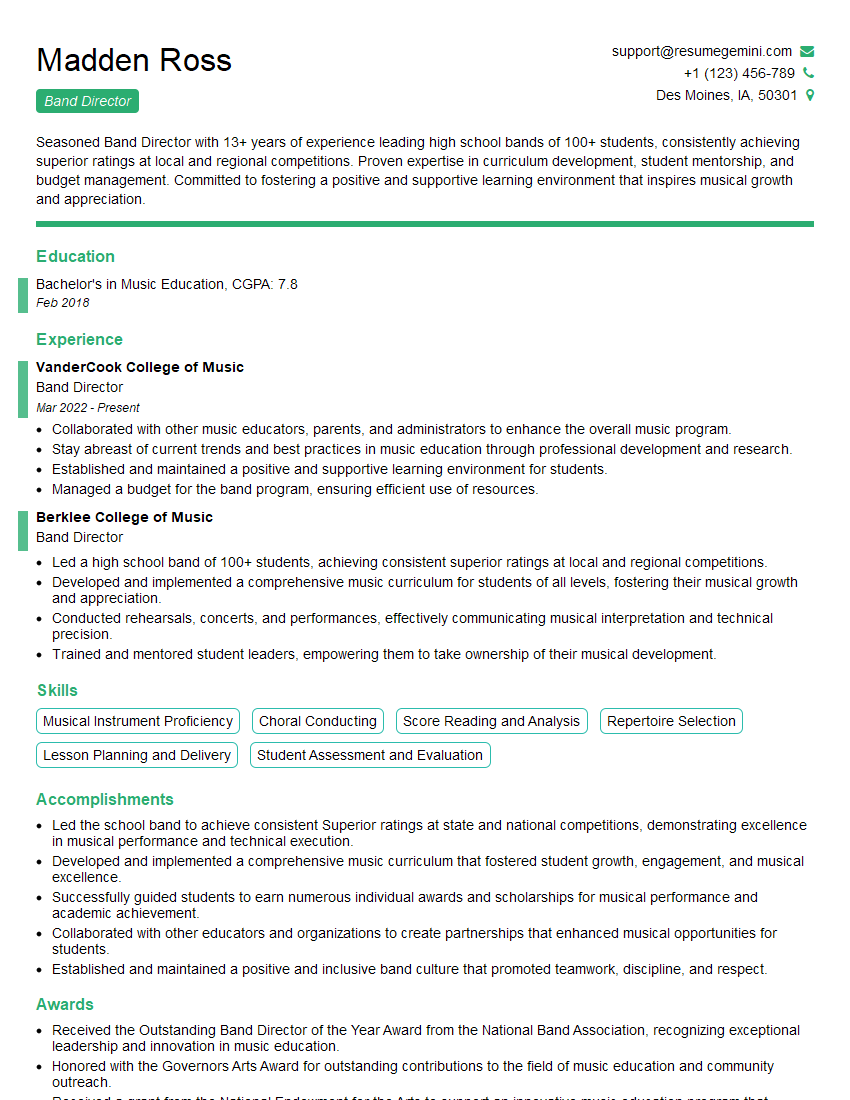
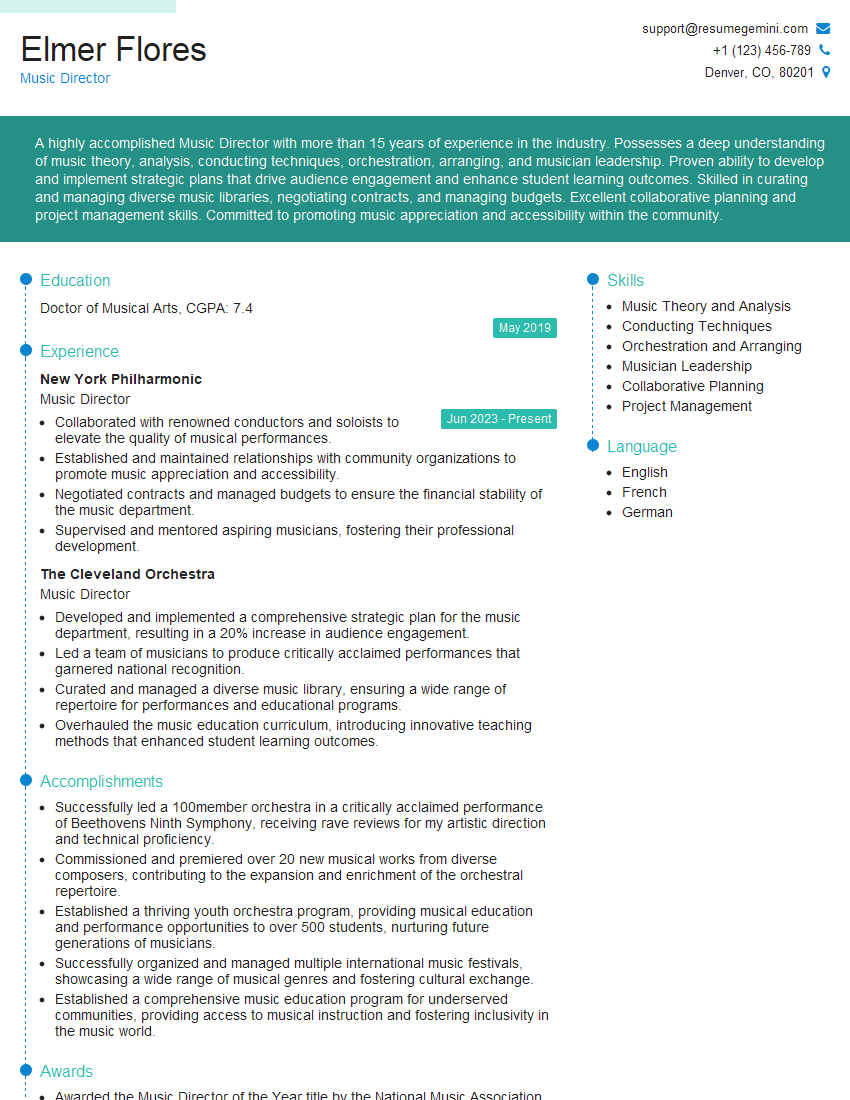
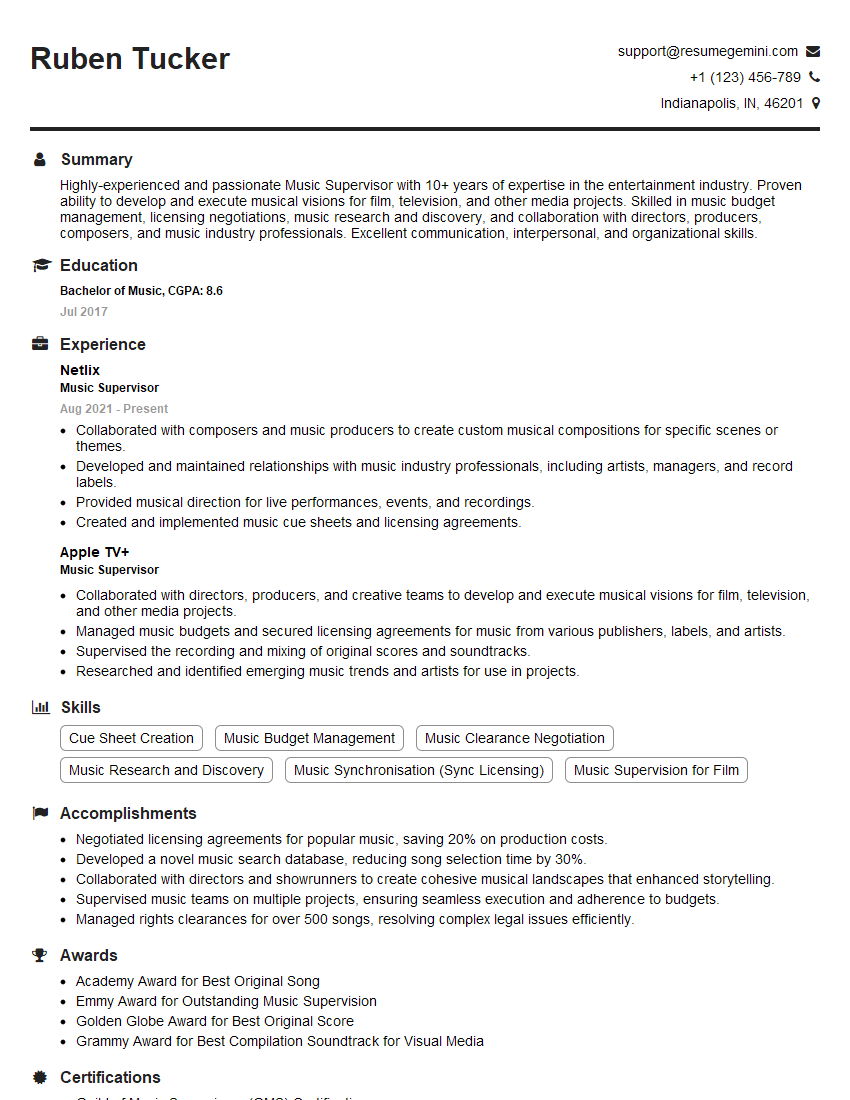
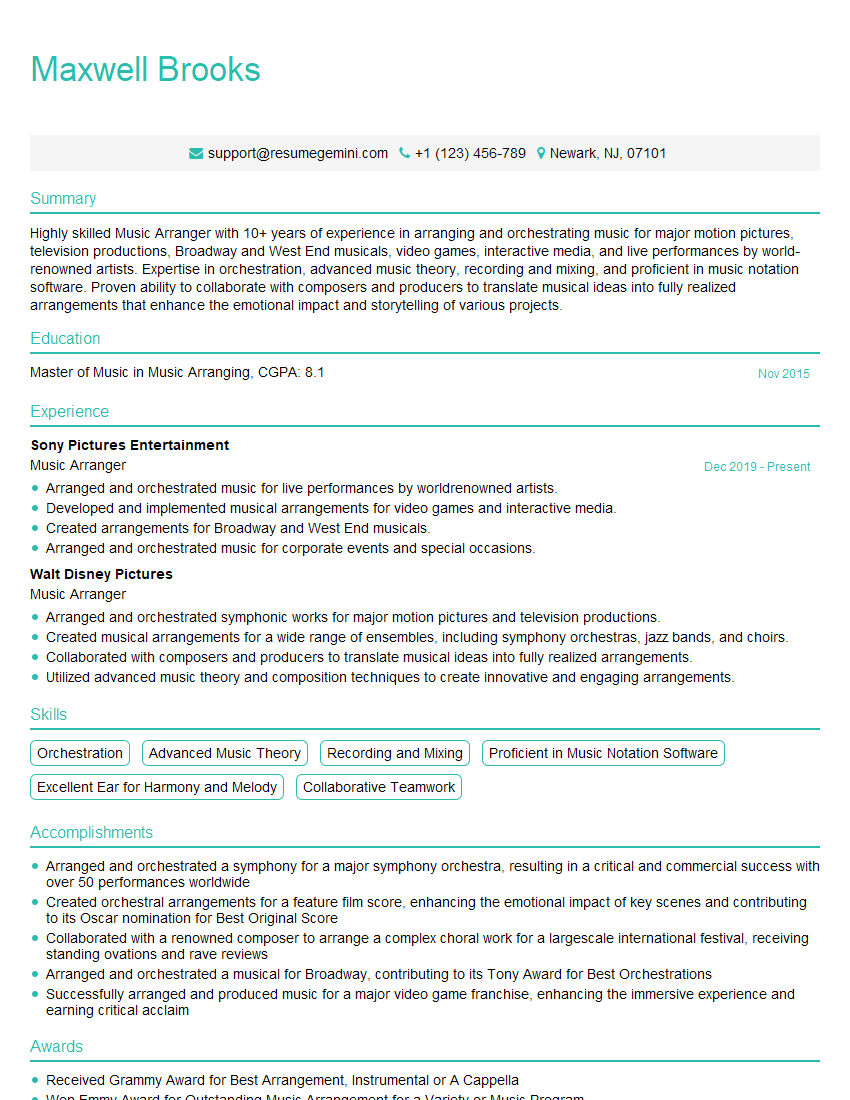
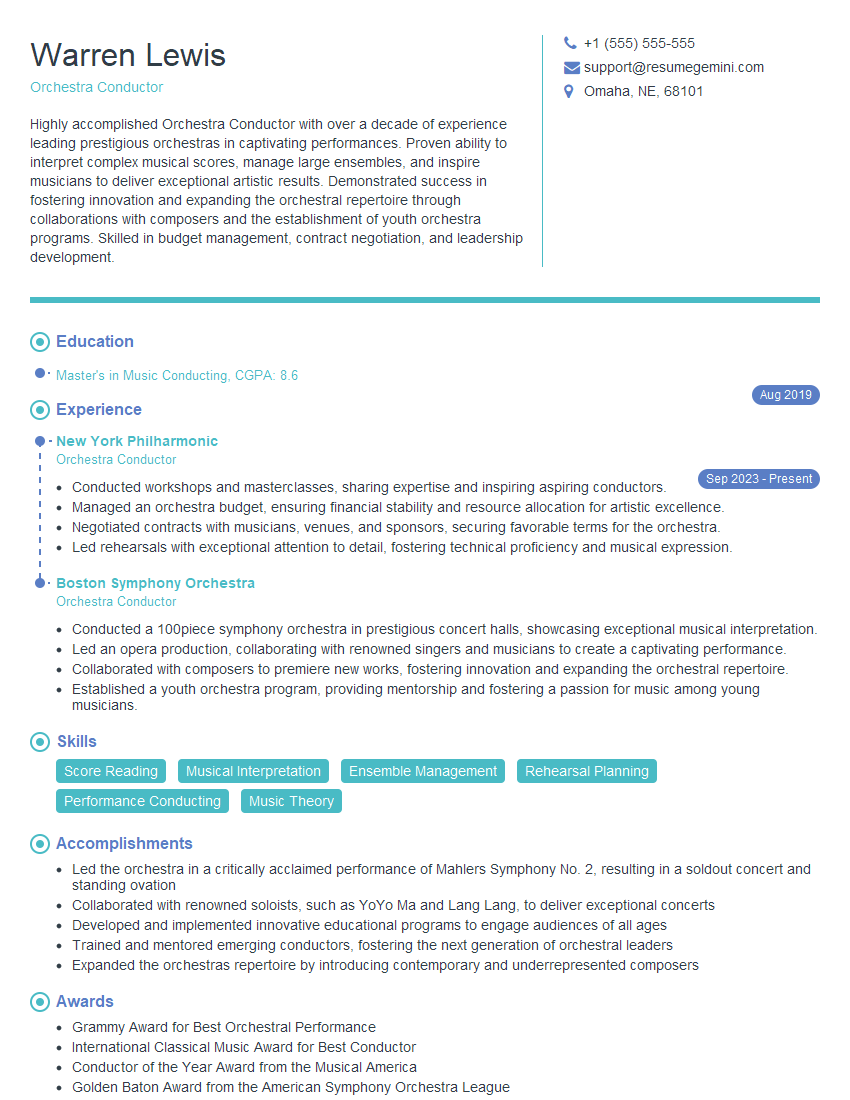
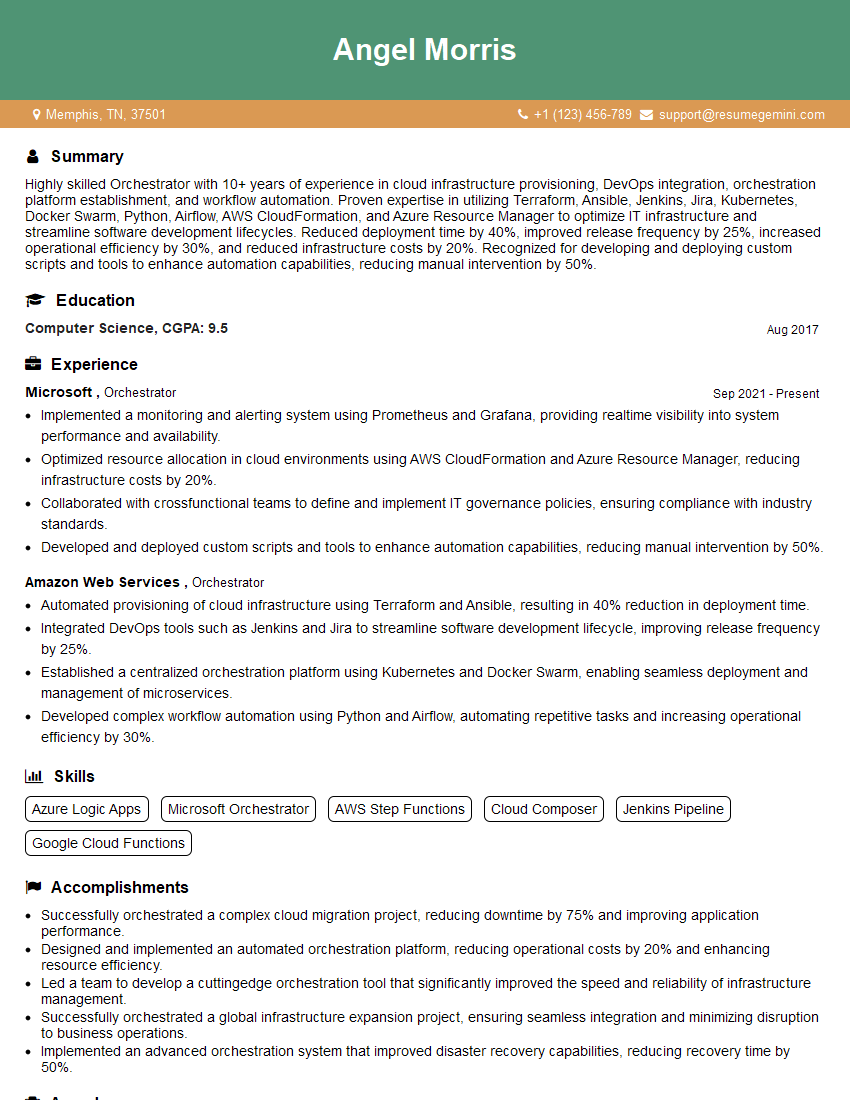
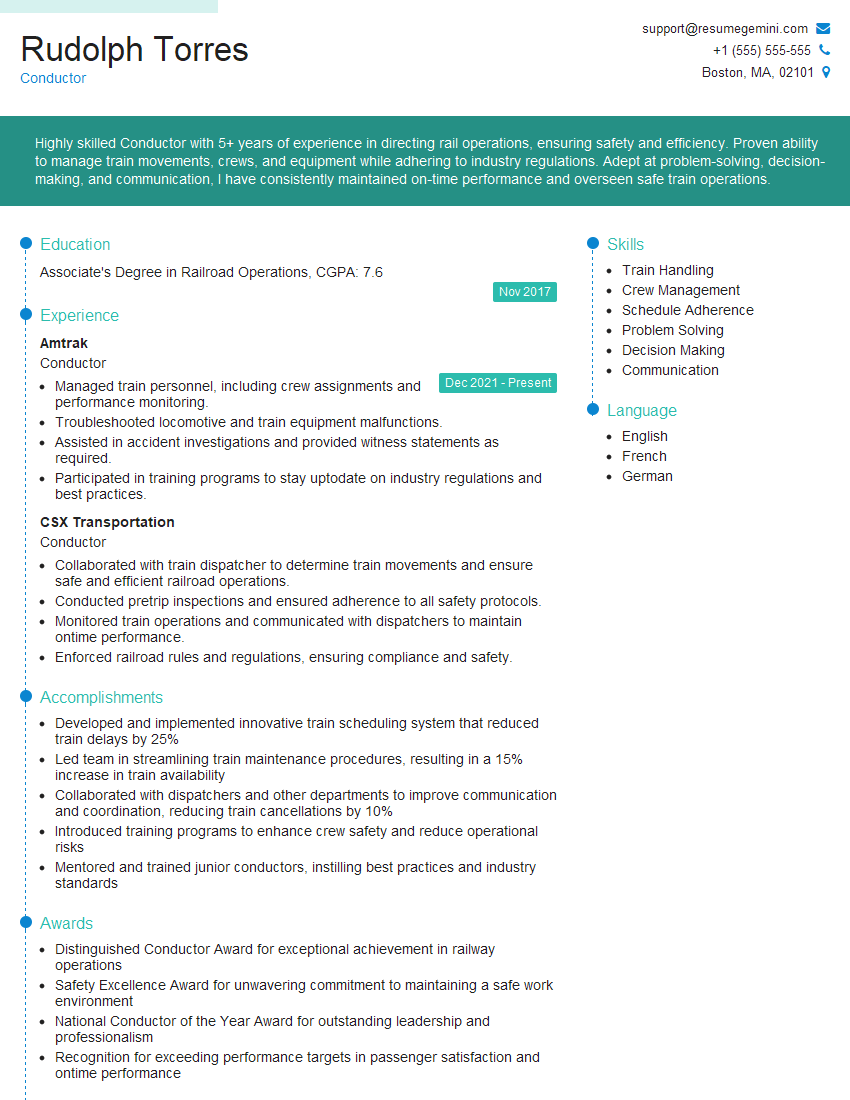
Mastering musical direction opens doors to exciting and fulfilling careers in theatre, opera, film, and concert settings. To significantly boost your job prospects, invest time in creating a strong, ATS-friendly resume that showcases your skills and experience effectively. ResumeGemini is a trusted resource that can help you build a professional and impactful resume, tailored to the specifics of your musical direction aspirations. Examples of resumes specifically designed for musical direction professionals are available to guide you. Take the next step towards your dream career today!
Explore more articles
Users Rating of Our Blogs
Share Your Experience
We value your feedback! Please rate our content and share your thoughts (optional).
What Readers Say About Our Blog
Very informative content, great job.
good