Cracking a skill-specific interview, like one for Basic Gemstone Cutting and Polishing, requires understanding the nuances of the role. In this blog, we present the questions you’re most likely to encounter, along with insights into how to answer them effectively. Let’s ensure you’re ready to make a strong impression.
Questions Asked in Basic Gemstone Cutting and Polishing Interview
Q 1. What are the different types of gemstone cutting styles?
Gemstone cutting styles are broadly categorized by the shape and arrangement of facets (polished surfaces). The goal is to maximize brilliance, fire, and scintillation, depending on the stone’s properties and desired aesthetic. Some popular styles include:
- Brilliant Cut: This is the most popular cut for diamonds and many other gemstones. It features a symmetrical arrangement of facets designed to produce maximum brilliance and scintillation. Think of the classic round brilliant cut.
- Step Cut: Characterized by parallel facets that create a more geometric, less sparkly appearance than brilliant cuts. Emerald cuts are a prime example; they show off the stone’s clarity and color exceptionally well.
- Mixed Cut: A combination of brilliant and step-cut elements. These cuts offer a balance between brilliance and clarity.
- Cabochon Cut: This is a polished, smooth, dome-shaped cut without facets. It’s ideal for opaque or translucent gemstones that don’t transmit light well, such as turquoise or opal. It accentuates color and chatoyancy (a cat’s-eye effect).
- Rose Cut: An older style with a flat base and triangular facets that meet at a point, creating a star-like pattern from above.
The choice of cut style significantly impacts the final appearance and value of the gemstone.
Q 2. Explain the process of faceting a gemstone.
Faceting a gemstone is a precise process of shaping and polishing a rough stone to create a specific pattern of facets. It involves several stages:
- Planning: The cutter determines the optimal orientation of the rough stone based on its internal structure (inclusions) and color distribution, aiming to minimize waste and maximize the stone’s beauty.
- Pre-forming: The rough stone is shaped into a preliminary form close to the desired final shape, often using a dop (a stick or device to hold the stone) and various grinding wheels.
- Faceting: Individual facets are created by carefully grinding and polishing the stone’s surface using progressively finer abrasives on a faceting machine. Each facet is precisely angled to reflect light optimally.
- Polishing: Once all facets are cut, the stone undergoes polishing to achieve a high level of brilliance and clarity. This process involves using progressively finer abrasives and polishing compounds.
The entire process demands skill, patience, and precision, as slight errors can significantly affect the final product. Imagine carefully sculpting a tiny work of art with incredible precision.
Q 3. Describe the tools and equipment used in gemstone cutting and polishing.
Gemstone cutting and polishing require specialized tools and equipment. These include:
- Faceting Machine: A precision machine with rotating laps (disks) used to cut and polish facets. This is the centerpiece of the process.
- Grinding Wheels: Wheels of varying grits (sizes of abrasive particles) used for rough shaping and initial faceting.
- Laps: Rotating disks made of various materials (e.g., cast iron, tin, diamond) used in the faceting machine for precision grinding and polishing.
- Abrasives: Powders or pastes containing diamond, silicon carbide, or other materials, used to grind and polish the stone. The grit size of the abrasive determines the level of surface refinement.
- Dop: A stick or holder used to secure the gemstone during cutting and polishing.
- Magnifying Glass/Microscope: Essential for inspecting the stone’s surface for defects and ensuring precise facet alignment.
- Polishing Compounds: Fine polishing agents used to achieve a high-luster finish.
The quality and condition of these tools directly impact the final product’s quality. Regular maintenance and proper usage are crucial.
Q 4. How do you select the appropriate abrasive for polishing different gemstones?
Abrasive selection is crucial for achieving a superior polish while avoiding damage to the gemstone. The choice depends heavily on the gemstone’s hardness and other properties. Here’s a simplified approach:
- Hardness: Harder gemstones (like diamonds) require harder abrasives (diamond powder), while softer stones (like opal) need softer abrasives (cerium oxide).
- Fracture Tendency: Stones prone to fracturing require gentler abrasives and careful application to prevent chipping or damage.
- Specific Gravity: For stones with high specific gravity, using too coarse an abrasive could lead to uneven grinding or unwanted marks.
A good cutter develops an intuitive understanding of material behavior and abrasive selection over time. It’s a delicate balance of power and finesse.
Q 5. What are the key factors to consider when choosing a gemstone’s final shape and cut?
Choosing a gemstone’s final shape and cut is a critical decision influencing its beauty, value, and marketability. Factors to consider include:
- Gemstone’s Properties: Hardness, clarity, color, and inclusions dictate the possible cuts and shapes. A stone with many inclusions, for example, may be better suited to a cabochon cut to mask imperfections.
- Desired Aesthetic: The desired look (modern, classic, etc.) influences the choice. A brilliant cut emphasizes brilliance, while a step cut highlights clarity and color.
- Market Trends: Current market trends in gemstone shapes and cuts are also relevant considerations for commercial viability.
- Maximizing Carat Weight: Cutters aim to maximize the carat weight while retaining good proportions and brilliance. This impacts profitability.
Think of it like designing a dress—you must consider the fabric’s properties (gemstone’s traits) and the desired style (aesthetic) to create a beautiful final product.
Q 6. How do you identify and address common issues during the cutting process (e.g., cracks, inclusions)?
Dealing with cracks and inclusions during cutting requires careful planning and skilled execution. Here’s how you address common issues:
- Cracks: Identifying cracks early is essential. A cutter might orient the rough to minimize the visibility of cracks or avoid them altogether during faceting. Severe cracks could render sections of the stone unusable.
- Inclusions: These internal flaws can affect the stone’s clarity and brilliance. The cutter strategically places facets to minimize their visibility or incorporates them into the design to create interesting features (sometimes intentionally).
- Feathering: Small cracks extending from the surface need special care during faceting and polishing to avoid propagation. Very fine abrasives might be needed to carefully manage feathering.
Experience helps anticipate issues. A skilled cutter can often ‘read’ the rough stone and plan for potential complications, minimizing losses and maximizing value.
Q 7. Explain the importance of proper polishing techniques for achieving high brilliance and clarity.
Proper polishing techniques are paramount for achieving high brilliance and clarity in a gemstone. The process involves:
- Progressive Grit Reduction: Starting with coarser abrasives to remove scratches and imperfections and progressively using finer grits to achieve a mirror-like finish.
- Even Pressure: Applying consistent pressure to the stone during polishing ensures an even surface and prevents uneven wear or scratches.
- Proper Lubrication: Using adequate lubrication (water or polishing oil) helps prevent overheating and ensures even abrasive distribution.
- Final Polishing: The final step often involves using very fine polishing compounds to attain exceptional luster and brilliance.
Polishing is the culmination of all prior work, akin to the final brushstrokes of a painting. It elevates the gem from merely cut to truly captivating.
Q 8. What are the differences between cabochon cutting and faceting?
The primary difference between cabochon cutting and faceting lies in how the gemstone’s surface is prepared to interact with light. A cabochon is a polished, smooth, dome-shaped gem, with no facets. Think of a perfectly smooth, rounded pebble. This method highlights the gem’s color and translucency, but doesn’t create the brilliance and fire of a faceted stone. Faceting, on the other hand, involves precisely cutting many flat surfaces (facets) onto the gemstone. These facets carefully manipulate the light entering the stone, causing it to refract and reflect internally, creating brilliance, fire (the dispersion of light into its spectral colors), and scintillation (the sparkle).
For example, opals, which rely heavily on their play of color, are almost always cut en cabochon, whereas diamonds, prized for their brilliance, are almost always faceted.
Q 9. Describe the process of making a cabochon cut gemstone.
Creating a cabochon involves several steps. First, the rough gemstone is shaped using various abrasives, from coarse to fine, gradually refining its form. This often involves sawing, grinding, and shaping with tools like diamond saws, grinding wheels, and files. Next, the gem is pre-polished with progressively finer grits to remove scratches and prepare a smooth surface. Finally, a high-polish is achieved using polishing compounds and soft polishing materials like felt or leather buffs. The goal is to create a smooth, highly reflective surface that showcases the stone’s color and translucency without any visible scratches or imperfections. Think of it like carefully sanding a piece of wood to bring out its natural beauty.
Q 10. How do you assess the quality of a cut gemstone?
Assessing the quality of a cut gemstone involves evaluating several factors. For faceted stones, this includes assessing the brilliance (overall brightness), fire (spectral colors produced by the dispersion of white light), and scintillation (sparkle). A well-cut stone will exhibit an even distribution of light across its facets, resulting in a vibrant and lively appearance. For cabochons, the focus is on the polish (smoothness and reflectivity of the surface), symmetry (evenness of the dome), and the overall enhancement of the stone’s color and translucency. The absence of scratches and inclusions also plays a critical role in the overall quality assessment. A skilled gemologist uses a combination of observation under magnification and knowledge of specific gem materials to make this evaluation.
Q 11. What are the different types of polishing compounds used?
Various polishing compounds are used depending on the hardness of the gemstone and the desired level of polish. Common compounds include diamond polishing compounds (for the hardest gems), cerium oxide (a versatile compound suitable for many gems), tin oxide (for softer stones), and chromium oxide. The compounds are typically suspended in a liquid, often water or oil, to create a slurry. The grade of the compound—ranging from coarse to extra-fine—determines the surface finish.
For example, a diamond might require progressively finer diamond compounds for polishing, while a softer stone like turquoise might be polished with tin oxide to avoid scratching.
Q 12. Explain the concept of girdle, crown, and pavilion in gemstone cutting.
In gemstone cutting, especially faceting, the girdle is the widest part of the stone, effectively the edge where the crown and pavilion meet. The crown is the top part of the faceted gemstone, above the girdle. The pavilion is the bottom part, below the girdle. The precise angles and proportions of these sections are crucial in determining the stone’s brilliance and fire. Think of it like a carefully designed wine glass – the shape dictates how light interacts with the liquid within. In this case, the shape dictates how light interacts with the gemstone.
Q 13. How do you maintain and clean your gemstone cutting and polishing equipment?
Maintaining and cleaning gemstone cutting and polishing equipment is crucial for both safety and efficiency. After each use, all equipment should be thoroughly cleaned to remove abrasive particles and polishing compounds. This typically involves brushing, wiping, and rinsing. Grinding wheels and laps should be checked for wear and replaced or dressed as needed. Lubricants should be replenished regularly. Regular maintenance prevents damage to equipment, ensures smooth operation, and extends its lifespan. For example, neglecting to clean a lap can lead to an uneven polishing surface. Proper storage in a clean and dry environment is also crucial to prevent rust and damage.
Q 14. What safety precautions are essential when working with gemstone cutting equipment?
Safety is paramount when working with gemstone cutting equipment. Always wear appropriate safety glasses or a face shield to protect your eyes from flying debris. Hearing protection is also essential, as some equipment can be quite noisy. Gloves should be worn to prevent cuts and abrasions, and a dust mask might be needed to reduce inhalation of abrasive dust. Follow the manufacturer’s instructions for each piece of equipment, and always ensure the equipment is properly secured and maintained. Never operate machinery while tired or under the influence of drugs or alcohol. Proper ventilation is crucial to mitigate the inhalation of potentially harmful dusts. Working with high-speed equipment always demands caution and attention to detail to prevent accidents.
Q 15. Describe the process of making a brilliant cut diamond.
Creating a brilliant-cut diamond is a meticulous process involving precise faceting to maximize brilliance, fire, and scintillation. It begins with a rough diamond, carefully assessed to determine its optimal orientation for maximizing yield and quality. The cutter then uses a series of precisely angled cuts to create a symmetrical arrangement of facets, typically 58 for a round brilliant.
The process generally involves:
- Planning: Determining the best orientation and proportions based on the rough diamond’s characteristics.
- Sawing and Bruting: Shaping the rough diamond into a preliminary form, often a round or near-round shape. Bruting is a process of rubbing two diamonds against each other to create a round shape.
- Faceting: Precisely cutting and polishing each facet at specific angles. The crown (top) facets reflect light inward, while the pavilion (bottom) facets redirect it upward through the table (top central facet).
- Polishing: Smoothing the facets to a high luster, enhancing the diamond’s sparkle. Different polishing methods are employed depending on the hardness and characteristics of the diamond.
Achieving a perfect brilliant cut requires significant skill and experience. Even slight deviations in angles can significantly impact the diamond’s appearance.
Career Expert Tips:
- Ace those interviews! Prepare effectively by reviewing the Top 50 Most Common Interview Questions on ResumeGemini.
- Navigate your job search with confidence! Explore a wide range of Career Tips on ResumeGemini. Learn about common challenges and recommendations to overcome them.
- Craft the perfect resume! Master the Art of Resume Writing with ResumeGemini’s guide. Showcase your unique qualifications and achievements effectively.
- Don’t miss out on holiday savings! Build your dream resume with ResumeGemini’s ATS optimized templates.
Q 16. How do you determine the appropriate angle for faceting a specific gemstone?
Determining the appropriate faceting angles for a gemstone depends on its refractive index (RI) – a measure of how much light bends when passing from air into the stone. Higher RI translates to more light dispersion, requiring optimized angles for maximum brilliance and fire. There’s no single formula, as it varies widely by gemstone type. For example, a diamond with a high RI of 2.42 needs different angles than an emerald with a RI of 1.57.
Experienced gemstone cutters utilize optical instruments like refractometers to measure RI. They also consult established angle charts and utilize their expertise based on the stone’s specific characteristics. The process is iterative, often involving trial and error and fine-tuning to achieve the desired optical effects. Software programs are also increasingly used to simulate different faceting schemes to predict the optimal angles before cutting.
Think of it like designing a mirror – you’d need to angle it correctly to reflect light effectively. Similarly, gemstone cutters must perfectly arrange facets to maximize light reflection and dispersion.
Q 17. Explain the relationship between light refraction and gemstone brilliance.
The brilliance of a gemstone is directly related to its ability to refract and reflect light. Refraction is the bending of light as it passes from one medium to another (e.g., air to gemstone). The higher the refractive index, the more the light bends. This bending concentrates light, creating sparkle. Reflection occurs when light bounces off the facets. Brilliance is a result of the interplay between these two phenomena.
A well-cut gemstone traps light inside, causing it to bounce around between facets before being reflected back toward the observer. This process maximizes the amount of light returned, resulting in exceptional brilliance. Poorly cut gemstones allow light to escape from the sides or bottom, leading to a dull or lifeless appearance. Think of a disco ball – its many facets reflect light brilliantly. Similarly, a well-cut gemstone uses its facets to intensify and reflect incoming light.
Q 18. What are the common problems encountered in gemstone cutting and how to solve them?
Common problems in gemstone cutting include:
- Fractures and inclusions: Internal flaws can cause the gemstone to break during cutting or affect its clarity and brilliance. Solutions include careful planning, using specialized equipment, and selecting only high-quality material.
- Improper faceting angles: Incorrect angles lead to poor light return and a dull appearance. Precise measurement and experience are crucial to overcome this.
- Uneven polishing: Poorly polished facets appear cloudy or dull. Proper polishing techniques and equipment are essential for achieving a flawless finish.
- Overheating: Excessive heat during cutting can damage the gemstone. Proper cooling techniques, like using water or oil, are necessary.
Solving these problems often requires a combination of expertise, skill, and the right tools. Careful planning, meticulous execution, and the use of quality materials are crucial to minimizing issues.
Q 19. How do you evaluate the symmetry and proportions of a cut gemstone?
Evaluating the symmetry and proportions of a cut gemstone is crucial for determining its overall quality and beauty. Symmetry refers to how well the facets align, while proportions relate to the relative sizes and positions of the crown and pavilion facets and the table. These are usually assessed visually with magnification, but can also be assessed with specialized software that analyzes digital images.
Symmetry: A perfectly symmetrical gemstone will have matching facets on opposite sides. Slight deviations can be acceptable, but significant asymmetry will negatively impact the light return, resulting in a less brilliant stone. You can assess this by looking for perfect mirroring across central axes.
Proportions: Optimal proportions maximize light reflection and minimize light leakage. Established standards exist for different cuts, and deviations from these standards can affect brilliance, fire, and scintillation. For example, the depth of a brilliant-cut diamond affects light return significantly.
These evaluations are typically made using specialized tools and experienced judgment. Deviation from ideal symmetry and proportions will diminish the stone’s overall visual appeal and value.
Q 20. What are the different hardness scales used for gemstones and their significance in cutting?
The Mohs Hardness Scale is the most common scale used to measure the relative hardness of minerals, including gemstones. It ranges from 1 (talc) to 10 (diamond), with each number representing a mineral that can scratch the mineral below it. Hardness is crucial in gemstone cutting because it dictates the tools and techniques that can be used.
Significance in cutting:
- Hardness determines the abrasive used: Harder gemstones require harder abrasives (e.g., diamond powder for diamond cutting). Using the wrong abrasive can damage the gemstone.
- Hardness influences cutting techniques: Softer stones require gentler techniques to avoid fracturing. Harder stones can withstand more aggressive cutting.
- Hardness affects polishing: Harder stones require more aggressive polishing to achieve a high luster.
Knowing the Mohs hardness is fundamental for selecting the right tools, techniques, and abrasives to ensure the gemstone’s integrity during the cutting and polishing process. Using the wrong abrasive on a soft gemstone might cause scratches and damage.
Q 21. Explain the concept of optical properties in gemstone selection.
Optical properties are fundamental to gemstone selection, particularly when determining a gem’s value and suitability for cutting. They dictate how light interacts with the stone, influencing its brilliance, fire, and overall appearance. Key optical properties include:
- Refractive index (RI): As discussed earlier, this measures how much light bends when entering the gemstone. Higher RI generally means more brilliance.
- Dispersion: This is the separation of white light into its spectral colors (fire). High dispersion leads to more vivid color flashes.
- Pleochroism/Dichroism: Some gemstones show different colors depending on the viewing angle (pleochroism) or only two distinct colors (dichroism). This is a crucial factor in selecting orientation during cutting.
- Transparency/Translucency/Opacity: This describes how much light passes through the gemstone. Transparency is highly valued in gemstones.
- Fluorescence: Some gemstones emit light under ultraviolet (UV) radiation. This can enhance or detract from the gem’s appearance, depending on the color and intensity of the fluorescence.
Understanding these properties allows cutters to select the best orientation for maximizing brilliance and fire, and to choose gems with desirable optical characteristics. A skilled cutter will carefully consider these properties to produce the most visually appealing outcome.
Q 22. How does the internal structure of a gemstone influence the cutting process?
The internal structure of a gemstone, specifically its crystallographic orientation and the presence of inclusions (internal flaws), significantly impacts how it’s cut and polished. Imagine trying to carve a piece of wood with knots – you’d need to work around them to avoid breakage. Similarly, knowing the gemstone’s internal structure allows us to determine the best orientation for cutting to maximize brilliance, minimize flaws’ visibility, and enhance its overall beauty and durability.
For example, a gemstone with distinct cleavage planes (natural planes of weakness) will need to be cut carefully to avoid fracturing along those planes. We use specialized tools and techniques, such as examining the rough stone under magnification, to identify these planes before beginning the cutting process. This prevents loss of material and potential damage to the stone. We also consider the presence of inclusions; sometimes, a clever cut can orient the inclusions to be less noticeable, enhancing the overall clarity and value of the finished gemstone.
Q 23. What are some common gemstones and their specific cutting challenges?
Different gemstones present unique challenges. Let’s look at a few examples:
- Diamonds: Their extreme hardness demands specialized diamond saws and polishing wheels. The goal is to maximize brilliance and fire, requiring precise angles and proportions. The presence of internal flaws (especially feathers and inclusions) requires careful planning to minimize their visual impact.
- Emeralds: These often contain inclusions that are part of their unique character. The challenge lies in finding the optimal cut that balances showcasing their vibrant green color with minimizing the visibility of these natural inclusions. A skilled cutter might choose to embrace certain inclusions as part of the stone’s ‘personality’.
- Rubies and Sapphires: These corundum gems require careful attention to color zoning. Some stones have variations in color intensity, so the cutter must select the orientation that highlights the most desirable color saturation. Precision is crucial to maintain the desired shape and facets.
- Opals: Opals are relatively soft and sensitive to heat and pressure. Their delicate nature requires gentler sawing and polishing techniques. The cutter must be mindful of potential fracturing and preserving the play-of-color, which is their defining characteristic.
Q 24. Describe your experience with different types of gemstone cutting saws.
My experience encompasses a variety of gemstone cutting saws, each suited for different materials and stages of the cutting process. I’ve worked extensively with:
- Diamond saws: Used for cutting hard stones like diamonds, rubies, and sapphires. These utilize diamond-impregnated blades for efficient and precise cutting. Different blade thicknesses and grit sizes are chosen based on the stone’s hardness and the desired cut.
- Silicon carbide saws: These are used for softer stones like opals, turquoise, and some varieties of quartz. They offer a balance of speed and precision while minimizing damage to the softer materials.
- Laser saws: For intricate and delicate cutting, laser saws offer unparalleled precision. They’re particularly useful for shaping very valuable or unusual gemstones where minimal material loss is crucial.
The selection of the saw is a critical decision, as an inappropriate saw can lead to fracturing, inefficient cutting, or a poor final product.
Q 25. How do you determine the ideal depth to width ratio for a gemstone cut?
Determining the ideal depth-to-width ratio is crucial for maximizing a gemstone’s brilliance and fire. It’s not a single number but depends on the gemstone’s refractive index (how much light bends within the stone), the desired cut style (brilliant, emerald, step, etc.), and the cutter’s artistic vision. A higher ratio often leads to a more sparkly stone, but can also reduce the stone’s overall size. Conversely, a lower ratio might prioritize size but at the potential cost of brilliance.
The process involves careful consideration of optical principles and experience-based knowledge. Experienced cutters often rely on proprietary calculations and pre-programmed software, but a fundamental understanding of geometry and optics is crucial. We utilize sophisticated software to simulate various cuts and ratios before committing to a final design.
Q 26. What are some advanced techniques in gemstone cutting that you are familiar with?
Beyond basic cutting, I’m proficient in several advanced techniques:
- Computer-aided design (CAD) and cutting: This allows for precise planning and simulation of cuts, maximizing the yield and minimizing waste. CAD software allows for 3D modeling of the stone and the creation of highly complex facet patterns.
- Laser faceting: Using lasers for extremely precise facet placement, particularly useful for intricate designs and smaller stones.
- Precision polishing techniques: Mastering techniques such as vibratory polishing and the use of specialized polishing compounds allows for achieving mirror-like finishes and enhancing the brilliance of the gem.
These techniques combine artistry with technology to create truly exceptional gemstones.
Q 27. Explain the use of dop sticks and their importance in faceting.
Dop sticks are essential tools in faceting. They are small, precisely shaped sticks, typically made of wood or metal, that hold the gemstone securely during the faceting process. Imagine trying to carve a small object without holding it firmly—it’s nearly impossible! The dop stick acts as the gemstone’s ‘handle’, enabling the cutter to manipulate it accurately and safely on the faceting machine.
The importance of the dop stick lies in its ability to provide a stable and consistent platform for precise faceting. The gemstone is adhered to the dop stick using a suitable adhesive, allowing for consistent angle control during faceting. Different types of dop sticks exist, based on the size and shape of the gemstone being cut, ensuring that the stone is properly secured for optimal results.
Q 28. How do you ensure consistent quality in your gemstone cutting and polishing work?
Maintaining consistent quality demands meticulous attention to detail at every stage, from initial assessment of the rough stone to final polishing. This involves several key strategies:
- Precision equipment: Utilizing well-maintained, calibrated cutting and polishing equipment is essential for consistent results.
- Thorough planning: Careful planning, including CAD modeling and precise calculations, ensures that the cutting process aligns with the desired outcome.
- Quality control checkpoints: Regular inspections during various stages help to catch and rectify any imperfections before they become major issues.
- Experienced craftsmanship: Years of experience are invaluable in recognizing and addressing the unique challenges presented by each stone.
- High-quality materials: Using premium-grade polishing compounds and other materials enhances the final finish and durability of the gem.
By adhering to these standards, I ensure the consistent creation of high-quality, beautiful gemstones.
Key Topics to Learn for Basic Gemstone Cutting and Polishing Interview
- Gemstone Properties: Understanding the physical and optical properties of various gemstones (hardness, refractive index, cleavage, etc.) and how these influence cutting and polishing techniques.
- Cutting Techniques: Mastering different cutting methods (e.g., brilliant cut, step cut, cabochon) and their applications based on gemstone characteristics. This includes understanding the geometry and proportions involved in each cut.
- Polishing Methods: Familiarizing yourself with various polishing techniques and the use of different abrasives and polishing compounds. Understanding the impact of polishing on gemstone brilliance and clarity is crucial.
- Equipment and Tools: Demonstrate knowledge of the machinery and tools used in gemstone cutting and polishing, including their operation, maintenance, and safety procedures.
- Quality Control: Understanding the process of assessing the quality of cut and polished gemstones, identifying flaws and imperfections, and implementing quality control measures.
- Problem-Solving: Being able to troubleshoot common issues encountered during the cutting and polishing process, such as cracks, chipping, and uneven surfaces. Describing your approach to problem-solving will be valuable.
- Health and Safety: Demonstrating awareness of safety protocols and best practices related to the use of machinery and handling of chemicals in a gemstone cutting and polishing environment.
Next Steps
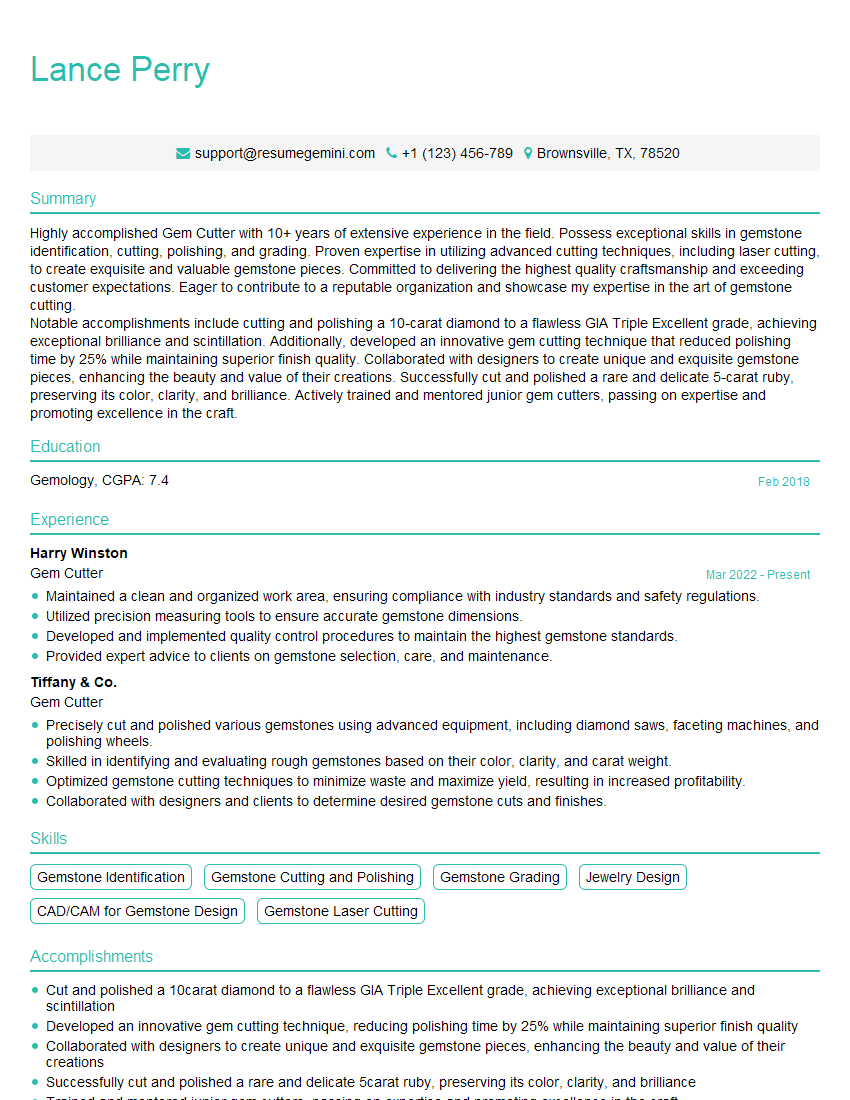
Mastering Basic Gemstone Cutting and Polishing opens doors to exciting career opportunities in the jewelry and gemstone industry. A strong understanding of these techniques will significantly enhance your job prospects and allow you to showcase your expertise. To maximize your chances of securing your dream role, creating a professional and ATS-friendly resume is paramount. ResumeGemini is a trusted resource that can help you build a compelling resume that highlights your skills and experience effectively. We provide examples of resumes tailored to Basic Gemstone Cutting and Polishing to guide you in showcasing your unique qualifications. Invest time in crafting a resume that truly reflects your capabilities – it’s your first impression to potential employers.
Explore more articles
Users Rating of Our Blogs
Share Your Experience
We value your feedback! Please rate our content and share your thoughts (optional).
What Readers Say About Our Blog
Very informative content, great job.
good