The thought of an interview can be nerve-wracking, but the right preparation can make all the difference. Explore this comprehensive guide to Basic sewing machine maintenance interview questions and gain the confidence you need to showcase your abilities and secure the role.
Questions Asked in Basic sewing machine maintenance Interview
Q 1. What are the common causes of skipped stitches on a sewing machine?
Skipped stitches are a common sewing machine frustration, often stemming from several interconnected issues. Think of it like a car engine misfiring – something is preventing the smooth, coordinated movement needed for perfect stitching.
- Incorrect Threading: This is the most frequent culprit. Improperly threaded needles, bobbins, or tension dials disrupt the delicate balance of thread flow. Imagine trying to braid hair with tangled strands – the result is uneven and messy. Double-check your machine’s manual for the precise threading route.
- Bent or Damaged Needle: A bent or dull needle can’t properly penetrate the fabric, causing skipped stitches. It’s like trying to sew with a blunt knife – it struggles to cut cleanly. Regularly inspect and replace your needles.
- Incorrect Needle Size or Type: Using the wrong needle for your fabric weight can lead to skipped stitches. A too-fine needle struggles with thick fabric, while a too-thick needle might damage delicate fabrics and also skip stitches. Always match your needle to your fabric.
- Improper Tension: If the upper or lower tension is too loose or too tight, the threads won’t interlock properly, leading to skipped stitches. This is like trying to tie shoelaces with one too loose and one too tight – they won’t knot securely.
- Dirty Hook or Bobbin Case: Lint and dust buildup in the bobbin area interfere with the smooth movement of the hook and bobbin, causing skipped stitches. Regular cleaning is essential for reliable performance.
Troubleshooting involves systematically eliminating each possibility, starting with the simplest (threading) and progressing to the more complex (timing).
Q 2. How do you lubricate a sewing machine properly?
Lubrication is crucial for the longevity and smooth operation of your sewing machine. It’s like oiling the hinges of a door – preventing squeaks and ensuring smooth, effortless movement. Use only high-quality sewing machine oil; household oils can damage the machine’s delicate parts.
Most machines have designated oiling points, usually indicated in the manual. Apply a single drop of oil to each point, avoiding excessive lubrication which can attract dust and lint. Common oiling points include the hook race, the shuttle race, and the various moving parts of the feeding mechanism. Gently wipe away any excess oil.
Lubricate your machine regularly, the frequency depends on how often you use it – at least once a month for regular use, and more frequently if you sew extensively.
Always consult your machine’s manual for its specific lubrication instructions and points, as models vary. Never oil the motor or electrical components.
Q 3. Describe the process of changing a sewing machine needle.
Changing a sewing machine needle is a simple yet critical task that needs to be performed regularly. A dull or bent needle can lead to a variety of problems, from skipped stitches to broken needles, which could even damage your machine. It’s a quick process, but precise technique avoids accidental damage.
- Turn off and unplug the machine: Safety first! Always unplug the machine before any maintenance.
- Loosen the needle clamp screw: Locate the screw that holds the needle in place, usually located just above the needle plate. Loosen it slightly, but don’t remove it completely.
- Remove the old needle: Carefully pull the old needle straight upwards, holding the shank firmly. Do not force it or twist it, this could damage the needle clamp.
- Insert the new needle: Carefully insert the new needle, flat side of the shank towards the back of the machine, ensuring it is firmly seated in the clamp.
- Tighten the needle clamp screw: Tighten the screw firmly using your fingers, ensuring the needle is secure. Do not overtighten, it could damage the needle or the clamp.
Remember to always use the correct type and size of needle for your fabric and project.
Q 4. What are the signs of a worn-out sewing machine belt?
A worn-out sewing machine belt is a common problem, usually indicated by several telltale signs. Think of it like a worn-out fan belt in a car; the machine won’t function properly without it.
- Slipping or Skipping: The most obvious sign is a noticeable slipping or skipping of the belt. You will notice the machine struggling to operate or the speed fluctuating erratically.
- Cracking or Fissures: Visually inspect the belt for cracks, fissures, or other signs of deterioration. A belt in poor condition will look dry, brittle, and have visible imperfections.
- Increased Noise Levels: A worn belt often makes an unusual amount of noise. This could be squeaking, squealing, or a general increase in the machine’s operating noise.
- Weakening and Stretching: Over time, a belt can stretch and weaken, losing its elasticity. This can lead to slipping and operational issues. The belt may appear loose or saggy when the machine is turned off.
If you notice any of these signs, replace the belt immediately. Using a worn belt can damage the motor or other machine components.
Q 5. How do you clean and maintain the bobbin case?
Cleaning and maintaining the bobbin case is essential for preventing skipped stitches, tension problems, and ensuring smooth sewing. Imagine it’s like cleaning the carburetor of a car; ensuring all the moving parts are free of obstructions.
- Remove the bobbin case: Carefully remove the bobbin case from your sewing machine, following the instructions in your manual. Be gentle, the case can be surprisingly delicate.
- Remove the bobbin: Take the bobbin out of the bobbin case.
- Clean the bobbin case: Use a small brush and/or compressed air to gently remove any lint, dust, or thread debris from the bobbin case. Pay close attention to all the small crevices and openings. A toothpick can also be helpful for removing stubborn lint.
- Check for damage: Carefully examine the bobbin case for any damage or wear. If the case is damaged, you will need to replace it.
- Reassemble: After cleaning, reinsert the bobbin into the bobbin case and then carefully place the bobbin case back into your sewing machine.
Regular cleaning, at least monthly for frequent users, will prevent problems and keep your sewing machine running smoothly.
Q 6. What are the different types of sewing machine needles and their uses?
Sewing machine needles come in a variety of types and sizes, each designed for specific fabrics and sewing tasks. Choosing the right needle is as crucial as choosing the right tool for any job.
- Universal Needles: These are the most common type, suitable for a wide range of fabrics, from cotton and linen to lightweight knits and synthetics. They’re the versatile workhorses of your needle collection.
- Ballpoint Needles: Designed for knit fabrics, their rounded tip prevents snagging and damage to stretchy materials. Think of them as specialized needles for stretchy fabrics.
- Sharp Needles: Ideal for woven fabrics such as cotton, linen, silk, and denim, their sharp point creates clean, precise stitches. They are the standard for woven materials.
- Stretch Needles: Similar to ballpoint needles but with a slightly different shape for added elasticity for highly stretchy fabrics like jersey and spandex.
- Embroidery Needles: These needles usually have a larger eye and are designed for thicker embroidery threads. They’re built for decorative and detailed stitching.
- Jeans/Heavy-duty Needles: Stronger needles designed for thick, durable fabrics such as denim, canvas, and leather. They can easily handle the tougher materials.
Needle size is indicated by a number, such as 90/14. The number relates to the needle’s diameter, with larger numbers indicating thicker needles. Always check your machine’s manual for compatible needle sizes.
Q 7. How do you identify and resolve timing issues on a sewing machine?
Timing issues on a sewing machine manifest as inconsistent stitch formation, broken stitches, or the needle striking the bobbin case. Identifying and resolving them requires a systematic approach.
Identifying Timing Issues: The most common sign is a consistently missed stitch pattern – perhaps every other stitch is incorrect. This indicates a problem with the coordination between the needle’s up-and-down motion and the shuttle or hook’s rotation. This rhythmic synchronization is vital for correct stitching.
Resolving Timing Issues: This is a more advanced maintenance task and often requires a certain level of mechanical aptitude or professional assistance. Incorrect timing usually needs expert adjustment, as it often involves precise internal adjustments to gears and the machine’s feed mechanism. Improper adjustments can further damage the machine, so it’s crucial to:
- Consult Your Manual: Check for your machine’s specific instructions on timing adjustments. Some machines have user-adjustable settings, but others require professional attention.
- Seek Professional Help: If your manual doesn’t provide instructions or if you feel uncomfortable making internal adjustments, consult a qualified sewing machine repair technician. They have the tools and expertise to diagnose and fix timing issues safely and accurately.
Attempting to adjust timing yourself without proper knowledge and tools is strongly discouraged, as it risks causing more damage.
Q 8. What safety precautions should be taken when maintaining a sewing machine?
Sewing machine maintenance, while rewarding, demands careful attention to safety. Think of it like working with any power tool – respect is key.
- Always unplug the machine before performing any maintenance task. This prevents accidental shocks and injury.
- Keep your workspace clean and well-lit to avoid tripping hazards and to see clearly what you’re doing. Clutter increases the chance of accidents.
- Use the appropriate tools. Improper tools can lead to damage or injury. A screwdriver that’s too big for the screw, for instance, can easily strip the screw head.
- Be mindful of moving parts. Never reach into the machine while it’s running. Even when powered off, some components may retain momentum.
- Dispose of waste materials properly such as broken needles and sharp scraps. Use a designated container to prevent accidental cuts and punctures.
- If you’re unsure about a procedure, consult your machine’s manual or seek professional help. Don’t attempt repairs beyond your skill level.
For example, I once saw someone try to clean their machine while it was still plugged in, leading to a minor electrical shock. Always prioritize safety first!
Q 9. How do you troubleshoot a sewing machine that is making unusual noises?
Unusual noises from your sewing machine often signal a problem that needs attention. Think of it like your car making a strange sound – you wouldn’t ignore it!
Troubleshooting starts with identifying the sound. Is it a grinding, clicking, whirring, or something else? This helps pinpoint the source.
- Grinding noises might indicate a worn or damaged needle, bent needle plate, or problems with the timing of the machine’s internal gears.
- Clicking sounds often come from loose parts or a need for lubrication.
- Whirring sounds can be due to excessive friction in the bobbin area or problems with the motor.
Next, systematically check:
- The needle: Replace it with a new, correctly sized needle.
- The bobbin case and bobbin: Ensure they are correctly wound and seated. Check for any debris or damage.
- The feed dogs: Make sure they move freely and aren’t obstructed by debris.
- The tension discs: Clean and lubricate these components according to the machine manual.
- The motor belt: Inspect the belt for wear and tear.
If the noise persists after these checks, professional servicing might be necessary. It’s better to be safe than sorry, especially with more complex internal mechanisms.
Q 10. What are the common problems associated with a broken needle?
A broken needle is a common sewing machine woe, leading to several frustrating issues. It can be a real productivity killer!
- Skipped stitches: A bent or broken needle often causes erratic stitch formation, leading to gaps in your seam.
- Broken thread: The needle’s broken point can snag or cut the thread, causing constant breakage.
- Damaged fabric: A broken needle tip can pierce the fabric, creating holes or snags.
- Needle plate damage: A violently broken needle can gouge or dent the needle plate.
Imagine trying to sew a delicate garment with a broken needle – disastrous! Therefore, always check your needle regularly for any bends or damage and replace it immediately if needed. Using a correctly sized needle appropriate for your fabric type is crucial to prevent breakages.
Q 11. Explain the function of the feed dogs.
Feed dogs are small, tooth-like components located beneath the needle plate. Think of them as the ‘grip’ of your sewing machine. They’re crucial for moving the fabric smoothly during sewing.
Their function is to grip and feed the fabric evenly under the needle, ensuring a consistent stitch length and preventing puckering or pulling. They operate in tandem with the presser foot to control the fabric’s movement. Without properly functioning feed dogs, your sewing would be extremely uneven and difficult.
For example, if the feed dogs are clogged with lint or damaged, they won’t feed the fabric properly. This leads to inconsistent stitches, skipped stitches, and frustrated sewers! Regular cleaning is essential for maintaining their optimal functionality.
Q 12. How do you adjust the tension on a sewing machine?
Tension adjustment is essential for achieving even, balanced stitching. It’s a balancing act between the upper and lower tensions.
The upper tension is controlled by a dial or knob on the sewing machine’s body, while the lower tension (which controls the bobbin tension) is usually adjusted by tightening or loosening the bobbin case screw (check your manual for specifics!).
Adjusting tension involves trial and error. Start by sewing a test seam. If the stitches are too loose, increase the upper tension. If they are too tight, decrease it. Conversely, if the stitches bunch up on the underside, loosen the bobbin case tension, and vice versa.
Ideally, you want evenly spaced stitches on both sides of the fabric. Think of it like a finely tuned instrument—a little adjustment can make all the difference.
Q 13. How do you clean the lint and debris from a sewing machine?
Lint and debris build-up is a common problem with sewing machines, causing all sorts of issues. Think of it like dust accumulating in your home – it needs regular cleaning!
Cleaning involves a few steps:
- Unplug the machine: Safety first!
- Remove the needle and presser foot: This gives you better access to the internal components.
- Use a brush (soft brush is best) to remove lint from all accessible areas, including around the bobbin case, the feed dogs, and under the needle plate.
- Use compressed air (canned air) to blow out stubborn lint in hard-to-reach places. Be gentle to avoid damaging components.
- Vacuum out larger debris: If using a vacuum, use a soft brush attachment to avoid scratching surfaces.
- Clean the bobbin case and area thoroughly: These areas are particularly prone to lint build-up.
Regular cleaning, ideally after each project or at least weekly, keeps your sewing machine running smoothly and prevents more significant problems down the road.
Q 14. What is the importance of regular sewing machine maintenance?
Regular sewing machine maintenance is vital for its longevity, performance, and even safety. Ignoring maintenance is like neglecting your car – minor problems can escalate into major breakdowns.
- Prolonged machine life: Regular cleaning and lubrication prevent wear and tear, extending the machine’s lifespan. It’s an investment in your equipment.
- Consistent stitching quality: A well-maintained machine produces consistent, high-quality stitches, resulting in professional-looking projects.
- Reduced risk of damage: Regular maintenance helps identify and prevent problems before they escalate, saving you money and frustration in the long run.
- Safety: A clean and well-maintained machine is a safer machine, reducing the risks associated with malfunctioning components.
Think of it this way: A well-maintained sewing machine is a joy to use, producing beautiful results with minimal frustration. A neglected machine is a source of constant problems and wasted time. Regular maintenance ensures your sewing experience is consistently positive and productive.
Q 15. How often should a sewing machine be serviced?
The frequency of sewing machine servicing depends heavily on usage. For hobbyists who sew occasionally, a yearly service is often sufficient. However, for professional tailors or those who sew daily, semi-annual or even quarterly servicing might be necessary. Think of it like a car – the more you drive it, the more frequently it needs maintenance. Ignoring regular servicing can lead to costly repairs down the line, and potentially damage your projects.
Career Expert Tips:
- Ace those interviews! Prepare effectively by reviewing the Top 50 Most Common Interview Questions on ResumeGemini.
- Navigate your job search with confidence! Explore a wide range of Career Tips on ResumeGemini. Learn about common challenges and recommendations to overcome them.
- Craft the perfect resume! Master the Art of Resume Writing with ResumeGemini’s guide. Showcase your unique qualifications and achievements effectively.
- Don’t miss out on holiday savings! Build your dream resume with ResumeGemini’s ATS optimized templates.
Q 16. What tools are essential for basic sewing machine maintenance?
Basic sewing machine maintenance requires a small but essential toolkit. You’ll need a soft brush (like a paintbrush) to remove lint and dust, a small screwdriver set (both Phillips and flathead), sewing machine oil (specifically designed for sewing machines – never use household oil!), and a lint brush or compressed air for cleaning hard-to-reach areas. A pair of tweezers can also be very helpful for removing tiny bits of thread or debris. Having a well-lit workspace is also crucial for precise maintenance.
Q 17. How do you identify and replace a broken sewing machine belt?
A broken sewing machine belt is usually identified by a machine that won’t stitch or stitches erratically, often accompanied by a noticeable whirring or grinding sound as the motor runs without transferring power. Replacing it involves opening the machine’s casing (refer to your machine’s manual for guidance – some models are easier to access than others!), carefully removing the old belt (taking note of its placement), and then installing the new belt in the exact same manner. Ensure the belt sits correctly in all grooves to avoid slippage. It’s a good idea to have a replacement belt on hand, as they can unexpectedly break.
Q 18. How do you thread a sewing machine correctly?
Threading a sewing machine correctly is critical for proper stitching. Each machine has its own threading path, and it’s crucial to follow the diagram printed on the machine itself. Generally, you’ll start by raising the presser foot, then guiding the thread through the tension discs (located at the top of the machine), around the take-up lever (a small, rotating lever), and down to the needle. Always make sure the thread is smooth and not twisted to avoid breakage. Incorrect threading can cause skipped stitches, thread breakage, and potentially damage the machine. Refer to your machine’s manual for the specific steps of your model. Imagine threading a needle – it’s a similar concept but on a larger scale.
Q 19. What are the signs of a worn-out presser foot?
A worn-out presser foot shows signs of wear and tear in several ways. You might notice scratches or dents on the foot’s soleplate, affecting the evenness of the stitch. It might also become loose or wobbly, leading to inconsistent stitching. The most common indication is the inability to consistently feed fabric smoothly; the fabric might bunch up or drag. If you suspect wear and tear, inspect the foot for damage, and consider replacing it as a worn presser foot can negatively impact stitch quality and fabric handling.
Q 20. How do you adjust the stitch length on a sewing machine?
Adjusting the stitch length is typically done using a dial or knob located on the front or side of your sewing machine. It’s usually clearly marked with numbers representing the length of the stitch in millimeters or stitches per inch (spi). A longer stitch length (larger number) is suitable for basting or seams that need flexibility, while a shorter stitch length (smaller number) is ideal for finer details and durable seams. Experimentation is key – it might require some trial and error to find your ideal settings for different fabrics and projects.
Q 21. How do you deal with a tangled thread in a sewing machine?
Dealing with a tangled thread requires patience and careful attention. Always turn the handwheel (the large wheel on the side of the machine) to gently unwind the thread. Start by removing the bobbin, if necessary, and carefully untangling any visible threads from the bobbin case or around the needle. Using tweezers can help in accessing those hard-to-reach tangles. Remember to never force anything; gently work the thread free to avoid damaging delicate parts of your machine. Prevention is key – ensure the thread is properly fed to avoid this issue in the first place.
Q 22. What is the purpose of the stitch regulator?
The stitch regulator, often found on higher-end sewing machines, is a crucial component for maintaining consistent stitch length and evenness, regardless of sewing speed. Think of it as the ‘cruise control’ for your stitches. Without it, your stitches might become longer or shorter depending on how quickly you push the foot pedal. A consistent stitch length is essential for achieving professional-looking seams and preventing skipped stitches or puckering.
It works by electronically monitoring and adjusting the feed dogs’ movement, which are the parts that move the fabric under the needle. This precise control ensures that the needle penetrates the fabric at precisely timed intervals, resulting in beautifully uniform stitches. This is especially important for delicate fabrics or intricate projects where even, consistent stitching is paramount.
Q 23. How do you know when to replace a sewing machine motor?
Knowing when to replace a sewing machine motor isn’t always straightforward, but there are key indicators. A loud, unusual humming or grinding sound is a major red flag. This indicates worn bearings or internal damage, potentially leading to complete motor failure. Overheating, where the motor gets excessively hot to the touch after only short periods of use, is another significant warning sign. This could be due to a failing capacitor or windings within the motor.
Weakened power is also a tell-tale symptom; the motor struggles to maintain speed, especially under load (e.g., sewing thick fabrics). If you experience these problems, it’s wise to have a professional assess the motor. Replacing the motor is generally a more cost-effective solution than extensive repairs, particularly if the machine is older or you value consistent performance. Sometimes, the motor simply can’t handle a certain kind of workload, and a replacement might be a good investment for a heavier duty machine.
Q 24. Describe your experience with different types of sewing machines.
My experience spans various sewing machine types, from basic mechanical models to advanced computerized machines and industrial models. I’ve worked extensively with both direct-drive and belt-driven machines. Mechanical machines, although simpler, require a deeper understanding of their mechanisms for effective troubleshooting. I find their straightforward design allows for quicker repairs and a clear understanding of cause and effect. Computerized machines present a different challenge, requiring knowledge of electronic components and software diagnostics. However, their ease of use and features make them popular for diverse sewing tasks.
Industrial machines, often used in manufacturing settings, are robust and built for heavy-duty work. Their intricate design and power require specialized skills and knowledge to handle. The experience gained with each type has provided a comprehensive understanding of the mechanics and electronics involved in different sewing machine designs and applications.
Q 25. How do you troubleshoot a sewing machine that won’t start?
Troubleshooting a sewing machine that won’t start requires a systematic approach. First, check the power supply – is the machine plugged in securely? Is the power outlet working? Then, inspect the power switch. Is it in the ‘on’ position? Does it feel loose or damaged? A simple test is to use a multimeter to check if power is reaching the machine.
If power is confirmed, inspect the foot pedal. Does the pedal’s cord have any visible damage? Sometimes, the pedal itself might be faulty, requiring replacement. If all electrical components are working correctly, the issue might be mechanical. Check the belt, making sure it’s correctly placed on the motor pulley and handwheel. Also, investigate any internal components that might be jammed.
If you’re unsure about any step, it’s best to consult a repair manual specific to your machine model or seek professional help. Forcing things when the cause is unknown could lead to further damage.
Q 26. What is your experience with different sewing machine brands?
Over the years, I’ve gained experience working with many sewing machine brands, including Singer, Brother, Bernina, Janome, and Juki. Each brand has its own design philosophy and characteristic strengths and weaknesses. Singer is known for its wide range of models, from basic to advanced. Brother offers excellent value for money, combining features and reliability. Bernina is renowned for high-end machines favored by professionals for precision and quality.
Janome provides reliable workhorses, while Juki is popular for its industrial and heavy-duty machines. My experience across these brands has taught me to adapt my approach based on the machine’s specific design and common problem areas associated with each brand. Understanding these brand-specific nuances is key to efficient and effective repair.
Q 27. Explain your process for diagnosing sewing machine problems.
My process for diagnosing sewing machine problems involves a structured, multi-step approach. It starts with a thorough visual inspection of the machine’s exterior and interior, checking for any obvious signs of damage or wear. Next, I’ll listen carefully for unusual sounds, such as grinding, clicking, or humming, that can indicate specific issues.
Then I proceed to testing the basic functions. I’ll try sewing on different fabric types, varying the stitch length and width to assess the performance under different conditions. Any inconsistencies during this process help pinpoint the problem areas. For example, uneven stitches might point to issues with the feed dogs, while skipped stitches could indicate timing or needle problems. I always keep detailed notes, documenting the symptoms and my testing procedure – this is especially crucial for warranty claims or unusual cases. If the diagnosis requires more advanced tools or skills, I don’t hesitate to seek additional support or suggest the client seek professional assistance.
Q 28. How do you handle difficult or unusual sewing machine repair requests?
Handling difficult or unusual sewing machine repair requests requires a combination of creativity, problem-solving skills, and a willingness to learn. I start by thoroughly documenting the problem, including any unusual symptoms or user feedback. This may involve taking photos or videos of the machine’s behavior. I then try to replicate the problem, if possible, to better understand the root cause.
For rare problems, I might research online forums, consult technical manuals or reach out to experienced colleagues or manufacturers. I always prioritize safety, ensuring that any repairs I attempt don’t risk causing more damage. If the problem proves too complex or beyond my skill set, I am upfront with the client and provide recommendations for seeking specialist help from authorized repair centers or more experienced technicians. The key is honesty, clear communication, and a commitment to finding a solution.
Key Topics to Learn for Basic Sewing Machine Maintenance Interview
- Understanding Sewing Machine Mechanics: Learn the basic components of a sewing machine (needle, bobbin, feed dogs, etc.) and their functions. Be prepared to explain how they interact during the sewing process.
- Thread Management and Tension: Master the art of threading the machine correctly, adjusting tension for different fabrics, and troubleshooting common threading issues. Practice identifying and resolving problems related to upper and lower thread tension.
- Needle Selection and Maintenance: Understand the different types of needles and their appropriate uses. Learn how to identify a bent or damaged needle and the importance of regular needle changes for optimal stitching.
- Bobbin Winding and Insertion: Practice winding bobbins efficiently and correctly inserting them into the machine. Be able to explain the significance of a properly wound bobbin for consistent stitching.
- Cleaning and Lubrication: Learn how to clean the machine’s internal parts (using appropriate tools), remove lint and debris, and apply lubrication where necessary. Explain the importance of regular maintenance for prolonging machine lifespan and preventing malfunctions.
- Troubleshooting Common Problems: Prepare to discuss common sewing machine issues such as skipped stitches, broken needles, inconsistent tension, and jammed feed dogs. Explain your approach to diagnosing and solving these problems.
- Safety Procedures: Discuss the importance of safety when working with sewing machines. This includes proper handling of needles, use of safety guards, and awareness of potential hazards.
Next Steps
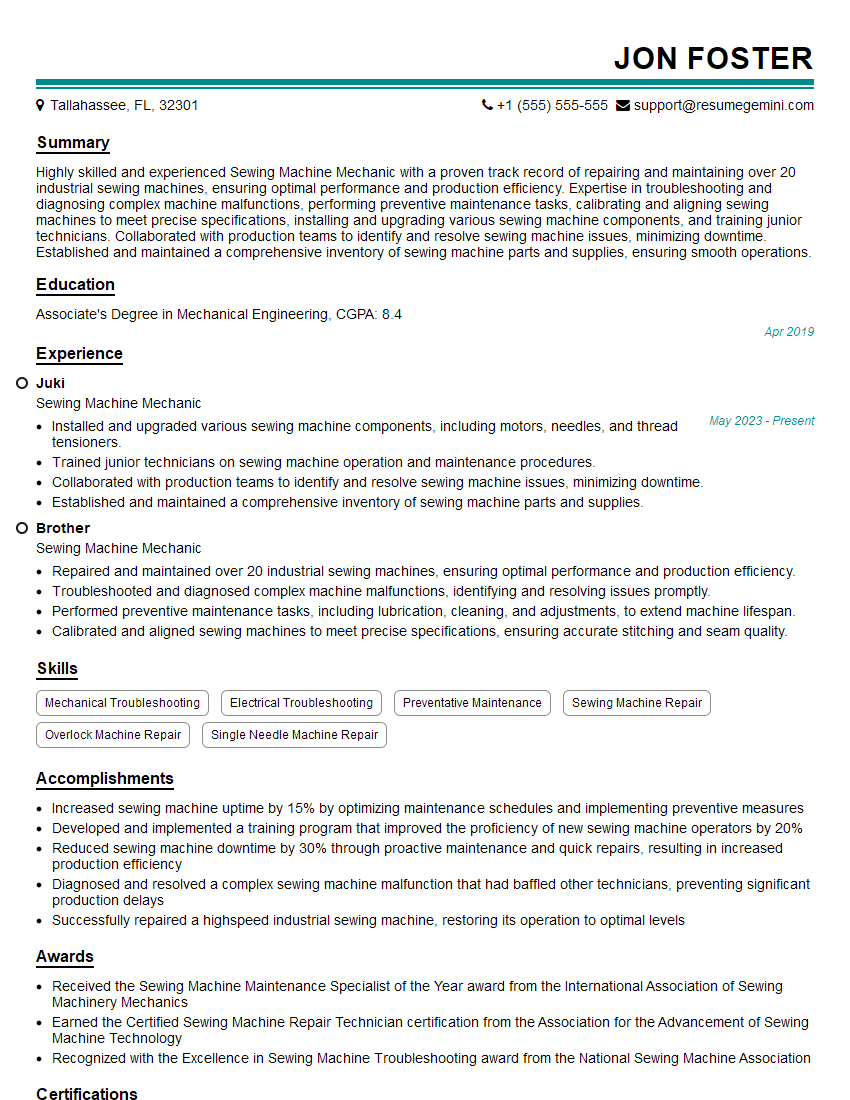
Mastering basic sewing machine maintenance is crucial for success in many roles within the textile and fashion industries, demonstrating your practical skills and attention to detail. A well-crafted resume is your key to unlocking these opportunities. Building an ATS-friendly resume increases your chances of getting noticed by recruiters. ResumeGemini can help you create a professional and impactful resume tailored to highlight your skills in sewing machine maintenance. Examples of resumes specifically designed for this field are available to guide you. Take the next step towards your dream career – build a winning resume with ResumeGemini today.
Explore more articles
Users Rating of Our Blogs
Share Your Experience
We value your feedback! Please rate our content and share your thoughts (optional).
What Readers Say About Our Blog
Very informative content, great job.
good