Are you ready to stand out in your next interview? Understanding and preparing for Bending Operation interview questions is a game-changer. In this blog, we’ve compiled key questions and expert advice to help you showcase your skills with confidence and precision. Let’s get started on your journey to acing the interview.
Questions Asked in Bending Operation Interview
Q 1. Explain the difference between air bending and bottom bending.
Air bending and bottom bending are two common methods used in press brake operations to form sheet metal. The key difference lies in how the punch and die interact with the workpiece and the resulting bend.
In air bending, the punch presses the sheet metal against the die, causing it to bend. The punch doesn’t fully contact the bottom of the die; there’s a small gap, or ‘air gap,’ between them. This method results in a more consistent bend radius and is less likely to cause surface marring on the workpiece. Think of it like gently pushing a piece of paper down onto a flat surface – it bends smoothly.
Bottom bending, on the other hand, involves the punch completely forcing the sheet metal to the bottom of the die. This creates a sharper bend but can lead to inconsistent results and potential damage to the workpiece if not done precisely. It’s like sharply creasing a piece of paper – you get a much more defined fold, but the crease itself may be less smooth.
The choice between air bending and bottom bending depends on the desired bend radius, material thickness, and the overall quality requirements. Air bending is generally preferred for its accuracy and gentler handling of the material, while bottom bending is sometimes chosen for its ability to achieve very sharp bends.
Q 2. Describe the safety procedures you follow when operating a press brake.
Safety is paramount when operating a press brake. My procedures always start with a thorough machine inspection before starting any work. I check for loose parts, proper lubrication, and ensure all safety guards are in place and functioning correctly. I never operate the machine without appropriate personal protective equipment (PPE), including safety glasses, hearing protection, and steel-toe boots.
Before each bend, I double-check the die set is correctly aligned and that the program accurately reflects the material properties and desired bend angle. I ensure the workpiece is securely clamped to prevent slippage. I always use the two-hand operation feature, so both my hands are away from the bending area when the machine is cycling. After completion, I power down the machine and remove all materials in a safe manner.
Regular training on press brake operation and safety protocols is crucial. I keep myself updated on the latest safety guidelines and procedures, and I never hesitate to stop the work if I sense a potential hazard.
Q 3. How do you determine the appropriate bending force for a given material and bend angle?
Determining the appropriate bending force requires understanding both the material’s properties and the geometry of the bend. The force is largely influenced by the material’s tensile strength, yield strength, and thickness, as well as the bend radius and angle. Accurate calculation usually involves using bending formulas or consulting material property charts and manufacturer’s data.
Many press brake manufacturers provide software or online calculators that take inputs such as material type, thickness, length, and bend angle to estimate the required tonnage. For example, a thicker piece of steel will require significantly more bending force than a thinner sheet of aluminum, even at the same bend angle. A sharp bend will also need greater force than a wide bend.
In my work, I usually start with a calculated estimate and make adjustments based on actual bending results and observations. I always prioritize safety and operate the machine well within its capacity to avoid machine damage and ensure consistent results.
Q 4. What are the common causes of bending defects, and how do you address them?
Common bending defects stem from various causes, including incorrect bend angle, material defects (like inconsistencies in thickness or surface imperfections), improper die selection, and insufficient or excessive bending force.
- Springback: The tendency of the material to partially return to its original shape after bending. This is usually addressed by over-bending the material to compensate for the springback effect. We use specialized software or bending handbooks to predict and adjust for springback.
- Fracturing/Cracking: This occurs if the bending force exceeds the material’s yield strength. It can be avoided by using proper bending techniques, selecting suitable dies, and optimizing the bending force.
- Wrinkling/Buckling: Often seen in bending thin materials, this is due to insufficient support or improper die geometry. To mitigate this, we may use different die types or add support devices to prevent buckling.
- Scoring/Marring: Damage to the material’s surface can be caused by using inappropriate or dull dies. Regular die maintenance and proper lubrication minimize such issues.
Addressing these defects involves a systematic approach. I start by analyzing the defect, identifying the root cause, and then adjusting the bending parameters (force, angle, die selection) or modifying the workpiece setup. Sometimes, I might even need to change the material if the defects are inherent to its properties.
Q 5. Explain the role of a die set in the bending process.
A die set in bending is a crucial component comprising an upper punch and a lower die. It shapes and defines the bend. The punch applies the force, while the die provides the support and determines the final bend radius and angle.
The choice of die set is critical for achieving the desired results. Different types of dies cater to varying needs – V-dies are commonly used for simple bends, while specialized dies like radius dies or air bending dies are employed for more precise or complex bending operations. The proper die selection needs to account for the material’s thickness and the desired bend characteristics.
Die maintenance is equally vital. Regular inspection for wear and tear, ensuring proper alignment, and keeping the dies clean and lubricated are necessary for producing consistent and high-quality bends. Dull or damaged dies can lead to material damage and inconsistent bends.
Q 6. How do you calculate the bend allowance?
Bend allowance calculation is essential for accurately determining the flat length of material required to achieve a desired bend. The bend allowance compensates for the additional length consumed during the bending process due to the material’s elongation in the bend area.
The calculation is often done using different formulas depending on the bend type and material properties, but a common approximation involves:
Bend Allowance ≈ (Bend Radius × Bend Angle in Radians)
where the bend angle in radians is calculated by converting the angle from degrees to radians (Radians = Degrees × π / 180). Bend radius is the distance from the neutral axis to the inside radius of the bend.
Many bending handbooks and software applications provide more detailed formulas and calculations that take into account additional factors such as material thickness, and the bend type.
Q 7. What is the importance of material properties in bending?
Material properties are fundamentally important in bending because they directly influence the bending force required, the final bend shape, and the likelihood of defects. Factors such as tensile strength, yield strength, elastic modulus (Young’s modulus), and ductility significantly impact the bending process.
For example, a high-tensile-strength material will require more bending force to achieve the same bend angle compared to a lower-strength material. Materials with higher ductility (ability to deform permanently without fracture) are more easily bent and are less prone to cracking during the bending process, while materials with higher elastic modulus show more springback.
Understanding these properties and using material data sheets or software to accurately calculate bending forces ensures consistent and high-quality bends and prevents material failure or damage. Without proper consideration of material properties, the results may be unpredictable and potentially hazardous.
Q 8. How do you select the appropriate bending tools for a specific job?
Selecting the right bending tools depends heavily on the material, thickness, and desired bend radius. It’s like choosing the right tool for a carpentry job – you wouldn’t use a hammer to screw in a screw.
- Material Type and Thickness: Thicker materials require more robust tools. For example, bending mild steel of 1/4” thickness needs a much stronger press brake than bending aluminum sheet of 1/16”.
- Bend Radius: The desired bend radius dictates the die size. A tighter radius requires smaller radius dies, potentially needing specialized tooling like V-dies or even air bending tools for delicate materials.
- Bend Angle Accuracy: For high-precision applications, tools with features like digital backgauges and adjustable dies are essential. Less critical bends can be achieved with simpler tooling.
- Production Volume: High-volume production warrants investing in specialized tooling designed for speed and efficiency, such as progressive dies or robotic bending systems. For one-off projects, simpler, more versatile tooling is suitable.
For instance, bending a small batch of thin aluminum parts might use a hand bender, while mass-producing thick steel parts demands a powerful hydraulic press brake with dedicated tooling.
Q 9. Describe your experience with different types of press brakes (e.g., hydraulic, mechanical).
I’ve extensive experience with both hydraulic and mechanical press brakes. Hydraulic presses are generally preferred for their versatility and smoother operation. They offer more precise control over bending force and speed, making them ideal for complex bends and a variety of materials.
- Hydraulic Press Brakes: Offer greater versatility in bending force and speed adjustment, allowing for gentler bending of thinner materials or more forceful bending of thicker materials. They are easier to program for automated operation.
- Mechanical Press Brakes: These are generally more robust and simpler mechanically. They tend to be more cost-effective, however, they offer less control over bending force and are typically used for simpler, high-volume tasks where precision isn’t paramount.
In my previous role, we used a large hydraulic press brake for high-precision bends in stainless steel, whereas our mechanical press brake was primarily used for simple bends in mild steel for large production runs. The choice always hinged on the specifics of the job.
Q 10. How do you measure the accuracy of a bend?
Bend accuracy is measured using a variety of tools and techniques. The most common methods focus on verifying the bend angle and the dimensions of the bent part.
- Protractor or Angle Gauge: A simple but effective method for measuring the bend angle directly on the finished part.
- Digital Angle Gauge: Offers improved accuracy compared to analog protractors.
- Calipers: Used to measure the overall dimensions of the bent part, such as the length and width, to ensure they meet the specifications.
- Coordinate Measuring Machine (CMM): For highly precise measurements, especially in complex geometries.
For example, if the design calls for a 90-degree bend with a tolerance of ±0.5 degrees, we’d use a digital angle gauge to ensure the actual bend falls within that range. We’d also use calipers to check the overall dimensions are correct after bending.
Q 11. Explain the process of setting up a press brake for a new job.
Setting up a press brake for a new job is a systematic process that requires precision and attention to detail. Think of it as preparing a culinary masterpiece – every step needs to be accurate.
- Determine Tooling: Select the appropriate dies (V-die, Gooseneck, etc.) and punches based on the material thickness, bend radius, and desired bend angle.
- Position the Dies: Carefully place the dies into the press brake, ensuring they are correctly aligned and securely fastened.
- Program the Backgauge: Set the backgauge to the required distance to achieve the desired bend length. This step is crucial for consistent results.
- Set the Bend Angle: Adjust the press brake’s controls to achieve the target bend angle. This may involve fine-tuning adjustments using the machine’s controls and monitoring the bending process.
- Perform a Test Bend: Before starting full production, always conduct a test bend on a scrap piece of material to verify the accuracy of the setup. Make any necessary adjustments.
- Production Run: After successfully testing the bend, proceed with the production run.
For example, if bending a U-shaped part, the backgauge needs to be set precisely to achieve the desired length of the part’s sides, and the dies chosen need to match the bend radius to avoid bending damage.
Q 12. How do you maintain and troubleshoot a press brake?
Regular maintenance and prompt troubleshooting are vital for ensuring the press brake’s safety and productivity. Neglecting maintenance is like neglecting your car – eventually, it will break down.
- Regular Inspections: Check for wear and tear on dies, punches, and other components. Look for any signs of damage or misalignment.
- Lubrication: Regularly lubricate moving parts according to the manufacturer’s recommendations to ensure smooth operation and prevent premature wear.
- Hydraulic System Maintenance: For hydraulic press brakes, regularly check fluid levels, filter conditions, and hydraulic pressure.
- Electrical System Checks: Ensure the electrical system is functioning correctly and that all safety interlocks are working properly.
- Troubleshooting: Common issues include bent or worn dies, hydraulic leaks, electrical malfunctions, and misalignment. Proper troubleshooting guides and diagnostic tools are essential.
For example, if the press brake isn’t bending accurately, you would check the alignment of the dies and punches first, followed by checking the backgauge settings. If a hydraulic leak is detected, it requires immediate attention from a qualified technician.
Q 13. What are the common types of sheet metal used in bending operations?
Many sheet metals are used in bending, each having its unique properties influencing the bending process. The selection depends on the application’s requirements for strength, corrosion resistance, and cost.
- Mild Steel: A common and cost-effective material, offering good strength and ductility.
- Stainless Steel: Offers superior corrosion resistance, making it ideal for outdoor applications. However, it’s harder to bend than mild steel.
- Aluminum: A lightweight and easily workable material, well-suited for applications where weight is a concern.
- Galvanized Steel: Offers corrosion protection and good strength, making it popular in construction.
- Copper and Brass: These materials are highly conductive and offer good corrosion resistance. They are often used for electrical and plumbing components.
The choice depends on the application – a car body might use mild steel for its strength and cost-effectiveness, whereas a food processing machine would use stainless steel for hygiene.
Q 14. Describe your experience with different bending materials (e.g., aluminum, steel, stainless steel).
My experience encompasses a wide range of materials, each requiring a different approach to bending. The key is understanding the material’s properties to avoid damage or inconsistent results.
- Aluminum: Soft and ductile, it bends easily but is susceptible to scratching and wrinkling if not handled carefully. Lower bending pressures and sharper dies are often used.
- Steel (Mild Steel, Stainless Steel, etc.): Steel is stronger and less ductile than aluminum, requiring higher bending pressures. The type of steel (mild steel, high-strength steel, stainless steel) significantly impacts the bending process and required tooling.
- Stainless Steel: Known for its work hardening, which increases its resistance to deformation over time. This needs to be considered when selecting the bending parameters, as it can lead to cracking if the bending process isn’t carefully managed.
For example, bending stainless steel often requires springback compensation (adjusting the bend angle slightly to account for the material’s tendency to spring back after bending) whereas bending aluminum often requires care to prevent wrinkling or surface damage.
Q 15. How do you handle different material thicknesses during bending?
Handling different material thicknesses in bending is crucial for achieving accurate and consistent results. The key is to adjust the bending parameters—specifically the pressure, die geometry, and bending angle—based on the material thickness. Thicker materials require more force to achieve the desired bend, while thinner materials are more susceptible to damage if excessive force is applied.
For example, when bending 1/8” steel, I might use a specific tonnage and a die set designed for that thickness. If I were then to bend 1/4” steel, I’d need to increase the tonnage significantly and possibly switch to a more robust die set designed for thicker materials. Furthermore, the bend angle itself might require minor adjustments due to springback (the tendency of the material to return to its original shape after bending). We often perform trial bends on scrap material of the same thickness and material before committing to a full production run.
Another aspect is material selection. Some materials, such as stainless steel or spring steel, exhibit greater springback than mild steel, requiring different bending parameters to achieve the desired final angle. Accurate calculations and practical experience are essential for successful bending of diverse material thicknesses.
Career Expert Tips:
- Ace those interviews! Prepare effectively by reviewing the Top 50 Most Common Interview Questions on ResumeGemini.
- Navigate your job search with confidence! Explore a wide range of Career Tips on ResumeGemini. Learn about common challenges and recommendations to overcome them.
- Craft the perfect resume! Master the Art of Resume Writing with ResumeGemini’s guide. Showcase your unique qualifications and achievements effectively.
- Don’t miss out on holiday savings! Build your dream resume with ResumeGemini’s ATS optimized templates.
Q 16. What are the safety considerations when working with different bending materials?
Safety is paramount in any bending operation. Different materials present unique hazards. For instance, working with sharp-edged materials like aluminum or stainless steel necessitates the use of appropriate gloves and eye protection to avoid cuts and abrasions. Materials like copper can work-harden quickly, requiring careful monitoring of the bending process to prevent cracks or fractures.
When working with thicker materials, potential for injury increases due to greater forces involved. Proper machine guarding and lockout/tagout procedures are crucial to prevent accidental activation of the press brake. Furthermore, handling heavy materials demands the use of lifting equipment (forklifts, cranes) or assistance to prevent back injuries.
Specific safety considerations may include understanding Material Safety Data Sheets (MSDS) for potentially hazardous materials, ensuring proper ventilation when working with materials that generate fumes during bending, and using appropriate hearing protection due to the noise generated by the equipment. Regular machine inspections and maintenance are also critical to avoid mechanical failures which could result in injury.
Q 17. Explain your understanding of bending radius and its significance.
The bending radius refers to the radius of the inner curve of the bent part. It’s a critical parameter in bending because it directly impacts the quality, strength, and appearance of the finished product. A too-tight bending radius can lead to cracking, while a too-large radius might result in a weak or undesirable bend.
The minimum bending radius is determined by the material’s thickness and ductility. Thicker materials require a larger minimum bend radius to avoid cracking, while more ductile materials can tolerate tighter radii. Choosing an appropriate bending radius is often guided by industry standards and best practices or through consultation of material specification sheets which often specify minimum bend radius values.
Imagine bending a paperclip; a small radius is easily achievable without tearing. However, try bending a thick steel rod with that same small radius—it’ll likely crack. The bending radius dictates the amount of material deformation, influencing the final shape and structural integrity of the bent part.
Q 18. How do you interpret engineering drawings related to bending operations?
Interpreting engineering drawings for bending operations requires careful attention to detail. The drawings usually specify the material, thickness, length, bend angles, and bend radii of each part. Detailed dimensions are provided along with tolerances, which indicate the acceptable range of variation in the final product.
I typically start by reviewing the drawing’s title block for material specifications and any special instructions. Then, I meticulously examine the dimensions and tolerances of each bend, including the bend angle, bend radius, and the lengths of the straight sections. Sometimes, drawings might include specific notations regarding the type of bending process required (air bending, bottom bending, etc.), or the desired surface finish.
For example, a drawing might specify a 90-degree bend with a 1/2” radius on a 1/8” thick piece of aluminum. Understanding the meaning and significance of each of these parameters is crucial in setting up the press brake to manufacture the part accurately.
Q 19. Describe your experience with CNC press brake programming.
I have extensive experience programming CNC press brakes using various software packages. My proficiency includes creating bending programs from scratch as well as modifying and optimizing existing programs. The process starts with interpreting the engineering drawings, then inputting the necessary parameters, like material thickness, bending angle, die selection, and press brake tonnage.
Proficiency in CNC press brake programming allows for creation of efficient programs that reduce setup time, minimize material waste, and enhance part quality. I am familiar with simulating the bending process virtually on the software before running the program on the machine, optimizing the process to avoid potential issues. This process reduces scrap and improves overall efficiency.
Furthermore, I understand how to compensate for springback in the program, ensuring that the final bent part meets the specified dimensions. Programming skills allow me to handle complex bending sequences involving multiple bends and complex part geometries.
Q 20. How do you ensure the quality and consistency of bent parts?
Ensuring the quality and consistency of bent parts involves a multi-faceted approach. It begins with meticulous attention to detail during the programming stage, followed by precise setup and execution of the bending operation. Material selection and proper die maintenance are also critical factors.
Precise programming, as mentioned earlier, is key. Regular calibration of the press brake ensures that the machine operates within its specified tolerances. Consistent material handling, preventing damage during feeding and positioning, is equally important. Regular maintenance of bending dies is crucial to prevent wear and tear, which could impact the accuracy of the bend.
Moreover, operator skill plays a significant role; skilled operators understand how to identify and correct minor variations that might arise during the bending process. A well-trained operator can adjust parameters in real-time as needed to maintain consistency throughout a production run. Employing statistical process control (SPC) techniques is vital for continual monitoring and improvement of the bending process.
Q 21. What are some common quality control checks for bent parts?
Common quality control checks for bent parts typically involve visual inspection, dimensional measurement, and sometimes, destructive testing. Visual inspection checks for any surface imperfections, such as cracks, scratches, or dents. Dimensional measurements use tools such as calipers and angle gauges to verify the accuracy of the bend angles, radii, and overall part dimensions against the engineering drawings. Tolerances specified on the drawings dictate whether a part is deemed acceptable.
Further, we employ gauges to check the consistency of the bends across a batch of parts. These gauges are specifically designed to match the dimensions of the final product, ensuring every part is within tolerance. For critical applications, destructive testing, such as tensile or bend testing, may be performed to validate the part’s strength and structural integrity.
Data collected from these quality checks helps us monitor the consistency of the bending process and identify potential areas for improvement. If deviations are identified, root cause analysis helps us make adjustments in the process, whether it’s re-calibration, die replacement or operator retraining, to maintain quality standards.
Q 22. Explain your experience with different types of bending dies.
My experience encompasses a wide range of bending dies, categorized primarily by their application and material handling. I’m proficient with V-dies, the most common type, used for simple bends in sheet metal. Their simplicity makes them ideal for high-volume production. I’ve also worked extensively with radius dies, which produce bends with a specific radius, crucial for achieving precise shapes. These are essential for applications where consistent curvature is critical. Furthermore, I have experience with more specialized dies such as W-dies for sharper bends, and multiple-bend dies for creating complex parts in a single operation. My experience extends to understanding the material’s impact on die selection; for instance, using hardened steel dies for harder materials to prevent premature wear and tear. Finally, I am familiar with progressive dies that perform multiple bending operations sequentially on a single workpiece, boosting efficiency significantly.
For example, in a previous role, we transitioned from using V-dies to radius dies for a component with tighter radius requirements. This change improved the final product’s quality, resulting in fewer rejects and a significant reduction in rework.
Q 23. How do you handle tooling changes and maintenance during a production run?
Tooling changes and maintenance are critical for uninterrupted production. My approach is proactive and preventative. Before any production run, I meticulously inspect all dies for wear and tear, checking for cracks, burrs, or damage. We utilize a standardized checklist to ensure comprehensive inspection. If a die shows signs of wear, I initiate a replacement process, ensuring the new die is correctly aligned and calibrated. During production, regular checks are performed to monitor die condition and part quality. Tooling maintenance is scheduled proactively, often incorporating lubrication and cleaning routines at regular intervals to extend die life. In the event of a die failure, I follow a troubleshooting protocol to identify the cause – whether material defects, incorrect machine settings, or die wear – before resuming production. We maintain a detailed log of all tooling changes, maintenance activities, and any associated downtime, which aids in predictive maintenance planning.
For instance, I once identified a minor misalignment in a bending die during a routine inspection that could have led to significant scrap if left unchecked. Timely correction avoided production delays and costly material waste.
Q 24. Describe a situation where you had to troubleshoot a bending problem.
During a large-scale production run of a complex automotive component, we encountered a recurring cracking issue near the bend line. Initially, we suspected the material’s properties. My troubleshooting process began with a thorough review of the bending parameters: pressure, speed, and die geometry. I also closely examined the material itself, checking for inherent defects. After eliminating these, we realized the problem stemmed from a slight inconsistency in the machine’s clamping pressure. Minor adjustments to the clamping system resolved the issue. This highlighted the importance of a systematic approach to troubleshooting that involves analyzing all potential factors before jumping to conclusions. Proper data logging – including material lot numbers, machine parameters, and defect types – proved invaluable in pinpointing the root cause.
Q 25. How do you prioritize tasks when multiple bending jobs are scheduled?
Prioritizing bending jobs involves considering several factors: due dates, material availability, machine capabilities, and the complexity of each job. I typically employ a combination of methods, including the Critical Path Method (CPM) and the First In, First Out (FIFO) method. CPM helps identify jobs critical to the overall project timeline. FIFO ensures fairness and avoids unnecessary delays. However, urgent jobs, such as those with immediate deadlines, might take precedence over others. I often use a Kanban-like system to visualize the workflow and manage task assignments, ensuring transparency and efficient resource allocation. Regular communication with the team and supervisors helps in adapting to unforeseen circumstances and making necessary adjustments.
Q 26. How do you adapt to changing production demands in bending operations?
Adapting to changing production demands in bending operations requires flexibility and a proactive approach. This involves having a comprehensive understanding of the machines’ capabilities and the versatility of different bending techniques. We maintain a library of different dies and tooling to handle a wide range of materials and designs. If demand increases, I will evaluate options like optimizing the current processes, evaluating the feasibility of overtime, or even investigating the possibility of procuring additional equipment to enhance production capacity. Conversely, if demands decrease, I’ll focus on preventative maintenance, training, or other value-adding activities to keep the team engaged and prepared for future fluctuations. Communication remains key; regular updates to management keep everyone informed of potential bottlenecks or delays.
Q 27. What are your strengths and weaknesses in bending operations?
My strengths lie in my problem-solving abilities, my in-depth understanding of bending processes, and my proactive approach to maintenance. I’m highly detail-oriented, ensuring consistently high-quality output. I’m also a quick learner and adaptable to new technologies and processes. My weakness, if I had to identify one, would be a tendency towards perfectionism, which can occasionally lead to spending extra time on tasks that could be completed with slightly less scrutiny. However, I’m actively working on balancing this with efficient time management.
Q 28. Where do you see yourself in five years in the field of bending operations?
In five years, I envision myself as a highly skilled and experienced bending operations supervisor, potentially leading a team and contributing to process optimization and innovation within the company. I would aim to improve our efficiency metrics and implement lean manufacturing principles to maximize productivity. I’m interested in expanding my knowledge in advanced bending techniques and exploring opportunities for automation and robotics within the field. Continuously updating my skills and knowledge through relevant courses and industry certifications is a priority to keep abreast of the latest advancements in bending operations.
Key Topics to Learn for Bending Operation Interview
- Material Properties and Selection: Understanding the impact of material properties (tensile strength, yield strength, ductility) on bendability and the selection of appropriate materials for specific bending applications.
- Bending Processes and Techniques: Familiarity with various bending methods (e.g., press brake bending, roll bending, tube bending) and their respective advantages and limitations. Understanding die selection and setup is crucial.
- Bend Allowance Calculation: Mastering the calculation of bend allowance to accurately predict the final dimensions of a bent part, considering material thickness, bend radius, and bend angle. This is a core practical skill.
- Springback Compensation: Understanding the phenomenon of springback (the elastic recovery of the material after bending) and methods for compensating for it to achieve the desired final dimensions.
- Die Design and Selection: Knowledge of different die types and their suitability for various bending operations. Understanding factors influencing die wear and maintenance.
- Quality Control and Inspection: Understanding methods for inspecting bent parts for defects (e.g., cracks, wrinkles, incorrect dimensions) and implementing quality control measures to ensure consistent product quality.
- Safety Procedures and Practices: Familiarity with safety regulations and best practices for operating bending machinery and handling materials to prevent accidents.
- Troubleshooting and Problem-Solving: Ability to diagnose and resolve common bending operation issues, such as material defects, die problems, and machine malfunctions.
- Automation and Programming (if applicable): Understanding CNC bending machine programming and operation, including the use of bending software and CAD/CAM integration.
Next Steps
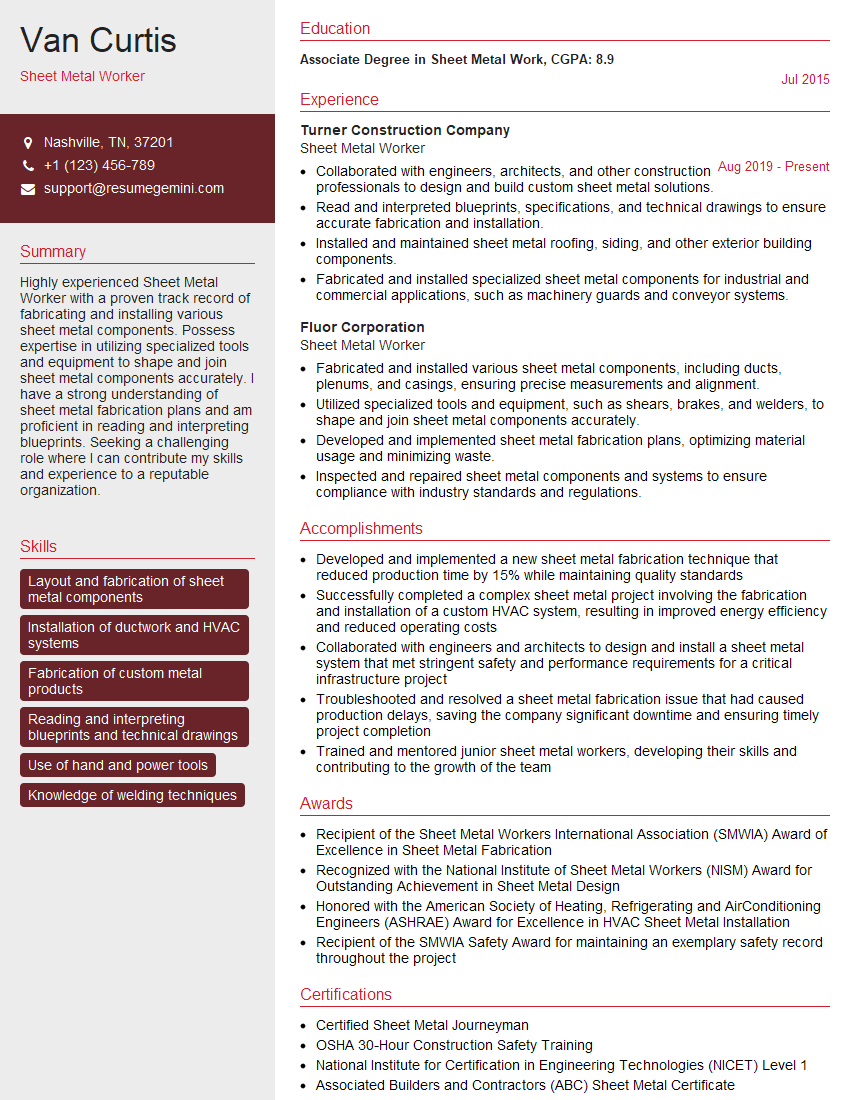
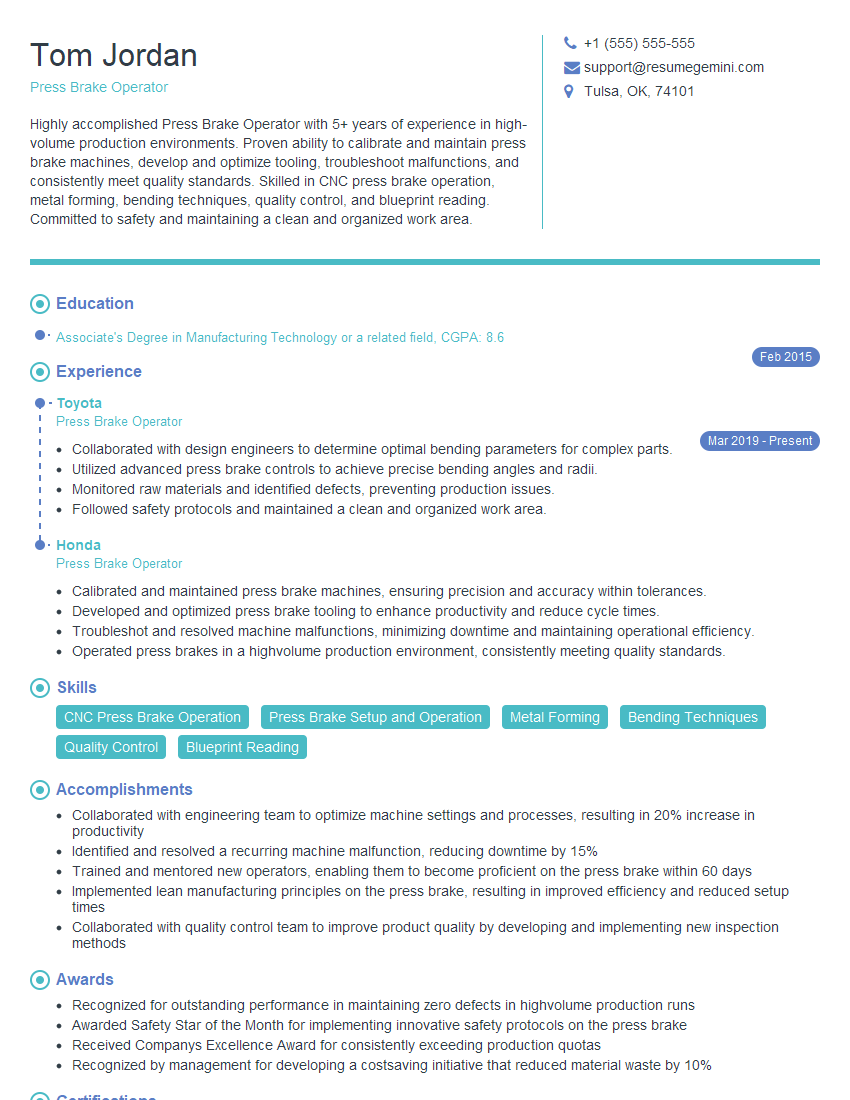
Mastering bending operation principles and techniques significantly enhances your career prospects in manufacturing and related industries. A strong understanding of these concepts demonstrates valuable practical skills and problem-solving abilities, opening doors to advanced roles and higher earning potential. To maximize your job search success, it’s crucial to present your skills effectively. Creating an ATS-friendly resume is paramount. We strongly recommend using ResumeGemini to build a professional and impactful resume that highlights your expertise in bending operations. ResumeGemini provides examples of resumes tailored specifically to Bending Operation roles, helping you showcase your qualifications in the best possible light.
Explore more articles
Users Rating of Our Blogs
Share Your Experience
We value your feedback! Please rate our content and share your thoughts (optional).
What Readers Say About Our Blog
Very informative content, great job.
good