Cracking a skill-specific interview, like one for Bridge Condition Assessment, requires understanding the nuances of the role. In this blog, we present the questions you’re most likely to encounter, along with insights into how to answer them effectively. Let’s ensure you’re ready to make a strong impression.
Questions Asked in Bridge Condition Assessment Interview
Q 1. Describe the different levels of bridge deck deterioration.
Bridge deck deterioration is a gradual process, typically categorized into several levels based on the severity and extent of damage. These levels often utilize rating scales, like the widely used AASHTO (American Association of State Highway and Transportation Officials) condition rating system. Let’s examine some key stages:
- Minor Cracking: This is the initial stage, characterized by fine hairline cracks with minimal impact on structural integrity. Think of these as superficial wrinkles on the bridge’s skin. They’re usually caused by temperature changes and shrinkage of the concrete.
- Moderate Cracking and Spalling: Here, cracks become more pronounced and widespread. Spalling, which is the chipping or breaking away of concrete, starts to occur. This indicates a more significant deterioration of the concrete’s surface. Imagine larger cracks developing, accompanied by small pieces of the concrete surface breaking off.
- Severe Cracking and Delamination: Cracks are extensive and deep, often accompanied by significant delamination (separation of layers of concrete). This substantially compromises the structural integrity of the deck. Think of large sections of the concrete deck separating or becoming loose. This stage requires urgent attention.
- Advanced Deterioration: This stage involves severe cracking, significant spalling, corrosion of reinforcing steel (exposed through cracks), and potential potholes or severe surface distress. This represents a very serious condition requiring immediate repair or replacement.
The specific descriptions and categorization can vary slightly depending on the adopted rating system and agency guidelines, but the general progression of damage remains consistent.
Q 2. Explain the process of conducting a visual bridge inspection.
A visual bridge inspection is the cornerstone of bridge condition assessment, providing a comprehensive overview of the structure’s condition. It’s a systematic process involving a thorough visual examination of all accessible components. Here’s a typical workflow:
- Preparation: This involves reviewing existing plans, drawings, and past inspection reports to understand the bridge’s design, history, and known issues. Safety planning is crucial, including traffic control measures and personal protective equipment (PPE).
- Inspection: Inspectors systematically examine all bridge elements, including the deck, superstructure, substructure, bearings, and abutments. They document observations using photos, sketches, and detailed written notes. This includes checking for cracks, spalling, corrosion, settlement, scour, and other signs of distress.
- Documentation: Detailed records of findings are crucial. This includes high-quality photographs clearly showing the location and extent of damage, along with precise descriptions of observed defects. Measurements, using appropriate tools, are taken to quantify the severity of the damage. GPS coordinates can help pinpoint the exact location of issues.
- Reporting: The inspection data is compiled into a comprehensive report, which includes a summary of findings, detailed descriptions of observed defects, photos, and recommendations for maintenance or repair. The report typically includes a condition rating or score for each bridge element.
Experienced inspectors utilize their judgment and knowledge to assess the significance of the observed damage. For instance, a small crack in a low-stress area might be insignificant, while a similar crack in a highly stressed area could indicate a serious problem.
Q 3. What are the common methods used for evaluating bridge substructure conditions?
Evaluating bridge substructure conditions is vital for ensuring long-term stability. Various methods are employed, depending on accessibility and the nature of the investigation:
- Visual Inspection: Similar to deck inspections, visual inspection is the primary method, checking for cracks, erosion, scour, settlement, and signs of undermining. Underwater inspections often involve divers or remotely operated vehicles (ROVs).
- Ground Penetrating Radar (GPR): GPR uses electromagnetic waves to detect subsurface anomalies such as voids, cracks, and changes in material properties within the foundation. It provides a non-destructive way to assess the internal condition of the foundation elements.
- Sonic testing: This method uses sound waves to evaluate the integrity of concrete piles and other foundation components by measuring the velocity of the sound waves through the material. Changes in wave velocity can indicate internal damage or deterioration.
- Pile Integrity Testing (PIT): This is a crucial method for assessing the condition of driven piles. Different methods exist, including dynamic testing (using impact and measuring the response) and static testing (applying a load and monitoring the displacement).
- Crosshole Sonic Logging (CSL): This is mainly applied to in-situ testing of concrete structures where sound waves are introduced into boreholes and their travel times are monitored and analyzed to determine concrete integrity.
The choice of method depends on factors like accessibility, cost, and the specific information needed. A combination of methods is often used for a more complete evaluation.
Q 4. How do you assess the condition of bridge bearings?
Bridge bearings are critical components that transmit loads between the superstructure and substructure. Assessing their condition is crucial for safety. Methods include:
- Visual Inspection: Checking for signs of corrosion, cracking, displacement, damage to the bearing surface, and evidence of improper seating.
- Measurement of Displacement: Precise measurements of bearing movement and settlement are taken to check for excessive deformation or misalignment.
- Load Testing: This involves applying controlled loads to the bearing and measuring the resulting deflection or movement. This helps to assess the bearing’s load-carrying capacity and identify any weaknesses.
- Non-Destructive Testing (NDT): Methods like ultrasonic testing can be used to evaluate the internal condition of the bearing material and detect flaws. This is especially relevant for elastomeric bearings, assessing for degradation or internal damage.
For example, signs of excessive corrosion on a steel bearing, or significant displacement of an elastomeric bearing could indicate critical problems requiring immediate attention and repair or replacement.
Q 5. What are the primary indicators of scour at bridge foundations?
Scour is the erosion of soil around bridge foundations, significantly weakening the structure’s support. Key indicators include:
- Exposed Foundation Elements: Increased exposure of the foundation elements, such as piles or footings, indicating erosion of the surrounding soil.
- Changes in Water Flow Patterns: Observations of changes in water flow around the piers or abutments, including increased velocity or turbulence.
- Scour Holes: Direct observation of scour holes (depressions) formed in the riverbed around the foundation.
- Sediment Deposition: Unexpected accumulation of sediment downstream of the bridge piers suggests upstream erosion.
- Vegetation Changes: Changes in vegetation along the riverbank, such as unusual sparseness or die-off near the bridge.
Experienced engineers also take into consideration hydrological data, such as historical river flow rates and sediment transport rates, to assess the potential for scour and the severity of the observed indicators.
Q 6. Explain your experience with various non-destructive testing (NDT) methods used in bridge inspections.
My experience encompasses a wide array of non-destructive testing (NDT) methods used in bridge inspections. These are crucial for evaluating internal conditions without causing damage to the structure. Specifically, I’ve extensively used:
- Ultrasonic Testing (UT): This method uses high-frequency sound waves to detect internal flaws in concrete and steel elements. It’s excellent for locating voids, cracks, and delaminations. I’ve utilized UT extensively to assess the condition of concrete decks, piles, and bridge bearings.
- Ground Penetrating Radar (GPR): As mentioned earlier, GPR is valuable for subsurface investigations, particularly for detecting voids and assessing the integrity of foundations. I’ve used GPR to map subsurface conditions and locate potential undermining or scour around bridge foundations.
- Chain Drag: A simple yet effective method for detecting subsurface voids or anomalies. I have used chain drag along the edges of bridge abutments to detect undermining from scour.
- Magnetic Particle Inspection (MPI): MPI is used to detect surface and near-surface cracks in ferromagnetic materials like steel. It’s commonly applied during the inspection of steel girders and other structural steel components.
- Cover Meter Testing: Measuring the depth of reinforcing steel in concrete is critical for assessing the level of concrete cover and identifying potential corrosion problems. I’ve extensively used this technique during bridge inspections.
The selection of appropriate NDT methods depends on several factors, including the material being inspected, the type of defect expected, and accessibility constraints.
Q 7. How do you interpret and report findings from a bridge inspection?
Interpreting and reporting bridge inspection findings is a critical step, ensuring that the data is accurately communicated to stakeholders and informs appropriate maintenance and repair decisions. My reporting process typically involves:
- Data Analysis: I meticulously analyze all collected data, including visual observations, measurements, and NDT results. This involves comparing the findings to established standards and guidelines to determine the severity of any identified defects.
- Condition Assessment: Based on the analysis, I assign a condition rating or score to each bridge element using a standardized system, such as the AASHTO rating system. This helps to quantify the overall condition of the bridge.
- Report Preparation: The report is comprehensively written and includes detailed descriptions of the findings, high-quality photographs, and a summary of the condition assessment. It also includes maps or diagrams that clearly illustrate the locations of any defects.
- Recommendations: The report presents clear and concise recommendations for maintenance, repair, or rehabilitation work. This includes prioritizing repairs based on the severity of the defects and potential safety risks.
- Communication: I effectively communicate the findings and recommendations to stakeholders including owners, engineers, and contractors. This may involve presentations, meetings, and direct dialogue.
Transparency and clarity are crucial in ensuring that the information is easily understood and actions are taken promptly. A well-written report serves as a critical document for managing the lifecycle of a bridge.
Q 8. Describe your experience using bridge rating systems (e.g., AASHTO).
Bridge rating systems, like the widely used AASHTO (American Association of State Highway and Transportation Officials) system, are crucial for assessing the structural condition of bridges. My experience spans over a decade, encompassing the application of the AASHTO condition rating methodology across various bridge types and ages. This involves a detailed inspection process, where each element of the bridge—deck, superstructure, substructure, and approaches—is evaluated according to predefined criteria. These criteria consider factors such as cracking, spalling, corrosion, and deflection. Each element receives a numerical rating, ultimately culminating in an overall bridge rating. For example, I’ve worked on projects where a bridge initially rated as ‘fair’ (say, 6 out of 9 on the AASHTO scale) following a thorough inspection and subsequent repairs, was upgraded to a ‘good’ rating (7-8) reflecting improved structural integrity. I’m proficient not only in applying the numerical rating system but also in interpreting the results and drawing practical conclusions regarding maintenance needs. This includes understanding how different distress types affect the overall structural performance and life expectancy of the bridge.
Q 9. How do you determine the appropriate maintenance or repair strategies for a bridge based on its condition assessment?
Determining the appropriate maintenance or repair strategy is a multi-step process directly informed by the bridge’s condition assessment. First, we analyze the condition ratings and identify critical deficiencies. For instance, significant deck deterioration might require immediate overlay while minor cracking in the substructure could warrant monitoring rather than immediate repair. Next, we consider the severity of the identified deficiencies, their potential impact on structural integrity and safety, and their anticipated rate of deterioration. This helps us prioritize actions. Then we assess cost-effectiveness, considering the repair or maintenance options available. A cost-benefit analysis often guides our decision, weighing the cost of various strategies against the long-term benefits in terms of extended bridge lifespan and reduced risk. Finally, we develop a detailed plan outlining the chosen strategy, including timelines, resource allocation, and potential traffic management requirements. For example, a bridge with significant corrosion in its support piers might necessitate a phased repair strategy: initial stabilization measures to prevent further damage, followed by a more comprehensive rehabilitation project during a planned traffic closure. This careful planning ensures both efficient resource utilization and minimal disruption to the public.
Q 10. What are the key factors to consider when developing a bridge inspection plan?
Developing a robust bridge inspection plan is paramount for ensuring the safety and longevity of bridges. Several key factors guide this process. Firstly, the bridge’s age, type, and traffic volume significantly influence inspection frequency and intensity. Older bridges or those carrying heavy loads often require more frequent and thorough inspections. Secondly, the bridge’s history, including past repairs or incidents, helps identify potential areas of concern and informs inspection priorities. Thirdly, environmental factors, such as exposure to de-icing salts or seismic activity, should also be considered. These factors influence deterioration rates and the type of distress to expect. Fourthly, the plan must specify the inspection methods and techniques to be employed, including visual inspection, non-destructive testing (NDT) methods like ultrasonic testing or ground penetrating radar, and the use of specialized equipment like climbing platforms. Finally, the plan must clearly define the personnel involved, their qualifications, and the reporting procedures. A well-structured plan includes clear timelines, responsibilities, and a documented methodology for data collection and analysis, ensuring consistency and accuracy over time.
Q 11. How do you prioritize bridge maintenance and repair projects?
Prioritizing bridge maintenance and repair projects requires a systematic approach balancing urgency, risk, and cost. A common method involves utilizing a risk-based prioritization system. This approach involves evaluating the structural condition, load capacity, and potential consequences of failure for each bridge. Bridges with significant deterioration, high traffic volumes, or potential for catastrophic failure are given higher priority. A scoring system might be used, assigning weights to various factors like structural rating, safety risk, and cost of repair, generating a composite score for each bridge. This score then informs the prioritization order, with higher scores representing greater urgency. Additionally, we consider the overall condition of the bridge network, ensuring that the program addresses both immediate needs and long-term structural preservation. This holistic approach ensures that limited resources are used effectively to maximize safety and the lifespan of the entire bridge network. For example, a bridge with a low structural rating and carrying a high volume of traffic would likely be prioritized over a bridge with minor cosmetic damage and low traffic volumes.
Q 12. Describe your experience with bridge software and data management systems.
I have extensive experience using various bridge software and data management systems, including specialized software for condition assessment, structural analysis, and database management. This includes software for storing and managing large datasets of bridge inspection data, integrating it with geographic information systems (GIS) for spatial analysis and visualization, and utilizing specialized modules for structural analysis to assist in predicting future conditions or evaluating the effectiveness of repair options. Examples of software I’ve used include [mention specific software – e.g., BridgeInspector, STRUDL, or other relevant programs]. The use of these programs helps us efficiently analyze large quantities of data, ensuring more informed decision-making in bridge management. These systems are critical for creating comprehensive bridge management databases, facilitating effective asset management, and tracking maintenance and repair histories. The ability to visualize data spatially and compare different bridges’ conditions over time provides crucial information for planning and resource allocation.
Q 13. What is your experience with documenting and reporting bridge inspection findings?
Documenting and reporting bridge inspection findings is a critical component of responsible bridge management. My experience in this area involves preparing detailed inspection reports that include high-quality photographs, precise measurements, and clear descriptions of observed deficiencies. These reports follow established templates and incorporate data from both visual inspections and non-destructive testing. I’m proficient in using specialized software for creating these reports, ensuring consistency, accuracy, and easy sharing among stakeholders. Critical information, such as severity ratings, recommendations for repair or maintenance, and estimated costs, are clearly presented in the reports. Moreover, the reports are meticulously reviewed to ensure accuracy and completeness before submission to relevant authorities. Maintaining a complete and accurate record of inspection findings is essential not only for meeting regulatory requirements but also for informing future maintenance and repair decisions and tracking the overall condition of the bridge over time. Furthermore, these documents can provide critical information in the event of a structural failure or legal dispute.
Q 14. Explain your familiarity with relevant codes, standards, and regulations for bridge inspection and maintenance.
My understanding of relevant codes, standards, and regulations for bridge inspection and maintenance is thorough and up-to-date. I am intimately familiar with the AASHTO standards for bridge design, inspection, and maintenance, as well as relevant federal, state, and local regulations. I understand the importance of adhering to these guidelines to ensure the safety and structural integrity of bridges. This includes understanding load capacity calculations, material specifications, and maintenance protocols to ensure bridges meet or exceed safety requirements. For example, I am well versed in the requirements for the inspection of underwater components and specialized techniques required in such circumstances. Staying abreast of updates and revisions in these codes and standards is an ongoing process that I actively pursue to ensure that my practice remains compliant and utilizes best practices for bridge management. Regular professional development, participation in conferences, and review of the latest publications are integral parts of my ongoing education.
Q 15. How do you address uncertainties and limitations in bridge condition assessment data?
Uncertainties in bridge condition assessment data are inevitable. They stem from limitations in inspection methods, the inherent variability of materials over time, and the difficulty in predicting future deterioration. Addressing these uncertainties involves a multi-pronged approach.
Probabilistic Modeling: Instead of assigning single values to parameters like remaining life or load capacity, we use probabilistic models. These models incorporate uncertainty by representing parameters as probability distributions (e.g., a range of possible values with associated likelihoods). This gives a more realistic picture than a single point estimate.
Redundancy Checks: We employ multiple inspection methods to cross-validate findings. For example, combining visual inspection with non-destructive testing techniques like ultrasonic testing helps mitigate the risk of missing critical defects.
Expert Judgement: Experienced inspectors bring valuable judgment to bear on ambiguous findings. They can often identify subtle clues suggesting potential issues, even in the absence of definitive quantitative data. Their experience helps weigh various pieces of evidence.
Data Quality Control: Implementing rigorous data collection protocols and quality checks minimizes errors. This includes using standardized forms, clear definitions of defect types, and regular calibration of equipment.
Sensitivity Analysis: We assess how sensitive the assessment results are to variations in input parameters. This helps identify critical uncertainties and areas where further investigation or data refinement is needed.
For example, if we’re uncertain about the extent of corrosion in a steel member, we might model the corrosion depth as a probability distribution rather than a single number. This then allows for a probabilistic prediction of the member’s remaining life, reflecting the inherent uncertainty.
Career Expert Tips:
- Ace those interviews! Prepare effectively by reviewing the Top 50 Most Common Interview Questions on ResumeGemini.
- Navigate your job search with confidence! Explore a wide range of Career Tips on ResumeGemini. Learn about common challenges and recommendations to overcome them.
- Craft the perfect resume! Master the Art of Resume Writing with ResumeGemini’s guide. Showcase your unique qualifications and achievements effectively.
- Don’t miss out on holiday savings! Build your dream resume with ResumeGemini’s ATS optimized templates.
Q 16. Describe a challenging bridge condition assessment project and how you successfully addressed it.
One particularly challenging project involved assessing a historic arch bridge built in the early 20th century. The bridge was constructed of unreinforced masonry, and extensive deterioration had occurred due to age, freeze-thaw cycles, and previous inadequate repairs. The challenges included:
Limited Access: Access to certain areas of the bridge was extremely limited due to its age and narrow design.
Complex Geometry: The complex geometry of the arch presented challenges for accurate data acquisition.
Hidden Defects: Many defects were hidden within the masonry, making it difficult to determine their extent.
We successfully addressed these challenges through a combination of strategies:
Advanced Imaging Techniques: Ground Penetrating Radar (GPR) and infrared thermography were used to detect subsurface defects and anomalies that were not visible during visual inspection.
Specialized Equipment: We employed lightweight, portable equipment to access the hard-to-reach areas.
3D Modeling: A 3D model of the bridge was created based on the inspection data, providing a comprehensive representation of its condition and allowing for accurate quantification of deterioration.
Collaboration with Experts: We consulted with masonry experts to interpret the findings and recommend appropriate repair strategies.
This project highlighted the importance of integrating various techniques and expertise to overcome the challenges presented by complex and deteriorated structures.
Q 17. Explain your understanding of different types of bridge failures.
Bridge failures can be broadly categorized into several types:
Fatigue Failure: This occurs due to repeated stress cycles, leading to the gradual propagation of cracks and eventual failure. Think of a paperclip repeatedly bent back and forth until it breaks.
Fracture Failure: A sudden, catastrophic failure resulting from a single, excessive load or a critical defect. This is like a sudden snap of a twig under excessive weight.
Corrosion Failure: Chemical deterioration of bridge components, most commonly seen in steel bridges. Rust weakens the steel, reducing its strength and leading to failure.
Buckling Failure: A sudden collapse of a compressive member due to excessive load. Imagine a slender column bending under heavy weight.
Creep Failure: A time-dependent deformation of materials under sustained stress, gradually weakening the structure over time.
Settlement Failure: Uneven settlement of the bridge supports causing stress concentrations and potential cracking.
Overload Failure: Simple failure due to a load exceeding the bridge’s design capacity.
Understanding these failure mechanisms is crucial for effective bridge assessment and maintenance planning. For example, regular inspection for signs of corrosion in steel bridges can help prevent fatigue and fracture failures.
Q 18. How do you communicate technical information effectively to non-technical audiences?
Communicating complex technical information to non-technical audiences requires clear, concise language and effective visualization. I use several key strategies:
Analogies and Metaphors: I relate technical concepts to everyday experiences. For example, I might explain fatigue failure using the analogy of a paperclip repeatedly bending.
Visual Aids: Diagrams, charts, and photographs are invaluable tools for simplifying complex information. A simple picture of a cracked beam is far more effective than a lengthy description.
Storytelling: I weave technical information into a narrative, making it more engaging and memorable. Sharing anecdotes from past projects can also make the information more relatable.
Plain Language: I avoid technical jargon as much as possible. If jargon is necessary, I always provide a clear explanation.
Interactive Presentations: I prefer using interactive presentations where the audience can ask questions and engage in discussions.
For example, when explaining the importance of bridge maintenance to a city council, I would avoid using complex engineering terms and instead focus on the implications of bridge failure – potential traffic disruptions, economic losses, and safety risks.
Q 19. What are your strengths and weaknesses as a bridge inspector?
Strengths: My strengths lie in my thoroughness, attention to detail, and problem-solving abilities. I am highly meticulous in my inspections and possess a strong understanding of structural mechanics and material science. My experience with various bridge types and assessment methods allows me to adapt my approach to different situations. I also pride myself on my ability to clearly communicate technical information to both technical and non-technical audiences.
Weaknesses: While I am confident in my abilities, I am always striving to improve my knowledge of the latest advancements in technology and data analysis techniques. Specifically, improving my proficiency in advanced software for structural modeling and data analysis is an ongoing goal.
Q 20. How do you stay updated on the latest advancements in bridge inspection techniques and technologies?
Staying current in this field is crucial. I employ several methods:
Professional Development Courses: I regularly attend workshops and seminars focused on new inspection technologies and best practices. This includes attending conferences offered by organizations like the American Society of Civil Engineers (ASCE).
Industry Publications and Journals: I subscribe to relevant journals and regularly read industry publications to stay abreast of the latest research and developments.
Networking with Colleagues: I actively network with other bridge inspectors and engineers to share knowledge and learn from their experiences.
Online Resources: I utilize online resources, such as professional organizations’ websites and reputable online journals, for access to the latest information and research papers.
For example, I recently completed a course on the use of drones for bridge inspection, a rapidly evolving technology that offers significant advantages in efficiency and safety.
Q 21. Describe your experience with different types of bridge structures (e.g., steel, concrete, timber).
My experience encompasses a wide range of bridge types, including:
Steel Bridges: I have extensive experience assessing various steel bridge types, including truss, girder, and arch bridges. My expertise includes identifying and evaluating corrosion, fatigue cracks, and other common steel bridge defects.
Concrete Bridges: I’m proficient in evaluating concrete bridges for cracking, spalling, delamination, and alkali-aggregate reaction. My experience also includes assessing pre-stressed and post-tensioned concrete structures.
Timber Bridges: I have experience assessing timber bridges for decay, insect infestation, and structural damage. I am familiar with various timber bridge designs and repair techniques.
Composite Bridges: I am also familiar with composite bridge structures, combining various materials like steel and concrete, and understand the unique challenges associated with assessing these complex structures.
This diverse experience allows me to effectively assess bridges of varying materials and designs, ensuring a comprehensive and accurate evaluation.
Q 22. How do you handle conflicts or disagreements with other members of a bridge inspection team?
Conflict resolution is crucial in any team environment, especially in high-stakes bridge inspections. My approach prioritizes open communication and collaborative problem-solving. If a disagreement arises, I believe in fostering a respectful dialogue where everyone feels heard. I encourage each team member to clearly articulate their perspective, supporting their claims with data or observations. If the disagreement persists, I facilitate a structured discussion, weighing the evidence and different viewpoints to reach a consensus that prioritizes the safety and accuracy of the inspection. Sometimes, a compromise may be necessary. However, if the conflict is irreconcilable, I escalate the issue to a senior manager to ensure a fair and objective resolution. For example, during an inspection of a historic arch bridge, I had a disagreement with a colleague regarding the severity of cracking in a keystone. By presenting photographic evidence, referencing relevant standards, and engaging in respectful discussion, we reached a joint assessment that incorporated both our concerns and ensured the bridge’s safety.
Q 23. What are your salary expectations?
My salary expectations are commensurate with my experience and expertise in bridge condition assessment, which includes extensive hands-on experience, advanced knowledge of relevant codes and standards, and proficiency in using advanced technologies like drones and specialized software. I am confident that my skills and contributions will add significant value to your team. I am open to discussing a competitive salary package that reflects my value and aligns with the industry standards for professionals in my field with my years of experience. I would be happy to provide specific salary figures after reviewing the details of the position and organizational compensation structure.
Q 24. Explain your experience with risk assessment in bridge management.
Risk assessment is fundamental to bridge management. My experience involves a multi-step process starting with identifying potential hazards, such as deterioration of structural elements, scour at bridge piers, or potential impacts from vehicle collisions. Then, I analyze the likelihood and potential consequences of each hazard using established methodologies, such as the AASHTO Bridge Management System. This process involves considering factors like traffic volume, bridge age, material type, and environmental conditions. For example, a bridge near a river might have a higher risk of scour-related damage. This risk assessment feeds into prioritizing maintenance and repair activities, allowing resources to be allocated effectively to mitigate the most critical risks. The output frequently informs the development of a bridge risk register, a crucial document for long-term bridge management.
Q 25. Describe your familiarity with different types of bridge deck treatments and repairs.
I am well-versed in various bridge deck treatments and repairs, ranging from simple crack sealing to complex overlay placements. I’m familiar with different materials, including asphalt concrete, polymer concrete, and various types of epoxy resins. My experience includes:
- Crack sealing: Employing various sealants to prevent water ingress and further deterioration.
- Overlayments: Installing new wearing surfaces to restore structural integrity and extend the service life. This can involve hot-mix asphalt, thin-bonded overlays, or other specialized materials.
- Concrete repairs: Addressing issues such as spalling, delamination, and potholes through methods like patching, shotcreting, and deck patching.
- Joint repairs and replacements: Maintaining the watertight integrity of the deck through proper joint sealing and replacement.
Q 26. How do you ensure the safety of yourself and your team during bridge inspections?
Safety is paramount during bridge inspections. Before each inspection, I develop a comprehensive safety plan outlining potential hazards, required personal protective equipment (PPE), and emergency procedures. This plan includes specific details about the bridge’s condition, potential fall hazards, traffic considerations, and weather conditions. Each team member is thoroughly briefed on the plan, and we conduct regular safety checks. PPE includes hard hats, high-visibility vests, safety harnesses, and fall protection equipment as needed. We utilize traffic control measures such as flaggers or lane closures when necessary to protect both the inspection team and the public. Regular communication and adherence to the safety plan ensure a safe and efficient inspection process. I always prioritize safety over speed and will postpone an inspection if weather or other conditions create unacceptable risks. For example, I have postponed inspections due to severe weather conditions or if unexpected structural issues were observed that raised safety concerns requiring further investigation and appropriate measures before proceeding.
Q 27. What is your experience with using drones or other advanced technologies for bridge inspections?
I have significant experience utilizing drones and other advanced technologies for bridge inspections. Drones equipped with high-resolution cameras and thermal imaging capabilities allow for detailed visual inspection of hard-to-reach areas, such as under the deck or high above the roadway. This significantly improves efficiency and safety, reducing the need for costly and potentially risky access equipment. I am proficient in operating and interpreting data from these systems. The collected data can then be integrated with other inspection data, and analyzed using specialized bridge inspection software, providing a comprehensive assessment of the bridge condition. Moreover, I’m familiar with other technologies including laser scanners and ground-penetrating radar which provide further insights into the structural integrity of the bridge. The use of these technologies leads to more comprehensive and accurate assessment reports, better risk management decisions, and optimized maintenance strategies.
Q 28. Describe your experience with the development of long-term bridge maintenance plans.
Developing long-term bridge maintenance plans requires a holistic approach. I start by conducting a comprehensive condition assessment, using both visual inspections and advanced non-destructive testing techniques. This data is then fed into a bridge management system (BMS), which uses algorithms to predict future deterioration and optimize maintenance scheduling. This involves prioritizing repairs based on risk levels, considering factors such as structural integrity, cost, and traffic impacts. The plan outlines specific maintenance activities, timelines, and associated budgets. It’s crucial to consider lifecycle costs, balancing immediate repair needs with long-term preventative maintenance. The plan should be regularly updated to reflect changes in the bridge’s condition or priorities. For example, I developed a ten-year maintenance plan for a network of bridges, integrating various data sources, prioritizing crucial repairs first, and showing how preventative measures could reduce costs and extend service life. This resulted in significant cost savings and improved public safety over the ten year period.
Key Topics to Learn for Bridge Condition Assessment Interview
- Visual Inspection Techniques: Understanding different methods for assessing bridge decks, substructures, and superstructures, including the use of various tools and equipment.
- Rating Systems and Standards: Familiarity with common bridge rating systems (e.g., AASHTO, PCI) and their practical application in assigning condition ratings and identifying deficiencies.
- Data Collection and Analysis: Mastering techniques for collecting reliable data, such as measurements, photographs, and detailed descriptions of observed defects. Knowing how to analyze this data to draw accurate conclusions about bridge condition.
- Structural Mechanics Fundamentals: Possessing a foundational understanding of structural principles relevant to bridge components, including load distribution, stress analysis, and material behavior.
- Common Bridge Defects and Their Causes: Identifying and diagnosing common types of bridge deterioration, such as cracking, corrosion, spalling, and scour, and understanding their underlying causes (environmental factors, design flaws, etc.).
- Reporting and Documentation: Creating clear, concise, and well-organized reports that effectively communicate findings and recommendations to clients or stakeholders.
- Safety Protocols and Best Practices: Understanding and adhering to all relevant safety regulations and best practices for conducting bridge inspections. Prioritizing safety and risk mitigation during assessment.
- Software and Technology: Familiarity with software used for bridge condition assessment, data management, and reporting (mentioning general categories rather than specific software names).
- Problem-Solving and Decision-Making: Demonstrating the ability to analyze complex situations, identify potential solutions to bridge-related issues, and make informed recommendations based on engineering principles.
- Communication Skills: Effectively communicating technical information clearly and concisely to both technical and non-technical audiences.
Next Steps
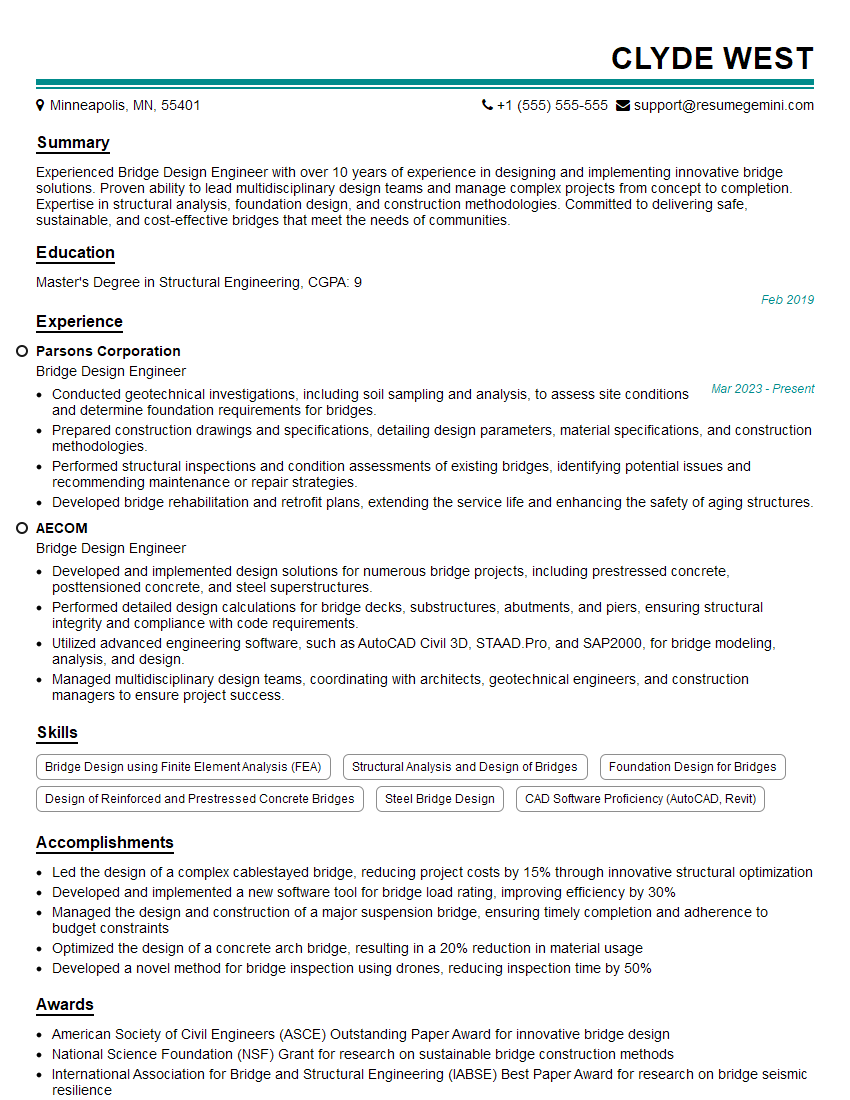
Mastering Bridge Condition Assessment opens doors to exciting career opportunities in civil engineering, offering diverse roles and strong earning potential. To maximize your chances of landing your dream job, it’s vital to present your skills and experience effectively. Creating an Applicant Tracking System (ATS)-friendly resume is crucial for getting noticed by recruiters. ResumeGemini is a trusted resource to help you build a professional and impactful resume. They provide examples of resumes tailored to Bridge Condition Assessment, ensuring your qualifications shine. Take the next step towards your career success today!
Explore more articles
Users Rating of Our Blogs
Share Your Experience
We value your feedback! Please rate our content and share your thoughts (optional).
What Readers Say About Our Blog
Very informative content, great job.
good