The thought of an interview can be nerve-wracking, but the right preparation can make all the difference. Explore this comprehensive guide to Brush Pens interview questions and gain the confidence you need to showcase your abilities and secure the role.
Questions Asked in Brush Pens Interview
Q 1. What are the key differences between felt-tip and nylon brush pens?
The core difference between felt-tip and nylon brush pens lies in the material of their nibs. Felt-tip pens utilize a porous felt material, creating a consistent line width that’s less responsive to pressure variation. Think of them as having a more fixed, predictable stroke. Nylon brush pens, however, feature flexible nylon fibers that mimic the feel of a real brush. This flexibility allows for variable line weight – thinner strokes with light pressure and thicker strokes with more pressure, offering far greater control and expressive potential. It’s like the difference between using a marker and a watercolor brush.
In short: Felt-tip pens offer simplicity and consistency, while nylon brush pens provide greater artistry and control over line weight.
Q 2. Explain the various brush pen nib sizes and their applications.
Brush pen nib sizes range considerably, impacting the type of lettering and art you can create. Sizes are often described as fine, medium, and broad, but this can vary across brands. A fine nib is excellent for detailed work, script lettering, and delicate illustrations; think tiny flourishes and intricate details. A medium nib offers a versatile balance, suitable for both calligraphy and sketching – it’s a good all-around choice. A broad nib is ideal for bold lettering styles, expressive brush strokes, and larger-scale artwork. It allows for dramatic variation in line weight with minimal pressure changes. Some brands even offer extra-fine or extra-broad options, expanding the creative possibilities further.
Choosing the right nib size depends entirely on your project. For example, if I’m creating a detailed invitation, I’d opt for a fine nib. For a large poster design, a broad nib would be more appropriate.
Q 3. Describe your experience with different brush pen inks (e.g., water-based, pigment-based).
My experience encompasses both water-based and pigment-based brush pen inks, each with its own distinct properties. Water-based inks are generally more affordable, vibrant, and blend easily. However, they are prone to feathering on certain papers and can be smudged easily, requiring careful handling and potentially a fixative. They are also often less water resistant.
Pigment-based inks, on the other hand, are known for their permanence, water resistance, and archival quality. They’re less prone to smudging and feathering, making them perfect for projects where longevity is important, such as artwork intended for display or important documents. They typically have a slightly less vibrant color initially, but offer more opacity and archival qualities.
I often choose water-based inks for quick sketches and practice work, whereas pigment inks are my go-to for finished pieces and professional projects. The choice depends on the desired effect and the intended use of the artwork.
Q 4. How do you achieve consistent line weight with a brush pen?
Achieving consistent line weight with a brush pen hinges on control and practice. First, ensure you’re holding the pen correctly – a relaxed grip at a comfortable angle is key. Avoid clenching the pen too tightly, as this restricts the natural movement of your hand. Next, focus on controlling your pressure. Think of the pen as an extension of your hand; use subtle pressure adjustments to vary the line weight smoothly. Practice consistent pressure for even lines, and gradual pressure changes for smooth transitions.
I recommend starting with simple exercises like drawing straight lines with varied pressure to build muscle memory. Over time, you’ll develop a feel for how much pressure creates the desired thickness, leading to consistent line weights.
Q 5. Explain your process for creating smooth transitions between thick and thin strokes.
Smooth transitions between thick and thin strokes are the hallmark of beautiful brush lettering and illustration. The key is a controlled and gradual pressure change. Start with a light pressure for a thin stroke, then gradually increase pressure as you move towards the thick portion of the stroke. The transition should be seamless, avoiding abrupt changes in line weight. Think of it like a gentle wave – a smooth curve from thin to thick and back again.
Practicing the basic strokes of calligraphy, like upstrokes and downstrokes, helps develop the muscle memory and hand-eye coordination needed for seamless transitions. Experiment with various pressures and speeds to refine your technique. The results are significantly improved with diligent practice.
Q 6. How do you care for and maintain your brush pens?
Proper care ensures your brush pens last longer and perform optimally. Always cap your pens immediately after use to prevent the ink from drying out. If the nib becomes clogged, gently clean it with water. Avoid harsh scrubbing or using abrasive materials, as this can damage the delicate nylon fibers. For stubborn clogs, you might soak the nib in a gentle cleaner. Store your pens horizontally or nib-up to prevent ink from settling unevenly.
Regular maintenance, even something as simple as wiping the nib after each use, makes a significant difference in the pen’s lifespan and performance. This ensures consistent ink flow and prevents damage to the brush tip.
Q 7. What are your preferred techniques for creating various lettering styles (e.g., serif, sans-serif)?
Creating various lettering styles with brush pens requires understanding the fundamental strokes and adapting them to each style. For serif lettering, which features small decorative flourishes at the ends of strokes, focus on controlled pressure changes and precise movements to form the serifs accurately. Pay attention to the subtle curves and transitions.
For sans-serif lettering, which lacks these flourishes, maintain consistent pressure for cleaner, simpler lines. The focus is on smooth, even strokes and precise spacing between letters. The key is maintaining consistent pressure for a more geometric look.
Experimentation is key. Practice writing each letter style multiple times, varying your pressure and speed to achieve the desired effect. Remember, observation and practice are paramount to mastering various lettering styles. Study examples of different lettering styles to understand their unique characteristics.
Q 8. Describe your experience with blending brush pen inks.
Blending brush pen inks is a crucial skill for creating smooth gradients and realistic effects. It hinges on understanding the ink’s properties and employing the right techniques. Water-based inks are generally the easiest to blend, while pigment inks, being more opaque, require a different approach.
The key is to work quickly, layering colors while they’re still wet. Think of it like watercolor painting – you can’t blend once it’s completely dry. For a smooth transition, I often use a ‘wet-on-wet’ technique, applying one color, then immediately overlapping with another, gently pulling the colors together with the brush tip. For a more defined blend, a ‘wet-on-dry’ approach might be better, adding the second color to a partially dry first layer to create a softer edge.
For example, to blend from a light blue to a darker blue, I’d start with the lighter shade, then gradually add the darker blue while the light blue is still wet, lightly feathering the colors together. If using pigment inks, a damp brush may be necessary to slightly lift and blend the colors.
Q 9. How do you create different textures and effects with brush pens (e.g., shading, highlights)?
Brush pens offer incredible versatility in creating textures and effects. Shading and highlighting are achieved primarily by manipulating the pressure and angle of the pen. Applying heavier pressure produces thicker, darker lines, perfect for shading. Conversely, lighter pressure creates finer lines, ideal for highlights.
For example, to shade a sphere, I’d use heavy pressure on the sides, gradually lightening the pressure as I move towards the light source. To add highlights, I’d use a very light touch, or even use a white gel pen for a sharper contrast. Varying the speed of the stroke also creates texture. A quick stroke might give a scratchy effect, while a slow, controlled stroke will yield a smooth finish.
Beyond shading and highlighting, stippling (creating a pattern with small dots) and hatching (using parallel lines) can generate various textures, from rough surfaces to soft fabrics. Experimentation with different brush tips and ink densities is key to unlocking the full range of textures available.
Q 10. Describe your approach to color mixing with brush pens.
Color mixing with brush pens is similar to watercolor painting but with its own nuances. Since you’re often working with small amounts of ink, layering is crucial. It’s easier to build up color intensity than to lighten it. I often start with a light base layer and then gradually add darker shades to achieve the desired hue.
For example, to create a warm orange, I might layer a light yellow base with progressively darker shades of orange and a touch of red. Direct mixing on the paper is possible, especially with water-based inks. However, this approach can result in a less-controlled blend. I usually prefer layered application for greater precision.
It’s important to note that color mixing can vary significantly depending on the brand and type of brush pen. Some brands offer more vibrant mixes than others, and the drying time can affect how effectively colors blend.
Q 11. How do you overcome common brush pen challenges (e.g., bleeding, feathering)?
Bleeding and feathering are common issues when using brush pens, particularly on cheaper paper. Bleeding occurs when the ink spreads beyond the intended lines, while feathering refers to the ink’s tendency to spread along the fibers of the paper, creating a fuzzy edge.
To minimize bleeding, the most effective solution is using a high-quality, smooth paper designed for brush pens. Papers like cold-press watercolor paper or cardstock are excellent choices. If budget is a concern, testing the paper is crucial before starting a project.
To reduce feathering, I often use a waterproof blending medium or apply a light coat of masking fluid before applying the ink. This acts as a barrier, preventing the ink from spreading uncontrollably. Another tip is to use a lighter touch and avoid overly saturated strokes.
Q 12. What are the advantages and disadvantages of using brush pens compared to other writing/drawing tools?
Brush pens offer a unique combination of versatility and control. Compared to felt-tip markers, they provide more nuanced line variation and expressive potential. Unlike fountain pens, brush pens are less prone to ink flow problems, and generally easier to clean.
- Advantages: Versatility in line weight, smooth blending capabilities, relatively easy maintenance, a wide range of colors and ink types, portability.
- Disadvantages: Can be more expensive than felt-tip markers, higher risk of bleeding/feathering on unsuitable paper, ink can sometimes be prone to smudging until dry, less consistent line width for inexperienced users.
The choice between brush pens and other tools ultimately depends on the project’s requirements. For detailed illustrations and calligraphy, brush pens are often preferred. However, for quick sketches or large-scale artwork, felt tip pens or even pencils might be a more practical choice.
Q 13. How do you create a consistent style across multiple brush pen projects?
Consistency across multiple projects depends on establishing a defined style and workflow. This involves consistent use of tools, color palettes, and techniques. Practicing regularly to hone skills and refine technique is critical.
Before embarking on a project, I often create a small color palette sample. I also carefully select the brush pens and paper, ensuring they are suitable for the style I intend to create. I might create detailed sketches or initial drafts before starting the final piece, ensuring that my technique is refined and consistent.
For example, if I’m working on a series of nature illustrations, I might establish a consistent color scheme, like earthy tones and greens, and consistently employ the same level of detail and shading technique throughout the series. This ensures a sense of unity and visual cohesion across all the pieces.
Q 14. How do you choose the appropriate brush pen for a specific project?
Choosing the right brush pen depends on the project’s requirements and personal preference. Consider these factors:
- Ink type: Water-based inks are easy to blend, while pigment inks are more opaque and durable. Dye-based inks are vibrant but can be less lightfast.
- Brush tip: Different tip shapes and sizes offer varied levels of control and line weight. Fine tips are suitable for details, while larger tips are better for broader strokes.
- Paper type: The paper significantly influences how the ink behaves. Smooth, high-quality paper reduces bleeding and feathering.
- Project needs: Calligraphy requires a pen with excellent control, while sketching might benefit from a more expressive brush tip.
For instance, if I’m working on delicate calligraphy, I’d choose a pen with a fine, flexible tip and water-based ink. For a bold, expressive painting, a larger, stiffer brush tip with pigment ink might be more appropriate.
Q 15. Explain your understanding of color theory in relation to brush pen usage.
Understanding color theory is fundamental to effective brush pen usage. It’s about how colors interact and create different effects, influencing mood and visual impact. This involves knowing about:
- Hue: The pure color, like red, blue, or green.
- Saturation: The intensity or purity of a color. A highly saturated color is vibrant, while a desaturated one is muted or dull.
- Value/Brightness: How light or dark a color is. This ranges from near-white to near-black.
- Color Harmonies: Using specific color combinations, like analogous (colors next to each other on the color wheel), complementary (opposite colors on the color wheel), or triadic (three colors evenly spaced on the color wheel), to create visually appealing results. For example, using analogous colors like blues and greens creates a calming effect, while complementary colors like orange and blue provide strong contrast.
In brush pen work, mastering color theory allows you to create depth, visual interest, and emotional resonance in your artwork. Knowing how to blend colors smoothly and create subtle gradations adds a professional touch.
Career Expert Tips:
- Ace those interviews! Prepare effectively by reviewing the Top 50 Most Common Interview Questions on ResumeGemini.
- Navigate your job search with confidence! Explore a wide range of Career Tips on ResumeGemini. Learn about common challenges and recommendations to overcome them.
- Craft the perfect resume! Master the Art of Resume Writing with ResumeGemini’s guide. Showcase your unique qualifications and achievements effectively.
- Don’t miss out on holiday savings! Build your dream resume with ResumeGemini’s ATS optimized templates.
Q 16. Describe your experience with different brush pen brands and their characteristics.
My experience spans a wide range of brush pen brands, each with its own unique characteristics. For example:
- Tombow Dual Brush Pens: Known for their blendability and vibrant colors. They are excellent for lettering, coloring, and creating smooth gradients. However, they can be slightly more expensive than other brands.
- Sakura Pigma Brush Pens: These are archival-quality, waterproof ink pens ideal for detailed work and sketching. They offer great control but lack the blendability of Tombow Dual Brush Pens.
- Winsor & Newton Brush Pens: These offer a wider range of colors, especially in shades suitable for fine art applications. They’re known for their rich pigment concentration but can be less forgiving for beginners due to their thicker ink flow.
Choosing the right brand depends entirely on the project. For a vibrant, blended illustration, I’d opt for Tombow. For precise line work and archival pieces, Sakura Pigma would be my choice. And for rich, intense colors in a painting, the Winsor & Newton pens are preferable.
Q 17. How do you maintain the longevity of your brush pen nibs?
Maintaining brush pen nibs is crucial for their longevity. Here’s my approach:
- Proper Storage: Always store your pens with the caps securely on to prevent ink from drying out. I keep mine upright in a dedicated pen case.
- Cleaning: After each use, I gently wipe the nib with a damp cloth or paper towel to remove any excess ink. For stubborn residue, a mild detergent can be used, but always ensure the nib is completely dry before storing.
- Avoid Harsh Surfaces: Never use your brush pens on abrasive surfaces as this can damage the nibs. Always use appropriate paper.
- Controlled Pressure: Use consistent, moderate pressure to avoid wear and tear. Avoid pressing too hard, which can damage the delicate fibers of the nib.
By following these simple steps, I can significantly extend the lifespan of my brush pens and maintain their performance.
Q 18. How do you address mistakes while working with brush pens?
Addressing mistakes is a normal part of the creative process. With brush pens, I employ several techniques:
- Paper Selection: Using higher-quality, less absorbent paper can make it easier to lift or erase mistakes.
- White Gel Pen: For small errors, a precision white gel pen can effectively cover mistakes.
- Masking Fluid: For larger areas, masking fluid can protect sections of the paper while you work around them. Remove the masking fluid once dry.
- Embrace Imperfection: Sometimes, incorporating the mistake into the design creates a unique effect, adding character to the piece. It’s not always about perfection; it’s about the overall artistic expression.
The best approach often depends on the nature of the mistake and the overall artistic style. Sometimes, restarting is the best option; other times, a creative solution integrates the error.
Q 19. Explain your understanding of paper type’s impact on brush pen performance.
Paper type significantly impacts brush pen performance. Heavier weight, less absorbent papers are crucial. Here’s why:
- Feathering: Absorbent papers cause ink to feather or bleed, ruining the clean lines and creating a messy look. Higher GSM (grams per square meter) paper minimizes this.
- Color Vibrancy: The paper’s surface affects how colors appear. High-quality paper allows for truer, more vivid colors. Lower-quality paper can dull the vibrancy.
- Ink Flow: The smoothness of the paper’s surface influences the ink flow. Smooth, high-quality paper allows the brush pen to glide effortlessly, while rough surfaces can cause the nib to snag or skip.
I always use at least 140gsm cold-pressed watercolor paper or similar quality cardstock for optimal brush pen results. Experimenting with different paper types helps to understand their nuances and choose the best fit for your chosen style.
Q 20. Describe your experience with digital brush pen tools and software.
Digital brush pen tools and software offer a fantastic alternative to traditional methods. My experience includes using:
- Procreate (iPad): Offers a wide range of customizable brush styles that mimic the feel of real brush pens. Its layer system allows for easy corrections and experimentation.
- Adobe Photoshop: A powerful program with similar capabilities, though it often requires a steeper learning curve. Its advanced tools enable greater control and precision.
- Clip Studio Paint: This software is known for its powerful brush engine and extensive customization options, making it ideal for creating detailed illustrations and comics.
Digital tools offer the advantage of undo/redo functionality, easy color adjustments, and the ability to easily share and reproduce work. However, the tactile experience of using a physical brush pen remains unmatched for many artists.
Q 21. How do you incorporate brush pens into a larger design project?
Incorporating brush pens into larger design projects depends on the project’s nature. Here are a few examples:
- Logo Design: Brush pens can add a hand-drawn, unique quality to a logo, creating a more personal and memorable brand identity.
- Invitation Design: The organic lines and textures produced by brush pens add elegance and personality to invitations, particularly for events like weddings.
- Illustration for Children’s Books: Brush pens are ideal for creating whimsical and expressive illustrations in children’s books, allowing for a wide range of styles and textures.
- Lettering and Calligraphy in Posters and Signage: Brush pens create eye-catching lettering and calligraphy which can add an artistic touch and improve readability.
Often, I use them in conjunction with other design elements, incorporating the organic brush strokes to add personality and visual interest to otherwise digital or print-based projects. The key is to consider how the characteristics of brush pens—texture, line variation, color blending—can enhance the overall design.
Q 22. Describe a time you had to troubleshoot a problem with your brush pens.
One time, I was working on a large-scale brush pen illustration for a client, and I encountered a frustrating issue with ink bleeding. I was using a heavier weight paper than usual, thinking it would prevent bleed-through, but the inks from my Tombow Dual Brush Pens were still feathering slightly, especially with the wetter, more saturated colors. My first troubleshooting step involved carefully examining the paper’s absorbency—I found that despite the higher weight, its texture was quite porous. My solution was two-fold: First, I switched to a paper with a smoother, less absorbent surface. This immediately reduced the bleeding. Secondly, I adjusted my technique, applying lighter layers of color and allowing each layer to fully dry before adding another. This controlled saturation and prevented the ink from pooling and spreading.
This experience highlighted the importance of understanding both the properties of your materials (paper, pens) and adjusting your approach based on those properties. It’s not just about the pens themselves; it’s about the entire system working in harmony.
Q 23. What are some innovative ways you have used brush pens in your work?
Beyond traditional illustration, I’ve explored innovative uses of brush pens. For example, I’ve used them to create custom lettering for packaging designs, achieving a hand-crafted, unique look that’s difficult to replicate digitally. The subtle variations in stroke weight and texture add a personal touch that resonates with consumers.
Another creative application involved using brush pens in mixed-media projects. I combined brush pen lettering with watercolor washes, allowing the watercolors to softly blend with the ink, creating interesting depth and luminosity. The brush pen lines provided a strong graphic element against the fluidity of the watercolor, resulting in a striking contrast.
I also experimented with brush pens for creating quick, expressive sketches for mood boards and concept development. Their immediacy and versatility make them ideal for rapidly generating ideas.
Q 24. How do you adapt your brush pen technique to different surfaces?
Adapting brush pen techniques to different surfaces is crucial for achieving optimal results. The key lies in understanding how various surfaces interact with the ink. For instance, on smooth, coated papers like watercolor paper, brush pens generally produce clean, crisp lines with minimal bleed-through. However, the ink might appear slightly less saturated.
On rougher surfaces like textured cardstock, you might get more varied line weights and subtle texture effects. The ink can also absorb more quickly, requiring a slightly faster and more decisive stroke. For porous surfaces, like some types of recycled paper, I often use lighter pressure and more layering to avoid excessive feathering or bleed-through. Experimentation is key – testing your brush pens on a sample of the material before starting your main project helps anticipate any potential challenges.
Working on fabrics or canvas requires specialized inks designed for textiles. You would need to account for the absorbent nature of the material, and techniques like layering might change depending on how the ink absorbs into the fibers. Ultimately, understanding the unique properties of each surface is paramount in achieving your desired effect.
Q 25. How do you stay current with new trends and techniques in brush pen art?
Staying updated in the dynamic world of brush pen art requires a multifaceted approach. I actively follow prominent artists and designers on social media platforms like Instagram and Pinterest, observing their techniques and experimenting with new styles I encounter. Many artists share tutorials, providing step-by-step guides that are incredibly valuable.
Attending workshops and online courses also greatly expands my skillset. Learning from experienced instructors provides direct feedback and accelerates my learning curve. Exploring art supply stores (both physical and online) and reading industry magazines or blogs helps me discover new brush pens and related materials. Experimentation with different brands, nibs and inks is integral to mastering new techniques and understanding their nuances.
Q 26. What are your favorite brush pen brands and why?
My favorite brush pen brands include Tombow Dual Brush Pens and Pentel Fude Touch Sign Pens. Tombow Dual Brush Pens are renowned for their vibrant color range, smooth ink flow, and excellent blending capabilities. The dual-tipped design (fine and brush) provides incredible versatility. I appreciate their reliability and consistency – they rarely let me down in a project.
Pentel Fude Touch Sign Pens, on the other hand, offer a unique feel. Their flexible brush tip allows for greater control over line variation, making them ideal for calligraphy and detailed lettering. The ink has a slightly different character than Tombow, with a slightly drier and more matte finish. This gives me the option to utilize a variety of textures and finishes.
Ultimately, my preference depends on the specific project – the characteristics of each brand lend themselves to different creative outcomes.
Q 27. Describe your workflow from initial concept to final piece using brush pens.
My workflow usually begins with conceptualization. I brainstorm ideas, sketch rough drafts, and develop a color palette. Once the concept is finalized, I create a detailed sketch on the chosen paper. This detailed sketch serves as a guideline for the ink application.
Next, I carefully apply the ink, starting with light layers and gradually building up the saturation. I use masking techniques or fine-liner pens for sharp details where necessary, often combining multiple brush pen colors for subtle shading and blending effects. Throughout the process, I pay close attention to line weight and stroke direction to create movement and visual interest.
Finally, after the ink is fully dry, I may add any finishing touches such as white gel pen highlights or other mixed media elements, before scanning and digitally enhancing the artwork if necessary. The entire process is iterative, allowing for adjustments and refinements throughout.
Q 28. How would you teach someone to use brush pens effectively?
Teaching someone to use brush pens effectively involves a structured approach. I’d start by introducing the different types of brush pens, explaining their unique properties and potential uses. Hands-on practice is essential. I’d guide students through basic strokes like upstrokes, downstrokes, and curves, emphasizing the importance of pressure control and hand positioning for consistent line variation.
I would then progress to more complex techniques like blending, layering, and creating different textures. I’d encourage experimentation with different papers and surfaces to help them understand how these materials influence the ink’s behavior. Providing specific projects and exercises, such as creating simple lettering or botanical illustrations, provides valuable practical experience.
Constructive criticism and feedback are critical. I’d observe their work, offer suggestions for improvement, and encourage them to explore their creativity freely. The goal is to build confidence and develop their unique style through consistent practice and exploration.
Key Topics to Learn for Brush Pens Interview
- Brush Pen Types and Characteristics: Understand the different types of brush pens (e.g., water-based, alcohol-based, fiber tip), their properties (e.g., water resistance, blending capabilities, stroke variations), and appropriate paper choices for optimal results.
- Brush Pen Techniques: Master fundamental techniques like pressure control for varying line weights, creating smooth gradients and blends, achieving different textures (e.g., dry brushing, wet-on-wet), and lettering styles (e.g., calligraphy, hand lettering).
- Color Theory and Mixing: Develop a strong understanding of color theory principles, including color harmonies, color mixing techniques with brush pens, and creating consistent color palettes for projects.
- Practical Applications: Be prepared to discuss how brush pens are used in various creative fields, such as illustration, calligraphy, lettering, hand-drawn designs, and journaling. Consider specific examples of projects where brush pens played a crucial role.
- Brush Pen Maintenance and Care: Demonstrate knowledge of proper brush pen care, including cleaning techniques, storage methods, and troubleshooting common issues (e.g., clogged nibs, ink flow problems).
- Troubleshooting and Problem-Solving: Be ready to discuss how you approach challenges related to brush pen techniques, color mixing, or unexpected results. Show your ability to adapt and find solutions.
- Industry Trends and Innovations: Stay updated on the latest brush pen technologies, new products, and emerging trends in the creative industry. This showcases your passion and commitment to the field.
Next Steps
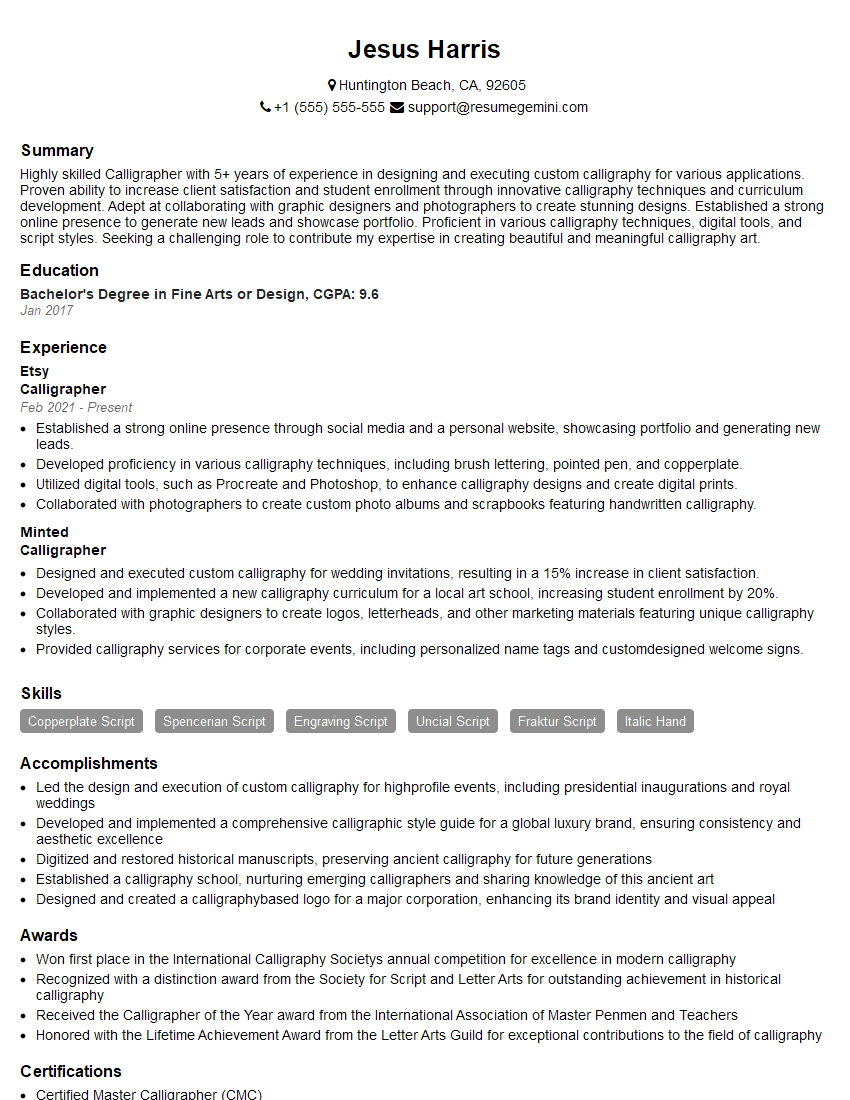
Mastering brush pen techniques significantly enhances your creative capabilities and opens doors to exciting career opportunities in design, illustration, and related fields. To maximize your job prospects, focus on crafting an ATS-friendly resume that highlights your skills and experience effectively. ResumeGemini is a trusted resource that can help you build a professional and impactful resume. Examples of resumes tailored to Brush Pen expertise are available to guide you. Take the next step and create a resume that showcases your talents and helps you land your dream job!
Explore more articles
Users Rating of Our Blogs
Share Your Experience
We value your feedback! Please rate our content and share your thoughts (optional).
What Readers Say About Our Blog
Very informative content, great job.
good