Cracking a skill-specific interview, like one for Buckling Analysis, requires understanding the nuances of the role. In this blog, we present the questions you’re most likely to encounter, along with insights into how to answer them effectively. Let’s ensure you’re ready to make a strong impression.
Questions Asked in Buckling Analysis Interview
Q 1. Explain the Euler buckling formula and its limitations.
The Euler buckling formula is a fundamental equation in structural mechanics that predicts the critical load at which a slender column will buckle, transitioning from a stable to an unstable equilibrium. It’s derived under the assumption of perfect column geometry, perfectly elastic material behavior, and a concentric axial load. The formula is: Pcr = (π²EI) / (KL)², where Pcr is the critical buckling load, E is the modulus of elasticity of the column material, I is the area moment of inertia of the column’s cross-section about the axis of bending, L is the length of the column, and K is the effective length factor, accounting for end conditions.
However, this formula has significant limitations. It only applies to:
- Slender columns: The column’s length must be significantly greater than its cross-sectional dimensions. If the column is short and stocky, the material’s strength, not its stiffness, will determine failure.
- Elastic material behavior: The formula assumes the material remains within its elastic region. If the column yields before buckling, the Euler formula is inaccurate.
- Perfect geometry and loading: Any initial imperfections (e.g., slight curvature, eccentricity of load) or non-axial loads will significantly reduce the actual buckling load compared to the theoretical Euler load. In reality, such imperfections are always present.
- Linear elastic material: It doesn’t account for nonlinear material behavior, such as plasticity.
For example, a perfectly straight, long steel rod will fail according to Euler’s formula, whereas a short, thick steel rod will fail due to yielding before significant buckling occurs.
Q 2. Describe different types of buckling (e.g., Euler, local, lateral-torsional).
Buckling can manifest in several ways, each with its own characteristics and failure mechanisms:
- Euler buckling (Column Buckling): This is the classic buckling mode described by the Euler formula, involving a slender column subjected to a compressive axial load. The column bends and deflects sideways, ultimately failing when it reaches its critical load. Think of a long, thin metal ruler compressed along its length.
- Local buckling: This occurs when a component buckles locally within its cross-section. This is typically seen in thin-walled sections like I-beams or channel sections, where the relatively thin flanges or webs buckle under compression before overall column buckling occurs. Imagine a thin sheet of metal buckling inwards under compression.
- Lateral-torsional buckling (LTB): This type of buckling affects beams under bending, where the beam not only bends in the plane of loading but also twists and deflects laterally. It’s common in beams with slender, unsymmetrical cross-sections. Think of a long, I-beam under bending: it will not only deflect down, but also twist sideways and out of its plane.
Understanding the different buckling modes is crucial for designing robust structures, as they can lead to premature and catastrophic failure if not accounted for in the design process.
Q 3. What is the effective length factor, and how does it influence buckling analysis?
The effective length factor (K) accounts for the impact of boundary conditions on the buckling behavior of a column. It represents the ratio of the effective length of the column to its actual length. The effective length is the length of an equivalent pin-ended column that would buckle at the same load as the actual column. The value of K ranges from 0.5 to 2.0, depending on the support conditions.
A lower K value indicates a more restrained column, requiring a higher buckling load to fail. For example, a fixed-fixed column (both ends rigidly fixed) will have a K value of 0.5, while a pinned-pinned column (both ends simply supported) has a K value of 1.0, and a fixed-free column (one end fixed, one end free) has a K value of 2.0.
The effective length factor significantly influences the buckling load. Using the wrong K value leads to inaccurate predictions of the critical buckling load, potentially resulting in unsafe designs. For instance, assuming K = 1.0 for a fixed-fixed column would overestimate the buckling load and lead to an under-designed structure.
Q 4. How do boundary conditions affect the buckling load?
Boundary conditions significantly impact the buckling load. They define how the column is supported at its ends. Different support conditions constrain the column’s ability to deform, affecting its stiffness and, consequently, its critical buckling load.
- Fixed-Fixed: Both ends are rigidly fixed, preventing both rotation and translation. This provides maximum restraint, resulting in the highest critical buckling load (lowest K value).
- Pinned-Pinned: Both ends are simply supported, allowing rotation but preventing translation. This has an intermediate level of restraint.
- Fixed-Free (Cantilever): One end is fixed, while the other is free. This offers minimal restraint and has the lowest critical buckling load (highest K value).
- Fixed-Pinned: One end is fixed, while the other is pinned. This provides a level of restraint between fixed-fixed and pinned-pinned.
For example, a column with fixed-fixed supports will withstand a significantly higher load before buckling compared to an identical column with fixed-free supports. The difference in buckling load is directly reflected by the K factor within the Euler formula.
Q 5. Explain the concept of critical buckling load.
The critical buckling load (Pcr) is the minimum compressive load that will cause a column to buckle. It represents the transition point between stable and unstable equilibrium. Below this load, the column remains straight; at or above this load, the column deflects laterally, ultimately leading to failure. The critical buckling load is crucial in structural design as it is the design limit that must not be exceeded for a stable and safe structure.
Determining the critical buckling load involves considering the column’s geometry (length and cross-sectional properties), material properties (Young’s modulus), and boundary conditions (effective length factor). Accurate calculation of this load is paramount in preventing structural collapse.
Q 6. Describe the difference between linear and nonlinear buckling analysis.
Linear and nonlinear buckling analyses differ fundamentally in their approach to solving buckling problems:
- Linear buckling analysis assumes small deformations and linear elastic material behavior. It utilizes eigenvalue analysis to determine the critical buckling load and corresponding buckling mode shape. This method is computationally efficient but limited to situations with small displacements and no significant geometric or material nonlinearity. It primarily provides the critical load but does not provide information on the post-buckling behavior.
- Nonlinear buckling analysis considers large deformations and can incorporate geometric and material nonlinearities. It uses iterative numerical methods, such as the Newton-Raphson method, to trace the load-displacement curve beyond the critical load. This analysis is more computationally expensive but provides a more realistic and complete picture of the buckling behavior, including post-buckling strength and the impact of initial imperfections.
The choice between linear and nonlinear analysis depends on the complexity of the problem and the required accuracy. Linear analysis is suitable for preliminary design and assessment of simple structures, while nonlinear analysis is necessary for detailed designs, complex geometries, or when post-buckling behavior is critical. For example, in designing aerospace structures where weight and stability are paramount, nonlinear analysis might be crucial due to the presence of thin-walled structures and the sensitivity to initial imperfections.
Q 7. What is the role of material properties in buckling analysis?
Material properties play a significant role in buckling analysis, primarily through the modulus of elasticity (E) and the yield strength (σy). The modulus of elasticity defines the material’s stiffness, indicating its resistance to deformation. A higher modulus of elasticity results in a higher critical buckling load, meaning the column will be able to withstand a greater compressive load before buckling.
The yield strength determines the material’s resistance to permanent deformation. If the compressive stresses due to the applied load exceed the yield strength before the buckling load is reached, the column will fail through yielding rather than buckling. This is particularly relevant for short, stocky columns where the material strength becomes the governing factor.
In addition to E and σy, other material properties like Poisson’s ratio can also influence the buckling load, particularly in more complex analysis scenarios. Therefore, selecting the appropriate material with suitable properties is paramount in achieving a safe and robust design.
Q 8. How does geometric imperfection influence buckling behavior?
Geometric imperfections, even seemingly insignificant deviations from a perfect geometry, significantly influence a structure’s buckling behavior. Imagine a perfectly straight, slender column – theoretically, it should buckle precisely at its Euler buckling load. However, real-world columns always have minor imperfections: slight bends, irregularities in cross-section, or variations in material properties. These imperfections act as initial triggers, initiating buckling at a load lower than the theoretical Euler load. The presence of imperfections essentially reduces the structure’s load-carrying capacity before reaching its theoretical buckling strength. The smaller the imperfection, the closer the actual buckling load will be to the theoretical value, but the impact is always present.
For instance, consider a tall building column. Even minute imperfections introduced during manufacturing or construction can considerably reduce its buckling resistance, meaning it may collapse under a load significantly less than predicted by idealized analysis. This highlights the critical importance of considering geometric imperfections in practical structural design to ensure safety and reliability.
Q 9. Explain the concept of imperfection sensitivity.
Imperfection sensitivity describes how dramatically a structure’s buckling load is affected by the presence of initial geometric imperfections. Some structures are highly sensitive, meaning even small imperfections drastically reduce their buckling load. Others are relatively insensitive, maintaining a buckling load close to the theoretical value even with considerable imperfections. This sensitivity depends on several factors, including the structure’s geometry (slenderness ratio), material properties (elastic modulus), and the type and magnitude of the imperfections.
Think of a perfectly balanced pencil standing on its tip. A tiny nudge (imperfection) will cause it to fall immediately (low buckling load). This represents a highly imperfection-sensitive structure. Conversely, a broad, sturdy base would be less sensitive – it takes a much larger disturbance to knock it over. In design, understanding imperfection sensitivity allows engineers to account for real-world imperfections and design structures robust enough to withstand them.
Q 10. Describe the use of Finite Element Analysis (FEA) in buckling analysis.
Finite Element Analysis (FEA) is a powerful computational tool extensively used in buckling analysis. It involves discretizing a structure into numerous smaller elements, each with defined properties. FEA software then solves complex equations to determine the structure’s response to various loads, including buckling loads. This approach allows us to analyze complex geometries, material nonlinearities, and boundary conditions, that would be impossible with analytical methods.
The process typically begins by creating a detailed finite element model of the structure, including its geometry, material properties, and boundary conditions. Then, the software applies a load and determines the structure’s stress and strain state. For buckling analysis, specific algorithms, such as eigenvalue buckling analysis, are used to find the critical buckling load at which the structure becomes unstable. FEA provides crucial insights into the buckling mode shapes (the pattern of deformation at buckling), enabling engineers to identify critical areas and implement design improvements.
Q 11. What are the common FEA software used for buckling analysis (e.g., ANSYS, ABAQUS)?
Several commercially available FEA software packages excel in buckling analysis. Leading examples include:
- ANSYS: A widely used, comprehensive FEA software offering a broad range of capabilities, including linear and nonlinear buckling analyses.
- ABAQUS: Known for its strength in handling complex material behaviors and nonlinear analyses, making it suitable for advanced buckling problems.
- Nastran: A powerful solver frequently employed for large-scale structural analysis, including buckling.
- LS-DYNA: Particularly well-suited for highly nonlinear and dynamic buckling simulations.
The choice of software often depends on the complexity of the analysis, the required level of accuracy, and the specific features needed.
Q 12. How do you model boundary conditions in FEA for buckling analysis?
Accurate boundary condition modeling is critical in FEA for buckling analysis. Boundary conditions define how a structure interacts with its surroundings. Incorrect modeling can lead to inaccurate predictions of buckling loads and mode shapes. Common boundary conditions include:
- Fixed Support: Restricts all degrees of freedom (translations and rotations) at a specific point or surface.
- Pinned Support: Restricts translations but allows rotations.
- Roller Support: Restricts translation in one direction but allows translation in other directions and rotation.
- Symmetry: Exploits symmetry to reduce the model size and computational time.
For example, a column fixed at its base and free at the top would be modeled with a fixed support at the base and no constraints at the top. Careful consideration of boundary conditions is necessary to accurately simulate the real-world constraints of the structure being analyzed.
Q 13. Explain the concept of eigenvalue buckling analysis.
Eigenvalue buckling analysis is a linear FEA method used to determine the critical buckling loads and corresponding mode shapes of a structure. It assumes linear elastic material behavior and small deformations. The method solves an eigenvalue problem, where the eigenvalues represent the buckling loads (often expressed as a load factor multiplying the applied load), and the eigenvectors represent the corresponding buckling mode shapes.
The lowest eigenvalue corresponds to the lowest critical buckling load, which is the most important value for design purposes. Higher eigenvalues represent subsequent buckling modes, which may become relevant under certain loading conditions. Eigenvalue analysis provides valuable information about the stability of a structure under various load scenarios and aids in identifying potential weaknesses.
Q 14. What are the different types of elements used in FEA for buckling analysis?
The choice of element type in FEA for buckling analysis significantly impacts the accuracy and efficiency of the simulation. Common element types include:
- Beam Elements: Suitable for slender structures like columns and beams, where bending behavior is dominant. They are computationally efficient but may be less accurate for complex cross-sections.
- Shell Elements: Ideal for thin-walled structures like plates and shells, where both bending and membrane actions are important. They offer a good balance between accuracy and computational cost.
- Solid Elements: Used for three-dimensional structures with complex geometries and stress states. They are highly versatile but computationally expensive, especially for large models.
The selection of element type depends on the structure’s geometry, the anticipated stress distribution, and the desired level of accuracy. A proper mesh density (element size) is also crucial for accurate results. Too coarse a mesh can lead to inaccurate predictions, while too fine a mesh unnecessarily increases computational time.
Q 15. How do you interpret the buckling mode shapes?
Buckling mode shapes represent the deformation pattern a structure takes when it buckles under a compressive load. Imagine a perfectly straight column: when it buckles, it doesn’t just bend randomly; it follows a specific shape, a mode shape. These shapes are characterized by nodes (points of zero displacement) and antinodes (points of maximum displacement). The first buckling mode is usually the most important and has the lowest critical buckling load. Higher modes involve more complex deformation patterns with multiple nodes and antinodes. They only become relevant if the structure is somehow prevented from buckling in the first mode.
Interpreting these shapes is crucial for understanding where stresses are concentrated during buckling and designing effective reinforcement strategies. For example, if a bridge’s beam shows a buckling mode with a large deflection at the mid-span, that indicates a need for extra support in the center to prevent collapse.
- First Mode: Often a simple sine wave or half sine wave, depending on the boundary conditions.
- Higher Modes: More complex waveforms with multiple half-sine waves.
By analyzing the mode shapes, engineers can pinpoint weaknesses in a structure’s design and implement modifications to enhance stability.
Career Expert Tips:
- Ace those interviews! Prepare effectively by reviewing the Top 50 Most Common Interview Questions on ResumeGemini.
- Navigate your job search with confidence! Explore a wide range of Career Tips on ResumeGemini. Learn about common challenges and recommendations to overcome them.
- Craft the perfect resume! Master the Art of Resume Writing with ResumeGemini’s guide. Showcase your unique qualifications and achievements effectively.
- Don’t miss out on holiday savings! Build your dream resume with ResumeGemini’s ATS optimized templates.
Q 16. Explain the concept of buckling load factor.
The buckling load factor (BLF) is a dimensionless multiplier applied to the applied load to determine the critical load at which buckling occurs. It essentially answers the question: ‘How much of the applied load is needed to cause buckling?’ A BLF of 1.0 indicates that the applied load itself is sufficient to cause buckling. A BLF greater than 1 means the structure can withstand the load without buckling; a BLF less than 1 implies that the structure is already in danger of buckling under the current load. It’s a crucial safety factor in design, providing a margin of safety against unexpected loads or imperfections.
For example, if a column is designed to withstand a 100 kN load, and a buckling analysis reveals a BLF of 1.5, it means the column can actually handle a load of 150 kN (100 kN * 1.5) before buckling occurs. This allows for a design that considers factors beyond simple load capacity.
Q 17. How do you verify the accuracy of your buckling analysis results?
Verifying the accuracy of buckling analysis results is paramount for structural integrity. There are several methods:
- Mesh Refinement: Repeating the analysis with a finer mesh can assess the convergence of results. If the critical buckling load changes significantly with mesh refinement, it signals the need for further refinement to ensure accuracy.
- Comparison with Experimental Data: Comparing analytical results with experimental buckling tests on similar structures provides invaluable validation. This is particularly useful for complex geometries or material behaviors.
- Analytical Solutions (Simplified Models): For simple geometries, analytical solutions can be used for comparison. This serves as a benchmark for more sophisticated numerical analysis.
- Verification with different FEA software: Running the analysis using different Finite Element Analysis (FEA) software packages can help catch potential errors within a specific software or methodology.
- Review of Assumptions and Model Simplifications: It is crucial to critically examine assumptions made during the modeling phase (material properties, boundary conditions, imperfections). Any discrepancies between the model and the real structure can affect the accuracy of the results.
A good practice is to document all these validation steps clearly to ensure the reliability of the findings.
Q 18. Describe the difference between static and dynamic buckling.
Static buckling occurs when a structure buckles under a gradually applied, constant load. Imagine slowly increasing the weight on a perfectly straight column until it suddenly buckles. The load is essentially static, and the failure is sudden. The analysis involves solving an eigenvalue problem to determine the critical load.
Dynamic buckling, on the other hand, involves a rapid application of load or an impact, leading to instability. Think of dropping a heavy object onto a beam; the high-speed impact can cause buckling even if the load’s magnitude is lower than the static buckling load. It requires a more complex time-dependent analysis that takes into account inertia and damping effects. Dynamic buckling is significantly harder to analyze and often necessitates advanced numerical techniques.
Q 19. What is the influence of residual stresses on buckling behavior?
Residual stresses are stresses that remain within a material after it has been manufactured or processed. These stresses can significantly influence buckling behavior. Compressive residual stresses can reduce the load-bearing capacity of a structure, making it more prone to buckling, effectively lowering the critical buckling load. Conversely, tensile residual stresses can slightly improve stability. Welding, for instance, commonly introduces residual stresses that need to be considered during buckling analysis. Failing to account for residual stresses can lead to inaccurate predictions and compromised structural safety.
In practice, accurately modeling and incorporating residual stresses into a buckling analysis is complex and often requires specialized techniques and experimental measurements. It might involve sophisticated FEA simulations that account for the manufacturing process.
Q 20. Explain the concept of post-buckling analysis.
Post-buckling analysis goes beyond determining the critical buckling load; it investigates the structure’s behavior *after* it has buckled. This is crucial because a structure might not necessarily fail immediately upon buckling. Some structures exhibit a stable post-buckling behavior, meaning they can sustain additional load beyond the critical load before complete collapse. Others show unstable post-buckling, where the load capacity decreases rapidly after buckling. This information is vital for assessing the load-carrying capacity and safety after initial buckling has occurred.
Nonlinear finite element analysis is typically required to perform post-buckling analysis, capable of handling large deformations and geometric nonlinearities. It helps to determine the post-buckling load-displacement curve, providing valuable insight into the structure’s behavior beyond the initial buckling point.
Q 21. How do you handle nonlinear material behavior in buckling analysis?
Nonlinear material behavior, such as plasticity or creep, significantly affects buckling. Linear elastic buckling analysis assumes a linear stress-strain relationship, which is not always true in reality. Materials may yield or creep under load, altering the stiffness and thus the buckling load. To handle this, nonlinear finite element analysis is essential. This involves using constitutive models that accurately describe the material’s nonlinear response, including yielding, strain hardening, and creep behavior.
For example, a steel column might exhibit plastic deformation before buckling, reducing its effective stiffness and lowering the critical buckling load compared to what a linear elastic analysis would predict. Proper consideration of material nonlinearity is therefore vital for obtaining accurate and conservative buckling predictions.
Q 22. Describe the buckling analysis of thin-walled sections.
Buckling analysis of thin-walled sections is significantly more complex than that of solid sections due to their susceptibility to local buckling, distortional buckling, and overall buckling modes. Local buckling involves the failure of the section’s individual elements (like plates or stiffeners), while distortional buckling refers to the out-of-plane deformation of the cross-section itself. Overall buckling, on the other hand, involves the entire member’s instability. Analyzing thin-walled sections often requires specialized finite element methods that can accurately capture the complex stress and strain distributions.
The analysis typically involves using finite element software with shell elements, which can handle the thin-walled geometry and the resulting complex stress states. We need to consider the material properties, the section geometry (including details like stiffeners, cutouts, and weld details), and the boundary conditions. Linear buckling analysis is commonly used to find the critical buckling load, which indicates the load at which the structure becomes unstable. However, for more accurate results, non-linear buckling analysis may be necessary to account for geometric nonlinearities and material nonlinearities.
For example, consider the buckling analysis of a thin-walled steel beam. A simple Euler buckling analysis might suffice if the section is relatively stiff, but if it’s a slender, complex section, a shell element model in a finite element program (like Abaqus, ANSYS, or LS-DYNA) would be necessary to accurately capture the local and distortional buckling behavior and determine the actual load-carrying capacity.
Q 23. Explain the concept of stability analysis.
Stability analysis assesses a structure’s ability to withstand loads without undergoing significant changes in its configuration. It’s crucial because structural failure doesn’t always happen through yielding (the material exceeding its strength limit). Instead, a structure can become unstable, undergoing large displacements and ultimately collapsing, even if the material stresses remain below the yield strength. This phenomenon is precisely what buckling analysis aims to predict.
There are two main approaches: linear and non-linear stability analysis. Linear analysis assumes small deformations and is typically used to determine the critical buckling load, that is, the load at which the first instability occurs. Non-linear stability analysis accounts for large deformations and allows the investigation of post-buckling behavior, providing more accurate predictions, particularly when the structure experiences significant deformations before collapse.
Imagine a perfectly straight column under compression. Linear buckling analysis will predict a critical load beyond which the column will buckle. Non-linear analysis will show how the column deflects after this critical load is exceeded and how much load it can still support before eventual failure.
Q 24. How do you determine the appropriate mesh density for accurate buckling analysis?
Determining the appropriate mesh density for accurate buckling analysis is crucial. An insufficiently refined mesh may miss important buckling modes, leading to inaccurate predictions of the critical buckling load. On the other hand, an excessively refined mesh increases computational costs without necessarily improving accuracy.
The optimal mesh density depends on several factors: the geometry’s complexity, the anticipated buckling mode shape, and the desired accuracy. A good strategy is to start with a relatively coarse mesh, perform the analysis, and then refine the mesh in areas of high stress gradients or anticipated buckling modes. This iterative process continues until the results converge, meaning further refinement doesn’t significantly change the critical buckling load.
A common approach is to refine the mesh around areas with significant stress concentrations or geometric discontinuities. You can also use mesh convergence studies to systematically refine the mesh and observe how the critical buckling load changes. When the change becomes negligible, you have reached sufficient mesh density.
Q 25. What are some common sources of error in buckling analysis?
Several common sources of error can significantly impact the accuracy of buckling analysis results. These include:
- Inadequate mesh density: As discussed earlier, a poorly refined mesh can lead to inaccurate predictions of buckling modes and critical loads.
- Incorrect boundary conditions: Improperly defined supports or constraints can dramatically alter the buckling behavior.
- Simplified geometry: Neglecting small geometric details, such as fillets or holes, can introduce significant errors.
- Inaccurate material properties: Using inaccurate values for Young’s modulus, Poisson’s ratio, or yield strength will lead to erroneous results.
- Numerical limitations: The chosen numerical method and its implementation in the finite element software may introduce errors.
- Ignoring initial imperfections: Real-world structures always have imperfections, which can significantly reduce their buckling capacity. Neglecting these imperfections in the analysis can lead to overly optimistic results.
Careful consideration and rigorous verification of each aspect of the analysis is crucial for minimizing these errors.
Q 26. How do you address uncertainties in material properties in buckling analysis?
Addressing uncertainties in material properties is vital for realistic buckling analysis. Material properties are often subject to variations due to manufacturing processes, environmental conditions, and inherent material variability.
One approach is to use probabilistic methods. This involves defining probability distributions for the uncertain material properties (e.g., a normal distribution for Young’s modulus). The analysis is then repeated multiple times using random samples from these distributions, generating a range of possible buckling loads. This provides a more realistic estimate of the structure’s buckling capacity, including its variability.
Another approach is sensitivity analysis, which assesses the impact of variations in individual material properties on the buckling load. This helps identify the most critical parameters and focus efforts on obtaining more accurate values for them. Furthermore, using appropriate material models (that include things like plasticity and creep) can also significantly improve the accuracy of buckling analysis under complex loading scenarios.
Q 27. Describe a challenging buckling analysis project you’ve worked on and how you overcame the challenges.
One particularly challenging project involved analyzing the buckling behavior of a large, complex offshore wind turbine tower. The tower had a tapered, thin-walled, lattice structure with numerous weld joints and complex loading conditions (including wind, wave, and current loads).
The primary challenge was accurately modeling the complex geometry and boundary conditions, especially the weld connections. The solution involved a multi-stage approach. First, we created a highly detailed 3D finite element model using shell elements to capture the thin-walled nature of the structure. Next, we carefully modeled the weld connections using appropriate constraints and contact elements, considering potential weld imperfections. Furthermore, we utilized a non-linear buckling analysis to capture the effects of large deformations and geometric non-linearities.
Finally, we performed a comprehensive sensitivity analysis to determine the influence of different parameters (like weld strength, wind loading variations, and material properties) on the critical buckling load. This helped quantify the uncertainty in our predictions, providing a more reliable basis for design decisions. By combining a detailed model with a systematic approach to uncertainty quantification, we provided the client with a robust and reliable analysis of the tower’s structural integrity.
Q 28. Explain how buckling analysis contributes to safe and efficient design.
Buckling analysis is fundamental to ensuring safe and efficient design in numerous engineering applications. By accurately predicting the critical buckling load, engineers can ensure that structures don’t fail unexpectedly due to instability. This is crucial for preventing catastrophic failures in bridges, buildings, aircraft, and many other structures.
In addition to safety, buckling analysis allows for efficient design. By understanding the buckling behavior, engineers can optimize the design to minimize material usage without compromising structural integrity. This leads to lighter, more cost-effective designs. For example, in aerospace engineering, reducing weight is paramount; accurate buckling analysis allows engineers to use the least amount of material possible while ensuring the structural safety of the aircraft.
Ultimately, buckling analysis empowers engineers to create structures that are not only safe but also economical and environmentally friendly by reducing material waste.
Key Topics to Learn for Buckling Analysis Interview
- Euler’s Formula and its Limitations: Understand the theoretical basis of buckling and its applicability to different column configurations. Consider the assumptions and limitations of the formula and when it’s appropriate to apply it.
- Buckling of Beams and Frames: Explore the analysis techniques for various beam and frame structures under compressive loads. This includes understanding different boundary conditions and their impact on critical loads.
- Energy Methods (Rayleigh-Ritz): Learn how energy methods are used to determine critical buckling loads, particularly for complex geometries where direct application of Euler’s formula is challenging. Understand the underlying principles and applications.
- Finite Element Analysis (FEA) in Buckling: Gain familiarity with using FEA software for buckling analysis. Understand how to model structures, apply boundary conditions, and interpret results, including mode shapes and critical loads.
- Stability Analysis: Understand the difference between linear and nonlinear buckling analysis and when each is appropriate. Learn about bifurcation points and post-buckling behavior.
- Practical Applications: Discuss real-world examples of buckling analysis in structural engineering, aerospace engineering, and mechanical engineering. Think about case studies and how the theoretical concepts are used in practice.
- Material Properties and Their Influence: Understand how material properties like Young’s modulus and yield strength affect the buckling capacity of structures. Explore the influence of material imperfections.
- Design Considerations and Safety Factors: Learn how buckling analysis informs design decisions, including the selection of appropriate materials, cross-sections, and safety factors. Understand the importance of incorporating buckling considerations into design codes and standards.
Next Steps
Mastering buckling analysis is crucial for career advancement in various engineering fields, opening doors to exciting projects and leadership opportunities. A strong understanding of these concepts will significantly enhance your interview performance and overall career prospects. To maximize your chances of landing your dream job, it’s essential to have an ATS-friendly resume that highlights your skills and experience effectively. ResumeGemini can help you create a professional and impactful resume tailored to the specific requirements of Buckling Analysis roles. Use ResumeGemini’s tools to build a compelling narrative of your skills and experience. Examples of resumes tailored to Buckling Analysis roles are available to guide you.

Engineering Manager Resume Sample

Principal Engineer Resume Sample

Project Engineer Resume Sample

Research Scientist Resume Sample

Design Engineer Resume Sample

Aerospace Engineer Resume Sample

Civil Engineer Resume Sample

Geotechnical Engineer Resume Sample

Structural Engineer Resume Sample

Naval Architect Resume Sample

Materials Engineer Resume Sample

Mechanical Engineer Resume Sample
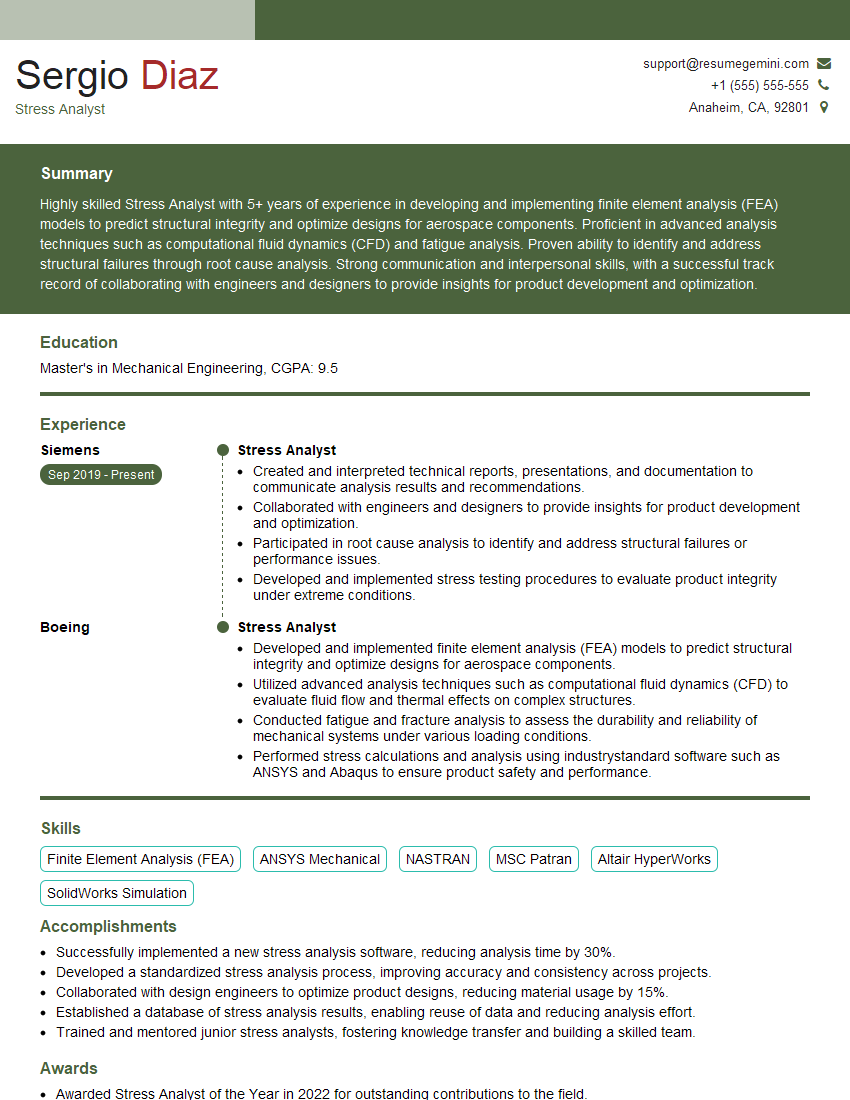
Stress Analyst Resume Sample

Automotive Engineer Resume Sample

Professor of Engineering Resume Sample
Explore more articles
Users Rating of Our Blogs
Share Your Experience
We value your feedback! Please rate our content and share your thoughts (optional).
What Readers Say About Our Blog
Very informative content, great job.
good