The thought of an interview can be nerve-wracking, but the right preparation can make all the difference. Explore this comprehensive guide to Car Setup and Engineering interview questions and gain the confidence you need to showcase your abilities and secure the role.
Questions Asked in Car Setup and Engineering Interview
Q 1. Explain the concept of vehicle dynamics.
Vehicle dynamics is the study of how a vehicle moves and responds to forces acting upon it. It encompasses a wide range of factors, including acceleration, braking, cornering, and stability. Understanding vehicle dynamics is crucial for engineers to design safe and efficient vehicles, and for racers to optimize their car’s performance. Think of it like this: vehicle dynamics is the science behind how a car ‘talks’ to the driver and the road. It involves understanding the interactions between the tires, the suspension, the steering system, and the car’s center of gravity.
For instance, a vehicle’s weight distribution significantly impacts its handling. A rear-heavy car will tend to oversteer (the rear end sliding out), while a front-heavy car might understeer (the front end pushing wide). Factors like tire grip, aerodynamic forces, and driver input also play a vital role in the overall dynamic behavior.
Q 2. Describe the different types of suspension systems and their characteristics.
Suspension systems are crucial for providing comfort and handling. There are several types:
- Independent Suspension: Each wheel moves independently. This provides better handling and comfort as bumps on one side don’t affect the others. Examples include MacPherson struts and double wishbones, common in most modern cars.
- Dependent Suspension: Wheels on the same axle are connected. This is simpler and cheaper but less sophisticated in terms of handling. Live axles are a classic example, often found in trucks and older vehicles.
- Air Suspension: Uses air springs instead of coils or leaf springs. This allows for adjustable ride height and damping, offering excellent comfort and handling adaptability, particularly in luxury vehicles and some heavy-duty trucks.
- Passive Suspension: Relies on springs and dampers to control the movement. Simple, robust, and relatively inexpensive but lacks adjustability.
- Active Suspension: Uses electronically controlled components to actively adjust the damping and ride height, providing superior control and comfort. These systems are typically found in high-performance or luxury vehicles.
The choice of suspension system depends on the vehicle’s intended use. A sports car prioritizes handling and might use an independent system with sophisticated geometry, while a truck might favor a simpler, more robust dependent system capable of handling heavy loads.
Q 3. How does tire pressure affect vehicle handling?
Tire pressure significantly impacts vehicle handling. Under-inflation leads to excessive tire flexing, reducing grip and increasing rolling resistance. This results in slower acceleration, reduced braking performance, and increased fuel consumption. The handling becomes vague and less responsive, with a greater tendency to understeer (the front of the car pushing wide in corners).
Over-inflation, on the other hand, reduces the tire’s contact patch with the road. This compromises grip, especially in corners, leading to reduced steering responsiveness and potentially causing loss of control. The ride becomes harsher and less comfortable. The ideal tire pressure is usually found in the owner’s manual and should be checked regularly.
Think of it like a balloon: under-inflated, it’s wobbly and unstable; over-inflated, it’s hard and loses its flexibility. Tires need just the right amount of pressure for optimal performance and safety.
Q 4. What is the role of anti-roll bars in vehicle setup?
Anti-roll bars (also known as sway bars) are used to reduce body roll during cornering. They connect the suspension on opposite sides of the vehicle, creating a stiffer connection between the left and right wheels. When the vehicle leans into a corner, the anti-roll bar resists this roll by transferring load from the heavily loaded wheel to the less loaded one. This improves stability and handling by reducing the car’s tendency to lean excessively.
For example, a thicker anti-roll bar will reduce body roll more effectively than a thinner one. However, a stiffer anti-roll bar can also make the ride harsher, especially over uneven surfaces. The optimal anti-roll bar stiffness is a compromise between handling and ride comfort.
Q 5. Explain the concept of camber, caster, and toe.
Camber, caster, and toe are crucial wheel alignments that significantly affect handling and tire wear. Let’s visualize them:
- Camber: The angle of the wheel relative to the vertical axis when viewed from the front. Positive camber means the top of the wheel leans outward; negative camber leans inward. Negative camber is often used in performance applications to increase contact patch during cornering.
- Caster: The angle of the steering axis when viewed from the side. Positive caster means the steering axis leans backward, providing directional stability and self-centering. It’s like the front wheel of a shopping cart; it naturally steers back to straight.
- Toe: The angle of the wheels as seen from above. Toe-in means the front of the wheels points slightly inward, while toe-out points slightly outward. Slight toe-in is usually preferred for reducing tire wear.
Precise adjustment of these angles is crucial for optimal handling. Incorrect alignment can lead to uneven tire wear, poor steering feel, and instability.
Q 6. How do you adjust suspension settings to improve cornering performance?
Adjusting suspension settings to improve cornering performance involves modifying several parameters. The approach depends on the specific vehicle and desired handling characteristics. Generally, you want to balance grip and stability:
- Spring Rates: Stiffer springs reduce body roll but can make the ride harsher.
- Damper Settings: Adjusting dampers (shock absorbers) controls rebound and compression. Stiffer damping reduces body roll but can sacrifice grip on uneven surfaces. A balance is needed.
- Ride Height: Lowering the ride height lowers the center of gravity, improving stability, but may reduce ground clearance.
- Anti-roll Bar Stiffness: Stiffer bars reduce body roll but can make the ride harsher, particularly over bumps.
The process often involves iterative adjustments on a track or test facility, analyzing data like g-forces and tire slip angles. Sophisticated data acquisition systems are often used to monitor vehicle behavior during testing, allowing for precise tuning.
Q 7. Describe the effects of different spring rates on vehicle handling.
Spring rates directly influence a vehicle’s handling and ride quality. The spring rate is a measure of the force required to compress the spring a certain distance. A higher spring rate means a stiffer spring.
- Higher Spring Rates: Provide better handling in corners by reducing body roll and improving responsiveness. However, they can make the ride harsher and less comfortable, transmitting more road imperfections to the cabin.
- Lower Spring Rates: Result in a softer, more comfortable ride, but increase body roll in corners and reduce handling responsiveness. They are better for comfort on rough roads but may cause excessive body roll and instability.
Choosing the right spring rate involves finding a balance between handling and comfort. The optimal rate depends on the vehicle’s weight, intended use, and driver preferences. A race car might use significantly stiffer springs than a family sedan.
Q 8. Explain the importance of data acquisition in vehicle setup.
Data acquisition is the backbone of modern vehicle setup. It’s the process of collecting vast amounts of data from various sensors on the car during testing or racing. This data provides crucial insights into the vehicle’s behavior, allowing engineers to make informed decisions to optimize performance and reliability. Think of it as giving the car a voice – it tells us what’s happening in real-time, far beyond what a driver can perceive.
For example, data acquisition systems can measure wheel speeds, suspension travel, brake pressures, engine parameters, aerodynamic forces, and much more. This data is then analyzed to understand how the car is responding to various inputs and track conditions.
Without data acquisition, setting up a race car would be akin to navigating a maze blindfolded. It would rely entirely on the driver’s subjective feedback, which can be inaccurate or incomplete. Data acquisition allows for objective, measurable improvements, leading to significantly faster and more consistent lap times.
Q 9. How do you interpret telemetry data to optimize vehicle performance?
Interpreting telemetry data requires a systematic approach. We start by visualizing the data using specialized software, plotting different parameters against time or distance. This allows us to identify correlations and anomalies. For example, analyzing lateral acceleration and steering angle reveals how the car responds to cornering. Analyzing brake pressures and deceleration tells us about braking performance and stability. We’re looking for things like excessive wheel slip, inconsistent braking, or unexpected suspension behavior.
Once we’ve identified areas of concern, we delve deeper. We might overlay multiple data channels to investigate the interplay of different systems. Let’s say we see high tire slip during cornering. We’d then examine suspension data to see if the car is improperly balanced, or aerodynamic data to see if there’s excessive lift. This process of correlation is key.
Finally, we use the insights to suggest changes. Perhaps a tweak to the suspension setup, a change to the aerodynamic configuration, or a modification to the braking system. We then return to the track with the changes implemented and repeat the data acquisition process to see if our interventions had the desired effect.
Q 10. What are the key performance indicators (KPIs) for a race car?
Key Performance Indicators (KPIs) for a race car are multifaceted, depending on the specific racing discipline. However, some consistent indicators include:
- Lap time: The ultimate measure of performance.
- Sector times: Identifying strong and weak areas of the track.
- Top speed: Crucial on long straights.
- Acceleration: 0-60 mph, 0-100 mph times.
- Braking performance: Stopping distances and stability.
- Tire wear: Managing tire degradation is vital for race strategy.
- Fuel consumption: Critical for fuel-limited races.
- Suspension travel: Monitoring the limits of the suspension to identify potential issues.
- Aerodynamic balance: Ensuring stability and predictability.
Beyond these, specific KPIs might include things like tire temperatures, brake temperatures, engine oil temperature, and even driver inputs like steering angle and throttle position, all reflecting on overall car performance and reliability. The goal is to minimize lap times while keeping the car within operational limits.
Q 11. Describe your experience with different types of shock absorbers.
I have extensive experience with various shock absorber types, including passive and active systems. Passive systems, like coil-overs and dampers, rely on mechanical components to control suspension movement. These are characterized by parameters such as spring rate, damping coefficient, and valving. We often fine-tune these to optimize the car’s handling characteristics for a given track.
Active systems, on the other hand, use electronically controlled actuators to adjust damping forces in real-time based on sensor input. These offer a level of sophistication that passive systems can’t match, allowing for adaptive ride and handling. I’ve worked with systems that adjust damping based on g-forces, wheel speeds, or even driver inputs. This allows for optimized performance across a broader range of conditions.
Furthermore, I’m familiar with different valving configurations within both passive and active systems. Each configuration offers unique characteristics in terms of ride comfort, responsiveness, and stability. Choosing the right shock absorber setup involves a deep understanding of the interplay between suspension dynamics, tire behavior, and aerodynamic forces. It’s a crucial step in optimizing vehicle handling and achieving competitive lap times.
Q 12. How do you balance aerodynamic downforce with drag?
Balancing aerodynamic downforce and drag is a constant optimization challenge in vehicle setup. Downforce increases grip and cornering speed, but it also increases drag, reducing top speed. The ideal balance depends on the specific track and racing conditions. A high-downforce setup is favored on tracks with many corners, while a low-downforce setup is better suited for tracks with long straights.
We often achieve this balance through adjustments to the aerodynamic components, such as the front and rear wings, diffusers, and underbody. Increasing the angle of attack of the wings increases downforce but also increases drag. Modifying the shape and size of these components allows for fine-tuning this balance. Computational Fluid Dynamics (CFD) simulations are frequently used to model and predict the aerodynamic performance of different configurations before testing on the track.
In practice, we might start with a baseline setup and iteratively adjust wing angles, or explore different wing configurations, measuring the trade-off between lap time and top speed. Data acquisition plays a critical role here, as it provides precise measurements of aerodynamic forces, which guide our adjustments.
Q 13. Explain the concept of weight transfer and its impact on handling.
Weight transfer is the shift in a vehicle’s weight distribution due to acceleration, braking, or cornering. Imagine a car accelerating. The weight shifts towards the rear, increasing the load on the rear tires and reducing the load on the front tires. This impacts traction and handling. During braking, the weight shifts forward, impacting braking stability and potentially causing understeer (the front tires losing grip).
In cornering, weight transfers to the outside wheels. The amount of weight transfer depends on factors like cornering speed, vehicle speed, vehicle weight, suspension setup, and the vehicle’s center of gravity. Understanding weight transfer is crucial because it significantly affects traction. Excessive weight transfer can lead to loss of traction, resulting in understeer or oversteer (the rear tires losing grip), making the car difficult to control.
We manage weight transfer through careful suspension tuning and chassis design. A lower center of gravity reduces weight transfer, enhancing handling stability. Proper spring and damper selection is critical to control the rate and magnitude of weight transfer, ensuring optimal tire contact throughout cornering and braking maneuvers. A well-balanced car minimizes abrupt weight shifts and maximizes tire grip.
Q 14. How do you analyze and troubleshoot vehicle handling problems?
Analyzing and troubleshooting vehicle handling problems is a systematic process that often involves a combination of subjective driver feedback and objective data analysis. We start by identifying the symptom: is the car understeering (front tires losing grip), oversteering (rear tires losing grip), or experiencing excessive body roll? Then we gather data – looking at tire pressures, suspension travel, and g-forces, as well as reviewing the driver’s comments.
For example, let’s say the car is exhibiting excessive understeer. We might look at the data to see if the front tires are consistently losing grip before the rear tires. This could suggest insufficient front tire pressure, a stiff front suspension setup, or even an aerodynamic imbalance. We might investigate the front suspension geometry, checking for issues like caster or camber misalignment.
Troubleshooting is an iterative process. We hypothesize the cause, make a change to the car setup (e.g., adjusting tire pressures, altering suspension settings, or modifying aerodynamic components), and then return to the track to test if the intervention had the desired effect. Data acquisition allows us to measure the impact of our changes objectively, enabling us to make informed decisions and refine the setup until we achieve the desired handling characteristics.
Q 15. What is the effect of different tire compounds on performance?
Different tire compounds significantly impact vehicle performance, primarily through their grip characteristics. The primary difference lies in the rubber compounds used in the tire’s construction. Softer compounds, like those used in qualifying tires, offer superior grip, leading to faster lap times but at the cost of reduced durability. They wear out much quicker. Conversely, harder compounds are more durable, better suited for longer races or varied track conditions, but sacrifice some grip resulting in slower lap times.
Think of it like this: imagine trying to grip a smooth glass surface with either a soft, sticky material or a hard, smooth one. The soft material offers far better grip, but it might tear or lose its effectiveness quickly. The hard material lasts longer, but provides less initial grip.
- Soft Compounds: High grip, low durability, faster lap times, suitable for short bursts of high performance (qualifying).
- Medium Compounds: Balance between grip and durability, versatile option for various race conditions.
- Hard Compounds: Low grip, high durability, slower lap times, better for longer races or less demanding tracks.
The choice of tire compound is crucial in strategic race planning. Teams carefully consider track conditions, race length, and desired performance levels when selecting their tire compounds.
Career Expert Tips:
- Ace those interviews! Prepare effectively by reviewing the Top 50 Most Common Interview Questions on ResumeGemini.
- Navigate your job search with confidence! Explore a wide range of Career Tips on ResumeGemini. Learn about common challenges and recommendations to overcome them.
- Craft the perfect resume! Master the Art of Resume Writing with ResumeGemini’s guide. Showcase your unique qualifications and achievements effectively.
- Don’t miss out on holiday savings! Build your dream resume with ResumeGemini’s ATS optimized templates.
Q 16. Describe your experience with different types of data acquisition systems.
My experience encompasses a wide range of data acquisition systems (DAQ), from basic systems utilizing sensors and a laptop for logging basic parameters to sophisticated, multi-channel systems capable of acquiring data at very high sampling rates. I’ve worked extensively with systems from AIM, Bosch, and Cosworth. The choice of system heavily depends on the application, budget, and complexity of the testing.
For example, in early-stage development, a relatively simple system might suffice to monitor basic parameters like speed, acceleration, and brake pressure. As testing progresses and the level of detail needed increases, more advanced systems are required. These can integrate advanced sensors for tire slip angle, suspension kinematics, and aerodynamic forces, providing the granular data needed for detailed performance analysis and simulation refinement.
I’m proficient in processing data from these systems using software like LabVIEW, MATLAB, and specialized DAQ software packages. Data analysis is critical as it reveals performance bottlenecks, allowing for targeted improvements to the vehicle setup and design.
Q 17. How do you use simulation tools to optimize vehicle setup?
Simulation tools are invaluable for optimizing vehicle setup before ever hitting the track, saving time and resources. I’ve used software packages like rFpro, iRacing, and CarSim extensively. These tools allow engineers to model vehicle dynamics with high fidelity, enabling the exploration of various setup parameters without physically modifying the car.
For instance, let’s say we’re trying to improve cornering speed. Instead of physically changing the suspension settings on the car repeatedly, we can use the simulation to model changes in ride height, spring rates, damper settings, and anti-roll bar stiffness. We use the software to virtually ‘test’ different combinations, evaluating their impact on things like lateral acceleration, tire slip angle, and yaw rate. The software provides detailed outputs and graphs that help guide decision making. This virtual testing reduces the number of real-world track tests needed.
This iterative process involves simulating changes, analyzing the results, and making further adjustments until an optimal setup is found. The simulation data provides the crucial information to fine-tune the setup and predict its performance on the actual track before the real-world test day even begins.
Q 18. Describe your experience with vehicle testing and validation procedures.
My vehicle testing and validation procedures follow a rigorous, iterative process, starting with a detailed test plan outlining objectives, parameters to be measured, and the testing methodology. This plan is crucial for efficient use of time and resources. The plan outlines how the data will be collected, analyzed, and verified.
The process generally involves several stages:
- Baseline Testing: Establish a benchmark performance level for the vehicle.
- Component Testing: Evaluate the performance of individual components (e.g., suspension, brakes, engine).
- System Testing: Evaluate the integrated performance of vehicle systems.
- Validation Testing: Verify that the vehicle meets performance targets and safety requirements.
Throughout the process, rigorous data analysis is crucial to identify areas for improvement. Data from various sensors, such as accelerometers, gyroscopes, and GPS, are carefully analyzed to pinpoint performance issues. This allows for targeted modifications and retesting to achieve the desired outcome. Documentation is meticulously maintained, ensuring traceability and facilitating the review process.
A key element is always the comparison of the experimental data to the simulation data. If there is a significant deviation between the simulated and real-world results, this helps to identify flaws in either the model or the test process, leading to crucial updates and improvements.
Q 19. Explain the process of setting up a vehicle for a specific track.
Setting up a vehicle for a specific track involves a holistic approach that considers track characteristics and driving style. The process starts with detailed analysis of the track layout, identifying high-speed sections, braking zones, and corners.
For instance, a track with many long, fast corners will require a setup focused on high-speed stability, potentially emphasizing aerodynamic balance and suspension geometry that resists high-load changes. In contrast, a track with many tight, technical corners would benefit from a setup that focuses on agility and responsiveness, adjusting parameters such as anti-roll bar stiffness and damper settings for quicker reactions.
The process is iterative. We begin with a baseline setup – a set of initial parameters based on experience and prior data. Then we conduct test runs on the track, acquiring data on tire slip angles, suspension travel, and vehicle dynamics. Based on the initial data analysis, we adjust the parameters (camber, caster, toe, ride height, spring rates, damper settings, and anti-roll bar settings). After each round of adjustments, we collect more data and refine the setup through additional iterations.
Driver feedback is crucial and integrates into this process. The driver’s input guides the changes and helps to fine-tune the setup to the unique driving style and preferences of the driver. This iterative process is repeated until an optimal setup is achieved, balancing stability, grip, and responsiveness.
Q 20. How do you manage the trade-offs between performance and durability?
Managing the trade-off between performance and durability is a constant balancing act in vehicle setup and engineering. Pushing for maximum performance often comes at the expense of component life. For example, running very stiff suspension settings will improve handling at the cost of increased stress on the suspension components, potentially leading to premature wear and failure. Similarly, maximizing aerodynamic downforce to increase cornering speeds can increase drag and stress on the chassis.
The approach involves careful consideration of the intended use and operational environment. For a short sprint race, you might prioritize performance even at the cost of component longevity. Conversely, for a long endurance race, durability needs more careful consideration. Here, the setup would need more conservative settings to ensure the vehicle reliably completes the race.
Data analysis and simulations play a key role. Using FEA (Finite Element Analysis) simulations, we can model the stresses and strains on various components under different loads. This enables engineers to design and set up the vehicle for optimal performance within safe limits, avoiding failures during racing.
Ultimately, it’s a complex decision based on risk assessment. The balance point is determined by carefully considering the cost of failure versus the gain in performance. This needs to be optimized for each specific race and situation.
Q 21. What are the common challenges faced in setting up a race car?
Setting up a race car presents several challenges:
- Tire Management: Getting the most out of the tires, balancing grip, wear, and temperature is vital. Tire degradation is always a concern that must be managed strategically.
- Aerodynamic Balance: Achieving a suitable balance between downforce, drag, and stability is crucial, especially at high speeds. Too much downforce can hinder top speed, while too little can lead to instability and loss of control.
- Suspension Setup: Finding the optimal suspension setup that provides sufficient grip and handling without compromising ride comfort or component durability is challenging. This is highly track specific.
- Driver Feedback Integration: Converting subjective driver feedback into quantifiable data that can be used to objectively optimize the setup remains a challenge.
- Limited Testing Time: The limited time available for testing at the track demands efficient planning and execution of tests. The resources are limited, and therefore making the most of this time is essential.
- Unpredictable Track Conditions: Weather and track conditions can change unexpectedly, impacting the optimal setup.
Overcoming these challenges requires a combination of advanced simulation tools, careful data analysis, effective communication between engineers and drivers, and a deep understanding of vehicle dynamics.
Q 22. Explain your experience with different types of braking systems.
My experience encompasses a wide range of braking systems, from conventional hydraulic systems to more advanced technologies like regenerative braking and electronically controlled braking systems. Let’s break down the key differences:
- Conventional Hydraulic Systems: These are the most common, relying on hydraulic pressure to activate brake calipers and pads. I’ve worked extensively with variations in master cylinder design, caliper configurations (fixed vs. floating), and brake pad materials, constantly optimizing for feel, stopping power, and fade resistance. For instance, I once worked on a project where we improved braking performance by 15% by optimizing brake pad material and caliper piston size.
- Anti-lock Braking Systems (ABS): ABS is crucial for safety. I’m experienced in calibrating ABS systems to ensure optimal performance across varying road surfaces and conditions. This includes adjusting parameters like wheel speed sensors and hydraulic control unit settings to prevent wheel lock-up and maintain steering control during braking.
- Electronic Stability Control (ESC): Beyond ABS, ESC is critical. I’ve worked on tuning ESC interventions, considering factors like yaw rate sensors and vehicle dynamics. Fine-tuning this system is essential to provide driver assistance without overly intrusive intervention. One project involved refining ESC parameters to improve the car’s stability during sudden lane changes.
- Regenerative Braking: In hybrid and electric vehicles, I’ve worked with regenerative braking systems, recovering kinetic energy during braking to recharge the battery. This requires careful integration with the conventional braking system to ensure smooth and predictable braking behavior. Managing the blending of friction braking and regenerative braking is a key challenge I’ve successfully addressed in various projects.
My expertise spans not only the theoretical understanding of these systems but also their practical application and fine-tuning for optimal performance and safety.
Q 23. Describe the importance of driver feedback in vehicle setup.
Driver feedback is paramount in vehicle setup. It’s the bridge between the objective data measured by sensors and the subjective experience of the driver, ultimately determining the car’s performance and handling characteristics. A car might have perfect lap times based on telemetry, but if the driver feels uncomfortable or lacks confidence, the setup is far from optimal.
I employ a structured approach to gather and analyze driver feedback. This includes:
- Structured Questionnaires: After test sessions, drivers complete detailed questionnaires focusing on specific aspects like steering feel, braking performance, body roll, and overall balance.
- Real-time Communication: During testing, I maintain constant communication with the driver through radio communication, allowing for real-time adjustments to the setup based on their immediate feedback.
- Data Correlation: I analyze the driver’s feedback in conjunction with telemetry data (speed, acceleration, steering angle, etc.) to identify correlations and understand the underlying causes of their observations. For example, if a driver complains about excessive understeer, I might examine the data for clues indicating a lack of front-end grip, and then adjust the suspension setup accordingly.
By combining objective data and subjective feedback, I can achieve a holistic understanding of vehicle performance and iterate toward an optimal setup that maximizes both performance and driver confidence.
Q 24. How do you ensure the safety of a vehicle during testing?
Safety is the absolute top priority during vehicle testing. Our safety protocols are multi-layered, covering all aspects from driver selection to testing environment.
- Driver Selection and Training: We utilize only highly skilled and experienced test drivers who are thoroughly familiar with our safety procedures. Regular training and refresher courses ensure they’re prepared for various scenarios.
- Track Selection and Preparation: Testing is conducted on dedicated tracks with appropriate safety features, including run-off areas, barriers, and medical personnel on-site.
- Vehicle Preparation: Before each test, the vehicle undergoes a rigorous inspection to ensure all systems are functioning correctly. Safety critical components are always double-checked.
- Data Monitoring and Emergency Procedures: Real-time data monitoring systems allow for continuous tracking of the vehicle’s performance and condition. Well-defined emergency procedures are in place, with clear communication channels between the driver, engineers, and track safety personnel.
- Graduated Testing Approach: Testing is typically conducted in a step-wise manner, starting with slower speeds and gradually increasing intensity as confidence in the vehicle’s safety and performance grows.
A detailed safety plan is developed and reviewed for every testing program, and all team members are thoroughly briefed and trained on their roles and responsibilities.
Q 25. What software and tools are you proficient in using for car setup?
My proficiency extends across several key software and tools crucial for car setup and analysis. These include:
- Data Acquisition Systems (DAQ): I’m experienced with various DAQ systems, like those from Bosch and NI, for collecting high-frequency data during testing. This data provides insights into vehicle dynamics, engine performance, and other critical parameters.
- MATLAB/Simulink: I use MATLAB and Simulink extensively for data analysis, model development, and simulation. This allows us to analyze telemetry data, build dynamic vehicle models, and simulate various scenarios before testing on track.
- Vehicle Dynamics Software (e.g., CarSim, Adams): These advanced simulation packages allow for detailed modelling and prediction of vehicle behavior, helping to optimize vehicle setup before physical testing. This is crucial for reducing testing time and cost.
- Spreadsheet Software (e.g., Excel): I proficiently use spreadsheets for data organization, analysis, and reporting. This allows for clear visualization of trends and performance parameters.
Beyond software, I’m also adept at using various hardware tools, including sensors, oscilloscopes, and diagnostic equipment.
Q 26. How do you manage the complexities of aerodynamic downforce and drag?
Managing the interplay between aerodynamic downforce and drag is a constant balancing act in vehicle setup. Downforce improves grip and handling, particularly in corners, but it comes at the cost of increased drag, reducing top speed and potentially affecting fuel efficiency. My approach focuses on optimizing this balance based on the specific demands of the vehicle and its intended use.
Techniques I employ include:
- Computational Fluid Dynamics (CFD): CFD simulations allow us to virtually test different aerodynamic components and configurations before physical prototyping. This is a cost-effective way to explore a wide design space and optimize for downforce and drag reduction.
- Wind Tunnel Testing: Wind tunnel testing provides critical experimental validation of CFD simulations and allows us to measure aerodynamic forces accurately. This data is essential for fine-tuning the vehicle’s aerodynamics.
- Aerodynamic Component Optimization: This involves optimizing the design of aerodynamic components like wings, diffusers, and splitters to maximize downforce while minimizing drag. This often involves detailed design iterations and careful balancing of various trade-offs.
- Ride Height and Rake Adjustment: Adjusting the vehicle’s ride height and rake angle can significantly impact aerodynamic balance and performance. Small changes can have a large effect, and it’s crucial to understand the sensitivities involved.
The ultimate goal is to find the sweet spot that provides enough downforce for optimal handling in corners without sacrificing excessive top speed or fuel efficiency. This balance is highly dependent on the specific racing track or driving environment.
Q 27. Explain your experience working with different teams and collaborating on vehicle projects.
Collaboration is essential in vehicle engineering. Throughout my career, I’ve worked extensively with diverse teams comprising engineers, designers, technicians, and drivers. My experience covers projects with varying team sizes and structures.
My approach to teamwork emphasizes:
- Clear Communication: I prioritize clear and concise communication, ensuring everyone understands project goals, responsibilities, and timelines. Regular meetings and progress updates are crucial.
- Constructive Feedback: I actively solicit and provide constructive feedback, fostering a collaborative environment where ideas are shared and discussed openly. I believe in creating a supportive atmosphere where everyone feels empowered to contribute.
- Problem-Solving: When faced with challenges, I facilitate collaborative problem-solving sessions, encouraging diverse perspectives and brainstorming innovative solutions. I actively listen to the perspectives of all team members.
- Conflict Resolution: In instances of disagreement, I strive to mediate constructively, finding common ground and reaching mutually agreeable solutions. The project’s success is always the priority.
One recent project involved a multidisciplinary team of 15 engineers. Through effective communication and collaboration, we successfully reduced the vehicle’s weight by 10% and improved its handling significantly.
Q 28. How would you approach optimizing vehicle setup for various weather conditions?
Optimizing vehicle setup for varying weather conditions requires a systematic approach that accounts for the significant impact of temperature, precipitation, and wind on tire grip, braking performance, and overall handling. My strategy involves:
- Tire Selection: Choosing the right tires is crucial. Different compounds and tread patterns are designed for specific conditions. For wet conditions, a tire with a higher water dispersal rate and deeper grooves is preferred. For dry conditions, a tire with a softer compound may offer more grip.
- Suspension Adjustments: Suspension setup adjustments are needed to match the grip levels afforded by the tires in different conditions. For instance, softer suspension settings might be better suited for wet or slippery conditions to maintain tire contact, while firmer settings are often used in dry conditions for improved handling responsiveness.
- Aerodynamic Considerations: While not as directly affected as tire grip, aerodynamics can change slightly with varying temperatures and wind conditions. Data analysis and simulation can help inform appropriate adjustments.
- Braking System Calibration: Braking distances are significantly longer in wet conditions. In such cases, the braking system may need to be adjusted to prevent wheel lock-up and maintain control. ABS settings will need fine-tuning to account for reduced grip levels.
- Data Analysis and Iterative Testing: Systematic testing and data analysis are essential. Data from test runs under various conditions inform iterative adjustments to the vehicle setup.
This multi-faceted approach ensures that the vehicle is well-prepared for a wide range of weather conditions, maximizing safety and performance under all circumstances.
Key Topics to Learn for Car Setup and Engineering Interview
- Vehicle Dynamics: Understanding forces acting on a vehicle (aerodynamics, tire forces, gravity) and how they influence handling and performance. Practical application: Analyzing telemetry data to optimize cornering speed.
- Suspension Systems: Knowledge of different suspension types (MacPherson strut, double wishbone, etc.), their characteristics, and how to adjust spring rates, damping, and anti-roll bars to achieve desired handling. Practical application: Tuning suspension for specific track conditions or driver preferences.
- Aerodynamics: Understanding downforce, drag, and lift, and their impact on vehicle stability and speed. Practical application: Interpreting aerodynamic data from wind tunnel testing or Computational Fluid Dynamics (CFD) simulations.
- Tire Technology and Management: Knowledge of tire construction, compounds, pressures, and their influence on grip, wear, and performance. Practical application: Selecting appropriate tires for different racing series or driving conditions and optimizing tire pressures for optimal performance.
- Data Acquisition and Analysis: Familiarity with telemetry systems and data analysis tools to understand vehicle performance and identify areas for improvement. Practical application: Using data to diagnose handling issues or optimize car setup for a specific track.
- Engine Performance and Mapping: Understanding engine characteristics, fuel delivery systems, and engine management systems. Practical application: Optimizing engine performance through adjustments to fuel maps and ignition timing.
- Brake Systems: Understanding brake components, brake bias, and ABS systems. Practical application: Tuning brake balance for optimal stopping power and stability.
Next Steps
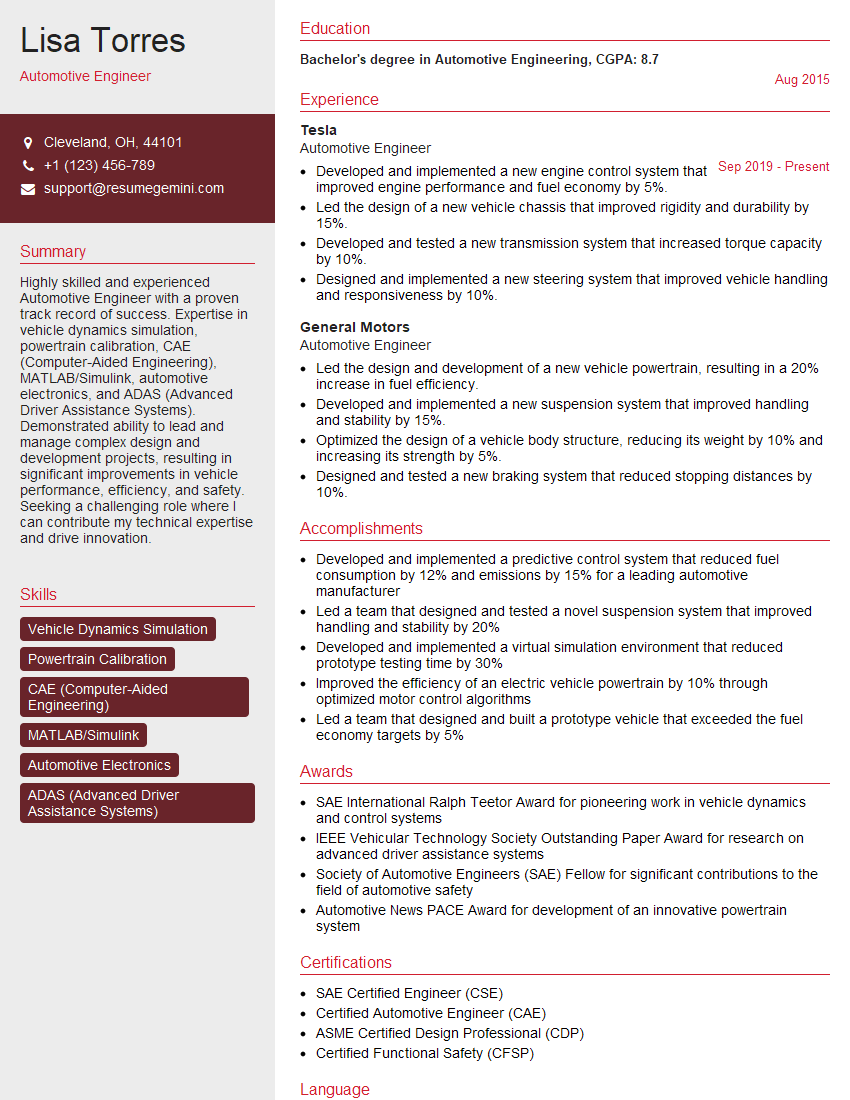
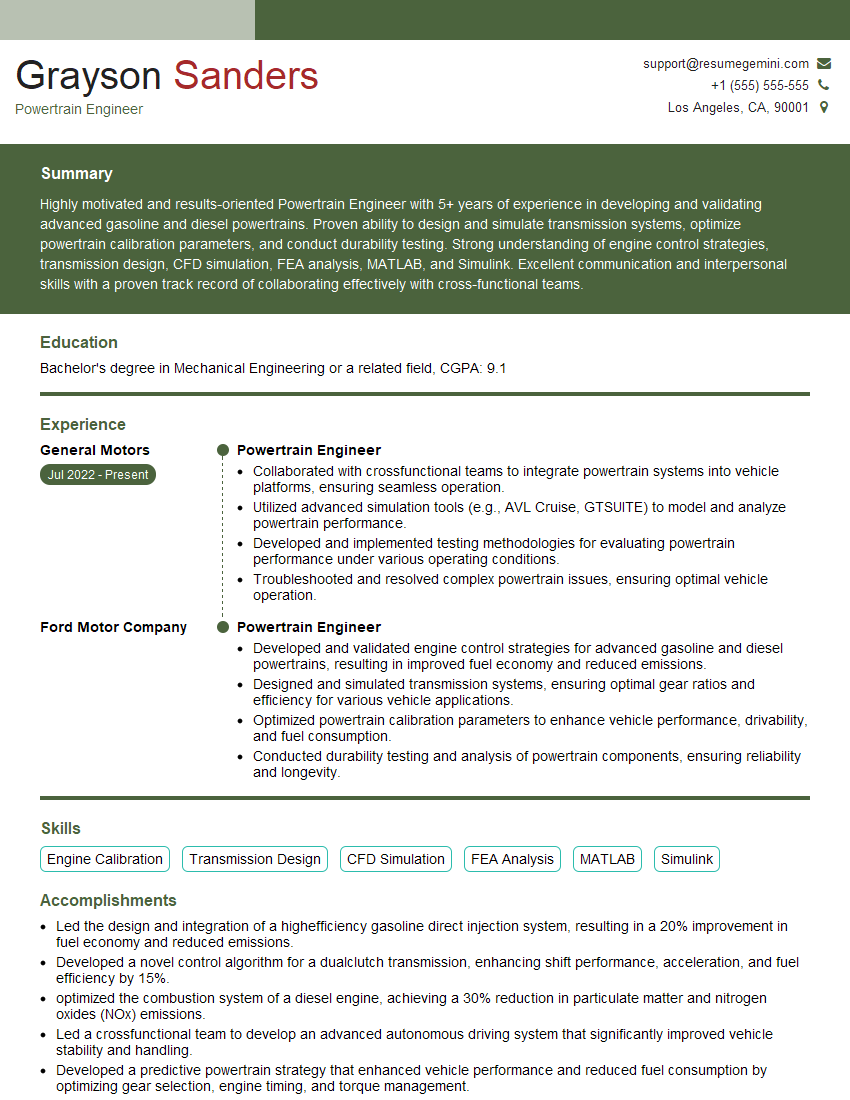
Mastering Car Setup and Engineering opens doors to exciting career opportunities in motorsports, automotive manufacturing, and performance tuning. To stand out from the competition, a well-crafted resume is crucial. An ATS-friendly resume ensures your application gets noticed by recruiters and hiring managers. We strongly encourage you to leverage ResumeGemini to build a professional and impactful resume that highlights your skills and experience effectively. ResumeGemini provides examples of resumes tailored to Car Setup and Engineering to help guide you in creating your own. Invest time in crafting a compelling resume – it’s your first impression and a key step toward your dream career.

Explore more articles
Users Rating of Our Blogs
Share Your Experience
We value your feedback! Please rate our content and share your thoughts (optional).
What Readers Say About Our Blog
Very informative content, great job.
good