The right preparation can turn an interview into an opportunity to showcase your expertise. This guide to Carpet Area Rug Installation interview questions is your ultimate resource, providing key insights and tips to help you ace your responses and stand out as a top candidate.
Questions Asked in Carpet Area Rug Installation Interview
Q 1. Describe your experience with different types of carpet padding.
Carpet padding, or underlayment, is crucial for the longevity and comfort of your area rug. Different types offer varying levels of cushioning, insulation, and moisture resistance. My experience encompasses a wide range, including:
- Rebond Padding: This is a budget-friendly option made from recycled fibers. It’s relatively thin and offers decent cushioning but has a shorter lifespan compared to other types.
- Foam Padding: Offers excellent cushioning and is comfortable underfoot. Different densities are available, influencing its thickness and durability. Higher density foam generally lasts longer.
- Memory Foam Padding: Provides superior cushioning and conforms to the shape of the rug and furniture, minimizing wrinkles. It’s the most comfortable option but also the most expensive.
- Felt Padding: A natural fiber padding that’s excellent for sound absorption and adding a layer of insulation. It’s less plush than foam but offers a good balance of comfort and durability.
- Rubber Padding: Primarily used for preventing slippage on hard floors. It’s not known for its cushioning but provides excellent grip.
Choosing the right padding depends on factors such as budget, desired comfort level, and the type of flooring underneath. For example, in a high-traffic area, a denser foam or felt padding would be ideal, while memory foam might be a better choice for a bedroom where comfort is prioritized.
Q 2. Explain the process of measuring for carpet area rug installation.
Accurate measuring is paramount for a professional carpet area rug installation. It’s not as simple as just measuring the room; you need to account for the rug’s placement and any obstacles.
- Determine Rug Placement: Decide where the rug will be positioned in the room. Consider furniture placement and how much floor space should be visible around the rug’s edges.
- Measure Length and Width: Using a measuring tape, carefully measure the length and width of the designated area. For rectangular spaces, this is straightforward. For irregular spaces, break the area into smaller, manageable rectangles or triangles to measure individually.
- Account for Irregularities: Note any irregularities in the floor, like protruding objects or recessed areas. These will need to be considered when ordering or cutting the rug.
- Double-Check Measurements: Always double-check your measurements to avoid errors. Minor inaccuracies can lead to significant issues later.
- Document Measurements: Write down all measurements clearly, noting any special considerations, such as doorways or alcoves.
For example, if you have a fireplace, you’ll need to measure around it to ensure the rug fits properly without covering the hearth. Accurate measuring ensures a perfect fit and avoids costly mistakes.
Q 3. How do you handle irregular room shapes during installation?
Irregular room shapes present a unique challenge, but with careful planning and the right tools, they can be handled effectively. The key is to break down the irregular shape into smaller, simpler geometric shapes (rectangles, triangles, etc.)
- Create a Template: Use graph paper or a similar material to draw a precise representation of the irregular space.
- Divide into Sections: Divide the irregular shape into smaller, measurable sections (rectangles and triangles are usually the easiest).
- Measure Each Section: Measure the length and width of each section accurately.
- Calculate Area: Calculate the area of each section using standard geometric formulas (length x width for rectangles, 0.5 x base x height for triangles).
- Total Area: Sum the areas of all sections to determine the total area needed for the carpet.
- Cut and Install: Carefully cut and install the carpet sections, ensuring a smooth transition between them.
For example, if you’re dealing with an L-shaped room, you’d divide it into two rectangles, measure each separately, and then add those measurements together before ordering or cutting the carpet. It’s crucial to add extra margin for seam allowances during the cutting process.
Q 4. What are the common challenges in installing large area rugs?
Installing large area rugs comes with its own set of challenges, primarily related to handling, stretching, and seaming.
- Maneuverability: Moving and positioning a large rug can be physically demanding, requiring multiple people and potentially specialized equipment.
- Seaming: Larger rugs often require seaming multiple pieces together. This requires precision and skill to ensure an invisible and durable seam.
- Stretching: Properly stretching a large rug to prevent wrinkles and buckling is critical. This usually involves using specialized tools and techniques.
- Potential for Wrinkles and Buckling: The sheer size of the rug makes it more prone to wrinkles and buckling during installation, requiring extra care and attention to detail.
- Floor Preparation: Ensuring a perfectly smooth and even subfloor is crucial to prevent ripples or bulges in the large rug.
For instance, a large rug in a high-traffic area might require more durable padding and more careful seaming to withstand the wear and tear. It’s vital to assess these factors and plan the installation meticulously before starting.
Q 5. How do you ensure proper stretching and seaming of carpet?
Proper stretching and seaming are essential for a professional-looking and long-lasting area rug installation. Improper stretching can lead to wrinkles, buckling, and premature wear.
- Use the Right Tools: This usually includes a power stretcher to pull and secure the rug, as well as a knee kicker for stretching in tighter areas.
- Prepare the Subfloor: Ensure the subfloor is clean, level, and free of debris. Any irregularities will show through the rug.
- Stretching Techniques: Start by carefully stretching the rug from the center outwards, using the power stretcher to pull the carpet taut. This process is repeated in stages, working methodically until the entire rug is tightly stretched.
- Seaming: Carefully align and butt the seams of the carpet pieces together, using adhesive designed for carpet. This adhesive must be appropriate for the type of carpet fibers being used and should be applied carefully to avoid staining.
- Seaming Tools: Specialized seaming tools, including a seam sealer, are used to create a strong, invisible seam that will withstand daily use and prevent unraveling.
For example, when seaming, a small amount of adhesive is applied along the seam line, then the two pieces are pressed together firmly and rolled over with a roller. This creates a strong and flat seam, and the seam sealer will further enhance its durability.
Q 6. What are the different methods for securing area rugs?
Several methods exist for securing area rugs, depending on the rug material, flooring type, and the level of security desired.
- Rug Pads: Rug pads with a non-slip backing are the most common method. They provide cushioning, prevent slippage, and protect the flooring. Different rug pads offer varying levels of grip.
- Double-Sided Tape: Double-sided tape can be used for smaller rugs or in areas where additional security is needed. However, it can be difficult to remove and might damage some floor types.
- Rug Grippers: These small, adhesive grips are placed under the corners of the rug to prevent slipping. They’re useful for lightweight rugs on hard floors.
- Furniture Placement: Heavy furniture placed on top of the rug can help keep it in place, but this isn’t a foolproof method, and it can cause wear to the rug over time.
- Professional Rug Installation: Some larger, high-value rugs may benefit from professional installation where the rug is tacked down or otherwise permanently fixed to the floor (though this is less common for area rugs).
The choice of securing method depends on the situation. For instance, a large rug in a high-traffic area might benefit from both a rug pad and furniture placement, while a small rug in a bedroom might only need a rug pad.
Q 7. Explain your experience with different types of carpet fibers.
My experience spans a variety of carpet fibers, each with its unique properties affecting durability, appearance, and maintenance.
- Nylon: A very durable and resilient fiber that is stain-resistant and easy to clean. It’s a popular choice for high-traffic areas.
- Polyester: A softer and more luxurious fiber than nylon, but it’s less durable and more prone to matting. It’s generally more affordable than nylon.
- Olefin (Polypropylene): A highly stain-resistant and water-resistant fiber, making it ideal for areas prone to spills. It is also quite durable and relatively inexpensive.
- Wool: A natural fiber that is luxurious, soft, and naturally stain-resistant. It is more expensive than synthetic fibers and requires more specialized cleaning.
- Silk: An extremely luxurious and expensive natural fiber that’s soft to the touch and beautiful. It’s very delicate and requires very specialized cleaning.
Choosing the right fiber depends on the intended use and the budget. For a high-traffic family room, nylon or olefin would be a practical choice, while wool or silk might be better suited for a low-traffic formal living room or bedroom where luxury and softness are prioritized.
Q 8. How do you deal with difficult transitions between flooring types?
Dealing with transitions between flooring types, like hardwood and carpet, requires meticulous planning and execution. The goal is to create a seamless and aesthetically pleasing transition that also ensures a safe and functional floor. A poor transition can lead to tripping hazards or a visually jarring effect.
- Using Transition Strips: These are readily available in various materials (metal, wood, plastic) and styles to match your flooring. They bridge the gap between different floor heights, hiding the seam and protecting the edges of each flooring type. Selecting the right type of transition strip is crucial – a simple T-molding works well for a straight transition, while a reducer strip is best if one floor is higher than the other.
- Ramp Transitions: For larger height differences, a gradual ramp transition made of wood or a similar material can be installed. This requires careful measurement and precision cutting to ensure a smooth, even slope.
- Custom Solutions: For truly unique situations, a custom transition might be necessary, possibly involving specialized carpentry or fabrication. This is often the case with complex angles or unusual floor materials.
For example, I once worked on a project where a high-pile shag carpet met a polished marble floor in a high-traffic area. Using a heavy-duty brass threshold strip not only bridged the height difference but also added a touch of elegance and durability. The key is careful planning – assessing the floor heights, materials, and the client’s aesthetic preferences before choosing the best solution.
Q 9. Describe your experience with installing rugs on stairs.
Installing rugs on stairs requires specialized techniques to ensure safety and longevity. It’s not a straightforward process and demands precision and attention to detail. Poorly installed stair rugs can be dangerous, leading to slips and falls.
- Measuring and Cutting: Accurate measurements are paramount. Each stair tread and riser needs to be measured individually to ensure a perfect fit. The rug needs to be cut precisely to accommodate the stair’s unique shape and any nosing (the overhanging part of a stair tread).
- Securing the Rug: Various methods exist, including using stair rods (decorative rods that hold the rug in place), double-sided carpet tape, or even tack strips (carefully installed to avoid damaging the stairs). The chosen method depends on the rug material, stair material, and the client’s preference. Always prioritize a method that won’t damage the stairs or create a tripping hazard.
- Safety Considerations: The rug should lie flat and securely on each step, with no bunching or wrinkling. Sufficient overlap is crucial to prevent the rug from shifting. For high-traffic areas, a rug with a non-slip backing is highly recommended.
In one instance, I used a combination of double-sided tape and stair rods to install a luxurious Persian rug on a grand staircase. The tape provided a firm grip, while the stair rods added an elegant finishing touch and further secured the rug. The client was delighted with the result and felt safe and confident using the stairs.
Q 10. What safety precautions do you take during carpet installation?
Safety is my utmost priority during any carpet installation. I follow a strict protocol to minimize risk to myself and the client’s property.
- Proper Personal Protective Equipment (PPE): This includes sturdy work boots with non-slip soles, safety glasses, gloves to protect against sharp objects and irritants, and a dust mask to prevent inhalation of fibers or dust.
- Secure Work Area: The work area should be properly cleared and free from obstacles to prevent tripping hazards. Appropriate lighting is essential for visibility.
- Safe Handling of Tools and Equipment: All power tools should be used according to manufacturer instructions and maintained regularly to prevent malfunctions. Sharp objects should be handled with care.
- Awareness of Surroundings: I am always mindful of the client’s belongings and take steps to protect them from damage. I’ll cover furniture or move it out of the way, and protect floors and walls from scratches.
- Emergency Preparedness: I am prepared for any potential emergency situations, including having a first-aid kit on hand.
Regular safety checks and adherence to these procedures is paramount in ensuring the project is completed without incident. A safe working environment not only protects myself but also preserves the client’s property and ensures their peace of mind.
Q 11. How do you handle customer concerns or complaints during installation?
Handling customer concerns or complaints during installation is crucial for maintaining client satisfaction. My approach is to be proactive, empathetic, and solution-oriented.
- Active Listening: I make sure I thoroughly understand the client’s concern, allowing them to fully explain the problem without interruption.
- Empathetic Response: I acknowledge their feelings and validate their concerns. This shows I take their feedback seriously.
- Problem Solving: I collaboratively identify the root cause of the issue. This often involves carefully examining the situation and exploring possible solutions.
- Appropriate Action: I implement the agreed-upon solution promptly and efficiently, aiming to exceed the client’s expectations whenever possible.
- Follow-up: I always follow up to ensure the client is satisfied with the resolution.
For example, if a client notices an imperfection in the finished work, I’ll calmly assess the situation, explain the possible causes (like an unexpected imperfection in the carpet itself), and offer solutions, like a minor repair or a replacement section if necessary. My goal is not only to fix the problem but also to build a positive relationship with the client.
Q 12. What tools and equipment are essential for area rug installation?
The tools and equipment for area rug installation vary depending on the project’s complexity, but some essentials include:
- Measuring Tape: Accurate measurements are vital for a proper fit. A reliable tape measure is essential.
- Utility Knife or Carpet Cutter: For precise cutting of the rug to size.
- Scissors: Useful for trimming excess carpet padding or rug fringes.
- Carpet Padding (if required): Provides cushioning and insulation for the rug.
- Double-Sided Carpet Tape: For securing rugs to the floor in smaller areas. This is often preferred over tack strips for area rugs to avoid damaging the floor.
- Stair Rods (for stair installations): Decorative and functional rods for securing rugs to stairs.
- Knee Pads: Essential for comfort during extended periods of kneeling.
- Power Stretcher (for larger rugs): Helps to stretch and smooth out wrinkles and creases in larger rugs. A hand-held stretcher can suffice for smaller ones.
These tools are the foundation of a successful installation. Proper maintenance and careful handling ensure they serve their purpose safely and effectively.
Q 13. How do you determine the appropriate amount of carpet padding?
The appropriate amount of carpet padding depends on several factors, including the type of area rug, the subfloor, and the desired level of comfort and cushioning. It’s not a one-size-fits-all answer.
- Rug Material: A thicker, plusher rug might require less padding than a thinner, more delicate rug. The padding should complement the rug’s thickness to create the desired overall comfort level.
- Subfloor: A concrete subfloor is usually harder than a wooden subfloor, and thus might benefit from a thicker layer of padding for increased comfort and insulation.
- Desired Cushioning: More padding provides more cushioning and a softer feel underfoot, but excessive padding can cause the rug to bunch or wrinkle.
- Padding Type: Different padding types provide various levels of cushioning, support, and durability.
Generally, a padding thickness of 1/4 inch to 3/8 inch is often sufficient for area rugs in most residential settings. However, it’s always best to consult with the rug supplier or manufacturer’s recommendations. Improper padding selection can affect the overall appearance and lifespan of the rug, so choosing the right padding is essential.
Q 14. Explain your understanding of carpet installation standards and codes.
My understanding of carpet installation standards and codes encompasses a variety of factors aimed at ensuring safety, quality, and longevity. These standards address various aspects, from installation techniques to material selection and safety practices.
- Safety Standards: Adhering to OSHA (Occupational Safety and Health Administration) guidelines is paramount for the safety of both the installers and those occupying the space. This includes proper handling of tools and materials, use of personal protective equipment, and ensuring the workspace is safe and hazard-free.
- Installation Techniques: Proper stretching and securing of the carpet are crucial to prevent wrinkling, bunching, and potential tripping hazards. Methods for seams and transitions need to create a smooth and consistent surface.
- Material Selection: Codes and standards often dictate requirements for fire-resistant materials, especially in commercial or public buildings. The use of appropriate adhesives and padding materials is also regulated in some cases.
- Local Building Codes: It’s essential to check for any local building codes or regulations that specifically pertain to carpet installation. These codes can vary from region to region.
Staying updated on the latest standards and codes is a continuous process, and I make it a point to regularly review and update my knowledge through industry publications and professional development opportunities. This ensures I provide high-quality installations that meet all applicable safety and quality standards.
Q 15. How do you ensure the rug lies flat and wrinkle-free?
Ensuring a rug lies flat and wrinkle-free is crucial for both aesthetics and longevity. It’s a multi-step process that begins even before installation. First, the rug needs to be acclimated to the room’s temperature and humidity for at least 24-48 hours. This allows the fibers to relax and prevents sudden shrinking or expansion after installation. Then, proper preparation of the subfloor is essential – a smooth, clean surface is key. Any bumps or unevenness will show through the rug. For larger rugs, I use a combination of techniques. This might include strategically placing weights (like sandbags) on the edges for a few days to gradually flatten it out. For smaller rugs, carefully stretching the rug and using a carpet stretcher along the edges can remove wrinkles. Finally, if wrinkles persist after a week, using a professional-grade steam cleaner can help relax the fibers and achieve a perfectly flat result. Think of it like ironing a really large, delicate garment – it requires patience and the right tools.
Career Expert Tips:
- Ace those interviews! Prepare effectively by reviewing the Top 50 Most Common Interview Questions on ResumeGemini.
- Navigate your job search with confidence! Explore a wide range of Career Tips on ResumeGemini. Learn about common challenges and recommendations to overcome them.
- Craft the perfect resume! Master the Art of Resume Writing with ResumeGemini’s guide. Showcase your unique qualifications and achievements effectively.
- Don’t miss out on holiday savings! Build your dream resume with ResumeGemini’s ATS optimized templates.
Q 16. What is your experience with installing different types of rug backing?
My experience encompasses a wide range of rug backing types, from natural jute and cotton to synthetic options like latex and rubber. Each requires a slightly different approach. Jute, for instance, is a natural fiber that can be somewhat unpredictable, sometimes needing more time to settle. Latex backings, while offering good grip, need to be handled carefully to avoid damaging the surface or leaving adhesive residue. Rubber backings are durable and provide excellent stability, particularly in high-traffic areas. I’ve also worked with rugs featuring a combination of backings, requiring a customized approach based on the specific materials and their properties. Understanding the characteristics of each backing is key to selecting the right installation method and adhesive for a long-lasting, wrinkle-free result. For example, a rug with a thin jute backing might need additional padding to ensure comfort and prevent wear.
Q 17. How do you manage time efficiently during a carpet installation project?
Efficient time management in carpet installation involves meticulous planning and preparation. Before starting any project, I always conduct a thorough site survey, measuring the area precisely and noting any potential challenges. This allows me to accurately estimate the time needed and order any necessary materials in advance. I also create a detailed workflow, breaking down the installation into smaller, manageable tasks. This ensures that the process flows smoothly and minimizes downtime. Utilizing the right tools and equipment is critical. Having everything readily available prevents unnecessary searching and delays. Finally, communication is paramount. Keeping the client updated on progress and addressing any concerns promptly builds trust and ensures everyone is on the same page. Think of it like a well-orchestrated symphony – each section needs to be played in harmony to achieve a beautiful result within the allocated time.
Q 18. How do you handle damaged or defective carpet during installation?
Handling damaged or defective carpet requires a systematic approach. First, I meticulously document the damage with photos and detailed notes. This is crucial for any warranty claims. Then, I communicate the issue clearly to the client and discuss possible solutions, such as replacing the damaged section with a matching piece from the remaining stock (if available) or exploring alternative solutions. If the damage is extensive, we might need to re-evaluate the entire installation, depending on the client’s preferences and the extent of the problem. In some cases, I might suggest consulting with the manufacturer for expert advice. Open communication and transparency with the client are vital in navigating these situations; finding a solution that satisfies both parties is my priority.
Q 19. Describe your experience with various rug installation adhesives.
My experience with rug installation adhesives includes working with both water-based and solvent-based options. Water-based adhesives are generally considered safer and easier to clean up, making them ideal for many residential applications. However, solvent-based adhesives offer superior strength and adhesion, which can be essential for larger rugs or areas with high foot traffic. The choice of adhesive depends on several factors, including the type of rug backing, the subfloor material, and the overall environment. I always carefully follow the manufacturer’s instructions and select the adhesive that best suits the specific requirements of each project. For instance, a delicate rug might necessitate a less aggressive adhesive to avoid damaging the fibers.
Q 20. What is your process for cleaning up after installation?
Thorough cleanup is a crucial part of professional carpet installation. After completing the installation, I meticulously remove any excess adhesive, debris, or packaging materials. I use appropriate cleaning solutions and tools to ensure that the work area is left spotless. Vacuuming is essential to remove any stray fibers or dust. Protecting the client’s furniture and belongings is a priority; I use floor protectors and coverings to prevent any damage or soiling. The goal is not just to finish the installation, but to leave the space cleaner than we found it. Think of it as leaving a client’s house better than it was before our visit – we want to build strong professional relationships based on quality work and exceptional service.
Q 21. How do you maintain a professional appearance and demeanor on the job site?
Maintaining a professional appearance and demeanor on the job site is paramount. I always arrive punctually and dressed appropriately in clean, professional attire. I treat the client’s property with respect, taking extra care to protect their belongings. Politeness and clear communication are essential. I actively listen to the client’s concerns, respond promptly to their queries, and keep them informed throughout the installation process. I strive to be courteous and respectful, creating a positive and professional experience. Think of it like this: we are representing our business, and each client interaction leaves a lasting impression. A friendly face and a professional attitude enhance the entire process for everyone involved.
Q 22. How do you deal with unexpected issues that arise during installation?
Unexpected issues during carpet installation are inevitable. My approach is methodical and proactive. First, I thoroughly assess the situation, identifying the root cause. This could range from uneven subflooring to unexpected obstacles like pipes or electrical wiring. Then, I communicate transparently with the client, explaining the problem and potential solutions. I always prioritize finding the best solution that balances quality, cost, and the client’s timeline. For example, if I discover significant subfloor irregularities, I’ll explain the need for leveling before installation to prevent future wrinkling or bunching. This involves a discussion of the added time and cost implications and exploring options like self-leveling compound or plywood patching. I’ve had instances where hidden plumbing required rerouting, demanding skillful work and clear communication with the homeowner. The key is to never panic, maintain professionalism, and focus on delivering a high-quality finished product, even when facing unexpected challenges.
Q 23. What is your experience working with different types of flooring?
Throughout my career, I’ve worked with a wide variety of flooring types, from hardwood and tile to vinyl and laminate. This experience provides me with a comprehensive understanding of subfloor preparation needs, which is crucial for successful carpet installations. Different flooring types demand different approaches to ensuring a smooth, level surface for the carpet. For instance, transitioning from existing hardwood to new carpet necessitates careful attention to height differences and potential expansion/contraction issues. Working with vinyl requires a specific tack strip and installation process to achieve a seamless transition. This broad experience allows me to approach each installation project with a customized plan tailored to the existing floor and the client’s chosen carpet.
Q 24. Describe your experience with estimating material costs for carpet installation.
Accurate material cost estimation is a critical skill. My process begins with a detailed measurement of the area to be carpeted. This includes factoring in waste, considering cuts and seams. I then obtain up-to-date pricing from reputable suppliers for the chosen carpet and padding. I carefully consider the type of carpet (pile height, density, material), the need for padding (thickness, density, and type), and any additional materials like tack strips, gripper rods, and seam sealer. I always provide the client with a clear breakdown of the costs involved, highlighting any potential adjustments based on unforeseen circumstances during installation. I’ve learned through experience to account for unexpected challenges – an unusually shaped room might require more material for efficient cutting and minimizing waste. Transparency is key to building trust and ensuring client satisfaction.
Q 25. How do you calculate the square footage of a room for carpet?
Calculating square footage for carpet involves precise measurements. I typically measure the length and width of each room in feet, then multiply the two to obtain the area in square feet (length x width = area). For irregularly shaped rooms, I divide the room into smaller, easily measurable rectangles or triangles and calculate the area of each shape separately before summing the results. For example, an L-shaped room would be split into two rectangles, each measured and calculated individually. Always double-check measurements to minimize errors. A 10% overage is often added to account for waste from cuts, seams, and adjustments for irregular shapes. Accurate measurements are crucial for ordering the right amount of carpet and providing an accurate cost estimate. Remember to add in closets and hallways that are included in the total square footage needed.
Q 26. How do you handle customer requests for specific installation techniques?
Client requests for specific installation techniques are essential to consider. I always listen carefully and discuss the feasibility and implications of their requests. This might include specific seam placement, stretching methods (power stretching vs. hand stretching), or particular finishing techniques. I explain any potential impact on cost or installation time and ensure we’re both on the same page before proceeding. For example, if a client requests a specific pattern matching across seams, that will likely require extra time and meticulous attention to detail. I’ll discuss the added labor costs upfront. If a technique they request isn’t ideal for their floor type or carpet material, I’ll explain the risks involved and offer alternatives, ultimately prioritizing quality and longevity. The goal is to collaborate and create a solution that meets their needs while maintaining professional standards.
Q 27. What is your experience with using power stretching tools?
Power stretching tools are indispensable for creating a taut, wrinkle-free carpet finish. My experience with these tools is extensive. I’m proficient in using a variety of power stretchers, understanding their capabilities and limitations. I know how to adjust the tension according to the carpet type and room dimensions. Proper power stretching prevents ripples, bunching, and unevenness. It’s a skill that requires both technical knowledge and practical experience to avoid damaging the carpet or subfloor. Improper use can easily lead to tearing or stretching the carpet beyond its limits. I also emphasize the importance of using the appropriate tools for the job. Selecting the correct power stretcher for the room size and carpet material ensures efficiency and safety.
Q 28. Describe your experience with removing old carpet and padding.
Removing old carpet and padding is a crucial, sometimes challenging, aspect of the process. My approach involves careful and methodical removal to minimize dust and damage to the subfloor. I use appropriate tools such as carpet removal tools, knives, and disposal bags to ensure a safe and efficient removal process. Depending on the adhesive used, the old carpet and padding may require additional techniques to remove them completely. This can include the use of specialized chemical solutions and scrapers to loosen the adhesive. Safety is paramount throughout this process. I always wear appropriate personal protective equipment (PPE), including gloves, eye protection, and a dust mask, to minimize exposure to dust and debris. I take the time to clean the subfloor thoroughly before installing the new carpet to prevent any issues with the new installation. Safe and efficient removal is vital for a successful new carpet installation.
Key Topics to Learn for Carpet Area Rug Installation Interview
- Measuring and Calculating: Understanding accurate room measurements, calculating carpet and padding needs, and accounting for waste and seams.
- Subfloor Preparation: Identifying and addressing subfloor imperfections, ensuring a level and stable base for installation, and selecting appropriate underlayment.
- Carpet Selection and Handling: Familiarizing yourself with different carpet types (pile height, fiber content), understanding their properties and suitability for various spaces, and proper handling to avoid damage.
- Installation Techniques: Mastering different installation methods (e.g., stretching, seaming, tacking), understanding the tools and equipment required, and adhering to industry best practices.
- Seaming and Finishing: Creating neat and invisible seams, using appropriate seaming tape and adhesive, and finishing the edges for a professional look.
- Problem Solving and Troubleshooting: Identifying and resolving common installation issues (e.g., wrinkles, ripples, unevenness), demonstrating practical solutions, and adapting to unexpected challenges on-site.
- Safety Procedures and Regulations: Adhering to workplace safety protocols, using appropriate personal protective equipment (PPE), and understanding relevant industry regulations and standards.
- Customer Communication and Service: Demonstrating excellent communication skills, understanding customer needs and expectations, and providing professional and courteous service.
Next Steps
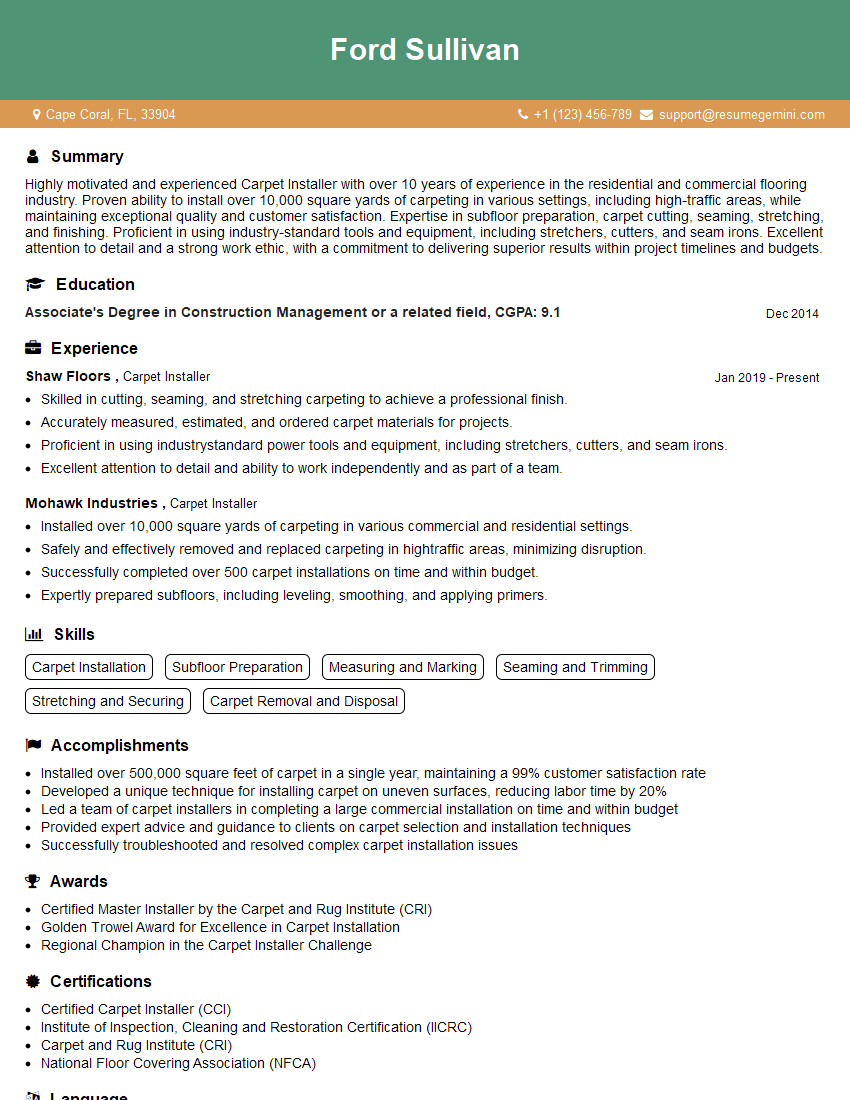
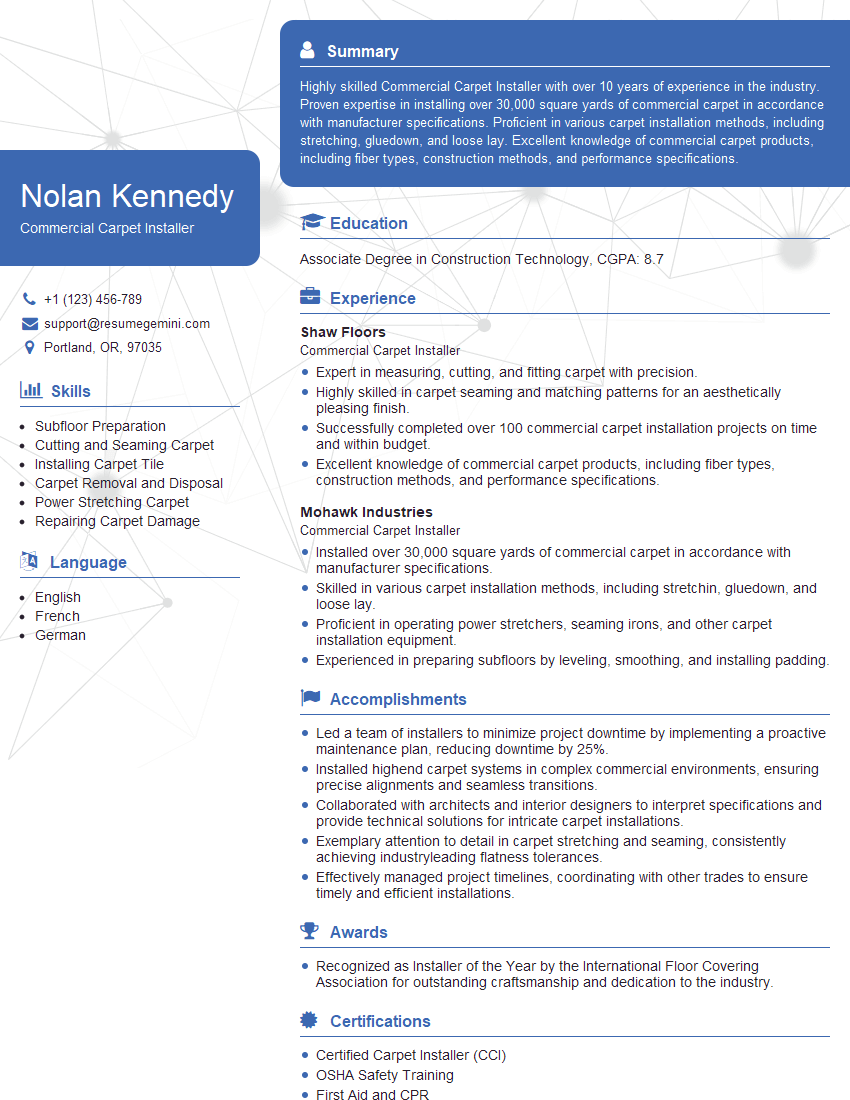
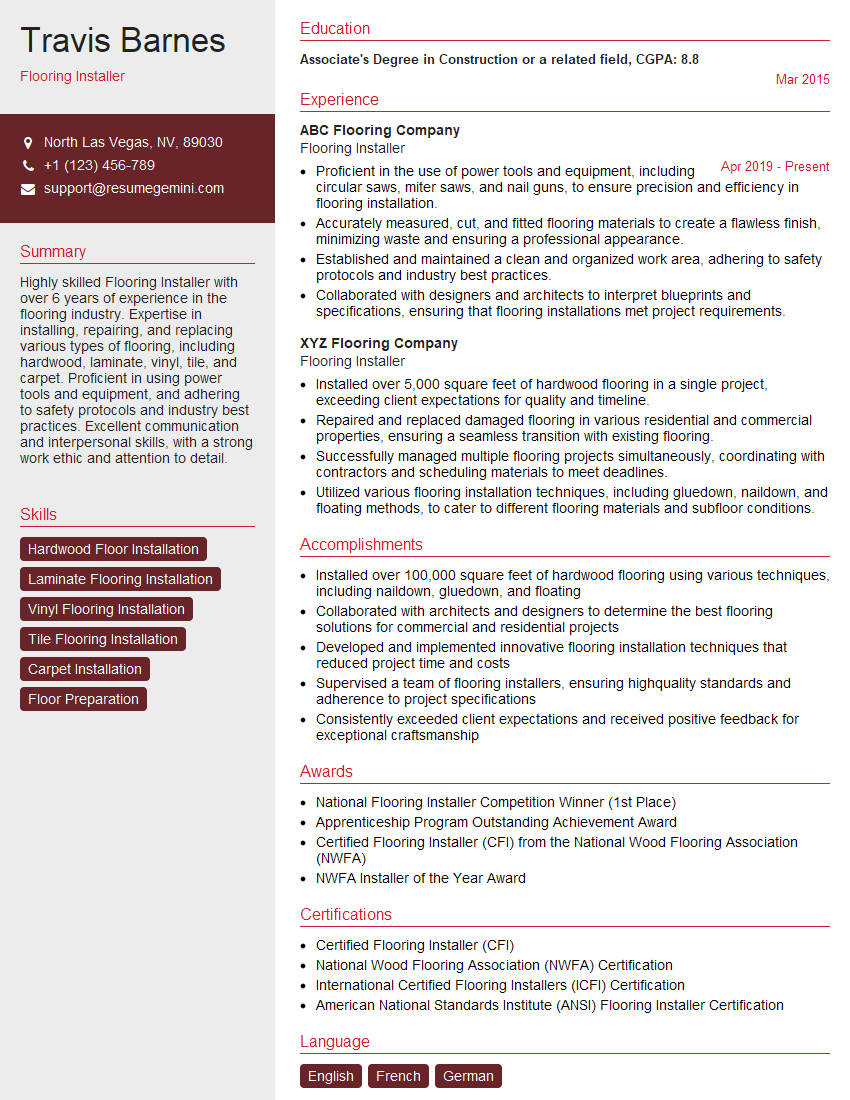
Mastering carpet area rug installation opens doors to rewarding career opportunities with excellent growth potential. A strong understanding of these techniques and a polished professional presentation will significantly improve your chances of landing your dream job. To maximize your interview success, create an ATS-friendly resume that highlights your skills and experience. ResumeGemini is a trusted resource to help you build a compelling resume that stands out. Examples of resumes tailored to the Carpet Area Rug Installation field are available to guide you through the process.


Explore more articles
Users Rating of Our Blogs
Share Your Experience
We value your feedback! Please rate our content and share your thoughts (optional).
What Readers Say About Our Blog
Very informative content, great job.
good