Interviews are more than just a Q&A session—they’re a chance to prove your worth. This blog dives into essential Carpet Tile Installation interview questions and expert tips to help you align your answers with what hiring managers are looking for. Start preparing to shine!
Questions Asked in Carpet Tile Installation Interview
Q 1. What types of adhesives are suitable for various carpet tile substrates?
Choosing the right adhesive is crucial for a successful carpet tile installation. The best adhesive depends heavily on the substrate—the surface you’re installing onto. We generally categorize substrates as concrete, wood, and resilient flooring (like vinyl or tile).
- Concrete: For concrete, a moisture-cured urethane adhesive is often the best choice. These adhesives are strong, durable, and provide excellent adhesion even in slightly damp conditions. However, always test for excessive moisture before installation to prevent problems. We use a moisture meter to ensure the concrete is adequately dry.
- Wood: Wood subfloors require a pressure-sensitive adhesive (PSA) or a modified acrylic adhesive. PSAs are easy to use, offering a strong bond and quick installation time. Modified acrylics offer a bit more flexibility and are a good option if there are minor subfloor imperfections. It’s vital that the wood is clean, dry, and free of any loose or splintery areas.
- Resilient Flooring: Installing carpet tiles over existing resilient flooring can be tricky. A specialized adhesive designed for this purpose is necessary to ensure a strong bond and prevent the carpet tiles from lifting or delaminating. Often, we’ll use a high-performance construction adhesive designed for such applications.
Remember to always follow the adhesive manufacturer’s instructions carefully, as application methods and drying times can vary.
Q 2. Describe your experience with different carpet tile installation methods.
Over the years, I’ve worked with several carpet tile installation methods, each with its own advantages and disadvantages. The most common methods include:
- Full-Spread Adhesive: This method involves applying adhesive to the entire subfloor surface before laying the carpet tiles. It offers excellent adhesion and is ideal for high-traffic areas or where a completely flat surface is required. However, it’s more time-consuming than other methods.
- Perimeter Adhesive: Here, adhesive is only applied around the perimeter of each tile. It’s faster than full-spread but provides less overall adhesion, making it better suited for low-traffic areas. It’s important to ensure a strong bond at the edges to prevent lifting.
- Tackified Carpet Tiles: These tiles come with an adhesive backing already applied. Installation is very quick, making it ideal for DIY projects or fast-paced commercial jobs. However, removal can be more challenging, and repositioning is more difficult once the adhesive sets.
My experience has shown that the best method depends on the project requirements, budget, and the client’s expectations. Factors like the subfloor condition, the type of carpet tile, and the intended use of the space all play a role in determining the appropriate method.
Q 3. How do you measure and calculate carpet tile quantities for a project?
Accurate measurement and calculation are essential to avoid costly material waste. I start by carefully measuring the area to be covered, noting any unusual shapes or obstructions. I then calculate the total square footage. Next, I consider the size of the carpet tiles being used. Most carpet tiles are 12”x12” or 18”x18”, but other sizes are available.
For example, if the area is 10ft x 12ft (120 sq ft), and I’m using 12”x12” tiles (1 sq ft each), I’ll need 120 tiles. However, I always add extra (typically 5-10%) to account for cuts, waste, and potential miscalculations. This extra material ensures I have enough to complete the job without facing shortages.
For irregular shapes, I might break the area down into smaller, more manageable sections, calculate the area of each section, and then sum them up. Detailed sketches and diagrams are always helpful during this phase.
Q 4. Explain the process of preparing a subfloor for carpet tile installation.
Subfloor preparation is arguably the most important step. A poorly prepared subfloor will lead to a subpar installation. I inspect the subfloor for any imperfections, including:
- Unevenness: Significant unevenness must be addressed by leveling the floor using self-leveling compound. Even small dips or bumps can cause the tiles to feel uneven underfoot.
- Moisture: Excessive moisture can cause adhesive failure. I use a moisture meter to ensure the subfloor is adequately dry before proceeding. If necessary, moisture remediation techniques are implemented.
- Debris & Dust: The subfloor must be meticulously cleaned. Any dust, debris, or loose particles can affect the adhesive bond. I typically use a shop vacuum to remove all debris.
- Damage: Any damaged sections of the subfloor must be repaired. This may involve replacing damaged sections of wood or repairing cracks in concrete.
After cleaning, the subfloor should be primed with a suitable primer before adhesive application. This improves the bond between the adhesive and the subfloor, particularly on concrete substrates.
Q 5. What are the common challenges encountered during carpet tile installation?
Several challenges can arise during carpet tile installation. Some common issues include:
- Uneven Subfloor: As mentioned before, an uneven subfloor leads to an uneven installation. Careful leveling is key.
- Improper Acclimation: Failure to properly acclimate the carpet tiles can result in expansion or contraction after installation, leading to buckling or gaps.
- Incorrect Adhesive Application: Applying too much or too little adhesive will directly affect the bond.
- Poor Subfloor Preparation: Dirt, debris, or moisture trapped beneath the tiles will create voids and adhesion issues.
- Matching Patterns/Colors: Achieving seamless transitions between tiles, especially with patterned tiles, can be demanding.
Experience helps in identifying and mitigating these challenges. Careful planning, attention to detail, and the right tools and materials are crucial for a successful installation.
Q 6. How do you ensure proper acclimation of carpet tiles before installation?
Acclimation is the process of allowing carpet tiles to adjust to the temperature and humidity of the installation environment before laying them. This prevents problems such as shrinking, expanding, or buckling after installation.
Typically, I let the carpet tiles sit in the room where they will be installed for at least 24-48 hours, ideally in their original packaging, so they acclimate to the surrounding temperature and humidity. This is especially important in environments with fluctuating temperatures or humidity levels. Failure to acclimate the tiles can lead to significant problems later on, leading to potential rework or costly replacements.
Q 7. Describe your experience with different types of carpet tile backing.
Carpet tile backing varies significantly, affecting the tile’s performance and installation. I’ve worked with several types:
- Foam Backing: This is a common and cost-effective option offering good cushioning and sound insulation. It’s easy to work with and provides a degree of softness underfoot. However, it is not always suitable for high-traffic areas.
- Felt Backing: Felt backing offers good moisture resistance and is durable. It’s less expensive than other options but may not provide as much cushioning as foam backing.
- Rubber Backing: Rubber backing is extremely durable and moisture-resistant, making it ideal for high-traffic areas or damp environments. It’s a premium option and offers increased stability.
- Combination Backings: Some carpet tiles utilize combination backings, blending the properties of different materials for enhanced performance. These are carefully chosen based on project needs.
Understanding the properties of each backing type allows me to select the right carpet tile for the specific application, ensuring both aesthetic appeal and long-term performance.
Q 8. How do you handle transitions between different flooring types?
Transitioning between different flooring types, like carpet tile and hardwood, requires careful planning and execution to create a seamless and visually appealing finish. The key is to use appropriate transition strips or reducers. These are metal, wood, or plastic profiles designed to bridge the height difference and cover the raw edges of the flooring materials.
For example, if transitioning from carpet tile to hardwood, we’d typically use a reducer strip. This strip is usually shaped with a sloped edge to smoothly guide the transition from the higher hardwood to the lower carpet tile. The reducer is secured to the hardwood floor, and the carpet tile is butted up against it. We carefully measure and cut both the hardwood and the reducer to ensure a perfect fit. Another common scenario is transitioning between carpet tile and ceramic tile. Here, a T-molding would be the ideal solution; the ‘T’ shape of the molding covers the edge of both flooring types. Its installation involves applying adhesive to the back of the molding and pressing it firmly onto the existing floors.
The choice of transition strip depends on the height difference between the flooring materials and aesthetic preferences. Accurate measurements and precise cutting are crucial for a professional-looking finish. Failure to correctly account for these factors could lead to an uneven, unsightly, and potentially hazardous transition.
Q 9. What safety precautions do you take during carpet tile installation?
Safety is paramount in any installation project, and carpet tile installation is no exception. We prioritize several key safety precautions:
- Proper Personal Protective Equipment (PPE): This includes safety glasses to protect against flying debris, work gloves to prevent cuts and abrasions, and dust masks or respirators to reduce inhalation of dust and fibers.
- Safe Handling of Tools and Materials: Knives, cutters, and other sharp tools are handled with care, and heavy materials are lifted correctly to prevent back injuries. We use appropriate lifting techniques and, if needed, seek assistance for heavier objects.
- Clean and Organized Workspace: Maintaining a clean workspace reduces the risk of slips, trips, and falls. Tools and materials are kept organized and out of walkways.
- Proper Ventilation: Adequate ventilation is crucial to prevent buildup of dust and fumes from adhesives. If using adhesives in a poorly ventilated area, respirators with appropriate cartridges are required.
- Awareness of Electrical Hazards: Caution is taken near electrical outlets and wiring to prevent accidental shocks or damage.
Following these safety guidelines ensures a safe and productive installation process for both the installer and the client.
Q 10. How do you troubleshoot common installation problems, such as buckling or uneven seams?
Buckling and uneven seams are common problems during carpet tile installation, often stemming from improper subfloor preparation or adhesive application. Let’s tackle each:
Buckling: This usually indicates uneven subflooring or insufficient adhesive.
- Troubleshooting: First, we inspect the subfloor for high or low spots. High spots might need to be sanded down; low spots might require filling with self-leveling compound. If the adhesive is the issue, the tiles often need to be removed, the subfloor cleaned thoroughly, and the installation process restarted with the proper amount and type of adhesive.
Uneven Seams: This typically arises from inconsistent spacing or improper alignment during installation.
- Troubleshooting: For this issue, careful re-measurement and precise cutting may be necessary. In some cases, the tiles may need to be carefully removed and reinstalled to correct the misalignment. A good way to avoid this is to use spacers to maintain consistent spacing during the initial installation.
Thorough subfloor preparation and consistent attention to detail during the installation process drastically reduce these issues. Regularly checking for alignment and evenness as you work helps prevent larger problems later.
Q 11. What tools and equipment are essential for efficient carpet tile installation?
Efficient carpet tile installation relies on having the right tools. Here are the essentials:
- Measuring Tape and Square: Accurate measurements are fundamental for proper planning and cutting.
- Utility Knife or Carpet Cutter: Precise cutting of carpet tiles to fit various spaces.
- Notched Trowel: For applying adhesive evenly and consistently; the notch size is dependent on the type of adhesive and the carpet tile’s thickness.
- Knee Pads: Comfort and support during prolonged kneeling.
- Spacer Tiles or Spacers: Maintaining consistent spacing between tiles for a professional appearance.
- Tacking Iron (if needed): For securing carpet around edges in certain installations.
- Power Trowel (for large installations): Ensures a smooth, consistent spreading of adhesive.
- Rubber Mallet: Carefully tapping tiles into place and avoiding damage.
- Seam Roller: To compress the adhesive and create a firm bond between tiles and the substrate.
Investing in quality tools significantly improves efficiency and ensures a superior installation.
Q 12. How do you maintain consistent tile spacing and alignment during installation?
Maintaining consistent tile spacing and alignment is vital for a professional-looking installation. Here’s how we achieve this:
- Use of Spacers: Plastic or other types of spacers are placed between tiles during installation to ensure uniform gaps. These spacers guarantee consistent grout lines and prevent tiles from shifting during the adhesive setting process.
- Snap Lines: Chalk lines or laser levels can be used to create reference lines across the floor, ensuring straight rows and accurate alignment of the tiles.
- Layout Planning: Careful planning of the tile layout, taking into consideration the room dimensions and potential cuts, is essential to minimizing waste and maximizing alignment.
- Regular Checks: Frequently checking the alignment and spacing of tiles during the installation process helps to identify and correct any deviations early on, before they become major problems.
Using a combination of these techniques leads to a much more professional and visually appealing outcome. The eye is particularly good at picking up inconsistencies, so it’s worth the extra time and effort.
Q 13. Explain the importance of proper moisture testing before installation.
Proper moisture testing before carpet tile installation is crucial because excessive moisture can lead to mold growth, adhesive failure, and ultimately, premature carpet tile damage. Moisture within the subfloor can cause the adhesive to break down, resulting in buckling or lifting of the tiles. Mold growth, in addition to causing an unpleasant odor, can also pose serious health risks.
We use a moisture meter to measure the moisture content of the subfloor. Different meters exist, but the principle is the same: it measures the electrical resistance or capacitance of the subfloor. The readings are then compared against acceptable levels defined by the adhesive manufacturer and relevant building codes. If the moisture content exceeds the acceptable levels, the subfloor will need to be allowed to dry adequately before installation can proceed. Delaying installation, even though it can seem inconvenient, prevents far costlier and more time-consuming repairs later.
Ignoring this step can result in costly repairs and create a potentially unhealthy living environment. It’s a critical preventative measure we never overlook.
Q 14. How do you manage waste materials and dispose of them responsibly?
Responsible waste management is a critical aspect of any professional installation. We handle waste materials meticulously:
- Careful Cutting and Planning: Precise measurement and cutting minimize waste generation in the first place.
- Material Sorting: We sort the waste into categories – cardboard, plastic packaging, and carpet scraps. This facilitates easier recycling and disposal.
- Recycling: Wherever possible, we recycle cardboard and plastic packaging. In some cases, carpet scraps may be recyclable depending on the material and local regulations.
- Disposal at Approved Facilities: Carpet scraps and non-recyclable materials are disposed of at designated landfill sites or recycling centers that are permitted to handle construction waste.
- Client Communication: We inform clients about our waste management procedures to ensure transparency and collaboration. Sometimes clients may have their preferred recycling facilities.
Environmental responsibility is paramount. We believe in minimizing our environmental impact and complying with all local regulations regarding waste disposal.
Q 15. What is your experience with carpet tile removal and disposal?
Carpet tile removal and disposal is a crucial aspect of any project. It’s not just about ripping up the tiles; it’s about doing it safely and responsibly. My process begins with a thorough assessment of the existing installation to determine the best removal method. For instance, if the adhesive is particularly strong, I might use a specialized tool to loosen the tiles, minimizing damage to the subfloor. For less stubborn installations, a combination of a pry bar and a scraper can be sufficient. Safety is paramount, so I always wear appropriate personal protective equipment (PPE), including gloves, eye protection, and a dust mask. After removal, the tiles and underlayment are carefully separated. The tiles are then categorized for recycling or disposal according to local regulations. In many cases, carpet tiles are recyclable, making it an environmentally friendly option compared to broadloom carpet. Disposal involves proper handling and transportation to a designated recycling facility or landfill, depending on local waste management guidelines. I’ve handled projects ranging from small residential spaces to larger commercial settings, adapting my techniques to suit the specific situation and waste disposal requirements.
Career Expert Tips:
- Ace those interviews! Prepare effectively by reviewing the Top 50 Most Common Interview Questions on ResumeGemini.
- Navigate your job search with confidence! Explore a wide range of Career Tips on ResumeGemini. Learn about common challenges and recommendations to overcome them.
- Craft the perfect resume! Master the Art of Resume Writing with ResumeGemini’s guide. Showcase your unique qualifications and achievements effectively.
- Don’t miss out on holiday savings! Build your dream resume with ResumeGemini’s ATS optimized templates.
Q 16. Describe your experience working with different types of underlayment.
My experience with underlayment is extensive, as the choice of underlayment significantly affects the overall quality and longevity of the carpet tile installation. I’ve worked with a wide variety of materials, including foam, rubber, and felt underlayments. Foam underlayments, especially those made from recycled materials, offer excellent cushioning and sound insulation. Rubber underlayments provide superior durability and moisture resistance, making them ideal for areas prone to high traffic or moisture. Felt underlayments are generally more economical but might not provide the same level of comfort or sound dampening. The selection process depends heavily on factors like the type of carpet tile being used, the intended use of the space (residential or commercial), and the budget. For example, a high-traffic commercial setting would benefit significantly from a durable rubber underlayment, while a residential bedroom might only require a more budget-friendly foam underlayment. Proper installation of the underlayment – ensuring it’s smooth, free from wrinkles, and properly seamed – is crucial for a successful installation. Ignoring this stage can result in uneven surfaces and damage to the carpet tiles.
Q 17. How do you determine the appropriate amount of adhesive to use?
Determining the appropriate amount of adhesive is critical for a successful carpet tile installation. Over-application leads to messy situations, increased cost, and potential issues with adhesion, while under-application can result in loose tiles and premature failure. The amount needed depends on several factors: the type of adhesive used, the type of substrate (concrete, wood, etc.), the type of carpet tile, and environmental conditions (temperature and humidity). I typically follow the manufacturer’s recommendations printed on the adhesive packaging as a starting point. However, experience allows me to adjust this based on the job’s specifics. For example, a porous substrate may require more adhesive than a non-porous one. I often employ a combination of methods to apply the adhesive, such as using a notched trowel for even distribution and preventing excess adhesive from being used. I also carefully monitor the application throughout the process, adjusting as needed to ensure the right amount of adhesive is used for optimal adhesion.
Q 18. Explain your process for cutting and trimming carpet tiles to fit.
Cutting and trimming carpet tiles is a skill that requires precision and accuracy. I typically use a sharp utility knife or carpet shears for precise cuts, ensuring clean lines. Before making any cuts, I always measure twice and cut once, ensuring a perfect fit. For intricate cuts around doorways or obstacles, I use a combination of measuring tools and templates to create precise patterns. I start by marking the tile with a pencil to guide the cut. For curved cuts, I often use a sharp utility knife and a flexible metal ruler to follow the curve accurately. After cutting, I always inspect the edges to ensure they are clean and even, using a trimming tool if necessary. I’ve found that taking this extra step ensures a seamless transition and a professional-looking finish. Think of it like working with a puzzle—each piece needs to be carefully cut and placed to create a complete and beautiful picture.
Q 19. How do you ensure the finished carpet tile installation meets quality standards?
Ensuring quality in a carpet tile installation involves attention to detail at every step of the process. This includes selecting appropriate materials, ensuring proper substrate preparation, adhering to manufacturer’s guidelines for adhesive and installation, and careful cutting and trimming of tiles. After completion, I conduct a thorough inspection to ensure the tiles are evenly laid, there are no gaps or bumps, and the edges are neatly finished. I check for any signs of poor adhesion or loose tiles. I also consider the overall appearance, ensuring the tiles align properly and there’s a consistent pattern or color throughout the space. Maintaining consistent tile spacing, avoiding excessive adhesive, and meticulously trimming around edges and obstacles are all key to achieving a high-quality result that meets my professional standards and client expectations. Any imperfections are promptly addressed before final approval.
Q 20. Describe your experience with working from blueprints or specifications.
Working from blueprints or specifications is an essential part of my job, especially in larger commercial projects. I meticulously review the plans to understand the layout, dimensions, and any specific requirements for the installation, such as transitions between different floor coverings or the use of specific materials. I carefully measure the space to verify the accuracy of the blueprints and adjust my plans if necessary. This includes checking for potential obstacles and planning the workflow accordingly. Blueprints allow for precise planning of material quantities, minimizing waste and ensuring a smooth installation process. For instance, I recently completed a project where blueprints detailed specific tile layouts and transitions between different flooring types. Adhering closely to these plans allowed us to finish the project on time and within budget, meeting the client’s expectations fully. Accurate interpretation of these documents ensures efficient and successful project completion.
Q 21. How do you manage your time and workload effectively on a job site?
Effective time and workload management on a job site is crucial for successful project completion. My approach involves meticulous planning before starting any project. This includes reviewing blueprints, creating a detailed schedule, and determining the required materials and tools. Once on site, I prioritize tasks based on their urgency and dependencies. I regularly communicate with my team, ensuring everyone is clear on their roles and responsibilities. I utilize checklists to ensure no steps are missed and to maintain organization throughout the project. Moreover, I maintain a flexible approach, ready to adapt to unforeseen challenges. For example, if unexpected delays arise, I reassess the schedule and communicate any adjustments to the client. In large projects, I might break the work down into manageable phases, allowing for better control and monitoring of progress. Consistent communication and proactive problem-solving are essential for efficient time management on the job site.
Q 22. How do you communicate with clients and other tradespeople?
Effective communication is the cornerstone of any successful project. With clients, I prioritize clear and concise explanations. Before starting, I thoroughly discuss the project scope, including materials, timelines, and costs, ensuring everyone is on the same page. I use visual aids like samples and sketches to illustrate different options and answer questions. Regular updates – phone calls, emails, or even short site visits – keep clients informed and build trust. With other tradespeople, such as electricians or plumbers, communication is equally crucial for coordination. I always confirm schedules in advance, communicate potential conflicts proactively, and maintain open lines of communication to resolve any issues that arise quickly and efficiently. For example, if an electrician needs access to a particular area, I ensure the carpet tile installation in that zone is completed beforehand or carefully protected.
Q 23. What are your skills in using power tools relevant to carpet tile installation?
My power tool proficiency is essential for efficient carpet tile installation. I’m highly skilled in operating various tools, including:
- Electric shears: For precise cutting of carpet tiles to fit around obstacles and achieve a neat finish.
- Knee kicker: To efficiently and accurately install tiles, ensuring evenness and minimizing gaps.
- Power stretcher: For large-scale projects, ensuring tight and uniform installation without wrinkles or bubbles.
- Utility knife: For precise trimming and detail work.
Safety is paramount, and I always use appropriate safety equipment, including eye protection, gloves, and dust masks. Regular maintenance and inspection of the tools ensure they are functioning optimally, leading to better results and preventing accidents. For example, a dull blade on the shears can lead to ragged cuts, which is why I sharpen them regularly.
Q 24. How do you handle unexpected problems or delays during installation?
Unexpected problems are a reality in any construction project. My approach focuses on proactive problem-solving. Firstly, I assess the situation calmly and identify the root cause. For example, if I discover uneven subflooring during installation, I don’t proceed blindly. Instead, I immediately consult with the client and potentially other tradespeople (e.g., the subfloor installer) to find the best solution. This might involve leveling the subfloor, adjusting the installation method, or even delaying certain steps until the issue is resolved. Open and honest communication is key, keeping the client informed of delays and alternative solutions. I meticulously document the issue, the chosen solution, and any adjustments to the schedule, ensuring transparency and accountability.
Q 25. Describe your experience with different types of carpet tile patterns and layouts.
I’ve worked with a wide variety of carpet tile patterns and layouts, including:
- Modular patterns: These offer flexibility and creative design possibilities, such as creating stripes, geometric designs, or even logos.
- Random layouts: This method involves installing tiles in a seemingly random order to create a more natural or textured look.
- Traditional layouts: Straightforward installations employing consistent patterns and directions.
My experience spans different tile shapes and sizes, from squares and rectangles to more intricate designs. Each pattern requires a unique approach, and understanding the nuances of each ensures a professional and aesthetically pleasing outcome. For instance, when dealing with intricate patterns, precise measuring and careful planning are paramount. I’ve completed projects ranging from simple office spaces to complex, multi-patterned installations in commercial settings, demonstrating my adaptability and skill.
Q 26. What is your experience with installing carpet tiles in high-traffic areas?
High-traffic areas require carpet tiles that are durable and resistant to wear and tear. I select appropriate, high-quality tiles designed for such environments. During installation, I pay particular attention to ensuring tight seams and proper adhesive application to maximize the lifespan and resilience of the flooring. Moreover, I recommend and discuss with clients the use of additional protective measures, such as high-quality underlayment that acts as a shock absorber, reducing the impact of foot traffic on the tiles. For example, I recently completed a project in a busy school hallway. I used heavy-duty commercial-grade carpet tiles and reinforced the seams with additional adhesive. The floor shows minimal wear even after months of heavy use, proving the effectiveness of this approach.
Q 27. What is your understanding of relevant building codes and safety regulations?
Understanding building codes and safety regulations is non-negotiable. I’m familiar with OSHA standards related to fall protection (when working at heights), proper handling of materials, and the use of personal protective equipment (PPE). I adhere to local building codes regarding fire safety, accessibility requirements (for example, ensuring proper transitions for wheelchairs), and environmental regulations related to waste disposal. Before commencing any project, I thoroughly review the applicable codes and regulations for that specific location and integrate them into the project plan. This ensures the installation is compliant, safe, and legally sound. For instance, I understand the regulations around proper ventilation and dust control during installation to prevent health hazards and environmental damage.
Q 28. How do you stay current with the latest trends and technologies in carpet tile installation?
Staying updated is crucial in this field. I attend industry trade shows and workshops to learn about new products, techniques, and technologies. I actively read industry publications and online resources, keeping abreast of the latest advancements in carpet tile manufacturing and installation. Additionally, I participate in professional organizations, networking with other installers and exchanging best practices. This continuous learning ensures I remain at the forefront of the industry, delivering innovative solutions and high-quality results to my clients. For example, I recently learned about a new adhesive technology that significantly reduces installation time and improves the durability of the bond, which I now frequently use in my projects.
Key Topics to Learn for Carpet Tile Installation Interview
- Understanding Carpet Tile Types: Learn the differences between various carpet tile materials (nylon, polyester, etc.), their properties, and suitability for different applications (residential vs. commercial).
- Substrate Preparation: Master the techniques for properly preparing the subfloor – leveling, cleaning, and priming – to ensure a successful installation and longevity of the tiles.
- Measurement and Layout: Practice accurate room measurement and develop efficient layout planning strategies to minimize waste and achieve aesthetically pleasing results. Consider different patterns and tile orientations.
- Installation Techniques: Gain hands-on experience with various installation methods, including adhesive application, tile placement, and seam alignment. Understand the importance of proper pressure and avoiding adhesive squeeze-out.
- Cutting and Trimming: Develop proficiency in accurately cutting carpet tiles to fit around obstacles and achieve precise edges. Master the use of appropriate cutting tools.
- Tools and Equipment: Familiarize yourself with the various tools used in carpet tile installation, understanding their purpose and proper usage, including measuring tools, knives, and adhesives.
- Troubleshooting Common Issues: Learn to identify and resolve common problems such as uneven surfaces, adhesive issues, and tile alignment challenges. This shows problem-solving skills.
- Health and Safety: Understand and adhere to all relevant health and safety regulations, including proper handling of adhesives and using appropriate personal protective equipment (PPE).
- Industry Standards and Best Practices: Stay updated on current industry standards and best practices for carpet tile installation. This showcases commitment to professional development.
Next Steps
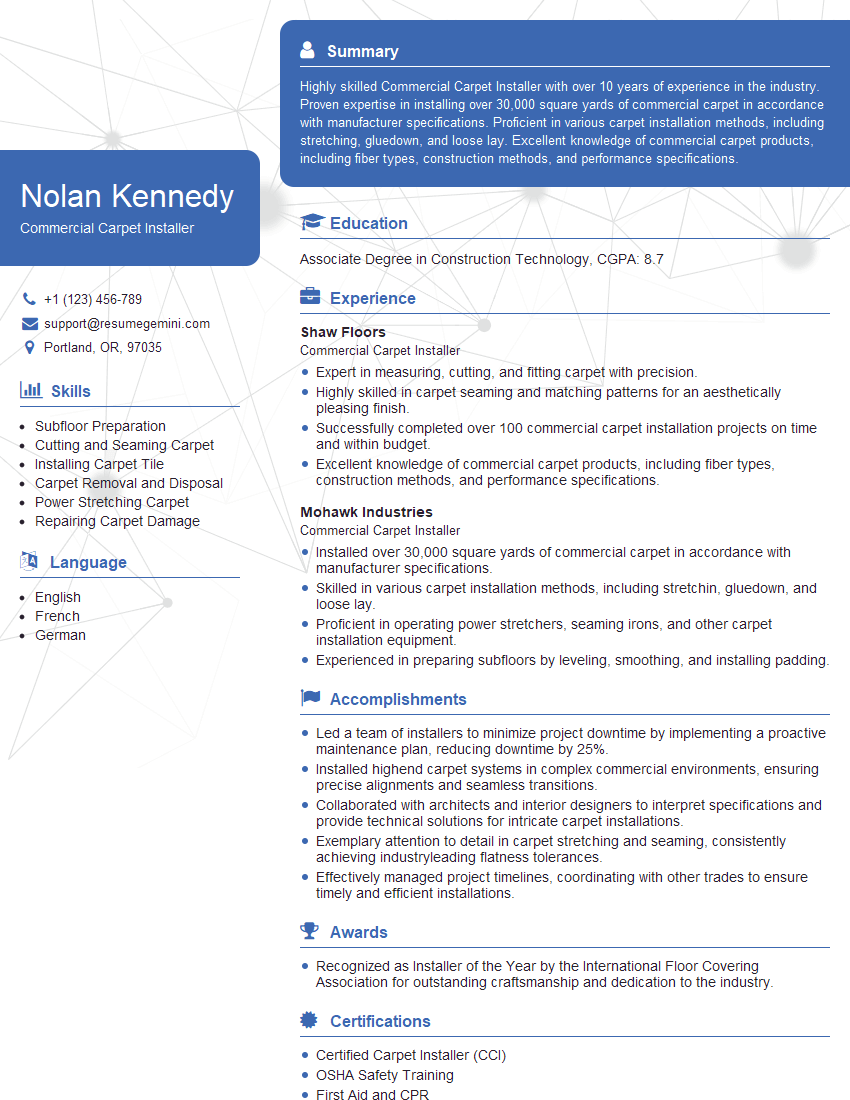
Mastering carpet tile installation opens doors to a rewarding career with opportunities for advancement and specialization. To stand out to potential employers, a strong, ATS-friendly resume is crucial. ResumeGemini is a trusted resource to help you craft a compelling resume that highlights your skills and experience. ResumeGemini provides examples of resumes tailored to the Carpet Tile Installation industry, ensuring your application makes a lasting impression. Invest the time in building a professional resume – it’s your first impression with potential employers.



Explore more articles
Users Rating of Our Blogs
Share Your Experience
We value your feedback! Please rate our content and share your thoughts (optional).
What Readers Say About Our Blog
Very informative content, great job.
good