The right preparation can turn an interview into an opportunity to showcase your expertise. This guide to RESTful API Integration interview questions is your ultimate resource, providing key insights and tips to help you ace your responses and stand out as a top candidate.
Questions Asked in RESTful API Integration Interview
Q 1. Explain the difference between REST and SOAP.
REST (Representational State Transfer) and SOAP (Simple Object Access Protocol) are both architectural styles for building web services, but they differ significantly in their approach. Think of it like this: REST is like sending postcards – simple, lightweight, and flexible. SOAP is more like sending registered mail – formal, structured, and requires more overhead.
- REST: Emphasizes simplicity and scalability. It uses standard HTTP methods (GET, POST, PUT, DELETE) and leverages existing web infrastructure. Data is typically transmitted in lightweight formats like JSON or XML. REST is stateless, meaning each request contains all the information needed to process it, independent of previous requests.
- SOAP: Is a more complex and heavyweight protocol that uses XML for both messages and encoding. It relies on WS-* specifications for features like security and transactions. SOAP is often more verbose and requires more bandwidth than REST. It typically uses a dedicated SOAP engine on the server side to handle requests.
In short, REST prioritizes simplicity and flexibility, while SOAP prioritizes robustness and formality. The choice between them depends on the specific needs of the application.
Q 2. Describe the constraints of RESTful APIs.
RESTful APIs adhere to a set of constraints that, when followed, ensure a clean, consistent, and scalable architecture. These constraints aren’t strict rules, but guiding principles that contribute to the elegance of REST. Think of them as the recipe ingredients for a successful RESTful dish.
- Client-Server: The client and server are independent of each other. The server provides resources, and the client requests them. This separation allows for independent evolution and scalability.
- Stateless: Each request from the client to the server must contain all the information necessary to understand and process the request. The server doesn’t maintain any client context between requests.
- Cacheable: Responses from the server should be cacheable to improve performance. This is particularly important for read-only resources.
- Uniform Interface: This is arguably the most important constraint and dictates how clients interact with the server through a standardized interface that uses standard HTTP methods and URIs.
- Layered System: Clients should not need to know whether they are communicating directly with the final server or an intermediary.
- Code on Demand (Optional): The server can extend client functionality by transferring executable code (e.g., JavaScript).
Violating these constraints can compromise the advantages of using REST, such as scalability and maintainability.
Q 3. What are the different HTTP methods used in REST and their purpose?
RESTful APIs primarily use HTTP methods to define the type of operation being performed on a resource. Imagine these methods as verbs that act upon resources (nouns).
GET: Retrieves a representation of a resource. Example:GET /users/123retrieves user with ID 123.POST: Creates a new resource. Example:POST /userscreates a new user.PUT: Replaces an existing resource with a new one. Example:PUT /users/123replaces user with ID 123.DELETE: Deletes a resource. Example:DELETE /users/123deletes user with ID 123.PATCH: Partially modifies an existing resource. Example:PATCH /users/123updates only the email address of user 123.
Using the correct HTTP method is crucial for maintaining the semantics and idempotency of your API. For instance, GET should always be safe (not causing side effects) and idempotent (multiple calls have the same effect as one).
Q 4. Explain the concept of statelessness in REST.
Statelessness in REST means that each request from a client to the server must contain all the information necessary to understand and process the request. The server doesn’t store any context about the client between requests. Think of it like a vending machine: each time you make a selection and insert money, the machine doesn’t remember your previous purchases; each transaction is independent.
This approach offers several benefits, including:
- Scalability: Servers can easily scale horizontally as each request is self-contained and doesn’t depend on server-side state.
- Reliability: If a server fails, requests can be easily rerouted to another server without losing context.
- Simplicity: The server’s logic is simplified as it doesn’t need to manage client sessions.
However, statelessness requires mechanisms like session IDs or authentication tokens to maintain user context across multiple requests, if needed.
Q 5. What is RESTful API resource representation?
RESTful API resource representation refers to how the data associated with a resource is formatted and transmitted. This is typically done using standard formats such as JSON (JavaScript Object Notation) or XML (Extensible Markup Language). Think of it as the way a server ‘describes’ a resource to a client.
For example, if a resource represents a ‘user’, its representation could be a JSON object like this:
{ "id": 123, "name": "John Doe", "email": "john.doe@example.com" }The choice between JSON and XML often depends on factors like the client’s capabilities and the desired level of verbosity. JSON is generally preferred for its lightweight nature and easier parsing by JavaScript.
Q 6. How do you handle error responses in RESTful APIs?
Handling error responses is crucial for building robust and user-friendly RESTful APIs. A well-designed error response should provide enough information for the client to understand the problem and take corrective action.
Effective error handling typically involves:
- Appropriate HTTP Status Codes: Using the correct HTTP status code (e.g.,
400 Bad Request,404 Not Found,500 Internal Server Error) to indicate the type of error. - Meaningful Error Messages: Providing a clear and concise description of the error in the response body. Avoid technical jargon where possible.
- Error Codes: Including a unique error code to help clients categorize and handle different types of errors.
- Consistent Error Format: Using a consistent format for error responses, such as JSON, across the entire API to simplify client-side handling.
Example JSON error response:
{ "error": { "code": 1001, "message": "Invalid input data", "details": "The 'email' field is required." } }Q 7. Explain the role of HTTP status codes in REST.
HTTP status codes are crucial in RESTful APIs for conveying the outcome of a request. They provide a standardized way for the server to communicate the success or failure of an operation, and the reason behind it. They act as a signal system between the server and the client.
Status codes are categorized into several classes:
- 1xx Informational: Indicates that the request has been received and is being processed.
- 2xx Successful: Indicates that the request was successfully received, understood, and accepted.
- 3xx Redirection: Indicates that further action needs to be taken by the client to complete the request.
- 4xx Client Error: Indicates that the client made an error in the request (e.g.,
400 Bad Request,404 Not Found). - 5xx Server Error: Indicates that the server encountered an error while processing the request (e.g.,
500 Internal Server Error).
Clients should carefully check the status code in every response to handle different scenarios gracefully. Using appropriate status codes improves the robustness and reliability of your API.
Q 8. What are the benefits of using RESTful APIs?
RESTful APIs offer numerous advantages that make them a cornerstone of modern software architecture. Their primary benefit stems from their statelessness and use of standard HTTP methods (GET, POST, PUT, DELETE), leading to simpler design, improved scalability, and better interoperability.
- Simplicity and Understandability: RESTful APIs are relatively easy to understand and use because they leverage familiar HTTP concepts. This reduces the learning curve for developers and simplifies integration processes.
- Scalability and Performance: The stateless nature of REST allows for easy scaling; each request is independent, making it easy to distribute load across multiple servers. This leads to better performance, especially under heavy load.
- Flexibility and Interoperability: REST APIs can be accessed from various platforms and devices using standard HTTP protocols. This promotes interoperability and allows for easy integration with different systems.
- Cacheability: Responses from REST APIs can be cached, reducing server load and improving response times. This is achieved using HTTP headers like
Cache-Control. - Modifiable Client-Server Architecture: Changes to the server-side application do not necessarily require modifications to the client, promoting loose coupling and greater flexibility.
For example, imagine a social media platform. A RESTful API allows mobile apps, web applications, and even third-party tools to interact with the same backend, accessing user data, posts, and other information consistently. This avoids the need for custom integration solutions for each client.
Q 9. What are some common challenges faced when integrating RESTful APIs?
While RESTful APIs offer many benefits, integrating them can present challenges. These often involve handling complexities of data formats, security, and error management.
- Data Format Handling: Choosing and managing data formats like JSON or XML can be tricky. Inconsistencies in data structures can lead to integration issues.
- Security Concerns: Authentication, authorization, and data protection are crucial. Poorly implemented security can lead to vulnerabilities and data breaches.
- Error Handling and Management: Effective error handling is vital for a smooth integration process. Without it, debugging and troubleshooting become difficult.
- Rate Limiting and Throttling: Excessive requests can overload the API. Implementations need robust mechanisms to manage and prevent this.
- API Documentation and Discoverability: Lack of clear and comprehensive documentation makes it challenging for developers to understand and use the API effectively. Tools like Swagger or OpenAPI can help address this.
- Dependency Management: Changes in the API can break existing integrations. Versioning and careful planning are crucial to mitigate this.
For instance, imagine an e-commerce website integrating with a payment gateway API. If the payment gateway’s API changes its data format without proper notification, the e-commerce site’s integration will likely fail until updated.
Q 10. How do you handle authentication and authorization in RESTful APIs?
Authentication verifies the identity of the client accessing the API, while authorization determines what actions the client is permitted to perform. Robust security measures are paramount to protect sensitive data.
Typically, authentication is handled at the beginning of the request cycle. Once authenticated, authorization is then checked for each specific operation requested. This is often done using HTTP headers such as Authorization containing the authentication token (e.g., JWT) or credentials. For example, a header like Authorization: Bearer .
To implement authorization, you might use roles and permissions. Each user has a role (e.g., admin, user), and each role has specific permissions for API endpoints. This ensures that only authorized users can access sensitive data or perform certain actions. For example, only an ‘admin’ user might be able to delete user accounts.
Q 11. Describe different API authentication methods (OAuth 2.0, JWT, etc.).
Several authentication methods exist for securing RESTful APIs. Each has its strengths and weaknesses.
- OAuth 2.0: A delegation protocol; it allows a third-party application to access resources on behalf of a user without requiring the user’s credentials. It’s widely used, particularly for social media integrations. Different grant types (Authorization Code, Client Credentials, Implicit, etc.) are available, each suited for different scenarios.
- JSON Web Tokens (JWT): Compact, self-contained tokens containing claims about the user. They are digitally signed and can be verified by the API. JWTs reduce the need for frequent database lookups, enhancing performance. They provide a stateless mechanism, beneficial for distributed systems.
- API Keys: Simple, lightweight tokens that identify the client. They are usually embedded in HTTP headers or query parameters. While easy to implement, they are less secure than OAuth 2.0 or JWT.
- Basic Authentication: A straightforward method where the client sends username and password encoded in Base64. It’s simple but less secure as it transmits credentials in plain text (although encoded, easily decoded). Generally avoided for sensitive applications.
Choosing the right method depends on the security requirements and the complexity of the application. For instance, a public API might use API keys, while a sensitive application might opt for OAuth 2.0 with JWT for better security and performance.
Q 12. Explain API versioning strategies.
API versioning is crucial for maintaining backward compatibility when making changes to your API. It ensures that older clients can continue to function correctly while new features and updates are added.
- URI Versioning: This approach includes the version number directly in the API endpoint URI. Example:
/v1/users,/v2/users. This is simple and easy to understand but can lead to many URLs if you have multiple versions. - Header Versioning: The API version is sent as an HTTP header, such as
X-API-Version: 2. This method allows multiple versions to be handled on the same endpoint, and is beneficial in the case of an update that is not breaking, and both versions may continue to be used. - Content Negotiation: Uses the
Acceptheader to specify the desired API version based on the media type. This is less common and might be used in combination with other techniques. Example:Accept: application/vnd.yourcompany.v2+json - Custom Headers: A header, like
X-API-Version, is commonly used for versioning. It offers flexibility and avoids cluttering the URI.
Consider a mobile app interacting with an API. When the API is updated to version 2, the app would need to be updated to use the new version. The chosen versioning method dictates how this transition is managed.
Q 13. How do you design a RESTful API for scalability and maintainability?
Designing a scalable and maintainable RESTful API requires careful consideration of several factors. The design should favor simplicity, consistency, and modularity.
- Microservices Architecture: Breaking down the API into smaller, independent services improves scalability and maintainability. Each microservice can be developed, deployed, and scaled independently.
- Resource-Based Design: Organize the API around resources and use standard HTTP methods (GET, POST, PUT, DELETE) to interact with them. This promotes a clear and consistent structure.
- Hypermedia Controls (HATEOAS): Include links in the responses that guide the client on how to interact with the API. This makes the API more self-documenting and improves discoverability.
- Caching Strategies: Implement appropriate caching mechanisms to reduce server load and improve response times. Using HTTP caching headers is key.
- Asynchronous Processing: For long-running tasks, use asynchronous processing (e.g., message queues) to avoid blocking the main API thread and improve responsiveness.
- Proper Documentation: Maintain comprehensive documentation using tools like Swagger/OpenAPI to make the API easy to understand and use. This simplifies maintenance and onboarding.
Imagine a large e-commerce platform. Using a microservices approach, you can separate order management, product catalog, and user authentication into distinct services, each scalable independently. This makes maintenance and updates much more manageable than handling everything in a monolithic system.
Q 14. What are some common tools and technologies used for testing RESTful APIs?
Many tools and technologies simplify RESTful API testing and ensure quality. These range from command-line utilities to comprehensive test suites.
- Postman: A popular GUI-based tool for designing, building, testing, and documenting APIs. It supports various authentication methods and allows for easy collaboration.
- curl: A command-line tool for transferring data with URLs. It’s versatile and useful for quick testing, though less suited for complex scenarios.
- REST-Assured (Java): A Java library specifically designed for testing RESTful APIs. It simplifies writing automated tests and integrates with testing frameworks like JUnit.
- Requests (Python): A Python library offering a simple and elegant way to make HTTP requests, vital for API testing within Python-based projects.
- JMeter: Performs load and performance testing. It helps identify bottlenecks and evaluate the API’s ability to handle a high volume of requests.
- Swagger/OpenAPI: While primarily used for documentation, these tools help automatically generate test cases from the API specification.
When building a REST API, utilizing one or more of these tools is highly recommended. They streamline the development process by accelerating testing and ensuring the API’s reliability and functionality.
Q 15. How do you troubleshoot issues with REST API integration?
Troubleshooting REST API integration issues requires a systematic approach. Think of it like diagnosing a car problem – you need to identify the symptoms before you can fix the root cause. I typically start by examining the HTTP response codes. A 4xx code (like 400 Bad Request or 404 Not Found) indicates a problem on the client-side (like incorrect input data or a wrong URL). A 5xx code (like 500 Internal Server Error or 502 Bad Gateway) points to a server-side issue.
Next, I’ll check the API logs for more detailed error messages. These logs often pinpoint the exact line of code or the specific component that failed. Network monitoring tools can also be invaluable, showing request and response times, packet loss, and other network-related issues. If the problem involves authentication, I would meticulously examine authorization headers and tokens. Finally, I’ll use debugging tools within my chosen programming language to step through the code and see what’s happening at each stage.
For example, if I’m getting a 400 Bad Request, I’d carefully examine the request payload to ensure it conforms to the API specification. If I receive a 500 Internal Server Error, I’d work with the API’s developers to analyze their server-side logs. This approach combines technical analysis with collaborative problem-solving.
Career Expert Tips:
- Ace those interviews! Prepare effectively by reviewing the Top 50 Most Common Interview Questions on ResumeGemini.
- Navigate your job search with confidence! Explore a wide range of Career Tips on ResumeGemini. Learn about common challenges and recommendations to overcome them.
- Craft the perfect resume! Master the Art of Resume Writing with ResumeGemini’s guide. Showcase your unique qualifications and achievements effectively.
- Don’t miss out on holiday savings! Build your dream resume with ResumeGemini’s ATS optimized templates.
Q 16. Describe your experience with API documentation tools (Swagger, OpenAPI).
I have extensive experience using both Swagger and OpenAPI (which are essentially the same thing, with OpenAPI being the more current specification) for API documentation. These tools are essential for creating and sharing well-documented, easy-to-understand APIs. They provide a standardized way to describe API endpoints, request and response formats, authentication methods, and more. Think of them as the instruction manuals for your API.
In my experience, using Swagger/OpenAPI has significantly improved collaboration between developers, testers, and clients. It reduces ambiguity and minimizes integration errors. I’ve used them to generate interactive API documentation, client SDKs (Software Development Kits) in various programming languages, and server-side code stubs. This automation speeds up the development process and improves consistency across different parts of the system. For example, I’ve used Swagger UI to visualize the API endpoints, and automatically generated client code in Java and Python using Swagger Codegen, making the API much easier for other developers to consume.
Q 17. Explain how to handle rate limiting in REST API integration.
Rate limiting is a crucial aspect of REST API design that protects the server from being overloaded by too many requests. Imagine a popular restaurant – if everyone tried to order at once, the kitchen would be overwhelmed. Rate limiting imposes restrictions on the number of requests a client can make within a given time period. There are various strategies to handle this.
The simplest approach is to implement a fixed rate limit. For instance, allowing only 100 requests per minute from a single IP address. More sophisticated techniques use sliding windows, where requests are tallied over a short period (e.g., 1 second) and averaged over a longer period (e.g., 1 minute). This allows for bursts of activity without triggering the limit immediately. If a client exceeds the rate limit, I typically return an HTTP 429 Too Many Requests response with information about the allowed rate and the remaining request quota. This allows the client to back off and retry later or implement more sophisticated retry logic with exponential backoff (increasing the waiting time between retries).
A robust system might also include different rate limits for different API endpoints or user roles. For instance, privileged users might have higher limits than regular users.
Q 18. How do you handle caching in REST API design?
Caching is a vital technique for improving the performance and scalability of REST APIs. Think of it like having a frequently used cookbook readily available on your countertop – you don’t have to go searching for it in the cupboard every time you need it. Caching stores frequently accessed data in a readily accessible location, such as a memory cache or a distributed cache like Redis or Memcached. When a request for data is received, the API first checks the cache. If the data is found (a cache hit), it’s served directly, avoiding the need to hit the database or a slower backend service. If the data is not found (a cache miss), the API retrieves it from the source, caches it, and then returns it to the client.
There are various caching strategies, such as HTTP caching (using headers like Cache-Control and Expires) and application-level caching. Properly implementing caching requires careful consideration of cache invalidation strategies to ensure data consistency. Stale data in the cache can lead to errors, so you need to regularly update the cache to reflect changes in the underlying data.
For example, using HTTP caching, you can specify how long a browser or client should cache a particular response. A CDN (Content Delivery Network) also leverages caching to serve content quickly to geographically dispersed users.
Q 19. What are some common security vulnerabilities in RESTful APIs and how to mitigate them?
RESTful APIs are susceptible to various security vulnerabilities. Some common ones include:
- SQL Injection: Occurs when malicious code is injected into database queries. Mitigation: Use parameterized queries or prepared statements to prevent direct execution of user-supplied input.
- Cross-Site Scripting (XSS): Allows attackers to inject malicious scripts into the API response. Mitigation: Properly sanitize and encode all user-supplied data before displaying it in the API response.
- Cross-Site Request Forgery (CSRF): Tricks a user into performing unwanted actions on a website. Mitigation: Use CSRF tokens to verify that requests originate from the legitimate website.
- Authentication and Authorization Vulnerabilities: Weak passwords, inadequate authentication mechanisms, and improper authorization checks can expose sensitive data. Mitigation: Implement strong authentication mechanisms (e.g., OAuth 2.0), use HTTPS, and carefully manage access control.
- Data Breaches: Improperly secured databases or insecure data storage can lead to data breaches. Mitigation: Use strong encryption techniques, implement robust access controls, and regularly audit and monitor access to sensitive data.
Addressing these vulnerabilities requires a multi-layered approach combining secure coding practices, robust authentication and authorization mechanisms, and regular security audits and penetration testing.
Q 20. Explain different types of API calls (GET, POST, PUT, DELETE).
HTTP methods define the type of operation performed on a resource. Think of them as verbs in a sentence, describing what action you want to take.
GET: Retrieves a resource. It’s a read-only operation; it shouldn’t change the server’s state. Example:GET /users/123retrieves information about user with ID 123.POST: Creates a new resource. Example:POST /userscreates a new user with data sent in the request body.PUT: Updates an existing resource. It replaces the entire resource with the data provided in the request body. Example:PUT /users/123replaces all information about user 123 with the data in the request body.DELETE: Deletes a resource. Example:DELETE /users/123deletes the user with ID 123.
Using these methods correctly ensures that your API follows REST principles, making it more predictable and easier to understand.
Q 21. How do you handle data transformation during API integration?
Data transformation is frequently necessary during API integration because different systems often use different data formats and structures. Think of it like translating between languages – you need to convert the data from one format into a format that the receiving system understands. This often involves converting data types, restructuring data, and mapping fields.
Common data transformation techniques include:
- Data Mapping: Mapping fields from one data structure to another. This might involve renaming fields, changing data types (e.g., string to integer), or merging multiple fields into one.
- Data Type Conversion: Changing the data type of a field (e.g., converting a string date to a date object). This often uses libraries or functions provided by programming languages.
- Data Filtering: Selecting specific fields from a larger dataset, often to reduce the amount of data transferred over the network.
- Data Validation: Ensuring that the data conforms to specific rules and constraints before it’s processed or stored. This might involve checking for data types, ranges, or required fields.
Tools and libraries like Apache Camel or JSON transformation libraries are frequently used to automate and streamline the data transformation process. The choice of tools depends on the complexity of the transformation, the programming languages involved, and the volume of data being processed. For example, using a library like Jackson in Java allows for efficient JSON parsing and manipulation during data transformation.
Q 22. What is HATEOAS and why is it important in RESTful APIs?
HATEOAS, or Hypermedia As The Engine Of Application State, is a constraint of RESTful architecture that emphasizes using hypermedia links within API responses to guide clients on how to interact with the system. Instead of hardcoding URLs into client applications, HATEOAS provides links that dynamically adapt to changes in the API’s structure. Imagine a website; you don’t need to know the exact URL of every page beforehand; you navigate by clicking links. HATEOAS does the same for APIs.
Its importance lies in decoupling client and server. Changes on the server-side (like adding new resources or modifying endpoints) don’t necessarily require client-side code updates as long as the hypermedia links are correctly updated. This improves maintainability, scalability, and the overall robustness of the system. For example, if a new resource ‘orders’ is added, the existing ‘customers’ resource can include a link to access the associated ‘orders’. The client automatically discovers the new endpoint, making it highly adaptable.
However, full HATEOAS implementation can be complex, often requiring significant design and development effort. Many APIs choose to implement partial HATEOAS or even forgo it completely in favour of simpler client-side interaction. The trade-off involves the extra effort against the benefits of extreme decoupling.
Q 23. Explain your experience with different API gateways.
I have extensive experience with various API gateways, including Kong, Apigee, and AWS API Gateway. Each possesses unique strengths and weaknesses. Kong, for instance, excels in its open-source nature and extensibility through plugins, allowing for customized functionalities like authentication, rate limiting, and transformation. Apigee, on the other hand, is a more comprehensive enterprise-grade solution with robust features for security, analytics, and management but with a higher cost and complexity. AWS API Gateway seamlessly integrates with other AWS services and offers excellent scalability but might have a steeper learning curve for developers unfamiliar with the AWS ecosystem.
In one project, we used Kong to manage several microservices. Its plugin system allowed us to easily implement authentication using JWT (JSON Web Tokens) and secure our APIs effectively. In another project, we leveraged Apigee’s advanced analytics capabilities for performance monitoring and troubleshooting; this was invaluable in identifying and resolving a bottleneck caused by a specific API endpoint. The selection of the right API gateway always depends on the project’s specific requirements, scalability needs, budget, and the team’s expertise.
Q 24. How do you deal with API rate limits?
Dealing with API rate limits is crucial for preventing abuse and ensuring fair access to your API. There are several strategies to handle this. The first line of defense is to implement robust rate limiting mechanisms on the API itself, often using tools like Nginx or dedicated rate limiting libraries. This involves configuring limits on requests per unit of time (e.g., requests per second or minute) based on IP address or API key.
If a client exceeds the rate limit, the API should return an appropriate HTTP status code (like 429 Too Many Requests) along with information about the remaining quota and reset time. On the client side, we can implement retry mechanisms with exponential backoff, where the client waits exponentially longer after each failed request. This avoids overwhelming the server with repeated requests immediately after hitting the rate limit. Caching frequently accessed data is also highly effective – reducing the load on the API. Implementing queuing mechanisms can help manage request bursts, storing requests temporarily and processing them at a sustainable rate.
For example, in a project involving a high-traffic e-commerce API, we implemented rate limiting based on API keys, allowing us to differentiate between different users and adjust their rate limits accordingly. We also implemented a robust retry mechanism on the client side to gracefully handle rate limit exceedances.
Q 25. Discuss your experience working with JSON and XML in REST API contexts.
JSON (JavaScript Object Notation) and XML (Extensible Markup Language) are both widely used data formats in REST APIs, each with its own strengths and weaknesses. JSON’s lightweight nature, human-readable format, and ease of parsing make it the more popular choice for most modern APIs. It’s often preferred for its speed and efficiency, especially in JavaScript-heavy web applications. However, XML’s ability to handle complex structures and its strong support for schemas through technologies like XSD (XML Schema Definition) might make it preferable for applications requiring strict data validation and very complex data structures.
I have worked extensively with both. In most cases, JSON was the default, preferred for its simplicity and broad support across various programming languages. However, in a particular project involving legacy systems that heavily relied on XML data exchange, I had to seamlessly integrate the new REST API with the existing systems, handling the XML data effectively using appropriate XML parsing libraries. This involved transforming data between JSON and XML formats when communicating between the new API and the older systems. The key here was understanding the specific constraints and optimizing the transformation process to maintain performance and efficiency.
Q 26. Describe a time you had to debug a complex REST API integration issue.
During one integration, we encountered a baffling issue where requests to a specific endpoint would intermittently fail with a 500 Internal Server Error, but without any clear error messages from the server logs. This was extremely frustrating, as the API worked flawlessly for most of the time.
Our debugging process was systematic. First, we carefully reviewed the API logs on both the client and server sides, but the logs didn’t provide any helpful hints. Next, we used network monitoring tools (like Wireshark) to capture the network traffic. This revealed that certain requests were experiencing very high latency before finally timing out. By carefully examining the request headers and response times, we discovered that the problem was related to specific data patterns in the request body. A particular combination of values was triggering a very long processing time on the server, leading to the intermittent failures.
The fix involved optimizing the server-side logic to handle this specific data pattern more efficiently. This solved the intermittent failure issue. This experience underscored the importance of systematically combining different debugging tools and techniques.
Q 27. How familiar are you with asynchronous communication patterns in REST?
Asynchronous communication patterns are essential in REST API design, particularly when dealing with long-running tasks or operations that might involve third-party services. Webhooks and message queues are commonly used. Webhooks allow the server to push notifications to the client when a specific event occurs. This avoids the client needing to poll the server continuously, improving efficiency and reducing latency. Message queues, like RabbitMQ or Kafka, enable decoupling between different parts of the system. A client can send a request, and the server immediately confirms receipt, without waiting for the entire processing to complete. The result is then pushed through a queue asynchronously.
For example, in an image processing API, instead of making the client wait for the image to be processed, a webhook can be used to notify the client once the processing is complete. The server can process the image in the background asynchronously. This significantly improves user experience by decoupling the long process from the initial request. The selection between webhooks and message queues depends on factors such as the need for guaranteed message delivery, message ordering, and the overall system architecture.
Q 28. What are your preferred methods for testing API performance and security?
For API performance testing, I rely heavily on tools like JMeter and k6. JMeter allows simulating a high volume of concurrent users to assess the API’s performance under stress and pinpoint bottlenecks. k6 is excellent for scripting more complex performance tests and provides detailed reports. I always focus on key metrics like response times, throughput, and error rates.
Regarding security testing, OWASP ZAP (Zed Attack Proxy) is a valuable tool for identifying vulnerabilities like SQL injection, cross-site scripting (XSS), and broken authentication. Manual penetration testing is also crucial to discover vulnerabilities that automated tools might miss. This involves exploring the API’s endpoints and trying to exploit potential weaknesses, often focusing on the authentication and authorization mechanisms. Secure coding practices and regular code reviews are also essential in minimizing potential vulnerabilities during development.
Key Topics to Learn for RESTful API Integration Interview
- HTTP Methods: Understand the nuances of GET, POST, PUT, DELETE, and PATCH requests and their appropriate use cases. Practice formulating requests and interpreting responses.
- RESTful Principles: Grasp the core architectural constraints of REST, such as statelessness, client-server architecture, and cacheability. Be prepared to discuss their implications in design and implementation.
- API Design Best Practices: Familiarize yourself with concepts like resource naming, versioning, error handling, and response codes (e.g., 2xx, 4xx, 5xx). Understand how to design APIs that are efficient, scalable, and easy to use.
- Authentication and Authorization: Explore different authentication mechanisms (e.g., OAuth 2.0, API keys) and how to secure API integrations effectively. Understand the implications of authorization and access control.
- Data Formats: Become proficient in working with common data formats like JSON and XML. Understand how to parse and manipulate data within these formats.
- API Documentation: Learn how to read and interpret API documentation effectively, understanding the available endpoints, parameters, and response structures. Practice using tools like Swagger/OpenAPI.
- Testing and Debugging: Develop your skills in testing API integrations using tools like Postman or curl. Be comfortable debugging common issues related to network requests, response handling, and data transformation.
- Practical Application: Prepare examples from your projects where you have integrated with RESTful APIs. Focus on explaining your design choices, problem-solving strategies, and the technologies you employed.
- Security Considerations: Discuss common security vulnerabilities in API integrations (e.g., injection attacks, cross-site scripting) and how to mitigate them.
Next Steps
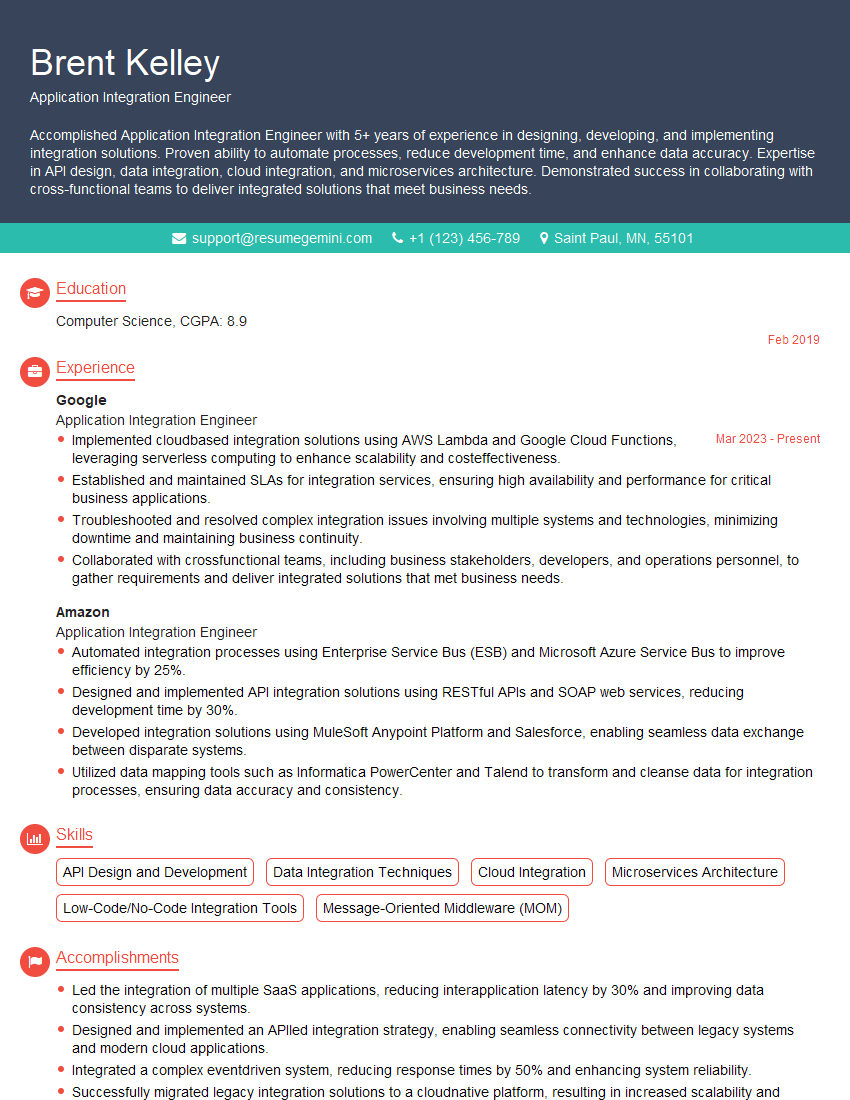
Mastering RESTful API integration is crucial for success in many modern software development roles, opening doors to exciting opportunities and higher earning potential. To maximize your job prospects, create an ATS-friendly resume that effectively highlights your skills and experience. ResumeGemini is a trusted resource to help you build a professional and impactful resume. They provide examples of resumes tailored to RESTful API Integration roles to help guide you. Take the next step in your career journey today!
Explore more articles
Users Rating of Our Blogs
Share Your Experience
We value your feedback! Please rate our content and share your thoughts (optional).
What Readers Say About Our Blog
Very informative content, great job.
good