The right preparation can turn an interview into an opportunity to showcase your expertise. This guide to Character Animation (MotionBuilder, Maya) interview questions is your ultimate resource, providing key insights and tips to help you ace your responses and stand out as a top candidate.
Questions Asked in Character Animation (MotionBuilder, Maya) Interview
Q 1. Explain your experience with MotionBuilder’s character retargeting tools.
MotionBuilder’s retargeting tools are invaluable for transferring animation data from one character rig to another, saving immense time and effort. The process involves mapping the source character’s joints to the target character’s corresponding joints. This isn’t simply a one-to-one mapping; it requires careful consideration of skeletal differences. For example, a character with a more pronounced clavicle will require adjustments to ensure smooth transfer of shoulder movements.
My experience includes utilizing MotionBuilder’s various retargeting methods, including its powerful FBX retargeting system. I’ve worked extensively with both automated and manual retargeting approaches. Automated retargeting provides a quick initial pass, but often requires manual refinement in areas like the fingers and feet. Manual retargeting offers precise control, allowing me to address specific issues, such as compensating for different limb proportions or joint rotations. I’ve found that a blended approach—starting with automated retargeting and then using manual adjustments—is the most efficient workflow.
A project I worked on involved retargeting motion capture data of a stuntman to a stylized game character. The initial automated retargeting resulted in exaggerated and unrealistic movements. By manually adjusting weights and tweaking the joint mappings, I was able to achieve a smooth, stylized animation that maintained the core performance of the source data. This demonstrated a deep understanding of both the technical aspects of retargeting and the artistic nuances needed to create believable results.
Q 2. Describe your workflow for creating realistic human locomotion in Maya.
Creating realistic human locomotion in Maya involves a multifaceted approach that combines technical skills with an understanding of human biomechanics. My workflow typically starts with reference gathering—observing real-world movement through video footage and possibly motion capture data. I then construct a robust and anatomically correct character rig, ensuring the joints and bones accurately reflect human anatomy. This is crucial for believable motion.
Next, I utilize a combination of techniques. Keyframing can provide precise control over specific poses and movements, particularly for subtle adjustments. However, for more fluid and natural movement, I often leverage procedural animation tools like the Maya’s curve editor to create smooth, realistic curves for joint rotations. This allows for more natural transitions and subtle variations in movement. Motion capture data can supplement my keyframing and procedural animation. I often use motion capture as a base, then meticulously refine the animation through keyframing and procedural animation, adding nuances specific to the character and the scene.
For example, in animating a character walking across uneven terrain, I might use motion capture as a starting point. Then I’d refine the animation to add subtle adjustments reflecting the character’s weight and the interaction with the environment. This might involve keyframing additional sway or adjustments to the foot placement to create a convincing response to the ground’s contours. Finally, I always test my animation with a variety of camera angles and lighting setups to ensure the realism holds under different viewing conditions. This iterative process ensures a final animation that is convincing and engaging.
Q 3. How do you approach animating secondary actions to enhance a character’s performance?
Secondary actions are the subtle movements that add realism and personality to a character animation. They are often overlooked but are crucial for bringing a character to life. My approach involves analyzing the primary action—the main movement—and then identifying opportunities for adding supplementary, related movements. These actions should be motivated by the primary action and the character’s emotional state.
For instance, while animating a character walking, secondary actions might include subtle head bobbing, arm swing variations, and a slight shift in weight distribution. These secondary actions are not random; they are carefully planned and executed to enhance the primary motion. Consider a character running: secondary actions could include windblown hair, breathing, and the subtle flexing of muscles. These actions need to maintain a natural flow and not distract from the primary action.
I use a layered approach, starting with the primary action and then gradually adding secondary actions. This prevents the animation from becoming overly cluttered or distracting. I also pay close attention to the timing and spacing of secondary actions, ensuring that they complement the primary action without competing with it. A common mistake is to add too many secondary actions, leading to a cluttered and unconvincing animation. Less is often more when it comes to secondary actions.
Q 4. What are your preferred methods for creating convincing facial expressions?
Creating convincing facial expressions requires a blend of technical skill and artistic understanding. My preferred methods incorporate a combination of techniques. I start with a well-designed facial rig, ensuring it provides the necessary control over muscles and features. Maya’s excellent rigging tools are crucial here, offering precise control over individual muscles for nuanced expressions.
Then I use a combination of keyframing and blendshapes. Keyframing allows me to precisely control the timing and intensity of specific expressions. Blendshapes offer a more efficient way to create a wide range of expressions by morphing between pre-defined shapes. I often employ a combination of both methods, utilizing keyframing for subtle adjustments and blendshapes for quick transitions between major expressions.
Reference is paramount; I often study images and videos of real-life facial expressions to ensure accuracy and naturalness. Understanding the underlying musculature of the face significantly enhances the realism and believability of the animation. Finally, I always test my facial animations in various lighting conditions and camera angles to ensure the expressions are readable and clear, regardless of the viewing perspective.
Q 5. Discuss your experience with different animation styles (e.g., realistic, stylized).
My experience encompasses a variety of animation styles, from photorealistic to heavily stylized. The approach significantly differs depending on the project requirements. For photorealistic animation, the goal is to create movement that is as close to real life as possible. This requires meticulous attention to detail, accurate representation of human anatomy, and a strong understanding of physics and biomechanics. It often involves motion capture as a base, followed by extensive refinement and polishing.
Stylized animation, on the other hand, often prioritizes artistic expression over strict realism. This may involve exaggeration of movements, simplification of anatomy, and adherence to a specific visual style. For example, a cartoon character might have exaggerated movements and expressions that would not be believable in a realistic context. This style often requires a different approach to posing and timing; exaggeration might be used to enhance the comedic effect or to convey specific emotions more effectively. The technical aspect is slightly different: while a realistic animation might prioritize smooth and believable curves, stylized animations might employ sharper curves to enhance the visual style.
Working on both styles broadened my understanding of animation principles and allowed me to adapt my approach according to the project needs. The core principles of animation remain consistent—timing, spacing, squash and stretch—but the application and degree of realism vary significantly.
Q 6. How do you troubleshoot animation issues in Maya?
Troubleshooting animation issues in Maya often involves a systematic approach. The first step is to isolate the problem. Is it a rigging issue, a keyframing problem, or something else entirely?
Common issues include unexpected joint rotations, animation artifacts (e.g., jittering), or problems with weight painting. I often start by checking the rig for any inconsistencies or errors. This may involve reviewing the joint hierarchy, the constraints, and the skinning weights to identify any potential sources of the problem.
For keyframing issues, reviewing the graph editor can pinpoint specific frames or keys that may be causing the problem. Maya’s playback tools are also useful for isolating the problem area in time. If weight painting is the culprit, examining the weight maps in the skin editor can help identify areas where weights need adjustments. If necessary, I use Maya’s debugging tools to analyze the animation data in detail to identify problematic elements.
Finally, I leverage Maya’s undo functionality extensively, allowing me to experiment with different solutions without risking significant progress loss. The problem-solving process is iterative: I identify potential causes, try different solutions, and refine the animation until the issue is resolved. The process takes into account the interaction between all parts of the system—rig, animation, and rendering—and requires patience and attention to detail.
Q 7. Explain your understanding of animation principles (e.g., squash and stretch, anticipation).
Animation principles are fundamental to creating believable and engaging animation. These principles, developed by Disney animators, provide guidelines for creating natural-looking movement.
- Squash and stretch: This principle involves deforming an object to emphasize its weight, mass, and elasticity. Think of a bouncing ball – it squashes on impact and stretches as it rebounds. This adds dynamism and realism to the animation.
- Anticipation: A movement is rarely sudden. Before a character performs a major action, there’s usually a subtle preparatory movement. For example, a character preparing to jump will first crouch down.
- Staging: This principle emphasizes clarity and readability. It’s about presenting the character and the action in a way that is immediately understandable to the viewer.
- Follow through and overlapping action: Parts of a character or object will continue moving after the main action is complete. Think of a character’s hair continuing to sway after they stop running.
- Slow in and slow out: Most natural movements start and end gradually, accelerating through the middle of the motion. Sudden stops and starts look unnatural.
- Arcs: Most natural movements follow an arc or curved path. This is more aesthetically pleasing and realistic than straight lines.
- Secondary action: As discussed earlier, these are supplementary movements that add depth and realism to the primary action.
- Timing: The speed and rhythm of movements are crucial for conveying emotion and personality.
- Exaggeration: This can add emphasis and visual interest to an animation without making it look unrealistic. This is particularly useful in stylized animation.
- Solid drawing: Maintaining a sense of three-dimensionality and weight adds realism even in stylized animations.
Understanding and applying these principles are essential for creating compelling and believable animations. I constantly refer to these principles throughout my workflow, ensuring that the final product is both visually appealing and technically sound.
Q 8. Describe your experience using MotionBuilder for motion capture data processing and cleanup.
My experience with MotionBuilder for motion capture data processing and cleanup is extensive. It’s a crucial step in bringing realistic movement to our characters. The process typically begins with importing the raw motion capture data, which often comes in as a collection of markers tracked on an actor’s body. This data is rarely perfect; it often contains noise, gaps, or inconsistencies.
In MotionBuilder, I utilize several techniques to clean this data. First, I use FBX files or BVH files for data import and leverage tools like the ‘Filter’ options to smooth out noisy data points, removing high-frequency jitters. I then employ the ‘Retargeting’ functionality to map the motion capture data to our specific character rigs. This process involves carefully adjusting the mapping to ensure accurate skeletal correspondence. Sometimes, I need to manually edit keyframes in problem areas, ensuring smooth transitions and avoiding unnatural poses or movements. For instance, in one project involving a horse, I had to manually clean up some erratic leg movements during galloping, meticulously adjusting the keyframes to create a fluid and believable animation.
Furthermore, I frequently utilize MotionBuilder’s powerful tools for ‘Layer Editing’ and ‘Blending’ to create variations within the captured motion, enhancing the character’s performance. I may layer in some subtle animations, like breathing, to add realism. The final stage involves exporting the refined data into our chosen 3D application, such as Maya, for final animation and polish.
Q 9. How do you handle animating complex character rigs?
Animating complex character rigs requires a strategic and layered approach. The complexity arises from the numerous bones, controls, and constraints involved in creating realistic and expressive character movement. My approach is to break down the animation process into smaller, manageable tasks. First, I thoroughly understand the rig’s structure and the intended use of each control. Many rigs have dedicated controls for specific actions (like facial expressions or fingers).
Secondly, I begin with blocking out the main poses of the animation, establishing the key moments of action. This gives me a clear overview of the overall movement and allows me to iterate quickly, adjusting timing and spacing. I prefer to utilize graph editor extensively for fine tuning and manipulating curves. Then, I start to refine the animation, adding details and secondary actions. This includes adding subtle movements such as weight shifts, breathing, and subtle facial expressions to enhance realism. For instance, while animating a character running, I’d add subtle head bobs and arm swings in addition to the primary leg movements. For extremely complex rigs, like those with facial muscles, I utilize tools that aid in automating some of these processes, such as blendshapes.
Finally, I constantly review the animation to assess the performance using the playback tools in Maya to ensure fluidity and believability. I pay close attention to the character’s weight, momentum, and overall believability. It’s iterative – a process of refinement and adjustment until I achieve the desired quality.
Q 10. What techniques do you use to improve animation performance in Maya?
Optimizing animation performance in Maya is crucial for smooth workflows and efficient rendering. The key is to minimize unnecessary geometry and reduce the processing load on the system. There are several techniques to achieve this.
- Reduce Polygon Count: Simplifying the character model, especially for animations that don’t require extreme detail, is the most effective way. Using proxies or lower-resolution models during animation and switching to higher-resolution only when rendering can significantly boost performance.
- Optimize Rigging: A well-structured and efficient rig is vital. Avoid unnecessary joints or constraints and use efficient methods for controlling the character’s movements. Too many constraints, for example, can slow things down drastically.
- Use Animation Layers Efficiently: While animation layers are invaluable, keep the number of layers used to a minimum, and ensure each layer contains only the necessary data. This is critical to avoid the unnecessary processing of superfluous data.
- Bake Animations: Baking animation data (converting keyframes into static meshes) reduces processing overhead significantly, especially if the animation has numerous intricate details or procedural effects.
- Use Proxies: Replace high-poly models with low-poly versions during animation, swapping back to high-poly during the final render.
For example, in a project with a large crowd scene, utilizing proxy models for the crowd and only animating a few high-detailed characters would drastically improve performance while still allowing the animator to focus on the character’s actions, rather than the rendering speed.
Q 11. Discuss your experience with different rigging techniques (e.g., skeletal, procedural).
My experience encompasses both skeletal and procedural rigging techniques. Skeletal rigging, the most common method, involves creating a hierarchy of joints (bones) to represent the character’s skeleton. This is generally the best approach for humanoid characters and those requiring expressive, fine-tuned animation. It offers excellent control over individual body parts.
Procedural rigging, on the other hand, utilizes algorithms and scripts to automate the creation and manipulation of character rigs. This approach is particularly useful for complex characters or creatures with intricate anatomy or for creating rigs that need to adapt to various character variations or deformations. A strong example would be creating a rig for a creature with many tentacles, where each tentacle is procedurally generated, rather than manually rigging each individual segment.
I choose the rigging technique based on the specific needs of the project. For humanoid characters, skeletal rigging is typically sufficient. However, for characters requiring highly articulated or organic deformations, procedural rigging becomes incredibly advantageous. I’ve combined both techniques in certain projects, leveraging the strengths of each for optimal control and efficiency. For instance, I could use a procedural rig to generate the base structure and then refine specific areas with manual skeletal adjustments.
Q 12. How do you manage and organize animation assets?
Managing and organizing animation assets is paramount for efficient collaboration and workflow. A clear and consistent naming convention is the cornerstone of organization. I utilize a hierarchical folder structure reflecting the project’s stages, character names, animation types, and versions. For instance, a typical folder structure might look like this: Project_Name/Characters/Character_A/Animations/Walk/Version_01/walk_cycle_v01.anim
This structure instantly clarifies the project, character, animation, and the version being used. I also employ version control systems (e.g., Perforce or Git) to track changes and revert to previous versions if needed. Metadata is also crucial; adding descriptive information to the assets (author, date, comments) ensures everyone working on the project can understand the animation’s context and purpose. This approach simplifies troubleshooting, enhances collaboration, and avoids confusion. A well-organized asset library also speeds up the overall animation pipeline.
Q 13. How do you collaborate effectively with other team members (e.g., riggers, modelers)?
Effective collaboration is critical in animation production. Clear communication and proactive feedback are key. I frequently hold regular meetings with riggers and modelers to discuss challenges, share progress, and address potential issues early on. I emphasize that sharing clear expectations and establishing a feedback loop is essential for success. I make sure all team members have access to the latest assets and versions via shared network drives and version control systems.
Before beginning animation, I ensure that the rig is thoroughly tested and meets the needs of the animation. This avoids issues later in the pipeline. Constructive feedback sessions are vital; providing detailed critiques but also being receptive to feedback myself fosters a collaborative environment. Tools such as review software or shared annotation software can be very useful in this regard. A positive collaborative environment minimizes conflicts and ensures a smoother workflow. During the process, clear and timely communication is paramount; using consistent communication channels and project management software is key to avoid confusion and delays.
Q 14. How do you optimize animation for game engines?
Optimizing animation for game engines involves minimizing polygon count, reducing the number of keyframes, and using appropriate animation techniques. Game engines have specific performance limitations, and exceeding those limits can significantly impact game performance. The first step is optimizing the character model itself, ensuring it is as low-poly as possible while still maintaining visual quality.
Next, I ensure the animation is optimized for the target platform. For example, I might reduce the sampling rate of the animation, decreasing the number of keyframes without significantly impacting visual quality. Techniques like root motion and animation blending are effective for optimizing animation performance. Root motion simplifies the integration of character movement into the game’s physics engine. Animation blending allows seamless transitions between various animations, such as walking, running, and jumping. This approach reduces the number of individual animations that need to be stored and processed. I also frequently use animation compression techniques to reduce file sizes, minimizing loading times.
Thorough testing is critical. Testing the animation within the game engine ensures it runs smoothly and meets performance targets. Regularly profiling the game to identify animation-related performance bottlenecks helps make necessary optimizations.
Q 15. What is your experience with animation software beyond Maya and MotionBuilder?
While Maya and MotionBuilder are my primary tools, my experience extends to other animation software packages. I’ve worked with Autodesk 3ds Max, primarily for environment creation and asset integration within character animation projects. I also possess a foundational understanding of Blender, which has been invaluable for quick prototyping and testing of animation concepts. My experience isn’t limited to the software itself; I’m adept at understanding the underlying principles of animation, which allows me to adapt to different software interfaces relatively quickly. For instance, while the keyframing techniques may vary between Maya and 3ds Max, the core principles of posing, timing, and spacing remain consistent.
Career Expert Tips:
- Ace those interviews! Prepare effectively by reviewing the Top 50 Most Common Interview Questions on ResumeGemini.
- Navigate your job search with confidence! Explore a wide range of Career Tips on ResumeGemini. Learn about common challenges and recommendations to overcome them.
- Craft the perfect resume! Master the Art of Resume Writing with ResumeGemini’s guide. Showcase your unique qualifications and achievements effectively.
- Don’t miss out on holiday savings! Build your dream resume with ResumeGemini’s ATS optimized templates.
Q 16. Explain your approach to creating believable character interactions.
Creating believable character interactions hinges on understanding the nuances of human behavior and translating that into animation. My approach involves a multi-step process. First, I thoroughly analyze the scene’s context and the characters’ motivations. This includes understanding their relationships, their emotional state, and their objectives. Then, I focus on the subtle details—the weight of the movements, the timing of reactions, and the interplay of body language and facial expressions. For example, if two characters are arguing, I might incorporate micro-expressions like slight eye twitches or lip curls to add depth and believability. I heavily rely on reference – observing real-life interactions, studying video footage, and even analyzing motion capture data to inform my work. Finally, I use iterative refinement through playblasts and feedback to ensure the interaction feels natural and convincing.
Q 17. Describe your experience working with different animation pipelines.
I have experience working within various animation pipelines, ranging from fully traditional animation workflows to those heavily reliant on motion capture. In traditional pipelines, I’ve worked from concept sketches and storyboards, building the animation from the ground up. In motion-capture driven pipelines, my role has involved cleaning and retargeting mocap data, blending it with keyframe animation to achieve the desired performance. I understand the challenges of managing assets and collaboration across different departments, such as modeling, rigging, and rendering. My experience includes managing version control using tools like Perforce and working within collaborative environments such as Shotgun. The key is adaptability – understanding how different elements of the pipeline interact and adjusting my workflow to optimize the overall process.
Q 18. How do you use feedback to improve your animation work?
Feedback is integral to improving my animation. I actively solicit feedback throughout the production process, starting from early blocking stages. I find it helpful to present my work in progress to peers and supervisors to get different perspectives. I use a structured approach to review feedback, focusing on both positive reinforcement and constructive criticism. I document feedback using specific timestamps in my animation timeline, and then I iterate and refine my work based on the suggestions received. I don’t take feedback personally; instead, I consider it as an opportunity to learn and improve my craft. For example, if feedback suggests the character’s reaction is too slow, I’ll focus on adjusting the timing and spacing to create a more responsive performance.
Q 19. Describe a challenging animation project and how you overcame it.
One particularly challenging project involved animating a character with highly complex and physically demanding movements – a parkour artist performing intricate maneuvers. The difficulty lay in ensuring that the character’s movements not only looked realistic but also adhered to the principles of physics. To overcome this, I utilized a multi-pronged approach. First, I extensively studied parkour videos and analyzed the movement physics through slow-motion analysis. Then, I used a combination of keyframe animation and motion capture data to achieve the desired level of realism. This involved careful retargeting and extensive tweaking of the mocap data to achieve the desired level of polish and finesse. Finally, I repeatedly refined the animation through playblasts, focusing on achieving seamless transitions and maintaining the character’s weight and momentum. The result was a believably fluid and dynamic animation that showcased the character’s skills.
Q 20. What are your strengths and weaknesses as a character animator?
My strengths lie in my strong foundational understanding of animation principles, my ability to create believable character performances, and my adaptability to different pipelines and software. I’m a proficient problem solver and I excel at collaborating effectively within a team. One area I’m continuously striving to improve is my efficiency in integrating complex secondary animation. I find that fine-tuning elements like hair, clothing, and subtle muscle deformations can be time-consuming, and I’m actively seeking techniques to optimize my workflow in this area. I am also always working to expand my knowledge of realistic facial animation techniques and how to best utilize procedural animation methods.
Q 21. How do you stay up to date with the latest industry trends in character animation?
Staying current in the fast-paced world of character animation involves a multi-faceted approach. I regularly attend industry conferences and workshops to network with other animators and learn about new techniques. I actively follow industry blogs and online publications, such as 80.lv, to keep abreast of the latest software updates and advancements. I participate in online communities and forums, such as those on artstation, to engage in discussions and learn from the experiences of other artists. Finally, I actively analyze high-quality animated films and games, paying close attention to the character animation to observe cutting-edge techniques and styles. This holistic approach ensures that I remain at the forefront of innovation in the character animation field.
Q 22. Explain your understanding of keyframing techniques.
Keyframing is the foundation of character animation. It involves setting key poses at specific points in time, allowing the software to interpolate (smoothly transition) between them, creating the illusion of movement. Think of it like creating a storyboard for your character’s actions, but instead of drawings, you’re positioning the character’s skeleton and manipulating its features at crucial moments.
For instance, to animate a character walking, I’d set keyframes for the beginning of a step, the midpoint, and the end. The software then calculates the in-between poses, resulting in a natural-looking walk cycle. The process involves selecting the desired animation channels (position, rotation, scale), setting their values at specific frames, and adjusting the curves that determine the speed and smoothness of the transitions.
- Precise Control: Keyframing provides fine-grained control over every aspect of the animation. I can adjust the timing, speed, and easing of each movement to achieve the desired effect.
- Flexibility: It’s adaptable to various animation styles, from realistic to stylized, depending on the selected curves and how the keyframes are spaced.
- Iterative Process: It’s rarely a ‘one-and-done’ task. I frequently scrub through the animation timeline, refining keyframes, tweaking curves, and adding more detail until it’s just right.
Q 23. Describe your experience with different types of animation curves.
Animation curves are the graphical representation of how a value changes over time. They dictate the speed, acceleration, and deceleration of an animation. In Maya and MotionBuilder, I’ve extensively used various curve types:
- Linear: Constant speed throughout. Useful for simple, mechanical movements, but can look unnatural for organic characters.
- Smooth/Bezier: Offers more control, allowing for smooth acceleration and deceleration. This is my go-to curve type for most character animations, providing a natural flow of movement.
- Step: Creates abrupt changes in values, resulting in a jerky, staccato-like animation. This can be used effectively for specific stylistic choices or glitches.
- Spline: Provides smooth transitions, often used in combination with tangents to fine-tune acceleration and deceleration. This allows me to create realistic movements such as a character’s weight shifting.
Understanding how these curves affect the timing and feel of an animation is crucial. I often adjust tangents to refine the curves, ensuring that movements are believable and engaging.
Q 24. How familiar are you with using animation layers in Maya?
Animation layers in Maya are an indispensable tool for organizing and managing complex animations. They allow me to create separate animation tracks for different aspects of a character’s performance, such as walk cycle, facial expressions, and gestures. Each layer acts as a separate container that doesn’t interfere with others.
For instance, I might have one layer for a character’s locomotion, another for subtle hand gestures, and a third for reactive facial expressions. This layered approach simplifies the animation process, allowing me to adjust individual elements without affecting the rest. The ability to blend layers with different weights allows for nuanced control of the final result, leading to more detailed and expressive animations.
Furthermore, I frequently use animation layers for non-destructive editing. If I need to experiment with different animations for a specific body part or action, I can do so on a separate layer without affecting the primary animation. This method speeds up the workflow and allows for various iterative design options.
Q 25. Discuss your experience using different blend shapes for facial animation.
Blend shapes are a powerful technique for facial animation, allowing for smooth transitions between different facial expressions. In Maya, I create blend shapes by morphing between a neutral face and various expressions (happy, sad, angry, surprised, etc.). Each expression is saved as a separate blend shape, and the software blends them together according to assigned weights.
For example, I might create a blend shape for a smile, another for raised eyebrows, and a third for a furrowed brow. I can then combine these shapes with different weights to create a wide range of nuanced facial expressions. The more blend shapes I create, the more realistic and expressive the character can become.
I often work with high-resolution models and many blend shapes, using them to create subtle shifts in the musculature of the face to mimic real-life expressions. Working with blend shapes demands attention to detail and careful weighting to achieve natural-looking transitions and avoid artifacts. This requires experience and finesse to ensure realism and expressiveness.
Q 26. How do you use reference material to inform your character animation?
Reference material is fundamental to believable character animation. I extensively use video footage, photographs, and even live-action recordings to inform my animation. Observing how real people move, react, and express themselves is invaluable. I gather video clips of people performing actions similar to those required in my animation. This helps to ensure that the movements are accurate and convincing.
I pay close attention to subtle details such as weight shifts, secondary actions (like fingers or clothing movement), and how the body responds to various forces and emotions. By analyzing this material, I can capture the nuances of human movement that would otherwise be difficult to replicate.
For example, when animating a character running, I might analyze several videos of different people running, taking note of their foot placement, arm swing, and torso rotation. This reference material provides the foundation for my animation process, allowing me to create a realistic and engaging performance.
Q 27. Explain your understanding of inverse kinematics (IK) and forward kinematics (FK).
Forward Kinematics (FK) and Inverse Kinematics (IK) are two different methods for controlling a character’s skeletal structure. FK involves directly manipulating each joint in a skeletal hierarchy, moving them one at a time. Think of it like controlling a puppet, where you move each joint individually. It’s intuitive and easy to use for simple poses but can become cumbersome for complex actions.
Inverse Kinematics (IK), on the other hand, allows you to control the end effector (e.g., a hand or foot) of a chain of joints, and the software automatically calculates the necessary joint rotations to achieve the desired position. Think of it like pulling a puppet’s hand; the arm automatically adjusts to reach the new position. This is highly efficient for complex movements like reaching, walking, and other intricate actions where calculating individual joint rotations is difficult. It’s particularly effective for character limbs and locomotion.
I often use a combination of FK and IK. FK for precise control of individual joints during key poses, and IK for smoother, more natural movement during complex actions. This blended approach allows for the best of both worlds—fine-tuned control and efficient animation.
Q 28. Describe your experience with procedural animation techniques.
Procedural animation involves using algorithms and scripts to generate animation automatically rather than relying solely on manual keyframing. It offers several advantages in terms of efficiency and consistency. In Maya and MotionBuilder, I’ve utilized several procedural techniques:
- Motion Capture (MoCap) data retargeting: I’ve worked with MoCap data, adapting the movements to different character rigs. This involves manipulating and cleaning up the captured data to fit the target model’s skeleton.
- Particle systems: These can create realistic effects like hair, fur, and cloth, significantly reducing the manual effort required to animate these details.
- Scripts and MEL/Python: Automating repetitive tasks such as creating walk cycles or generating various poses using scripts significantly increases efficiency and consistency.
Using these techniques enhances workflow and allows the creation of incredibly detailed and complex animations, saving considerable time and effort compared to entirely manual techniques. Procedural animation is incredibly useful for repetitive actions or tasks requiring a large number of frames. For example, automatically generating realistic crowd animations using procedural systems would be much faster and more efficient than keyframing each character individually.
Key Topics to Learn for Character Animation (MotionBuilder, Maya) Interview
- Character Rigging Fundamentals: Understanding joint hierarchies, constraints, and skinning techniques in both MotionBuilder and Maya. Practical application: Demonstrate your ability to troubleshoot rigging issues and optimize rigs for performance.
- Animation Principles: Mastering the 12 principles of animation and applying them to create believable and engaging character performances. Practical application: Analyze and critique existing animation, identifying strengths and weaknesses based on these principles.
- Motion Capture (MoCap) Data Processing: Cleaning, retargeting, and editing MoCap data within MotionBuilder. Practical application: Describe your workflow for incorporating and refining MoCap data to enhance your animations.
- Facial Animation Techniques: Creating realistic and expressive facial animations using blendshapes, muscle systems, and animation controls in Maya. Practical application: Explain your approach to creating nuanced facial expressions for different emotional states.
- Simulation and Dynamics: Utilizing Maya’s dynamics tools to add realistic movement to clothing, hair, or other elements interacting with the character. Practical application: Explain how you would approach simulating cloth or hair to enhance a character’s performance.
- Workflow and Pipeline: Understanding the various stages of a character animation pipeline, from asset preparation to final rendering. Practical application: Describe your preferred workflow for a typical animation project, highlighting efficiency and problem-solving strategies.
- Software Proficiency: Demonstrating a strong understanding of both MotionBuilder and Maya’s toolsets and their respective strengths. Practical application: Be prepared to discuss specific tools and techniques you’ve used effectively.
- Problem-Solving and Iteration: Articulating your approach to overcoming animation challenges and refining your work through iteration and feedback. Practical application: Provide examples of how you’ve addressed technical hurdles and improved your animation through iterative processes.
Next Steps
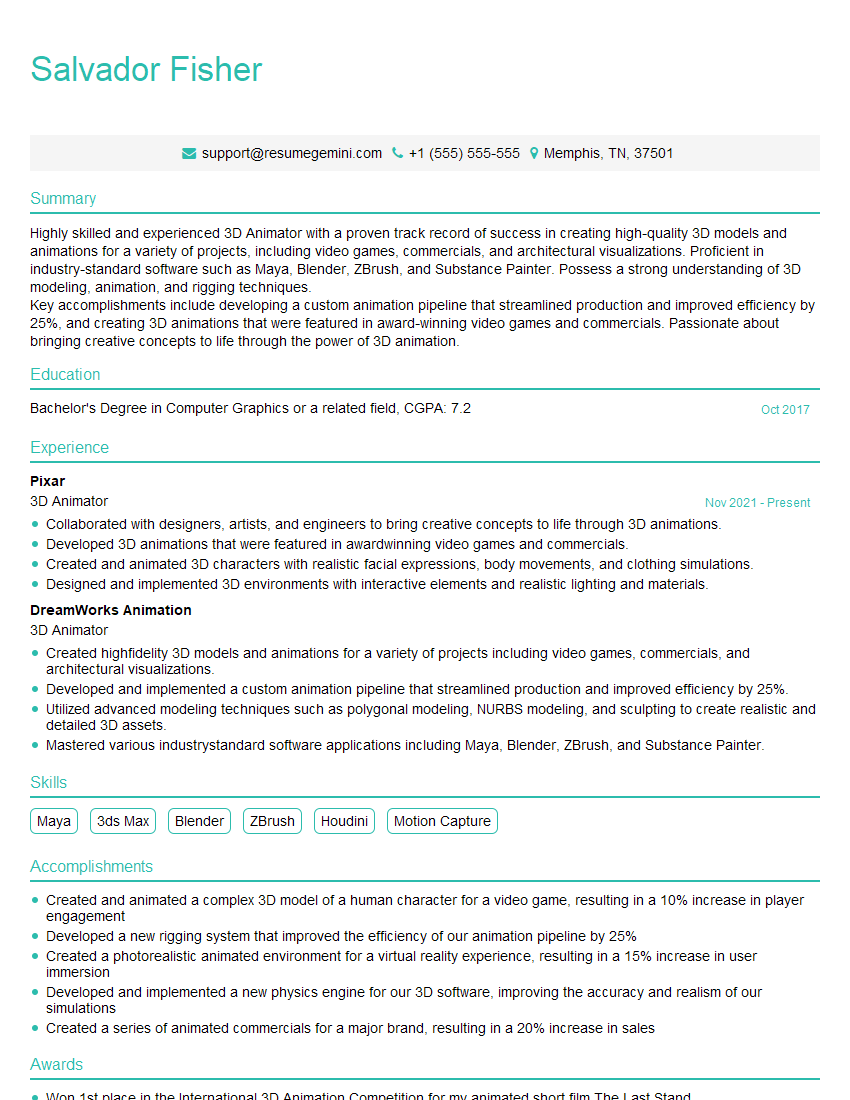
Mastering Character Animation in MotionBuilder and Maya is crucial for career advancement in the visual effects and animation industries, opening doors to exciting opportunities and collaborations. To maximize your job prospects, creating a strong, ATS-friendly resume is paramount. ResumeGemini is a trusted resource for building professional resumes that highlight your skills and experience effectively. Examples of resumes tailored to Character Animation (MotionBuilder, Maya) roles are available to help guide you.
Explore more articles
Users Rating of Our Blogs
Share Your Experience
We value your feedback! Please rate our content and share your thoughts (optional).
What Readers Say About Our Blog
Very informative content, great job.
good