Every successful interview starts with knowing what to expect. In this blog, we’ll take you through the top Characterization Techniques: SEM, AFM, XRD interview questions, breaking them down with expert tips to help you deliver impactful answers. Step into your next interview fully prepared and ready to succeed.
Questions Asked in Characterization Techniques: SEM, AFM, XRD Interview
Q 1. Explain the principle of operation of a Scanning Electron Microscope (SEM).
A Scanning Electron Microscope (SEM) works by scanning a focused beam of electrons across the surface of a sample. These electrons interact with the atoms in the sample, producing various signals that provide information about the sample’s surface topography, composition, and crystal structure. Think of it like a super-powered magnifying glass that uses electrons instead of light.
The interaction between the electrons and the sample generates several signals, including secondary electrons (SE), backscattered electrons (BSE), and X-rays. Secondary electrons are low-energy electrons emitted from the sample’s surface, providing high-resolution images of surface topography. Backscattered electrons are high-energy electrons that are reflected back from the sample, providing information about the sample’s composition, as heavier elements scatter more electrons. X-rays, generated through the interaction of the electrons with the sample’s atoms, are used for elemental analysis.
These signals are detected by detectors, and the information is processed to create images. The beam is scanned in a raster pattern, similar to how a television screen displays an image, building up a complete picture point by point.
Q 2. Describe the different imaging modes available in SEM and their applications.
SEM offers several imaging modes, each providing different information:
- Secondary Electron (SE) imaging: This mode provides high-resolution images of surface topography, showing surface details like texture, roughness, and fine structures. It’s ideal for visualizing features like cracks, pores, or surface modifications.
- Backscattered Electron (BSE) imaging: BSE imaging provides information about the sample’s composition. Heavier elements appear brighter than lighter elements, making it useful for identifying different phases or elemental variations within a sample. Think of it as a compositional map.
- Electron Backscatter Diffraction (EBSD): EBSD is a powerful technique that provides crystallographic information. By analyzing the diffraction patterns of backscattered electrons, we can determine the crystal orientation and structure of the sample. This is particularly valuable for studying materials like metals and minerals.
Applications: These imaging modes are used extensively in various fields including materials science (analyzing fracture surfaces, identifying phases in alloys), biology (imaging cells and tissues), nanotechnology (characterizing nanoparticles), and semiconductor technology (inspecting microelectronic devices).
Q 3. What are the advantages and disadvantages of SEM compared to other microscopy techniques?
Advantages of SEM over other microscopy techniques:
- High resolution: SEM provides significantly higher resolution than optical microscopy, allowing for the visualization of nanoscale features.
- Large depth of field: SEM images have a large depth of field, meaning more of the sample is in focus at once, providing a good overall view.
- Versatile imaging modes: As discussed, SEM offers different imaging modes providing information beyond simple topography.
- Elemental analysis: SEM can be coupled with energy-dispersive X-ray spectroscopy (EDS) for elemental analysis.
Disadvantages of SEM:
- Vacuum requirement: SEM requires a high vacuum environment, limiting the analysis of some samples, particularly hydrated or volatile ones.
- Sample preparation: Samples often require extensive preparation, which can be time-consuming and potentially alter the sample.
- Cost: SEM instruments are expensive to purchase and maintain.
- Charging effects: Non-conductive samples may suffer from charging, which can affect image quality.
Compared to other microscopy techniques like optical microscopy (limited resolution), Transmission Electron Microscopy (TEM; requires extremely thin samples), or AFM (limited imaging area in some modes), SEM provides a good balance between resolution, depth of field, and sample preparation, making it a versatile technique.
Q 4. How do you prepare a sample for SEM analysis?
Sample preparation for SEM is crucial for obtaining high-quality images. The method depends on the sample’s nature and the information sought. Key steps often include:
- Cleaning: Removing any dust or contaminants from the sample surface.
- Mounting: Attaching the sample to a suitable stub for SEM analysis. Conductive adhesives or double-sided carbon tape are commonly used.
- Coating (for non-conductive samples): Non-conductive samples are often coated with a thin layer of conductive material (e.g., gold, platinum) to prevent charging effects during imaging. This coating is done using a sputter coater.
- Sectioning or polishing (if necessary): For bulk samples, sectioning or polishing might be necessary to obtain a flat, smooth surface for analysis.
For example, if analyzing a fractured polymer, one might clean the sample with compressed air, mount it on a stub with conductive carbon tape, and then sputter coat it with gold before imaging to improve image quality.
Q 5. Explain the concept of depth of field in SEM imaging.
Depth of field in SEM refers to the range of distances from the sample that remain in acceptable focus in the image. A large depth of field means a greater portion of the sample is in sharp focus, providing a more three-dimensional appearance. Imagine taking a picture of a landscape; a large depth of field would keep both the foreground and the distant mountains sharp.
In SEM, the depth of field is inversely proportional to the magnification. At lower magnifications, the depth of field is greater, providing a broader view of the sample’s topography. As magnification increases, the depth of field decreases, resulting in a narrower region of focus. This is because higher magnifications use smaller electron beams which have a smaller depth of penetration.
Q 6. What are common artifacts observed in SEM images and how can they be minimized?
Several artifacts can affect the quality of SEM images. Common ones include:
- Charging: Non-conductive samples can accumulate charge from the electron beam, leading to image distortions, such as bright spots or uneven contrast.
- Beam damage: The electron beam can damage sensitive samples, altering their morphology or composition.
- Contamination: Sample contamination by residual hydrocarbons or other materials can lead to the appearance of spurious features in the image.
- Shadowing: Uneven surface topography can cause shadowing effects in the image, obscuring some details.
Minimizing artifacts:
- Coating non-conductive samples: This effectively prevents charging effects.
- Using low beam currents: Reducing the electron beam current can minimize beam damage to sensitive samples.
- Maintaining a clean environment: Working in a clean environment and regularly cleaning the SEM chamber helps to minimize contamination.
- Optimizing imaging parameters: Adjusting parameters like accelerating voltage and working distance can help reduce shadowing and other artifacts.
Q 7. Explain the principle of operation of an Atomic Force Microscope (AFM).
An Atomic Force Microscope (AFM) is a high-resolution scanning probe microscopy technique that uses a sharp tip at the end of a cantilever to scan the surface of a sample. The tip’s interaction with the surface is monitored, and this information is used to create images of the sample’s topography and other properties. Unlike SEM, which uses electrons, AFM uses a physical probe to ‘feel’ the surface.
The cantilever is typically made of silicon or silicon nitride and is usually microfabricated. As the tip scans the surface, it interacts with the sample through different forces: van der Waals forces, electrostatic forces, magnetic forces, or capillary forces, depending on the operating mode. These interactions deflect the cantilever, and the deflection is measured using a laser beam reflected from the back of the cantilever onto a photodiode. This deflection data is used to generate a 3D image of the surface, often at a nanometer scale.
AFM’s different modes (contact, tapping, non-contact) allow for various material properties to be investigated beyond just topography, such as stiffness, adhesion, friction and others.
Q 8. Describe different AFM modes (e.g., contact, tapping, non-contact) and their applications.
Atomic Force Microscopy (AFM) offers several modes of operation, each providing unique insights into sample properties. The three main modes are contact, tapping, and non-contact.
- Contact Mode: In contact mode, the AFM tip is in constant contact with the sample surface. The cantilever’s deflection, measured by a laser beam, provides information about the surface topography. This mode is straightforward and provides high resolution, but can be damaging to soft samples due to the continuous force applied. Application Example: Measuring the step height on a semiconductor wafer.
- Tapping Mode (Intermittent Contact): This mode minimizes tip-sample interaction by oscillating the cantilever at its resonant frequency. The tip intermittently touches the surface, reducing lateral forces and thus damage to soft samples. The amplitude of the oscillation changes with surface height, providing topographical information. Application Example: Imaging biological cells or polymers.
- Non-Contact Mode: In non-contact mode, the cantilever oscillates above the sample surface. Changes in the resonant frequency of the cantilever due to the interaction with the surface’s forces are used to create an image. This mode is ideal for very delicate or soft samples, minimizing damage, but offers lower resolution than contact or tapping modes. Application Example: Studying the surface properties of highly sensitive materials such as Langmuir-Blodgett films.
Choosing the appropriate AFM mode depends entirely on the sample’s characteristics and the information sought. If high resolution is paramount and sample robustness isn’t a concern, contact mode may be preferable. If minimizing damage is crucial, tapping or non-contact modes are recommended.
Q 9. What are the advantages and disadvantages of AFM compared to other surface characterization techniques?
AFM boasts unparalleled resolution at the nanoscale, allowing for visualization of individual atoms and molecules. This high resolution is a key advantage over other surface characterization techniques such as Scanning Electron Microscopy (SEM). However, AFM also has limitations.
- Advantages:
- High resolution: AFM can achieve sub-nanometer resolution, far surpassing SEM in this regard.
- Versatile imaging modes: AFM offers multiple modes to study different sample properties (topography, stiffness, friction, etc.).
- Works in various environments: AFM can operate in liquid or gaseous environments, opening possibilities for studying biological or chemical processes in situ.
- Disadvantages:
- Slower imaging speed: Compared to SEM, AFM is considerably slower, making large-area imaging time-consuming.
- Tip wear: AFM tips can wear down, requiring frequent replacement, adding to operational costs.
- Sample preparation: Sample preparation for AFM can be more challenging than for SEM, especially for delicate samples.
- Limited penetration depth: Unlike SEM, AFM provides information only about the surface layers.
The choice between AFM and other techniques, such as SEM or XRD, depends on the specific research question. For example, while SEM provides excellent surface morphology at a micrometer scale, AFM is necessary for high-resolution imaging at the nanoscale. XRD, on the other hand, is invaluable for determining crystal structure and phase composition.
Q 10. How do you prepare a sample for AFM analysis?
Sample preparation for AFM is crucial for obtaining high-quality images. The process depends heavily on the sample’s nature and the type of information sought. Here are some key considerations:
- Substrate selection: A flat, clean, and stable substrate is needed to avoid artifacts. Mica, silicon wafers, or glass are commonly used.
- Sample mounting: The sample should be firmly attached to the substrate, ensuring stability during scanning.
- Sample cleanliness: Dust or other contaminants can interfere with imaging. Careful cleaning is usually performed using appropriate solvents or methods, such as sonication or plasma cleaning.
- Conductivity considerations: For electrically conductive samples, grounding may be needed to avoid charging artifacts. For insulating samples, coating techniques can help reduce charging effects.
- Sample hydration: For biological samples, maintaining appropriate hydration is often critical.
In summary, sample preparation should always be tailored to the sample and the intended AFM experiment. Consultation of the literature related to the specific material and application is highly beneficial.
Q 11. What is a cantilever and how does it work in AFM?
The cantilever is a tiny, flexible beam (typically made of silicon or silicon nitride) with a sharp tip at its end. This tip acts as the probe, scanning across the sample surface.
In AFM, the cantilever’s deflection is measured using a laser beam reflected from its back. As the tip scans across the sample, the forces between the tip and the surface cause the cantilever to bend or deflect. This deflection is sensed by the laser and converted into a signal that represents the sample’s topography or other properties.
Think of it like a tiny diving board. The tip is the end of the board, and the sample is the water’s surface. The extent of bending (or deflection) shows how high or low the surface is.
Q 12. How is the resolution of AFM determined?
AFM resolution is not a single number, but rather depends on several factors:
- Tip radius: Smaller tip radii generally lead to higher resolution. The tip’s geometry directly limits how small a feature can be resolved.
- Cantilever stiffness: Stiffer cantilevers are less sensitive to smaller forces, resulting in lower resolution.
- Imaging mode: Contact mode generally provides higher lateral resolution than tapping or non-contact modes.
- Scan rate: Slower scan rates usually provide higher resolution.
- Data processing: Image processing techniques can significantly improve the apparent resolution of the acquired data.
Ultimately, AFM resolution is determined by the combined effects of all these factors. It’s not simply stated as ‘x nanometers’, but rather is described as a capability, for example, achieving atomic resolution under ideal conditions with a very sharp tip and appropriate cantilever.
Q 13. Explain the principle of X-ray Diffraction (XRD).
X-ray Diffraction (XRD) is a powerful technique for determining the crystallographic structure of materials. It relies on the constructive interference of X-rays scattered by the regularly spaced atoms within a crystal lattice.
A monochromatic beam of X-rays is directed at a crystalline sample. The atoms in the crystal lattice scatter the X-rays, and these scattered waves interfere with each other. If the path difference between the scattered waves is an integer multiple of the X-ray wavelength, constructive interference occurs, producing a diffraction peak. The angles at which these diffraction peaks occur are related to the spacing between the crystal planes.
By analyzing the positions and intensities of these diffraction peaks, one can determine the crystal structure, phase composition, crystallite size, and other important information about the material.
Q 14. What is Bragg’s Law and how is it used in XRD analysis?
Bragg’s Law is a fundamental equation in XRD that describes the condition for constructive interference of X-rays scattered from a crystal lattice.
The law states: nλ = 2d sinθ
nis an integer (order of reflection)λis the wavelength of the X-raysdis the interplanar spacing (distance between parallel crystal planes)θis the angle of incidence (angle between the incident X-ray beam and the crystal plane)
In XRD analysis, Bragg’s Law is used to determine the interplanar spacing (d) from the measured diffraction angles (θ) and the known X-ray wavelength (λ). This d-spacing then helps to identify the material’s crystal structure by comparison with known crystallographic databases.
For example, if you know the wavelength of your X-rays and measure the angle at which a diffraction peak occurs, you can calculate the d-spacing of the crystal planes responsible for that peak. By comparing this d-spacing to known values for different materials, you can identify the material.
Q 15. Describe different XRD techniques (e.g., powder diffraction, single-crystal diffraction).
X-ray diffraction (XRD) is a powerful technique used to characterize crystalline materials. It exploits the interaction of X-rays with the periodic arrangement of atoms in a crystal lattice. Two main techniques exist: powder diffraction and single-crystal diffraction.
Powder Diffraction: This method uses a sample consisting of many tiny, randomly oriented crystallites. The X-rays diffract from various crystallographic planes within these crystallites, producing a diffraction pattern of concentric rings (or arcs if the sample is not perfectly randomly oriented). This technique is ideal for analyzing polycrystalline materials, which are common in many industrial applications.
Single-Crystal Diffraction: This technique employs a single, well-formed crystal. The X-rays diffract from specific crystallographic planes, yielding a diffraction pattern of discrete spots. This method provides significantly more detailed information about the crystal structure, including unit cell parameters and atom positions. It’s crucial for determining the complete structure of a new material.
Think of it like this: powder diffraction is like looking at a sparkling, scattered pile of diamonds, while single-crystal diffraction is like carefully examining one perfect diamond under a microscope.
Career Expert Tips:
- Ace those interviews! Prepare effectively by reviewing the Top 50 Most Common Interview Questions on ResumeGemini.
- Navigate your job search with confidence! Explore a wide range of Career Tips on ResumeGemini. Learn about common challenges and recommendations to overcome them.
- Craft the perfect resume! Master the Art of Resume Writing with ResumeGemini’s guide. Showcase your unique qualifications and achievements effectively.
- Don’t miss out on holiday savings! Build your dream resume with ResumeGemini’s ATS optimized templates.
Q 16. How do you interpret an XRD pattern?
Interpreting an XRD pattern involves identifying the positions, intensities, and shapes of the diffraction peaks. The position of a peak is directly related to the spacing between crystallographic planes (d-spacing), which is determined by Bragg’s Law: nλ = 2d sinθ, where n is an integer, λ is the wavelength of the X-rays, d is the interplanar spacing, and θ is the diffraction angle.
The intensity of a peak is related to the number of atoms in the unit cell and their scattering factors. The peak shape provides information about the crystallite size and microstrain. By comparing the observed pattern with known patterns in databases (like the International Centre for Diffraction Data – ICDD), we can identify the phases present in the sample.
For instance, a sharp peak indicates a well-crystallized material, while a broad peak suggests small crystallite size or significant microstrain.
Q 17. What information can be obtained from XRD analysis (e.g., crystal structure, crystallite size, phase composition)?
XRD analysis provides a wealth of information about crystalline materials, including:
Crystal Structure: XRD can determine the crystal system (e.g., cubic, tetragonal, hexagonal), lattice parameters (unit cell dimensions), and space group (symmetry).
Crystallite Size: The broadening of diffraction peaks can be used to estimate the average size of the crystallites using the Scherrer equation. Smaller crystallites lead to broader peaks.
Phase Composition: By comparing the observed diffraction pattern with standard patterns, we can identify the different crystalline phases present in the sample. This is invaluable for determining the purity of a material or identifying the products of a chemical reaction.
Preferred Orientation: If the crystallites in the sample are not randomly oriented, but instead show a preference for certain orientations, this can be detected in the XRD pattern.
Residual Stress: Small shifts in the peak positions can indicate the presence of residual stress in the material.
Q 18. What are the limitations of XRD analysis?
Despite its power, XRD has some limitations:
Amorphous Materials: XRD is primarily sensitive to crystalline materials. Amorphous materials, lacking long-range order, produce only a diffuse halo rather than sharp diffraction peaks, making structural analysis challenging.
Small Quantities: Analyzing very small quantities of material can be difficult because the signal might be too weak.
Overlapping Peaks: In complex mixtures, overlapping peaks can make phase identification challenging.
Surface Sensitivity: XRD is a bulk technique, providing information about the entire sample rather than just the surface. Surface-sensitive information requires different techniques.
Instrument Limitations: The resolution and accuracy of the data are dependent on the quality of the instrument and experimental setup.
Q 19. How do you identify different phases in a material using XRD?
Identifying different phases in a material using XRD involves comparing the observed diffraction pattern with known patterns in databases such as the ICDD database (PDF-2). The positions and relative intensities of the diffraction peaks are used as a fingerprint to identify the phases present. Software packages can assist with this process by performing peak fitting, indexing, and comparing with the database.
For example, if a pattern shows peaks consistent with both quartz (SiO2) and calcite (CaCO3), one can conclude the sample is a mixture of those two phases. The relative intensities of the peaks can also provide information about the relative proportions of each phase.
Q 20. Explain the difference between SEM, AFM, and XRD techniques.
SEM, AFM, and XRD are all powerful characterization techniques, but they provide complementary information about materials:
SEM (Scanning Electron Microscopy): Provides high-resolution images of the surface morphology of materials, allowing visualization of surface features down to the nanometer scale. It can also be used for elemental analysis using techniques like EDS (Energy Dispersive Spectroscopy).
AFM (Atomic Force Microscopy): Provides even higher resolution imaging than SEM, capable of resolving individual atoms on a surface. It also measures surface properties such as roughness and stiffness.
XRD (X-ray Diffraction): Probes the internal crystalline structure of a material, providing information about crystal structure, phase composition, crystallite size, and preferred orientation. It is not a surface sensitive technique.
In short: SEM shows what a material looks like on the surface, AFM shows what it looks like at an atomic level on the surface, and XRD shows the internal crystal arrangement.
Q 21. What are the applications of SEM in materials science?
SEM finds wide application in materials science:
Microstructural Analysis: Examining the grain size, shape, and distribution in metals and alloys is critical for understanding their mechanical properties.
Fracture Analysis: Determining the cause of material failure through observation of fracture surfaces.
Particle Characterization: Analyzing the size, shape, and morphology of particles in powders, ceramics, and composites.
Surface Coating Analysis: Evaluating the thickness, uniformity, and adhesion of coatings.
Failure Analysis: Identifying defects, inclusions, or other anomalies in materials that may have contributed to failure.
For example, SEM can help determine if a crack in a metal component initiated at a particular grain boundary or due to the presence of an inclusion.
Q 22. What are the applications of AFM in nanotechnology?
Atomic Force Microscopy (AFM) is a powerful technique in nanotechnology because it allows for direct imaging and manipulation of materials at the nanoscale. Unlike electron microscopy, AFM doesn’t require a vacuum, making it suitable for studying biological samples and materials in their native environment.
- Surface Imaging: AFM can produce high-resolution images of surface topography, revealing features like steps, pits, and individual molecules. This is crucial for characterizing nanomaterials, thin films, and surface modifications.
- Nanomanipulation: AFM’s sharp tip can be used to move, scratch, or even write on surfaces at the nanoscale. This opens doors for nanolithography, creating nanoscale patterns for electronic devices or other applications.
- Mechanical Properties: Beyond imaging, AFM can measure material properties like stiffness, adhesion, and friction at a nanoscale level. This is essential for understanding the mechanical behavior of nanomaterials and their suitability for specific applications.
- Electrical Properties: Certain AFM modes (e.g., conductive AFM) can map the electrical properties of surfaces, revealing information about conductivity, charge distribution, and potential barriers. This is vital for the development of nanoscale electronic devices.
For example, AFM has been instrumental in characterizing the surface roughness of carbon nanotubes, which is crucial for their use in composites and electronics. It’s also used extensively in the study of DNA and protein structures, providing insights into their interactions and functions.
Q 23. What are the applications of XRD in material identification?
X-ray Diffraction (XRD) is a fundamental technique for identifying crystalline materials. It works by directing X-rays onto a sample and analyzing the diffraction pattern produced. Each crystalline material produces a unique diffraction pattern, like a fingerprint, allowing for its precise identification.
- Phase Identification: By comparing the measured diffraction pattern to a database of known materials (like the International Centre for Diffraction Data (ICDD) database), we can identify the phases present in a sample. This is critical in material science, geology, and many other fields.
- Crystal Structure Determination: XRD can reveal details about the crystal structure of a material, including its unit cell dimensions, symmetry, and atomic positions. This information is essential for understanding the material’s properties and behavior.
- Quantitative Phase Analysis: XRD can determine the relative amounts of different phases present in a mixture. This is useful in determining the composition of alloys, ceramics, and other multi-phase materials.
- Crystallite Size and Strain: The broadening of diffraction peaks can provide information about the average crystallite size and internal strain within the material.
For instance, XRD is used in the semiconductor industry to identify different phases during the growth of semiconductor crystals. It also helps geologists identify minerals in rock samples, providing valuable information about the geological history of a region.
Q 24. Describe a situation where you used SEM to solve a problem.
In a previous project, we were investigating the failure mechanism of a microelectronic device. The device exhibited intermittent electrical shorts, and we needed to pinpoint the root cause. Scanning Electron Microscopy (SEM) proved invaluable.
We used SEM to image the failed device’s surface at high magnification. We observed cracks in the metal interconnect lines, indicating that these cracks were causing the intermittent shorts. By using SEM’s high resolution and depth of field, we were able to locate very small cracks which were undetectable with other techniques. The energy-dispersive X-ray spectroscopy (EDS) capabilities integrated within our SEM provided elemental information, enabling us to identify the composition of the material surrounding the cracks which helps us understand the nature of the failure. This analysis allowed us to propose changes in the manufacturing process to reduce stress and prevent these failures in future devices.
Q 25. Describe a situation where you used AFM to solve a problem.
We once faced a challenge in understanding the nanoscale morphology of a newly synthesized polymer. Its properties were not as predicted, and we suspected it was related to its surface structure. AFM came to the rescue.
Using tapping mode AFM, we imaged the polymer’s surface at high resolution. We found unexpected nanoscale aggregates, which explained the deviations in its properties. The 3D images generated by the AFM provided clear visualization of the morphology, and we were able to analyze the size, distribution, and surface roughness of these aggregates. This information helped us modify the synthesis process to obtain a polymer with the desired properties by mitigating the aggregation. It helped in better understanding the relationship between polymer synthesis methods and resultant nano-scale properties.
Q 26. Describe a situation where you used XRD to solve a problem.
A pharmaceutical company was developing a new drug delivery system based on nanoparticles. They needed to confirm the crystalline structure of the drug within the nanoparticles to ensure its stability and bioavailability. XRD was the perfect solution.
We used XRD to analyze the nanoparticles. The resulting diffraction pattern revealed the crystalline structure of the drug, confirming its presence and its crystalline form. We also observed that the drug was well-dispersed within the nanoparticle matrix. Quantitative analysis also confirmed its relative amount within the nanoparticles. This information was critical for the company to proceed with further clinical trials, as it proved the stability and integrity of the drug delivery system.
Q 27. What software packages are you familiar with for analyzing SEM, AFM, and XRD data?
I am proficient in several software packages for analyzing SEM, AFM, and XRD data. For SEM, I regularly use ImageJ for image processing and analysis and AZtec software for EDS data analysis. For AFM, I use Gwyddion and SPIP for image analysis and quantification of surface parameters. Finally, for XRD, I use MDi, Jade and HighScore Plus for pattern indexing, phase identification, and crystal structure refinement. My experience also includes using proprietary software packages provided by the instrument manufacturers.
Q 28. How would you troubleshoot a problem encountered during SEM, AFM, or XRD analysis?
Troubleshooting microscopy and diffraction analysis requires a systematic approach. Here’s a general framework:
- Identify the problem: What is not working as expected? Are you getting no signal, poor resolution, artifacts, or inaccurate measurements?
- Check the basics: Make sure the equipment is properly calibrated and aligned. For SEM, this means verifying the vacuum, filament, and detectors. For AFM, this involves checking the cantilever and tip. For XRD, alignment, sample positioning and detector settings should be carefully reviewed. Verify sample preparation was done appropriately.
- Examine the sample: Is the sample properly prepared? Is it contaminated or damaged? SEM samples often require coating; AFM samples need to be clean and appropriately mounted. Poorly prepared XRD samples can lead to very misleading results.
- Review the settings: Are the instrument parameters (acceleration voltage, beam current, magnification, etc. for SEM; scan parameters for AFM; X-ray source and detector parameters for XRD) appropriate for the sample and the analysis being performed? Experiment with multiple parameter settings.
- Consult documentation: Refer to the manufacturer’s manuals and troubleshooting guides. Search online forums and literature for similar issues.
- Seek expert advice: If the problem persists, contact the instrument manufacturer’s support or consult with colleagues who have experience with these techniques.
For instance, if I encounter blurry images in SEM, I would systematically check the vacuum, the filament, the alignment, the detector, and the sample preparation. Similarly, if XRD peaks are broadened excessively, I would investigate factors such as crystallite size, strain and instrumental effects.
Key Topics to Learn for Characterization Techniques: SEM, AFM, XRD Interview
- Scanning Electron Microscopy (SEM):
- Principles of electron-sample interactions (backscattered electrons, secondary electrons).
- Sample preparation techniques for SEM (e.g., sputtering, coating).
- Image interpretation and analysis (morphology, composition).
- Applications in materials science, nanotechnology, and biology.
- Understanding limitations and artifacts in SEM imaging.
- Atomic Force Microscopy (AFM):
- Different AFM modes (contact, tapping, non-contact).
- Tip-sample interactions and force curves.
- Image processing and analysis (height, phase, amplitude).
- Applications in surface science, nanotechnology, and polymer science.
- Calibration and troubleshooting common AFM issues.
- X-ray Diffraction (XRD):
- Bragg’s Law and its application to crystal structure determination.
- Diffractometer operation and data acquisition.
- Phase identification and quantification using XRD patterns.
- Crystallite size and strain analysis using peak broadening.
- Applications in materials science, mineralogy, and pharmaceuticals.
- Comparative Analysis:
- Strengths and weaknesses of each technique.
- Choosing the appropriate technique for a given research question.
- Integrating data from multiple techniques for comprehensive characterization.
- Problem-Solving:
- Troubleshooting common issues encountered during experimentation.
- Interpreting complex data sets and drawing meaningful conclusions.
- Presenting results clearly and concisely in written and oral formats.
Next Steps
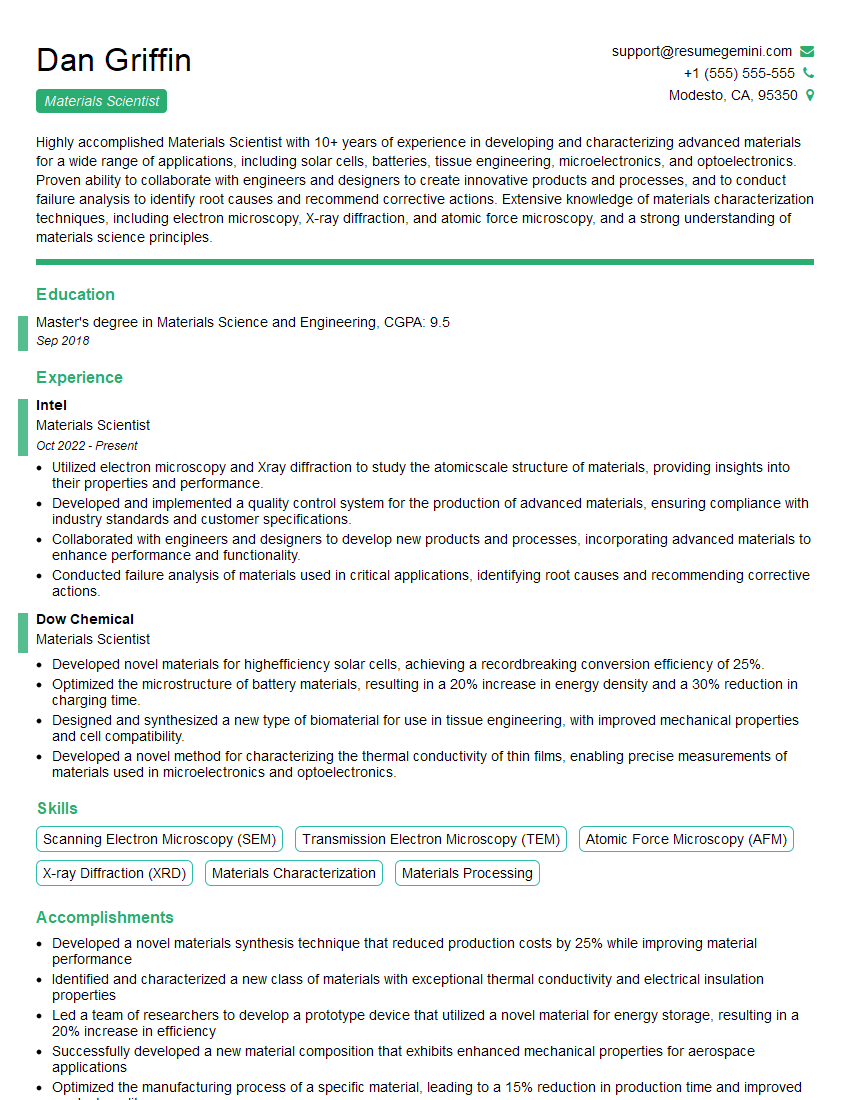
Mastering Characterization Techniques: SEM, AFM, and XRD is crucial for a successful career in materials science, nanotechnology, and related fields. These techniques are highly sought-after skills, opening doors to exciting research and development opportunities. To maximize your job prospects, create an ATS-friendly resume that effectively highlights your expertise. ResumeGemini is a trusted resource to help you build a professional and impactful resume. Examples of resumes tailored to Characterization Techniques: SEM, AFM, and XRD are available to guide you. Invest time in crafting a compelling resume – it’s your first impression!







Explore more articles
Users Rating of Our Blogs
Share Your Experience
We value your feedback! Please rate our content and share your thoughts (optional).
What Readers Say About Our Blog
Very informative content, great job.
good