Every successful interview starts with knowing what to expect. In this blog, we’ll take you through the top Choir Direction interview questions, breaking them down with expert tips to help you deliver impactful answers. Step into your next interview fully prepared and ready to succeed.
Questions Asked in Choir Direction Interview
Q 1. Describe your experience in selecting repertoire appropriate for different choir levels.
Selecting appropriate repertoire is crucial for a choir’s success and enjoyment. It’s about finding pieces that challenge singers while remaining accessible and engaging. My approach involves carefully considering the choir’s vocal range, technical abilities, and musical maturity.
For beginner choirs, I prioritize shorter pieces with simpler harmonies and rhythms, focusing on building foundational skills like breath control and tone production. Examples include unison songs with easy melodic contours or two-part rounds like ‘Row, Row, Row Your Boat’.
Intermediate choirs can handle more complex harmonies, longer phrases, and varied dynamics. I might choose pieces with gentle dissonance or more intricate rhythmic patterns.
Advanced choirs can tackle challenging works with complex polyphony, extended vocal ranges, and demanding musical textures. For these groups, I might select pieces from the Renaissance or Baroque periods or contemporary works with significant technical demands. The key is to always ensure a gradual progression of difficulty, building confidence and skill throughout the year. I frequently consult choral anthologies and resource books that cater to specific skill levels, and I always consider the individual voices within the choir when selecting pieces.
Q 2. How do you manage rehearsals efficiently and effectively?
Efficient and effective rehearsals are built upon meticulous planning and clear communication. I begin each rehearsal with a warm-up routine designed to prepare singers both vocally and mentally. This includes breathing exercises, vocalises, and simple rhythmic exercises.
Then, I break down the rehearsal into focused segments, tackling specific sections of a piece or working on particular technical aspects. For instance, I might dedicate one segment to improving diction, another to refining phrasing, and another to perfecting dynamic contrasts. I encourage active participation through regular sectionals and small group work, which allows for personalized feedback and targeted instruction.
Clear communication is essential. I explain my intentions, offer specific and actionable feedback, and foster a supportive learning environment. Regular assessments, such as short informal performances or recordings, provide valuable feedback and track progress. Finally, I end rehearsals with a brief cool-down and a clear outline of the next rehearsal’s focus. Time management is key; I always stick to a detailed schedule and avoid unnecessary repetition.
Q 3. Explain your approach to teaching sight-reading techniques to a choir.
Teaching sight-reading is a gradual process requiring patience and a structured approach. I begin by introducing fundamental rhythmic and melodic patterns using simple exercises. We start with simple solfège syllables or numbers to establish the melodic contour before introducing the notes on the staff.
Then, I introduce progressively more complex rhythms and melodies, ensuring that each new element is thoroughly understood before moving on. I often use rhythmic dictation exercises to develop rhythmic acuity and introduce techniques such as using ‘do’ as a reference pitch to build a sense of tonality.
I emphasize the importance of understanding the musical context, encouraging singers to anticipate melodic phrases and harmonic progressions. We use a variety of sight-reading materials, starting with simplified arrangements and gradually progressing to more complex scores. Regular practice and feedback are crucial; I often conduct short, focused sight-reading sessions during rehearsals. The goal is not perfection but rather the development of the ability to decode music quickly and efficiently.
Q 4. What strategies do you use to develop blend and balance within a choir?
Achieving blend and balance requires a multifaceted approach that involves careful attention to vocal technique, sectional work, and spatial arrangement. I begin by working with each section individually to ensure that each voice within the section is producing a consistent tone quality. This involves addressing issues of intonation, vowel formation, and breath support.
Once individual sections are balanced, I focus on blending them together. This often involves adjusting the balance between sections depending on the harmonic texture. For instance, a strong bass section might need to be encouraged to sing with a softer dynamic to balance with a lighter soprano section.
The physical arrangement of the choir also plays a role. I might adjust the seating arrangement to improve the projection of quieter sections or to create a more unified sound. I regularly use listening exercises, where different sections try to match the timbre and dynamic level of other sections. Regular feedback and recording sessions help identify and correct imbalances, gradually cultivating a cohesive and harmonious choral sound.
Q 5. How do you address vocal issues or technical challenges among singers?
Addressing vocal issues requires sensitivity, expertise, and a collaborative approach. I start by creating a safe and supportive environment where singers feel comfortable sharing concerns.
If a singer has a vocal problem, I first encourage them to consult with a qualified vocal specialist for diagnosis. I offer my observations, but I never attempt to offer medical advice.
Once a diagnosis is made (if needed), I work collaboratively with the singer and the specialist to develop a plan to manage the issue. This may involve modifying vocal technique, adapting repertoire, or adjusting rehearsal strategies to reduce strain. The focus is always on maintaining the singer’s vocal health while preserving their participation in the choir. I might use modified vocal exercises or adjust their vocal part to address their specific limitations.
Q 6. Describe your experience with conducting different choral styles (e.g., Renaissance, Baroque, contemporary).
Conducting different choral styles requires adapting one’s technique and interpretive approach to reflect the historical and stylistic characteristics of each period. For Renaissance music, I focus on clarity of articulation, precise intonation, and a sense of flowing, linear melody.
Baroque music often requires a more dynamic and expressive approach, with a focus on ornamentation and rhythmic vitality. I might use a more assertive conducting style to convey the drama and grandeur of the music.
Contemporary choral music necessitates a thorough understanding of the composer’s intentions and stylistic preferences. I might collaborate closely with the composer to gain insights into their vision for the piece. Adaptability and versatility are key to successfully conducting diverse choral styles, from the elegant formality of Renaissance polyphony to the rhythmic energy of contemporary works.
Q 7. How do you assess the vocal capabilities of singers during auditions?
Auditions provide a valuable opportunity to assess the vocal capabilities of singers and their suitability for the choir. I begin by asking singers to sing a prepared piece of their choice, allowing me to assess their vocal technique, tone quality, intonation, and musicality.
Then, I might ask them to sing a simple vocalise or a short sight-reading exercise to gauge their vocal agility and ability to read music. I listen for things like vocal range, breath control, and overall musicality. I also observe their posture, confidence, and overall attitude.
The goal is not to create a choir of technically perfect singers, but rather a group of singers who are passionate, dedicated, and work well together. My approach is always to be supportive and encouraging, focusing on the singers’ strengths and potential for growth. The audition is not just a test, but also a chance to build a strong rapport with prospective singers.
Q 8. What techniques do you use to maintain discipline and enthusiasm during rehearsals?
Maintaining discipline and enthusiasm in choir rehearsals requires a delicate balance. It’s not about rigid control, but fostering a positive and productive environment. My approach is multifaceted:
Clear Expectations: From the outset, I clearly communicate expectations regarding attendance, punctuality, preparedness (knowing music beforehand), and respectful behavior. This sets a foundation for a disciplined rehearsal process. I use a combination of verbal instruction and written rehearsal schedules distributed in advance.
Positive Reinforcement: I focus on celebrating successes, both large and small. Praising individual and group achievements boosts morale and motivates singers to strive for excellence. A simple “That was beautiful!” or a specific comment about technique goes a long way.
Constructive Feedback: When addressing errors, I prioritize constructive feedback, focusing on the ‘how’ rather than simply stating ‘wrong’. For example, instead of saying, “That was flat,” I might say, “Let’s try to support that note with a deeper breath and engage your diaphragm more.”
Varied Rehearsal Techniques: I incorporate games, movement activities, and informal discussions to break up the intensity and prevent monotony, keeping rehearsals engaging and preventing burnout. This is especially important for longer sessions.
Open Communication: I encourage open communication. I create a safe space where singers feel comfortable expressing concerns or suggestions. Regular check-ins help gauge morale and address any emerging issues proactively.
Q 9. Explain your approach to working with singers of different skill levels and musical backgrounds.
Working with singers of diverse skill levels and backgrounds is a rewarding challenge that requires adaptability. My approach involves:
Differentiated Instruction: I tailor my instruction to meet the needs of each individual. This might involve providing extra support to less experienced singers while offering more challenging exercises to advanced singers. I might use smaller group sessions or one-on-one coaching during rehearsals to address specific skill gaps.
Sectionals: I frequently work with sections (sopranos, altos, tenors, basses) separately. This allows me to provide focused attention to each section’s unique challenges and develop a cohesive sound across the ensemble. It also provides a sense of belonging and ownership within each voice part.
Positive Peer Learning: I create opportunities for singers to learn from one another. More experienced singers can mentor newer ones, fostering a supportive and collaborative environment. This can be as simple as pairing a more experienced singer with someone newer during sectional rehearsals.
Gradual Progression: I introduce new material gradually, building upon singers’ existing skills. This prevents overwhelming beginners while keeping more advanced singers engaged. We might start with simpler arrangements and gradually work towards more challenging repertoire.
Celebrating Differences: I embrace the diversity of backgrounds and musical experiences. I encourage singers to share their unique perspectives and insights, enriching the ensemble’s overall performance and enriching the learning experience for everyone.
Q 10. How do you adapt your rehearsal techniques to accommodate diverse learning styles?
Accommodating diverse learning styles requires a multifaceted approach that goes beyond simply presenting information. I utilize various strategies to cater to visual, auditory, and kinesthetic learners:
Visual Aids: I use scores, diagrams, videos, and other visual aids to support my instruction. This is particularly helpful for visual learners who benefit from seeing the music or observing the physical aspects of singing technique.
Auditory Learning: I frequently use listening exercises, focusing on tonal quality, rhythm, and phrasing. I might play recordings of professional choirs or specific sections to highlight exemplary performances and give a benchmark for the ensemble. I use aural exercises to help develop the students’ listening skills, which are essential to blend and harmonize effectively.
Kinesthetic Learning: I incorporate movement activities and physical exercises to enhance understanding and engagement. This helps kinesthetic learners (those who learn best through movement) connect with the music on a physical level. I often use physical gestures to illustrate musical concepts like dynamics and phrasing.
Multi-Sensory Approach: I combine these methods, understanding that most individuals learn through a blend of senses. For example, while explaining the dynamics of a piece, I’d demonstrate with physical gestures, explain the markings on the score, and play back sections emphasizing the dynamic contrasts.
Q 11. Describe your experience with preparing a choir for a performance.
Preparing a choir for a performance involves a systematic and comprehensive approach. It’s a journey that begins well before the performance date. My process typically includes:
Repertoire Selection: Careful selection of repertoire is crucial. I consider the choir’s skill level, vocal range, and the desired performance style. The chosen pieces should showcase their strengths and challenge them appropriately.
Detailed Rehearsal Plan: I create a detailed rehearsal schedule outlining specific goals for each session. This ensures a focused and efficient rehearsal process, tracking progress on individual sections and overall piece mastery.
Technical Refinement: A significant portion of rehearsals is dedicated to refining technical aspects – vocal technique, intonation, diction, and blending. We address common challenges such as breath control, resonance, and phrasing.
Musical Interpretation: I guide singers toward a cohesive and expressive musical interpretation. We explore the emotional nuances of the music and discuss the composer’s intent and historical context. This fosters a deeper understanding and connection with the music.
Performance Practice: As the performance date approaches, we conduct full run-throughs under simulated performance conditions. This helps build confidence and reduces performance anxiety. We focus on stage presence and address any technical or interpretative issues.
Dress Rehearsal: A full dress rehearsal, preferably in the performance venue, is essential. This helps singers get used to the acoustics and address any logistical considerations.
Q 12. How do you handle conflict or disagreements among singers?
Handling conflict or disagreements among singers requires diplomacy and a focus on resolving issues constructively. My approach involves:
Active Listening: I create a space for all involved to express their perspectives without interruption. I actively listen to understand their concerns and the root cause of the conflict.
Mediation: I act as a mediator, guiding singers towards a mutually acceptable solution. I help them identify common ground and find ways to collaborate effectively.
Focus on Shared Goals: I remind singers of their shared goal – creating a beautiful and successful performance. This helps redirect their focus towards collaboration rather than conflict.
Fairness and Impartiality: I strive to be fair and impartial, treating all singers with respect and understanding. This is crucial to maintain trust and build a positive environment.
Private Conversations: If necessary, I address individual concerns in private conversations, fostering a more open and supportive dialogue. I might address persistent negative behaviours individually to help address the root cause.
Sometimes, if a conflict is unresolvable or disrupts the group’s dynamics significantly, I might need to make difficult decisions regarding personnel.
Q 13. How do you incorporate technology (e.g., recording software, notation programs) into your choral work?
Technology plays a significant role in my choral work, enhancing efficiency and artistic expression:
Recording Software: I use recording software (e.g., Audacity, Logic Pro) to capture rehearsals and performances. This allows for detailed analysis of vocal technique, intonation, and balance. Singers can listen back and identify areas for improvement. It also provides a valuable record of progress.
Notation Software: I utilize notation software (e.g., Sibelius, Finale) to create and edit scores, create customized arrangements, and prepare personalized practice materials for singers. This allows for greater flexibility and precision in preparing repertoire.
Video Conferencing: For geographically dispersed choirs or to reach individual singers for coaching, video conferencing (e.g., Zoom, Google Meet) allows for remote rehearsals and personalized instruction. This expands the possibilities of working with singers in different locations.
Audio Playback: I use audio playback during rehearsals to demonstrate correct phrasing, dynamics, and articulation. This allows for detailed demonstration of musical examples, particularly useful for complex pieces.
Q 14. What are your strategies for fundraising or securing resources for a choir?
Securing resources for a choir requires a multi-pronged approach encompassing various fundraising and grant-seeking strategies:
Grant Applications: I research and apply for grants from arts councils, foundations, and corporate sponsors. Strong proposals highlighting the choir’s artistic merit, community impact, and financial needs are crucial.
Fundraising Events: Organizing concerts, recitals, and other fundraising events are effective ways to generate revenue. These events also provide valuable performance opportunities.
Individual Donations: Cultivating relationships with individual donors and encouraging regular contributions helps create a sustainable funding base. I use different platforms and communication channels to maintain a transparent relationship with our donors and ensure they feel valued.
Corporate Sponsorships: I approach local businesses and corporations seeking sponsorships in exchange for recognition and advertising opportunities. This establishes mutually beneficial relationships.
Membership Fees: Depending on the choir structure, establishing appropriate membership fees can contribute to operating costs and sustainability. I ensure fair pricing aligned with the value proposition of the choir.
Q 15. How do you build rapport and trust with your singers?
Building rapport and trust with singers is foundational to successful choir direction. It’s about creating a safe and encouraging environment where everyone feels valued and respected. This goes beyond simply being friendly; it involves active listening, empathy, and consistent positive reinforcement.
- Open Communication: I foster open dialogue, encouraging singers to share their concerns and feedback. This might involve regular informal chats before or after rehearsals, or dedicated feedback sessions.
- Individual Attention: I make an effort to learn each singer’s name and something personal about them. Remembering their preferences, challenges, and strengths shows I care about them as individuals, not just as voices in a choir.
- Positive Reinforcement: I focus on celebrating successes, both big and small. Instead of dwelling on mistakes, I emphasize progress and offer constructive criticism in a supportive manner. A simple ‘well done’ or specific praise for technique can go a long way.
- Fairness and Consistency: Maintaining fairness in assigning parts, opportunities for solos, and providing feedback builds trust. Consistency in expectations and rehearsal structure provides a sense of stability and predictability.
- Shared Goals: Clearly articulating the choir’s artistic vision and involving singers in setting goals creates a sense of shared purpose and collective achievement.
For instance, I once had a shy alto who was hesitant to participate fully. By taking the time to chat with her individually, understanding her apprehension, and offering gentle encouragement, I helped her gain confidence and become a valuable contributor to the choir.
Career Expert Tips:
- Ace those interviews! Prepare effectively by reviewing the Top 50 Most Common Interview Questions on ResumeGemini.
- Navigate your job search with confidence! Explore a wide range of Career Tips on ResumeGemini. Learn about common challenges and recommendations to overcome them.
- Craft the perfect resume! Master the Art of Resume Writing with ResumeGemini’s guide. Showcase your unique qualifications and achievements effectively.
- Don’t miss out on holiday savings! Build your dream resume with ResumeGemini’s ATS optimized templates.
Q 16. Explain your understanding of vocal anatomy and physiology.
A strong understanding of vocal anatomy and physiology is crucial for effective choir direction. It allows me to identify potential issues, suggest appropriate exercises, and ensure singers use their voices healthily.
- Respiratory System: I understand the importance of breath support – the diaphragm, intercostal muscles, and abdominal muscles working together to provide a steady stream of air. Poor breathing can lead to strained voices or breathiness.
- Larynx and Vocal Folds: I know the larynx houses the vocal folds (vocal cords), which vibrate to produce sound. I understand how tension and relaxation affect vocal fold vibration, and how to encourage healthy vocal fold closure for a clear, resonant tone.
- Resonance: I understand how sound resonates in the vocal tract (pharynx, mouth, and nasal cavity), influencing timbre and projection. I guide singers in using these resonating chambers effectively for a fuller, richer sound.
- Articulators: I’m familiar with the role of the tongue, lips, jaw, and soft palate in shaping vowels and consonants – clear articulation is essential for intelligibility.
This knowledge informs my warm-ups, exercises, and individual coaching. For example, if a singer is experiencing vocal fatigue, I can assess their breathing technique and suggest exercises to improve breath support and reduce strain on their vocal folds.
Q 17. Describe your experience with vocal warm-ups and exercises.
Vocal warm-ups and exercises are non-negotiable in my choral rehearsals. They prepare singers physically and vocally, preventing injury and enhancing performance.
- Humming and Lip Trills: These gentle exercises relax the vocal folds and warm up the voice without strain.
- Scales and Arpeggios: These develop vocal range, flexibility, and intonation. I vary the rhythm and dynamics to keep it engaging.
- Tongue Trills and Syllable Exercises: These improve articulation and agility.
- Breathing Exercises: I incorporate deep breathing exercises to improve breath control and support.
- Vocalises: These are melodic exercises designed to improve vocal technique and blend. I tailor these to the specific demands of the repertoire.
I always start with gentle exercises and gradually increase the intensity. I also monitor singers for signs of strain and adjust the exercises accordingly. For example, if I notice a singer struggling with high notes, I might focus on exercises that target their upper register gradually, avoiding pushing them too hard.
Q 18. How do you incorporate musical theory and analysis into your choral rehearsals?
Musical theory and analysis are integral to my choral work. They provide a framework for understanding the music we perform and achieving a higher level of musicality.
- Harmony and Counterpoint: I explain the harmonic structure of the piece, highlighting voice leading and counterpoint to ensure the choir understands the relationships between the different parts.
- Form and Structure: We analyze the musical form (e.g., sonata form, rondo), identifying key sections and transitions. This allows singers to understand the overall architecture of the piece and interpret it effectively.
- Melody and Rhythm: I use rhythmic exercises and melodic dictation to develop rhythmic accuracy and melodic precision.
- Dynamics and Expression: We analyze the composer’s markings for dynamics and expression, discussing how to interpret these markings to convey the emotion and meaning of the music.
For instance, when working on a complex Bach choral piece, I might spend time dissecting the contrapuntal lines, explaining how the different voices intertwine and create a richer harmonic texture. This understanding helps singers appreciate the music’s complexity and perform it with greater accuracy and expressiveness.
Q 19. What is your philosophy of choral singing?
My philosophy of choral singing centers around creating a cohesive and expressive ensemble that embodies both technical excellence and artistic integrity. It’s about more than just hitting the right notes; it’s about conveying the emotion and meaning behind the music.
- Collaboration: I believe in a collaborative approach, where singers feel empowered to contribute their ideas and interpretations.
- Musicality: I strive to cultivate musicality in every aspect of our singing – phrasing, dynamics, articulation, and tone.
- Ensemble Blend: Achieving a beautiful and unified blend of voices is a priority. I work on balance, intonation, and diction to achieve a cohesive sound.
- Emotional Depth: I encourage singers to connect with the music on an emotional level, bringing their own unique experiences and interpretations to their performance. This creates more compelling and authentic performances.
- Lifelong Learning: I encourage continuous learning and growth, both technically and artistically. This may involve attending workshops, masterclasses, or studying new repertoire.
Ultimately, my goal is to create a choir that not only performs beautifully but also inspires and moves its audience.
Q 20. How do you evaluate the progress of your choir?
Evaluating the choir’s progress is an ongoing process, not a single event. I use a multi-faceted approach to assess our development.
- Regular Rehearsals and Feedback: Throughout rehearsals, I provide regular feedback on intonation, rhythm, balance, and phrasing. This allows me to address issues promptly and monitor progress.
- Informal Assessments: I observe singers during rehearsals, noting their individual progress and the choir’s overall development.
- Formal Performances: Performances offer a crucial opportunity to evaluate the choir’s progress in a real-world setting. I use recordings and audience feedback to identify areas for improvement.
- Self-Assessment: I encourage singers to engage in self-assessment, reflecting on their individual progress and identifying their areas of strength and weakness.
- Data Tracking: I might track attendance, participation levels, and progress on specific technical aspects to identify trends and patterns.
By combining these methods, I gain a comprehensive understanding of the choir’s progress, allowing me to adjust our rehearsal plans and focus on areas needing further development.
Q 21. Describe your approach to coaching individual singers.
Coaching individual singers is crucial for addressing specific needs and improving the overall choir’s performance. My approach is tailored to the individual’s strengths and weaknesses.
- Active Listening: I begin by carefully listening to the singer, identifying the areas where they need improvement.
- Targeted Exercises: I design specific exercises to address those weaknesses. This might involve breathing exercises, vocalises, or articulation drills.
- Positive Feedback and Encouragement: I emphasize positive reinforcement, focusing on the singer’s strengths and providing constructive criticism in a supportive manner.
- Visual Aids: I might use visual aids such as diagrams or videos to illustrate vocal techniques.
- Collaboration: I work closely with the singer, creating a collaborative environment where they feel comfortable sharing their thoughts and concerns.
For example, if a singer struggles with breath support, I would guide them through specific breathing exercises, explaining the mechanics of proper breathing and demonstrating the correct posture. I might also have them sing short phrases, focusing on sustained breath and controlled airflow. I’d celebrate their progress and offer constructive feedback to improve their technique.
Q 22. How do you manage the administrative tasks associated with choir direction?
Managing the administrative tasks of a choir involves a blend of organization, technology, and communication. It’s like running a small business, but with the added joy of music! I use a combination of digital tools and traditional methods.
Digital Tools: I utilize online scheduling platforms like Google Calendar or Calendly for rehearsals and events, cloud-based storage services (like Google Drive or Dropbox) to share music scores, announcements and important documents, and email lists to send out mass communications to the choir members.
Traditional Methods: I maintain a physical filing system for crucial documents that require a paper trail, like membership rosters and financial records. Regular choir meetings, even brief ones, can address logistical issues directly and foster a sense of community.
Delegation: Whenever possible, I delegate tasks. For example, a trusted member might handle attendance tracking or assist with the organization of social events.
Budgeting and Fundraising: I create and manage a budget, seeking grants or organizing fundraising events to cover expenses like sheet music, performance venue rentals, and travel.
By combining these methods, I ensure all administrative tasks run smoothly, leaving me more time to focus on the musical aspects of leading the choir.
Q 23. What are your strategies for recruiting and retaining members in a choir?
Recruiting and retaining choir members requires a multi-pronged approach focusing on creating a welcoming and rewarding experience. It’s about building a community as much as it is about the music itself.
Recruitment: I utilize a variety of methods. This includes word-of-mouth referrals, social media campaigns (Facebook, Instagram), flyers in community centers, collaborations with local schools and colleges, and participation in local events. I always highlight the choir’s unique qualities and the fun, collaborative nature of the group.
Retention: Creating a positive and inclusive atmosphere is key. This involves valuing each singer’s contribution, providing opportunities for leadership and development, organizing social events to foster camaraderie, offering varied repertoire to keep things interesting, and providing constructive feedback in a supportive manner. Regular communication keeps everyone informed and engaged.
Addressing Challenges: Addressing conflicts or issues promptly and fairly is essential. Open communication channels and a commitment to resolving problems collaboratively are crucial for maintaining a harmonious group.
Ultimately, building a strong choir is about creating a community where singers feel valued, supported, and challenged – resulting in higher retention rates.
Q 24. How do you handle criticisms or negative feedback?
Handling criticisms or negative feedback is crucial for growth and improvement. My approach is to listen actively, respond thoughtfully, and focus on constructive solutions.
Active Listening: I carefully listen to the feedback without interrupting, aiming to understand the perspective of the person offering the critique. I ask clarifying questions to ensure I fully grasp their concerns.
Thoughtful Response: I acknowledge their feedback, expressing gratitude for their input. I avoid becoming defensive and focus on what I can learn from the criticism.
Constructive Solutions: I explore ways to address the concerns raised. This may involve adjustments to rehearsal techniques, repertoire choices, or communication strategies. If the feedback is valid, I make appropriate changes and explain my reasoning to the choir.
Professional Boundaries: While I value feedback, I maintain professional boundaries. Unconstructive criticism or personal attacks are addressed privately and respectfully, and if necessary, further action may be taken.
By handling criticism constructively, I transform negative experiences into opportunities for improvement and strengthen the choir’s overall dynamics.
Q 25. How do you ensure the safety and well-being of your singers?
Ensuring the safety and well-being of my singers is paramount. It’s about creating a physically and emotionally safe environment.
Physical Safety: This includes providing a safe performance space, ensuring adequate lighting and ventilation, and being mindful of potential hazards during rehearsals and performances. I also ensure that all equipment is safely handled and properly maintained.
Emotional Well-being: I cultivate a supportive and inclusive environment where every singer feels respected and valued. I address any bullying or harassment immediately and decisively. I am also attentive to signs of stress or burnout among choir members and encourage them to seek help if needed.
Health Considerations: I promote healthy vocal habits by emphasizing proper breathing techniques, hydration, and vocal rest. I am aware of the physical demands of singing and adjust rehearsals as needed to prevent injuries.
Emergency Preparedness: Having a clear emergency plan, including contact information for emergency services and designated personnel, is crucial. This plan is reviewed and updated regularly.
By prioritizing safety and well-being, I create a positive and productive environment where singers can thrive.
Q 26. What is your experience with different microphone techniques and sound reinforcement in choral settings?
My experience with microphone techniques and sound reinforcement in choral settings is extensive. Proper microphone placement and sound reinforcement are crucial for a successful choral performance.
Microphone Types: I’m familiar with various microphone types – cardioid, hypercardioid, omnidirectional – and understand their optimal use in different choral arrangements. For instance, cardioid mics are excellent for isolating individual sections, while omni-directional mics are better for capturing a more blended sound.
Microphone Placement: Strategic microphone placement is key. This depends on the size of the choir, the acoustics of the space, and the desired balance between sections. Overlapping microphones may be necessary for large choirs to achieve a balanced sound. Careful attention must be paid to minimizing feedback.
Sound Reinforcement Systems: I understand how to work with various sound reinforcement systems, including mixers, equalizers, and compressors, to achieve optimal sound quality. I’m adept at troubleshooting common sound issues and adjusting levels to ensure clarity and balance.
Practical Experience: I have extensive experience working with sound engineers and have personally managed sound reinforcement for numerous choral performances in diverse venues. This experience allows me to communicate effectively with sound engineers to achieve a desirable sound.
My expertise in this area ensures that the choir’s sound is clear, balanced, and impactful for the audience.
Q 27. How do you create a positive and inclusive environment for your choir?
Creating a positive and inclusive environment is the cornerstone of a successful choir. It’s about building a community where everyone feels welcomed, respected, and valued for their unique contributions.
Welcoming Atmosphere: I strive to create a welcoming and supportive atmosphere from the first rehearsal. This involves actively engaging with each member, learning their names and backgrounds, and fostering a sense of camaraderie.
Diversity and Inclusion: I actively encourage diversity within the choir, valuing different musical backgrounds, vocal types, ages, and cultural experiences. I ensure that the repertoire selected reflects this diversity and provides opportunities for singers of all skill levels to shine.
Respectful Communication: I promote respectful communication among choir members and foster a culture of constructive feedback. I address any instances of bullying, harassment, or discrimination immediately and decisively.
Shared Goals: I emphasize shared goals, focusing on the collective achievement of musical excellence. This sense of shared purpose unites the choir and fosters a strong sense of community.
By prioritizing inclusivity and fostering a positive atmosphere, I create an environment where every singer feels empowered and inspired to contribute their best to the choir.
Q 28. Describe a time you had to adapt your plans due to unforeseen circumstances in a rehearsal or performance.
During a performance of Handel’s Messiah, our scheduled soprano soloist fell ill just hours before the concert. This required immediate improvisation and adaptation.
Problem Identification: The immediate challenge was finding a replacement soloist capable of performing the demanding arias with little rehearsal time.
Solution Generation: I swiftly contacted several trusted colleagues and former members of the choir, exploring their availability and vocal capabilities. Fortunately, a highly capable soprano was available.
Implementation and Adaptation: We quickly organized a run-through with the replacement soloist, focusing on the key arias. I adapted the rehearsal schedule to accommodate this unexpected change, prioritizing the crucial sections.
Result: Despite the unforeseen circumstances, the performance went exceptionally well thanks to the quick thinking and cooperation of the replacement soloist and the choir. The audience was unaware of the last-minute change.
This experience reinforced the importance of adaptability, resourcefulness, and strong communication in navigating unexpected challenges within choir direction.
Key Topics to Learn for Your Choir Direction Interview
- Vocal Technique & Pedagogy: Understanding various vocal techniques, including breath support, resonance, and articulation, and how to effectively teach these to singers of different skill levels.
- Rehearsal Techniques & Strategies: Mastering efficient and engaging rehearsal methods, including warm-ups, sectionals, and full choir rehearsals; developing strategies for addressing individual and group challenges.
- Score Reading & Analysis: Demonstrating proficiency in reading and interpreting musical scores, identifying compositional elements, and conveying the composer’s intent to the choir.
- Program Planning & Selection: Articulating your approach to creating balanced and engaging concert programs, considering repertoire selection, audience engagement, and artistic goals.
- Choir Management & Administration: Understanding the practical aspects of managing a choir, including auditions, scheduling, budgeting, and communication with singers and stakeholders.
- Conducting Technique & Baton Skills: Demonstrating clear and effective conducting techniques, including precise beat patterns, phrasing, dynamics, and communication with the choir.
- Aural Skills & Sight-Singing: Highlighting your strong aural skills, including sight-singing, dictation, and ear training, essential for guiding singers accurately.
- Problem-Solving & Conflict Resolution: Describing your experience in addressing challenges within a choir setting, such as managing conflicts, addressing vocal issues, or motivating singers.
- Musical History & Theory: Demonstrating a foundational knowledge of music history and theory relevant to the choral repertoire, enabling informed program choices and insightful interpretations.
- Collaboration & Communication: Explaining your collaborative approach to working with musicians, administrators, and other stakeholders to achieve shared artistic goals.
Next Steps
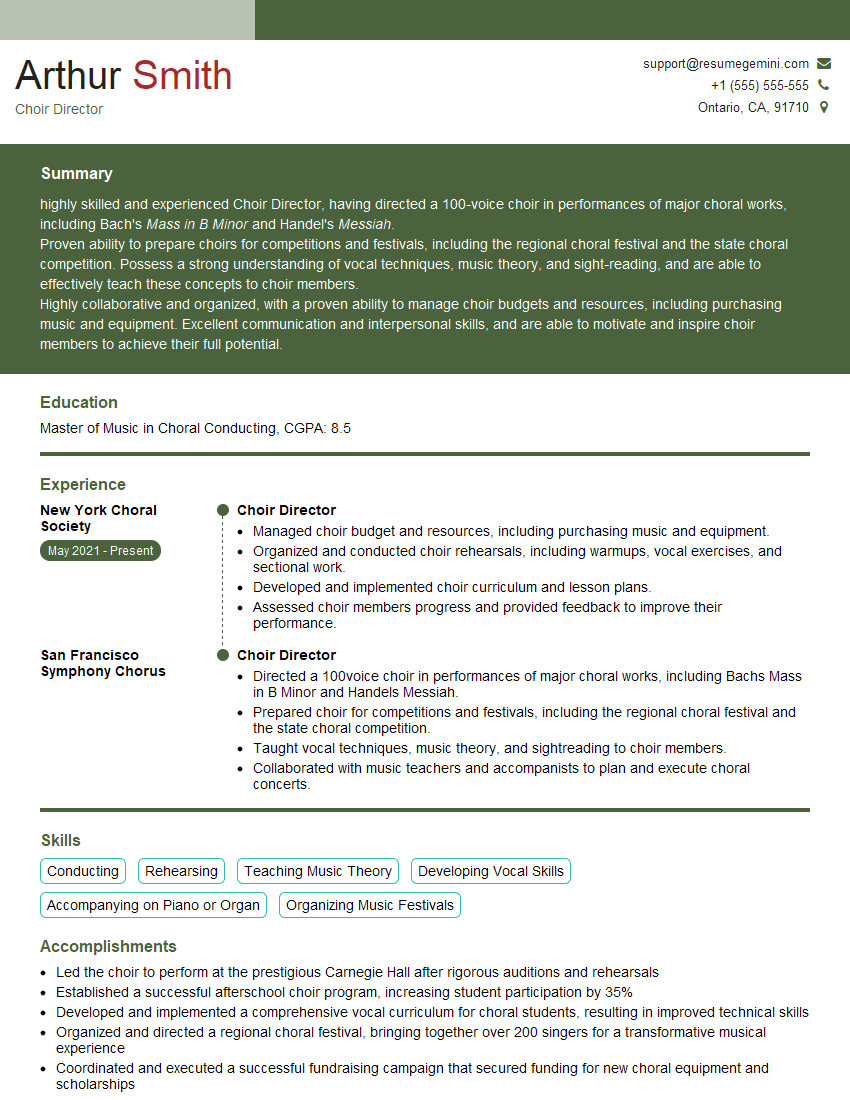
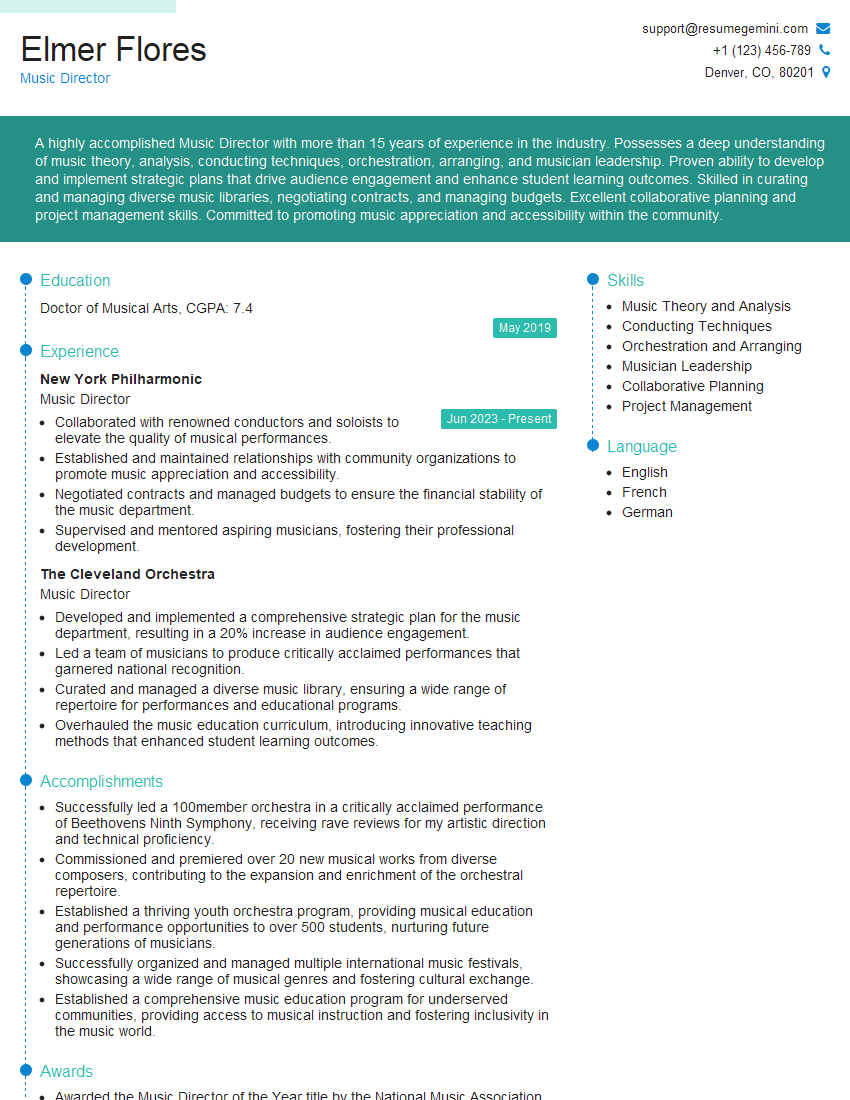
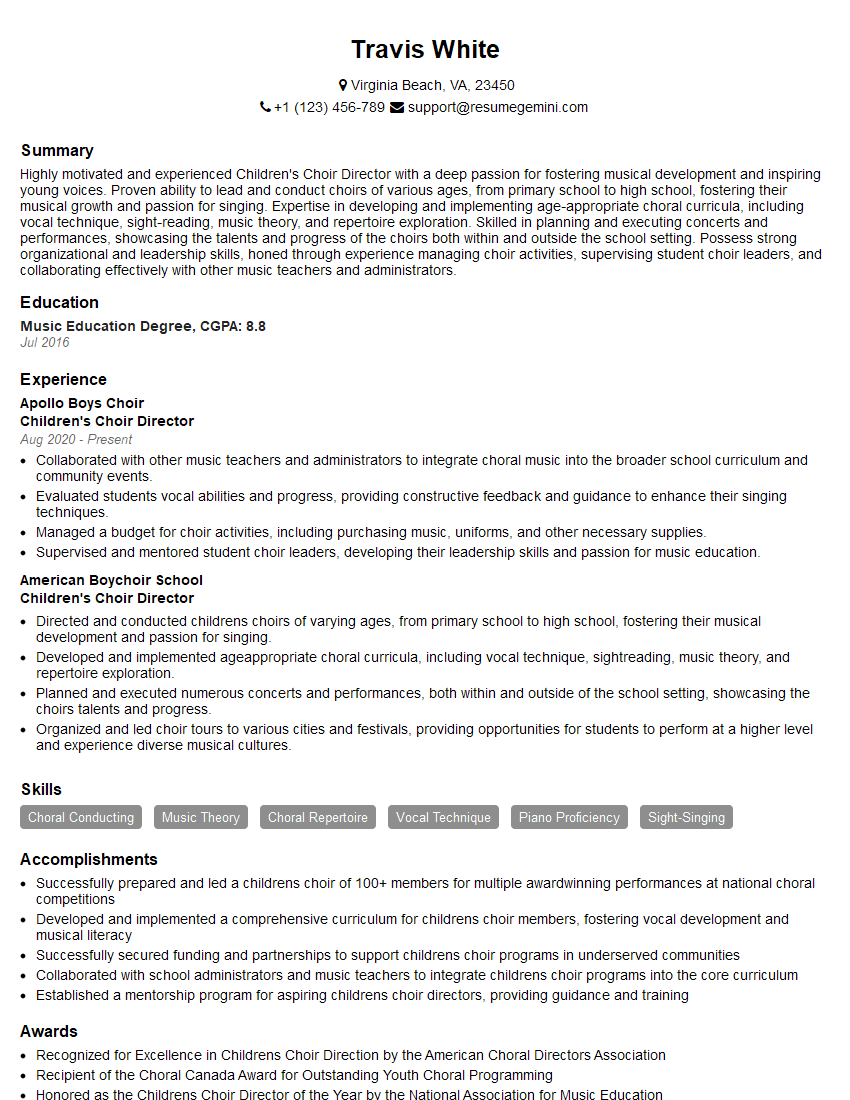
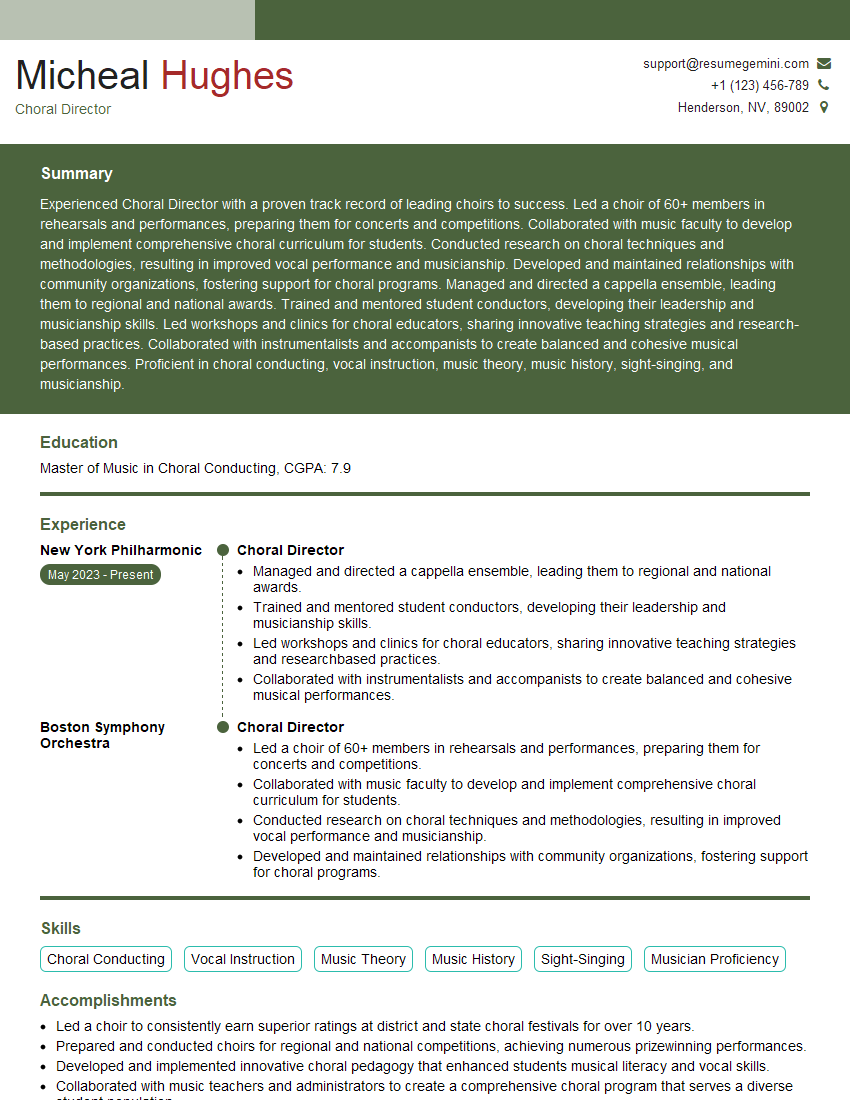
Mastering the art of Choir Direction opens doors to fulfilling and rewarding careers, allowing you to share your passion for music and nurture the talents of others. To maximize your job prospects, create a compelling and ATS-friendly resume that highlights your skills and experience. ResumeGemini is a trusted resource that can help you build a professional resume tailored to the specific demands of the Choir Direction field. Examples of resumes specifically designed for Choir Direction positions are available to help guide you.
Explore more articles
Users Rating of Our Blogs
Share Your Experience
We value your feedback! Please rate our content and share your thoughts (optional).
What Readers Say About Our Blog
Very informative content, great job.
good