Interviews are more than just a Q&A session—they’re a chance to prove your worth. This blog dives into essential Choral Repertoire interview questions and expert tips to help you align your answers with what hiring managers are looking for. Start preparing to shine!
Questions Asked in Choral Repertoire Interview
Q 1. What are the key characteristics of Renaissance choral music?
Renaissance choral music (roughly 1400-1600) is characterized by a distinct shift from the medieval style. It’s marked by a move towards greater imitative counterpoint, where melodic lines are interwoven and echo each other. This created a richer, more complex texture than the simpler harmonies of earlier periods.
- Imitation: One voice would begin a phrase, and others would enter successively, imitating the melody. Think of it like a musical conversation where different voices join in at different times, but all are related.
- Homophony and Polyphony: While polyphony (multiple independent melodic lines) dominated, periods of homophony (a single melody with harmonic accompaniment) also appeared, adding variety.
- Modal Harmony: Unlike the major/minor tonality we’re familiar with today, Renaissance music used church modes (scales different from our major and minor scales), creating unique harmonic colors.
- Text Setting: Composers often used word painting, where the music directly reflects the meaning of the text. For example, a soaring melody might accompany words about heaven.
- Vocal Ranges: The music was predominantly written for SATB (Soprano, Alto, Tenor, Bass) choirs, reflecting the established vocal ranges in the churches and courts of the time.
Examples include the works of Josquin des Prez and Giovanni Pierluigi da Palestrina, masterpieces of elegant counterpoint and expressive vocal writing. Their music embodies the sophistication and beauty of the Renaissance aesthetic.
Q 2. Discuss the compositional techniques of J.S. Bach’s choral works.
J.S. Bach’s choral works are masterpieces of Baroque counterpoint, utilizing a wide array of sophisticated techniques. His mastery lies in his ability to blend these techniques seamlessly to create intensely expressive and powerful music.
- Counterpoint: Like the Renaissance, Bach used complex counterpoint, but with even greater intricacy and independence of voices. He frequently employed canons (where one voice imitates another) and fugues (a complex compositional form based on a single theme).
- Chorale Harmonization: Bach frequently used Lutheran chorales (hymn tunes) as the basis for his choral works, harmonizing them in inventive and often breathtaking ways. He could transform a simple hymn tune into a complex, multifaceted composition.
- Orchestration: While primarily known for his choral works, Bach skillfully integrated instrumental forces, using them to support and enhance the vocal parts. The interplay between the voices and the orchestra is a hallmark of his style.
- Texture: Bach’s choral works showcase a wide range of textures, from dense polyphony to simple homophony. He masterfully shifts between these textures to create dynamic and engaging musical experiences.
- Structure: His large-scale works, such as the Mass in B Minor and the Passion according to St. Matthew, exhibit intricate structures that build dramatic tension and emotional depth. The use of da capo arias (repeated sections with variations) contributes to this structure.
Think of the B Minor Mass – a monumental work displaying a mastery of all these techniques, demonstrating the pinnacle of Baroque compositional skill and emotional depth.
Q 3. Compare and contrast the vocal styles of Romantic and Baroque choral compositions.
Baroque and Romantic choral styles differ significantly in their approach to vocal writing and expression.
- Baroque (roughly 1600-1750): Characterized by a focus on contrapuntal textures, clear articulation, and relatively restrained dynamics. The vocal style emphasized clarity of line and precise intonation. Ornamentation was common, but typically controlled and integrated into the overall texture. Think of the controlled intensity of Bach’s chorales.
- Romantic (roughly 1780-1900): Romantic choral music emphasizes expressive power, emotional intensity, and a wider dynamic range. The use of larger choral forces became more common, creating a more powerful and dramatic sound. Harmony became richer and more chromatic (using notes outside the traditional diatonic scales). The focus shifted from pure counterpoint to a broader emotional expression with greater use of homophony, particularly in large climaxes. Think of the soaring melodies and dramatic swells in Mendelssohn’s Elijah.
In short: Baroque choral music is characterized by precision and intellectual complexity, while Romantic choral music prioritizes emotional expression and dramatic impact. The difference is comparable to the distinction between a finely crafted clock and a passionate, sweeping landscape painting.
Q 4. Explain the importance of vocal blending in choral performance.
Vocal blending is paramount in choral performance; it’s the cornerstone of a unified and beautiful sound. It refers to the seamless integration of all voices, creating a homogenous tone quality where individual voices are indistinguishable from the whole.
- Balance: Each section (soprano, alto, tenor, bass) should have an equal volume and projection, preventing any single section from overpowering the others.
- Tone Quality: Choir members should strive for a consistent tone color, avoiding harsh or strained sounds. This requires careful attention to breath support, resonance, and vocal technique.
- Intonation: Precise pitch matching is crucial; even slight variations can disrupt the blend. Careful ear training and practice are essential.
- Diction and Articulation: Clear diction aids in blending by ensuring that the words are understood as a unified whole. Consistent articulation adds to the precision and overall sound.
A well-blended choir sounds like a single, rich instrument, not a collection of individual voices. Imagine a tapestry: individual threads are beautiful in their own right, but the true masterpiece is the unified whole.
Q 5. How do you select repertoire appropriate for a specific choir’s skill level?
Selecting appropriate repertoire involves carefully assessing the choir’s capabilities. It’s a crucial step in maintaining the singers’ motivation and fostering a positive rehearsal environment.
- Vocal Range and Skill Level: Choose music that lies comfortably within the choir’s range and is technically manageable. Avoid pieces with excessively challenging leaps, complex rhythms, or demanding vocal techniques if the choir lacks the skills.
- Musical Style and Genre: Select music that matches the choir’s experience and preference. A choir experienced in Renaissance music might find a challenging piece from that era more rewarding than a contemporary work.
- Textual Demands: Consider the difficulty of the text, including the length of phrases, pronunciation challenges, and emotional demands.
- Rehearsal Time: Choose pieces that can be adequately rehearsed within the available time frame. Overly ambitious programming can lead to frustration and burnout.
- Audience and Occasion: Consider the context of the performance. A simple and uplifting piece might be appropriate for a casual concert, while a more challenging and dramatic work could be suitable for a formal event.
I often start with a preliminary assessment of the choir’s abilities, followed by a discussion of their interests and goals. Then I create a balanced program that challenges them appropriately while still being enjoyable and achievable.
Q 6. Describe your approach to teaching sight-reading to a choir.
Teaching sight-reading involves a multi-faceted approach that combines technical skills and musical understanding.
- Rhythm Training: Start with rhythmic exercises, focusing on recognizing and interpreting different note values and rhythmic patterns. Use simple exercises that gradually increase in complexity.
- Interval Training: Work on recognizing and singing intervals (the distance between two notes) to improve pitch accuracy and sight-reading skills.
- Melodic Dictation: Practice melodic dictation, where singers learn to transcribe short melodies they hear. This enhances their ability to quickly recognize and sing melodies from the score.
- Gradual Progression: Begin with simple, easy pieces and gradually increase the difficulty. Focus on manageable sections, gradually expanding to larger chunks of music.
- Active Listening: Emphasize active listening before sight-reading; have singers listen to a recording of the piece to familiarize themselves with the melody and harmony.
- Repetition and Practice: Regular sight-reading practice is essential to improve proficiency. Make it a regular part of each rehearsal.
My approach always emphasizes a supportive and encouraging atmosphere. I often work with smaller groups of singers to provide individualized feedback and address specific challenges.
Q 7. What strategies do you use to improve choral diction and articulation?
Improving choral diction and articulation requires a combination of physical exercises, attentive listening, and mindful practice.
- Articulation Exercises: Use tongue twisters and exercises that focus on specific consonant sounds to improve clarity and precision. These exercises can be combined with vocal warm-ups.
- Consonant and Vowel Production: Work on the accurate production of both consonants and vowels. Pay attention to the placement of the tongue, lips, and jaw.
- Textual Analysis: Analyze the text together to understand the meaning and phrasing. Discuss punctuation, stress, and intonation. This helps singers convey the essence of the words they sing.
- Individual and Section Work: Address diction issues individually and with sections of the choir. Provide specific feedback on pronunciation and articulation.
- Recording and Playback: Record rehearsals and use playback to identify areas where diction or articulation needs improvement. This provides objective feedback.
- Performance Practice: The focus on diction and articulation should extend beyond rehearsals into performance. Remind singers to pay attention to clarity during performance.
Ultimately, clear diction enhances both the musical and emotional impact of the choral performance making the message of the music accessible and engaging for the audience.
Q 8. How do you address intonation problems in a choral rehearsal?
Addressing intonation problems in a choir requires a multifaceted approach. It’s rarely a simple fix, but rather a process of identifying the source of the issue and then systematically addressing it.
Identify the Problem: First, pinpoint where the intonation problem lies. Is it a specific section (sopranos, tenors, etc.)? A particular interval? A specific chord? Careful listening and potentially using a tuning app can help isolate the problem.
Isolate the Source: Once identified, try to determine why the intonation is off. Are singers struggling with a difficult interval? Are they relying too heavily on their inner ear and not external reference points (piano, tuning fork)? Is the vocal part itself ambiguous or poorly written?
Targeted Exercises: I might employ interval training exercises, focusing on the problematic intervals. Simple warm-ups focusing on major and minor seconds, thirds, and perfect fifths can be highly effective. For example, having the section sing a series of major thirds, starting on different pitches, can help train their ear and muscles.
Section Work: Addressing the issue section by section is crucial. This allows for more individualized attention and helps to avoid overwhelming the entire choir. It’s also helpful to work with smaller groups within sections to identify potential leaders who can support the rest of the section.
Model and Demonstration: Often, simply singing the problematic passage correctly myself, and then having the section imitate me, can be highly effective. If necessary, I’ll break down the phrase into smaller, manageable chunks.
Use of Technology: While not always necessary, tuning apps can be beneficial in providing immediate feedback to singers and helping them identify their own pitch discrepancies. However, I always emphasize that these are tools, not replacements for a well-trained ear.
For example, when rehearsing the challenging descending chromatic line in Brahms’ Requiem, I found that the altos were consistently sharp on specific notes. By isolating that section, focusing on intervallic practice, and modelling the correct intonation, we successfully resolved the issue.
Q 9. Explain your method for balancing vocal sections within a choral piece.
Balancing vocal sections is crucial for achieving a well-rounded and resonant choral sound. It’s a continuous process throughout rehearsal, requiring careful attention to dynamics, articulation, and individual vocal strengths.
Careful Score Analysis: I begin by analyzing the score, noting sections where particular voice parts carry the melodic line or harmonic weight. Understanding the compositional intent is vital for achieving balance.
Dynamic Adjustments: I use dynamic markings (piano, mezzo piano, forte, etc.) strategically, adjusting the volume of each section to complement others and create a unified sound. A section that is naturally louder might need to sing with a mezzo piano dynamic in order to avoid overpowering the others.
Blending Techniques: I emphasize the importance of vocal blending. Exercises that focus on matching vowel sounds and consonants can greatly improve the homogeneity of the sound across sections. This might involve having sections sing in unison on short phrases, gradually building to more complex harmonies.
Individual Attention: I pay close attention to individual singers within each section. Some singers naturally have stronger voices than others. I might work individually with quieter singers to improve their projection and breath support while guiding louder singers to refine their control.
Section-Specific Exercises: I incorporate section-specific exercises to address individual weaknesses. For example, if the tenors are struggling with a particular passage, we will focus on that section until the balance with the other voices is achieved.
Strategic Placement: Sometimes, the physical placement of singers within the choir can impact the balance. In larger choirs, I might experiment with the positioning of sections to ensure optimal sound projection.
For instance, in rehearsing Verdi’s Requiem, I found that the basses were overpowering the sopranos in the ‘Dies Irae’. We worked on dynamic control, blending, and individual projection within each section to achieve a more balanced, dramatic sound.
Q 10. How do you manage rehearsal time effectively to achieve desired results?
Efficient rehearsal time management is paramount. It requires careful planning, clear communication, and flexible adaptation.
Prioritize Goals: Each rehearsal should have a clear set of objectives. I determine what needs to be accomplished based on the stage of rehearsal (early stages focus on individual parts, later stages focus on overall performance) and communicate this clearly to the choir.
Detailed Rehearsal Plans: I create detailed plans that outline the specific pieces or sections to be addressed in each rehearsal, allocating time appropriately for each item. These plans include specific musical objectives, such as focusing on intonation in one section and phrasing in another.
Warm-ups and Cool-downs: I incorporate vocal warm-ups and cool-downs into each rehearsal. This is not only crucial for preventing injury but also helps singers prepare vocally for the more challenging aspects of the piece.
Flexibility and Adaptability: Despite careful planning, it’s crucial to be flexible. Some sections might require more attention than anticipated. I adjust my plan as needed, recognizing that rehearsal time is a precious resource.
Breaks and Engagement: Regular breaks are essential for maintaining singers’ focus and energy. I encourage short breaks and integrate interesting exercises to maintain engagement.
Review and Assessment: At the end of each rehearsal, we review the progress made, highlight areas that need improvement and plan for the next rehearsal. This helps ensure that everyone is on the same page.
For example, when working on a complex piece like Bach’s Mass in B Minor, I might dedicate one rehearsal to tackling difficult contrapuntal sections, another to phrasing and dynamics, and another to refining the overall balance and tempo.
Q 11. Discuss the challenges of programming a diverse choral repertoire.
Programming a diverse choral repertoire presents exciting opportunities but also significant challenges. The goal is to create a program that is both musically satisfying and engaging for the choir and audience.
Vocal Capabilities: The most crucial aspect is assessing the choir’s vocal capabilities and range. A program must be tailored to the singers’ strengths, avoiding pieces that are too technically demanding or stylistically inappropriate. This requires an honest evaluation of the choir’s current level.
Stylistic Variety: Creating a program with a varied selection of styles, periods, and composers is crucial to maintaining interest and preventing monotony. A balance between familiar and unfamiliar works is usually a good approach.
Thematic Cohesion: While diversity is important, the program should have a certain degree of thematic cohesion. It might be organized chronologically, thematically (e.g., exploring works on a particular topic), or by a unifying stylistic element.
Audience Considerations: The audience’s expectations and musical preferences must be considered, balancing the desire to challenge the audience with the need to provide an enjoyable concert experience.
Logistical Factors: Practical factors such as rehearsal time, access to scores, and potential stage limitations must be factored into the program planning process. This includes considering the length of the concert and the pacing of the program.
Singer Engagement: A diverse program should also offer singers diverse experiences and challenges, fostering their growth and skill development. This might involve including pieces with different vocal styles, languages, and rhythmic complexity.
For example, a program I recently curated included works from Renaissance polyphony, Romantic choral masterpieces, and contemporary arrangements of folk songs, all connected by a subtle theme of nature and spirituality.
Q 12. Describe your experience conducting a large-scale choral work.
Conducting a large-scale choral work is a remarkable experience demanding meticulous preparation, strong leadership, and exceptional organizational skills.
Thorough Score Study: The first step involves a comprehensive study of the score, understanding the overall structure, phrasing, dynamics, and harmonic complexities. This in-depth knowledge allows for effective communication with the singers.
Rehearsal Strategies: I use various rehearsal techniques, such as sectional rehearsals, full choir rehearsals, and individual coaching, to address specific issues and build a cohesive performance. The rehearsal process is a continuous cycle of refinement, requiring patience, and a commitment to achieving the desired artistic vision.
Communication and Collaboration: Clear and concise communication is essential when working with a large group. I foster a collaborative environment where singers feel comfortable contributing to the interpretation of the work.
Technical Aspects: Managing the technical aspects, such as sound balance, stage setup, lighting, and interaction with other performers (if any), is a significant part of the process. This requires effective collaboration with technical staff.
Emotional Connection: Creating an emotional connection with the singers and conveying the expressive depth of the music is crucial. This involves careful attention to nuances, dynamics, and tempo variations.
Performance Management: Managing the performance itself involves maintaining control, adapting to unforeseen circumstances, and ensuring that the singers are well-supported and confident. The final performance is the culmination of months, sometimes years, of work.
My experience conducting Handel’s Messiah with a 200-voice choir was a particularly challenging yet rewarding project. It required careful planning and coordination to manage such a large ensemble, but the resulting performance was deeply moving.
Q 13. What software or technology do you use to manage choral scores and parts?
Technology plays a significant role in managing choral scores and parts, improving efficiency and accuracy. Several software options are available, each with its strengths and weaknesses.
Finale: Finale is a widely used notation software that allows for creating, editing, and printing scores and individual parts. Its capabilities extend beyond simple score creation, allowing for detailed score organization, customized part assignments, and the creation of rehearsal tracks.
Sibelius: Similar to Finale, Sibelius is a powerful notation software offering advanced features for score creation and management. It excels in handling complex scores and offers excellent integration with other music software.
Dorico: Dorico is a newer notation program that has gained popularity for its user-friendly interface and powerful features. It provides highly customizable options for score layout and part extraction.
Cloud Storage: Services like Google Drive or Dropbox are invaluable for sharing scores and parts with singers, especially in large choirs or when working remotely. They offer easy collaboration and version control.
Music Engraving Software: For professional-level engraving, specialized software like Antares or Engraving Plus can ensure scores are professionally printed.
In my work, I primarily use Finale for creating and managing scores and parts. The ability to easily create customized parts with specific markings for each section is invaluable for preparing effective rehearsals.
Q 14. How do you foster a positive and collaborative rehearsal environment?
Fostering a positive and collaborative rehearsal environment is crucial for achieving musical excellence and maintaining singer morale. It’s about creating a space where singers feel comfortable, respected, and empowered.
Respect and Encouragement: I prioritize creating a respectful and encouraging environment where singers feel safe to take risks and share their ideas. Positive reinforcement and constructive criticism are vital. I avoid public reprimands, focusing instead on individual coaching.
Open Communication: Open communication is essential. I encourage singers to voice their concerns and offer feedback. I actively listen to their perspectives and address their issues fairly.
Shared Goals: Clearly articulating the musical goals and sharing the artistic vision with the choir fosters a sense of shared purpose and collaboration. When everyone understands the “why” behind the work, it creates a stronger team dynamic.
Team Building Activities: Incorporating team-building activities, even informal ones, can foster camaraderie and strengthen the bonds among the singers.
Humor and Lightheartedness: While discipline is important, a lighthearted and enjoyable rehearsal environment can greatly improve morale and productivity. I use appropriate humor to break tension and keep rehearsals engaging.
Recognition and Appreciation: Recognizing and appreciating the hard work and dedication of the singers is vital. I acknowledge individual and collective achievements regularly.
For example, before a major performance, I’ll often organize a social gathering to bring the choir together outside the rehearsal setting. This helps build community and morale, leading to a more unified and energized performance.
Q 15. How do you assess the strengths and weaknesses of individual singers?
Assessing individual singers involves a holistic approach, combining objective measurements with subjective evaluations. I begin by listening carefully to their vocal tone, identifying their range, and evaluating their breath support and diction. For example, I might note a singer’s tendency to sing flat on certain notes, indicating potential issues with pitch recognition or vocal placement. I also assess their musicality, looking at their rhythmic accuracy, phrasing, and overall interpretation of the music.
Beyond the technical aspects, I assess their commitment and engagement. Do they participate actively in rehearsals? Do they show a willingness to learn and improve? I might observe their posture, body language, and facial expressions during singing to understand their comfort level and engagement. These observations help me create tailored support plans. For instance, a singer struggling with breath control might benefit from specific breathing exercises, while a singer lacking confidence might need encouragement and positive feedback. This process also helps me craft balanced vocal parts within the choir, ensuring a homogenous sound while leveraging each singer’s unique strengths.
Career Expert Tips:
- Ace those interviews! Prepare effectively by reviewing the Top 50 Most Common Interview Questions on ResumeGemini.
- Navigate your job search with confidence! Explore a wide range of Career Tips on ResumeGemini. Learn about common challenges and recommendations to overcome them.
- Craft the perfect resume! Master the Art of Resume Writing with ResumeGemini’s guide. Showcase your unique qualifications and achievements effectively.
- Don’t miss out on holiday savings! Build your dream resume with ResumeGemini’s ATS optimized templates.
Q 16. Describe your experience working with diverse musical styles within a choral context.
My experience spans a wide spectrum of choral styles, from the Renaissance polyphony of Josquin des Prez to the contemporary works of Eric Whitacre. Working with diverse styles requires flexibility and adaptability. For example, preparing a choir for a performance of Bach’s Mass in B Minor demands a different approach than preparing them for a performance of a modern gospel piece. With Baroque music, the focus might be on period-instrument style, articulation, and historically informed interpretation; with Gospel, it might be on rhythmic precision, emotional expression, and a strong sense of groove. I adjust my rehearsal techniques accordingly, perhaps employing more formal methods for Baroque and more interactive, expressive techniques for contemporary music. This adaptability extends to understanding the cultural context of different musical traditions and ensuring respectful and authentic performances.
Q 17. What strategies do you employ to engage audience members in your choral performances?
Engaging the audience is crucial for a successful choral performance. I use several strategies. Firstly, I believe in selecting repertoire that is both musically stimulating and emotionally resonant. Program selections that tell a story or explore a unifying theme can significantly enhance audience engagement. I might include program notes that provide context for the pieces, enhancing appreciation and understanding. Furthermore, good audience engagement begins long before the performance starts: creating a visually appealing performance space, with appropriate lighting and seating arrangements, sets a positive tone.
During the performance, strong stage presence and visual communication from the choir are key. I encourage expressive singing and mindful stage movements. I sometimes work with the choir on gestures or choreography that complement the music. Finally, I believe in direct interaction with the audience. A well-placed spoken introduction or acknowledgment of the audience’s presence before or between pieces can create a sense of connection and shared experience.
Q 18. How do you incorporate audience feedback into your programming decisions?
Audience feedback is invaluable. I actively solicit it through post-concert surveys, informal conversations, and online reviews. This feedback allows me to understand what resonated with the audience and what could be improved. For example, if a particular piece received overwhelmingly positive reviews, I might feature more works from that composer or style in future concerts. Conversely, if a piece was poorly received, I would analyze its reception to discern what factors contributed to negative feedback. Was it the choice of piece itself? Was the performance lacking? This critical self-reflection informs future programming choices, leading to more informed and audience-centric concerts.
Q 19. How do you choose appropriate accompaniment for your choral selections?
Choosing appropriate accompaniment is crucial for a balanced and effective choral performance. My approach considers the style, era, and character of the choral selection. For example, a Renaissance motet might be beautifully complemented by a harpsichord or lute, while a Romantic choral work could benefit from a full orchestra or piano. I consider the inherent texture and dynamic range of the choral piece; an overly ornate accompaniment could overshadow the choir’s vocals, whereas a sparse accompaniment may not provide sufficient harmonic support. I always collaborate closely with the accompanist to ensure a unified and well-balanced interpretation. This collaboration involves sharing my artistic vision and clarifying any stylistic requirements.
Q 20. Explain your process for preparing a choir for a performance.
Preparing a choir for a performance is a multi-stage process. It begins with careful selection of repertoire, tailored to the choir’s capabilities and the desired concert theme. Next, I create a detailed rehearsal plan, breaking down each piece into smaller sections for focused work on individual technical and musical challenges. This involves addressing intonation, diction, phrasing, balance, and dynamics. Each rehearsal builds upon the previous one, incorporating both technical work and musical interpretation. I often record rehearsals to provide singers with objective feedback on their performance.
As the performance approaches, I focus on bringing the pieces together, ensuring a seamless flow and consistent stylistic approach. I might incorporate dress rehearsals to simulate performance conditions and address any remaining issues. Throughout this process, maintaining a positive and encouraging atmosphere is essential to building confidence and fostering teamwork within the choir. The end goal is a cohesive performance that is both technically excellent and artistically compelling.
Q 21. What are some effective techniques for managing vocal health in a choir?
Managing vocal health is paramount. I begin by educating singers about proper vocal hygiene, stressing the importance of hydration, avoiding vocal strain, and getting adequate rest. I incorporate warm-up and cool-down routines into every rehearsal, incorporating vocal exercises designed to prepare the vocal cords for singing and to prevent fatigue. These exercises might involve humming, scales, and gentle articulation exercises. I emphasize proper breathing techniques and posture, crucial for efficient and healthy vocal production.
Throughout rehearsals, I monitor singers for signs of vocal strain or fatigue. I encourage singers to take breaks when needed and to communicate any concerns they have about their voices. I regularly remind singers about the importance of rest and recovery, especially before performances. If a singer is experiencing vocal difficulties, I advise them to seek professional help from a vocal coach or doctor. This preventative approach ensures the long-term vocal health of the choir members and contributes to consistent and high-quality performance.
Q 22. How do you address performance anxiety in singers?
Performance anxiety is a common challenge for singers, manifesting as stage fright, nervousness, or even physical symptoms. Addressing it requires a multi-pronged approach focusing on both mental and physical preparation.
Mental Strategies: I encourage singers to practice mindfulness techniques like deep breathing and meditation to calm their nervous systems. Visualization, where they mentally rehearse the performance successfully, can significantly boost confidence. Positive self-talk, replacing negative thoughts with affirmations, is also crucial. We might even use cognitive behavioral therapy (CBT) techniques to identify and challenge negative thought patterns.
Physical Strategies: Regular physical exercise helps manage stress hormones. Vocal warm-ups are not just about vocal preparation; they also help singers feel more in control and centered before a performance. Ensuring adequate rest and hydration is also key.
Exposure Therapy: Gradually increasing exposure to performance situations, starting with smaller, less intimidating settings, helps desensitize singers to the anxiety triggers. This could involve performing for smaller groups, recording themselves, or participating in informal ‘mock’ performances.
For example, with a particularly anxious singer, I might start by having them sing a short piece just for me, then gradually increase the audience size over several rehearsals. I also emphasize the importance of focusing on the joy of music-making rather than solely on the performance itself.
Q 23. Discuss your experience in preparing a choir for competition or adjudication.
Preparing a choir for competition or adjudication is a rigorous process demanding meticulous attention to detail. It’s not just about achieving technical perfection; it’s about conveying the emotional depth and artistic intent of the chosen pieces.
Piece Selection: Careful consideration goes into selecting repertoire that showcases the choir’s strengths while challenging their abilities. The pieces should be diverse in style and period, offering a balanced program.
Rehearsal Structure: Rehearsals are highly structured, focusing on individual vocal technique, section balancing, diction, phrasing, and expressive interpretation. I often incorporate sectional rehearsals to address individual challenges and blend sections effectively. We’ll also spend considerable time on stylistic nuances, understanding the historical context of the music.
Performance Practice: This goes beyond simply singing the notes. We focus on stage presence, audience engagement, and dynamic control. Mock performances are crucial to simulate the actual competition environment and identify any performance-related issues early on. Video recordings are invaluable for self-assessment and identifying areas for improvement.
Collaboration: I encourage collaborative work between singers, fostering a sense of teamwork and shared responsibility.
For instance, preparing for a competition involving a challenging piece by Bach, we might dedicate weeks to mastering the counterpoint and intricate harmonies before moving on to phrasing and expressive nuances. The process is intensely collaborative, with the singers actively participating in the interpretive discussions.
Q 24. What is your philosophy regarding the role of choral music in the community?
I believe choral music plays a vital role in strengthening community bonds and enriching cultural life. It provides a platform for shared expression, fostering a sense of belonging and collective achievement.
Community Engagement: Choral singing brings people from diverse backgrounds together, transcending age, social, and economic barriers. It fosters social interaction and creates a supportive community environment.
Cultural Preservation: Choirs often perform a wide range of repertoire, including both traditional and contemporary pieces, preserving and promoting musical heritage.
Educational Value: Participation in a choir offers valuable educational opportunities, developing musical skills, teamwork, and discipline.
Therapeutic Benefits: Singing has proven therapeutic effects, reducing stress and promoting mental well-being. The act of making music together creates a sense of shared joy and accomplishment.
For example, I’ve worked with choirs that regularly perform in community events, nursing homes, and schools, sharing the joy of choral music with wider audiences and fostering a sense of civic responsibility within the community.
Q 25. How do you select appropriate choral literature for different liturgical seasons?
Selecting appropriate choral literature for different liturgical seasons requires a deep understanding of both the musical repertoire and the theological significance of each season.
Advent: Pieces reflecting themes of hope, expectation, and the coming of Christ are appropriate. This might include works featuring contemplative harmonies and introspective texts.
Christmas: Joyful and celebratory music is the focus, often featuring carols, nativity scenes, and songs of praise. Consider pieces that reflect the mystery and wonder of the birth of Christ.
Lent: Music that expresses penitence, reflection, and contemplation is suitable. This could include works that explore themes of suffering, sacrifice, and redemption.
Easter: Joyful and triumphant music celebrating the resurrection is paramount. Works expressing themes of new life, hope, and victory are ideal.
Ordinary Time: The selection is broader, incorporating diverse themes of praise, thanksgiving, and reflection on the life of Christ and the teachings of the Church. This allows for a greater variety of musical styles and periods.
For instance, during Lent, I might choose pieces by composers like Victoria or Byrd, known for their reflective and penitential style. For Easter, I might select celebratory works by Handel or more contemporary pieces emphasizing themes of renewal.
Q 26. Describe your experience working with composers or arrangers of choral music.
Working with composers and arrangers has been a highly rewarding aspect of my career. It’s a collaborative process where I gain insights into their creative process, and they receive valuable feedback from a practical, performance-oriented perspective.
Collaboration: My role involves offering suggestions on vocal ranges, tessitura (the comfortable range of the voice), and overall suitability of the piece for the choir’s abilities. I might offer suggestions on phrasing, dynamics, and overall musical expression.
Feedback: The composer or arranger receives feedback based on the choir’s experience rehearsing the work. This ensures the piece is both musically satisfying and practically achievable for the ensemble.
For example, I worked with a composer on a new piece for my choir. I suggested slight adjustments to the vocal lines in certain sections to make them more comfortable for the singers, improving the overall performance. The composer was receptive to my suggestions, and the final result was an excellent piece that the choir could perform confidently.
Q 27. How do you adapt your rehearsal techniques to accommodate different learning styles?
Adapting rehearsal techniques to accommodate diverse learning styles is crucial for maximizing participation and effectiveness. I use a variety of methods to cater to visual, auditory, and kinesthetic learners.
Visual Learners: I use visual aids such as charts, diagrams, and scores. I might use colored markings on the score to highlight important phrases or sections. Hand gestures can reinforce rhythmic or dynamic cues.
Auditory Learners: I provide clear and concise verbal explanations, emphasizing accurate intonation and phrasing. I might use recordings of professional choirs as models for interpretation and style.
Kinesthetic Learners: I incorporate movement and physical activities into rehearsals. For example, rhythmic exercises or conducting gestures help internalize musical patterns and improve coordination.
Variety of Approaches: I combine these methods, constantly varying the approach to keep rehearsals engaging and catering to all learning styles.
For instance, when working on a complex piece, I might first explain the structure visually using a flowchart. Then I would demonstrate the key sections aurally, followed by kinesthetic exercises to internalize the rhythmic patterns.
Q 28. What is your approach to dealing with conflict or disagreements within a choir?
Conflict within a choir can arise from various sources, including personality clashes, disagreements over musical interpretation, or scheduling issues. Addressing conflict requires a fair, sensitive, and timely approach.
Open Communication: Creating a safe space for open communication is paramount. I encourage singers to express their concerns respectfully and constructively.
Mediation: I often act as a mediator, helping individuals understand different perspectives and find common ground. This might involve separate conversations to address individual concerns before a group discussion.
Focus on Shared Goals: Reminding singers of their shared goal—creating beautiful music together—can help resolve disputes and foster a sense of unity.
Fairness and Consistency: Applying rules and expectations consistently to all singers ensures fairness and prevents resentment.
For example, if a disagreement arises regarding tempo, I would encourage open discussion, allowing each singer to explain their interpretation, and then we would collectively decide on a tempo that works for the overall musical expression. Fairness and clarity in decision-making are crucial for maintaining harmony within the choir.
Key Topics to Learn for Choral Repertoire Interview
- Historical Context: Understanding the historical evolution of choral music and its stylistic changes across different periods. This includes recognizing key composers and their compositional techniques.
- Stylistic Analysis: Analyzing choral works for texture, harmony, form, and melodic characteristics. Applying this analysis to understand the composer’s intent and expressive qualities.
- Vocal Technique and Score Interpretation: Understanding vocal ranges, tessitura, and phrasing. Demonstrating the ability to interpret a score and identify challenges for singers.
- Conducting Techniques and Choral Rehearsal Strategies: Understanding effective rehearsal techniques for different choral styles and addressing common challenges in choral singing. This includes shaping phrases, balancing sections and achieving stylistic nuances.
- Program Building and Contextualization: Ability to curate a balanced and engaging choral program considering factors like thematic unity, audience appeal, and performance practicality.
- Score Reading and Sight-Singing Proficiency: Demonstrating the ability to quickly read and analyze choral scores, including both vocal and instrumental parts. Proficiency in sight-singing is crucial.
- Literature Knowledge: Extensive familiarity with a wide range of choral repertoire, encompassing diverse styles, periods, and composers. Be prepared to discuss specific works and their significance.
- Problem-Solving and Adaptation: Understanding how to address vocal imbalances, intonation issues, rhythmic complexities, and other common challenges encountered during rehearsals and performances.
Next Steps
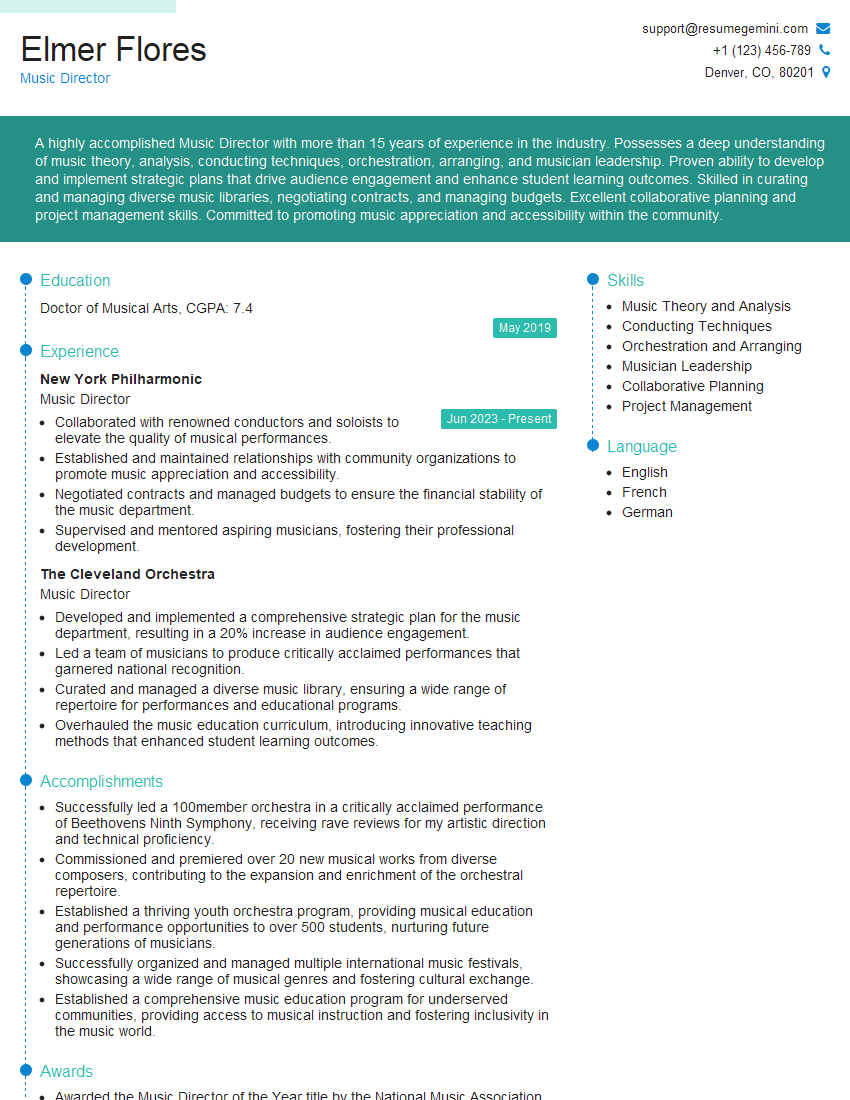
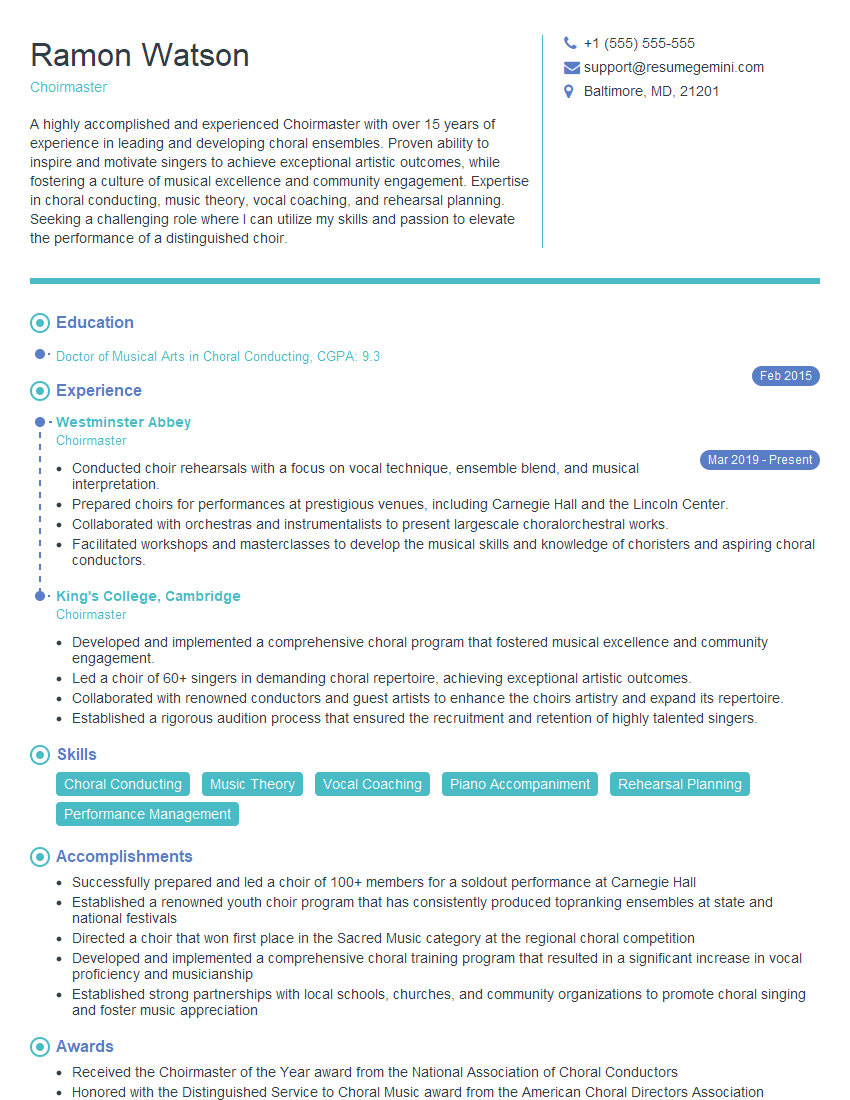
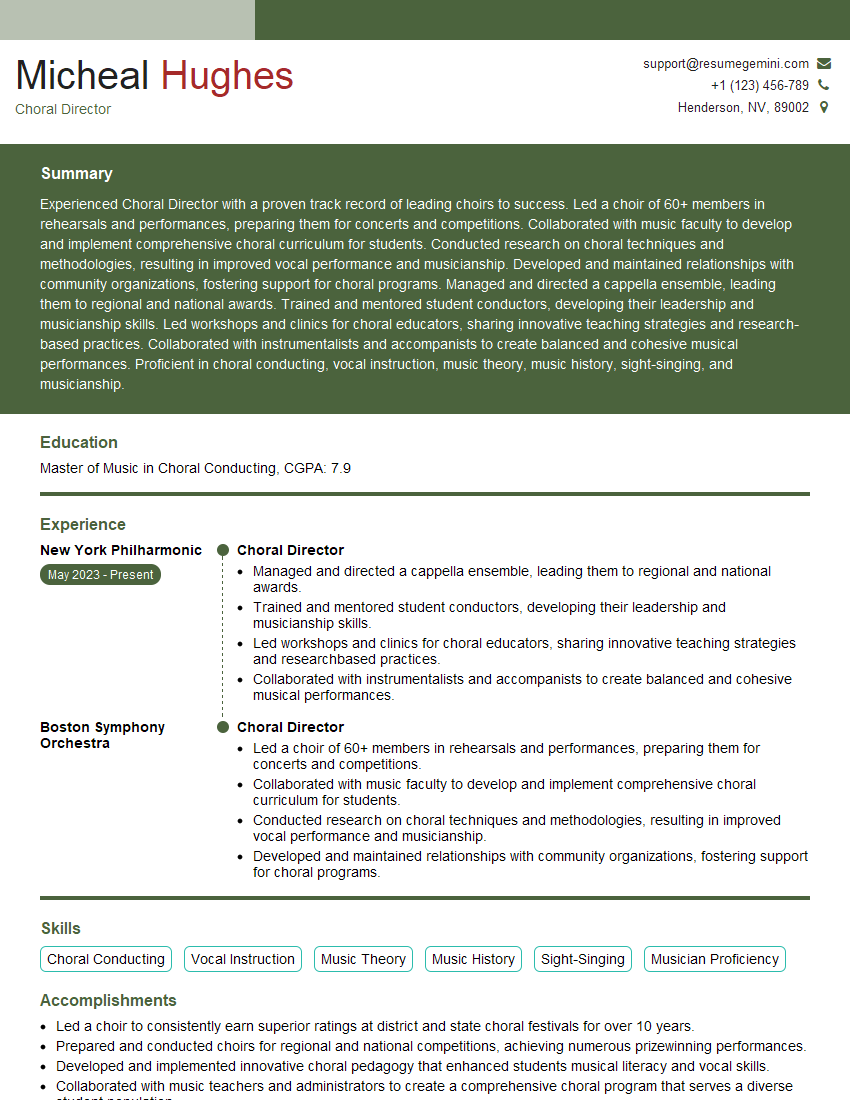
Mastering choral repertoire is essential for career advancement in choral conducting, music education, and related fields. A strong understanding of repertoire demonstrates your expertise and passion, making you a highly competitive candidate. To enhance your job prospects, creating an ATS-friendly resume is crucial. This ensures your application is effectively screened by Applicant Tracking Systems used by many organizations. We strongly recommend using ResumeGemini, a trusted resource for building professional and effective resumes. ResumeGemini provides examples of resumes tailored to the choral repertoire field, helping you present your skills and experience in the best possible light.
Explore more articles
Users Rating of Our Blogs
Share Your Experience
We value your feedback! Please rate our content and share your thoughts (optional).
What Readers Say About Our Blog
Very informative content, great job.
good