Every successful interview starts with knowing what to expect. In this blog, we’ll take you through the top Choreography and Movement interview questions, breaking them down with expert tips to help you deliver impactful answers. Step into your next interview fully prepared and ready to succeed.
Questions Asked in Choreography and Movement Interview
Q 1. Explain your preferred choreographic process.
My choreographic process is iterative and deeply collaborative. It begins with a conceptual phase, where I explore themes, musicality, and the desired emotional impact. I might start with a single image, a musical phrase, or a specific feeling. This initial spark guides my exploration of movement vocabulary.
Next, I move into improvisation and experimentation. This phase involves extensive movement exploration, often working with dancers to organically develop phrases and sequences. We build upon initial ideas, testing variations and refining the flow. I heavily rely on feedback during this stage, shaping the choreography through a constant dialogue between myself and the dancers.
The third stage is a process of structuring and refining the choreography. This involves sequencing the phrases, creating transitions, and paying close attention to dynamics and spatial relationships. Here, I consider the overall narrative arc and the way the choreography will unfold in space and time. The final step involves polishing and fine-tuning the piece, paying careful attention to detail and ensuring the dancers fully understand and can execute the choreography smoothly and expressively. This iterative process allows for organic growth and keeps the creativity alive throughout.
Q 2. Describe your experience working with diverse dance styles.
My experience spans a wide range of dance styles, including contemporary, ballet, jazz, and hip-hop. This breadth allows me to approach choreography with a diverse toolkit and blend different styles effectively. For instance, I might use the precision of ballet technique to enhance a contemporary piece, or incorporate the rhythmic energy of hip-hop into a more lyrical sequence. The key is to understand the underlying principles and aesthetics of each style to seamlessly integrate them.
Working with diverse styles has not only enriched my own choreographic vocabulary but also deepened my understanding of different movement aesthetics and cultural influences. I’ve learned to appreciate the unique strengths and challenges of each style, fostering a more adaptable and informed approach to choreography.
A specific example: In one project, I combined the fluidity of contemporary movement with the sharp precision of African dance, creating a powerful contrast that heightened the emotional impact of the piece. The dancers’ diverse backgrounds contributed significantly to the richness and authenticity of the fusion.
Q 3. How do you adapt choreography for different skill levels?
Adapting choreography for different skill levels requires a nuanced understanding of both the choreography and the capabilities of the dancers. I approach this by creating a tiered approach. I start with a core vocabulary of movement, accessible to all levels. Then, I develop variations and extensions for more advanced dancers, while providing simpler options for those with less experience. This allows all dancers to participate fully, feeling challenged yet supported.
This doesn’t involve simplifying the choreography so much as differentiating it. For example, a complex turn sequence can be adapted by allowing less experienced dancers to perform a simpler version with fewer rotations or by emphasizing the quality of movement rather than the technical difficulty. I often use the analogy of a building – the core structure (basic choreography) remains the same, while the ornamentation (advanced variations) changes based on skill level. This provides a sense of shared experience while acknowledging the individual capabilities of each dancer.
Q 4. Discuss your approach to creating emotionally resonant movement.
Creating emotionally resonant movement is achieved through a careful consideration of several factors: physicality, dynamics, and musicality. The physicality encompasses how the movement is executed – the weight, fluidity, tension, and release involved. Dynamics affect the intensity and energy of the movement. A sudden shift from sharp, angular movements to flowing, sustained ones can evoke a powerful emotional response. Finally, the relationship between the movement and the music is crucial. The timing, rhythm, and emotional tone of the music directly influence the emotional impact of the choreography.
I encourage dancers to explore the emotional landscape of the piece. I might use guided imagery or specific prompts to help dancers connect with the emotional core of the choreography. This helps dancers find authenticity in their performance, making the emotion palpable for the audience. For example, if the piece explores feelings of loss, I might ask dancers to recall a personal experience of loss to inform their movement, ensuring their performance feels genuine and deeply connected.
Q 5. How do you incorporate storytelling into your choreography?
Storytelling through choreography is a powerful way to engage the audience on a deeper level. I begin by identifying the central narrative or theme. This might be a linear story, a series of interconnected vignettes, or an abstract representation of an idea. Once the narrative is established, I use movement as a visual language to communicate the story’s progression, characters, conflicts, and resolution. This often involves using spatial relationships, contrasting movement styles, and symbolic gestures.
The use of narrative structure is crucial. I structure the choreography with a clear beginning, middle, and end. This provides a framework for the audience to follow the story. Moreover, clear transitions between sections of the choreography aid in maintaining the narrative flow. I often use changes in lighting, music, or costume to emphasize important shifts in the story. For instance, a sudden change from flowing, graceful movement to sharp, angular movements can visually represent a change in mood or a significant plot point. The focus is always on clarity and engaging the audience on a visceral level.
Q 6. Describe your experience collaborating with other creative professionals.
Collaboration is essential to my creative process. I’ve had the pleasure of working with composers, set designers, lighting designers, and costume designers. Each collaboration enhances the overall artistic vision. The process begins with open communication and a shared understanding of the artistic goals. I find it vital to provide other creative professionals with a clear vision of the choreography’s concept, emotional tone, and stylistic direction.
For instance, in a recent project, I worked closely with the composer to ensure that the music and movement were intrinsically linked. The composer’s musical choices directly inspired the movement vocabulary, resulting in a cohesive and highly impactful performance. Similarly, the set designer’s work created a visual landscape that complemented the emotional journey of the choreography. This synergistic approach ensures that all elements of the production work together harmoniously to create a unified and powerful artistic experience.
Q 7. Explain your method for teaching complex choreography.
Teaching complex choreography requires patience, clear communication, and a structured approach. I break down complex sequences into smaller, manageable sections. This allows dancers to master each element before integrating them into the larger piece. I often use a layered approach, introducing the choreography gradually, starting with the foundational steps and gradually adding more complex layers. This method minimizes frustration and promotes understanding.
Visual aids, such as video recordings and diagrams, can greatly enhance the learning process. I might use video to demonstrate the choreography from different angles, allowing dancers to understand the spatial relationships and intricate details. I also encourage dancers to ask questions and provide ample opportunity for feedback, ensuring everyone is comfortable with the material before moving on. This patient and supportive approach allows dancers to build confidence and master challenging choreography with precision and artistry.
Q 8. How do you ensure the safety of dancers during rehearsals?
Ensuring dancer safety is paramount. It’s not just about preventing injuries; it’s about fostering a trusting and productive rehearsal environment. My approach is multi-faceted.
Thorough Warm-up and Cool-down: Every rehearsal begins with a comprehensive warm-up tailored to the demands of the choreography, focusing on flexibility, strength, and cardiovascular health. Similarly, a structured cool-down helps prevent muscle soreness and injury.
Proper Technique Emphasis: I meticulously teach correct technique, emphasizing proper body alignment, efficient movement patterns, and safe execution of challenging steps. This reduces the risk of strain and injury. For example, when teaching a jump, I’ll emphasize proper leg extension and landing techniques, along with the importance of core engagement.
Progressive Rehearsal Strategy: I introduce new choreography gradually, building complexity step-by-step. This prevents overwhelming dancers and gives them time to master each segment before moving on to more demanding sequences. I might start with individual sections before combining them into longer phrases.
Open Communication: I encourage dancers to communicate any discomfort or pain immediately. A culture of open communication ensures that potential problems are addressed promptly before they escalate into serious injuries. I actively listen to their feedback and adjust the choreography or training as needed.
Appropriate Space and Environment: I ensure a safe rehearsal space with sufficient room for movement, adequate lighting, and a clean, uncluttered floor. This minimizes the risk of tripping or collision. The space needs to be clear of obstacles to avoid unexpected accidents.
Q 9. What software or tools do you use for choreography?
Technology significantly enhances the choreography process. While I value traditional methods like sketching and note-taking, I utilize several software tools for efficiency and creativity.
Video Editing Software (e.g., Adobe Premiere Pro, Final Cut Pro): I use these for recording and editing rehearsal footage. This allows me to analyze movement, refine details, and create visual representations of the choreography for dancers and collaborators. I can also use slow-motion to isolate specific movements for analysis and feedback.
Choreography Software (e.g., Kinovea, MotionBuilder): These programs allow for more advanced analysis of movement, and some offer features to create and manipulate virtual dancers within a 3D space. They are valuable for intricate sequences or experimenting with different perspectives.
Audio Editing Software (e.g., Audacity, Logic Pro): Precise control over the music is vital. I can adjust tempo, add or remove sections, and create custom soundtracks that precisely match the choreography.
Presentation Software (e.g., PowerPoint, Keynote): I use presentation software to create visual aids for rehearsals. This is especially useful for showing complex spatial patterns or timing cues.
Q 10. How do you handle creative differences with a director or choreographer?
Creative differences are inevitable, and handling them professionally is key to a successful collaborative process. My approach focuses on open dialogue, mutual respect, and compromise.
Active Listening: I prioritize understanding the perspectives of the director or choreographer, asking clarifying questions and ensuring I understand their vision completely.
Presenting my Rationale: I clearly articulate my artistic rationale, explaining the choices I’ve made and the desired impact of the choreography. This allows for a more informed discussion.
Finding Common Ground: I aim to find common ground by identifying shared goals and exploring alternative approaches that integrate both our visions. This could involve adjusting certain aspects of the choreography to achieve a mutually satisfying outcome.
Respectful Negotiation: Negotiation is key. This might involve making concessions, offering compromises, or suggesting alternatives that better suit the project’s overall objectives.
Professionalism: Maintaining professionalism throughout the process is crucial. Even when disagreements arise, it’s vital to communicate respectfully and constructively. The goal is to solve problems, not to escalate conflict.
For example, in a recent project, the director wanted a more dramatic and expansive feel, while my initial concept was more intimate and lyrical. Through discussions, we found a compromise by incorporating elements of both styles, creating a work with both intimacy and power.
Q 11. Describe your approach to music selection for choreography.
Music selection is a crucial element influencing choreography’s emotional impact and overall structure. My approach is a blend of intuition and analytical consideration.
Understanding the Narrative: I begin by carefully examining the narrative or theme of the piece. What emotions, ideas, or story needs to be conveyed? The music should align with and enhance this narrative.
Exploring Diverse Genres: I explore a wide range of musical genres, seeking pieces that resonate emotionally and rhythmically. A piece might inspire specific movement ideas or suggest a particular stylistic approach.
Analyzing Musical Structure: I analyze the music’s structure, identifying key changes, dynamics, and rhythmic variations. These will become important reference points for choreographic transitions and phrasing.
Experimental Listening: I listen to potential music repeatedly, allowing myself to fully immerse in its mood and energy. I actively seek out sections that resonate deeply and inspire creative ideas. This helps to build a deeper understanding of what the music offers choreographically.
Trial and Error: It’s an iterative process. I’ll experiment with different music selections during rehearsals, observing how the dancers respond to various rhythms and tempos. The most successful combination is one which enhances both the dancers’ performance and conveys the intended message.
Q 12. How do you incorporate spatial dynamics into your work?
Spatial dynamics—how dancers utilize and interact with the performance space—are essential to the choreography’s visual impact and narrative. My approach involves strategic planning and creative use of levels, pathways, and formations.
Level Variations: I use different levels (high, medium, low) to create visual interest and depth. This could involve dancers moving on platforms, using stairs, or incorporating floor work to contrast with more elevated movements.
Pathways and Lines: I carefully design the dancers’ pathways across the stage, creating lines, shapes, and patterns that enhance the choreography’s visual impact. Straight lines might convey power, while curving lines could suggest fluidity or grace.
Formations and Grouping: I use formations and groupings strategically to highlight specific dancers or convey particular relationships. Close groupings might emphasize intimacy, while scattered formations can emphasize isolation or independence.
Interaction with the Set: If there’s a set, I incorporate it into the choreography, using it as another element within the spatial design. Dancers might interact with props or structures, creating unique interactions with the environment.
Perspective and Focus: I consider how the audience’s perspective will influence the experience. I might use deep space to create a sense of grandeur or close proximity to enhance intimacy.
For example, in a recent piece, I used a circular pathway to symbolize the cyclical nature of life, contrasted with straight lines that represented moments of unwavering strength.
Q 13. How do you address technical challenges in your choreography?
Technical challenges are common in choreography, and addressing them requires a combination of problem-solving skills, creativity, and collaboration. My approach is iterative and involves several key steps:
Identify the Problem: Clearly defining the challenge is crucial. Is it a technical limitation of the dancers, a spatial constraint, or a logistical issue?
Brainstorm Solutions: I brainstorm potential solutions, considering alternative movement sequences, adjustments to the staging, or potential use of technology. This often involves discussions with the dancers and technical crew.
Experiment and Refine: I experiment with different solutions during rehearsals, testing their feasibility and effectiveness. This iterative process allows for refinement and improvement.
Collaborate and Seek Advice: If necessary, I seek advice from colleagues, dance professionals, or experts in relevant fields. This can provide valuable perspectives and insights.
Embrace Innovation: Sometimes, technical challenges can lead to unexpected creative breakthroughs. Finding innovative solutions can result in fresh and original movement ideas.
For instance, if a lift proves too difficult for the dancers, I might explore alternative partnering techniques or simplify the lift to maintain the intended effect without compromising safety.
Q 14. What are your strengths and weaknesses as a choreographer?
Self-awareness is essential for professional growth. Recognizing my strengths and weaknesses allows me to focus on enhancing my skills and seeking support where needed.
Strengths: I excel at creating emotionally resonant choreography. I am adept at translating abstract ideas and concepts into visceral movement experiences. I also have a strong ability to collaborate effectively, building trust and rapport with dancers and creative teams.
Weaknesses: While I am detail-oriented, I sometimes get lost in the nuances of movement and overlook the larger narrative arc. I am working on improving my ability to delegate tasks effectively and manage my time more strategically. This often involves creating clear timelines and breaking down tasks into manageable chunks.
I am continually working to improve my weaknesses. I’ve recently started utilizing project management tools to better organize my workload and ensure projects stay on track.
Q 15. Describe a time you had to overcome a significant challenge in a dance project.
One significant challenge I faced was during the creation of a contemporary piece exploring themes of isolation and connection. The initial choreography felt fragmented and lacked a cohesive narrative. The dancers, while talented, struggled to find the emotional depth required for the piece.
To overcome this, I implemented a multi-pronged approach. First, I revisited the initial concept, focusing on strengthening the narrative arc. I developed a detailed storyboard outlining the emotional progression of the piece, scene by scene. Second, I incorporated improvisational exercises into rehearsals, encouraging dancers to explore the themes of isolation and connection personally, allowing for spontaneous movement to emerge organically. Finally, I integrated specific somatic practices, such as Alexander Technique, to help the dancers improve their body awareness and emotional expression.
The result was a more cohesive and emotionally resonant piece. The dancers, through the improvisation and somatic work, found their own unique expression of the themes, adding layers of depth and authenticity to the choreography.
Career Expert Tips:
- Ace those interviews! Prepare effectively by reviewing the Top 50 Most Common Interview Questions on ResumeGemini.
- Navigate your job search with confidence! Explore a wide range of Career Tips on ResumeGemini. Learn about common challenges and recommendations to overcome them.
- Craft the perfect resume! Master the Art of Resume Writing with ResumeGemini’s guide. Showcase your unique qualifications and achievements effectively.
- Don’t miss out on holiday savings! Build your dream resume with ResumeGemini’s ATS optimized templates.
Q 16. How do you handle criticism of your choreography?
Criticism is an integral part of the creative process. I view it as an opportunity for growth and refinement, not a personal attack. My approach is to listen actively, without defensiveness, to understand the critic’s perspective. I analyze the feedback objectively, separating constructive critique from subjective opinions.
For example, if feedback highlights a lack of clarity in a particular section, I will carefully examine that section, possibly experimenting with different movement variations or emphasizing specific dynamics to enhance clarity. If the criticism is more subjective, such as a personal preference for a different style, I acknowledge the feedback but ultimately maintain my artistic vision, understanding that not every piece will resonate with every audience.
Ultimately, my goal is to use constructive criticism to enhance the piece, learning from the feedback and improving future work.
Q 17. Discuss your experience with different rehearsal techniques.
My experience spans various rehearsal techniques, each with its own strengths. I regularly use a combination of methods depending on the piece and the dancers’ needs.
- Traditional Rehearsal Structure: This involves setting the choreography step-by-step, meticulously working through sequences until technical proficiency is achieved. This is crucial for complex or intricate choreography.
- Improvisation-Based Rehearsal: This technique encourages exploration and creativity, allowing dancers to generate movement organically based on themes, music, or emotional cues. It’s invaluable for fostering creative input and discovering unexpected movement possibilities.
- Contact Improvisation: This technique emphasizes physical interaction and weight sharing between dancers, often leading to unique and expressive movement qualities. It’s particularly useful when working on pieces involving partner work or exploring themes of interdependence.
- Laban Movement Analysis: I utilize the principles of Laban to analyze and refine movement qualities, helping dancers understand how to apply specific movement characteristics (flow, weight, space, time) to enhance expression.
Choosing the appropriate techniques requires careful consideration of the piece’s style, the dancers’ skill level, and the desired outcome.
Q 18. How do you maintain the energy and motivation of dancers during rehearsals?
Maintaining energy and motivation in rehearsals requires a multifaceted approach that balances structure, creativity, and empathy.
I start by creating a positive and supportive rehearsal environment. This includes clear communication, setting realistic expectations, and offering regular constructive feedback. I also prioritize building a strong rapport with the dancers, fostering a sense of camaraderie and shared purpose.
To combat fatigue, I incorporate varied rehearsal activities. We might have stretches and warm-ups tailored to the demands of the choreography, followed by periods of focused work on specific sections, interspersed with playful improvisation exercises or games to maintain momentum and prevent burnout.
Regular breaks are crucial, and I aim to make them engaging rather than just rest periods. This could involve discussions about the piece’s themes or listening to inspiring music. Celebrating milestones, both large and small, also helps to boost morale and maintain the momentum of the rehearsal process.
Q 19. What is your experience with casting dancers for a production?
Casting is a crucial part of bringing a choreography to life. My approach involves a thorough understanding of both the demands of the piece and the strengths of the dancers.
I begin by defining the specific physical and stylistic requirements of each role. This includes considering factors like technical skill level, body type, and interpretative ability. I then review auditions, paying close attention not only to technical proficiency but also to the dancer’s expressiveness, understanding of the work, and overall suitability for the role.
Sometimes, it’s about finding the perfect fit—a dancer whose personality and movement vocabulary align with the essence of the character. Other times, it might involve selecting dancers who complement each other, creating dynamic and visually compelling ensembles. The final casting decisions are based on a holistic evaluation, aiming for a harmonious blend of technical skill, artistry, and collaborative potential.
Q 20. How do you use movement to convey specific emotions?
Movement is a powerful tool for conveying emotions. It’s not about mimicking emotions directly, but rather about utilizing the expressive potential of the body to evoke specific feelings in the audience.
For example, to convey sadness, I might utilize slow, weighted movements, perhaps with a drooping posture and slumped shoulders. The dancer’s gaze could be downcast, and their movements may be restricted, reflecting the inward focus of sadness. Conversely, to convey joy, I might incorporate light, bouncy movements, perhaps with open arms and a lifted chest. The dancer’s movements might be expansive, reflecting the outward expression of joy.
Specific techniques such as body language, facial expressions, and dynamics (speed, force, and flow) are meticulously tailored to shape the emotional impact of each movement phrase. Using varied movement vocabularies, from sharp, angular movements for anger to fluid, flowing movements for serenity, allows me to create a multi-faceted emotional landscape within a single piece.
Q 21. Describe your understanding of dance history and its influence on your work.
My understanding of dance history deeply informs my work. Studying the evolution of dance styles, from the grace of classical ballet to the dynamism of modern and contemporary techniques, provides a rich context for understanding movement aesthetics and their expressive potential.
For instance, studying the influence of Isadora Duncan’s pioneering work in modern dance has heightened my appreciation for natural, expressive movement. Similarly, exploring the innovations of Martha Graham and Merce Cunningham has expanded my understanding of how movement can express both personal and universal themes. This historical knowledge allows me to draw inspiration from the past while forging my own unique choreographic voice.
Understanding the historical context of dance informs not only my aesthetic choices but also my approach to collaboration. It allows me to appreciate the vast diversity within the world of dance, leading to a richer and more meaningful creative process.
Q 22. Explain your approach to creating original movement vocabulary.
Creating original movement vocabulary is a deeply personal and iterative process. It starts with exploring fundamental movement principles – weight, space, time, flow – and then pushing those boundaries. I don’t believe in simply inventing steps; I aim to discover movement phrases that embody the essence of a piece.
My process often begins with somatic exploration – paying close attention to how my body moves organically and identifying unique sensations. This might involve improvisational sessions, exploring different textures of movement (sharp, fluid, suspended), or focusing on specific anatomical articulations. From these explorations, I identify core motifs which I then develop and refine, considering the dancers’ capabilities and the piece’s overall narrative. I might then arrange these motifs into phrases, sequences and larger sections, ensuring a logical and compelling flow.
For instance, I once developed a vocabulary based on the imagery of unraveling threads, exploring movements that suggested both fragility and strength. These motifs, initially developed through improvisation, were then molded into a cohesive and expressive language for the dancers.
Q 23. How do you ensure the choreography fits the overall concept of a performance?
Choreography must serve the concept, not the other way around. My approach begins with a thorough understanding of the narrative, themes, and emotional landscape of the performance. I create a detailed ‘movement map’ which outlines the emotional progression of the piece, and how movement can mirror or contrast it.
This map dictates the selection of movement qualities. For example, a scene portraying conflict might demand sharp, angular movements and abrupt transitions, while a scene of tender intimacy could utilize softer, flowing gestures. I meticulously plan the use of space, formations, and dynamics to ensure the choreography enhances the storytelling. This might involve using specific spatial relationships to depict power dynamics or employing levels to create visual interest and emotional depth.
In a recent production about environmental devastation, the initial chaotic and frantic movements transitioned into slow, deliberate gestures of mourning and reflection as the narrative progressed. This careful mapping ensured the choreography effectively mirrored the changing emotional landscape of the story.
Q 24. Describe your experience with different performance venues and their impact on choreography.
Different venues profoundly impact choreography. The size, shape, acoustics, and technical capabilities of a space all inform my creative choices. A large proscenium theatre demands expansive choreography, with careful consideration of sightlines and the use of the stage depth. Intimate black box theaters allow for more experimental work, with the dancers often interacting closely with the audience.
For example, a piece designed for an outdoor amphitheater would need to consider weather conditions and the potential for distractions from the surroundings, incorporating movement that is both visually striking from a distance yet intricate enough to capture attention from closer views. Choreography for a smaller, more enclosed space could focus on nuanced movements and subtle shifts in energy. Adapting to specific venues requires flexibility and a willingness to revise and refine the choreography accordingly.
Q 25. How do you utilize different movement qualities (e.g., sharp, fluid, percussive)?
Movement qualities are the building blocks of expressiveness. I consciously use a wide range – sharp, percussive movements can convey energy, aggression or precision, while fluid, flowing movements communicate grace, emotion, or tranquility. The contrast between these qualities creates dramatic effect.
For example, a scene might begin with sharp, staccato movements reflecting tension, then seamlessly transition into fluid, lyrical movement as the tension resolves. This interplay of contrasting qualities adds depth and complexity to the choreography, keeping the audience engaged and preventing monotony. The skillful integration of varying qualities requires a strong understanding of dynamic phrasing, tempo changes, and the dancers’ ability to execute them seamlessly.
I often use percussive movements to create a sense of rhythmic drive, contrasting them with more sustained, flowing movements to emphasize a shift in emotion or narrative.
Q 26. What is your understanding of body mechanics and its relation to choreography?
Body mechanics are paramount to creating safe and effective choreography. A deep understanding of anatomy, biomechanics and kinesiology is crucial to prevent injuries and maximize expressive potential. I always prioritize the dancers’ well-being and work to create movement phrases that are both aesthetically pleasing and physically sustainable.
This means considering factors such as weight transfer, postural alignment, range of motion and efficient use of energy. For example, I avoid repetitive movements that could strain joints or muscles, and I incorporate warm-up and cool-down routines into rehearsals to prepare dancers and prevent injury. I also work closely with a physical therapist or athletic trainer as needed to address individual dancer needs and identify potential risk factors.
Q 27. How do you incorporate improvisation into your choreographic process?
Improvisation plays a vital role in my choreographic process, serving as a source of inspiration and a tool for discovery. It allows dancers to explore movement freely, uncovering unexpected phrases and ideas that might not emerge from a purely structured approach. I often use improvisation sessions as a starting point to develop movement vocabulary, themes, and overall structure.
The process might involve giving the dancers a specific stimulus, such as a musical phrase, a thematic concept or an emotional state. They then improvise, and I observe, documenting noteworthy phrases that emerge. I then select, shape and refine these improvisational fragments, weaving them into the overall structure of the choreography. It’s a collaborative process, encouraging creativity and ownership from the dancers.
In one instance, the dancers improvised to a piece of music focusing on the theme of transformation. The resulting movement material contained stunning phrases that organically captured the essence of metamorphosis, which formed the backbone of a subsequent solo piece.
Q 28. Describe your experience with working with dancers with varying levels of training.
Working with dancers of varying skill levels requires adaptability and a nuanced approach. I believe that everyone has the potential for creative movement, regardless of their formal training. My strategy involves creating a supportive and inclusive environment where all dancers feel comfortable and respected.
I tailor the choreography to the dancers’ abilities, providing individual modifications and support as needed. For more experienced dancers, I might incorporate complex sequences and challenging technical elements, whereas less experienced dancers will be given opportunities to develop their skills and build confidence through simpler, more accessible phrases. I also work to foster a sense of collaboration and community, ensuring that all dancers feel valued and empowered to contribute their unique perspectives.
I often create opportunities for different dancers to mentor or support each other, facilitating knowledge sharing and developing strong ensemble dynamics.
Key Topics to Learn for Choreography and Movement Interview
- Movement Principles: Understanding fundamental concepts like space, time, force, and flow, and their application in choreography.
- Choreographic Processes: Exploring various methods of creating choreography, including improvisation, composition techniques, and structured approaches. Practical application: Discuss your experience with different choreographic processes and the outcomes.
- Musicality and Rhythm: Analyzing and interpreting music to create movement sequences that effectively convey emotional intent and narrative. Practical application: Prepare examples demonstrating your understanding of how movement translates musical phrasing and dynamics.
- Technical Skills: Demonstrating proficiency in specific movement styles (e.g., ballet, modern, contemporary, jazz) and the ability to adapt and apply these techniques creatively.
- Collaboration and Communication: Highlighting your ability to work effectively with dancers, musicians, and other creative professionals, including clear communication of your artistic vision.
- Storytelling and Theme: Showcasing your ability to develop and communicate a narrative or theme through movement, conveying meaning and emotion to the audience.
- Innovative approaches to choreography: Discussing your understanding of current trends and the ability to experiment with new ideas and technologies in your creative process.
- Problem-solving and adaptation: Showcasing how you approach challenges in choreography, such as adapting movement to diverse spaces, performers, or limitations.
Next Steps
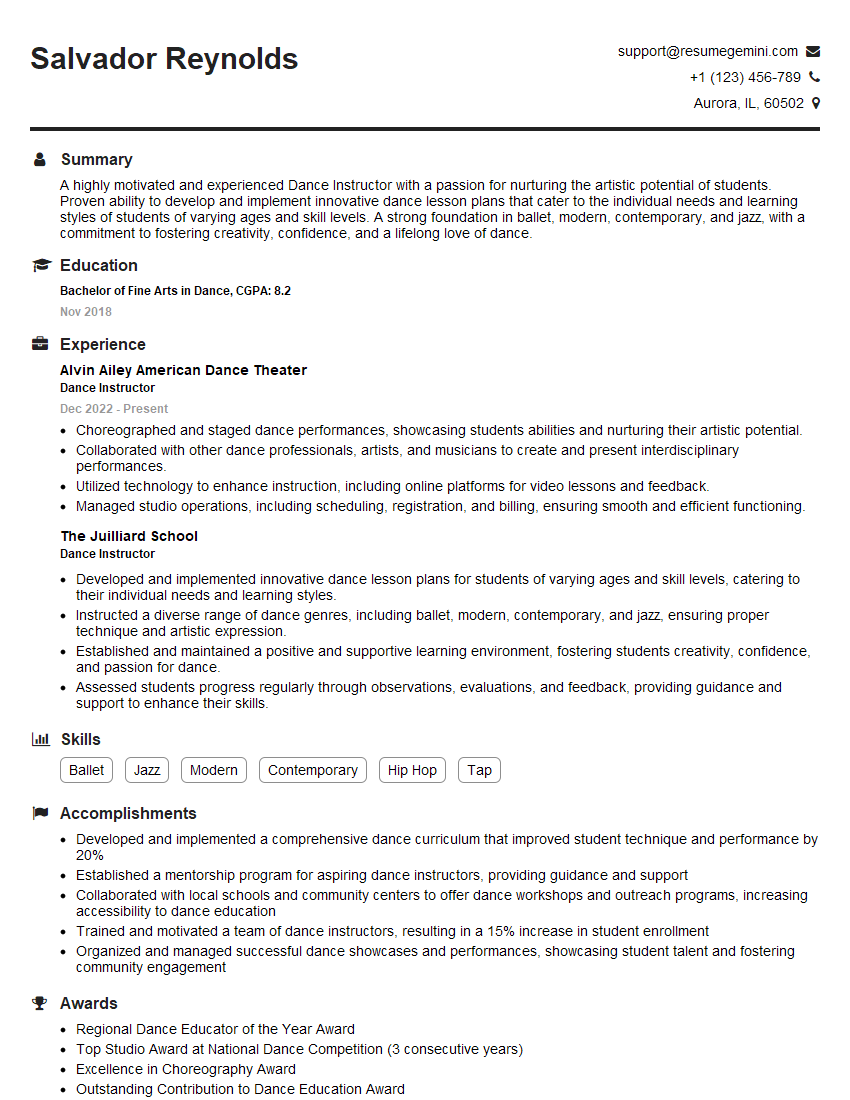
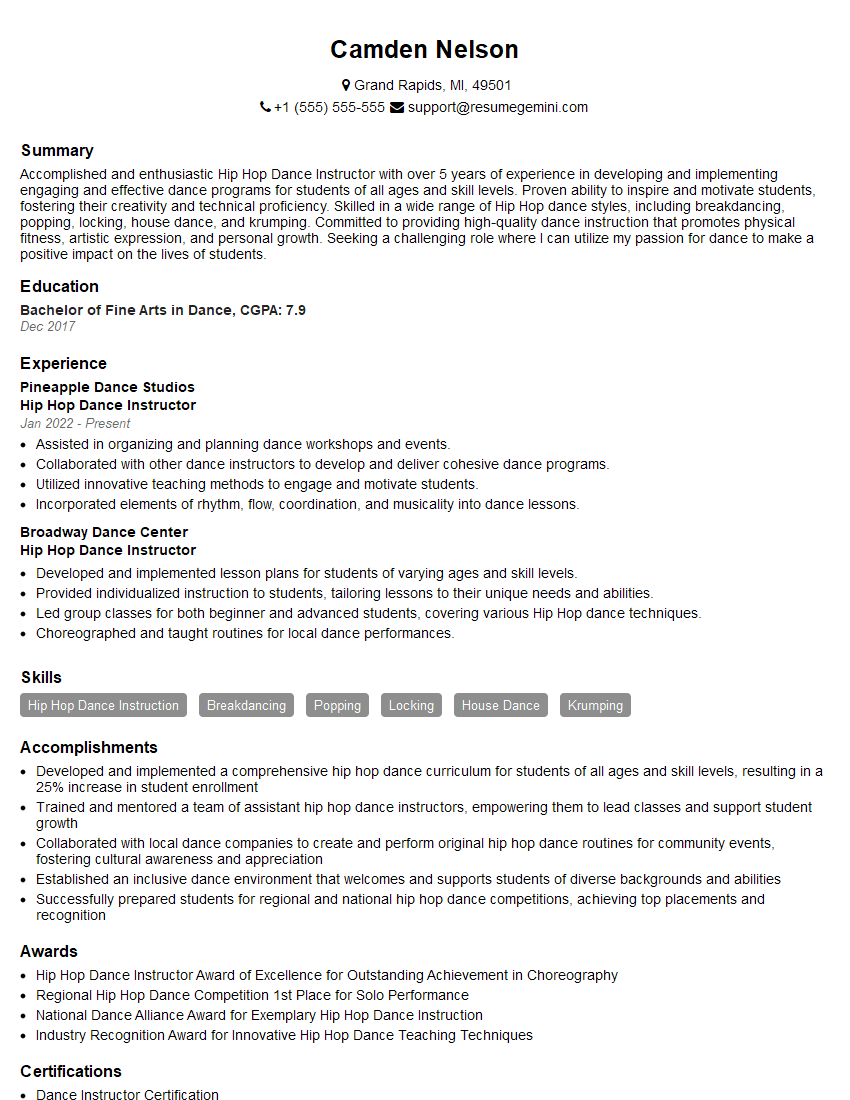
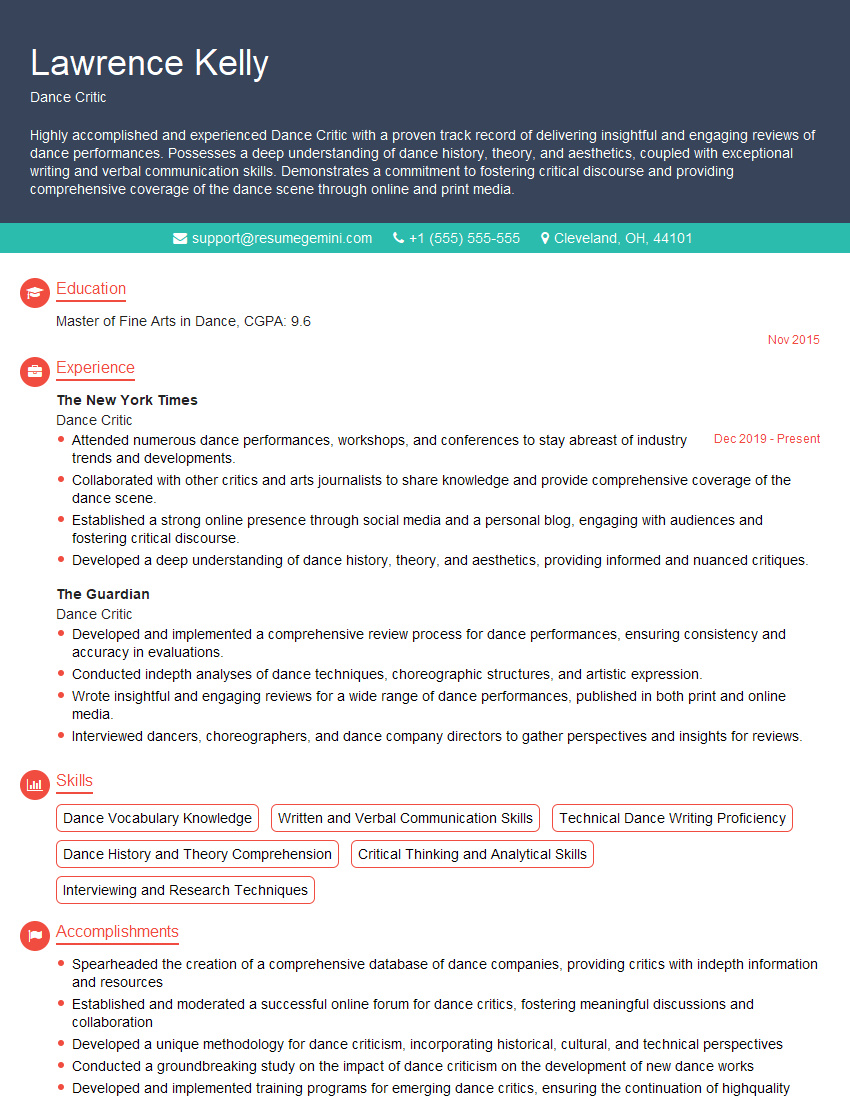
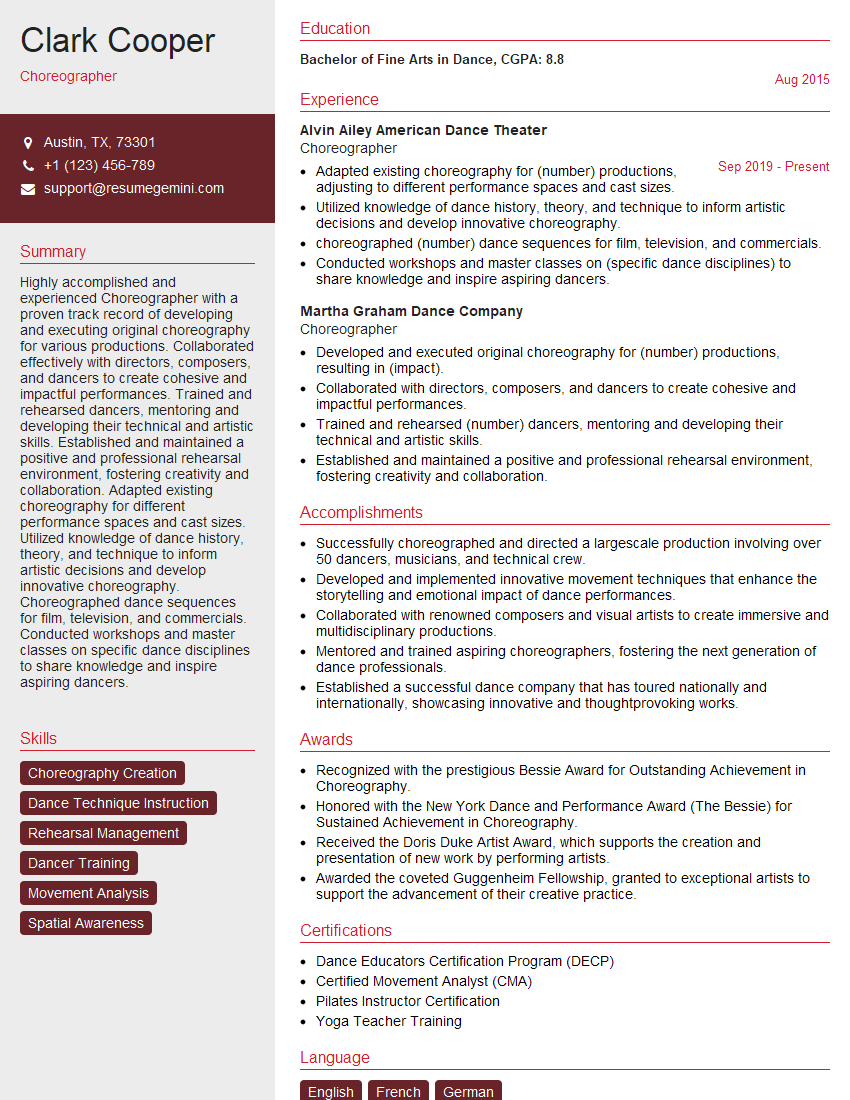
Mastering Choreography and Movement opens doors to exciting and fulfilling careers in dance, theatre, film, and beyond. A strong resume is your key to unlocking these opportunities. Creating an ATS-friendly resume that highlights your skills and experience is crucial for getting noticed by potential employers. To help you craft a compelling and effective resume, we recommend using ResumeGemini, a trusted resource for building professional resumes. ResumeGemini provides examples of resumes tailored to Choreography and Movement, ensuring your application stands out from the competition. Invest the time to build a professional resume – it’s an investment in your future success.
Explore more articles
Users Rating of Our Blogs
Share Your Experience
We value your feedback! Please rate our content and share your thoughts (optional).
What Readers Say About Our Blog
Very informative content, great job.
good