Every successful interview starts with knowing what to expect. In this blog, we’ll take you through the top Client Relations and Account Management interview questions, breaking them down with expert tips to help you deliver impactful answers. Step into your next interview fully prepared and ready to succeed.
Questions Asked in Client Relations and Account Management Interview
Q 1. Describe your experience managing client expectations.
Managing client expectations is crucial for maintaining positive relationships and achieving project success. It involves a proactive and transparent approach, setting realistic goals from the outset, and consistently communicating progress and potential challenges. This prevents misunderstandings and ensures clients feel valued and informed.
My approach involves:
- Clearly defining the scope of work: I work closely with clients to document every aspect of the project, including deliverables, timelines, and success metrics. This leaves no room for ambiguity and sets clear expectations.
- Regular communication: I maintain consistent contact with clients through regular updates, progress reports, and meetings. This keeps them informed and allows for immediate feedback and adjustment.
- Setting realistic timelines: I always avoid over-promising and under-delivering. I provide realistic time estimates based on past experience and potential roadblocks. This builds trust and credibility.
- Proactive problem-solving: When issues arise, I address them immediately, proposing solutions and keeping the client informed every step of the way. This demonstrates commitment and prevents minor issues from escalating.
For example, in a recent project involving website development, I meticulously documented all features, design specifications, and timelines in a detailed project proposal. This ensured the client fully understood what to expect and avoided later disagreements regarding deliverables.
Q 2. How do you prioritize competing client demands?
Prioritizing competing client demands requires a structured approach that balances urgency, importance, and client relationships. It’s not just about who shouts loudest but about strategic decision-making that maximizes overall value and client satisfaction.
My process usually involves:
- Assessing urgency and impact: I evaluate each request based on its deadline, potential consequences of delay, and the overall impact on the client’s business objectives.
- Prioritization matrix: I often use a prioritization matrix (e.g., Eisenhower Matrix – Urgent/Important) to categorize tasks and allocate resources effectively.
- Communication with clients: I communicate openly with clients about my prioritization process, explaining the rationale behind my decisions. This ensures they understand my approach and fosters trust.
- Negotiating timelines and scope: Where possible, I negotiate timelines or scope adjustments to manage workload effectively. This requires diplomatic communication and a willingness to compromise.
For instance, if one client needs an urgent bug fix while another requires a long-term strategic planning session, I’d address the urgent bug fix first, then schedule the strategic planning to ensure both needs are met without compromising quality or deadlines.
Q 3. Explain your process for identifying and addressing client concerns.
Identifying and addressing client concerns is a proactive and empathetic process. It involves active listening, clear communication, and a commitment to finding solutions.
My process typically follows these steps:
- Active listening: I pay close attention to the client’s concerns, asking clarifying questions to fully understand the issue.
- Empathetic understanding: I acknowledge the client’s feelings and perspectives, demonstrating empathy and showing I value their input.
- Problem definition: I clearly define the problem from the client’s perspective, ensuring everyone is on the same page.
- Solution exploration: I collaborate with the client to explore potential solutions, taking their input into consideration.
- Action plan: I develop a concrete action plan, including timelines and responsibilities, and communicate it clearly to the client.
- Follow-up: I follow up with the client to ensure the solution addressed their concerns and to solicit further feedback.
For example, if a client expressed frustration about a delay in a project, I would first listen carefully, acknowledge their frustration, and then explain the cause of the delay and the steps being taken to rectify the situation. I would then agree on a revised timeline and communicate regularly to keep them informed of progress.
Q 4. How do you build and maintain strong client relationships?
Building and maintaining strong client relationships is a continuous process that requires consistent effort, trust, and mutual respect. It’s about building a partnership, not just a transaction.
My strategy revolves around:
- Personalized communication: I tailor my communication style to each client, understanding their preferences and communication styles.
- Value-added services: I proactively seek opportunities to go above and beyond expectations, providing extra value to demonstrate my commitment.
- Regular check-ins: I schedule regular check-ins beyond project updates, to simply check in and foster open communication.
- Active listening and empathy: I listen actively to client concerns and demonstrate genuine empathy to build trust and rapport.
- Proactive problem-solving: I anticipate potential challenges and proactively address them, preventing issues from escalating.
I view each client relationship as a long-term partnership. For example, I regularly send relevant industry articles to clients, showcasing my expertise and maintaining a consistent connection beyond project deliverables.
Q 5. What metrics do you use to measure client satisfaction?
Measuring client satisfaction is crucial for understanding performance and identifying areas for improvement. I use a combination of quantitative and qualitative metrics.
Quantitative metrics include:
- Client satisfaction surveys: Regular surveys using standardized questionnaires provide numerical data on overall satisfaction.
- Net Promoter Score (NPS): This metric measures client willingness to recommend services to others.
- Customer Lifetime Value (CLTV): This indicates the long-term value of a client relationship.
Qualitative metrics include:
- Client feedback: Gathering direct feedback through meetings, emails, or informal conversations.
- Project reviews: Conducting formal project reviews to assess performance and client satisfaction.
- Referrals: The number of referrals from existing clients is a strong indicator of satisfaction.
By using a combination of these metrics, I can gain a holistic understanding of client satisfaction and identify areas for improvement.
Q 6. Describe a situation where you had to negotiate a favorable outcome for your client.
In a recent project with a major technology firm, we faced a significant challenge when a critical software component failed to meet performance specifications during the final stages of development. The client threatened to terminate the contract, citing breach of agreement and demanding significant compensation for project delays.
My approach involved:
- Open communication: I immediately communicated the issue to the client, acknowledging the problem and its impact without making excuses.
- Collaborative problem-solving: I proposed a joint solution, suggesting alternative components, expedited testing, and adjusted timelines, showing commitment to a swift resolution.
- Value proposition: I highlighted the overall value we provided, and the significant progress already made on other deliverables, emphasizing the long-term partnership.
- Negotiation: I negotiated a revised contract that included a fair adjustment to the payment schedule and a commitment to deliver fully functional software within a revised timeline, mitigating the impact on the client.
Through open communication, collaborative problem-solving, and a willingness to compromise, we reached a favorable outcome. The project was successfully completed, and the client relationship was strengthened.
Q 7. How do you handle difficult or demanding clients?
Handling difficult or demanding clients requires patience, empathy, and a structured approach. It’s about understanding their motivations, addressing their concerns, and setting boundaries respectfully.
My approach involves:
- Empathetic listening: I listen carefully to understand their concerns and perspectives, even if their approach is aggressive or demanding.
- Clear communication: I clearly communicate expectations, policies, and limitations in a respectful manner.
- Setting boundaries: I set clear professional boundaries while maintaining respect and empathy. This prevents the client from taking advantage.
- Problem-solving collaboration: I focus on collaboratively finding solutions that address their concerns and meet project goals.
- Escalation process: For particularly challenging situations, I have a clear escalation process to involve senior management or other appropriate resources.
For example, if a client consistently makes unreasonable demands, I’d calmly but firmly explain the limitations and propose alternative solutions that align with our capabilities and contractual agreements. This involves maintaining professional distance while demonstrating care and respect.
Q 8. How do you stay organized while managing multiple client accounts?
Staying organized with multiple clients requires a systematic approach. Think of it like a well-orchestrated symphony – each client is an instrument, and I’m the conductor ensuring harmonious performance. I rely heavily on a robust CRM (Customer Relationship Management) system, meticulously documenting every interaction, task, and deadline. This isn’t just about task lists; it’s about understanding the unique needs and priorities of each client. I use color-coding, labels, and prioritized task lists within my CRM to visually represent urgency and importance. For example, a red flag might indicate an urgent issue requiring immediate attention, while a yellow flag might represent an upcoming deadline. I also dedicate specific time slots each week for focused work on each client’s projects, minimizing context switching and maximizing efficiency. Regular review of my calendar and to-do lists helps me stay proactive and anticipate potential roadblocks.
- CRM System: My CRM acts as a central hub for all client information, ensuring data consistency and accessibility.
- Prioritized Task Lists: I utilize a system of prioritization to focus on the most critical tasks first.
- Time Blocking: I schedule dedicated time blocks for specific clients to maintain focus and improve productivity.
Q 9. What is your approach to onboarding new clients?
Onboarding new clients is crucial for establishing a strong foundation for a long-term relationship. My approach is centered around a structured process, ensuring a smooth transition and setting clear expectations. It’s akin to welcoming a new guest to a well-planned event – everything should be seamlessly arranged. It begins with a thorough understanding of their needs and expectations through detailed discovery calls and questionnaires. This allows me to tailor my services and develop a customized plan that addresses their specific goals. Next, I create a detailed onboarding plan outlining key milestones, timelines, and communication protocols. I ensure this plan is thoroughly reviewed and signed off by the client, fostering transparency and alignment. Finally, I conduct regular check-in calls during the initial weeks to address any concerns and provide ongoing support. This helps establish a strong rapport and demonstrates my commitment to their success.
- Discovery Calls: Thorough initial conversations to understand client needs.
- Customized Onboarding Plan: Tailored plan specific to each client’s requirements.
- Regular Check-in Calls: Ongoing communication to address concerns and provide support.
Q 10. How do you ensure consistent communication with your clients?
Consistent communication is the cornerstone of any successful client relationship. It’s not just about responding to queries; it’s about proactively keeping clients informed and engaged. I employ a multi-channel approach, utilizing email, phone calls, and project management software depending on the client’s preference and the nature of the communication. For example, I might use email for routine updates and formal reports, while reserving phone calls for more complex issues or sensitive discussions. I also utilize project management tools to share progress updates, documents, and track tasks collaboratively. Regularly scheduled calls are part of my strategy – perhaps a weekly check-in or a monthly review depending on the project’s complexity. This maintains a consistent flow of information and prevents misunderstandings. Finally, I always maintain a clear and concise communication style, avoiding jargon and tailoring my messaging to the client’s understanding.
- Multi-Channel Communication: Using email, phone, and project management software based on client preference and context.
- Regular Scheduled Calls: Maintaining consistent communication through proactive check-ins.
- Clear & Concise Messaging: Ensuring the client understands the information provided.
Q 11. Describe your experience using CRM software.
My experience with CRM software is extensive. I’ve used several platforms, including Salesforce, HubSpot, and Zoho CRM, adapting my skills to different systems as needed. I’m proficient in utilizing the key features of CRM software such as contact management, lead tracking, opportunity management, reporting, and automation. For example, I’ve used Salesforce to track the entire client lifecycle, from initial lead generation to ongoing account management. This allows for detailed analysis of client interactions, sales trends, and overall account health. I understand the importance of data integrity and regularly ensure data accuracy and consistency within the system. I’ve also utilized the automation features of these systems to streamline tasks such as email marketing, appointment scheduling, and reporting, freeing up more time to focus on building client relationships. My skills extend to data analysis within the CRM, identifying key trends and insights to optimize sales strategies and improve client service.
- Proficiency in Multiple Platforms: Experience with Salesforce, HubSpot, and Zoho CRM.
- Data Integrity and Accuracy: Maintaining high standards of data quality in the CRM.
- Automation and Streamlining: Using automation features to improve efficiency.
- Data Analysis: Utilizing CRM data for strategic decision-making.
Q 12. How do you identify opportunities for upselling or cross-selling to existing clients?
Identifying upselling and cross-selling opportunities requires a deep understanding of the client’s current needs and future goals. It’s not about aggressive selling; it’s about identifying how my services can provide added value. This involves proactive communication and ongoing monitoring of client projects and activities. For example, if a client initially engaged for website development expresses interest in SEO, I would present them with a tailored proposal outlining the benefits of adding SEO services to their current package. I also leverage CRM data to track usage patterns and identify potential needs. Regular reviews of client accounts help me assess if there are any gaps or areas where I can provide additional assistance. This is about building relationships where the client sees you as a trusted advisor and strategic partner rather than just a vendor. A crucial element is presenting solutions, not just products—framing the value proposition of upselling or cross-selling in terms of how it will improve their business outcomes.
- Proactive Communication: Regularly engaging with clients to understand their evolving needs.
- CRM Data Analysis: Tracking usage patterns and identifying potential needs.
- Value-Based Selling: Presenting solutions that align with the client’s business goals.
Q 13. How do you handle client complaints or negative feedback?
Handling client complaints or negative feedback requires a proactive and empathetic approach. It’s an opportunity to demonstrate your commitment to client satisfaction and build trust. My first step is to actively listen to the client’s concerns without interrupting. This helps me understand the root cause of the issue. Then, I acknowledge their feelings and validate their experience, showing empathy and understanding. Next, I outline a clear plan of action to address the problem, providing realistic timelines and keeping the client updated throughout the process. If the problem is my responsibility, I apologize sincerely and take ownership of the mistake. Transparency is key—even if I can’t immediately resolve the issue, I keep the client informed every step of the way. The goal is not only to resolve the immediate issue but to strengthen the client relationship. A follow-up communication to ensure their satisfaction and confirm resolution is crucial. I also use feedback constructively, identifying areas for improvement in my processes or services.
- Active Listening: Understanding the client’s perspective and concerns.
- Empathy and Validation: Showing understanding and acknowledging feelings.
- Clear Plan of Action: Outlining steps to address the problem with realistic timelines.
- Transparency and Communication: Keeping the client informed throughout the process.
- Follow-up: Ensuring satisfaction and identifying areas for improvement.
Q 14. What strategies do you use to retain clients?
Client retention relies on building strong, long-term relationships built on trust, mutual respect, and consistent value delivery. It’s a marathon, not a sprint. I focus on exceeding client expectations consistently. Regular check-ins, both proactive and reactive, are paramount. Proactive check-ins prevent issues, while reactive check-ins allow for swift issue resolution. I actively seek feedback and utilize it to continuously improve services. This shows clients that their input is valued and that I’m committed to their long-term success. Personalized communication, understanding their business goals deeply, and demonstrating a genuine interest in their achievements are vital. Rewarding loyalty with exclusive offers or preferential treatment strengthens the bond. Finally, actively seeking referrals demonstrates a confidence in the value provided, and a strong client advocate network is invaluable for long-term growth.
- Exceeding Expectations: Consistently delivering high-quality service and support.
- Regular Check-ins: Maintaining consistent communication and identifying potential issues early.
- Feedback Collection and Utilization: Using feedback to improve services and meet client needs.
- Personalized Communication: Building rapport and understanding client’s unique needs.
- Loyalty Rewards: Recognizing client loyalty with exclusive offers.
- Referrals: Encouraging client referrals through exceptional service.
Q 15. How do you measure the success of your client relationships?
Measuring the success of client relationships isn’t solely about revenue; it’s a holistic assessment encompassing several key performance indicators (KPIs). I utilize a multi-faceted approach, tracking metrics such as client satisfaction (measured through surveys and regular check-ins), retention rates, the Net Promoter Score (NPS), and the achievement of mutually agreed-upon goals outlined in service level agreements (SLAs).
- Client Satisfaction: Regular feedback through surveys, one-on-one meetings, and informal communication provides valuable insights into client perception of our service quality and responsiveness. A high satisfaction score directly correlates to a successful relationship.
- Retention Rate: This metric reflects the percentage of clients who continue their business with us over time. A high retention rate indicates strong client loyalty and successful relationship management.
- Net Promoter Score (NPS): The NPS measures client willingness to recommend our services to others. A high NPS demonstrates strong brand advocacy and reflects the overall positive impact of our client relationships.
- SLA Achievement: Meeting or exceeding the targets set within our SLAs ensures clients receive the promised level of service and reinforces trust. We regularly monitor performance against these pre-defined targets.
By tracking these KPIs, I gain a comprehensive understanding of the health of our client relationships and identify areas for improvement. For example, a dip in NPS might highlight a need for enhanced communication or training, while a low SLA achievement rate could indicate resource allocation issues.
Career Expert Tips:
- Ace those interviews! Prepare effectively by reviewing the Top 50 Most Common Interview Questions on ResumeGemini.
- Navigate your job search with confidence! Explore a wide range of Career Tips on ResumeGemini. Learn about common challenges and recommendations to overcome them.
- Craft the perfect resume! Master the Art of Resume Writing with ResumeGemini’s guide. Showcase your unique qualifications and achievements effectively.
- Don’t miss out on holiday savings! Build your dream resume with ResumeGemini’s ATS optimized templates.
Q 16. Describe your experience working with clients in different industries or cultures.
My experience spans diverse industries, including technology, finance, and healthcare, and I’ve worked with clients across various cultural backgrounds. This exposure has honed my adaptability and cross-cultural communication skills. For instance, in the tech sector, clients often prioritize innovation and speed, requiring quick responses and proactive problem-solving. In contrast, the financial industry emphasizes meticulousness, accuracy, and compliance. This necessitates a more formal and detailed approach.
Working with international clients has broadened my understanding of nuanced communication styles. I’ve learned the importance of being sensitive to cultural differences in communication preferences, such as directness versus indirectness, formality, and nonverbal cues. For example, in some cultures, silence during a negotiation is acceptable, while in others, it might be interpreted as a lack of interest. Understanding these subtleties is crucial for building trust and effective relationships.
I adapt my approach by conducting thorough research on each client’s industry, organizational structure, and cultural norms before engaging. This proactive research enables me to tailor my communication style and approach, enhancing mutual understanding and collaboration.
Q 17. How do you adapt your communication style to different clients?
Adapting communication style is essential for effective client relationship management. My approach is guided by active listening and observation. I assess each client’s communication preferences – are they direct or indirect, detail-oriented or results-focused, formal or informal?
For instance, some clients prefer concise, bullet-pointed updates, while others appreciate more detailed narratives. I adjust my language, tone, and delivery to match their preferred style. With highly technical clients, I ensure my language is precise and avoids jargon. With less technically inclined clients, I use clear, simple language and focus on outcomes. Moreover, I’m mindful of their preferred communication channels (email, phone, video conferencing) and adjust accordingly.
This adaptable communication strategy ensures clarity, enhances understanding, and builds rapport, ultimately leading to stronger and more productive relationships. It’s about being a chameleon, adapting to the needs of each client while remaining authentic and professional.
Q 18. How do you build trust and rapport with clients?
Building trust and rapport is the cornerstone of successful client relationships. It’s a process that requires consistent effort and genuine engagement. I focus on several key strategies:
- Active Listening: Truly listening to clients’ needs, concerns, and perspectives demonstrates respect and understanding. It helps me to tailor my solutions to their specific requirements.
- Empathy and Understanding: Putting myself in the client’s shoes and acknowledging their challenges builds a foundation of trust. This involves understanding their business objectives and showing genuine concern for their success.
- Transparency and Honesty: Open and honest communication builds credibility. I always keep clients informed about project progress, potential challenges, and any changes that may impact them.
- Reliability and Consistency: Meeting deadlines, keeping promises, and consistently delivering high-quality service are critical for building trust and fostering long-term relationships.
- Proactive Communication: Regularly checking in with clients, offering support, and proactively addressing potential issues before they escalate demonstrates my commitment and enhances their confidence in my capabilities.
Building trust is like building a house – it requires a solid foundation of open communication, consistent effort, and genuine care. It’s an ongoing process that strengthens over time.
Q 19. Describe a time you exceeded client expectations.
In a previous role, a client experienced an unexpected system outage just before a critical product launch. They were understandably panicked, and the initial prognosis was that the launch would be significantly delayed. Instead of simply conveying the bad news, I immediately assembled a cross-functional team, including engineers and marketing specialists. We worked around the clock, exploring all possible solutions. We ultimately devised a workaround that minimized disruption and allowed the client to launch their product only a few hours behind schedule.
This went beyond simply meeting expectations; it was about demonstrating our commitment and resourcefulness in a high-pressure situation. The client was incredibly grateful for our rapid response and dedication, and this experience strengthened our relationship significantly. It also led to them recommending our services to several other companies.
This experience highlighted the importance of proactive problem-solving and quick decision-making under pressure. It also showed the value of having strong cross-functional collaboration within my team and with the client.
Q 20. How do you handle conflict between different stakeholders (client and internal teams)?
Conflict resolution requires a collaborative and diplomatic approach. My strategy involves facilitating open communication, actively listening to all perspectives, and seeking mutually acceptable solutions. The first step is to identify the root cause of the conflict. This often requires careful questioning and active listening to understand the concerns of both the client and internal teams.
Next, I establish a common goal: finding a solution that satisfies all parties involved. I work to foster a collaborative environment where all stakeholders feel heard and respected. I facilitate open discussion, encouraging everyone to express their perspectives without interruption. I focus on finding common ground and areas of agreement.
If necessary, I may utilize conflict resolution techniques such as mediation or compromise to help reach a consensus. Documentation throughout the process ensures that everyone is on the same page and helps prevent future misunderstandings. The ultimate objective is not simply to resolve the immediate conflict, but to strengthen relationships and enhance future collaboration.
Q 21. What is your experience with contract negotiation?
My contract negotiation experience is extensive and encompasses various types of agreements, from service level agreements (SLAs) to non-disclosure agreements (NDAs) and complex licensing contracts. My approach centers around a thorough understanding of both my organization’s interests and the client’s needs. Before entering negotiations, I conduct extensive research to understand market rates, industry benchmarks, and the client’s specific requirements.
During negotiations, I prioritize open and transparent communication. I strive to create a win-win scenario where both parties feel that their interests have been addressed. I’m adept at identifying areas of compromise and finding creative solutions that meet the needs of both sides. For instance, I might offer flexible payment terms or bundled services to address budgetary constraints, or I might propose alternative solutions that provide equivalent value while addressing specific client concerns.
After the agreement is finalized, I ensure that all parties clearly understand their obligations. The contract is meticulously reviewed, and any ambiguities are clarified before signing. Thorough contract management ensures that expectations are met and disputes are minimized, ultimately leading to strong and productive client partnerships.
Q 22. How do you ensure data security and confidentiality for your clients?
Data security and confidentiality are paramount in client relations. My approach is multifaceted and adheres to strict protocols. It starts with understanding the sensitivity of client data and implementing appropriate measures from the outset. This includes adhering to all relevant data privacy regulations like GDPR or CCPA, depending on the client’s location and the nature of the data.
- Access Control: Implementing robust access control systems, ensuring only authorized personnel with a legitimate business need have access to sensitive information. This often involves role-based access controls (RBAC) and multi-factor authentication (MFA).
- Data Encryption: Employing encryption both in transit (using HTTPS) and at rest (using database encryption) to protect data from unauthorized access even if a breach occurs.
- Regular Security Audits and Training: Conducting regular security audits and penetration testing to identify and address vulnerabilities. Furthermore, providing ongoing security awareness training to all staff to foster a security-conscious culture.
- Data Loss Prevention (DLP) tools: Utilizing DLP tools to monitor and prevent sensitive data from leaving the organization’s control through unauthorized channels. This includes email, USB drives, and cloud storage.
For example, I once worked with a financial institution where data breaches were a critical concern. We implemented end-to-end encryption for all client communication and transactions, alongside rigorous access control policies and employee training, exceeding industry best practices and exceeding client expectations for security.
Q 23. How do you track and report on key performance indicators (KPIs) for your clients?
Tracking and reporting KPIs is crucial for demonstrating value and identifying areas for improvement. My process involves collaborating with clients to define the most relevant KPIs, establishing a clear reporting framework, and using appropriate technology to monitor and analyze data.
- KPI Definition: I work closely with clients to define KPIs that align with their business objectives. These might include customer satisfaction scores (CSAT), net promoter score (NPS), conversion rates, or other metrics relevant to the specific engagement.
- Data Collection and Analysis: I use a combination of CRM software (like Salesforce or HubSpot) and analytics platforms (like Google Analytics) to collect and analyze data related to the KPIs. This includes setting up dashboards and reports to visualize key performance indicators.
- Regular Reporting: I provide regular reports (weekly, monthly, quarterly) that showcase the progress against the KPIs. These reports should be clear, concise, and easily understandable, avoiding technical jargon.
- Actionable Insights: The reports aren’t just about presenting numbers; they also include insights and recommendations based on the data, suggesting improvements to strategies and processes.
For instance, with a marketing agency client, we tracked website traffic, lead generation, and conversion rates. By analyzing the data regularly, we were able to identify the most effective marketing channels, optimize campaigns, and ultimately improve ROI significantly. Regular reporting with clear visualizations played a vital role in showcasing our success and building strong trust.
Q 24. Describe your experience presenting client updates or proposals.
Presenting client updates and proposals requires clear communication and a tailored approach. My experience emphasizes clarity, visual aids, and a focus on the client’s needs. I adapt my style based on the audience and the context.
- Preparation: I meticulously prepare presentations, ensuring the content is concise, relevant, and visually appealing. I utilize charts, graphs, and other visuals to communicate complex information effectively.
- Storytelling: Instead of simply presenting data, I craft a narrative that demonstrates the value and impact of our work, connecting it directly to the client’s goals.
- Interactive Sessions: I encourage questions and discussions during presentations, ensuring the client has a clear understanding and feels heard. This fosters open communication and builds trust.
- Follow-up: After the presentation, I always send a follow-up email with a copy of the presentation, key takeaways, and next steps, reinforcing the information and ensuring clarity.
In one instance, I presented a new strategic plan to a large corporation’s executive team. I structured the presentation around a clear narrative, showcasing how our approach would directly address their business challenges and deliver tangible results. The use of compelling visuals and interactive elements ensured the presentation resonated well, leading to swift approval of the plan.
Q 25. How do you identify and mitigate potential risks to client relationships?
Identifying and mitigating risks is proactive relationship management. My approach involves anticipating potential challenges, developing contingency plans, and maintaining open communication.
- Risk Assessment: I regularly assess potential risks to the client relationship, considering factors like market changes, competitor activities, internal changes within the client’s organization, and potential project roadblocks.
- Communication: Open and honest communication with the client is crucial for identifying and addressing potential issues early on. Regular check-ins and progress reports help proactively address concerns.
- Contingency Planning: I develop contingency plans to address potential problems before they escalate. This could include alternative solutions, fallback strategies, or escalation procedures.
- Proactive Problem Solving: I actively monitor performance indicators and communicate any potential issues immediately, proposing solutions and collaborating with the client to mitigate negative impacts.
For example, I anticipated a potential supply chain disruption for a client manufacturing product. We worked together to secure alternative suppliers, avoiding significant delays and production setbacks. Early communication and proactive measures prevented a major crisis.
Q 26. What is your approach to problem-solving in a client-facing role?
My approach to problem-solving in a client-facing role is structured and collaborative. It prioritizes understanding the client’s perspective and finding mutually agreeable solutions.
- Active Listening: I begin by actively listening to the client to fully understand the problem and their needs. This includes asking clarifying questions and seeking to understand the root cause.
- Collaboration: I work collaboratively with the client to brainstorm solutions. I value their input and seek their agreement on the best course of action.
- Solution Development: I develop concrete solutions, considering their feasibility, impact, and alignment with the client’s objectives. I present these options clearly and concisely.
- Implementation and Follow-up: I ensure the agreed-upon solution is implemented efficiently and effectively. I follow up with the client to monitor progress and address any further issues.
For instance, a client was experiencing delays in a project due to unforeseen technical difficulties. After understanding the problem, I collaborated with our technical team and the client to devise a revised timeline and allocate additional resources, leading to project completion with minimal disruption.
Q 27. How do you use technology to improve efficiency in managing client accounts?
Technology is vital for efficient client account management. I utilize various tools and platforms to streamline processes and enhance communication.
- CRM Systems: I leverage CRM (Customer Relationship Management) systems like Salesforce or HubSpot to manage client data, track interactions, and automate tasks. This improves organization and ensures consistent client service.
- Project Management Software: Tools like Asana, Trello, or Monday.com help track project progress, assign tasks, and manage deadlines, fostering transparency and collaboration with clients.
- Communication Platforms: Utilizing tools like Slack or Microsoft Teams facilitates seamless communication and collaboration with clients and internal teams.
- Automation Tools: Automating repetitive tasks, such as email responses or report generation, frees up time to focus on more strategic client interactions. This improves efficiency and reduces manual effort.
Using a CRM, I can easily track all client interactions, ensuring consistent communication and proactive support. This integrated approach eliminates the need for multiple spreadsheets and email chains, leading to increased efficiency and client satisfaction.
Q 28. How do you stay updated on industry trends and best practices in client relations?
Staying updated on industry trends and best practices is crucial for providing excellent client service. My approach is multi-pronged and continuous.
- Industry Publications and Research: I regularly read industry publications, research reports, and white papers to stay informed about the latest trends and best practices in client relations and account management.
- Networking and Conferences: Attending industry conferences and networking events provides opportunities to learn from peers, hear expert insights, and expand my professional network.
- Professional Development: I actively participate in professional development opportunities, such as webinars, online courses, and workshops, to enhance my skills and knowledge.
- Client Feedback: I actively solicit feedback from clients, using it to improve my service and identify areas where I can enhance my approach.
For example, I recently attended a conference focused on the latest advancements in CRM technology, learning about new features that would streamline my workflow and improve client engagement significantly. Continuously adapting to industry changes ensures I consistently offer the best possible service.
Key Topics to Learn for Client Relations and Account Management Interview
- Building Rapport and Trust: Understanding the nuances of establishing strong client relationships based on mutual respect and understanding. Practical application: Describe a time you successfully built rapport with a challenging client.
- Effective Communication Strategies: Mastering written and verbal communication, including active listening, clear articulation, and adapting your communication style to different client personalities. Practical application: Provide examples of how you’ve tailored your communication to meet diverse client needs.
- Client Needs Analysis & Solutions: Proficiently identifying client needs, proposing tailored solutions, and managing expectations effectively. Practical application: Describe your approach to understanding a client’s underlying business challenges and providing solutions.
- Conflict Resolution & Negotiation: Handling client disagreements and concerns diplomatically and professionally, finding mutually beneficial solutions. Practical application: Explain your strategy for resolving a significant client conflict.
- Account Planning & Strategy: Developing and implementing comprehensive account plans to achieve client objectives and business goals. Practical application: Outline the key components of a successful account plan and how you would monitor its progress.
- CRM Software & Tools: Demonstrating proficiency in utilizing Customer Relationship Management (CRM) systems to manage client interactions, track progress, and analyze data. Practical application: Discuss your experience with specific CRM software and how you utilize its features.
- Performance Measurement & Reporting: Tracking key performance indicators (KPIs) and preparing regular reports to demonstrate the value delivered to clients. Practical application: Describe the metrics you would use to track the success of a client account and how you would present this data.
Next Steps
Mastering Client Relations and Account Management is crucial for career advancement, opening doors to leadership roles and increased earning potential. A well-crafted, ATS-friendly resume is your key to unlocking these opportunities. ResumeGemini can help you create a professional and impactful resume that highlights your skills and experience effectively. We provide examples of resumes tailored to Client Relations and Account Management to guide you in showcasing your abilities. Take the next step towards your dream career – build your best resume with ResumeGemini.
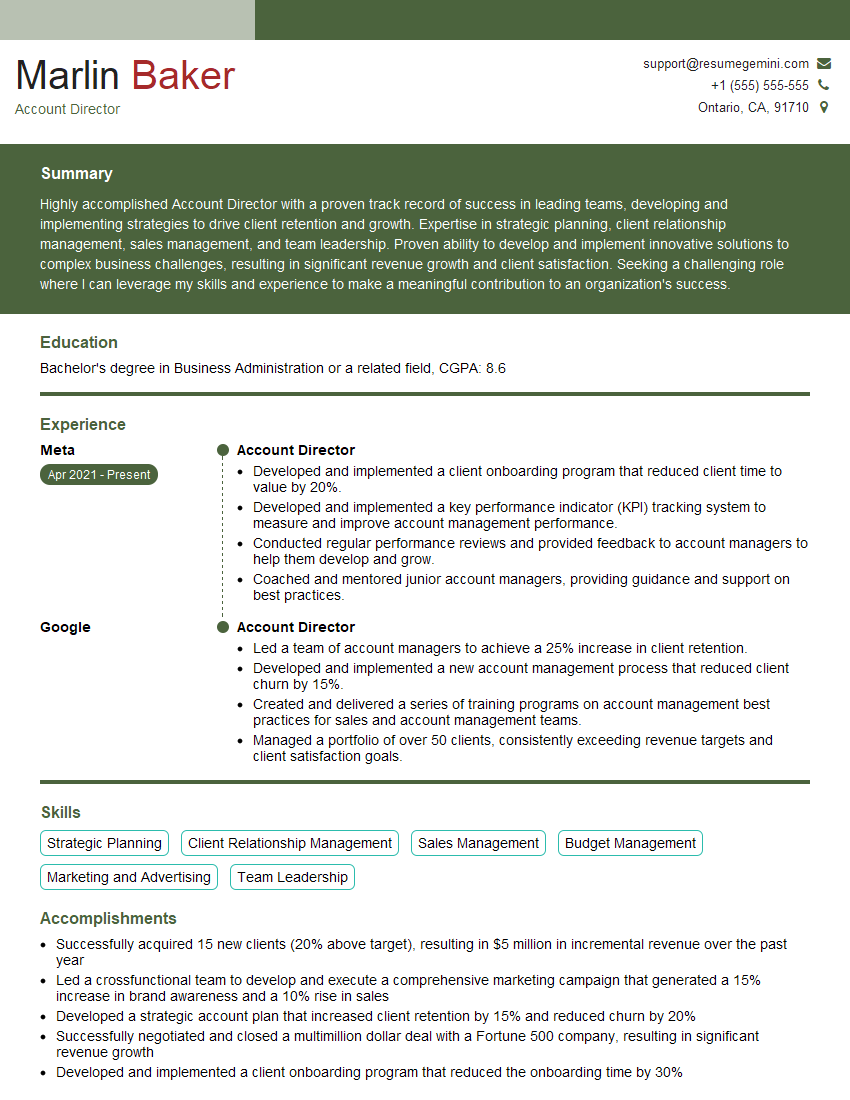
Account Director Resume Sample
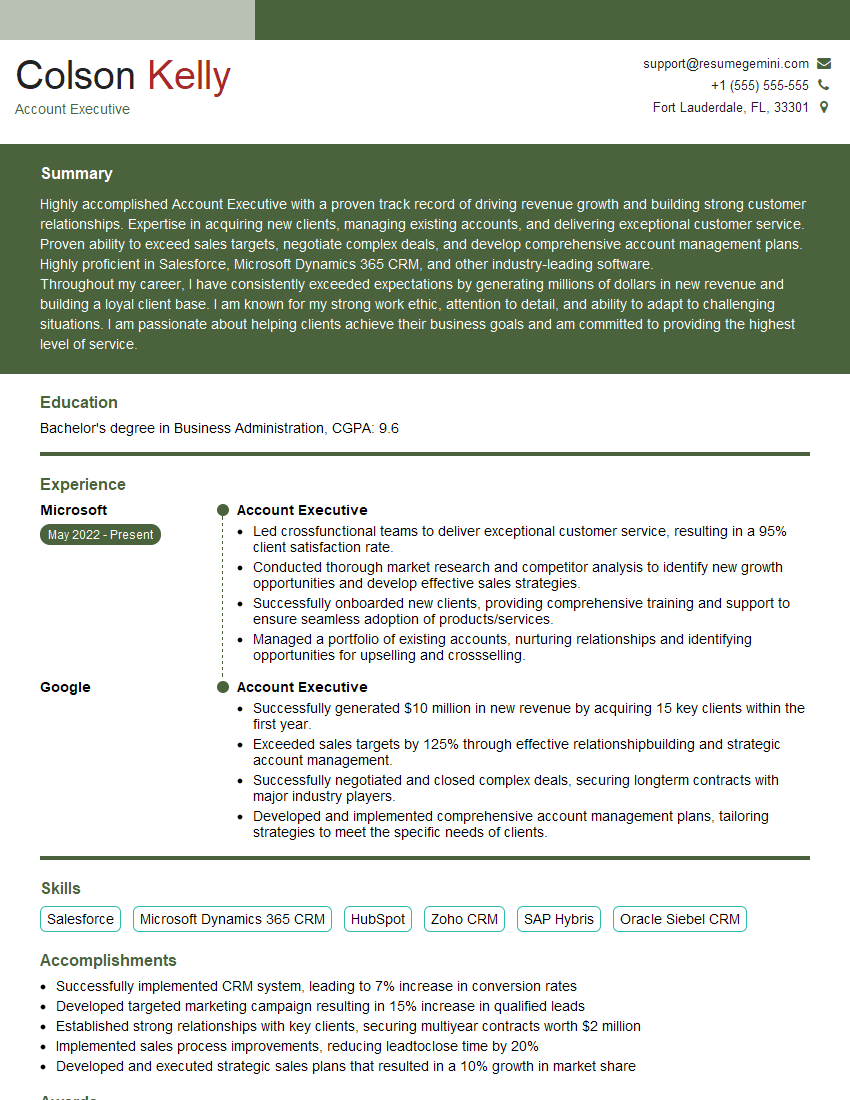
Account Executive Resume Sample
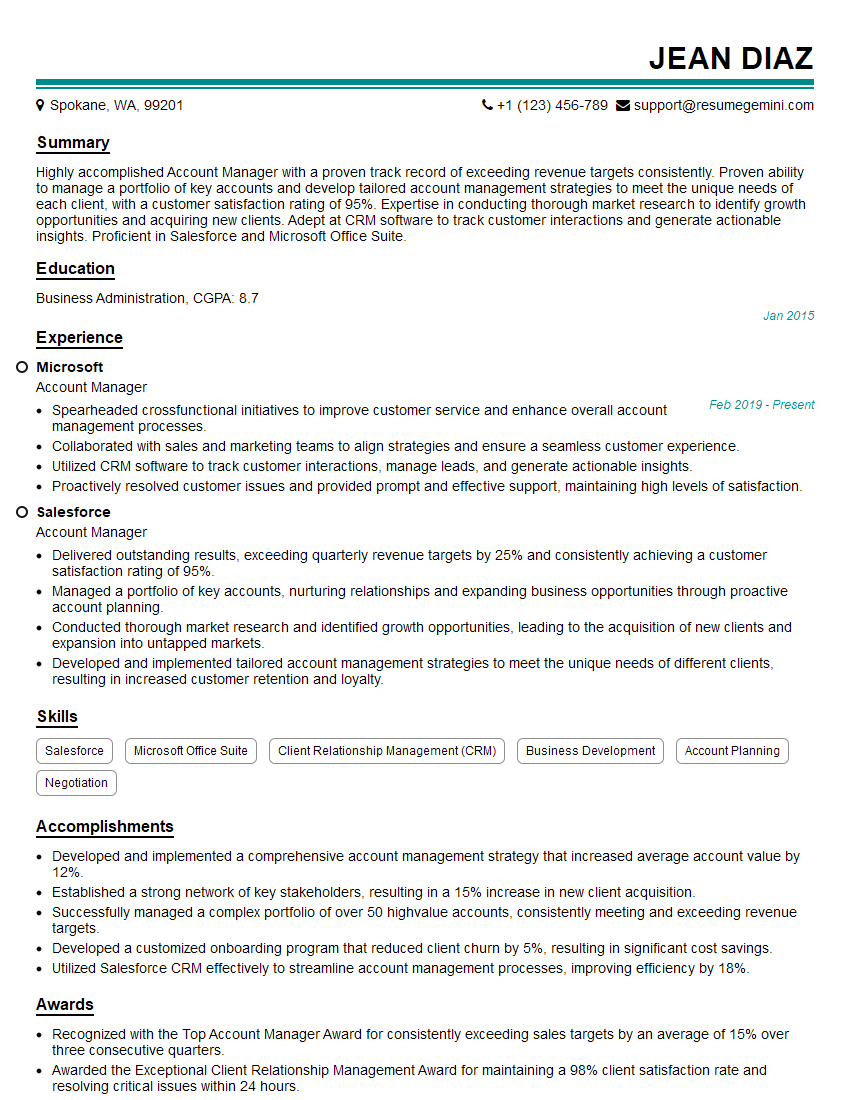
Account Manager Resume Sample
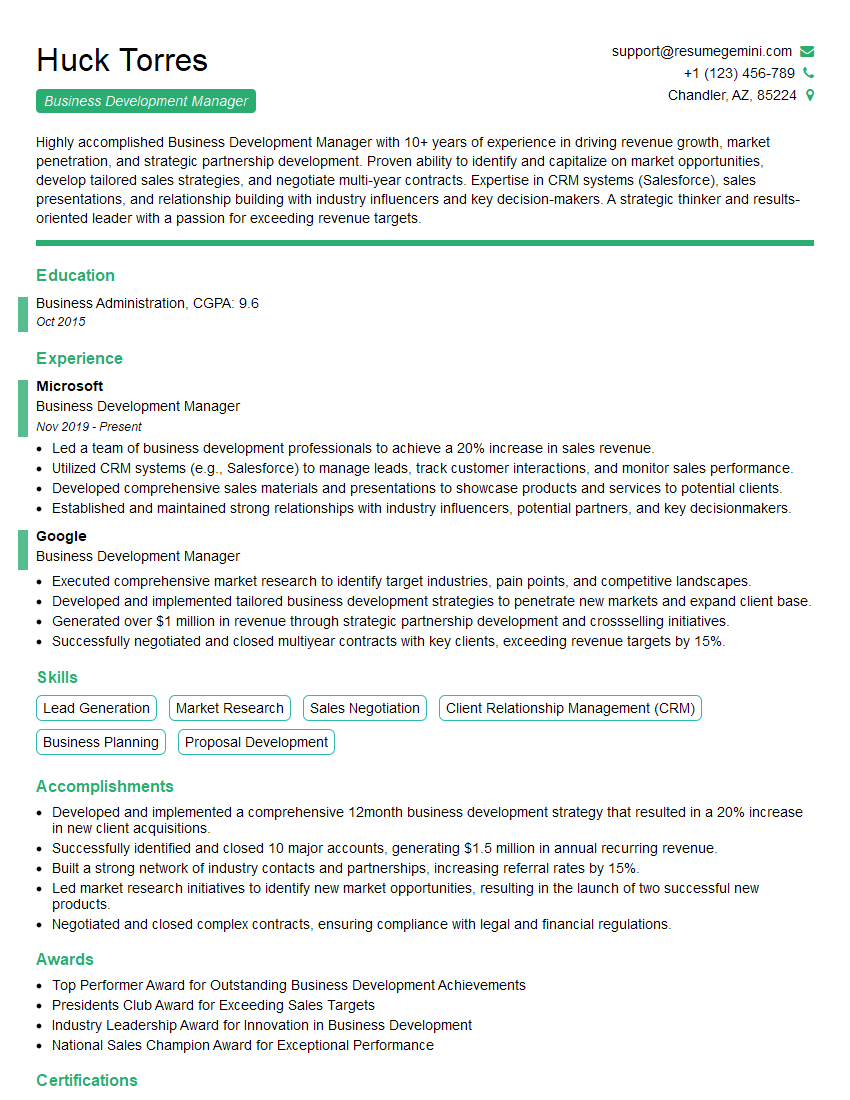
Business Development Manager Resume Sample
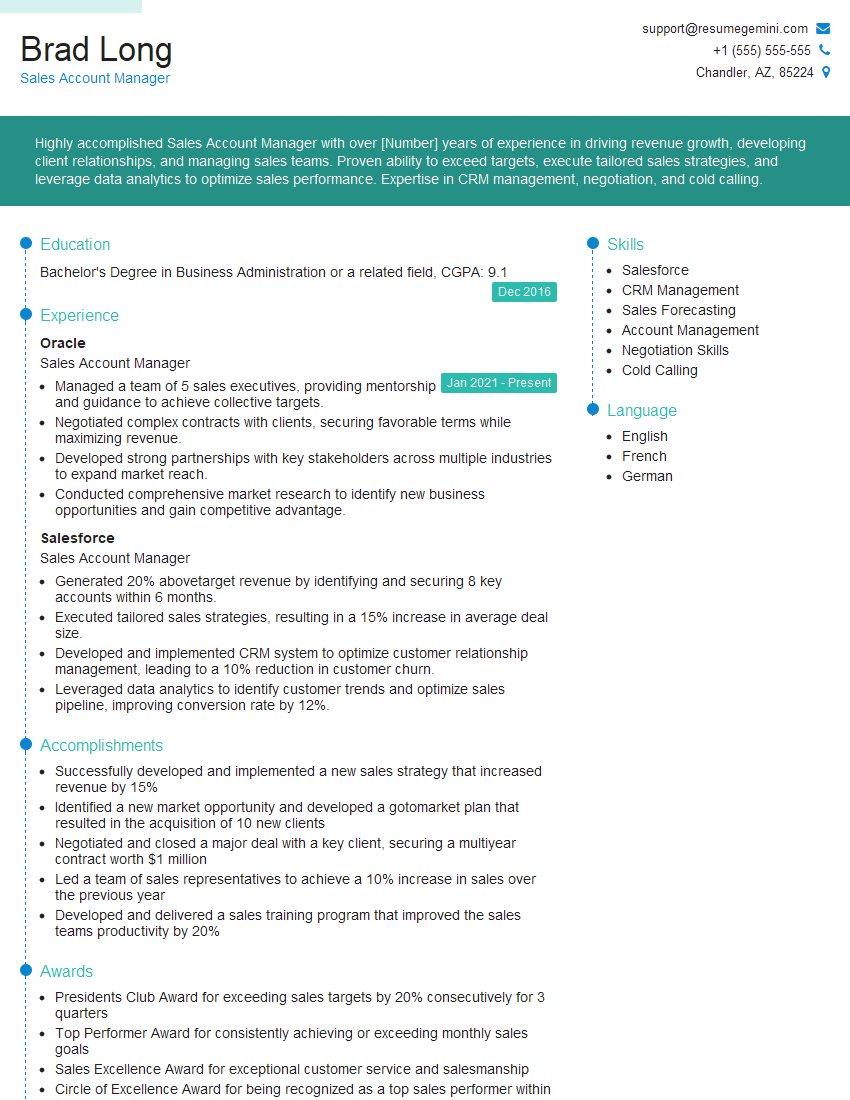
Sales Account Manager Resume Sample
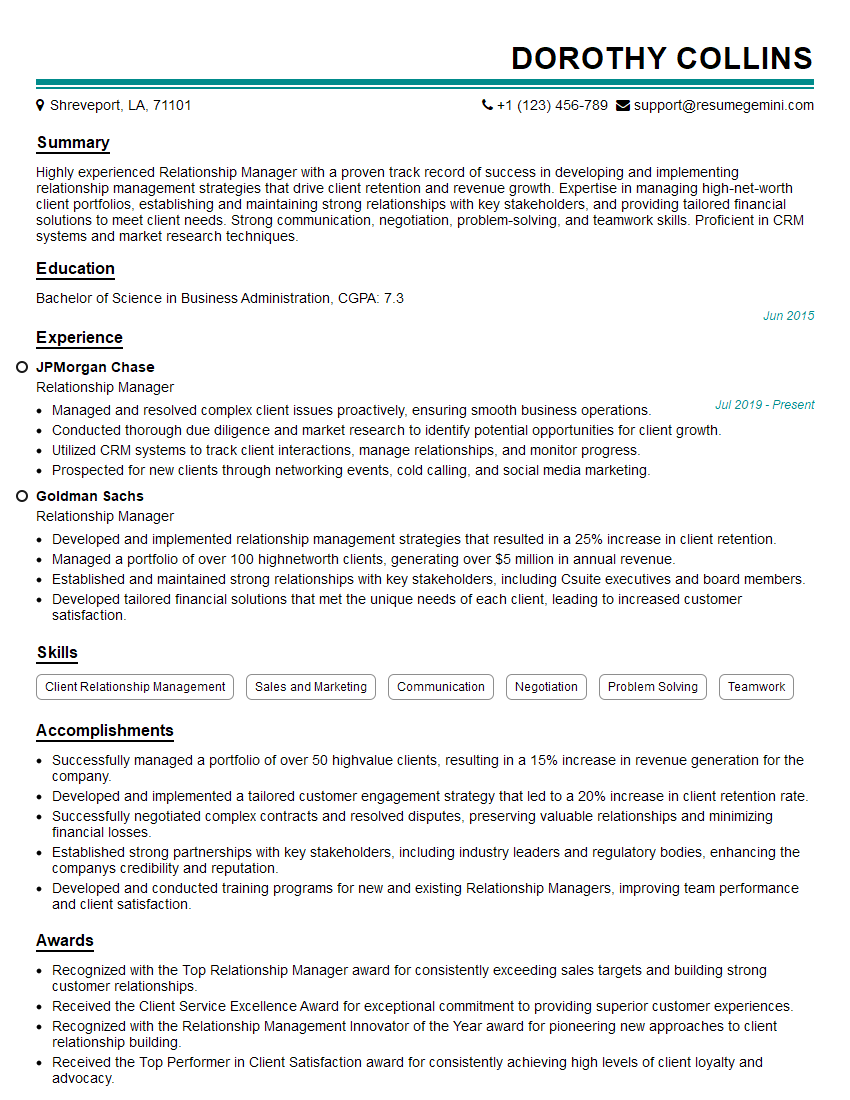
Relationship Manager Resume Sample
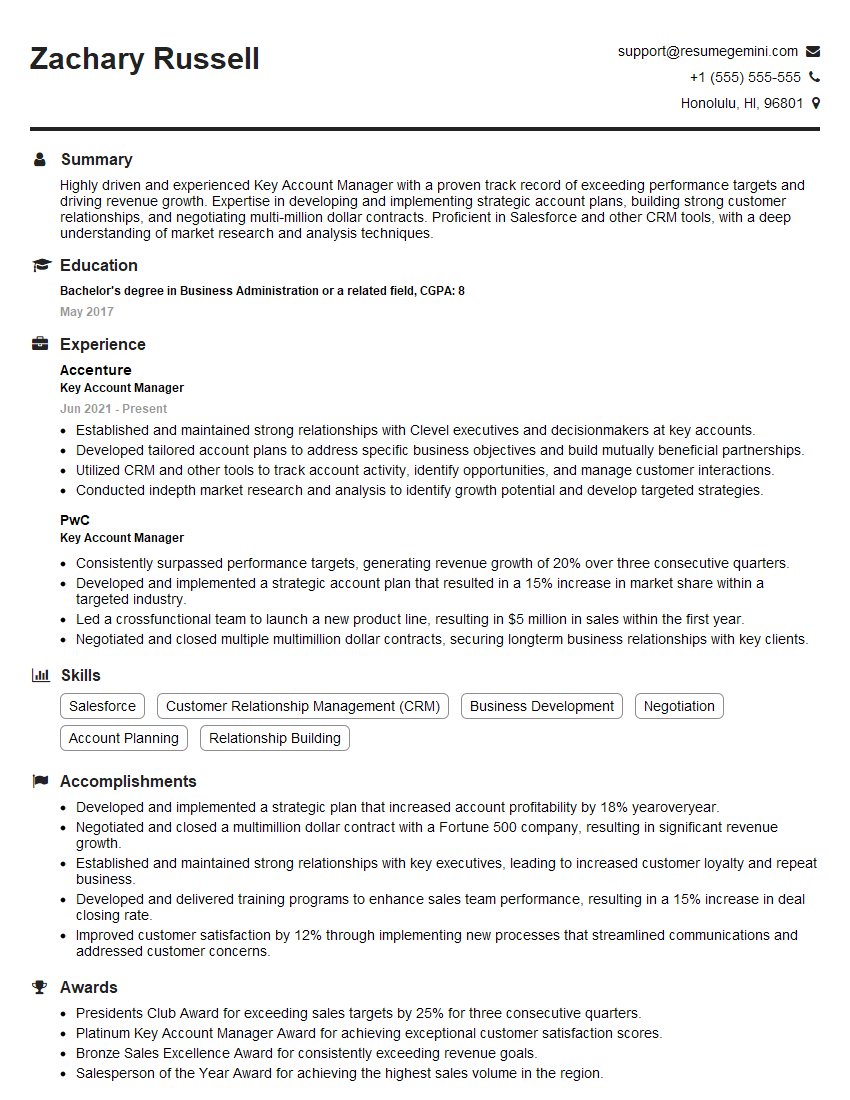
Key Account Manager Resume Sample
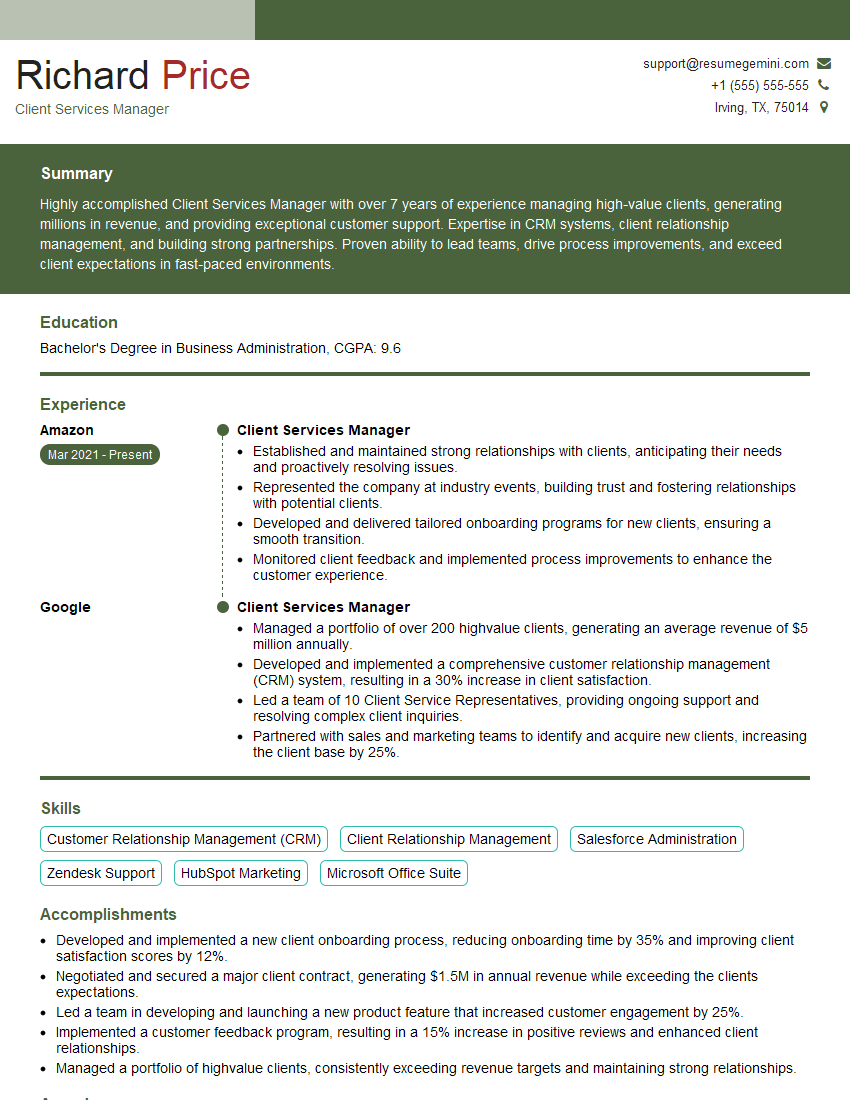
Client Services Manager Resume Sample
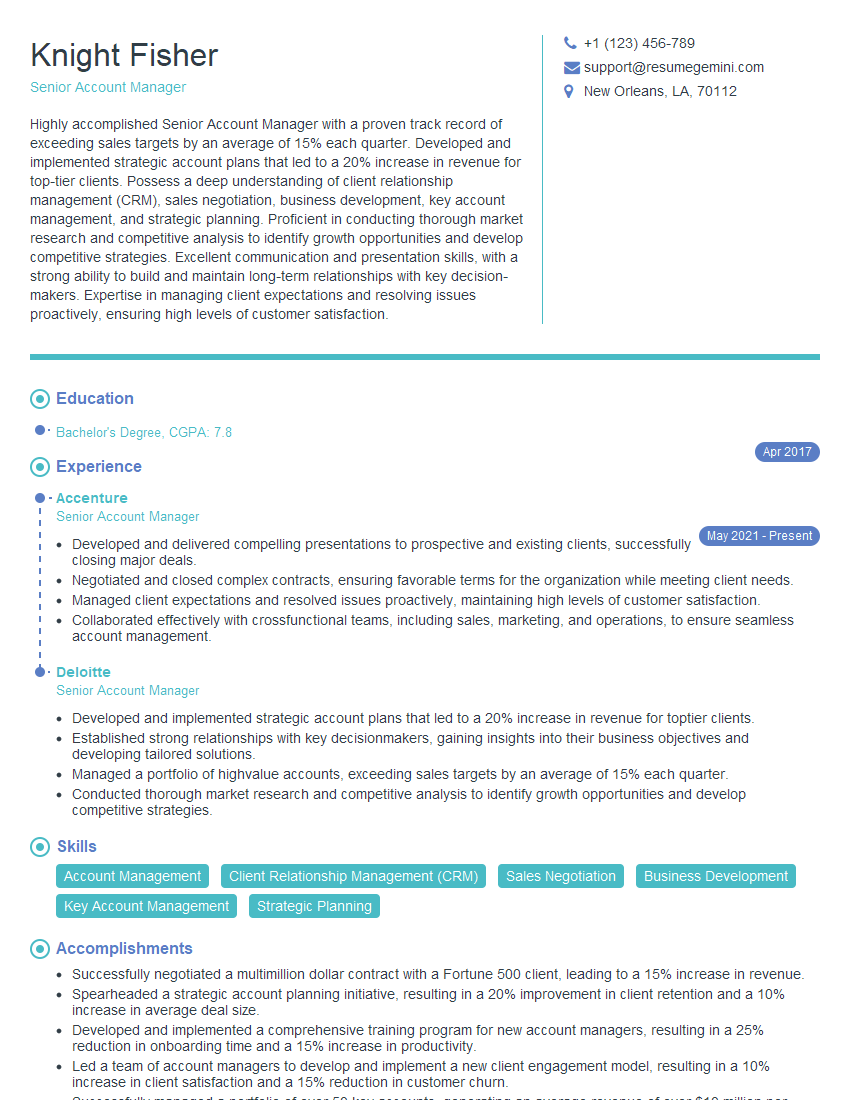
Senior Account Manager Resume Sample
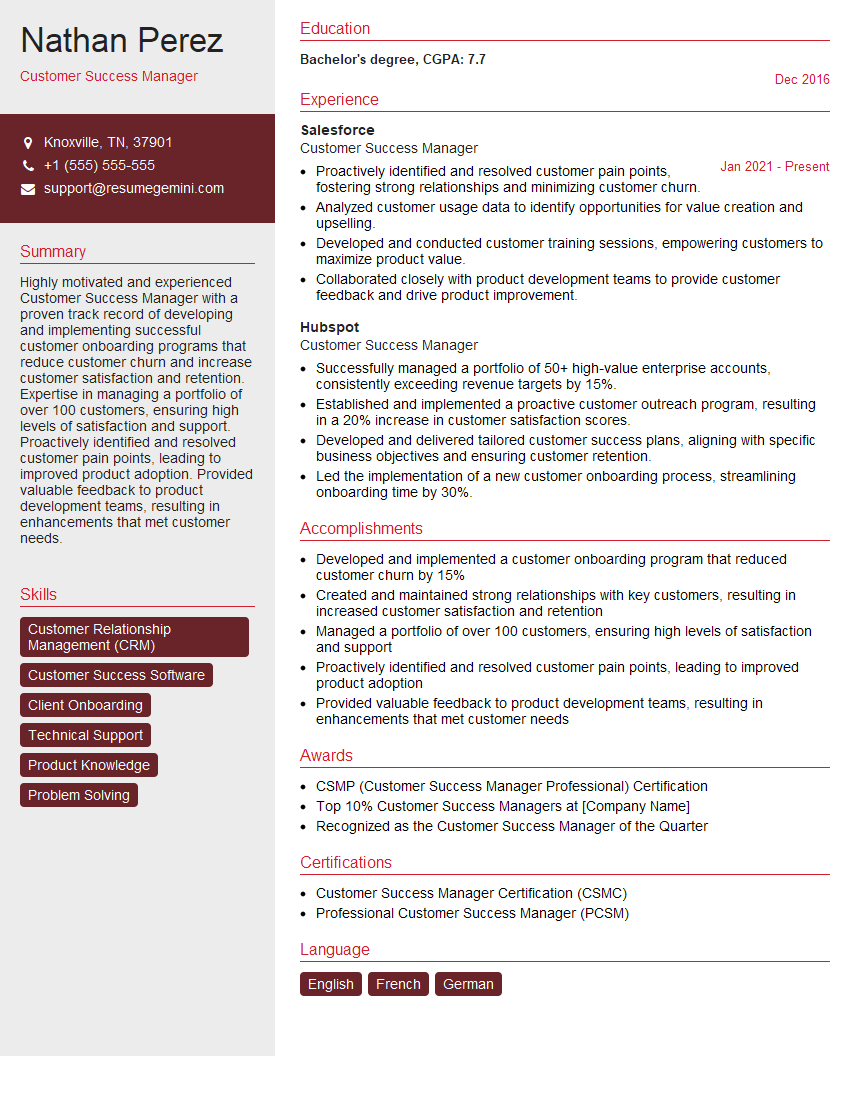
Customer Success Manager Resume Sample
Explore more articles
Users Rating of Our Blogs
Share Your Experience
We value your feedback! Please rate our content and share your thoughts (optional).
What Readers Say About Our Blog
Very informative content, great job.
good