Cracking a skill-specific interview, like one for Clinical Illustration, requires understanding the nuances of the role. In this blog, we present the questions you’re most likely to encounter, along with insights into how to answer them effectively. Let’s ensure you’re ready to make a strong impression.
Questions Asked in Clinical Illustration Interview
Q 1. Describe your experience with different illustration software (e.g., Adobe Illustrator, Photoshop, 3D modeling software).
My expertise spans a wide range of illustration software, essential for creating diverse and high-quality medical illustrations. I’m highly proficient in Adobe Illustrator, utilizing its vector-based capabilities for precise anatomical drawings that can be scaled without loss of quality. This is crucial for creating illustrations for print, web, and presentations. I also leverage Adobe Photoshop extensively for raster-based image manipulation, particularly for photorealistic rendering, adding texture and depth to illustrations, and incorporating photographic elements.
Furthermore, my skills extend to 3D modeling software such as Blender and ZBrush. These tools allow me to create intricate 3D models of anatomical structures, which can then be rendered and incorporated into my illustrations, providing unparalleled realism and detail, especially for complex structures like the human brain or skeletal system. For example, I recently used Blender to create a 3D model of the heart for a client, allowing for dynamic views and animations not achievable with solely 2D software.
Q 2. Explain your process for creating a medical illustration from concept to final product.
My process is iterative and collaborative, ensuring the final product meets the highest standards of accuracy and clarity. It begins with a thorough understanding of the client’s needs and the specific medical concept to be illustrated. This involves detailed discussions to determine the purpose, target audience, and desired style of the illustration.
- Research & Concept Development: I meticulously research the anatomical structures and medical concepts involved, utilizing peer-reviewed journals, textbooks, and reputable online resources. I then develop several initial sketches to explore different compositional and stylistic approaches, presenting them to the client for feedback.
- Sketching & Refinement: The selected sketch is refined using Adobe Illustrator, focusing on precise anatomical accuracy and visual clarity. This stage involves numerous iterations, constantly consulting anatomical references to maintain precision.
- Colorization & Detailing: Using Adobe Photoshop, I add color, texture, and finer details. I pay close attention to color accuracy, using color palettes that are both visually appealing and scientifically accurate.
- Review & Revisions: The illustration is reviewed by both myself and the client for accuracy, clarity, and overall effectiveness. I’m responsive to feedback and incorporate necessary revisions to ensure client satisfaction.
- Finalization & Delivery: Once approved, the final illustration is prepared for delivery in the client’s preferred format (e.g., high-resolution image file, vector file).
Q 3. How do you ensure anatomical accuracy in your illustrations?
Anatomical accuracy is paramount in medical illustration. To ensure this, I rely on multiple strategies:
- Comprehensive Research: I consult a variety of peer-reviewed journals, anatomical atlases (like Gray’s Anatomy), and reputable medical textbooks to verify anatomical details. I cross-reference information from multiple sources to minimize errors.
- Collaboration with Experts: For complex illustrations, I collaborate with medical professionals – anatomists, surgeons, or specialists – to review my work and provide feedback on its accuracy. This peer review is crucial for validating the accuracy of my depictions.
- Reference Images: I use high-quality anatomical images and photographs as references throughout the illustration process. This includes medical scans like MRI and CT images, which provide detailed three-dimensional views.
- Software Tools: Software like 3D modeling applications allow for precise measurements and accurate representation of anatomical structures. Software such as Illustrator’s precise vector tools ensures lines are clean and accurately represent structures.
For instance, while illustrating a surgical procedure, I would carefully review surgical techniques and anatomical positioning in relevant literature before starting the illustration, then get a surgical expert to verify the accuracy.
Q 4. What are your preferred methods for research and information gathering for medical illustrations?
My research methods are rigorous and multi-faceted. I utilize a combination of approaches to gather the most accurate and comprehensive information:
- Peer-Reviewed Journals: Publications like the Journal of the American Medical Association (JAMA) and The Lancet provide in-depth research findings and detailed anatomical descriptions.
- Medical Textbooks: Classic anatomical atlases like Gray’s Anatomy and specialized medical textbooks serve as essential references for anatomical details and structures.
- Online Databases: Reputable online databases like PubMed offer access to a vast body of medical literature, allowing me to find research articles specific to my projects.
- Medical Professionals: Collaborating with doctors, surgeons, and other medical experts is invaluable for verifying accuracy, clarifying ambiguities, and getting insights into specific procedures or conditions.
- Medical Imaging: I frequently utilize medical images (radiographs, CT scans, MRI scans, etc.) to provide a three-dimensional understanding of the structures I’m illustrating.
Q 5. Describe your experience working with medical professionals and clients.
I have extensive experience collaborating with medical professionals and clients across various disciplines. My approach is centered around open communication, active listening, and a collaborative spirit. I always begin by understanding the client’s specific needs, whether they are educators, medical device companies, or healthcare providers.
For instance, in one project, I worked closely with a cardiothoracic surgeon to illustrate a complex heart surgery. His expertise ensured anatomical accuracy, and our regular communication ensured the illustrations effectively communicated the procedure’s steps and nuances. Similar collaborations have been crucial in developing educational materials for pharmaceutical companies and illustrations for medical textbooks. The ability to translate technical information into visually compelling and easy-to-understand visuals is a key factor in successful collaboration.
Q 6. How do you handle feedback and revisions on your work?
Feedback and revisions are integral parts of my creative process. I actively solicit and welcome feedback from clients and medical experts throughout the project. I view feedback not as criticism, but as an opportunity to improve the accuracy and effectiveness of the illustrations.
My process for handling revisions involves:
- Active Listening: I carefully listen to the feedback, asking clarifying questions to fully understand the concerns.
- Organized Tracking: I use a project management system to track revisions and ensure all feedback is addressed.
- Iterative Refinement: I make the necessary changes, often creating multiple revisions to explore different solutions before finalizing the adjustments.
- Clear Communication: I keep the client informed of my progress, providing updates and seeking confirmation once revisions are complete.
This approach ensures that the final illustrations accurately reflect the client’s vision and meet the highest standards of accuracy and clarity.
Q 7. Explain your understanding of medical terminology and anatomical structures.
A strong grasp of medical terminology and anatomical structures is fundamental to my work. My understanding extends beyond simple memorization; it involves a deep comprehension of the functional relationships between different anatomical components. I can confidently interpret complex medical descriptions and translate them into visually accurate and informative illustrations.
For example, I understand the difference between the various types of cartilage (hyaline, elastic, fibrocartilage) and their locations in the body. I know the precise arrangement of the layers of the skin (epidermis, dermis, hypodermis) and can depict their structures accurately. I’m familiar with regional anatomy (such as the structures of the brachial plexus or the carpal bones) and systemic anatomy (such as the cardiovascular system or the respiratory system). My knowledge encompasses both gross anatomy (visible structures) and microscopic anatomy (cellular structures). This detailed understanding allows me to create illustrations that are both scientifically accurate and easily understood by the intended audience. This is particularly important when illustrating complex surgical procedures, physiological processes, or detailed anatomical structures.
Q 8. How do you incorporate visual clarity and effective communication in your illustrations?
Visual clarity and effective communication are paramount in medical illustration. It’s about translating complex medical information into easily understandable visuals. I achieve this through several key strategies:
- Strategic simplification: I avoid unnecessary detail, focusing on the essential anatomical structures or processes. Think of it like highlighting the key plot points in a story, rather than including every single detail.
- Clear labeling and annotation: Precise and concise labels are crucial. I use clear fonts and consistent placement to avoid confusion. For example, I might use arrows to point to specific structures and different colored labels to categorize them.
- Effective use of color: Color plays a significant role in guiding the viewer’s eye and emphasizing important features. I use a color palette that enhances visual hierarchy and avoids clashing or distracting colors. For example, warm colors might be used to indicate inflammation, while cool colors might indicate healthy tissue.
- Appropriate perspective and scale: I carefully choose the angle and scale of the illustration to optimize understanding. A cross-sectional view might be better than a full-body view for showing internal organs, for instance.
- Consistent style and design: Maintaining consistency in style, font, and labeling throughout a series of illustrations ensures a professional and easily navigable presentation.
For example, when illustrating a complex surgical procedure, I would create a series of illustrations, each focusing on a specific step, with clear annotations to guide the viewer through the process.
Q 9. Describe your experience with different illustration styles (e.g., realistic, stylized).
My experience spans a range of illustration styles, each tailored to the specific project requirements. I’m proficient in:
- Realistic style: This style prioritizes anatomical accuracy and detail, often used for textbooks or educational materials. I meticulously research and reference anatomical atlases and other reliable sources to ensure accuracy.
- Stylized style: This allows for greater creative freedom, simplifying complex structures while retaining clarity. It’s great for infographics, patient education materials, or when a more engaging and less intimidating style is required. For example, using simplified shapes and muted colors can make complex information more accessible to a lay audience.
- Cross-hatching and line art: This technique is particularly effective for conveying depth and texture, often employed for detailed anatomical drawings.
One project involved creating a realistic illustration of the human heart for a medical textbook, requiring precise anatomical detail. Another project used a stylized approach to create engaging infographics explaining common heart conditions for a patient education website. Adaptability is key—the choice of style depends heavily on the intended audience and the message being conveyed.
Q 10. How do you manage deadlines and prioritize tasks in a fast-paced environment?
Managing deadlines in a fast-paced environment involves meticulous planning and efficient workflow management. I utilize several strategies:
- Project Breakdown: I break down large projects into smaller, manageable tasks with clearly defined deadlines. This allows for better tracking of progress and identification of potential bottlenecks.
- Prioritization: I prioritize tasks based on urgency and importance, focusing on the most critical aspects first. This often involves working closely with the client to understand their priorities.
- Time Management Techniques: I use techniques like the Pomodoro Technique (working in focused bursts with short breaks) to maintain concentration and avoid burnout. I also regularly review my schedule and adjust priorities as needed.
- Communication: Open communication with clients is crucial. Regular updates on progress and any potential delays are essential to maintain transparency and manage expectations.
- Contingency Planning: I always build in some buffer time to accommodate unexpected delays or revisions.
For instance, if I have multiple projects with tight deadlines, I use a project management tool to visually track progress, assign deadlines to individual tasks, and ensure everything is completed on time. Proactive communication with clients helps prevent last-minute changes or surprises.
Q 11. What is your understanding of copyright and intellectual property related to medical illustrations?
Understanding copyright and intellectual property is crucial in medical illustration. Medical images, whether photographs or illustrations, are often subject to copyright protection. This means that obtaining permission from the copyright holder is essential before using existing images or adapting them for your work. This includes:
- Image sourcing: Using only royalty-free images or those with explicit permission from the copyright holder.
- Attribution: Properly crediting the original source of any images or data used.
- Original work: Creating original illustrations ensures full ownership of the copyright. This is my preferred method, avoiding any potential legal issues.
- Contracts: Carefully reviewing contracts with clients to understand the ownership and usage rights of the created illustrations.
Ignorance of copyright laws can lead to serious legal consequences. I always prioritize ethical sourcing and ensure that all my work adheres to copyright regulations.
Q 12. Explain your experience with creating illustrations for different media (e.g., print, digital, animation).
My experience encompasses creating illustrations for various media:
- Print: I’ve produced illustrations for textbooks, journals, brochures, posters, and other print materials. This often involves working with high-resolution images and considering the limitations of print production.
- Digital: I create illustrations for websites, e-books, presentations, and interactive media. This requires adapting the illustrations for various screen sizes and resolutions.
- Animation: I have experience in creating animated illustrations for educational videos, explainer videos, and medical simulations. This involves understanding animation principles and collaborating with animators.
For example, a project for a medical textbook required high-resolution illustrations optimized for print reproduction. In contrast, a project for an online patient education portal required illustrations that were responsive and adaptable to various screen sizes. Understanding the specific requirements of each medium is key to successful execution.
Q 13. How do you adapt your illustration style to suit different audiences and purposes?
Adapting my illustration style depends on the target audience and the purpose of the illustration. I consider factors like:
- Audience knowledge: Illustrations for medical professionals require greater detail and accuracy compared to those for the general public. A simplified style might be more effective for a lay audience.
- Communication goal: If the goal is to educate, a clear and detailed illustration is ideal. If it’s to persuade, a more emotionally engaging style might be appropriate.
- Context: The illustration’s placement – in a textbook, website, or presentation – influences its style and design.
For instance, when creating illustrations for a children’s book about the human body, I would use a playful and colorful style with simplified anatomical structures. On the other hand, illustrations for a scientific journal would require a much more realistic and detailed approach. This adaptability ensures the illustration effectively communicates its intended message to the intended audience.
Q 14. Describe your experience with color theory and its application in medical illustration.
Color theory is fundamental in medical illustration. It’s not just about aesthetics; it significantly impacts how information is perceived and understood. I use color to:
- Highlight key features: Using contrasting colors to draw attention to specific structures or processes.
- Create visual hierarchy: Organizing information by using different shades and saturation to guide the viewer’s eye.
- Convey meaning: Using color conventions (e.g., red for inflammation, blue for veins) to enhance understanding and avoid ambiguity. However, it’s important to note that color conventions might vary across cultures, so it’s crucial to be aware of these variations.
- Create mood and tone: The color palette can significantly influence the overall mood and feeling of the illustration.
For example, in an illustration of a surgical procedure, I might use a cool color palette for the healthy tissue and a warmer palette to highlight the area of surgery. Understanding color psychology and its impact on the viewer is crucial for creating effective and informative medical illustrations.
Q 15. Explain your understanding of visual hierarchy and its importance in conveying information effectively.
Visual hierarchy is the arrangement of elements in an illustration to guide the viewer’s eye and emphasize key information. It’s like a roadmap for understanding, ensuring that the most crucial details are noticed first. Think of it as a visual story with a clear beginning, middle, and end. A poorly designed illustration, lacking visual hierarchy, might overwhelm the viewer with too much information at once, making comprehension difficult. Effective visual hierarchy utilizes various techniques including:
- Size: Larger elements naturally draw more attention.
- Color: Bright, contrasting colors are more eye-catching.
- Placement: Elements placed centrally or at the top tend to be noticed first.
- Contrast: Using different textures, shades, and weights to separate important elements from the background.
- Depth: Layering and perspective create a sense of visual depth, guiding the viewer’s eye through the illustration.
For instance, in illustrating a complex anatomical structure, I might use a larger, brighter color for the primary anatomical feature and a less saturated color for secondary structures, ensuring that the viewer quickly understands what is of primary importance.
Career Expert Tips:
- Ace those interviews! Prepare effectively by reviewing the Top 50 Most Common Interview Questions on ResumeGemini.
- Navigate your job search with confidence! Explore a wide range of Career Tips on ResumeGemini. Learn about common challenges and recommendations to overcome them.
- Craft the perfect resume! Master the Art of Resume Writing with ResumeGemini’s guide. Showcase your unique qualifications and achievements effectively.
- Don’t miss out on holiday savings! Build your dream resume with ResumeGemini’s ATS optimized templates.
Q 16. How do you approach the creation of illustrations for complex medical concepts?
Illustrating complex medical concepts requires a structured approach. I begin by thoroughly researching the topic, often consulting with medical professionals or referencing peer-reviewed publications. I then break down the concept into smaller, manageable parts. This process is similar to building with LEGOs: a complex structure is composed of many simple components. I’ll create a series of sketches and thumbnails, experimenting with various visual styles to determine the most effective way to convey the information. For example, if illustrating a complex surgical procedure, I might use a step-by-step approach, accompanied by clear labels and arrows to guide the viewer through the process. Using a combination of diagrams, cross-sections, and 3D renderings can effectively communicate multi-dimensional aspects of the subject. Finally, I carefully curate colors, textures, and visual cues to enhance clarity and accuracy without overwhelming the viewer.
Q 17. Describe your experience with creating illustrations for educational materials.
I have extensive experience creating illustrations for various educational materials, including textbooks, patient education brochures, and online learning modules. One memorable project involved creating illustrations for a children’s book explaining the human digestive system. I employed bright, playful colors and simplified anatomical representations to make the information engaging and easily digestible for young readers. The challenge was to maintain scientific accuracy without making it too complex. The response was overwhelmingly positive, demonstrating the power of clear, approachable medical illustration. Another project involved creating a series of illustrations for a medical textbook explaining different types of fractures. I focused on clarity and anatomical precision to effectively communicate the subtleties of bone fracture patterns.
Q 18. How do you use visual aids to enhance the understanding of complex medical procedures?
Visual aids are indispensable for understanding complex medical procedures. Animations and interactive diagrams are particularly effective. For example, I’ve created animated sequences demonstrating the steps involved in minimally invasive surgery. These animations allow viewers to ‘see’ the procedure from various angles, providing a much deeper understanding than static images alone. Similarly, interactive diagrams let viewers explore a 3D model of an organ, zooming in on specific structures and manipulating it to understand the procedure’s spatial aspects. Clear labeling, concise explanations, and consistent visual style are key elements to ensure the visuals are effective teaching tools.
Q 19. Explain your understanding of the ethical considerations in creating medical illustrations.
Ethical considerations are paramount in medical illustration. Accuracy is crucial; any misrepresentation can have serious consequences. I always verify my work with medical professionals to ensure anatomical accuracy and avoid perpetuating misinformation. I also respect patient privacy and confidentiality, ensuring no identifiable patient information is ever included in my illustrations. I ensure that the illustrations do not present any sort of bias or stereotype, especially concerning race or gender. Furthermore, any depiction of a medical procedure should always be conducted with sensitivity and respect for the patient’s dignity. Finally, proper attribution and copyright considerations are essential.
Q 20. How do you ensure accessibility in your illustrations for individuals with disabilities?
Accessibility is a core principle in my work. I adhere to WCAG (Web Content Accessibility Guidelines) where applicable. For instance, when creating digital illustrations, I use sufficient color contrast to ensure readability for individuals with visual impairments. I also provide alternative text descriptions for images, allowing screen readers to convey the information to visually impaired users. When designing print materials, I use clear, concise labels and avoid complex visual clutter. In cases where high-resolution imagery is not accessible, I will develop alternative simplified versions to ensure information is understandable for everyone.
Q 21. Describe your experience with using reference materials and anatomical atlases.
Reference materials and anatomical atlases are indispensable tools. I regularly consult Gray’s Anatomy and other authoritative sources to ensure anatomical accuracy. I use high-resolution images from these resources as a basis for my illustrations, ensuring that even the finest details are accurately represented. My process involves meticulous cross-referencing and comparison of multiple sources to confirm accuracy, especially when dealing with complex structures or procedures. When dealing with less common conditions, peer-reviewed medical journals and specialist texts become my most important resources.
Q 22. What strategies do you use to maintain consistent quality and accuracy across projects?
Maintaining consistent quality and accuracy in medical illustration is paramount. My approach is multifaceted and centers around establishing clear protocols from the outset of each project. This includes a detailed review of the provided source material – be it medical scans, research papers, or surgeon’s notes – to ensure complete understanding of the required anatomical details and clinical context.
I utilize a standardized workflow, starting with meticulous sketching and anatomical referencing. I then employ a layered approach in my digital software, allowing for easy revision and correction of individual elements. Regular quality checks are incorporated at each stage, from initial concept sketches to the final rendered image. This might involve self-review using checklists, peer review with other illustrators, or even consultation with the client (physician or medical writer) to ensure accuracy and adherence to their specifications.
For instance, in a recent project illustrating a complex surgical procedure, I meticulously cross-referenced each step with the surgical video and the surgeon’s written description. This rigorous cross-referencing ensured the accuracy of every detail, from the positioning of instruments to the precise depiction of tissue layers.
Q 23. How do you incorporate patient privacy and confidentiality into your work?
Patient privacy and confidentiality are non-negotiable. I adhere strictly to HIPAA guidelines and any other relevant regulations regarding the use and protection of Protected Health Information (PHI). This begins with only working with anonymized data. Any identifiable patient features – like facial characteristics or unique medical identifiers – are either excluded entirely or carefully masked.
Furthermore, all digital files are securely stored, utilizing encrypted drives and password-protected access. My workflow includes a thorough review of each image to ensure no PHI is inadvertently included. I also sign confidentiality agreements when required, and I never discuss project details with anyone outside the designated team.
For example, if provided with an image showing a patient’s face during a procedure, I would replace it with a generic illustration showcasing the anatomical area only. Similarly, any identifying information such as medical record numbers are always removed before the image is used.
Q 24. Explain your understanding of different image file formats and their uses.
Understanding image file formats is crucial for efficient workflow and optimal image quality. The choice of format depends on the intended use and the requirements of the project. For instance, I frequently use:
- TIFF (Tagged Image File Format): A lossless format ideal for high-resolution images that require significant editing and manipulation without quality degradation. I use TIFF during the initial stages of illustration and for final files needing archival quality.
- PNG (Portable Network Graphics): This lossless format supports transparency and is suitable for web use or presentations where crispness and clear lines are crucial. I often export illustrations into PNG for inclusion in online publications.
- JPEG (Joint Photographic Experts Group): A lossy format that achieves smaller file sizes by compressing data. While suitable for web images, I prefer to avoid using JPEG for illustrations that need fine detail, because of the loss of quality inherent in this format.
- AI (Adobe Illustrator): A vector format, AI files are scalable without losing resolution, invaluable for logos, diagrams, and illustrations requiring resizing for different platforms without quality compromise.
- EPS (Encapsulated PostScript): A vector format compatible with various software applications, suitable for high-quality printing and publishing.
Selecting the appropriate file format ensures that images maintain quality throughout the design and production process, maximizing visual fidelity and ensuring compatibility across different platforms.
Q 25. How do you handle conflicting requirements or feedback from multiple stakeholders?
Handling conflicting requirements from stakeholders necessitates proactive communication and a structured approach. I begin by carefully documenting all requirements, highlighting any potential conflicts early in the process. Then, I schedule a meeting with all involved parties – physicians, medical writers, editors – to discuss these conflicts openly and collaboratively.
I use a visual approach, presenting different design options that address the varying requirements. This often involves creating mock-ups showcasing the trade-offs of different choices. The goal is to find a consensus, ensuring that the final illustration meets the core needs and communicates the information accurately while accommodating the diverse perspectives of the stakeholders.
For example, if a surgeon requests a highly detailed illustration of a specific surgical instrument, while the medical writer wants a simpler, more generalized image for the intended audience, I present both options alongside a compromise that incorporates key details in a streamlined way.
Q 26. What are your professional development goals related to medical illustration?
My professional development focuses on staying at the forefront of advancements in both medical illustration techniques and technology. I aim to improve my proficiency in 3D medical illustration software, which allows for the creation of interactive and immersive anatomical models. I’m also keen to expand my knowledge of emerging visualization techniques like virtual reality and augmented reality in medical education.
Furthermore, I plan to further develop my understanding of specific medical fields, such as cardiology and neurology, to enhance my ability to create highly accurate and contextually relevant illustrations. I plan to achieve this through online courses, attending industry conferences and workshops, and actively engaging in peer-review of medical illustrations.
Q 27. Describe your experience with collaborating in a team environment.
I thrive in collaborative environments and consider myself a highly effective team player. My experience includes working on multiple projects with teams of physicians, medical writers, graphic designers, and editors. I am comfortable taking direction, offering constructive feedback, and working efficiently towards shared goals. I believe in open communication and actively participate in brainstorming sessions to ensure creative solutions and accurate depictions of complex medical concepts.
In a recent project creating an anatomy textbook, I collaborated closely with the lead author to ensure the illustrations accurately reflected the written content. I proactively communicated with the layout designer regarding image placement and sizing, ensuring seamless integration into the final publication. This collaborative approach resulted in a high-quality, well-received textbook.
Q 28. What is your salary expectation for this position?
My salary expectation for this position is commensurate with my experience and skillset within the medical illustration field. I am confident that my expertise and proven ability to deliver high-quality work would add significant value to your team. I am open to discussing a specific salary range based on a more detailed understanding of the role’s responsibilities and the organization’s compensation structure.
Key Topics to Learn for Clinical Illustration Interview
- Medical Anatomy & Physiology: Demonstrate a thorough understanding of human anatomy and physiological processes relevant to the specific medical conditions you’ll be illustrating. This includes accurate depiction of structures and their relationships.
- Illustration Techniques & Software: Showcase proficiency in various illustration techniques (e.g., digital painting, vector graphics, 3D modeling) and mastery of relevant software (e.g., Adobe Photoshop, Illustrator, InDesign, 3D modeling software). Be prepared to discuss your workflow and artistic choices.
- Medical Terminology & Communication: Exhibit a strong grasp of medical terminology and the ability to clearly and concisely communicate complex medical information through visuals. This includes understanding the target audience for your illustrations.
- Visual Communication Principles: Demonstrate understanding of design principles like layout, color theory, typography, and visual hierarchy to ensure your illustrations are effective and easily understood. Explain how you achieve clarity and impact.
- Ethical Considerations & Copyright: Discuss your awareness of ethical considerations in medical illustration, including patient privacy, informed consent, and copyright regulations. Show understanding of proper image usage and attribution.
- Portfolio Development & Presentation: Be prepared to discuss your portfolio, highlighting your strongest pieces and explaining the creative process behind them. Practice presenting your work confidently and articulately.
- Problem-Solving & Collaboration: Show your ability to adapt to different projects, solve visual communication challenges, and effectively collaborate with medical professionals and other team members.
Next Steps
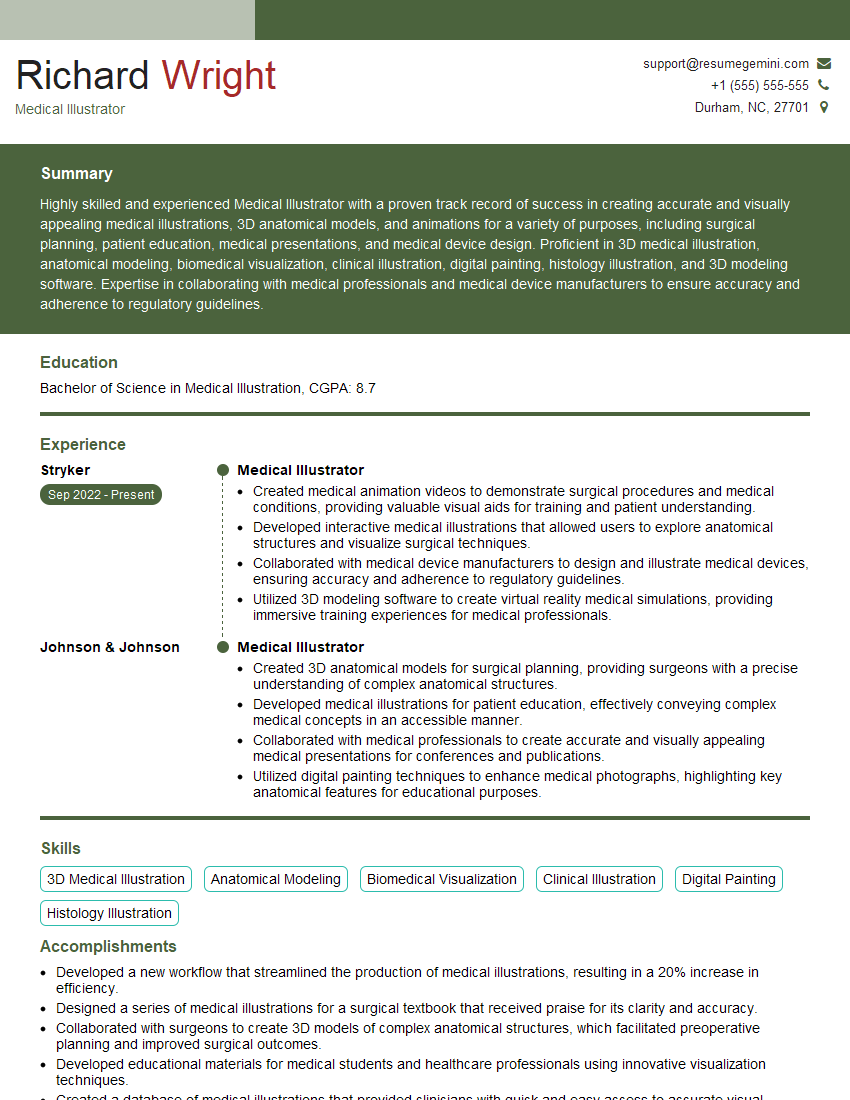
Mastering Clinical Illustration opens doors to a rewarding career with significant growth potential, impacting patient care and medical education. A strong resume is crucial for showcasing your skills and experience to potential employers. Creating an ATS-friendly resume significantly increases your chances of getting your application noticed. We highly recommend using ResumeGemini to build a professional and impactful resume that highlights your unique qualifications. ResumeGemini provides examples of resumes tailored to Clinical Illustration to guide you in crafting the perfect application.
Explore more articles
Users Rating of Our Blogs
Share Your Experience
We value your feedback! Please rate our content and share your thoughts (optional).
What Readers Say About Our Blog
Very informative content, great job.
good