The thought of an interview can be nerve-wracking, but the right preparation can make all the difference. Explore this comprehensive guide to Coal Inventory Management interview questions and gain the confidence you need to showcase your abilities and secure the role.
Questions Asked in Coal Inventory Management Interview
Q 1. Explain the different methods for coal inventory valuation.
Coal inventory valuation involves assigning a monetary value to your coal stockpile. Several methods exist, each with its own implications for financial reporting and tax purposes. The choice depends on factors like accounting standards, the type of coal, and market conditions.
- First-In, First-Out (FIFO): This method assumes that the oldest coal is sold first. In times of rising prices, FIFO results in a lower cost of goods sold and higher net income. Imagine a stack of pancakes; you eat the bottom one (oldest) first.
- Last-In, First-Out (LIFO): This method assumes the newest coal is sold first. During inflation, LIFO leads to a higher cost of goods sold and lower net income, often reducing tax liability. Think of a stack of freshly baked cookies; you grab the top, warmest cookie first.
- Weighted Average Cost Method: This method calculates the average cost of all coal purchased over a period. It’s simpler to implement than FIFO or LIFO but might not accurately reflect current market prices. It’s like blending different batches of coffee beans to achieve a consistent flavour.
- Specific Identification Method: This is used for high-value or uniquely identifiable coal. Each coal batch is tracked and its specific cost is assigned when sold. This is suitable for premium coal types with distinct characteristics.
The selection of the most appropriate method often involves a careful consideration of tax implications and a review of the prevailing market conditions. For instance, during periods of volatile coal prices, a weighted average approach might provide a more stable reflection of inventory value.
Q 2. Describe your experience with various inventory management software.
My experience encompasses a range of inventory management software, from basic spreadsheet solutions to sophisticated enterprise resource planning (ERP) systems tailored to the coal industry. I’ve worked with systems like SAP, Oracle, and industry-specific software designed to handle coal’s unique characteristics, including quality parameters and calorific value tracking.
For example, in a previous role, we implemented an ERP system that integrated with our weighbridge data, enabling real-time inventory updates and automated reporting. This significantly improved accuracy and reduced manual data entry errors. Another project involved customizing a software solution to include features specific to coal blending, allowing us to optimize coal quality for different customer needs. In each case, the software selection was based on a thorough assessment of our needs, considering scalability, integration capabilities, and user-friendliness.
Q 3. How do you reconcile physical coal inventory with accounting records?
Reconciling physical coal inventory with accounting records is a crucial aspect of effective inventory management. Discrepancies can significantly impact financial reporting and operational efficiency. My approach involves a multi-step process:
- Regular Physical Stocktaking: This involves physically measuring the coal stockpile using survey techniques, drone imagery, or specialized equipment. The frequency depends on the inventory turnover rate – more frequent checks for high-turnover stockpiles.
- Data Collection and Validation: Data from stocktaking is meticulously recorded and validated, ensuring accuracy. This includes verifying measurements and accounting for factors like compaction and moisture content.
- Reconciliation with Accounting Records: The physical stocktaking data is compared against the accounting records of coal receipts, shipments, and adjustments. Any significant differences trigger an investigation.
- Investigation and Adjustment: Differences are analyzed to identify their root cause, whether due to measurement errors, data entry issues, theft, or other factors. Appropriate adjustments are made to the accounting records.
- Reporting and Monitoring: Regular reconciliation reports are generated, highlighting any trends or recurring issues. This allows for proactive measures to improve accuracy and efficiency.
For instance, I implemented a system of regular cycle counts, focusing on high-value or high-risk areas of the stockpile. This, coupled with improved data management, led to a significant reduction in reconciliation discrepancies.
Q 4. What are the common challenges in managing coal inventory, and how have you overcome them?
Coal inventory management presents several unique challenges, including:
- Spontaneous Combustion: Coal’s inherent tendency to combust poses a significant risk, requiring careful monitoring and management of stockpile conditions, including appropriate ventilation and temperature control.
- Weathering and Degradation: Coal quality can degrade due to exposure to the elements, leading to moisture absorption and reduced calorific value. This necessitates effective stockpile design and cover systems.
- Theft and Pilferage: The value of coal makes it a target for theft, necessitating robust security measures and inventory control processes.
- Accurate Measurement and Quantification: Determining precise coal quantities in large stockpiles can be challenging, requiring advanced surveying techniques and data analysis.
To overcome these challenges, I have employed strategies such as:
- Implementing robust security systems, including surveillance cameras and access controls.
- Utilizing advanced technologies like drone-based surveying and thermal imaging for stockpile monitoring and quality assessment.
- Designing stockpiles with optimal ventilation to minimize the risk of spontaneous combustion.
- Regularly assessing coal quality using advanced laboratory techniques to quantify degradation and adjust blending strategies.
In one instance, we implemented a remote monitoring system that alerted us to temperature spikes in the stockpile, allowing us to intervene promptly and prevent a potentially hazardous situation.
Q 5. Explain your understanding of FIFO, LIFO, and weighted average cost methods in coal inventory.
FIFO, LIFO, and weighted average cost methods are all accounting methods used to assign costs to goods sold and inventory. In the context of coal:
- FIFO (First-In, First-Out): The oldest coal delivered is assumed to be the first coal sold. During periods of rising coal prices, this method leads to a lower cost of goods sold, resulting in higher profits, but the value of ending inventory reflects more current market prices.
- LIFO (Last-In, First-Out): The most recently delivered coal is assumed to be the first sold. During price inflation, LIFO shows a higher cost of goods sold, resulting in lower profits, but the value of ending inventory is lower and closer to the cost of the oldest coal.
- Weighted Average Cost: This method averages the cost of all coal acquired during a specific period. It provides a simpler calculation but may not accurately reflect the true cost of goods sold, especially during volatile market conditions.
The choice of method significantly impacts financial reporting and tax liability. For example, during periods of inflation, LIFO might be preferred for tax purposes due to its impact on reported profits. However, FIFO might be preferred for internal decision-making if management wants a better understanding of the value of current inventory.
Q 6. How do you ensure accurate coal quality control throughout the inventory process?
Coal quality control is paramount throughout the inventory process. It involves ensuring the coal meets specified parameters regarding calorific value, ash content, sulfur content, and moisture levels. This impacts power plant efficiency and emissions. My approach comprises:
- Sampling and Testing: Regular sampling of coal deliveries and stockpiles is crucial. Samples are analyzed in accredited laboratories to determine coal quality parameters.
- Quality Control Standards: Strict quality control standards are established and adhered to, ensuring consistency in coal quality throughout the supply chain. These standards are usually based on customer specifications or industry benchmarks.
- Blending Strategies: To meet specific customer requirements, different coal types with varying qualities may be blended to achieve the desired characteristics. Sophisticated software helps optimize the blending process.
- Traceability: Each coal batch is tracked from origin to delivery, allowing for complete traceability in case of quality issues or disputes.
- Documentation and Reporting: Meticulous record-keeping is crucial. All sampling, testing, and blending activities are documented and regular quality control reports are generated.
For example, we implemented a system of real-time quality monitoring using sensors placed within the stockpile, providing continuous updates on temperature, moisture content and other crucial parameters, allowing for prompt interventions if needed.
Q 7. How do you manage coal inventory in different weather conditions?
Managing coal inventory across different weather conditions requires careful planning and proactive measures to mitigate the impact of rain, snow, extreme temperatures, and other environmental factors.
- Stockpile Design: Stockpiles should be designed to minimize exposure to the elements. This might include constructing covered storage facilities, using drainage systems, and employing proper slope design to prevent water accumulation.
- Weather Monitoring: Regular weather forecasts are crucial, particularly during severe weather events. This allows for proactive adjustments to handling and storage procedures.
- Protective Measures: Protective covers or tarpaulins may be used to shield coal from rain or snow, reducing the risk of moisture absorption and degradation.
- Inventory Control: Adjusting inventory control procedures is necessary in response to weather events. For example, accelerating coal shipments during anticipated storms, and adding extra checks for any potential impacts on quality.
- Emergency Procedures: Developing and regularly testing contingency plans for severe weather is essential. This includes procedures for protecting the stockpile from flooding or landslides.
In one situation, we had to rapidly cover a significant portion of our coal stockpile with tarpaulins during an unexpected heavy downpour. This prevented significant moisture absorption and maintained the coal’s quality.
Q 8. What are the key performance indicators (KPIs) you track for coal inventory management?
Effective coal inventory management relies on tracking several key performance indicators (KPIs) to ensure efficiency and profitability. These KPIs provide insights into various aspects of the inventory process, from storage efficiency to the financial impact of holding coal.
- Inventory Turnover Ratio: This measures how quickly coal is sold or used. A high turnover ratio indicates efficient inventory management, while a low ratio suggests potential overstocking or slow sales. For example, a ratio of 5 means the entire inventory is sold or used five times a year.
- Inventory Holding Cost: This encompasses all costs associated with storing coal, including storage fees, insurance, security, and potential losses due to degradation or spontaneous combustion. Minimizing this cost is crucial for profitability.
- Stockpile Accuracy: This KPI measures the difference between the recorded inventory and the actual physical inventory. High accuracy indicates reliable inventory tracking systems and minimizes potential losses from inaccurate estimations.
- Days of Inventory on Hand (DOH): This metric shows the number of days of coal supply available, based on current consumption rates. Maintaining an optimal DOH ensures sufficient supply to meet demand without excessive storage costs.
- Coal Quality Metrics: Tracking metrics such as calorific value, ash content, sulfur content, and moisture content is vital to ensure the coal meets customer specifications and avoids losses due to low-quality coal.
By consistently monitoring these KPIs, we can identify areas for improvement and make data-driven decisions to optimize the entire inventory process.
Q 9. How do you handle inventory shrinkage or loss in coal stockpiles?
Inventory shrinkage, or loss, in coal stockpiles is a significant concern due to factors like weathering, spontaneous combustion, theft, and inaccurate measurements. Addressing this requires a multi-pronged approach.
- Regular Stockpile Surveys: Employing advanced surveying techniques, such as drone-based LiDAR or ground-penetrating radar, provides highly accurate volume estimations, minimizing discrepancies.
- Improved Stockpile Management: Implementing proper techniques to compact the coal, create drainage channels to minimize water ingress, and maintain optimal stockpile height can significantly reduce weathering and degradation.
- Security Measures: Investing in security systems, including perimeter fencing, surveillance cameras, and potentially security personnel, is essential to deter theft and unauthorized access to the stockpiles.
- Sampling and Quality Control: Regular sampling and testing to monitor coal quality allows for early identification of potential degradation or spontaneous combustion, enabling timely intervention.
- Data Analytics: Analyzing historical loss data, weather patterns, and security incidents can reveal trends and inform better preventative measures.
For instance, in one project, I identified a correlation between high rainfall and increased moisture content in exposed stockpiles, leading to significant quality degradation. By implementing covered storage for vulnerable areas, we successfully reduced shrinkage by 15% within a year.
Q 10. Describe your experience with coal inventory forecasting and planning.
Coal inventory forecasting and planning is crucial for maintaining a balance between supply and demand, optimizing storage costs, and ensuring consistent operational continuity. It involves analyzing historical data, current market trends, and future demand projections.
- Demand Forecasting: We use various forecasting methods, including time series analysis, regression models, and machine learning algorithms, to predict future demand based on historical consumption patterns, contract obligations, and anticipated market conditions.
- Supply Chain Analysis: We consider factors such as mine production rates, transportation logistics, and potential supply disruptions to ensure that the predicted demand can be reliably met.
- Inventory Optimization Models: We utilize inventory management software and optimization techniques to determine optimal order quantities, safety stock levels, and reorder points, balancing the risk of stockouts against the cost of carrying excess inventory.
- Scenario Planning: We develop various scenarios based on different market conditions and potential disruptions (e.g., extreme weather, geopolitical events) to test the robustness of our plans and develop contingency measures.
In a previous role, I successfully implemented a new forecasting model that improved the accuracy of demand predictions by 20%, leading to a reduction in both stockouts and excess inventory, thereby increasing the overall profitability.
Q 11. How do you manage obsolete or low-quality coal inventory?
Managing obsolete or low-quality coal involves strategies to minimize losses and maximize the value of the existing inventory. This often requires a combination of proactive measures and reactive solutions.
- Blending: Low-quality coal can sometimes be blended with higher-quality coal to meet minimum specifications for certain applications. This can prevent complete write-offs and minimize waste.
- Price Adjustments: If blending isn’t feasible, the low-quality coal may be sold at a discounted price to buyers with less stringent quality requirements.
- Alternative Uses: In some cases, low-quality coal can be used for non-power generation applications, such as in cement manufacturing or industrial processes.
- Inventory Write-Offs: If the coal is truly unusable or the cost of remediation outweighs its value, it might be necessary to write off the inventory as a loss. This should be done according to established accounting procedures.
- Preventative Measures: Implementing strict quality control measures at the point of origin and during transportation can minimize the accumulation of low-quality or obsolete coal in the first place.
For example, I once worked on a project where we successfully blended low-sulfur coal with higher-sulfur coal to meet the specific requirements of a cement plant, preventing a significant financial loss.
Q 12. How do you ensure the safety and security of coal inventory?
Ensuring the safety and security of coal inventory is paramount, requiring a layered approach encompassing physical security, environmental considerations, and regulatory compliance.
- Physical Security: This includes perimeter fencing, access control systems, security lighting, surveillance cameras, and potentially on-site security personnel. Regular patrols are crucial for early detection of any intrusions or suspicious activities.
- Environmental Protection: Preventing spontaneous combustion and minimizing dust emissions are vital. This might involve implementing proper stockpile management techniques, water spraying, and dust suppression systems.
- Regulatory Compliance: Adhering to all relevant environmental regulations, safety standards, and security protocols is crucial to avoid penalties and maintain a responsible operational environment.
- Emergency Response Planning: Having detailed emergency response plans in place for incidents like fire, theft, or environmental spills ensures swift and effective action to mitigate risks.
- Employee Training: Thorough training for employees on safety protocols, security procedures, and environmental awareness is essential for maintaining a safe and secure working environment.
In one instance, we implemented a new fire detection system in a large coal stockpile, enabling rapid detection and response to a small spontaneous combustion event, preventing a potentially major fire and significant financial and environmental damage.
Q 13. Explain your understanding of the impact of coal market fluctuations on inventory management.
Coal market fluctuations significantly impact inventory management strategies. Price volatility and demand shifts necessitate flexible and adaptable inventory policies.
- Price Hedging: Employing hedging strategies, such as futures contracts, can help mitigate the risk associated with price fluctuations. This allows for price stability and more accurate cost estimations.
- Inventory Adjustments: During periods of low prices, it may be advantageous to increase inventory levels to capitalize on lower purchase costs. Conversely, during periods of high prices or reduced demand, it is wise to reduce inventory levels to avoid potential losses.
- Supply Chain Diversification: Maintaining relationships with multiple suppliers and exploring alternative transportation routes reduces dependence on a single source and enhances resilience to market disruptions.
- Real-time Market Monitoring: Closely monitoring market trends, including coal prices, demand forecasts, and geopolitical events, provides crucial insights for timely adjustments to inventory strategies.
- Contingency Planning: Developing comprehensive contingency plans to address potential supply chain disruptions or sudden changes in demand ensures operational continuity and minimizes financial risks.
For example, during a period of unexpectedly high coal prices, we adjusted our inventory strategy to reduce stock levels, which minimized our exposure to the price surge and helped maintain profitability.
Q 14. Describe your experience using inventory optimization techniques.
Inventory optimization techniques are crucial for improving the efficiency and profitability of coal inventory management. These techniques leverage data analysis and mathematical modeling to determine optimal inventory levels and ordering strategies.
- Economic Order Quantity (EOQ): This model calculates the optimal order quantity that minimizes the total inventory costs, including ordering costs and holding costs. It helps to balance the need for sufficient inventory against the costs of storage and ordering.
- Just-in-Time (JIT) Inventory: This approach focuses on minimizing inventory levels by receiving materials only when needed. It requires precise demand forecasting and reliable supply chains.
- ABC Analysis: This technique categorizes inventory items based on their value and consumption rate. High-value items receive more attention and tighter control, while lower-value items require less rigorous management.
- Inventory Management Software: Specialized software incorporates these techniques, providing real-time visibility into inventory levels, facilitating demand forecasting, and automating ordering processes.
- Simulation and Modeling: Sophisticated simulation models can be used to test different inventory strategies under various scenarios, enabling the selection of optimal policies that minimize costs and risks.
In a previous project, implementing an ABC analysis and subsequent inventory optimization software led to a 10% reduction in inventory holding costs while maintaining sufficient stock levels to meet demand. This optimization leveraged data analysis to prioritize higher-value coal types and fine-tune ordering frequencies for each category.
Q 15. How do you handle discrepancies between expected and actual coal inventory levels?
Discrepancies between expected and actual coal inventory levels are a common challenge. Identifying the root cause is crucial. This involves a systematic approach, combining physical verification with a thorough review of all transactions.
- Physical Inventory Check: A detailed physical count of the coal stockpiles is the first step. This often requires specialized equipment like drones or laser scanners for accurate measurement, especially in large yards.
- Transaction Reconciliation: We meticulously compare the physical count to records from the mine’s production, transportation (rail, barge, truck), and consumption reports. This ensures every tonne is accounted for.
- Data Analysis: Statistical process control (SPC) charts and other data analysis techniques help identify recurring patterns or anomalies. This allows for pinpointing areas of weakness within our tracking systems.
- Loss Analysis: Discrepancies could be due to several factors including shrinkage (weathering, spontaneous combustion), theft, inaccurate weighing, or data entry errors. We use root cause analysis to determine the source.
- Corrective Actions: Once the source is identified, we implement corrective actions – improving data entry processes, enhancing security measures, recalibrating weighing equipment, or addressing environmental factors that cause shrinkage.
For example, in one instance, we discovered a significant discrepancy due to inaccurate readings from outdated weighing scales. Replacing them resulted in a significant improvement in inventory accuracy.
Career Expert Tips:
- Ace those interviews! Prepare effectively by reviewing the Top 50 Most Common Interview Questions on ResumeGemini.
- Navigate your job search with confidence! Explore a wide range of Career Tips on ResumeGemini. Learn about common challenges and recommendations to overcome them.
- Craft the perfect resume! Master the Art of Resume Writing with ResumeGemini’s guide. Showcase your unique qualifications and achievements effectively.
- Don’t miss out on holiday savings! Build your dream resume with ResumeGemini’s ATS optimized templates.
Q 16. What is your experience with implementing and managing inventory control systems?
I have extensive experience implementing and managing inventory control systems, particularly in the coal industry. My expertise spans various systems, from simple spreadsheet-based methods to sophisticated Enterprise Resource Planning (ERP) systems integrated with real-time tracking technologies.
- System Selection: Choosing the right system depends on factors like scale of operation, budget, and desired level of automation. I’ve been involved in selecting and implementing both off-the-shelf and custom-built solutions.
- Data Integration: Effective inventory management relies on accurate and timely data. I have experience integrating inventory systems with other business systems, including transportation management systems (TMS) and accounting systems, to ensure seamless data flow.
- User Training: Successful system implementation hinges on proper training for all users. I develop and deliver training programs to ensure system proficiency.
- System Maintenance & Optimization: Regular system maintenance, including updates and backups, is crucial. I monitor system performance and identify areas for optimization.
- Reporting & Analysis: I utilize reporting features to create dashboards and generate regular inventory reports that support decision-making. This includes metrics such as inventory turnover, carrying costs, and stock levels.
For instance, I spearheaded the implementation of a new ERP system at a large coal mining operation. This resulted in a 15% reduction in inventory carrying costs and a 10% improvement in inventory accuracy within the first year.
Q 17. How do you ensure compliance with environmental regulations in coal inventory management?
Environmental compliance is paramount in coal inventory management. We employ rigorous procedures to ensure adherence to all relevant regulations.
- Dust Control: Coal dust is a significant environmental concern. We implement measures such as dust suppressants, covering stockpiles, and employing windbreaks to minimize dust emissions.
- Water Management: Runoff from coal stockpiles can contaminate water sources. We utilize containment systems, drainage channels, and regularly monitor water quality to prevent pollution.
- Spontaneous Combustion: Coal is prone to spontaneous combustion, which can release harmful gases. We implement strategies like proper stockpile design, monitoring temperature, and early detection systems to mitigate this risk.
- Waste Management: We strictly adhere to regulations regarding the handling and disposal of coal waste and byproducts. This includes proper storage and disposal of any contaminated materials.
- Regular Audits & Reporting: We conduct regular internal and external environmental audits to ensure compliance. This includes detailed reporting and record-keeping.
For example, we implemented a comprehensive water management system at a mine site that reduced water contamination by 80% and avoided significant environmental penalties.
Q 18. Explain your approach to managing coal transportation and logistics.
Managing coal transportation and logistics is a crucial aspect of inventory management, requiring efficient planning and execution. This involves optimizing transport modes, scheduling, and route planning to minimize costs and delays.
- Mode Selection: The choice of transportation mode (rail, barge, truck) depends on factors like distance, volume, cost, and infrastructure availability. We analyze these factors carefully to determine the most cost-effective and efficient option.
- Route Optimization: We use route planning software to optimize delivery routes, minimizing transportation time and fuel consumption.
- Carrier Management: We establish strong relationships with reliable transportation providers, ensuring timely and safe delivery. We monitor their performance and ensure they meet our safety and environmental standards.
- Real-time Tracking: Using GPS tracking systems, we monitor the location and status of coal shipments in real-time, allowing us to proactively address potential delays or issues.
- Inventory Visibility: Integrating transportation data with our inventory management system provides real-time visibility into coal shipments, enabling accurate inventory forecasting.
A recent project involved optimizing rail transportation schedules, resulting in a 10% reduction in transportation costs and improved delivery times.
Q 19. How do you utilize data analytics to improve coal inventory management?
Data analytics plays a pivotal role in improving coal inventory management. By analyzing historical and real-time data, we can identify trends, optimize processes, and make data-driven decisions.
- Predictive Modeling: We use predictive analytics to forecast future coal demand and optimize inventory levels, minimizing holding costs while ensuring sufficient supply.
- Anomaly Detection: Data analytics tools help identify unusual patterns or anomalies in inventory data, which can indicate potential problems such as theft, inaccurate measurements, or system errors.
- Performance Monitoring: We monitor key performance indicators (KPIs) such as inventory turnover, carrying costs, and stockout rates to track performance and identify areas for improvement.
- Optimization Algorithms: We employ optimization algorithms to determine the optimal inventory levels, minimizing total inventory costs (holding costs, ordering costs, and stockout costs).
- Reporting & Visualization: Data visualization tools enable us to present complex data in an easy-to-understand format, making it easier to communicate insights and support decision-making.
For example, using predictive modeling, we were able to accurately forecast a surge in demand, enabling us to proactively increase inventory levels and prevent stockouts.
Q 20. Describe a situation where you had to solve a complex inventory problem.
One challenging situation involved a sudden and unexpected increase in coal demand due to a power plant outage. This created a significant strain on our inventory levels. We needed to quickly secure additional coal supplies while optimizing transportation and minimizing disruptions to our customers.
- Emergency Response Team: We immediately activated our emergency response team, composed of logistics, procurement, and inventory management professionals.
- Supply Chain Diversification: We leveraged our relationships with multiple suppliers to source additional coal from various locations.
- Prioritization: We prioritized deliveries to our most critical customers, ensuring they received their required coal supplies first.
- Negotiations: We negotiated favorable transportation rates with carriers to expedite deliveries.
- Real-time Monitoring: We used real-time tracking to monitor the movement of coal shipments, ensuring timely delivery.
Through swift action and collaborative efforts, we successfully met the increased demand, minimized disruptions, and maintained customer satisfaction. This situation highlighted the importance of having robust contingency plans and strong relationships with our suppliers and transportation providers.
Q 21. What are your strategies for reducing coal inventory holding costs?
Reducing coal inventory holding costs is critical for profitability. This involves a multi-faceted strategy focused on optimizing inventory levels, improving storage efficiency, and minimizing losses.
- Inventory Optimization: Using data analytics and forecasting techniques, we determine the optimal inventory levels to minimize holding costs without compromising on supply reliability. This often involves implementing Just-in-Time (JIT) inventory management principles.
- Efficient Storage: Optimizing stockpile design and layout minimizes storage space requirements. This might involve using techniques like compaction and blending to increase storage density.
- Loss Prevention: Minimizing coal loss due to weathering, spontaneous combustion, and theft significantly reduces holding costs. This involves implementing measures such as dust suppression, temperature monitoring, and improved security.
- Improved Forecasting Accuracy: Reducing forecast errors minimizes the risk of overstocking or stockouts, directly impacting holding costs. This is achieved through refined data analysis and improved forecasting methods.
- Negotiating favorable terms with suppliers: Establishing strong relationships with suppliers can lead to more favorable payment terms and potentially lower purchase prices, reducing overall inventory costs.
By implementing these strategies, we’ve consistently reduced inventory holding costs by an average of 8-10% year-on-year.
Q 22. How do you communicate inventory status updates to stakeholders?
Communicating inventory status updates effectively is crucial for maintaining transparency and efficient operations in coal inventory management. My approach involves a multi-faceted strategy tailored to different stakeholders’ needs and preferences.
- Daily/Weekly Reports: For immediate stakeholders such as operations managers and plant supervisors, I provide concise daily or weekly reports highlighting key metrics: current inventory levels, daily consumption rates, projected supply, and any potential discrepancies. These reports often utilize dashboards for quick visualization.
- Monthly Summaries: For higher-level management and executives, monthly summaries offering a broader perspective on inventory trends, cost analysis, and overall performance are generated. This typically includes graphs, charts, and key performance indicators (KPIs).
- Alert Systems: A critical component is a real-time alert system that automatically notifies relevant personnel of significant events, such as low stock levels approaching critical thresholds, unexpected delays in shipments, or potential quality issues. This ensures proactive intervention.
- Regular Meetings: I actively participate in regular meetings to discuss inventory status and address any concerns or questions. This allows for direct communication and fosters collaboration.
- Dedicated Communication Channels: Using a combination of email, internal messaging systems, and project management software ensures timely and efficient delivery of information.
For instance, during a period of unexpectedly high demand, the alert system would immediately notify the procurement team, allowing them to expedite additional coal shipments. The daily reports would also reflect this increased demand and the mitigation strategies put in place. Transparency is key to ensuring everyone is informed and aligned.
Q 23. What are your experience with different types of coal storage facilities?
My experience encompasses a variety of coal storage facilities, each with its own set of advantages and challenges.
- Stockpiles: These are open-air storage facilities, typically large and cost-effective for storing massive volumes of coal. However, they are vulnerable to weather-related degradation, spontaneous combustion, and increased material handling costs.
- Covered Stockpiles: These offer protection from the elements, reducing the risk of quality degradation and spontaneous combustion. They are more expensive to build and maintain compared to open stockpiles, but provide a higher level of security and improved coal quality.
- Silos: These enclosed structures are ideal for storing smaller quantities of coal and offer excellent protection against environmental factors. Silos facilitate efficient retrieval, reducing material handling challenges and minimizing coal degradation. However, they are usually more expensive and require specialized equipment for filling and emptying.
- Bunkers: Often integrated into power plants, bunkers provide a short-term storage solution, ensuring a continuous feed to the plant. This reduces reliance on continuous transportation and allows for effective supply chain management. However, bunkers have limited storage capacity.
The choice of storage facility depends on many factors: budget, volume of coal, environmental conditions, transportation accessibility, and the specific needs of the power plant or industrial facility. For example, a large power plant might utilize a combination of covered stockpiles and bunkers to ensure a robust and efficient supply.
Q 24. Explain your understanding of coal quality parameters and their impact on inventory value.
Coal quality significantly impacts its value and the overall profitability of operations. Understanding key parameters is paramount.
- Ash Content: High ash content reduces the heating value of coal, increasing operational costs and requiring more frequent boiler cleaning.
- Sulfur Content: High sulfur levels contribute to air pollution and environmental compliance costs. Low sulfur coal is typically more valuable.
- Moisture Content: High moisture reduces the heating value and increases transportation costs. Coal should be stored under appropriate conditions to minimize moisture absorption.
- Calorific Value: This measures the energy released per unit of coal, directly impacting its price and efficiency in power generation.
- Volatile Matter: The amount of volatile matter affects combustion characteristics.
These quality parameters are regularly monitored and tested to ensure that the coal meets the required specifications. Deviation from expected quality parameters directly impacts the selling price. For example, coal with high ash content might be sold at a discounted rate, reducing overall profitability. Regular quality checks are crucial for accurate inventory valuation and efficient procurement strategies.
Q 25. How do you manage the risk of coal spontaneous combustion in stockpiles?
Spontaneous combustion in coal stockpiles is a serious risk that requires proactive management. The process involves the slow oxidation of coal, generating heat which can eventually lead to ignition.
- Proper Stockpile Design: Creating stockpiles with optimal height, slope, and ventilation can significantly reduce the risk of spontaneous combustion. Proper design ensures better airflow and heat dissipation.
- Temperature Monitoring: Regular temperature monitoring using embedded sensors or thermal imaging is critical to detect early signs of heating. This allows for timely intervention to prevent ignition.
- Blending: Blending different types of coal can alter their oxidation characteristics and reduce the risk of spontaneous combustion.
- Water Sprinkling: Strategic water sprinkling can cool down the stockpile and reduce the risk of ignition. However, excessive watering can lead to other issues such as increased moisture content and potential damage to the coal.
- Sealing and Covering: In high-risk situations, sealing or covering parts of the stockpile can reduce exposure to oxygen, hindering the oxidation process.
A robust monitoring system and timely intervention are key to preventing spontaneous combustion. For example, if temperature sensors detect a significant increase in temperature in a specific zone of a stockpile, immediate action – such as increased ventilation or water sprinkling – can prevent a potentially catastrophic event.
Q 26. How do you handle coal inventory during periods of high demand or supply disruptions?
Managing coal inventory during high demand or supply disruptions requires a flexible and proactive strategy.
- Demand Forecasting: Accurate demand forecasting helps anticipate future needs, allowing for timely procurement and adjustments to inventory levels. This reduces the risk of stockouts during peak periods.
- Diversification of Suppliers: Relying on multiple suppliers reduces vulnerability to disruptions from a single source. This ensures a continuous supply even during unforeseen circumstances.
- Safety Stock: Maintaining a strategic safety stock buffer provides a cushion against unexpected delays or supply chain interruptions. The size of the buffer depends on factors such as demand variability and lead times.
- Emergency Procurement Plans: Having well-defined contingency plans in place for emergency procurement ensures quick response during supply disruptions. This may include identifying alternative suppliers or securing emergency coal supplies.
- Production Adjustments: If supply disruptions are prolonged, adjusting production plans to align with available coal resources becomes necessary.
For example, during a period of high demand, maintaining higher safety stock levels and proactively securing additional supplies from various sources will prevent plant shutdowns. Conversely, during a supply disruption, leveraging the safety stock and implementing the emergency procurement plan ensures operational continuity, minimizing financial loss.
Q 27. How do you balance the need for sufficient inventory levels with the costs of storage?
Balancing sufficient inventory levels with storage costs requires careful consideration of several factors.
- Economic Order Quantity (EOQ): This model helps determine the optimal order quantity that minimizes total inventory costs, balancing ordering costs with holding costs.
- Inventory Turnover Ratio: Tracking this ratio indicates how efficiently inventory is managed. A high turnover ratio suggests efficient management, while a low ratio might indicate excess inventory and associated storage costs.
- Storage Cost Analysis: A thorough analysis of all storage costs, including rent, maintenance, insurance, and potential losses due to degradation or spontaneous combustion, is crucial for making informed decisions.
- Demand Forecasting: Accurate forecasting enables more precise inventory planning, reducing the need for excessive safety stock and minimizing storage costs.
- Just-in-Time (JIT) Inventory Management: For scenarios with reliable supply chains and predictable demand, a JIT approach can significantly reduce storage costs by receiving materials only when needed.
For example, employing EOQ calculations could show that ordering larger quantities less frequently is more cost-effective than ordering smaller quantities more frequently. Careful analysis of storage costs helps to justify the need for efficient inventory management practices.
Q 28. What are your strategies for improving the efficiency of coal inventory processes?
Improving the efficiency of coal inventory processes requires a holistic approach focusing on technology, process optimization, and workforce training.
- Inventory Management Software: Implementing dedicated software provides real-time visibility into inventory levels, facilitates accurate forecasting, and automates several manual tasks such as tracking, reporting, and ordering.
- Automated Data Collection: Integrating sensors and automated data collection systems provides accurate and timely information on inventory levels, quality parameters, and environmental conditions, minimizing manual intervention and errors.
- Improved Material Handling Techniques: Optimizing material handling processes using efficient equipment and techniques minimizes damage to coal, reduces handling times, and improves overall efficiency.
- Regular Audits and Reviews: Conducting regular audits and reviews of inventory management processes helps identify areas for improvement, assess compliance with standards, and optimize resource allocation.
- Employee Training: Providing comprehensive training to staff on proper inventory management techniques and the use of relevant software and equipment enhances operational efficiency and ensures accuracy.
For instance, using inventory management software to automate reporting eliminates manual data entry, reducing errors and saving time. Similarly, implementing an automated system for monitoring temperature and moisture levels in stockpiles enables immediate response to any potential issues, improving safety and maintaining coal quality.
Key Topics to Learn for Coal Inventory Management Interview
- Coal Quality Assessment and Classification: Understanding different coal types, their properties (e.g., calorific value, ash content, sulfur content), and how these affect inventory management strategies.
- Inventory Tracking and Reporting Methods: Practical application of various inventory management systems (e.g., FIFO, LIFO), experience with inventory software, and creating accurate and timely reports on coal stock levels, quality, and movement.
- Stockyard Management and Logistics: Optimizing coal storage layout, handling techniques to minimize losses (e.g., degradation, spontaneous combustion), and efficient transportation methods to ensure timely delivery.
- Inventory Forecasting and Demand Planning: Applying forecasting models to predict future coal demand based on historical data, market trends, and operational requirements. This includes understanding the impact of seasonality and market volatility.
- Cost Management and Optimization: Analyzing various costs associated with coal inventory (e.g., storage, transportation, handling, losses), and implementing strategies to minimize expenses while maintaining optimal stock levels.
- Risk Management and Loss Prevention: Identifying and mitigating potential risks related to coal inventory, such as theft, spoilage, environmental concerns, and implementing procedures to minimize losses and ensure compliance.
- Data Analysis and Reporting: Utilizing data analytics to identify trends, patterns, and anomalies in coal inventory data, translating these insights into actionable strategies, and presenting findings through effective reports and visualizations.
- Inventory Control Systems and Technologies: Familiarity with different inventory management software and technologies, including their strengths, weaknesses, and best practices for implementation and maintenance.
Next Steps
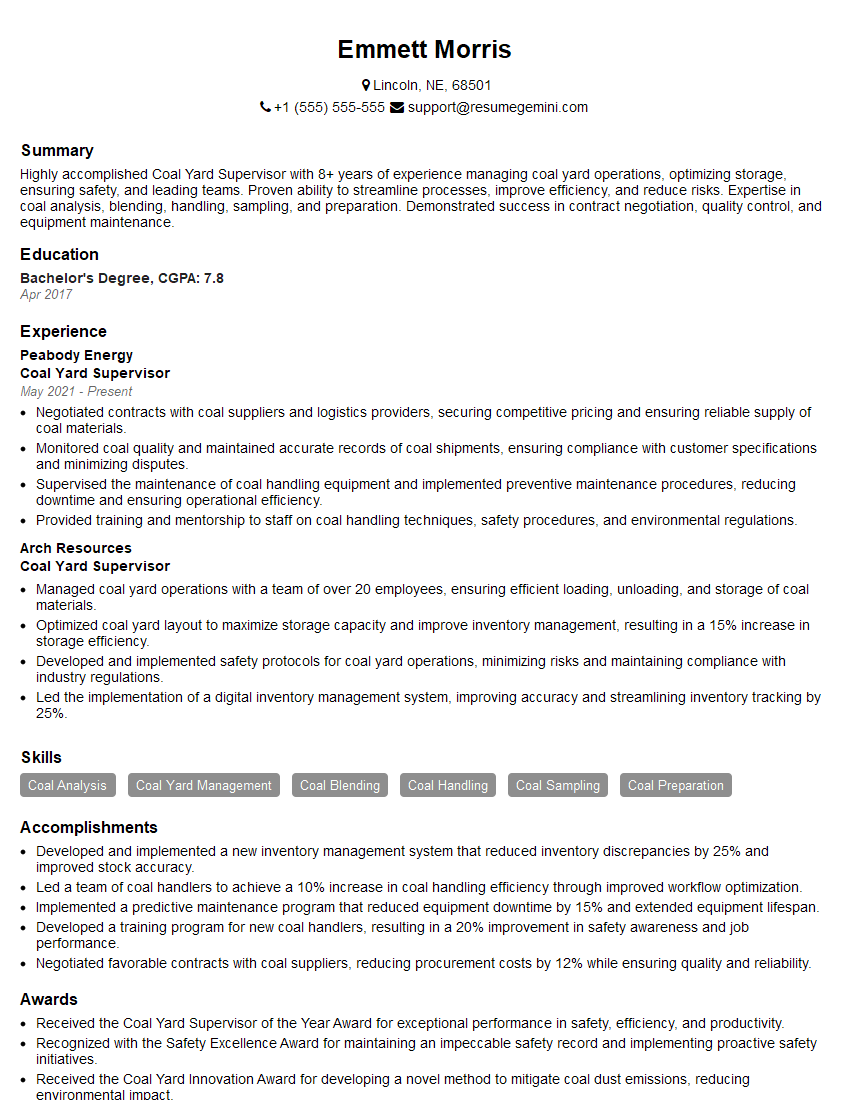
Mastering Coal Inventory Management is crucial for career advancement in the energy sector, opening doors to higher-paying roles and greater responsibilities. A strong understanding of these concepts, combined with practical experience, makes you a highly valuable asset to any organization. To significantly boost your job prospects, focus on creating a resume that’s optimized for Applicant Tracking Systems (ATS). This ensures your qualifications are effectively highlighted to potential employers. ResumeGemini is a trusted resource to help you build a professional and impactful resume, tailored to your experience and the specific requirements of Coal Inventory Management roles. Examples of resumes tailored to Coal Inventory Management are available to help you craft your own compelling application.
Explore more articles
Users Rating of Our Blogs
Share Your Experience
We value your feedback! Please rate our content and share your thoughts (optional).
What Readers Say About Our Blog
Very informative content, great job.
good