Interviews are more than just a Q&A session—they’re a chance to prove your worth. This blog dives into essential CAE Analysis (FEA, CFD) interview questions and expert tips to help you align your answers with what hiring managers are looking for. Start preparing to shine!
Questions Asked in CAE Analysis (FEA, CFD) Interview
Q 1. Explain the difference between FEA and CFD.
FEA (Finite Element Analysis) and CFD (Computational Fluid Dynamics) are both powerful computational methods used to simulate physical phenomena, but they address different aspects.
FEA primarily focuses on structural mechanics, analyzing how objects behave under stress and strain. Think of it like digitally testing the strength of a bridge or the flexibility of a car chassis. It considers factors like material properties, applied loads, and constraints to predict displacements, stresses, and strains.
CFD, on the other hand, simulates the flow of fluids – liquids and gases. This could range from analyzing the airflow over an airplane wing to predicting blood flow in arteries. It uses fluid dynamics principles to solve equations governing fluid motion, pressure, and temperature.
In essence, FEA is for ‘solid’ problems while CFD handles ‘fluid’ problems. There can be overlap, for example, fluid-structure interaction (FSI) simulations that combine both techniques to analyze problems like the effect of water flow on a dam.
Q 2. Describe the types of elements used in FEA.
The choice of element type in FEA depends heavily on the nature of the problem and the desired accuracy. There’s a trade-off between complexity and computational cost.
- Linear elements: These are the simplest, using straight lines (in 2D) or triangles/tetrahedrons (in 3D) to represent the geometry. They’re computationally efficient but less accurate for complex shapes or high stress gradients.
- Quadrilateral/Hexahedral elements: These use four (2D) or eight (3D) nodes, offering better accuracy and smoother results compared to linear elements, especially when representing curved shapes. However, they are more complex to mesh.
- Higher-order elements: These use more nodes per element, leading to even greater accuracy, particularly in regions with rapid changes in stress or displacement. But, they demand significantly more computational resources.
- Beam elements: Specifically designed for slender structures like beams and columns, accurately capturing bending and shear effects.
- Shell elements: Ideal for thin-walled structures like plates and shells, capturing bending and membrane stresses.
- Solid elements: The most general type, suitable for three-dimensional stress analysis of various shapes.
For instance, a simple beam analysis might use beam elements, while a complex car crash simulation would likely employ a combination of solid, shell, and possibly beam elements depending on the components being analyzed.
Q 3. What are the different meshing techniques used in FEA and CFD?
Meshing – the process of dividing the geometry into smaller elements – is crucial for both FEA and CFD. The quality of the mesh directly impacts the accuracy and efficiency of the simulation.
- Structured meshing: Elements are neatly arranged in a regular pattern, often using a grid-like structure. This is computationally efficient but can be challenging to generate for complex geometries.
- Unstructured meshing: Elements are arranged irregularly, allowing for better adaptation to complex shapes and features. This offers greater flexibility but can be computationally more expensive.
- Adaptive meshing: The mesh is refined automatically during the simulation, adding more elements to regions with high gradients (e.g., high stress or velocity) to improve accuracy. This is computationally efficient by focusing on critical areas.
- Hybrid meshing: Combines structured and unstructured meshes to leverage the advantages of both approaches, such as using structured meshes in simpler areas and unstructured meshes in complex regions.
In CFD, specific meshing techniques like inflation layers near walls are commonly used to accurately resolve boundary layers, critical for many aerodynamic analyses.
Q 4. How do you handle convergence issues in FEA and CFD simulations?
Convergence issues, where the solution doesn’t stabilize or reaches an inaccurate result, are common challenges in both FEA and CFD. Several strategies help address this:
- Mesh refinement: Refining the mesh, especially in regions of high gradients, can improve accuracy and promote convergence. Think of it like increasing the resolution of a picture – more detail makes the final picture clearer and more accurate.
- Solver adjustments: Different solvers have different convergence characteristics. Experimenting with different solver types and parameters (e.g., under-relaxation factors, time step sizes) is crucial.
- Boundary condition review: Inaccurate or poorly defined boundary conditions can cause convergence problems. Carefully review and refine boundary conditions. Are the boundary conditions properly representing the physical situation?
- Iterative solution techniques: Many solvers employ iterative methods; increasing the number of iterations might improve convergence, but keep in mind it increases computational cost.
- Non-linearity handling: For non-linear problems (where material behavior changes with stress or strain), techniques like Newton-Raphson iteration are often employed. Appropriate parameters for these methods help achieve convergence.
Troubleshooting convergence requires systematic investigation. Start by reviewing the mesh quality, then boundary conditions, and finally the solver settings.
Q 5. Explain the concept of boundary conditions in FEA and CFD.
Boundary conditions define how the model interacts with its surroundings. They are essential for both FEA and CFD simulations to realistically represent the physical situation.
In FEA, common boundary conditions include:
- Fixed supports (constraints): Restricting displacement in one or more directions (e.g., fixing a beam at one end).
- Applied loads: Forces, pressures, or moments applied to the model.
- Symmetry conditions: Exploiting symmetry in the geometry to reduce the computational cost.
In CFD, boundary conditions are more nuanced:
- Inlet conditions: Defining the velocity, pressure, and temperature of the fluid entering the domain.
- Outlet conditions: Specifying the pressure or a combination of pressure and velocity at the exit.
- Wall conditions: Defining the interaction of the fluid with solid surfaces (e.g., no-slip condition for viscous fluids).
- Symmetry conditions: Similar to FEA, these reduce computational cost.
Incorrect boundary conditions can lead to completely unrealistic results; therefore, meticulously defining them based on the actual physical system is critical.
Q 6. What are the different types of solvers used in FEA and CFD?
Both FEA and CFD employ a variety of solvers, each with strengths and weaknesses. The choice often depends on the problem’s complexity and computational resources.
FEA solvers often categorize into:
- Direct solvers: Solve the system of equations directly, offering high accuracy and robustness, but can be computationally expensive for large problems.
- Iterative solvers: Solve the equations iteratively, offering better scalability for large problems but potentially slower convergence.
CFD solvers commonly include:
- Finite volume method (FVM): Popular due to its conservation properties and ability to handle complex geometries. It’s widely used in commercial CFD software.
- Finite element method (FEM): Also applicable in CFD, offering flexibility in meshing and element types.
- Finite difference method (FDM): Simpler to implement but often limited to structured meshes and simpler geometries.
The selection of a solver is a crucial decision that must align with the specific requirements of the simulation.
Q 7. How do you validate your FEA and CFD results?
Validation is paramount in ensuring the reliability of FEA and CFD results. It involves comparing simulation results with experimental data or established analytical solutions.
Methods for validation include:
- Experimental comparison: Conducting physical experiments to obtain data (e.g., measuring strain gauges in FEA, measuring velocity profiles in CFD) and comparing them with the simulation results. This is often the most robust validation method.
- Analytical solution comparison: For simpler problems, analytical solutions exist, allowing direct comparison. This serves as a benchmark for the simulation’s accuracy.
- Benchmark studies: Comparing results with published data from similar simulations or experiments. This helps to assess the accuracy and reliability of the simulation approach.
- Mesh convergence studies: Demonstrating that the results are independent of mesh refinement, ensuring that the mesh resolution is sufficient.
- Sensitivity analysis: Investigating the influence of input parameters on the results, identifying the most sensitive variables and uncertainties.
A thorough validation process builds confidence in the simulation’s accuracy and reliability. It is not a single step but an iterative process.
Q 8. Explain the concept of mesh independence.
Mesh independence refers to the point in a finite element analysis (FEA) or computational fluid dynamics (CFD) simulation where further mesh refinement (increasing the number of elements) no longer significantly affects the solution. Think of it like zooming in on a map: initially, adding more detail (more elements) drastically changes your perception. However, at some point, adding more detail provides negligible improvement to the overall picture.
Achieving mesh independence is crucial for ensuring the accuracy and reliability of simulation results. If a solution is mesh-dependent, it means the results are an artifact of the mesh and not a true representation of the physical phenomenon. We verify mesh independence by performing simulations with progressively finer meshes. If the solution converges (i.e., the change in results becomes insignificant) as the mesh is refined, then we have achieved mesh independence.
For example, imagine simulating the stress in a simple beam under load. A coarse mesh might produce significantly different stress values compared to a fine mesh. However, once you reach a certain mesh density, further refinement produces only minor changes in the stress values, indicating mesh independence. We usually plot a graph of the solution against element size to visualize this convergence.
Q 9. What are the limitations of FEA and CFD?
FEA and CFD, while powerful tools, have limitations. FEA’s limitations stem from the discretization of the continuous domain into finite elements. This introduces approximation errors, especially when modeling complex geometries or material behaviors. Furthermore, accurate modeling of contact and non-linear material properties can be challenging and computationally expensive. The accuracy of the results is also highly dependent on the quality of the mesh and the assumptions made in the model.
CFD similarly faces limitations, primarily related to turbulence modeling. Accurately predicting turbulent flows requires complex models that can be computationally expensive and may not capture all aspects of the turbulence accurately. Other limitations include the difficulty in handling multiphase flows, complex boundary conditions, and the need for high-quality meshes, especially near walls. Additionally, both techniques rely on constitutive models (equations that describe material behavior), which may not be perfectly representative of real-world materials.
In summary, both FEA and CFD rely on simplifying assumptions and approximations, and the results should always be interpreted with a critical understanding of these limitations. Careful model validation and verification are essential to ensure the reliability and accuracy of the simulations.
Q 10. How do you choose the appropriate element type for a given problem?
Choosing the appropriate element type is critical for accurate and efficient simulations. The choice depends on several factors: the geometry, material properties, and the type of analysis being performed.
- Linear vs. Quadratic Elements: Linear elements are simpler, computationally less expensive, but may require finer meshes for accurate results. Quadratic elements are more accurate but more computationally demanding.
- Solid Elements: These are used for solid structures and include tetrahedral, hexahedral (brick), and wedge elements. Hexahedral elements are generally preferred due to their better accuracy, but tetrahedral elements are better for complex geometries.
- Shell Elements: These are used to model thin structures like plates and shells, and are computationally more efficient than 3D solid elements for such geometries.
- Beam Elements: These are used for slender structures like beams and columns. They are computationally very efficient but may not be suitable for complex stress states.
- Fluid Elements: In CFD, these can include linear or quadratic elements, and the choice often depends on the order of the solution scheme used.
For example, simulating the stress in a simple beam would benefit from using beam elements due to their efficiency. However, a complex part with intricate geometry and non-linear material behavior might necessitate the use of hexahedral solid elements or a combination of element types to accurately capture the stress field.
Q 11. Describe your experience with different FEA and CFD software packages.
I have extensive experience with various FEA and CFD software packages. In FEA, I’m proficient in ANSYS Mechanical, Abaqus, and Nastran. I’ve used ANSYS for large-scale structural analysis, leveraging its robust capabilities for non-linear material modeling and contact analysis. Abaqus has been instrumental in my work involving complex material models and advanced constitutive laws, especially in the analysis of composites. Nastran’s strength lies in its efficiency for linear static and dynamic analyses of large assemblies.
My CFD experience includes using ANSYS Fluent and OpenFOAM. Fluent excels in its extensive library of turbulence models and multiphase flow capabilities. OpenFOAM, with its open-source nature and flexibility, is ideal for customizing solvers and exploring advanced numerical techniques. I’ve applied these tools to various projects, ranging from aerodynamic simulations of aircraft components to fluid flow analysis in complex piping systems.
Q 12. Explain your experience with pre- and post-processing tools.
Pre- and post-processing are crucial steps in any CAE analysis. My experience encompasses the entire workflow, from geometry preparation and mesh generation to result visualization and interpretation.
For pre-processing, I utilize tools such as ANSYS SpaceClaim, HyperMesh, and ICEM CFD for geometry cleanup, mesh generation, and boundary condition definition. SpaceClaim’s intuitive interface simplifies complex geometry modifications. HyperMesh offers powerful meshing capabilities and allows for precise control over element quality. ICEM CFD provides specialized meshing tools for CFD applications, enabling the creation of high-quality meshes, particularly in complex fluid domains.
In post-processing, I leverage the visualization and data analysis capabilities of ANSYS Mechanical APDL, Abaqus CAE, and Tecplot. These tools allow for detailed examination of results, including stress contours, displacement fields, velocity vectors, and pressure distributions. I am adept at extracting key data, generating reports, and effectively communicating findings to both technical and non-technical audiences.
Q 13. How do you handle non-linearity in FEA and CFD simulations?
Non-linearity in FEA and CFD simulations arises from various sources, including material non-linearity (e.g., plasticity, hyperelasticity), geometric non-linearity (large deformations), and contact non-linearity. Handling non-linearity requires specialized numerical techniques.
In FEA, iterative solution methods, such as Newton-Raphson, are employed to solve the non-linear equations. These methods involve linearizing the problem around an initial guess and iteratively refining the solution until convergence is achieved. Proper convergence criteria and load stepping schemes are crucial for obtaining reliable results. Arc-length methods are commonly used to overcome difficulties associated with limit points or snap-through behavior.
In CFD, non-linearity arises primarily from the convective terms in the Navier-Stokes equations. Iterative solvers, often combined with techniques like implicit time integration or stabilization methods (e.g., upwind schemes), are used. Appropriate turbulence models are essential to address non-linear behavior in turbulent flows.
Understanding the type of non-linearity present is critical for choosing the appropriate numerical techniques and solution strategies. Careful monitoring of the convergence process and the use of appropriate solver settings are also vital for obtaining accurate and reliable results.
Q 14. Explain the concept of turbulence modeling in CFD.
Turbulence modeling in CFD is crucial because directly solving the Navier-Stokes equations for turbulent flows is computationally prohibitive. Turbulence is characterized by chaotic, unpredictable fluctuations in velocity and pressure. Turbulence models provide a way to approximate the effects of turbulence without resolving all the fine-scale details.
Several turbulence models exist, ranging from simpler models like the k-ε model to more complex models like Reynolds Stress Models (RSM) and Large Eddy Simulation (LES).
- RANS (Reynolds-Averaged Navier-Stokes) Models: These models decompose the flow variables into mean and fluctuating components and solve for the mean flow. Examples include the k-ε and k-ω models. They are computationally efficient but may not be accurate for all flows.
- LES (Large Eddy Simulation): This approach directly resolves the large-scale turbulent eddies and models the smaller scales. It’s computationally more expensive than RANS models but can provide more accurate predictions, especially for flows with complex turbulent structures.
- DNS (Direct Numerical Simulation): This involves resolving all scales of turbulence and is only feasible for simple flows due to its extreme computational cost.
The choice of turbulence model depends on the specific flow characteristics, computational resources, and desired accuracy. For example, a k-ε model might suffice for a simple external aerodynamics problem, while LES might be necessary for a complex internal flow with significant separation and recirculation.
Q 15. Describe your experience with different turbulence models.
Turbulence modeling in CFD is crucial for accurately simulating flows where the fluid motion is chaotic and unpredictable. Different models make various assumptions to simplify these complex flows. The choice of model depends heavily on the specific application and the desired level of accuracy versus computational cost.
- Spalart-Allmaras (SA): A one-equation model, relatively simple and computationally inexpensive, making it suitable for many external aerodynamics applications. It’s good for attached flows but can struggle with separated flows.
- k-ε (k-epsilon): A two-equation model using turbulence kinetic energy (k) and its dissipation rate (ε). It’s widely used and robust but can be less accurate near walls, requiring wall functions. Variations like the Realizable k-ε model improve accuracy in swirling flows.
- k-ω (k-omega): Another two-equation model using k and the specific dissipation rate (ω). Generally more accurate near walls than k-ε, but can be more sensitive to mesh resolution. The SST (Shear Stress Transport) k-ω model is a popular hybrid combining the strengths of both k-ε and k-ω.
- LES (Large Eddy Simulation): A higher-fidelity technique that directly resolves the large-scale turbulent structures, modeling only the smaller scales. It’s computationally expensive but offers high accuracy, particularly for complex flows.
- DES (Detached Eddy Simulation): A hybrid approach combining RANS (Reynolds-Averaged Navier-Stokes) for the near-wall regions and LES for the separated regions. This balances computational cost and accuracy.
For instance, I once used the SST k-ω model to simulate airflow over an aircraft wing, achieving good agreement with experimental data. For a more computationally expensive project involving a turbulent mixing process in a chemical reactor, LES provided significantly more detailed insights into the mixing behavior.
Career Expert Tips:
- Ace those interviews! Prepare effectively by reviewing the Top 50 Most Common Interview Questions on ResumeGemini.
- Navigate your job search with confidence! Explore a wide range of Career Tips on ResumeGemini. Learn about common challenges and recommendations to overcome them.
- Craft the perfect resume! Master the Art of Resume Writing with ResumeGemini’s guide. Showcase your unique qualifications and achievements effectively.
- Don’t miss out on holiday savings! Build your dream resume with ResumeGemini’s ATS optimized templates.
Q 16. How do you perform a sensitivity analysis in FEA and CFD?
Sensitivity analysis in both FEA and CFD helps determine how changes in input parameters affect the output results. It’s crucial for identifying the most influential parameters and understanding the robustness of the model.
In FEA: We can vary material properties (Young’s modulus, Poisson’s ratio), geometry dimensions, boundary conditions (loads, constraints), or mesh density. The effect on stress, strain, or displacement is then observed. This can be done using a Design of Experiments (DOE) approach (e.g., Latin Hypercube Sampling) or by systematically varying one parameter at a time. Software often offers built-in tools to automate this process.
In CFD: Similar to FEA, we can vary parameters like inlet velocity, temperature, fluid properties (density, viscosity), boundary conditions (inlet/outlet pressure/velocity), or mesh refinement. The impact on velocity, pressure, temperature, or other flow characteristics is then analyzed.
Example: Imagine analyzing the stress in a bridge. A sensitivity analysis might reveal that a small variation in the Young’s modulus of the material has a much larger impact on the stress levels than a change in the applied load. This highlights the critical material property and guides design optimization.
Software tools often provide visual representations of sensitivity, such as charts showing the effect of each parameter on the output, aiding in informed decision-making.
Q 17. What are the different types of loads you can apply in FEA?
FEA allows for a wide range of load types, each representing different physical forces or effects. Proper load application is critical for accurate results.
- Point Loads: Concentrated forces acting at a single point. Think of a weight placed on a beam.
- Distributed Loads: Forces spread over a surface area or length. Examples include pressure on a plate or self-weight of a beam.
- Pressure Loads: Forces distributed uniformly or non-uniformly over surfaces. Common in fluid-structure interaction problems or when dealing with internal pressures.
- Thermal Loads: Loads due to temperature changes causing expansion or contraction. This is critical when analyzing thermal stresses.
- Gravity Loads: The force of gravity acting on the structure’s mass.
- Centrifugal Loads: Forces resulting from rotational motion. Important when modeling rotating machinery.
- Inertial Loads: Forces due to acceleration or deceleration. Critical in dynamic simulations (e.g., impact analysis).
- Moment Loads: Forces creating a rotational effect. Think of a wrench tightening a bolt.
Example: In a car crash simulation, inertial loads are crucial. They represent the forces acting on the vehicle’s structure during the impact.
Q 18. Explain the concept of stress concentration.
Stress concentration refers to the localized increase in stress around geometric discontinuities such as holes, fillets, notches, or abrupt changes in cross-section. These discontinuities act as stress raisers, leading to significantly higher stress levels in those areas compared to the nominal stress in the surrounding material.
Think of it like a river flowing around a rock. The water velocity (and hence, stress in the analogy) increases significantly as it flows around the narrower section of the river caused by the rock. This concentration of flow (stress) can cause erosion (failure) much faster than a wider section of the river.
The severity of stress concentration is quantified by the stress concentration factor (Kt), which is the ratio of the maximum stress at the discontinuity to the nominal stress in the component. Kt values are often obtained from experimental data or analytical solutions, and are dependent on the geometry of the discontinuity and the type of loading.
Stress concentration is a major concern in design as it can lead to premature failure, even if the average stress in the component is well below the material’s yield strength. Proper design techniques such as using fillets, avoiding sharp corners, and optimizing geometries help to mitigate the effects of stress concentration.
Q 19. How do you interpret stress and strain results from FEA?
Interpreting stress and strain results from FEA involves understanding the distribution of these quantities within the analyzed structure. Software typically visualizes these results using color contours, vectors, or graphs.
Stress: Represents the internal forces within a material. It’s often expressed as Von Mises stress, which combines different stress components into a single value to predict yielding. High Von Mises stress values indicate areas prone to failure. Principal stresses provide the maximum and minimum stresses at a point, offering insights into the direction of stress.
Strain: Represents the deformation of the material due to applied loads. It’s a measure of how much the material has stretched or compressed. Linear strain is the change in length divided by the original length. Software may also display principal strains, showing the maximum and minimum strains in orthogonal directions.
Interpretation Steps:
- Identify areas of high stress and strain: Look for regions with intense colors on the stress/strain contour plots. These are potential failure points.
- Analyze the stress and strain distribution patterns: Study the flow of stress and strain throughout the structure to gain insights into load paths.
- Compare results with material properties: Check if the maximum stress exceeds the yield strength or ultimate tensile strength of the material. This determines if failure is predicted.
- Consider safety factors: Apply appropriate safety factors to ensure that the design is robust and accounts for uncertainties.
Example: If a component shows high Von Mises stress exceeding the yield strength in certain areas, design changes are needed, such as increasing the cross-sectional area, using a stronger material, or modifying the geometry to reduce stress concentration.
Q 20. Explain the concept of fluid flow and heat transfer in CFD.
CFD simulations involve solving the Navier-Stokes equations, governing fluid motion, and often coupled with the energy equation for heat transfer. The Navier-Stokes equations describe how fluid velocity, pressure, and density change in space and time, considering forces such as viscosity, pressure gradients, and external forces (like gravity).
Fluid Flow: CFD models describe how fluid moves in a domain, considering factors like the flow regime (laminar or turbulent), the geometry of the domain, and boundary conditions. The solution provides details about the velocity field (velocity vectors and contours) and pressure field, critical for understanding flow patterns, pressure drops, and forces exerted by the fluid.
Heat Transfer: Often coupled with fluid flow analysis, heat transfer considers conduction (heat flow within a material), convection (heat transfer through fluid movement), and radiation (heat transfer through electromagnetic waves). The energy equation, solved simultaneously with the Navier-Stokes equations, determines the temperature distribution within the fluid and surrounding structures. This is particularly important in applications like electronics cooling, heat exchangers, and combustion simulations.
Example: In simulating airflow through a computer heatsink, CFD is used to predict the temperature distribution on the heatsink fins and the effectiveness of the cooling mechanism. This involves solving both fluid flow (to determine the airflow pattern) and heat transfer (to understand the temperature distribution).
Q 21. How do you interpret velocity and pressure results from CFD?
Interpreting velocity and pressure results from CFD is crucial for understanding fluid flow behavior.
Velocity: Visualized using vector plots (arrows showing flow direction and magnitude) or contour plots (showing velocity magnitude as color variations). High-velocity regions may indicate areas of high shear stress or potential flow separation, which are critical in design. Velocity profiles across a section of the flow reveal how velocity changes with distance from boundaries.
Pressure: Pressure contours show the pressure distribution throughout the flow domain. High-pressure zones can indicate stagnation points or regions of high resistance to flow. Pressure differences drive the flow, and pressure drop calculations are crucial in determining the energy losses in pipelines or ducts.
Interpretation Steps:
- Identify regions of high and low velocity: High velocity areas may indicate potential issues like flow instability or erosion. Low-velocity regions can signify stagnation or recirculation zones.
- Examine pressure gradients: The direction and magnitude of pressure gradients drive the flow. Large pressure gradients suggest high accelerations or flow disturbances.
- Analyze streamline patterns: Streamlines visualize the flow trajectories. Flow separation, recirculation zones, or vortices can be easily identified from streamline patterns.
- Calculate key parameters: Calculate pressure drops, drag coefficients, lift coefficients, or other relevant flow parameters to quantify the performance.
Example: In designing an aircraft wing, CFD analysis reveals the pressure distribution around the airfoil. The pressure difference between the upper and lower surfaces generates lift. Analyzing the velocity field helps identify areas of potential flow separation, which might cause loss of lift and stall.
Q 22. Describe your experience with experimental validation of FEA and CFD results.
Experimental validation is crucial for ensuring the accuracy and reliability of FEA and CFD simulations. It involves comparing simulation results with real-world experimental data obtained through physical testing. This process allows us to identify discrepancies, refine our models, and ultimately build confidence in our predictions.
In my experience, this has involved a variety of techniques. For instance, I worked on a project analyzing the stress distribution in a turbine blade. We used strain gauges mounted on a physical blade to measure stress under operational conditions. We then compared these measurements to the stress predictions from our FEA model. Initial discrepancies led us to refine the material properties in the FEA model, accounting for temperature-dependent variations. After several iterations of model refinement and further testing, we achieved excellent correlation between the simulation and experimental data, validating the accuracy of our FEA model for subsequent design iterations.
Another example involved CFD simulation of airflow around an aircraft wing. We conducted wind tunnel tests to measure pressure distribution and lift coefficients. Comparing these results to our CFD simulations helped us refine the mesh resolution, turbulence model, and boundary conditions to obtain highly accurate aerodynamic predictions. This iterative process of simulation, testing, and refinement is key to building robust and reliable CAE models.
Q 23. Explain your experience with optimization techniques in CAE.
Optimization techniques are vital for improving designs and reducing development time and costs. My experience spans several optimization methods. I’ve extensively used gradient-based methods such as the method of steepest descent for optimizing the design of structural components to minimize weight while meeting strength requirements. This iterative process involves calculating the gradient of an objective function (e.g., weight) with respect to design variables (e.g., dimensions), and iteratively updating the design to move in the direction of the negative gradient. I’ve also used topology optimization, a powerful technique that can identify the optimal material layout within a given design space to achieve a specific objective function. This is particularly helpful in generating innovative designs that may not have been considered through traditional methods.
Furthermore, I’m proficient in using response surface methodology (RSM) to approximate the complex relationships between design variables and objective functions. This is useful when dealing with computationally expensive simulations. RSM allows us to create a surrogate model which we can optimize much more quickly. Selecting the appropriate optimization technique depends heavily on the complexity of the problem, the computational cost of the simulations, and the desired level of accuracy.
Q 24. Describe a challenging CAE project you worked on and how you overcame the challenges.
One particularly challenging project involved simulating the fluid-structure interaction (FSI) of a bioprosthetic heart valve. The challenge lay in accurately capturing the complex interaction between the fluid flow of blood and the deformation of the valve leaflets. The model needed to account for highly non-linear material behavior, complex geometries, and the dynamic nature of the blood flow.
The initial simulations exhibited significant instability and convergence issues. We overcame this by employing several strategies. Firstly, we carefully refined the mesh in critical areas, particularly near the leaflets, to improve the accuracy of the solution. Secondly, we carefully selected an appropriate FSI coupling scheme which balanced stability and computational cost. Thirdly, we systematically investigated various turbulence models to find one which provided an accurate representation of blood flow whilst maintaining reasonable computational expense. Finally, we employed adaptive time stepping to handle the dynamic nature of the valve motion. Through a meticulous and iterative approach, we were able to achieve stable and accurate simulations that provided valuable insights into the valve’s performance.
Q 25. How do you ensure the accuracy and reliability of your CAE simulations?
Ensuring the accuracy and reliability of CAE simulations is paramount. My approach is multi-faceted:
- Mesh Refinement and Validation: I meticulously refine the mesh in critical regions to minimize discretization errors. Mesh independence studies are crucial to ensure that the results are not significantly affected by the mesh size.
- Model Verification and Validation: I systematically verify the model’s accuracy by comparing results against analytical solutions or simpler models wherever possible. Validation against experimental data, as discussed previously, is also essential.
- Appropriate Material Models: Using accurate material models that capture the relevant material behavior under the loading conditions is vital. This often requires considering temperature dependence, non-linearity, and other relevant factors.
- Boundary Condition Selection: Careful consideration of boundary conditions is critical. They must accurately reflect the physical reality of the system being simulated. Sensitivity analyses are often performed to assess the impact of variations in boundary conditions.
- Uncertainty Quantification: Acknowledging and quantifying uncertainties in material properties, boundary conditions, and other input parameters is crucial. Techniques like Monte Carlo simulations can be used to assess the variability in the simulation results.
Through these rigorous procedures, I strive to ensure the high quality and reliability of my simulations, building confidence in the results and their practical applications.
Q 26. What are your strengths and weaknesses as a CAE engineer?
Strengths: My strengths lie in my strong problem-solving abilities, my deep understanding of CAE principles, and my proficiency in a variety of simulation software packages. I am a highly effective communicator, able to explain complex technical concepts to both technical and non-technical audiences. I am also a collaborative team player, comfortable working with engineers from diverse backgrounds. My experience with experimental validation sets me apart, as it allows me to create truly robust and reliable simulation models.
Weaknesses: While I am proficient in many areas of CAE, I would like to expand my knowledge and experience in advanced optimization techniques, specifically in the field of multi-objective optimization. While I can perform these methods, I’d like to deepen my expertise in this area to further enhance my problem-solving capabilities.
Q 27. Where do you see yourself in 5 years?
In five years, I see myself as a leading CAE engineer, contributing significantly to innovative product development. I envision myself taking on more challenging projects, mentoring junior engineers, and potentially leading a team. I would like to expand my expertise in areas such as additive manufacturing simulation and high-performance computing to further enhance my contributions to the field.
Q 28. Do you have any questions for me?
I am very interested in learning more about the specific CAE projects currently underway at your company and the opportunities for professional development and advancement that you offer. Could you describe the company culture and its emphasis on innovation and collaboration?
Key Topics to Learn for CAE Analysis (FEA, CFD) Interview
- Finite Element Method (FEM) Fundamentals: Understanding meshing techniques, element types (e.g., linear, quadratic), and the basic steps involved in a FEA workflow. Practical application: Analyzing stress and deflection in a simple cantilever beam.
- Computational Fluid Dynamics (CFD) Basics: Grasping governing equations (Navier-Stokes), boundary conditions, and different solution methods. Practical application: Simulating airflow over an airfoil to determine lift and drag.
- Material Modeling: Familiarize yourself with various material models (linear elastic, plastic, hyperelastic) and their application in FEA and CFD simulations. Practical application: Choosing the appropriate material model for a specific component in a structural analysis.
- Meshing Strategies: Understanding different meshing techniques (structured, unstructured, adaptive) and their impact on accuracy and computational cost. Practical application: Optimizing mesh density to balance accuracy and simulation time.
- Validation and Verification: Learn the importance of validating simulation results against experimental data and verifying the accuracy of the numerical methods used. Practical application: Comparing simulation results to experimental measurements and identifying potential sources of error.
- Software Proficiency: Demonstrate familiarity with at least one FEA and one CFD software package (e.g., ANSYS, Abaqus, Fluent, OpenFOAM). Practical application: Describing your experience with pre-processing, solving, and post-processing in your chosen software.
- Advanced Topics (Optional): Explore areas like advanced constitutive models, turbulence modeling, multiphysics simulations, and optimization techniques. This demonstrates a deeper understanding and proactive learning approach.
Next Steps
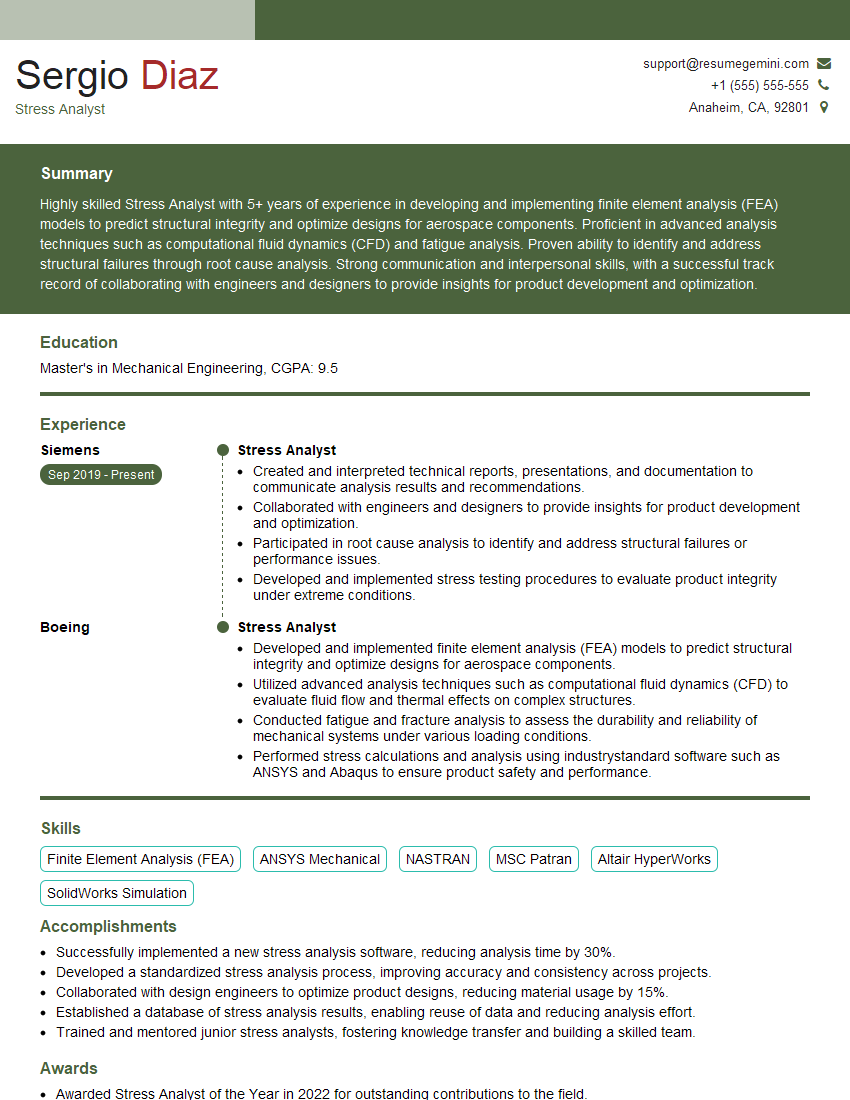
Mastering CAE Analysis (FEA, CFD) opens doors to exciting and rewarding careers in various industries. Your expertise in simulation and analysis will be highly valuable in design optimization, product development, and research. To significantly boost your job prospects, crafting an ATS-friendly resume is crucial. ResumeGemini is a trusted resource to help you build a professional and effective resume that highlights your skills and experience. They provide examples of resumes specifically tailored to CAE Analysis (FEA, CFD) roles, enabling you to present yourself in the best possible light to potential employers. Take the next step towards your dream career today!
Explore more articles
Users Rating of Our Blogs
Share Your Experience
We value your feedback! Please rate our content and share your thoughts (optional).
What Readers Say About Our Blog
Very informative content, great job.
good