Interviews are opportunities to demonstrate your expertise, and this guide is here to help you shine. Explore the essential Collaborative Creation interview questions that employers frequently ask, paired with strategies for crafting responses that set you apart from the competition.
Questions Asked in Collaborative Creation Interview
Q 1. Describe your experience facilitating collaborative projects.
My experience facilitating collaborative projects spans diverse settings, from small cross-functional teams to large-scale, multi-organizational initiatives. I’ve consistently focused on establishing clear goals, defining roles and responsibilities, and fostering a culture of open communication and mutual respect. I leverage a variety of techniques, depending on the project’s scope and the team’s dynamics. For instance, in a recent project involving the development of a new software platform, I utilized agile methodologies, incorporating daily stand-up meetings, sprint reviews, and retrospectives to ensure transparency and iterative progress. In another project, focusing on a strategic marketing campaign, I employed design thinking workshops to generate innovative ideas and facilitate collaborative brainstorming sessions.
Key to my approach is proactive identification of potential roadblocks and addressing them preemptively. This involves careful consideration of team members’ strengths, weaknesses, and communication styles, enabling me to tailor my facilitation strategies accordingly. I also prioritize building trust and rapport within the team, creating a safe space for individuals to voice their opinions and contribute effectively.
Q 2. Explain a time you resolved conflict within a collaborative team.
During a collaborative project designing a new product line, two team members, a marketing specialist and a product engineer, clashed over the product’s target market segmentation. The engineer advocated for a broad approach, while the marketer pushed for a niche strategy. The conflict threatened to derail the project timeline. To resolve this, I first facilitated a structured discussion, ensuring both individuals felt heard and understood. I then guided them through a SWOT (Strengths, Weaknesses, Opportunities, Threats) analysis for each approach, highlighting the pros and cons of both broad and niche strategies. This objective analysis provided a common ground for discussion. Finally, we collaboratively developed a compromise solution – a phased approach, starting with a niche market launch followed by gradual expansion.
This experience reinforced the importance of active listening, impartial mediation, and the use of objective tools for conflict resolution in collaborative environments. It showed the value of finding a solution that incorporates elements from each conflicting viewpoint rather than forcing a unilateral decision.
Q 3. How do you handle disagreements during a collaborative process?
Disagreements are inevitable in collaborative projects; they often indicate a healthy exploration of diverse perspectives. My approach prioritizes constructive dialogue and focuses on finding common ground. I use several techniques to manage disagreements, including:
- Active Listening: Ensuring all parties feel heard and understood is paramount.
- Reframing: Rephrasing opposing viewpoints to highlight shared goals and identify areas of agreement.
- Data-Driven Decision Making: Basing decisions on factual information and evidence, rather than subjective opinions.
- Facilitated Problem-Solving: Guiding the team through a structured process to collaboratively identify solutions.
- Compromise and Negotiation: Encouraging participants to find mutually agreeable solutions that incorporate elements from different perspectives.
Ultimately, the goal is not to eliminate disagreements, but to transform them into opportunities for creative problem-solving and improved outcomes.
Q 4. What tools and techniques do you use to foster collaboration?
I utilize a range of tools and techniques to foster collaboration, adapting my choices to the specific project and team context. These include:
- Project Management Software: Tools like Asana, Trello, or Jira facilitate task management, communication, and progress tracking.
- Communication Platforms: Slack, Microsoft Teams, or Google Chat enable seamless communication and information sharing.
- Collaborative Document Editing: Google Docs, Microsoft Word Online, or Overleaf allow real-time co-authoring and version control.
- Video Conferencing: Zoom, Google Meet, or Skype facilitate virtual meetings and team interactions.
- Mind Mapping and Brainstorming Tools: Mural, Miro, or XMind support visual collaboration and idea generation.
Beyond specific software, I emphasize the importance of establishing clear communication protocols, regular check-ins, and opportunities for informal interactions to build team cohesion and encourage spontaneous collaboration.
Q 5. Describe your process for identifying and utilizing diverse perspectives in a collaborative environment.
Identifying and utilizing diverse perspectives is crucial for innovation and comprehensive problem-solving. My process involves several key steps:
- Diverse Team Composition: Actively seeking individuals with varying backgrounds, experiences, and skill sets.
- Structured Brainstorming: Employing techniques like nominal group technique or brainwriting to ensure all voices are heard, especially from those who might be less vocal.
- Perspective-Taking Exercises: Encouraging team members to consider the project from different stakeholders’ viewpoints.
- Conflict Resolution Strategies (as mentioned above): Transforming potential disagreements into opportunities for enriched perspectives.
- Regular Feedback Mechanisms: Creating opportunities for team members to share their thoughts and ideas throughout the project lifecycle.
I believe valuing diverse perspectives not only enriches the quality of the final product but also creates a more inclusive and engaging collaborative environment.
Q 6. How do you ensure all team members are engaged in a collaborative project?
Ensuring all team members are engaged requires a multi-faceted approach. I focus on:
- Clear Roles and Responsibilities: Assigning tasks that align with individual skills and interests, fostering a sense of ownership and accountability.
- Regular Communication and Feedback: Providing frequent updates, soliciting input, and acknowledging individual contributions.
- Open and Inclusive Meetings: Creating a safe space for everyone to participate, and actively encouraging quieter team members to share their ideas.
- Opportunities for Collaboration and Social Interaction: Incorporating team-building activities and informal gatherings to foster rapport and camaraderie.
- Personalized Support and Mentorship: Providing tailored support to address individual needs and challenges.
Engaging all team members is not just about ensuring everyone completes their tasks; it’s about fostering a sense of belonging and shared purpose.
Q 7. What strategies do you use to manage competing priorities in a collaborative setting?
Managing competing priorities in a collaborative setting often requires a structured and transparent approach. I typically use the following strategies:
- Prioritization Matrix: Employing a framework like Eisenhower Matrix (urgent/important) to rank tasks based on their urgency and importance.
- Project Scope Management: Clearly defining the project’s scope and objectives, ensuring that all activities align with the overall goals.
- Regular Review and Adjustment: Holding frequent meetings to review progress, identify emerging challenges, and adjust priorities as needed.
- Agile Methodologies: Adopting iterative approaches, allowing for flexibility and adaptation to changing circumstances.
- Open and Honest Communication: Maintaining open lines of communication to ensure everyone is aware of priorities and potential conflicts.
Effective prioritization requires clear communication, a shared understanding of project objectives, and a willingness to adapt to changing circumstances. It’s about focusing on the highest-impact activities that will deliver the most value within the given constraints.
Q 8. How do you measure the success of a collaborative project?
Measuring the success of a collaborative project goes beyond simply meeting deadlines. It involves a holistic assessment encompassing several key areas. We need to consider both the tangible outputs and the intangible benefits of the collaborative process.
- Outcome Achievement: Did the project achieve its stated goals and objectives? This might involve quantifiable metrics like sales figures, user engagement, or defect rates, depending on the project’s nature. For example, if the goal was to increase website traffic by 20%, we measure the actual increase and compare it to the target.
- Quality of Output: Was the final product or service of high quality, meeting the defined standards and user expectations? This often involves user feedback, testing results, and peer reviews. A successful collaborative project produces a product that is not only functional but also user-friendly and aesthetically pleasing.
- Team Effectiveness: Did the team work well together? Were there effective communication channels, conflict resolution mechanisms, and a shared understanding of roles and responsibilities? This can be assessed through team surveys, feedback sessions, and observation of team dynamics. A strong team collaboration can lead to innovations beyond the initial project scope.
- Process Efficiency: Was the project completed on time and within budget? Were there any significant roadblocks or delays, and if so, how were they addressed? Efficient project management is crucial in maintaining momentum and preventing burnout.
- Individual Growth: Did team members learn new skills, gain experience, and enhance their collaborative capabilities? This aspect is often overlooked, but it’s vital for individual and organizational development. Opportunities for professional growth fosters a more engaged and motivated team.
Ultimately, success is a blend of these factors, and the weight given to each will vary depending on the specific project goals and context.
Q 9. Explain your experience using collaborative project management software.
I have extensive experience using various collaborative project management software, including Jira, Asana, Trello, and Microsoft Teams. My experience spans different project types and team sizes. I find the choice of software depends heavily on the project’s needs and the team’s familiarity with specific platforms.
For example, in a small team developing a marketing campaign, Trello’s Kanban board approach worked exceptionally well for visualizing progress and managing tasks. The simple drag-and-drop interface was intuitive and facilitated easy task assignment and tracking. However, for larger, more complex projects involving software development, Jira’s robust features for issue tracking, sprint management, and reporting were far more suitable. It provided greater control over workflow, detailed task breakdown, and comprehensive metrics for assessing progress.
Beyond task management, I’ve leveraged Microsoft Teams extensively for real-time communication, file sharing, and video conferencing, significantly improving team collaboration and responsiveness. The integration with other Microsoft products further enhanced productivity.
My proficiency includes configuring workflows, customizing dashboards, generating reports, and training team members on effective use of these tools. I believe the right software, used effectively, can significantly boost a team’s productivity and improve the overall collaborative experience.
Q 10. How do you adapt your collaborative approach to different team dynamics?
Adapting my collaborative approach to different team dynamics is crucial for effective project management. I approach this by first understanding the team’s unique characteristics, communication styles, and individual strengths and weaknesses. This involves careful observation, informal conversations, and active listening.
- Communication Styles: Some teams prefer direct, concise communication; others might prefer more detailed explanations and feedback. I tailor my communication style to match the team’s preference, ensuring everyone feels heard and understood.
- Decision-Making Processes: Some teams function best with consensus-based decisions; others might prefer a more hierarchical structure. I facilitate the decision-making process in a way that aligns with the team’s preferred approach. For example, if the team prefers a consensus approach, I might facilitate brainstorming sessions and discussions to ensure everyone has a voice.
- Conflict Resolution: Different teams handle conflict differently. My approach is to identify the root cause of any conflict, encourage open communication, and facilitate a solution that addresses everyone’s concerns. This often involves active mediation and finding common ground.
- Leadership Styles: Some teams thrive under a directive leader, while others prefer a more collaborative and supportive leader. I adjust my leadership style to be effective within the specific team context.
Essentially, I act as a facilitator, adapting my methods to create an environment where every team member feels valued, respected, and empowered to contribute their unique skills and perspectives. This flexible approach ensures the project is delivered efficiently and effectively.
Q 11. Describe your process for providing constructive feedback in a collaborative environment.
Providing constructive feedback is essential for continuous improvement in a collaborative environment. My process focuses on being specific, balanced, and respectful.
- Specificity: I avoid vague statements and instead focus on concrete examples. Instead of saying “Your work is sloppy,” I would say, “In the report, the data on page 3 lacks proper citation, making it difficult to verify the information.”
- Balance: I highlight both strengths and areas for improvement. This approach ensures the feedback is not solely negative, maintaining a positive and motivating tone. For instance, I might say, “Your presentation was engaging and well-structured, and the visuals were particularly effective. However, the conclusion could benefit from summarizing the key takeaways more concisely.”
- Respect: I ensure my feedback is delivered in a respectful and empathetic manner. I avoid making personal attacks or judging individuals. The focus is on improving the work, not the person.
- Focus on solutions: Whenever possible, I offer specific suggestions on how the work can be improved. Instead of just identifying a problem, I help find a solution.
- Timing and context: Feedback should be timely and delivered in an appropriate context. A one-on-one conversation is often more effective than a public forum.
By following this process, I aim to make feedback a valuable tool for growth and development, rather than a source of negativity or defensiveness.
Q 12. How do you handle situations where a team member is not contributing effectively?
When a team member is not contributing effectively, I address the situation using a structured approach that balances support and accountability.
- Private Conversation: I begin with a private conversation to understand the reason for the lack of contribution. This could be due to personal issues, unclear expectations, lack of skills, or resource constraints. Open communication is key to identifying the root cause.
- Clarify Expectations: I ensure the team member understands their responsibilities and the project’s goals. This often involves revisiting the project plan, clarifying roles, and setting clear expectations.
- Offer Support: If the issue stems from a lack of skills or knowledge, I offer support through mentoring, training, or assigning simpler tasks to build confidence and competence. I strive to empower the team member to succeed.
- Adjust Roles: If the team member’s skillset doesn’t match the assigned tasks, I re-evaluate their role and responsibilities to better align them with their capabilities.
- Escalation: If the underperformance persists despite the interventions, I involve the project manager or relevant authority to explore further solutions, such as performance improvement plans or other disciplinary actions. This is a last resort.
My goal is to help the team member improve their contribution while ensuring the project’s success. This requires a blend of empathy, firmness, and a commitment to supporting the individual within the team.
Q 13. What are the key elements of successful collaborative projects, in your opinion?
In my experience, successful collaborative projects hinge on several key elements:
- Clear Goals and Objectives: Everyone must understand the project’s purpose, goals, and desired outcomes. Without a shared vision, collaboration becomes fragmented and inefficient.
- Effective Communication: Open, transparent, and regular communication is vital. This involves establishing clear communication channels, using appropriate tools, and actively listening to team members’ feedback.
- Well-Defined Roles and Responsibilities: Each team member should have a clear understanding of their responsibilities and how their work contributes to the overall project goal. This minimizes confusion and ensures accountability.
- Shared Understanding of Processes: The team needs a consistent approach to managing tasks, tracking progress, and making decisions. Standardized workflows and processes contribute to efficiency and clarity.
- Constructive Conflict Resolution: Disagreements are inevitable, but a successful team knows how to manage conflict constructively, fostering open discussions and finding mutually acceptable solutions.
- Trust and Respect: A foundation of trust and mutual respect among team members is essential for open communication, collaboration, and effective problem-solving. Team members should feel comfortable sharing their ideas and concerns without fear of judgment.
- Effective Leadership: Strong leadership is vital for guiding the team, facilitating collaboration, resolving conflicts, and ensuring the project stays on track. This leadership should be supportive and empowering.
When these elements are present, collaborative projects tend to thrive, producing high-quality outputs and fostering a positive team experience.
Q 14. How do you balance individual contributions with the overall team goal?
Balancing individual contributions with the overall team goal requires a delicate balance of autonomy and coordination. It’s a continuous process of alignment and adjustment.
- Clearly Defined Individual Roles: Each team member should have specific responsibilities that contribute to the overall team goal. This ensures individual efforts are aligned with the broader objective and prevents redundancy or overlap.
- Regular Check-ins: Frequent check-ins with individual team members help track progress, address challenges, and ensure alignment with the team’s objectives. This allows for early identification of potential roadblocks and swift adjustments.
- Open Communication: Encouraging open communication ensures individuals feel comfortable raising concerns, sharing ideas, and requesting support when needed. This fosters a sense of shared ownership and collective responsibility.
- Flexible Task Management: Allowing some flexibility in how tasks are approached promotes creativity and innovation while still adhering to the overall project goals. It encourages individual ownership and problem-solving.
- Shared Goals and Metrics: Using shared goals and metrics provides a clear framework for individual contributions, allowing team members to understand how their work impacts the bigger picture. This promotes a shared sense of purpose and accomplishment.
Essentially, it’s about creating a supportive environment that empowers individuals to excel while working cohesively towards a common objective. It’s a dynamic process that requires continuous monitoring, adjustment, and open communication to ensure both individual and team success.
Q 15. How do you manage the workload and responsibilities within a collaborative project?
Effective workload management in collaborative projects hinges on clear task assignment and responsibility delegation. It’s not just about dividing the work; it’s about ensuring everyone understands their role and how it contributes to the overall goal. We begin with a detailed project breakdown, identifying individual tasks and their dependencies. This is often visualized using tools like Gantt charts or project management software. Then, we assign tasks based on individual expertise and availability. Regular check-ins, using methods like daily stand-up meetings or weekly progress reports, keep everyone aligned and allow for adjustments as needed. For example, in a recent website redesign project, we used a Kanban board to visually track tasks, ensuring transparency and allowing team members to easily see what was in progress and what needed attention.
Crucially, we build in buffer time to account for unexpected delays or challenges. This prevents bottlenecks and allows for flexibility. Finally, we utilize project management software to track progress, deadlines, and resource allocation, making the process transparent and efficient.
Career Expert Tips:
- Ace those interviews! Prepare effectively by reviewing the Top 50 Most Common Interview Questions on ResumeGemini.
- Navigate your job search with confidence! Explore a wide range of Career Tips on ResumeGemini. Learn about common challenges and recommendations to overcome them.
- Craft the perfect resume! Master the Art of Resume Writing with ResumeGemini’s guide. Showcase your unique qualifications and achievements effectively.
- Don’t miss out on holiday savings! Build your dream resume with ResumeGemini’s ATS optimized templates.
Q 16. What strategies do you employ to build trust and rapport within a team?
Building trust and rapport is paramount for successful collaboration. It’s about fostering a sense of psychological safety where team members feel comfortable sharing ideas, concerns, and even admitting mistakes. I achieve this through several strategies. Firstly, I prioritize open and honest communication, actively listening to team members’ perspectives and acknowledging their contributions. Secondly, I promote a culture of mutual respect and appreciation, celebrating successes both big and small. This often involves regular team-building activities, even virtual ones, designed to help people connect on a personal level.
Thirdly, I strive to be transparent about project decisions and challenges, ensuring everyone understands the rationale behind them. This builds credibility and reduces uncertainty. For instance, in a previous project where we faced a significant technical challenge, I kept the team informed about every step we were taking to solve it. This transparency not only maintained their morale but also fostered a sense of collective responsibility.
Q 17. Describe your experience working with remote or geographically dispersed teams.
I have extensive experience working with geographically dispersed teams, both virtually and through a combination of in-person and remote interactions. The key to success lies in establishing clear communication protocols and utilizing appropriate collaborative tools. This includes scheduling regular video conferences to maintain a sense of personal connection, using project management software to track progress and deadlines, and employing asynchronous communication methods like email or messaging platforms for updates and discussions.
For instance, I managed a global design project where team members were based across three continents. We utilized video conferencing for weekly meetings, Slack for quick questions and updates, and a shared online workspace for document collaboration. Careful consideration of time zones is also crucial; we ensured that meeting times were convenient for the majority of the team, or split larger sessions into smaller, more focused ones.
Q 18. How do you ensure effective communication within a large collaborative team?
Effective communication within a large team requires a multi-faceted approach. We use a combination of methods to ensure everyone stays informed and engaged. This starts with establishing clear communication channels and protocols: who to contact for specific issues, designated channels for different types of communication, and guidelines for responding to inquiries. We leverage project management software with built-in communication features to consolidate discussions and prevent information silos.
Regular team meetings are essential, but for large teams, it’s often beneficial to have smaller, sub-team meetings or working groups to address specific issues. We also emphasize the importance of clear and concise written communication, using templates and guidelines to ensure consistent messaging. For instance, in a large-scale software development project, we used a dedicated project management system that integrated communication tools, such as chat and announcements, to keep everyone updated on the progress and any changes.
Q 19. How do you identify and address potential roadblocks in a collaborative project?
Proactive identification and mitigation of roadblocks is crucial for successful collaborative projects. This involves a combination of risk management and continuous monitoring. We start with a thorough risk assessment at the beginning of the project, identifying potential challenges and developing contingency plans. This might involve brainstorming sessions with team members to identify potential obstacles related to technology, resources, or team dynamics.
Throughout the project, we maintain close monitoring of progress, using key performance indicators (KPIs) to track milestones and identify potential deviations from the plan. When roadblocks arise, we address them promptly through open discussion and collaborative problem-solving. This often involves bringing together relevant team members to brainstorm solutions, and if necessary, adjusting the project plan or seeking additional resources. In one project, we discovered a critical dependency on a third-party API that was experiencing delays. By addressing this early, through communication with the API provider and a quick adaptation to our development schedule, we avoided significant project delays.
Q 20. Explain your experience using different collaborative platforms or tools.
My experience with collaborative platforms and tools is extensive. I’m proficient in using project management software like Asana, Jira, and Trello for task management, progress tracking, and communication. I’ve also used collaborative document editing tools such as Google Docs and Microsoft Office 365, which facilitate real-time co-authoring and version control. For communication, I’ve utilized platforms like Slack and Microsoft Teams for instant messaging, file sharing, and video conferencing. The choice of tool depends heavily on the project’s size, complexity, and the team’s preferences. In smaller projects, a simpler tool like Trello might suffice, while larger, more complex projects often benefit from a more robust system like Jira.
Beyond these tools, I’ve also utilized specialized platforms for design collaboration (Figma), code repositories (GitHub), and knowledge management (Confluence). My approach is to choose the tools that best support the project’s workflow and enhance team collaboration.
Q 21. Describe a time you had to negotiate priorities or resources within a collaborative project.
In a recent marketing campaign project, we faced a classic resource allocation challenge. We had ambitious goals, but our budget and team capacity were limited. Initially, there were competing priorities among team members regarding the allocation of design and development resources. Some wanted to focus heavily on creating numerous video advertisements, others preferred to concentrate on social media content.
To resolve this, I facilitated a meeting where we clearly defined each team member’s goals and priorities. We then used a prioritization matrix to rank different campaign components based on their potential impact and the resources required. This transparent process allowed us to make data-driven decisions. We agreed on a balanced approach: developing a smaller number of high-quality video ads and augmenting the strategy with targeted social media campaigns. This involved some tough negotiations, but by focusing on the overall campaign objectives and presenting a clear rationale, we secured buy-in from all team members. The result was a successful campaign that exceeded expectations within the given constraints.
Q 22. How do you incorporate feedback and iterations into the collaborative design process?
Incorporating feedback and iterations is crucial for successful collaborative design. Think of it like sculpting – you start with a rough idea, get feedback, refine it, and repeat the process until you have a polished masterpiece. We use a structured approach. First, we establish clear feedback channels, such as regular design reviews, online comment threads using tools like Miro or Figma, and dedicated feedback sessions. These sessions aren’t just about pointing out flaws; we encourage constructive criticism focusing on ‘what’ and ‘why’, not just ‘how’. Second, we prioritize different feedback types: early-stage feedback focuses on the overall concept and direction; later-stage feedback zeroes in on specifics like usability and aesthetics. Third, we document all feedback, using a version control system (e.g., Git for code, Figma’s version history for design) to track changes and ensure transparency. Finally, we establish clear decision-making processes to resolve conflicting feedback and prioritize changes based on project goals and user needs. For example, we might use a weighted scoring system for feedback based on the source’s expertise and the importance of the issue.
Q 23. What metrics do you use to evaluate the effectiveness of collaborative processes?
Evaluating collaborative processes requires a multi-faceted approach. We look beyond simple outputs; we analyze the process itself. Key metrics include: Team Productivity: measured by velocity (number of tasks completed per iteration), cycle time (time taken from task initiation to completion), and defect density (number of bugs or issues). Collaboration Effectiveness: assessed through surveys gauging team satisfaction, communication frequency and quality, and perceived contribution levels. Tools can be used here to measure collaboration interactions. Outcome Quality: measured by user feedback, success metrics (e.g., website conversions, app downloads), and stakeholder satisfaction. Innovation: evaluated by the number of novel ideas generated, the diversity of perspectives incorporated, and the successful implementation of creative solutions. Inclusivity: measured by participant engagement levels across demographics and feedback diversity. For example, we might track participation rates from various team members during brainstorm sessions. We combine quantitative data (metrics) with qualitative data (feedback from surveys and interviews) to build a comprehensive picture of our process’s effectiveness.
Q 24. How do you ensure that the collaborative process is inclusive and equitable?
Ensuring inclusivity and equity is paramount. It’s about creating a safe and welcoming environment where every voice is heard and valued. We achieve this through several strategies: Diverse Team Composition: we actively recruit individuals from diverse backgrounds and perspectives. Inclusive Communication: we use clear, concise language, avoiding jargon. We also use multiple communication methods (e.g., written, verbal, visual) to cater to different learning styles. Accessible Tools and Platforms: we ensure all collaborative tools and platforms are accessible to individuals with disabilities. Equitable Decision-Making: we establish transparent and fair decision-making processes, ensuring that all voices are considered equally. Conflict Resolution: we implement strategies for handling conflicts constructively and respectfully, ensuring everyone feels heard. Regular Check-ins: we conduct regular check-ins with team members to identify and address any potential barriers to participation or inequities. For example, we might use anonymous surveys to gauge team members’ perceptions of inclusivity. This is not just about representation; it’s about fostering a culture where diverse perspectives are actively sought out and valued.
Q 25. Describe your understanding of different collaborative working styles.
Understanding collaborative working styles is crucial for optimizing team dynamics. Some common styles include: Communicators: thrive in team discussions and enjoy open communication. Collaborators: focus on shared goals and consensus-building. Individual Contributors: prefer independent work but contribute effectively within the team framework. Drivers: are highly results-oriented and prioritize efficiency. Supporters: focus on ensuring team morale and building relationships. Recognizing these styles helps us build balanced teams and tailor communication strategies. For example, we might assign tasks to individuals based on their preferred working style, ensuring everyone can contribute effectively. We also actively facilitate communication between different working styles to avoid misunderstandings and ensure everyone feels heard.
Q 26. How do you encourage innovation and creativity within a collaborative team?
Encouraging innovation and creativity requires fostering a culture of psychological safety, where team members feel comfortable taking risks and sharing unconventional ideas. We use several methods: Brainstorming Sessions: structured sessions dedicated to generating a wide range of ideas, focusing on quantity over quality initially. We use techniques like ‘brainwriting’ (writing ideas down individually before sharing) to ensure equal participation. Design Thinking Workshops: hands-on workshops that focus on user empathy and problem-solving through prototyping and iteration. Cross-functional Collaboration: bringing together individuals from different departments or backgrounds to introduce fresh perspectives and challenges to assumptions. Idea Incubators: dedicate time for exploration of unconventional ideas, even if they seem initially impractical. Celebrating Failures: fostering a learning culture where mistakes are viewed as opportunities for growth and improvement. This is about creating space for experimentation and removing the fear of judgment.
Q 27. What strategies do you use to maintain momentum and engagement in a long-term collaborative project?
Maintaining momentum and engagement in long-term projects requires proactive strategies: Clear Goals and Milestones: establish well-defined goals and break down the project into manageable milestones with clear deadlines. Regular Communication and Updates: maintain consistent communication, keeping everyone informed of progress, challenges, and upcoming milestones. Recognition and Rewards: acknowledge and celebrate team achievements, both big and small, to maintain morale and motivation. Team Building Activities: organize regular team-building activities to strengthen relationships and improve collaboration. Flexibility and Adaptability: remain flexible and adaptable to unexpected changes or challenges, keeping the team focused on the overall goals. Feedback Loops: establish regular feedback loops to assess progress, identify issues, and adjust strategies as needed. Celebrate Milestones: Recognizing and celebrating successful completion of milestones keeps motivation high and provides a sense of accomplishment. These keep the team focused, motivated and energized.
Q 28. How do you document and share learnings from collaborative projects to improve future initiatives?
Documenting and sharing learnings is crucial for continuous improvement. We do this through various methods: Project Post-Mortems: structured sessions after project completion to discuss successes, challenges, and lessons learned. Knowledge Bases: creating centralized repositories for project documentation, best practices, and lessons learned, accessible to all team members. Case Studies: developing case studies of successful and unsuccessful aspects of projects to provide valuable insights for future initiatives. Feedback Surveys: gathering feedback from team members to identify areas for improvement in processes or tools. Process Documentation: Creating detailed documentation of the collaborative process, including communication channels, decision-making processes, and tools used. These ensure continuous learning and iterative improvements, enhancing future collaborative efforts.
Key Topics to Learn for Collaborative Creation Interview
- Understanding Collaborative Processes: Explore various collaborative methodologies (Agile, Scrum, Kanban, etc.), their strengths, weaknesses, and appropriate application in different contexts. Consider the role of communication, feedback, and conflict resolution within these frameworks.
- Effective Communication & Teamwork: Practice articulating your ideas clearly and concisely, both verbally and in writing. Discuss your experience in active listening, providing constructive criticism, and navigating differing perspectives within a team. Consider examples showcasing your ability to build consensus and manage group dynamics.
- Tools & Technologies for Collaboration: Familiarize yourself with popular collaborative platforms (e.g., project management software, shared document editors, version control systems). Be prepared to discuss your proficiency and experience using these tools to streamline workflows and enhance team productivity.
- Idea Generation & Brainstorming Techniques: Understand different brainstorming methods and their effectiveness in generating innovative solutions. Be ready to discuss your experience with techniques like mind mapping, lateral thinking, and design thinking.
- Conflict Resolution & Negotiation: Discuss your approach to resolving conflicts within a team environment. Highlight your ability to mediate disagreements constructively and reach mutually beneficial outcomes. Consider examples demonstrating your negotiation skills.
- Project Management in Collaborative Settings: Demonstrate understanding of project planning, execution, monitoring, and closure in collaborative projects. Discuss your experience with defining roles, setting timelines, tracking progress, and managing resources effectively.
Next Steps
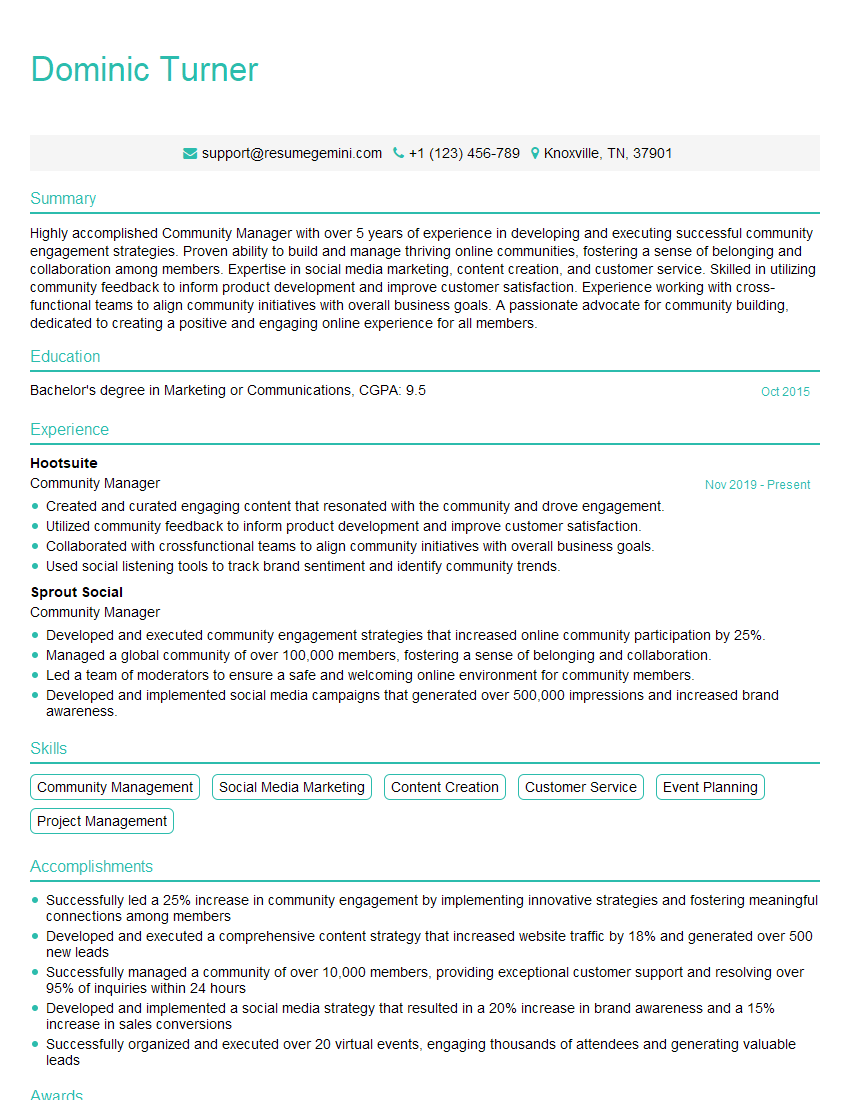
Mastering collaborative creation is crucial for career advancement in today’s interconnected world. Employers highly value individuals who can effectively work within teams, contribute creatively, and navigate complex projects. To significantly boost your job prospects, creating an ATS-friendly resume is essential. This ensures your application gets noticed by recruiters and hiring managers. We strongly recommend using ResumeGemini, a trusted resource, to build a professional and impactful resume. Examples of resumes tailored to Collaborative Creation roles are available to help you create a winning application.


Explore more articles
Users Rating of Our Blogs
Share Your Experience
We value your feedback! Please rate our content and share your thoughts (optional).
What Readers Say About Our Blog
Very informative content, great job.
good