Interviews are opportunities to demonstrate your expertise, and this guide is here to help you shine. Explore the essential Color Communication and Presentation interview questions that employers frequently ask, paired with strategies for crafting responses that set you apart from the competition.
Questions Asked in Color Communication and Presentation Interview
Q 1. Explain the difference between additive and subtractive color mixing.
Additive and subtractive color mixing are two fundamentally different approaches to creating colors. Think of it like this: additive is like building with light, while subtractive is like mixing paints.
Additive color mixing is used in devices that emit light, like monitors and televisions. It starts with black (absence of light) and adds red, green, and blue (RGB) light to create other colors. Adding all three at full intensity produces white light. Imagine shining a red, a green, and a blue flashlight onto a white wall – where they overlap, you’ll see different colors resulting from the combination of light wavelengths.
Subtractive color mixing is used in print media, where inks absorb light. It starts with white (all light reflected) and subtracts color by adding pigments like cyan, magenta, yellow, and black (CMYK). Adding all four inks together absorbs most of the light, producing black (or a very dark color). Think of mixing paints: each pigment absorbs certain wavelengths of light, leaving the reflected wavelengths to determine the final color you see.
- Additive: RGB (Red, Green, Blue) – used in screens
- Subtractive: CMYK (Cyan, Magenta, Yellow, Key [Black]) – used in printing
Q 2. Describe the principles of color harmony and provide examples.
Color harmony refers to the pleasing arrangement of colors. Several principles guide harmonious color combinations. Understanding these principles can greatly enhance the aesthetic appeal of any design.
- Complementary: Colors opposite each other on the color wheel (e.g., red and green, blue and orange). This combination offers high contrast and visual excitement. Think of a Christmas card with red and green.
- Analogous: Colors adjacent to each other on the color wheel (e.g., blue, blue-green, green). This creates a calm and serene effect. Imagine a tranquil nature scene with greens and blues.
- Triadic: Three colors equally spaced on the color wheel (e.g., red, yellow, blue). This creates a vibrant and balanced palette, offering more versatility than complementary. Consider a playful children’s book cover using these colors.
- Tetradic (Double Complementary): Two complementary pairs (e.g., red-green and blue-orange). This offers a rich and complex palette, but requires careful balancing to avoid muddiness. Think of a sophisticated piece of artwork using a variety of warm and cool tones.
- Monochromatic: Different shades, tints, and tones of a single color. This creates a cohesive and elegant look. Consider a modern minimalist website design using various shades of grey.
Choosing the right harmony depends on the desired mood and message. A vibrant triadic scheme might suit a children’s product, while a calm analogous scheme could be perfect for a spa or meditation app.
Q 3. How would you use color psychology to influence customer behavior in a marketing campaign?
Color psychology leverages the emotional and psychological associations people have with different colors to influence behavior. In marketing, understanding this is crucial.
- Red: Stimulates excitement, urgency, and appetite (often used in fast-food restaurants or sale promotions).
- Blue: Evokes trust, calmness, and security (frequently used by banks and corporations).
- Green: Associated with nature, growth, and health (suitable for eco-friendly products or healthcare brands).
- Yellow: Represents optimism, happiness, and creativity (often used for children’s products or to attract attention).
- Purple: Suggests luxury, royalty, and creativity (often used for high-end products or artistic endeavors).
For example, a campaign for a new energy drink might use vibrant reds and yellows to energize the audience, while a campaign for a financial institution might focus on blues and greens to project stability and trust. The key is to align color choices with the brand identity and target audience. Always test and analyze your campaign results to ensure the effectiveness of your color choices.
Q 4. What are the key considerations when choosing colors for a website’s user interface?
Website UI color choices are critical for usability and user experience. Poor color choices can lead to decreased readability, difficulty in navigation, and a negative brand perception.
- Readability: Sufficient contrast between text and background is paramount. Tools like WebAIM’s contrast checker can help ensure sufficient contrast for accessibility.
- Accessibility: Consider users with color vision deficiencies. Use color in a way that’s still understandable to those with protanopia, deuteranopia, or tritanopia.
- Branding: Colors should align with the brand’s identity and evoke the desired emotions.
- Hierarchy: Use color to guide users’ eyes and establish visual hierarchy (e.g., using a brighter color for calls to action).
- Consistency: Maintain consistent color usage throughout the website for a cohesive look and feel.
For example, a website selling eco-friendly products should employ greens and blues, while a technology company might opt for blues and greys, conveying a sense of innovation and professionalism.
Q 5. Explain your understanding of color spaces (e.g., RGB, CMYK, LAB).
Color spaces define the range of colors that can be represented digitally. Each has its own strengths and weaknesses.
- RGB (Red, Green, Blue): An additive color model used for screens. Each color is represented by a numerical value (0-255) for each channel (R, G, B).
rgb(255, 0, 0)represents pure red. - CMYK (Cyan, Magenta, Yellow, Key [Black]): A subtractive color model used for printing. Each color is represented by a percentage (0%-100%). It’s important to note that CMYK can’t accurately represent the full range of colors that RGB can.
- LAB (L*a*b*): A device-independent color space that describes colors based on human perception. It’s useful for color management across different devices and media, as it’s more consistent. L represents lightness, a represents the red-green axis, and b represents the yellow-blue axis.
Understanding these differences is crucial for ensuring color consistency across different media. For example, an image created in RGB for a website might look different when printed using CMYK unless proper color management is applied.
Q 6. How would you ensure color consistency across different print and digital media?
Ensuring color consistency across print and digital media requires careful color management. The key is to establish a common reference point.
- Profile creation: Create color profiles for your monitors, printers, and scanners. These profiles characterize the color capabilities of each device.
- Color conversion: When converting between color spaces (e.g., RGB to CMYK), use a reliable color management system (CMS) to ensure accurate transformation. Avoid simply converting using default settings.
- Proofing: Use soft proofs (simulations of printed colors on screen) and hard proofs (actual prints) to preview the final results before mass production. This helps identify and address any discrepancies early on.
- Standard color references: Use standardized color systems (such as Pantone) to specify colors consistently across all media.
By using a consistent workflow and employing proper color management tools, you can minimize color variations and maintain a professional brand image across all platforms.
Q 7. What color management software are you familiar with?
I am familiar with several color management software packages, including Adobe Color, X-Rite i1Profiler, and ColorSync Utility (included with macOS). These tools assist in creating color profiles, converting between color spaces, and ensuring color consistency across different devices and media. My experience includes using these tools in various projects to achieve accurate color reproduction across print and digital platforms.
Q 8. Describe your process for creating a compelling color palette for a brand.
Creating a compelling brand color palette is a strategic process that goes beyond simply choosing appealing colors. It involves understanding the brand’s personality, target audience, and market positioning. My process typically involves these steps:
- Brand Discovery: I begin by thoroughly understanding the brand’s mission, values, and desired emotional response. This includes reviewing existing brand guidelines (if any), conducting market research, and potentially interviewing key stakeholders.
- Mood Board Creation: Based on the brand discovery, I create a mood board with images, textures, and colors that evoke the desired brand feeling. This is a visual brainstorming session that helps to solidify the direction.
- Color Selection: I then select a core color palette, usually consisting of a primary color, secondary color(s), and accent colors. The primary color represents the brand’s essence, while secondary and accent colors add depth and versatility. I consider color psychology, ensuring the colors resonate with the target audience and communicate the right message.
- Testing and Refinement: The chosen palette is rigorously tested across various applications, such as logos, website mockups, and marketing materials. Feedback is gathered and adjustments are made until the palette perfectly aligns with the brand identity.
- Documentation: Finally, the final color palette is documented with specific color codes (e.g., HEX, RGB, CMYK) and usage guidelines to ensure consistency across all brand applications.
For example, a tech company aiming for innovation might use a palette of blues and greens, while a luxury brand might opt for sophisticated golds and deep purples. The key is creating a cohesive system that reflects the brand’s unique identity.
Q 9. How would you address a client who insists on using a color combination that clashes?
Addressing a client’s insistence on a clashing color combination requires a delicate balance of tact and expertise. I wouldn’t simply dismiss their preference. Instead, I’d employ a collaborative approach:
- Acknowledge and Validate: Begin by acknowledging the client’s input and expressing appreciation for their involvement. Something like, “I understand your preference for these colors, and I appreciate you sharing your vision.”
- Educate Gently: Explain the principles of color theory, highlighting why the chosen combination might not be optimal. I’d use visual aids, perhaps showing examples of how similar color schemes have worked well or poorly in the past. For example, I might point out that combining two colors of similar saturation and value can lead to muddiness and lack of contrast.
- Offer Alternatives: Instead of directly criticizing their choice, I would propose alternative color combinations that incorporate aspects of their preferred colors while improving the overall aesthetic and functionality. I’d present several options and explain the rationale behind each.
- Show, Don’t Just Tell: I’d create mockups showcasing both the client’s suggested combination and the proposed alternatives, allowing them to see the impact of different color choices in a concrete context.
- Compromise and Iterate: If necessary, I’d be willing to compromise by incorporating elements of their preferred colors in a more balanced way. The goal is to find a solution that satisfies both the client’s preferences and the principles of effective color design.
The key is to create a partnership where the client feels heard and respected, while also ensuring the final design is visually successful and achieves its intended purpose.
Q 10. What are some common color accessibility issues and how can they be mitigated?
Color accessibility is crucial for ensuring inclusivity and usability for everyone, especially those with visual impairments. Common issues include:
- Insufficient Contrast: Text and background colors that are too similar in value (lightness/darkness) make reading difficult for people with low vision. Tools like WebAIM’s contrast checker can help assess contrast ratios.
- Colorblindness: Many people experience colorblindness, which affects their ability to distinguish certain colors. Using a limited number of colors with sufficient contrast can mitigate this. Designing with colorblind-friendly palettes is key.
- Over-reliance on Color Alone: Using color alone to convey information is problematic because colorblind individuals might miss the intended meaning. Always use alternative cues, like text labels or patterns, to reinforce information conveyed by color.
Mitigation strategies include:
- Meeting WCAG Guidelines: Adhering to the Web Content Accessibility Guidelines (WCAG) ensures sufficient contrast ratios between text and background colors (e.g., a minimum 4.5:1 ratio for normal text).
- Using Colorblind-Friendly Palettes: Tools and resources are available online that generate palettes designed to be easily distinguishable by people with various types of colorblindness.
- Adding Redundant Cues: Always supplement color-coded information with alternative cues, such as text labels, shapes, or patterns.
- Testing with Colorblind Simulation Tools: There are readily available online tools that simulate different types of colorblindness, allowing designers to preview their designs from the perspective of individuals with these conditions.
By actively considering and addressing these issues, we can create designs that are inclusive and accessible to a wider audience.
Q 11. Explain the concept of color temperature and its impact on mood and perception.
Color temperature refers to the warmth or coolness of a color, often described on a scale from warm (reds, oranges, yellows) to cool (blues, greens, purples). This is analogous to the temperature of light, with warmer colors resembling incandescent light and cooler colors resembling daylight.
Impact on Mood and Perception:
- Warm Colors: Generally evoke feelings of comfort, energy, excitement, and sometimes even aggression. They can appear closer and more dominant.
- Cool Colors: Tend to create a sense of calmness, serenity, professionalism, or even sadness. They can appear more distant and less prominent.
Example: A website using warm colors like oranges and reds might feel more energetic and inviting, suitable for a fast-food restaurant. In contrast, a website for a financial institution might utilize cool blues and greens to convey trust and stability.
Understanding color temperature is crucial for setting the appropriate mood and guiding the viewer’s perception. A designer must carefully consider the intended message and the desired emotional response when selecting the temperature of their color palette.
Q 12. How do you stay updated on current color trends and design best practices?
Staying updated on color trends and design best practices requires a multi-faceted approach:
- Following Design Publications and Blogs: I regularly read publications such as AIGA Eye on Design, Design Milk, and various design blogs to stay informed about emerging trends and best practices.
- Attending Industry Conferences and Workshops: Participating in design conferences and workshops provides opportunities to learn from experts and network with other professionals in the field. This allows for first-hand exposure to current trends.
- Utilizing Online Color Trend Forecasting Tools: Several websites and tools specialize in color trend forecasting, providing insights into popular color palettes used across various industries. These tools can be a valuable resource.
- Monitoring Social Media Platforms: Platforms like Pinterest, Instagram, and Behance showcase the work of designers across the globe, providing a visual representation of current design trends.
- Analyzing Competitor Work: Observing how competitors are using color in their branding and marketing materials offers a good sense of current trends in specific industries.
By combining these approaches, I can maintain a current understanding of evolving trends and design best practices, ensuring my work remains relevant and innovative.
Q 13. Describe a situation where you had to troubleshoot a color-related issue in a presentation.
In one project, a client provided a presentation deck with images embedded that appeared significantly desaturated and washed-out when projected onto a large screen. The client was adamant that the images looked fine on their laptop screen.
Troubleshooting Steps:
- Color Profile Investigation: I first checked the color profiles of the images and the presentation software. The images were saved with an sRGB profile, while the projector was likely using a wider gamut profile. This discrepancy resulted in a loss of color vibrancy on the projector.
- Image Optimization: I re-saved the images with a color profile more appropriate for projection, improving color accuracy and saturation.
- Projector Calibration: I also suggested the client check their projector’s settings and calibration. Slight adjustments in brightness, contrast, and color settings could further enhance the image quality.
- Alternative Image Format: In cases of severe color issues, using a lossless image format like PNG instead of JPEG can ensure better color fidelity.
The issue was resolved by a combination of image optimization and projector adjustment, ensuring the presentation was visually appealing and conveyed the intended message effectively. This experience reinforced the importance of considering the display medium when preparing visuals for presentation.
Q 14. What are some effective strategies for using color to enhance readability in a presentation?
Effective use of color significantly enhances readability in presentations. Here are some strategies:
- High Contrast: Use a sufficient contrast ratio between text and background colors to ensure readability for everyone, including people with visual impairments. Dark text on a light background or vice versa is typically the most effective.
- Color Hierarchy: Utilize different colors to create a visual hierarchy, guiding the viewer’s eye to the most important information. For instance, use a bold color for headings and a less prominent color for body text.
- Strategic Color Coding: Use color consistently to represent categories or concepts, making it easier for the audience to follow the flow of information. A color-coded legend can be helpful.
- Limited Color Palette: Avoid using too many colors. A limited palette with 2-4 core colors will keep the presentation clean and prevent visual clutter.
- Appropriate Color Temperature: Select color temperatures that complement the overall mood and enhance readability. For example, a predominantly cool palette might suit a factual or technical presentation, while a warmer palette might be more fitting for a more emotional or creative presentation.
- Accessibility Considerations: Ensure that the color choices meet accessibility standards (WCAG) to accommodate individuals with colorblindness or low vision.
By strategically employing color, presentations can be made more engaging, informative, and accessible, leading to better communication and understanding.
Q 15. Explain the importance of considering cultural context when selecting colors.
Color holds profound cultural significance; what’s appealing in one culture might be offensive in another. For example, white symbolizes purity and mourning in many Western cultures, but in some Asian cultures, it’s associated with death. Red signifies luck and prosperity in China, yet it can represent anger or danger in other parts of the world. Ignoring these nuances can lead to miscommunication and even brand damage.
To navigate this effectively, thorough research is crucial. Before selecting a color palette, I’d consult resources like cultural color dictionaries and conduct surveys or focus groups within the target audience. Understanding the symbolism and emotional connotations associated with different colors in the specific cultural context is paramount. For instance, a marketing campaign aimed at a Japanese audience might benefit from incorporating more blue (associated with peace and tranquility), while a campaign for a Latin American market might leverage vibrant yellows and oranges (representing energy and happiness).
Career Expert Tips:
- Ace those interviews! Prepare effectively by reviewing the Top 50 Most Common Interview Questions on ResumeGemini.
- Navigate your job search with confidence! Explore a wide range of Career Tips on ResumeGemini. Learn about common challenges and recommendations to overcome them.
- Craft the perfect resume! Master the Art of Resume Writing with ResumeGemini’s guide. Showcase your unique qualifications and achievements effectively.
- Don’t miss out on holiday savings! Build your dream resume with ResumeGemini’s ATS optimized templates.
Q 16. How would you use color to create a sense of hierarchy in a visual design?
Color is a powerful tool for establishing visual hierarchy, guiding the viewer’s eye through the design and emphasizing key information. We typically use variations in saturation, brightness, and hue to create this hierarchy.
- Saturation: Using highly saturated colors for primary elements (like call-to-action buttons) draws immediate attention. Less saturated colors serve as a supportive background.
- Brightness/Value: Brighter colors tend to stand out, while darker colors recede. This difference in value helps establish a clear visual order.
- Hue: Strategically using contrasting hues can separate different sections of the design. For example, using a cool blue for one section and a warm orange for another would create a clear distinction.
Think of a website layout: The main navigation menu might be in a vibrant, saturated blue, while the main content area uses a lighter, less saturated shade of the same blue. Calls-to-action might be in a contrasting, high-saturation color, such as orange or green.
Q 17. What are the benefits and drawbacks of using Pantone Matching System (PMS)?
The Pantone Matching System (PMS) is a standardized color reproduction system. It assigns specific numerical values to colors, ensuring consistency across various printing methods and media.
Benefits: PMS offers unparalleled color accuracy and consistency. This is particularly beneficial for branding, where maintaining a precise brand color is vital across all marketing materials, regardless of the printer or medium used. It also simplifies color communication between designers, printers, and clients.
Drawbacks: PMS colors are typically more expensive to print than process colors (CMYK). The limited color range of PMS doesn’t capture the vast spectrum available in other systems. Furthermore, PMS colors may not translate perfectly across different printing processes and substrates (paper types).
Q 18. How would you explain complex color concepts to a non-design audience?
Explaining complex color concepts to a non-design audience requires a clear, simple approach, avoiding jargon. I’d use analogies and practical examples to illustrate the key ideas.
For instance, to explain color temperature (warm vs. cool), I’d compare warm colors (reds, oranges, yellows) to the feeling of sunlight or a fireplace, and cool colors (blues, greens, purples) to the feeling of a cool ocean breeze or a winter sky. To demonstrate color harmony, I might use the analogy of a well-balanced meal: just as a meal with complementary flavors is pleasing, a color palette with harmonious colors creates a visually appealing result. I would show examples of complementary and analogous color schemes, explaining how they create different moods and effects.
Q 19. Describe your experience with color profiling and calibration.
Color profiling and calibration are essential for ensuring accurate color reproduction across various devices and workflows. I have extensive experience using color management software such as X-Rite i1Profiler to create custom profiles for monitors, printers, and scanners.
My workflow typically involves measuring the color output of each device and creating a profile that compensates for its inherent inaccuracies. This ensures that the colors displayed on my monitor match the colors printed on paper or displayed on a website. Regular calibration is also crucial to maintain accuracy over time, as devices and their color output can drift.
I’ve successfully used this process to troubleshoot and solve color inconsistencies in many projects, ensuring clients receive the precise colors envisioned in their branding and design assets.
Q 20. What is your preferred method for presenting color palettes to clients?
My preferred method for presenting color palettes is to create a visually appealing and informative presentation that caters to the client’s needs and understanding.
I typically use mood boards showcasing the colors in context, showing how they would look on different surfaces and materials. I’ll include examples of real-world applications, and will always provide the color codes (Pantone, HEX, RGB) in a clear, organized format. I also provide a print-out of the palette to allow for offline referencing.
Client engagement is key, so I encourage feedback and discussion throughout the process, modifying the palette based on their input until we reach a shared vision.
Q 21. How would you approach creating a consistent color scheme for a multi-platform application?
Creating a consistent color scheme across multiple platforms (web, mobile, print) requires a meticulous approach using a central color palette, meticulously defined across different formats. Inconsistent representations can damage the brand identity and user experience.
My process involves:
- Defining a core color palette: Establishing primary, secondary, and accent colors using a system like Pantone or a digitally defined color system.
- Creating style guides: Comprehensive style guides detail how each color should be used across different platforms, including web (HEX codes), print (Pantone codes), and mobile (RGB values where appropriate). This removes ambiguity.
- Testing across platforms: Rigorous testing on all target devices ensures consistency of color reproduction, making necessary adjustments to maintain visual unity across the board.
- Version Control: Using a version control system, ideally alongside a collaborative design platform, ensures the style guide and color palette remain centrally managed and updated, promoting consistency across the team.
This multifaceted strategy ensures a unified brand aesthetic, regardless of the platform or device.
Q 22. Discuss your knowledge of different print techniques and their influence on color accuracy.
Different print techniques significantly impact color accuracy. The choice of printing method directly influences how accurately colors are reproduced from the digital design to the physical print. For example, offset printing, a high-volume process, uses CMYK (Cyan, Magenta, Yellow, Key/Black) inks, which can often result in slight variations from the original RGB (Red, Green, Blue) design file. This is because RGB is an additive color model (light-based), while CMYK is subtractive (ink-based). Digital printing methods, like inkjet or laser printing, offer more control and sometimes closer color matches but can still have discrepancies due to paper type and printer calibrations. Screen printing, another popular method, mixes inks directly, offering vibrant colors but limiting fine details and potentially leading to inconsistencies in color saturation across large prints.
- Offset Printing: High volume, cost-effective, but potential for color shifts due to CMYK limitations and press calibration.
- Digital Printing: Versatile, good for smaller runs and proofs, but paper and printer settings influence color accuracy.
- Screen Printing: Vibrant colors, good for textiles and large-scale projects, but color consistency can be challenging.
To minimize color discrepancies, a crucial step involves creating color profiles for each printing method and working closely with the printer to ensure accurate color matching using color management software and color proofs.
Q 23. How do you handle color discrepancies between design mockups and final product?
Addressing color discrepancies between design mockups and the final product requires a multi-faceted approach. The first step is to establish clear communication and expectations with all stakeholders upfront. This includes defining the color space (e.g., RGB, CMYK, Pantone) and specifying the target printing method. During the design phase, we incorporate color management strategies, like using color profiles, to ensure consistency across different devices and software.
When discrepancies arise, a thorough analysis is necessary. This involves comparing the digital mockup and the physical sample under controlled lighting conditions. Tools like spectrophotometers provide precise color measurements to identify the delta E (a measure of color difference). This allows for targeted adjustments in the design or print process. We might need to adjust ink formulations, calibrate printers, or even revisit the design itself to achieve better accuracy.
Documentation is crucial. A detailed record of the color profile used, the printing method employed, and the delta E values is essential for future reference and troubleshooting.
Q 24. How would you use color to convey a specific message or emotion?
Color psychology is a powerful tool for communication. We can leverage the emotional associations of different colors to effectively convey specific messages. For instance, using warm colors like red or orange can evoke feelings of excitement, energy, or urgency, making them ideal for advertising products aimed at an active audience. Cool colors like blue and green are often associated with calmness, trust, and serenity, making them suitable for brands emphasizing reliability or natural products. Purple might represent luxury or creativity.
Imagine designing a campaign for a new energy drink. Using vibrant reds and oranges would effectively convey energy and excitement. Conversely, a campaign for a relaxation app might utilize calming blues and greens. The key is understanding the target audience and choosing colors that resonate with their emotions and expectations. Beyond primary associations, color combinations and contrasts play a crucial role in shaping the overall message.
Q 25. What is your understanding of the perceptual aspects of color, such as simultaneous contrast?
Understanding the perceptual aspects of color is critical for effective color communication. Simultaneous contrast, for example, is the phenomenon where the perceived color of an object is influenced by its surrounding colors. A grey square placed on a red background appears greenish, while the same grey square on a green background might appear reddish. This happens because our visual system tries to maintain balance and contrast.
Other perceptual factors include color constancy (our brain’s ability to perceive consistent colors despite changing light sources) and afterimages (the lingering perception of a color after it is removed from view). These perceptual effects influence how we experience and interpret color, and ignoring them can lead to unexpected results in design and communication. For instance, understanding simultaneous contrast is vital in logo design to ensure the logo’s colors remain visible and distinct on various backgrounds.
Q 26. Describe your process for creating a presentation that is both visually appealing and informative.
Creating visually appealing and informative presentations involves a strategic approach. Firstly, I define the core message and key takeaways. Then I structure the content logically, using clear headings, subheadings, and bullet points to enhance readability. Visual aids, such as charts, graphs, and high-quality images, are essential for illustrating complex information.
Careful color selection is paramount; I use a limited palette of colors that complement each other and are consistent with the overall brand identity. I maintain a balance between text and visuals, ensuring that the presentation doesn’t feel cluttered. Font selection also plays a role, opting for easy-to-read fonts with sufficient contrast against the background. White space is used effectively to separate elements and improve visual hierarchy. Finally, the presentation should be reviewed thoroughly for clarity and accuracy before its delivery.
Q 27. How do you ensure your presentations are accessible to individuals with color blindness?
Creating accessible presentations for individuals with color blindness requires a thoughtful approach. The most effective strategy is to minimize reliance on color alone to convey information. Instead of using color to differentiate data points on a chart, I would use different shapes, patterns, or labels. For instance, rather than representing different categories with solely different colors, I’d use a combination of color and distinct symbols (like circles, squares, triangles).
I also use a color palette that is color-blind-friendly. Tools and websites are available that analyze color palettes and identify potential issues for those with common forms of color blindness (e.g., protanopia, deuteranopia). Providing alternative text descriptions for images also enhances accessibility for all users. Regular testing with color blindness simulation software ensures that the presentation is understandable to a wider audience.
Q 28. Explain your experience with creating presentations using different software (e.g., PowerPoint, Keynote)
I’m proficient in various presentation software, including PowerPoint and Keynote. Both offer powerful features for creating compelling visuals and delivering engaging presentations. PowerPoint’s extensive template library and integration with other Microsoft Office products make it versatile for various projects. Keynote, known for its clean interface and intuitive design tools, offers a more streamlined workflow, ideal for creating visually sophisticated presentations.
My experience encompasses creating everything from simple slide decks to complex presentations with animations and interactive elements. I adapt my choice of software to the specific needs of each project, considering factors like the target audience, the complexity of the information, and the available resources. Regardless of the software, I always prioritize clarity, consistency, and visual appeal in the final product.
Key Topics to Learn for Color Communication and Presentation Interview
- Color Theory Fundamentals: Understanding the color wheel, color harmonies (complementary, analogous, etc.), and color temperature.
- Color Psychology: How different colors evoke emotions and influence perceptions; applying this knowledge to design and presentations.
- Color Systems and Models (RGB, CMYK, Pantone): Knowing the differences and appropriate uses of each system in various contexts.
- Accessible Color Design: Principles of designing for color blindness and visual impairments; ensuring inclusivity in presentations and materials.
- Branding and Corporate Identity: Understanding how color contributes to brand recognition and messaging; applying color palettes consistently.
- Practical Application: Demonstrating experience using color effectively in presentations (PowerPoint, Keynote, etc.), marketing materials, or design projects.
- Case Studies: Analyzing successful (and unsuccessful) uses of color in real-world examples to illustrate understanding.
- Problem-Solving: Describing approaches to resolving color-related challenges, such as color inconsistencies across platforms or difficulties achieving specific design goals.
- Software Proficiency: Highlighting your skills in design software (Adobe Creative Suite, Figma, etc.) relevant to color manipulation and presentation creation.
Next Steps
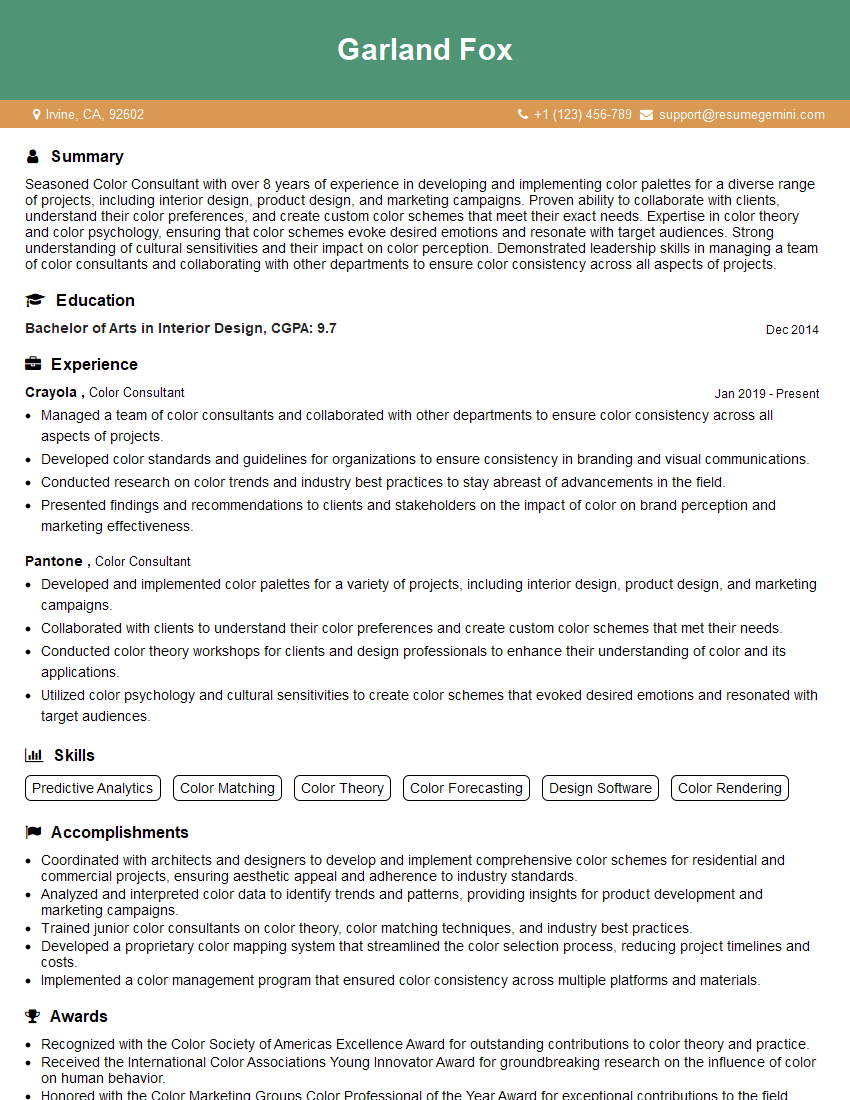
Mastering Color Communication and Presentation is crucial for career advancement in many creative fields, enhancing your ability to effectively convey information and build compelling narratives. A strong resume is your first impression, and making it ATS-friendly significantly increases your chances of landing interviews. To build a truly impactful resume showcasing your expertise, we highly recommend using ResumeGemini. ResumeGemini provides a powerful platform for crafting professional resumes, and we have included examples tailored specifically for Color Communication and Presentation professionals below to help you get started.
Explore more articles
Users Rating of Our Blogs
Share Your Experience
We value your feedback! Please rate our content and share your thoughts (optional).
What Readers Say About Our Blog
Very informative content, great job.
good