Interviews are opportunities to demonstrate your expertise, and this guide is here to help you shine. Explore the essential Color Correction and Matching interview questions that employers frequently ask, paired with strategies for crafting responses that set you apart from the competition.
Questions Asked in Color Correction and Matching Interview
Q 1. Explain the difference between color correction and color grading.
Color correction and color grading are often confused, but they serve distinct purposes in post-production. Think of it like this: color correction is fixing a problem, while color grading is adding artistic flair.
Color correction aims to restore the colors of a video to their natural state. This involves neutralizing color casts (like an overall orange or blue tint), fixing exposure issues, and ensuring white balance is accurate. It’s about achieving a realistic and faithful representation of the original scene. For instance, correcting a video shot under a sodium vapor lamp which casts a strong orange hue to match the expected daylight color temperature.
Color grading, on the other hand, is a stylistic choice. It’s about manipulating the colors to create a specific mood or look. This could involve increasing saturation, altering contrast, or applying a specific color palette to match the overall tone of a film or project. A film noir might use deep blues and shadows for a moody atmosphere; this is color grading.
Q 2. Describe the process of color balancing a video clip.
Color balancing a video clip involves adjusting the overall color temperature and tint to achieve a neutral and balanced look. This typically involves three primary steps:
- White Balance: This is the most crucial step. You want to ensure that white appears white, not tinged with color. Most editing software allows for adjusting the white balance using tools like ‘white balance eyedropper’ (selecting a known-white area in the shot) or by manually adjusting temperature (Kelvin) and tint (green/magenta).
- Color Cast Correction: After white balancing, you might still see color casts. These are unwanted color tints that affect the entire shot. You can correct these using color wheels or curves, targeting specific color channels (red, green, blue) to neutralize the undesirable hues. For example, if the shot is too blue, you’d add some yellow to counteract it.
- Fine-tuning: Once the major color casts are addressed, further adjustments might be needed to achieve the desired look. This could involve subtle adjustments to contrast, saturation, and individual color channels to refine the image’s overall color balance and quality.
The specific tools vary by software (e.g., DaVinci Resolve, Adobe Premiere Pro, Final Cut Pro), but the underlying principles remain the same.
Q 3. What are the common color spaces used in video post-production (e.g., Rec.709, DCI-P3)?
Several color spaces are commonly used in video post-production, each with its own characteristics and application:
- Rec. 709: This is the standard color space for HDTV and Blu-ray. It covers a smaller gamut (range of colors) than some other spaces but is widely compatible with various devices and displays. It is a good starting point for most projects.
- DCI-P3: This is a wider gamut color space used in digital cinema projection. It can represent a much richer and more vibrant range of colors than Rec. 709. You’ll see this used in high-end film production and mastering.
- Adobe RGB (1998): A wide-gamut color space used primarily in photography and print design. It’s less common in video but can be useful for projects that will also have print components.
- XYZ: This is a device-independent color space, often used as an intermediary space for conversions between other color spaces.
Choosing the right color space depends on the project’s final output and target display. Working in a wider gamut like DCI-P3 gives you more creative freedom during grading, but you must ensure proper color management to avoid color shifts during the final delivery to standard definition platforms.
Q 4. How do you handle color casts in video footage?
Color casts are unwanted color tints that affect the overall image. They are often caused by lighting conditions (e.g., tungsten lighting causing an orange cast or fluorescent lighting causing a greenish cast). Handling color casts involves:
- Identifying the Cast: First, determine the dominant color tint. Is it blue, orange, green, etc.? This often involves observing the neutral areas in your footage (like a grey card if available).
- White Balance Correction (as described above): This is often the most effective first step, as it addresses the source of many color casts. Using the white balance tools in your editing software is key.
- Using Color Wheels or Curves: If white balance isn’t enough, these tools offer more precision. By manipulating the color channels (RGB), you can target and subtract the offending color. For example, to remove an orange cast, you’d add cyan (opposite of orange on the color wheel).
- Selective Color Correction: Sometimes, color casts are not uniform across the entire shot. Tools like masking allow you to target specific areas affected by the cast for localized correction.
Remember that subtle adjustments are usually better than drastic changes. It’s easy to over-correct, leading to unnatural-looking colors.
Q 5. Explain your experience with LUTs (Look-Up Tables).
LUTs (Look-Up Tables) are pre-defined color transformations. They’re essentially a set of instructions that map input colors to output colors. They’re incredibly useful for streamlining the color grading process.
My experience with LUTs is extensive. I utilize them in several ways:
- Consistency: LUTs help maintain consistent color across different shots or projects. Once I’ve created a LUT that matches my desired look, I can apply it to multiple clips, ensuring a cohesive aesthetic.
- Speed and Efficiency: Applying a LUT is much faster than manually adjusting individual color settings. This is especially helpful when working with large amounts of footage.
- Creative Exploration: Many professionally made LUTs are available online, allowing for rapid exploration of different color styles. I frequently experiment with these to find the right tone for a project, before further fine-tuning.
- Custom LUT Creation: For specific looks or stylistic choices, I create my custom LUTs. This enables me to reproduce desired effects consistently across multiple projects and maintain a signature style.
Understanding how LUTs work, their strengths, and limitations is essential for a polished, consistent final product. You always need to fine-tune after application, as they are not a perfect one-size-fits-all solution.
Q 6. How do you match the color of two different shots or clips?
Color matching two different shots or clips requires careful observation and adjustments to bring them into visual harmony. My approach involves these steps:
- Analyze the Differences: Start by visually comparing the two clips. Note the differences in exposure, color temperature, saturation, and overall tone.
- Identify a Common Reference Point: Find a common element between the two shots (e.g., a shared object or background color). Use this as a point of reference for matching.
- Adjust the Less-Ideal Shot: Generally, one clip will serve as the ‘master’ or reference. Adjust the other clip to match its color temperature, exposure, and overall tone. This often involves using color wheels, curves, and other color correction tools.
- Iterative Refinement: The process is iterative. You will need to make adjustments, compare the shots again, and fine-tune until a consistent look is achieved. Pay close attention to skin tones and other subtle details.
- Consider the Context: The final match doesn’t need to be perfect pixel-for-pixel. It should create a visual cohesion in the context of the overall sequence. A slight difference may be acceptable for a more natural transition.
Effective color matching is all about achieving seamless transitions and visual consistency. It’s a combination of technical skill and artistic judgment.
Q 7. Describe your workflow for correcting skin tones.
Correcting skin tones is critical for achieving a realistic and pleasing look in video. My workflow typically involves:
- Assessing the Skin Tone: First, I assess the overall skin tone in the shot, paying attention to any color casts (e.g., too red, too green, too yellow). I usually look for a balanced, natural skin tone as my goal.
- Selective Color Correction: I often use masking techniques to select only the skin tones and apply color corrections specifically to those areas. This prevents affecting other parts of the image unintentionally.
- Using Curves and Color Wheels: These tools allow for precise adjustments of specific color channels to fine-tune the skin tones. I might slightly reduce the saturation if the skin looks too flushed or enhance it if needed.
- Careful Detailing: I pay close attention to detail, making subtle adjustments to achieve a smooth, even skin tone without losing natural texture.
- Avoiding Over-Correction: Over-correction can easily lead to an unnatural and artificial look. I work iteratively, making small changes and frequently checking the results. Often, the less you do, the better the outcome.
The goal is to create natural-looking and consistent skin tones throughout the video, enhancing the overall visual quality and realism.
Q 8. What are some common color correction tools and techniques you use?
Color correction involves manipulating the color and tonal values of an image or video to achieve a desired aesthetic or to correct for inconsistencies. My toolbox includes a variety of tools and techniques, depending on the project’s needs and the software I’m using.
- Curves: These are powerful tools allowing precise adjustments to the tonal range of individual color channels (red, green, blue). I use them to fine-tune contrast, introduce subtle color shifts, or correct color casts. For instance, a slight ‘S’ curve can boost contrast effectively.
- Levels: Similar to curves, but provides a simpler interface for adjusting the white, black, and grey points of an image. This is crucial for setting a solid foundation before more nuanced corrections.
- Color Balance: This tool adjusts the overall color temperature and tint. It’s great for quickly correcting color casts caused by different light sources, for example, warming up an image that’s too cool.
- Selective Color: This allows precise color adjustments to specific color ranges within the image. I use it to subtly desaturate or shift the hue of specific colors without affecting the overall balance. For example, I might desaturate the greens in a landscape to make the subject pop.
- Color Wheels: These provide a visual representation of the color relationships in the image, helping me understand how different colors interact and making adjustments more intuitive.
The specific application of these tools often involves a combination of techniques and iterative refinement, viewing the results on multiple calibrated displays to ensure accuracy across various contexts.
Q 9. How do you approach correcting footage shot under mixed lighting conditions?
Correcting footage shot under mixed lighting conditions requires a strategic approach. The challenge lies in unifying the different color temperatures and casts present. My strategy is usually a multi-step process:
- Identify the dominant light sources: This involves careful observation of the footage to determine the types of light (tungsten, fluorescent, daylight) and their relative intensities.
- Separate color grades where possible: If the footage allows, I might mask different sections of the frame and apply distinct corrections to areas lit differently. This isolates the impact of each light source.
- White Balance adjustments: I’ll start with correcting the dominant light source, using white balance tools to establish a consistent base. It’s often helpful to use a reference point (e.g., a known white object) within the scene.
- Selective Color Correction: I utilize tools like curves and selective color to fine-tune the color balance, targeting areas that still exhibit inconsistencies after the initial white balance correction.
- Color Grading for Stylistic Consistency: Finally, once the technical color issues are resolved, I might add a color grade to achieve a visually pleasing and consistent aesthetic across the entire footage.
Remember, the key is to work iteratively, constantly reviewing the results and making subtle adjustments until the colors are harmonized and the overall image looks natural and consistent.
Q 10. Explain the concept of white balance and its importance in color correction.
White balance refers to the process of adjusting the colors in an image to accurately reflect the colors under the light source used during capture. Think of it as setting a reference point for what ‘white’ actually looks like in your scene.
Its importance in color correction is paramount. If the white balance is incorrect, all other colors will be off as well. An image shot under tungsten lighting, for instance, will appear orange if not properly white-balanced. This can lead to unnatural-looking skin tones, skewed colors, and an overall displeasing aesthetic.
In practice, I’ll often perform white balance corrections early in the process, either in-camera (if possible) or during post-production using tools like the white balance eyedropper or by manually adjusting color temperature and tint. This step sets a solid foundation for all subsequent color adjustments. A correctly white-balanced image simplifies the rest of the color correction workflow significantly.
Q 11. How do you handle color fringing or chromatic aberration?
Color fringing, or chromatic aberration, is an optical phenomenon where different wavelengths of light (colors) are not focused at the same point by the lens. This results in colored fringes, particularly noticeable around high-contrast edges.
To handle this, I typically use software tools that offer chromatic aberration correction. Many applications have dedicated plugins or built-in features for this purpose. These tools often involve automatically detecting and correcting the color fringes, sometimes by analyzing the edges within the image. If the automated correction is insufficient, I may use more manual techniques such as masking and selectively adjusting color levels in the affected areas.
In some cases, particularly with older footage or lenses, manual corrections might require more effort and attention to detail. A combination of careful masking and color adjustment tools can often yield satisfactory results, although the process can be time-consuming.
Q 12. What software are you proficient in for color correction?
I’m proficient in several industry-standard software packages for color correction. My core expertise lies in:
- DaVinci Resolve: This is my go-to application for most projects, offering an incredibly powerful and flexible set of tools for both color correction and grading. I appreciate its node-based workflow and extensive capabilities.
- Adobe Premiere Pro & After Effects: I often work within Adobe’s Creative Cloud suite, using Premiere for video editing and After Effects for compositing and additional effects that might influence color. The Lumetri Color panel in Premiere provides a solid foundation for color correction.
- Baselight (less frequently): I have experience with Baselight, primarily on high-end projects requiring advanced features and collaborative workflows.
My proficiency extends beyond the software itself; I’m adept at utilizing the different features and workflows each package offers to best achieve the desired results, adapting my approach based on project specifics and deadlines.
Q 13. How do you manage color consistency across different devices and displays?
Maintaining color consistency across different devices and displays is critical for accurate representation of the final product. This relies heavily on color management.
My approach involves:
- Color-managed workflows: I ensure my software and operating system are correctly configured for color management. This involves setting up profiles for my monitors and displays, as well as utilizing appropriate color spaces (e.g., Rec.709 for broadcast television, DCI-P3 for cinema).
- Calibration and profiling: I regularly calibrate my monitors using a colorimeter to ensure accurate color reproduction. These tools measure the color output of the display, creating a profile that the operating system uses to correct the color information.
- Reference monitors: For critical work, I use reference monitors, which are high-quality displays designed to accurately reproduce a specific color space. These are crucial for consistent viewing during the color grading process.
- Soft Proofing: Before finalizing my work, I use soft proofing to simulate the image’s appearance on different devices, ensuring consistency across various screens and output formats.
By implementing these steps, I strive to deliver a consistent color experience for the viewer, regardless of the device or display they are using.
Q 14. What is color gamut, and how does it affect your workflow?
Color gamut refers to the range of colors a device or system can reproduce. Think of it like the palette an artist has available. Some palettes are larger and more varied, allowing for a wider range of colors, while others are more limited.
Color gamut significantly impacts my workflow. Understanding the limitations of different color spaces is crucial. For example, if I’m working with footage shot in a wide gamut (like ProRes 4444), I need to be mindful of how those colors will translate to a smaller gamut, such as sRGB (used for web display). Converting from a wide gamut to a smaller one may result in some color clipping or shifting. I might employ techniques like gamut mapping to manage this conversion and minimize undesirable effects. It’s also important to know that different displays may also have different gamuts, which can lead to slight discrepancies between what I see on my monitor and what the final output will look like on another display.
Knowing the target gamut at the very beginning allows me to make informed decisions about the color correction process to avoid surprises during the final stages of the project.
Q 15. Explain your experience with HDR (High Dynamic Range) color grading.
HDR color grading is significantly different from Standard Dynamic Range (SDR) work. In SDR, we’re dealing with a limited range of luminance and color information, often compressed to fit the display capabilities. HDR, however, opens up a vastly wider range. We’re working with much brighter highlights, much deeper shadows, and a far richer spectrum of colors. This necessitates a nuanced approach to color correction.
My experience with HDR involves mastering the nuances of HDR workflows, specifically working with different HDR formats like HDR10, Dolby Vision, and HLG. This involves understanding the different color spaces (like Rec.2020) and mastering the tools that manage the increased dynamic range, including using tools to manage highlight clipping and shadow detail recovery more effectively than in SDR. I utilize specialized HDR monitors to ensure accurate representation throughout the grading process, understanding that what looks great on an SDR monitor might be crushed or blown out on an HDR display. A crucial element is understanding the intended display – different HDR screens have different capabilities, so the final grade needs to be mindful of that.
For instance, in a recent project involving a nature documentary, the sheer brightness of a sunlit landscape presented a challenge. In SDR, I might have simply reduced the highlights, but in HDR, I carefully managed the luminance to preserve detail in the bright areas while maintaining the rich, vibrant colors without causing blooming or halo effects.
Career Expert Tips:
- Ace those interviews! Prepare effectively by reviewing the Top 50 Most Common Interview Questions on ResumeGemini.
- Navigate your job search with confidence! Explore a wide range of Career Tips on ResumeGemini. Learn about common challenges and recommendations to overcome them.
- Craft the perfect resume! Master the Art of Resume Writing with ResumeGemini’s guide. Showcase your unique qualifications and achievements effectively.
- Don’t miss out on holiday savings! Build your dream resume with ResumeGemini’s ATS optimized templates.
Q 16. Describe a challenging color correction project you’ve worked on and how you overcame the challenges.
One particularly challenging project involved color correction for a period drama shot on multiple cameras, including older film cameras and modern digital cameras. The inconsistency in color temperature, skin tones, and overall image characteristics across different sources was substantial. The film footage had a very specific, warm aesthetic, while the digital footage was cooler and much more neutral.
My approach involved a multi-step process. First, I carefully analyzed the footage from each camera to identify the key differences and inconsistencies. I meticulously graded each camera source individually, using primary and secondary color correction tools to match the color temperature and skin tones as closely as possible, while preserving the character of each camera’s image. I then used advanced techniques like color matching and LUTs (Look-Up Tables) to blend the different camera sources seamlessly. LUTs acted as a bridge, creating a consistent look across the entire project without making one source look completely like the other, sacrificing the unique character of each camera.
The final hurdle was achieving consistent skin tones across the actors, who were often illuminated with different lighting setups. To ensure accurate skin tone rendition, I utilized sophisticated tools to analyze skin tone ranges, color grading each actor individually then creating a baseline, and then applying gradual adjustments to keep a stylistic consistency across different shots.
Q 17. What are some common color correction problems and how do you solve them?
Common color correction problems are numerous, but some of the most frequent include:
- Color Casts: An unwanted overall tint, like a green or orange hue, usually stemming from inconsistent lighting or camera settings. This is remedied by using color balance tools to neutralize the unwanted color.
- Poor Skin Tones: Unnatural or inconsistent skin tones are a major concern. Solutions involve targeted adjustments to skin tones using selective color correction, ensuring a realistic representation.
- Incorrect White Balance: This leads to a color temperature shift across the entire scene, making it appear too warm or too cool. White balance correction tools are essential in resolving this.
- Highlight Clipping and Shadow Detail Loss: Overexposure leads to loss of detail in bright areas, while underexposure loses shadow detail. Careful exposure adjustment and shadow/highlight recovery tools help regain lost information.
Solving these issues often requires a combination of techniques. I often start with primary color correction (white balance, gain, lift, gamma, contrast) before moving onto secondary color correction (selective color adjustments, curves, masks) for more targeted fixes.
Q 18. Explain your understanding of color temperature and color grading workflows.
Color temperature refers to the relative warmth or coolness of a light source, measured in Kelvin (K). Lower Kelvin values (e.g., 2000K) represent warmer light (like candlelight), while higher values (e.g., 10000K) indicate cooler light (like daylight).
My color grading workflow usually starts with establishing a consistent color temperature. I often begin by correcting the white balance, ensuring all scenes are correctly balanced to a target color temperature. Once this is done, I then focus on creative color grading. This involves using tools like curves, color wheels, and selective color correction to enhance the mood, style, and overall look of the project. Different color temperatures can significantly impact the mood. A warmer tone could evoke feelings of comfort and nostalgia, whereas a cooler tone might create a sense of mystery or distance.
A common workflow might involve setting a baseline color temperature for the entire project and then using secondary color correction tools to adjust individual shots or scenes to complement each other and reflect the intended aesthetic.
Q 19. How do you deal with color inconsistencies between different cameras?
Color inconsistencies between cameras are a constant challenge in multi-camera productions. I tackle this by establishing a color reference using a color chart or a common element throughout the footage that can be used as a reference. This involves generating a profile (LUT) for each camera to ensure consistency. Color matching is extremely important here.
This process often begins with the most crucial footage. I meticulously grade this and establish a baseline, then I use that baseline to grade the rest of the footage, ensuring color consistency across all cameras. Software like DaVinci Resolve offers tools that greatly assist with matching color across various footage sources. I can directly compare, analyze, and match the color spaces within this software making for a significantly smoother process.
Q 20. How do you collaborate with other members of the post-production team on color decisions?
Collaboration is key in post-production. I strongly believe in open communication and iterative feedback. With the director, cinematographer, and other stakeholders, I typically start with a reference image or a look that defines the desired aesthetic. I present several grading options, explaining the technical aspects and the artistic choices behind each one, providing them with visuals to compare and evaluate. I take this feedback and use it to iterate on the grade, adjusting the color palette to reach a consensus.
Regular check-ins and screenings are vital. This allows everyone to see how the grade progresses and to address concerns early on. Using cloud-based storage and collaboration tools makes sharing dailies and feedback easier and more efficient.
Q 21. What is your process for archiving and managing color corrected projects?
Archiving and managing color-corrected projects are crucial for ensuring long-term accessibility and integrity. My process begins by establishing a clear and consistent file naming convention. I organize files into well-defined folders based on the project name, date, and version. This includes the original footage, intermediate files, and the final color-graded footage, as well as any LUTs or other profiles generated during the color correction process.
For storage, I use a combination of local and cloud-based storage, using RAID systems for redundancy. Metadata is essential; I include comprehensive information about the project, camera settings, color space, and grading decisions. Regular backups are a must, and I use version control systems to track changes and revert to previous versions if needed. Maintaining accurate records is crucial for future reference and potential future work.
Q 22. What are the benefits of using a calibrated monitor for color correction?
A calibrated monitor is absolutely crucial for accurate color correction. Think of it like this: you wouldn’t bake a cake using a broken oven and expect perfect results. Similarly, without a calibrated monitor, your color perception is skewed, leading to inconsistencies across different screens and ultimately, a final product that doesn’t match your vision or the client’s expectations.
Calibration ensures your monitor displays colors accurately according to a standard profile (like sRGB or DCI-P3). This means the colors you see on your screen are a true representation of the colors that will be printed or displayed elsewhere. This eliminates guesswork and significantly reduces the time spent on adjustments later in the pipeline.
Benefits include: consistent color across different displays, improved accuracy in color grading decisions, reduced time spent on revisions, and a more professional and reliable workflow.
Q 23. Explain the difference between primary and secondary color correction.
Primary and secondary color correction are distinct stages in the color grading process, each with its own goals.
Primary color correction focuses on fixing technical issues. It’s about ensuring the footage is balanced and accurate, addressing problems like white balance (making sure whites appear white, not tinted), color temperature (fixing inconsistencies in the overall warmth or coolness), and exposure (adjusting brightness levels). It’s like laying a solid foundation for a building – you need it to be level before adding aesthetic elements.
Secondary color correction, on the other hand, is where the creative choices come in. This is about enhancing the mood, setting the tone, and creating a specific visual style. This might involve color grading using curves, masks, and other tools to selectively adjust colors in specific areas of the image. For example, you might want to saturate the blues in a sky or desaturate the greens in a particular scene to draw focus to another element. This is akin to decorating and furnishing a built house.
Q 24. Describe your experience with different color grading styles (e.g., film-like, stylized).
My experience encompasses a wide range of color grading styles. I’ve worked on projects requiring a naturalistic, film-like aesthetic, achieved through subtle adjustments and a focus on realistic skin tones and color palettes. For instance, I recently graded a documentary where the goal was to maintain a ‘look’ that felt authentic to the time period.
I also have considerable experience with more stylized approaches. This includes vibrant, saturated looks for commercials, or more desaturated, moody palettes for dramas. For one music video, we employed a heavy teal and orange contrast to create a dramatic and visually striking effect. I’ve even worked on projects using custom LUTs (look-up tables) to achieve specific stylistic looks, quickly and consistently applying a pre-determined set of color transformations.
My adaptability allows me to seamlessly transition between these styles, always prioritizing the client’s vision and the overall narrative of the project.
Q 25. What methods do you use to ensure color accuracy across platforms?
Maintaining color accuracy across different platforms requires a multi-faceted approach. It starts with using a color-managed workflow from capture to output.
- Consistent Color Space: Working within a standard color space like Rec.709 for television or DCI-P3 for cinema throughout the entire post-production process is key. This ensures consistency across different software and hardware.
- Reference Monitors: Utilizing calibrated reference monitors – ideally, multiple monitors calibrated to the same profile – ensures accuracy in viewing and grading.
- Soft Proofing: Regularly soft-proofing my work against the target output format (e.g., web, print, cinema) is essential to predict how the final colors will look on the intended platform.
- LUTs: Creating and using custom LUTs can help maintain a consistent look across different platforms by applying a specific set of color transformations.
- Output-Specific Adjustments: Making slight adjustments near the end of the process, based on the specific requirements of the output platform, is often needed.
By employing these strategies, I can effectively minimize color variations between platforms, ensuring a consistent and high-quality final product.
Q 26. How do you balance creative color grading with maintaining realism?
Balancing creative color grading with realism is a delicate art. It’s about finding a harmony between artistic expression and maintaining the believability of the scene.
I approach this by first establishing a realistic baseline through primary color correction. This serves as a foundation for creative adjustments. Then, I use selective color grading tools, like masks and curves, to refine specific aspects of the image. For example, I might subtly enhance the saturation of the sunset without making the scene look unnatural or cartoonish. The key is using tools precisely and understanding that less is often more. Over-saturation or unrealistic colors can pull the audience out of the story.
Open communication with the client is crucial here. By discussing their creative vision and ensuring the final result aligns with the project’s goals (e.g., a documentary versus a fantastical film), I can effectively navigate this balance.
Q 27. How do you stay current with the latest advancements in color correction technology?
Staying up-to-date in color correction requires continuous learning and engagement with the industry. My methods include:
- Industry Publications and Websites: I regularly read publications focused on filmmaking, post-production, and color grading, such as [mention relevant publications].
- Online Courses and Tutorials: I frequently explore online courses and tutorials on platforms like [mention relevant platforms] to learn about new techniques and software advancements.
- Networking and Conferences: Participating in industry conferences and workshops facilitates collaboration and exposure to the latest trends and technologies.
- Experimentation: I dedicate time to testing new software features and plugins to expand my skillset and improve workflow efficiency.
This multi-pronged approach allows me to integrate the latest technologies and best practices into my workflow.
Q 28. How do you address client feedback regarding color correction and grading decisions?
Addressing client feedback is paramount. I believe in fostering an open and collaborative environment.
I start by actively listening to their concerns, ensuring I fully understand their perspective. I then explain my color grading choices, providing technical justifications when necessary. If needed, I will demonstrate how the changes affect the overall look, using A/B comparisons, to illustrate the impact visually. Often, clarifying the technical aspects helps resolve any misunderstandings.
I’m always willing to make adjustments based on reasonable and constructive feedback. I see this process as a collaborative effort, and the goal is to deliver a final product that both fulfills the client’s creative vision and maintains the integrity of the work.
Key Topics to Learn for Your Color Correction and Matching Interview
- Color Spaces and Gamuts: Understanding different color spaces (sRGB, Adobe RGB, ProPhoto RGB) and their gamuts is fundamental. Be prepared to discuss their strengths and weaknesses in various applications.
- Color Theory Fundamentals: Demonstrate a solid grasp of hue, saturation, value, and their relationships. Practice explaining color harmony and contrast.
- White Balance and Exposure Correction: Know how to achieve accurate white balance and correct exposure issues, explaining the impact on overall color accuracy.
- Color Grading Techniques: Be ready to discuss various color grading methods (e.g., using curves, color wheels, and lookup tables) and their suitability for different image types and stylistic goals.
- Workflow and Software Proficiency: Highlight your experience with industry-standard software (DaVinci Resolve, Adobe Photoshop, etc.) and explain your efficient workflow for color correction and matching tasks.
- Color Matching and Consistency: Explain your approach to matching colors across different shots, scenes, and deliverables. Discuss strategies for maintaining color consistency throughout a project.
- Understanding Colorimetry and its Applications: Showcase knowledge of color measurement instruments and principles. This demonstrates a deeper understanding of color accuracy and its technical implications.
- Troubleshooting Color Issues: Be prepared to discuss common color problems (e.g., color casts, banding, and artifacts) and how you would approach diagnosing and solving them.
- Practical Application Examples: Prepare specific examples from your portfolio or previous projects where you successfully applied color correction and matching techniques. Be ready to discuss challenges and solutions.
Next Steps: Level Up Your Career
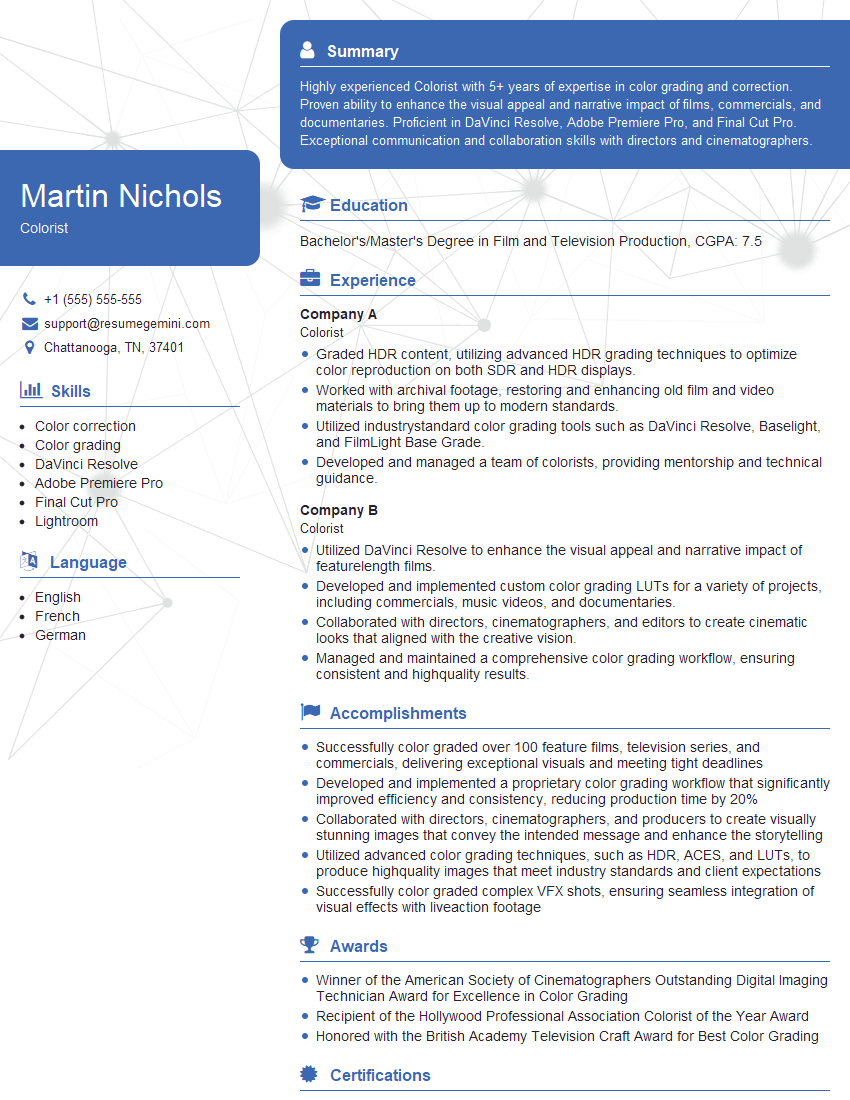
Mastering color correction and matching is crucial for career advancement in visual media. A strong understanding of these skills opens doors to exciting opportunities and higher earning potential. To maximize your job prospects, crafting an ATS-friendly resume is key. ResumeGemini is a trusted resource to help you build a professional and effective resume that highlights your skills and experience. We offer examples of resumes tailored specifically to Color Correction and Matching professionals to give you a head start. Take the next step in your career journey – build a standout resume with ResumeGemini today!
Explore more articles
Users Rating of Our Blogs
Share Your Experience
We value your feedback! Please rate our content and share your thoughts (optional).
What Readers Say About Our Blog
Very informative content, great job.
good