Interviews are more than just a Q&A session—they’re a chance to prove your worth. This blog dives into essential Color Matching and Correction interview questions and expert tips to help you align your answers with what hiring managers are looking for. Start preparing to shine!
Questions Asked in Color Matching and Correction Interview
Q 1. Explain the difference between additive and subtractive color mixing.
Additive and subtractive color mixing are two fundamentally different approaches to creating colors. Imagine painting a wall versus shining colored lights on it. That’s the essence of the difference.
Additive color mixing is the process of combining different lights to create new colors. It’s used in screens (monitors, TVs, projectors) which emit light. The primary additive colors are red, green, and blue (RGB). When all three are combined at full intensity, you get white light; when none are present, you get black.
- Example: A computer screen creates yellow by combining red and green light.
Subtractive color mixing, on the other hand, involves mixing pigments or dyes. It’s used in printing (CMYK – cyan, magenta, yellow, and key [black]) and painting. Each pigment absorbs certain wavelengths of light, and the remaining wavelengths determine the perceived color. Combining all primary subtractive colors ideally results in black; the absence of pigment results in white (or the color of the substrate).
- Example: Mixing blue and yellow paint creates green because the blue pigment absorbs some of the red and yellow light, leaving mostly green light to be reflected.
Understanding this difference is crucial for color management. A color that looks accurate on a screen might not print correctly because of the different mixing systems.
Q 2. Describe the CIE color space and its importance in color management.
The CIE (Commission Internationale de l’Éclairage) color space is an internationally recognized standard that describes all the colors visible to the average human eye. It’s not a device-dependent color space, unlike sRGB or Adobe RGB; it’s a mathematical model representing all perceivable colors.
The most common CIE color space is CIE 1931 XYZ. It uses three imaginary primary colors (X, Y, Z) that, when combined in various proportions, can match any visible color. ‘Y’ represents luminance (brightness). The CIE diagram shows the gamut of visible colors, a horseshoe-shaped area. Any color within this area can be defined by its X and Y coordinates.
Importance in color management:
- Universally understood standard: Provides a common language for color communication between different devices and software.
- Color space conversions: Enables transformation of colors between different color spaces (e.g., from RGB to CMYK).
- Gamut mapping: Helps in predicting how well a color can be reproduced on different devices with differing color gamuts.
- Color difference calculations: Allows quantitative measurements of color differences, which is essential for quality control.
Without the CIE color space, consistent color reproduction across various devices and workflows would be incredibly challenging, if not impossible.
Q 3. What are the different color profiles (e.g., sRGB, Adobe RGB, ProPhoto RGB) and their applications?
Color profiles are standardized sets of data that define the color characteristics of a specific device or printing process. They map the device’s color gamut (the range of colors it can reproduce) to the CIE color space. Different profiles cater to different needs and output methods.
- sRGB: The standard for the web and most consumer displays. It has a relatively small gamut, meaning it can’t reproduce all the colors visible to the human eye. This choice simplifies online color consistency.
- Adobe RGB: A wider gamut color space often used in professional photography and printing. It allows for a broader range of colors, especially in the greens and blues, than sRGB.
- ProPhoto RGB: An extremely wide gamut color space, encompassing nearly all colors visible to humans. Used in high-end digital photography and pre-press workflows. However, this wide gamut can sometimes lead to color shifts when converting to smaller gamuts like sRGB.
Applications:
- sRGB: Website design, social media, general-purpose images.
- Adobe RGB: High-quality prints, photography workflows requiring a wider color range than sRGB.
- ProPhoto RGB: Archival purposes, high-end image editing where maximum color fidelity is crucial, before converting to a working gamut like Adobe RGB or sRGB for printing or display.
Choosing the right color profile is crucial for maintaining color consistency throughout the workflow. Using the wrong profile can lead to significant color discrepancies between the digital image and the final output.
Q 4. How do you handle color inconsistencies between different devices (monitors, printers)?
Color inconsistencies between devices arise due to differences in their color gamuts, color temperature, and individual device calibrations. To address this, a multi-pronged approach is necessary:
- Color Calibration and Profiling: Use a colorimeter or spectrophotometer to calibrate monitors and measure the printer’s color output. This generates device-specific profiles, allowing software to correctly translate colors.
- Soft Proofing: Simulates the appearance of an image on a specific device (monitor, printer) using the respective color profile before actual printing. This helps predict potential color shifts.
- Gamut Mapping: Converting the color from a wider gamut source into the target device’s gamut. This involves making choices on how to manage colors that fall outside the target gamut (clipping, compression). This step requires understanding the limitations of the output device and choosing an appropriate gamut mapping strategy (perceptual, relative colorimetric, absolute colorimetric).
- Color Management System (CMS): Employing a CMS like those built into Adobe Creative Suite, ensures consistency by managing color profiles across different applications and devices.
- Using a controlled viewing environment: Maintaining consistent lighting conditions for viewing digital images on monitors to avoid subjective variations.
For instance, an image edited in Adobe RGB might appear dull on an sRGB monitor because the latter can’t reproduce the broader range of colors. Soft proofing helps identify this before sending to a printer. Color management ensures the correct interpretation across the entire pipeline.
Q 5. Explain the concept of gamut mapping and its importance in color reproduction.
Gamut mapping is the process of translating colors from a source color space with a wide gamut (the range of colors a device can reproduce) to a destination color space with a narrower gamut. It’s essential because different devices have different capabilities.
For example, a digital image created in ProPhoto RGB (wide gamut) will need to be mapped to sRGB (narrower gamut) for display on a typical computer monitor or for display on the web. Colors that lie outside the destination gamut must be handled using one of several methods, each with tradeoffs:
- Clipping: Colors outside the gamut are simply cut off. This might result in color loss but prevents unexpected color shifts.
- Compression: Colors outside the gamut are mapped to the closest color *within* the gamut. It aims to preserve the overall appearance but can lead to desaturation.
- Perceptual: Aims to maintain the overall visual appearance by prioritizing preservation of color relationships, potentially leading to slight color shifts.
- Relative Colorimetric: Keeps the relative colors as close as possible to the original while clipping out-of-gamut colors, preserving white balance.
- Absolute Colorimetric: Preserves the absolute color values, but can introduce significant shifts.
The choice of gamut mapping method depends on the specific application. For instance, clipping might be acceptable for web images, whereas compression or perceptual mapping might be preferred for photo prints to maintain a visually pleasing result. Careful consideration of the gamut mapping method is crucial for high-quality color reproduction across different media.
Q 6. What are color temperature and white balance, and how do they affect color accuracy?
Color temperature refers to the color of white light emitted from a light source. It’s measured in Kelvin (K). Lower Kelvin values (e.g., 2700K) represent warmer colors (more yellow/orange), while higher values (e.g., 6500K) represent cooler colors (more blueish). Sunlight has a color temperature that varies throughout the day.
White balance is the process of adjusting the color of an image to reflect the actual color temperature of the light source under which the image was captured or displayed. It’s crucial because the camera sensor or display might interpret white differently depending on the light source’s color temperature, resulting in a color cast. For example, images shot under incandescent lighting (warm) will appear yellowish if white balance isn’t set correctly. The goal is to obtain a neutral white point in your image, making all other colors appear more accurate.
Impact on color accuracy: Incorrect white balance can drastically alter the perceived colors in an image, leading to an overall color cast (e.g., making an image appear too warm or too cool). Accurate white balance ensures that all colors appear as they would under the light source’s true color temperature, improving the fidelity of the image’s colors.
Q 7. Describe different methods for color correction (e.g., curves, levels, color balance).
Color correction aims to adjust the colors in an image to achieve a more accurate or visually appealing result. Several methods are used, often in combination:
- Curves: A powerful tool for precise adjustments to individual color channels (RGB). It allows for non-linear adjustments, providing fine control over contrast and color tones. You can selectively target specific tonal ranges for adjustments.
- Levels: A simpler method for adjusting the overall brightness, contrast, and color balance. It allows you to adjust the black, white, and mid-tone points of the image’s histogram.
- Color Balance: Adjusts the overall mix of colors in the image. This is typically done by adjusting the balance between the RGB color channels, or via temperature and tint controls for simulating various light sources.
- Selective Color: Allows for adjustments to the individual color components (cyan, magenta, yellow, black) within the selected colors. This enables targeted color correction without impacting the entire image.
- Hue/Saturation: Allows adjustment of the hue (color), saturation (intensity), and lightness (brightness) of specific colors. This is a simpler, less precise approach than curves, but easier to use for less technical adjustments.
The choice of method depends on the specific correction needed. For subtle adjustments, levels or color balance might suffice. For more precise and targeted corrections, curves are invaluable. Often a combination of these methods is needed for optimal results. For example, you might use levels to adjust overall brightness and contrast and then curves to fine-tune specific tonal ranges or color channels.
Q 8. How do you identify and correct color casts in an image?
Identifying and correcting color casts, those unwanted color tints in an image, involves a multi-step process. Think of it like removing a colored filter from a lens. First, you need to identify the cast – is it a blueish tint (common in shadow areas under an overcast sky), a yellowish tint (often from incandescent lighting), or something else? This often involves visually inspecting the image, perhaps zooming into neutral areas like a white wall or grey pavement which should appear neutral in tone. Software tools provide various ways to analyze this.
Secondly, you use color correction tools. A common approach is using white balance adjustment. Most image editing software offers presets (e.g., Daylight, Shade, Tungsten) or allows for manual adjustments using color temperature (Kelvin) and tint. White balance aims to make neutral tones appear true white, thus removing the cast. More advanced techniques include using curves or selective color adjustments to target specific color channels. For example, if you identify a blue cast, you can subtly reduce the blue channel’s contribution in the shadow areas using curves and boost the red and yellow to counteract this. The goal is subtle, natural corrections rather than drastically altering the image’s overall look.
A final and essential step is to use a calibrated monitor! An uncalibrated monitor will provide an inaccurate representation of colors, leading to inaccurate color correction.
Q 9. Explain the concept of Delta E and its significance in color difference measurement.
Delta E (ΔE) is a numerical representation of the perceived difference between two colors. Imagine you have two slightly different shades of blue; ΔE quantifies how different our eyes perceive these shades. It’s not a simple difference in RGB values; it’s a perceptually uniform color difference, meaning a ΔE of 1 always represents the same perceived difference in color, regardless of the colors involved.
Different formulas exist for calculating ΔE, most notably ΔE76, ΔE94, and ΔE2000. ΔE2000 is currently considered the most accurate as it better accounts for human perception across the entire color spectrum. A ΔE value below 1 is generally imperceptible to the human eye, while a value above 3 is typically noticeable. In color management, ΔE values serve as a key metric in various contexts: comparing color standards with actual printed output (ensuring consistency), assessing the performance of color reproduction devices, and making adjustments during color correction processes. A tolerance of ΔE < 1 is often the aim for high-end print and screen color matching.
Q 10. What is color profiling, and why is it crucial for accurate color reproduction?
Color profiling is the process of creating a characterization file (a profile) that describes the color capabilities of a specific device, be it a monitor, printer, or scanner. Think of it as creating a unique ‘identity card’ for the device that tells the computer how to translate colors accurately. Without a profile, the computer assumes the device can accurately reproduce every color, which is almost never true. This results in variations in color between what is displayed on the screen and what is printed, causing significant inconsistencies.
Color profiling is crucial for accurate color reproduction because it allows the computer to manage the differences between the color spaces of different devices. Each device has its own limitations in reproducing colors (e.g. gamut). Profiling accounts for these limitations so colors can be appropriately adjusted between screen, printer and other output devices. For example, a printer may not be able to reproduce the vibrant greens of a monitor. Profiling allows for a mapping of the monitor’s color to the printer’s nearest equivalent. Without color profiling, you end up with color shifts and inconsistencies. Therefore it is fundamentally important for achieving colour accuracy in a wide range of applications, from pre-press proofing to final print.
Q 11. Describe your experience with color management software (e.g., Adobe Photoshop, X-Rite i1Profiler).
I have extensive experience with both Adobe Photoshop and X-Rite i1Profiler software. Photoshop’s color management tools are a critical part of my workflow; they allow me to work with different color profiles, adjust color settings, and utilize various color correction techniques. I regularly use tools like curves, levels, selective color, and color balance to fine-tune images and ensure color consistency across projects.
X-Rite i1Profiler, on the other hand, is essential for creating and maintaining accurate color profiles for my monitors and printers. I use it to calibrate my displays to industry standards like sRGB or Adobe RGB, ensuring that what I see on screen closely reflects the printed output. I also regularly profile my printers to optimize their color reproduction capabilities and minimize color discrepancies between the digital and physical print.
For example, I recently had a project requiring very accurate Pantone color matching. Using i1Profiler to profile the printer to the specific Pantone color space enabled me to create very close color matches to the Pantone color standards in the final product.
Q 12. How do you handle color issues related to different printing processes (e.g., offset, digital)?
Handling color issues related to different printing processes requires a deep understanding of each process’s color characteristics. Offset printing, for instance, often uses a CMYK color model and has a wider color gamut than many digital printing processes. Digital printing, such as inkjet or toner-based, can exhibit slightly different color behavior due to variations in ink or toner formulations.
My approach involves: 1) Using appropriate color profiles for each process: offset printing might need an ICC profile specific to the press and substrates used. 2) Soft proofing: simulating the final print appearance on screen using the appropriate ICC profile helps catch potential issues early. 3) Color proofing: using physical color proofs generated on the target device provides a definitive reference for color accuracy. 4) Understanding color gamut limitations: I’m always mindful of the color gamuts of different printing methods. If a color outside the gamut is used, it needs to be addressed via color substitution or other design adjustments.
In practice, this often involves working with printers to manage expectations regarding color reproducibility and color matching. For instance, when working with a client on high-end brochures, I’d work closely with the print shop to establish a color proof that accurately reflects the final output.
Q 13. What are your methods for ensuring consistent color across various media?
Ensuring color consistency across various media (print, web, screen) demands a robust color management workflow. The core principle is utilizing a common color space as a reference point. Adobe RGB or sRGB are often chosen as working color spaces. This means the image is edited in the selected color space throughout the workflow, guaranteeing that the color information is consistent from the start.
My workflow usually includes: 1) Establishing a consistent working color space. 2) Utilizing soft-proofing and color profiling throughout all stages. 3) Communicating clearly with clients and printers to set expectations. 4) Using color management software to convert between color spaces as needed, but always in a controlled manner, converting only once. 5) Regularly checking color consistency against calibrated monitors and color proofs. 6) Understanding the limitations of different devices. By carefully managing color conversions, I can minimize color shifts and ensure the final product retains visual consistency across all media.
Q 14. How do you troubleshoot color problems in a printing workflow?
Troubleshooting color problems in a printing workflow involves a systematic approach. I’d begin by identifying the exact nature of the problem: is the color too dark, too light, or off-hue? Is the issue consistent across the entire print, or localized? Where in the workflow did the problem arise (design, proofing, printing)?
My troubleshooting steps are: 1) Review the color profile: Ensure the correct profiles are used at each stage. 2) Check the source file: Inspect for color inconsistencies or incorrect color space settings in the original file. 3) Examine the color proof: Compare the proof against the printed output to pinpoint any discrepancies. 4) Analyze the print conditions: Check printer settings, ink levels, paper type, and other factors influencing color reproduction. 5) Consult with the printer: Discuss the problem with the printing professionals to gather additional insights. 6) Test prints: Perform test prints with adjusted settings to isolate the problem. 7) If necessary, consider re-profiling equipment.
It’s often a process of elimination, carefully investigating each potential point of failure. Careful record-keeping is also essential. Documenting the steps taken during troubleshooting helps identify and address similar problems in future.
Q 15. Explain the concept of spectral color measurement.
Spectral color measurement is the process of measuring the amount of light reflected or transmitted by an object at different wavelengths across the visible spectrum. Think of it like creating a detailed fingerprint of the object’s color. Instead of simply saying ‘red,’ we quantify exactly how much red, how much orange, how much yellow, etc., are present. This is done using a spectrophotometer, which shines light of various wavelengths onto the object and measures the amount of each wavelength reflected or transmitted.
This detailed spectral data provides a far more accurate representation of color than relying on human perception alone. For instance, two objects might appear visually similar under certain lighting conditions but have significantly different spectral curves, indicating a potential color mismatch under different lighting.
In practice, spectral data is crucial in various industries like printing, textile manufacturing, and automotive paint production, ensuring consistent color reproduction across different batches and manufacturing processes.
Career Expert Tips:
- Ace those interviews! Prepare effectively by reviewing the Top 50 Most Common Interview Questions on ResumeGemini.
- Navigate your job search with confidence! Explore a wide range of Career Tips on ResumeGemini. Learn about common challenges and recommendations to overcome them.
- Craft the perfect resume! Master the Art of Resume Writing with ResumeGemini’s guide. Showcase your unique qualifications and achievements effectively.
- Don’t miss out on holiday savings! Build your dream resume with ResumeGemini’s ATS optimized templates.
Q 16. Describe different color matching algorithms.
Color matching algorithms aim to find the best combination of colorants (inks, dyes, pigments) to reproduce a target color. Several algorithms exist, each with its strengths and weaknesses:
- Additive Color Matching: Used for light-based displays (monitors, screens). It involves combining red, green, and blue light to create a wider range of colors. The algorithm determines the intensity of each primary color needed to match the target color. Think of your computer screen – it mixes these three primary colors to generate all the colors you see.
- Subtractive Color Matching: Employed in printing and painting, this method works by subtracting light from white light through the use of cyan, magenta, yellow, and black (CMYK). The algorithm calculates the amount of each ink to absorb specific wavelengths to achieve the desired color. Imagine mixing paints – you start with white and each pigment subtracts light to create a darker hue.
- Neural Network-based Algorithms: These advanced algorithms leverage machine learning to analyze color data and predict optimal colorant combinations, often achieving higher accuracy and efficiency than traditional methods. They are trained on massive datasets of color measurements and colorant compositions, allowing for superior prediction.
The choice of algorithm depends on the application and the desired level of accuracy. Additive algorithms are simpler for displays, while subtractive methods are better for print media. Neural network-based approaches offer a high level of accuracy but require significant computational resources.
Q 17. What are the limitations of various color spaces?
Different color spaces each have their limitations. While some excel at representing specific color characteristics, none are universally perfect. Let’s consider some examples:
- RGB: Device-dependent; colors look different on different monitors due to variations in screen technology and calibration. It also struggles with accurate representation of certain colors, especially in the range of deep blues and greens.
- CMYK: Subtractive, prone to color gamut limitations. It can’t create as vivid colors as RGB, and achieving accurate color matches across different printing processes can be challenging.
- Lab: Device-independent, better at capturing perceptual differences between colors. However, it may not always translate directly to real-world color reproduction in all devices. Also, Lab values can appear counterintuitive to those unfamiliar with it.
- HSV (HSB): Intuitive color model based on hue, saturation, and value (brightness). Useful for color selection and manipulation, but its mathematical properties aren’t ideal for many color calculations.
Understanding these limitations is crucial when choosing a color space for a specific task. The best choice depends on whether the end-goal is display, print, or accurate perceptual representation.
Q 18. How do you handle color discrepancies between a digital image and a physical print?
Discrepancies between digital images and physical prints are common due to differences in the color spaces used by the monitor and the printer, and in the characteristics of the devices. Addressing these requires a multi-pronged approach:
- Profile Matching: Ensure both your monitor and printer have accurate ICC profiles. These profiles characterize the color reproduction capabilities of each device. Using appropriate profiles is essential for consistent color translation across devices.
- Soft Proofing: Use color management software to simulate the printed output on your screen. This gives you a preview of how the image will appear before printing, allowing for adjustments to minimize discrepancies.
- Test Prints: Produce test prints using your chosen printing settings and compare them to your digital image on a properly calibrated monitor. Iterative adjustments to your image and printing settings may be necessary.
- Paper Type and Ink Selection: Different paper types and ink absorb light differently, affecting the final output. Choose materials appropriate for your intended print results and account for how these will interact with the color profiles in the process.
By systematically addressing each of these factors, you can significantly reduce color discrepancies between digital images and their physical prints.
Q 19. Explain the role of ICC profiles in color management.
ICC profiles are the cornerstone of color management. They act as a digital translation dictionary for colors, providing a detailed description of how a specific device (monitor, printer, scanner) renders colors. Essentially, the profile maps the device’s color space to a standardized color space (like CIELAB) allowing accurate color reproduction across different devices.
Without ICC profiles, a color appearing as a bright red on one monitor might be dull pink on another. ICC profiles ensure consistency by giving each device a unique profile that describes its color capabilities. Software then uses these profiles to convert colors between different color spaces, optimizing the representation of the intended colors.
Consider a photograph: The image file is built in a certain color space, and the ICC profile for your monitor is used to translate that to the proper colors shown on your screen. Similarly, the ICC profile for your printer is used to translate those colors to the correct ink quantities during the printing process. All this ensures that the colors intended are correctly represented.
Q 20. How do you calibrate your monitor for accurate color representation?
Calibrating your monitor for accurate color representation is critical for any color-critical work. Here’s a step-by-step process:
- Use a Colorimeter or Spectrophotometer: These devices objectively measure your screen’s color output. They are more precise than using your eyes alone.
- Install Calibration Software: Many color calibration tools are available, often bundled with colorimeters or sold separately. Popular options include Datacolor SpyderX, X-Rite i1Display Studio.
- Follow the Software Instructions: The software guides you through a calibration process, which typically involves measuring your screen’s color output at various points and then creating a custom profile based on the measurements.
- Adjust Settings: The software will recommend adjustments to your monitor’s settings (brightness, contrast, white point). Apply these settings.
- Save the Profile: The calibration software saves a custom ICC profile specific to your monitor. Ensure your operating system is using this profile.
- Regular Recalibration: Monitors drift over time, so regular recalibration (every few months) is recommended to maintain accuracy.
Calibrating your monitor ensures consistency in color representation for editing photos, designing graphics, or any task requiring accurate color perception. A properly calibrated monitor is like having a trusty, well-tuned instrument – essential for precise and accurate work.
Q 21. What is the difference between hue, saturation, and brightness?
Hue, saturation, and brightness (or value) are the three main attributes that define a color in the HSV (or HSB) color model. Think of it like this:
- Hue: This is the pure color itself – red, green, blue, yellow, etc. It’s the basic spectral position of a color on the color wheel. Hue is the “what” of a color.
- Saturation: This refers to the intensity or purity of a color. A fully saturated color is vibrant and pure, while a desaturated color is dull or grayish. Saturation is the “how much” of the hue.
- Brightness/Value: This refers to the lightness or darkness of a color. A bright color is closer to white, while a dark color is closer to black. Brightness is the “how bright” of a color.
Imagine a red apple. Its hue is red. A bright, shiny red apple would have high saturation and high brightness, while a dark, dull red apple would have low saturation and low brightness. Understanding these components allows for more precise color manipulation and descriptions.
Q 22. Explain your workflow for color correction in a video editing project.
My color correction workflow in video editing begins with a thorough assessment of the footage. I start by identifying the overall color temperature and identifying any inconsistencies or unwanted color casts. Think of it like balancing a painter’s palette – you need to establish a baseline before you can start refining the colors.
- Initial Assessment: I evaluate the footage for overall exposure, color temperature (is it too warm or cool?), and the presence of any color casts (e.g., a green tint from outdoor shadows).
- White Balance Correction: This is crucial. I use a white balance tool to correct inaccurate color temperatures, aiming for a neutral white point. This often involves adjusting the RGB levels, particularly the blue and red channels.
- Primary Color Correction: Next, I address global color issues using curves or lift/gamma/gain adjustments in my chosen software (DaVinci Resolve, Premiere Pro, etc.). This involves subtly shifting the overall color balance to achieve a desired aesthetic.
- Secondary Color Correction: Here, I refine specific areas, often using color wheels or masks to isolate particular parts of the image. For example, I might selectively warm up skin tones while cooling down shadows.
- Color Grading: Once the correction is complete, I might introduce stylistic color grading to achieve a specific look and feel, maintaining overall consistency. This step is artistic and can use LUTs (Lookup Tables) or other creative tools.
- Final Review: I compare the corrected footage with the original material, ensuring color accuracy and aesthetic appeal. I perform the final review on a calibrated monitor.
For instance, in a recent project involving outdoor scenes, I first corrected the overall blue cast resulting from the overcast sky, then selectively warmed skin tones to add vibrancy while ensuring color consistency across various shots.
Q 23. Describe your experience with color grading tools and techniques.
I’m proficient in various color grading tools and techniques, including those found in DaVinci Resolve, Adobe Premiere Pro, and Final Cut Pro. My experience encompasses using both traditional methods like curves, lift/gamma/gain, and color wheels, as well as more advanced techniques like using LUTs (Lookup Tables) and working with color spaces such as Rec. 709 and DCI-P3.
LUTs are particularly useful for applying consistent color styles across a project, speeding up the workflow significantly. Imagine it like applying a filter with much finer control, allowing precise adjustments. I also utilize advanced tools like color scopes (vectorscope, waveform monitor, parade) to objectively assess color accuracy and balance.
Furthermore, I have extensive experience using various color grading methodologies, such as the ACES (Academy Color Encoding System) workflow for its accurate color management capabilities in high-end productions. My expertise allows me to translate between different color spaces and prevent color shifts during the editing process.
Q 24. How do you ensure color consistency in a collaborative project?
Color consistency in a collaborative project requires a standardized workflow and clear communication. The most effective approach is to establish a reference frame early on, often by defining a project LUT or a set of color parameters. Think of it as a shared color palette for everyone to reference.
- Establishing a Reference: This could involve shooting a color chart or using a standardized color target at the beginning of the shoot, or establishing a master color grade that all subsequent editors and colorists can use.
- Communication and Collaboration: Regular meetings with the team to review progress and ensure color consistency across all elements are vital. We might share project files on a cloud-based platform that allows for version control and collaborative editing.
- Color Management Software: Employing tools that facilitate color management across different platforms and software is crucial. This involves using software with consistent color profiles to avoid discrepancies.
- Calibrated Monitors: All team members should work on calibrated monitors to guarantee that everyone sees the same colors. This is fundamental for accurate color judgment.
In a recent project, we used a shared DaVinci Resolve project with a locked LUT and color grading parameters to maintain color consistency across a team of five colorists working remotely.
Q 25. Describe your experience using colorimeters and spectrophotometers.
I have extensive hands-on experience with colorimeters and spectrophotometers, using them for precise color measurement and calibration. Colorimeters measure color subjectively, while spectrophotometers measure color objectively. The choice depends on the application and level of detail required.
Colorimeters are useful for quick on-set checks, while spectrophotometers provide more precise measurements and data that can be used for profiling monitors and projectors. I use them to create accurate color profiles for displays, ensuring that what I see on my screen accurately reflects the final output. This is particularly crucial in quality control, where consistent color reproduction is paramount.
For example, I’ve used a spectrophotometer to profile a high-dynamic-range (HDR) monitor for accurate color reproduction of HDR content. This ensures that highlights and shadows are represented accurately and consistently.
Q 26. How do you manage color in a high-volume production environment?
Managing color in high-volume production demands efficient and repeatable workflows. Automation and standardization become critical. This involves defining standard operating procedures (SOPs), implementing color management systems, and leveraging software tools for batch processing.
- Automated Workflows: Employing scripting or automation tools to streamline color correction processes minimizes the risk of inconsistencies and allows for faster processing of large volumes of content.
- Color Management Systems: Implementing robust color management systems, such as those based on profiles and LUTs, helps maintain consistency across different devices and software applications.
- Batch Processing: Using software that allows for batch processing of image or video files speeds up the entire process while still maintaining color accuracy.
- Quality Control Procedures: Establishing rigorous quality control checks at each stage of the production pipeline helps catch any color-related issues early on. This might involve regularly using colorimeters or spectrophotometers to monitor output.
In one project involving thousands of product shots, I developed a custom Python script to automate color correction and batch processing, significantly reducing turnaround time and ensuring consistent color across all images.
Q 27. What are your preferred methods for evaluating the accuracy of color reproduction?
My preferred methods for evaluating color reproduction accuracy involve a combination of subjective and objective assessments. Subjective evaluation utilizes visual inspection on calibrated monitors, while objective evaluation leverages color measurement instruments.
- Visual Inspection: I perform critical reviews on calibrated monitors in a controlled environment, checking for subtle color shifts and ensuring overall aesthetic consistency. This is often combined with feedback from other team members and clients.
- Colorimetry and Spectrophotometry: Using colorimeters and spectrophotometers provides objective data on the accuracy of color reproduction, allowing for quantitative analysis of color differences (Delta E).
- Color Scopes: Utilizing vectorscopes and waveform monitors allows me to visually assess aspects like skin tone and saturation levels, ensuring that colors are within acceptable ranges.
- Comparison Charts: Using color charts and targets before and after processing allows for quick and objective visual confirmation of color accuracy.
For example, in post-production for a high-end commercial, I used a spectrophotometer to measure the color reproduction of the final output on different displays, ensuring that the client’s expectations were met regardless of the screen type.
Q 28. Discuss your experience with color-related quality control procedures.
My experience with color-related quality control (QC) procedures covers a wide range, from simple visual checks to rigorous instrumental measurements. The extent of QC procedures depends on the complexity and criticality of the project.
- Visual Inspection: This is a fundamental step, involving careful examination of images and videos for color inconsistencies, unwanted casts, and other anomalies. This requires calibrated viewing conditions.
- Instrumental Measurement: Employing colorimeters and spectrophotometers allows for precise measurements, ensuring that colors fall within acceptable tolerances. This gives quantitative data to validate the subjective assessment.
- Software Analysis: Utilizing tools within editing software (vectorscopes, waveform monitors, histograms) helps identify issues such as clipping, insufficient dynamic range, or color banding.
- Color Profile Management: Implementing a structured approach to color profile management throughout the production workflow is critical for minimizing color shifts and inconsistencies. This usually includes utilizing ICC profiles.
- Documentation: Maintaining detailed records of the QC process is vital, including the measurement data obtained from instruments and any corrections made.
In a high-profile advertising campaign, our QC process included daily color reviews, using a spectrophotometer to regularly check the color accuracy of monitors, and a detailed log of all color-related adjustments and approvals.
Key Topics to Learn for Your Color Matching and Correction Interview
- Color Spaces and Transformations: Understand the differences between RGB, CMYK, LAB, and other color spaces. Practice converting between them and the implications for image editing.
- Colorimetry and Color Science Principles: Grasp fundamental concepts like spectral power distribution, metamerism, and color appearance models. Be prepared to discuss their practical relevance.
- Color Management Systems (CMS): Familiarize yourself with how CMS work to ensure color consistency across different devices and workflows. Understand ICC profiles and their role in color accuracy.
- Color Correction Techniques: Master techniques like white balance correction, color grading, and shadow/highlight adjustments. Be ready to discuss various software tools and their functionalities (e.g., Photoshop, DaVinci Resolve).
- Color Matching Algorithms: Explore the principles behind different color matching algorithms and their applications in various industries (e.g., printing, photography, video production).
- Workflows and Best Practices: Discuss efficient workflows for color correction in different contexts. Highlight your understanding of non-destructive editing, version control, and quality assurance.
- Troubleshooting and Problem-solving: Be ready to discuss common color-related issues (e.g., color casts, banding, moiré patterns) and your approaches to resolving them.
- Hardware and Software Considerations: Demonstrate your understanding of the impact of different hardware (monitors, printers) and software (editing suites) on color accuracy and workflow.
Next Steps
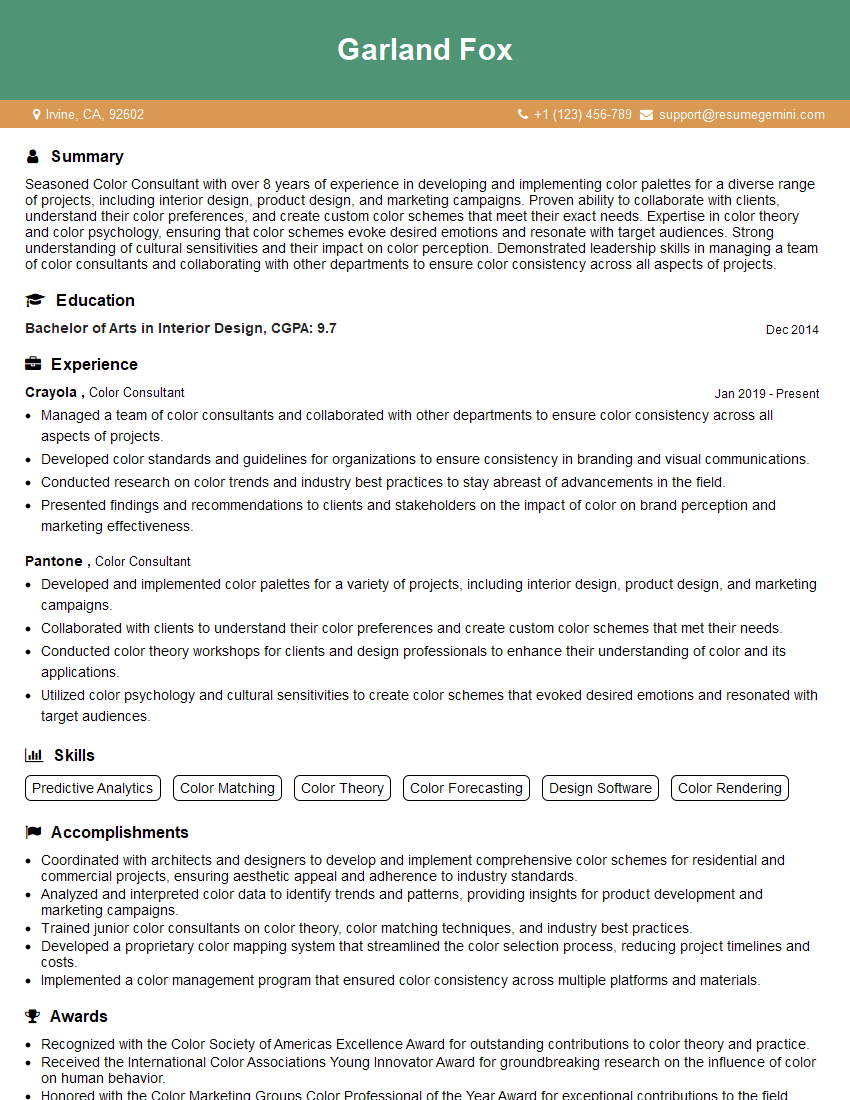
Mastering Color Matching and Correction opens doors to exciting career opportunities in various creative industries. A strong understanding of these concepts is highly valued by employers, setting you apart from other candidates. To maximize your job prospects, create a compelling and ATS-friendly resume that highlights your skills and experience effectively. ResumeGemini is a trusted resource that can help you build a professional resume that showcases your abilities to potential employers. We provide examples of resumes tailored to Color Matching and Correction roles to help you get started. Invest time in crafting a powerful resume; it’s your first impression!
Explore more articles
Users Rating of Our Blogs
Share Your Experience
We value your feedback! Please rate our content and share your thoughts (optional).
What Readers Say About Our Blog
Very informative content, great job.
good