The thought of an interview can be nerve-wracking, but the right preparation can make all the difference. Explore this comprehensive guide to Commercial Piping interview questions and gain the confidence you need to showcase your abilities and secure the role.
Questions Asked in Commercial Piping Interview
Q 1. Explain the different types of pipe materials used in commercial piping systems and their applications.
Selecting the right pipe material is crucial for a commercial piping system’s longevity and performance. The choice depends heavily on the fluid being transported, the operating pressure and temperature, and the surrounding environment. Here are some common materials and their applications:
- Carbon Steel (CS): The workhorse of commercial piping. It’s strong, readily available, and relatively inexpensive. Common applications include water, steam, and oil lines in various industrial settings. However, it’s susceptible to corrosion, especially in environments with high humidity or chemicals. We often use protective coatings or select stainless steel as a more resilient alternative in such scenarios.
- Stainless Steel (SS): Offers superior corrosion resistance compared to carbon steel. Different grades of stainless steel (e.g., 304, 316) provide varying degrees of corrosion resistance and strength, making them suitable for handling aggressive chemicals, high-purity fluids (like pharmaceuticals), and food processing applications. The increased cost is justified by its longer lifespan and reduced maintenance.
- Copper: Excellent corrosion resistance and thermal conductivity, making it ideal for potable water lines and HVAC systems. It’s also relatively easy to work with, but its cost can be higher than steel.
- Plastic Pipes (PVC, CPVC, HDPE): These are lightweight, corrosion-resistant, and suitable for applications involving chemicals that would attack metal pipes. However, they are generally less robust than metal pipes and have limitations regarding temperature and pressure.
- Ductile Iron: Stronger than carbon steel and provides excellent resistance to internal pressure and external loads, making it suitable for underground and high-pressure applications. This is a frequent choice in municipal water systems.
The selection process involves a thorough risk assessment, considering factors like cost, lifespan, maintenance requirements, and potential environmental impacts. For instance, in a chemical plant handling corrosive substances, stainless steel would be preferred for its corrosion resistance, even with the higher initial cost.
Q 2. Describe your experience with piping stress analysis and how you ensure system integrity.
Piping stress analysis is fundamental to ensuring system integrity. My experience involves using CAESAR II and other similar software to model piping systems and analyze stresses due to pressure, temperature variations, weight, and other external loads. This analysis identifies potential areas of high stress concentration and ensures that the system can withstand these stresses without failure.
To ensure system integrity, I follow a rigorous process: First, a detailed 3D model of the piping system is created, incorporating all components like valves, fittings, and supports. Then, we define the operating conditions, including pressure, temperature, and fluid properties. The software calculates stresses and displacements throughout the system. Finally, we compare these results against allowable stress limits defined by relevant codes (like ASME B31.1 or B31.3), and we iterate on the design—adjusting pipe sizes, support locations, or material selection—until all stress criteria are met. This may also involve incorporating flexibility factors to account for uncertainties and potential operational variations. I always document the analysis thoroughly and ensure the results are reviewed by a qualified engineer. A recent project involved a high-pressure steam line where the analysis revealed a potential stress concentration at a valve. By strategically placing additional supports, we mitigated the risk of failure and ensured safe operation.
Q 3. What are the common codes and standards used in commercial piping design (e.g., ASME B31.1, B31.3)?
Several codes and standards govern the design of commercial piping systems, ensuring safety and reliability. The most prominent include:
- ASME B31.1: Power Piping. This code applies to piping systems in power plants, refineries, and other high-pressure, high-temperature applications.
- ASME B31.3: Process Piping. This is the most commonly used code for piping systems in chemical plants, refineries, and other process industries. It covers a wide range of fluids and operating conditions.
- ASME B31.4: Liquid Petroleum Transportation Piping Systems. This code addresses piping systems for the transportation of liquid petroleum products.
- ASME B31.5: Refrigeration Piping. Focuses on the design of piping systems for refrigeration applications.
- API 650: Welded Tanks for Oil Storage. While not directly piping, its knowledge is crucial as piping often interacts with storage tanks.
Adherence to these codes is crucial for ensuring the system’s safety, and compliance is often a prerequisite for obtaining permits and insurance. Any deviation from the code must be justified by rigorous engineering analysis and documented thoroughly.
Q 4. How do you determine the appropriate pipe size for a given application?
Determining the appropriate pipe size is critical for efficient and reliable operation. It’s a balancing act between cost and performance. Too small a pipe results in increased pressure drop and reduced flow rate, while too large a pipe is unnecessarily expensive and might cause issues with pressure control. The process typically involves:
- Flow Rate Determination: Calculate the required flow rate based on the process requirements (e.g., gallons per minute for water, cubic meters per hour for gas).
- Fluid Properties: Determine the fluid’s viscosity, density, and other relevant properties at the operating temperature and pressure.
- Pressure Drop Calculation: Use engineering software or established formulas (like Darcy-Weisbach equation) to calculate the pressure drop across the piping system for various pipe sizes. Friction losses, elevation changes, and fitting losses are key factors.
- Acceptable Pressure Drop Limits: Establish acceptable pressure drop limits based on pump capacity, equipment requirements, and process needs. This often involves working closely with process engineers.
- Economic Considerations: Larger pipes reduce pressure drop but increase material costs. An optimal pipe size balances these competing factors, aiming for the most cost-effective solution that meets the performance requirements.
Often, iterative calculations are performed, testing different pipe sizes until the acceptable pressure drop limits are met while minimizing cost. Software tools significantly expedite this process.
Q 5. Explain the process of designing a piping system for a high-pressure application.
Designing a piping system for high-pressure applications demands meticulous attention to detail and adherence to stringent safety standards. The process is more complex than for low-pressure systems and includes:
- Material Selection: High-strength materials like high-yield-strength carbon steel or specialized alloys are crucial to withstand the elevated pressures. The selection considers the fluid compatibility as well.
- Stress Analysis: Thorough stress analysis using software like CAESAR II is essential to ensure the system can handle the pressure loads and any thermal stresses. This analysis typically includes consideration of fatigue effects, particularly if the system undergoes frequent pressure or temperature cycles.
- Weld Inspection: Welding is often used in high-pressure applications, necessitating stringent quality control. Non-destructive testing (NDT) methods, such as radiographic testing and ultrasonic testing, are used to ensure weld integrity.
- Pressure Relief Devices: Safety relief valves (SRVs) are crucial in high-pressure systems to prevent over-pressurization in case of emergencies. Proper sizing and location of these valves are critical.
- Support Design: Robust support systems are needed to prevent excessive stress and deflection under pressure. Analysis often considers dynamic loads and vibration.
- Pressure Testing: Hydrostatic testing or pneumatic testing is performed to verify the system’s ability to withstand operating pressure and detect any leaks.
For example, in designing a high-pressure hydraulic system for a power plant, we would select high-strength steel pipes, ensure meticulous welding, use advanced stress analysis techniques, and strategically place supports to minimize vibrations and potential stress points. The entire system would undergo rigorous testing before commissioning.
Q 6. Describe your experience with various piping support methods and their selection criteria.
Piping support methods are crucial for ensuring structural integrity and preventing excessive stress and vibration. The selection depends on factors like pipe size, weight, operating temperature, pressure, and the overall system layout. Common methods include:
- Rigid Supports: These provide fixed points of support and restrict pipe movement in all directions. They are used where minimal movement is desirable, but careful consideration of thermal expansion is crucial to avoid over-stressing the system.
- Spring Supports: These allow for thermal expansion and contraction, reducing stress on the pipes. They are typically used for larger pipe runs or in areas with significant temperature variations.
- Anchors: Provide a fixed point to prevent movement and absorb stress from expansion, contraction and other loads.
- Guides: Restrict movement in one direction, allowing movement in others, useful in controlling thermal expansion.
- Variable Spring Supports: Adapt to changing loads and temperatures, offering more flexibility.
Selecting the appropriate support method involves calculating the anticipated loads on the piping system and considering the potential for thermal expansion and contraction. Software like CAESAR II assists in this process by evaluating stresses under various loading conditions. For instance, in a long pipeline with significant temperature fluctuations, spring supports would be preferred to accommodate expansion and prevent excessive stress on the pipes and connected equipment.
Q 7. How do you manage risks associated with piping system failures?
Managing risks associated with piping system failures is paramount, requiring a multi-faceted approach:
- Design Reviews: Regular design reviews by experienced engineers help identify and mitigate potential flaws early in the process. This often involves peer reviews and checks against relevant codes and standards.
- Quality Control During Construction: Rigorous quality control during construction is crucial to ensure proper installation and welding. This includes material verification, weld inspection, and regular quality audits.
- Regular Inspection and Maintenance: A comprehensive inspection and maintenance program is vital for identifying and addressing potential problems before they escalate. This might include visual inspections, ultrasonic testing, and other NDT methods at defined intervals.
- Emergency Response Plan: Having a well-defined emergency response plan in place is critical to minimize the impact of a piping system failure. This plan should outline procedures for shutting down systems, containing leaks, and ensuring personnel safety.
- Predictive Maintenance: Using advanced techniques like vibration analysis to detect subtle changes that can signal impending failures, allowing for proactive maintenance.
By implementing these measures, we significantly reduce the likelihood of failures and their potential consequences. A proactive approach to safety is always prioritized to ensure both the efficient operation and longevity of the system, and above all, personnel safety.
Q 8. What is your experience with hydraulic calculations for piping systems?
Hydraulic calculations are the cornerstone of any successful piping system. They ensure the system operates efficiently and safely, preventing issues like pressure drops, excessive flow velocities, and equipment damage. My experience encompasses using various methods, from basic hand calculations using the Darcy-Weisbach equation and Hazen-Williams equation to sophisticated software simulations.
For example, in a recent project involving a high-pressure water distribution network for a large commercial building, I used software like AFT Fathom to model the entire system, accounting for pipe diameter, length, material, fittings, and pump characteristics. This allowed us to optimize pipe sizing, minimizing material costs while ensuring adequate pressure at all points of use. We identified potential bottlenecks and adjusted the design accordingly, avoiding costly oversizing of pipes. I also have extensive experience with hand calculations, particularly for simpler systems or quick estimations. This involves determining head loss, flow rates, and pressure drops across various components of the piping network. This skill is crucial for quick on-site assessments and troubleshooting.
Q 9. Explain your familiarity with different types of pipe fittings and their applications.
Pipe fittings are essential components that connect, direct, and control fluid flow within a piping system. My familiarity extends to a wide range of fittings, each chosen based on specific application requirements. Think of them as the joints and connectors that hold the system together, and their selection impacts the overall system’s functionality and longevity.
- Elbows: Change the direction of flow. Different types exist (e.g., 45° or 90°) influencing head loss.
- Tees: Allow for branching flow. The type of tee (e.g., straight tee, reducing tee) affects pressure drops and flow distribution.
- Reducers/Enlargers: Transition between different pipe diameters, minimizing turbulence and pressure loss.
- Valves: Control flow (e.g., gate valves, globe valves, ball valves, check valves). Each valve type has its own application and operational characteristics regarding flow control, pressure drop, and maintenance.
- Unions: Disconnectable joints that allow easy disassembly for maintenance or repair.
- Flanges: Secure pipe sections together, often used in higher-pressure systems. Different standards and pressure ratings apply.
Selecting the right fittings is critical. For instance, using a short-radius elbow instead of a long-radius elbow in a high-velocity system can lead to excessive turbulence and erosion. Similarly, improper selection of valves can create unnecessary pressure drop or hinder functionality. In my experience, I have always ensured that fittings are chosen for their strength, durability, and corrosion resistance in accordance with the project specifications and relevant industry standards.
Q 10. Describe your experience with piping insulation and its importance.
Piping insulation is crucial for maintaining the temperature of fluids within a piping system, and its importance extends beyond energy efficiency. It prevents heat loss (in hot systems) or heat gain (in cold systems), minimizing energy consumption and reducing operational costs. It also protects personnel from burns or frostbite in certain applications.
I’ve worked with various insulation materials, including fiberglass, mineral wool, calcium silicate, and polyurethane foam, selecting each based on factors such as temperature range, environmental conditions, and fire safety requirements. For example, in a chilled water system, proper insulation prevents condensation, protecting the piping and surrounding areas from water damage. In high-temperature steam lines, insulation is critical for safety and preventing heat loss. A poorly insulated system will inevitably lead to higher energy bills and potential safety hazards. The selection and installation of insulation are important aspects of my work; ensuring compliance with standards and best practices is always at the forefront.
Q 11. How do you ensure compliance with relevant safety regulations during piping installation?
Safety is paramount in commercial piping installations. Compliance with relevant regulations, such as OSHA and ASME codes, is non-negotiable. My approach involves a multi-layered strategy:
- Pre-installation Planning: Thorough review of blueprints, specifications, and safety regulations before any work commences. This includes identifying potential hazards and developing mitigation strategies.
- Proper Material Selection: Selecting materials that meet the required pressure, temperature, and corrosion resistance ratings. This ensures system integrity and prevents failures.
- Adherence to Codes and Standards: Following established industry standards and best practices for welding, pipe fitting, and installation procedures.
- Regular Inspections: Performing routine inspections during the installation process to identify and rectify any deviations from the plan or safety issues.
- Safety Training and Equipment: Ensuring that all personnel involved are properly trained in safety procedures and using appropriate personal protective equipment (PPE).
- Proper Documentation: Keeping accurate records of materials, procedures, and inspections for traceability and audit purposes.
In one instance, a potential hazard was identified during a pre-installation review. We adjusted the design to incorporate additional support structures for long runs of high-pressure piping, preventing potential sag and subsequent failure. This proactive approach saved time and resources and, more importantly, ensured the safety of workers and the public.
Q 12. What software are you proficient in for piping design and analysis (e.g., AutoCAD, Revit, PDMS)?
Proficiency in design and analysis software is essential for efficient and accurate piping system design. My expertise includes AutoCAD, Revit, and PDMS. AutoCAD is indispensable for creating 2D drawings, while Revit is a powerful tool for building 3D models, allowing for better visualization and coordination. PDMS is a more advanced system used in large-scale industrial projects for plant design and management, with excellent capabilities for creating comprehensive piping models.
For example, in a recent project involving a complex chemical processing plant, PDMS was crucial for accurately modeling the entire piping system, including all equipment, instrumentation, and support structures. This allowed for clash detection (identifying conflicts between different disciplines), optimized routing, and efficient material take-offs. AutoCAD and Revit are frequently used in smaller projects, while PDMS is reserved for large-scale projects due to its complexity and cost.
Q 13. Explain your experience with piping isometric drawings and their importance.
Piping isometric drawings are detailed 2D representations of piping systems, showing the exact location, orientation, and dimensions of pipes, fittings, valves, and support structures. They are crucial for fabrication, installation, and maintenance. They act as the roadmap for the construction team.
Imagine trying to assemble a complex system from a set of incomplete plans – chaos would ensue! Isometric drawings provide a comprehensive, unambiguous view that prevents errors during the fabrication and installation phases. They also streamline the procurement of materials and reduce installation time, leading to project cost savings and smoother project execution. I have extensive experience in reviewing, interpreting, and generating isometric drawings, ensuring their accuracy and completeness. Discrepancies in isometric drawings can lead to costly rework and delays.
Q 14. Describe your process for troubleshooting leaks in a commercial piping system.
Troubleshooting leaks in commercial piping systems demands a systematic approach. My process involves:
- Safety First: Isolating the affected section of the piping system to prevent further damage or injury. This includes shutting down the system or isolating the affected section using valves.
- Visual Inspection: Carefully examining the area for signs of leakage, such as wetness, corrosion, or visible cracks. This is often the first and most effective method for identifying the source of the leak.
- Pressure Testing: If the leak is not readily apparent, pressure testing is conducted to pinpoint the location of the leak. This involves pressurizing the system and monitoring for pressure drops.
- Ultrasonic Testing: This non-destructive method uses ultrasonic waves to detect leaks in inaccessible areas or buried pipes. It offers a high degree of accuracy.
- Dye Penetrant Testing: This method is used to detect surface cracks in metal pipes. A dye is applied to the surface, and then a developer is applied, which makes any cracks visible.
- Repair or Replacement: Once the leak’s source is found, the necessary repairs or replacement of damaged components are carried out. This could range from tightening a loose fitting to replacing a section of pipe.
A recent experience involved a leak in an underground section of a fire sprinkler system. After isolating the section, we utilized ultrasonic testing to pinpoint the precise location of the leak. This minimized excavation and reduced the disruption to the building’s operation. This precise approach, enabled by using the right tools and techniques, highlights the importance of a well-defined troubleshooting procedure.
Q 15. How do you manage a piping project within budget and schedule constraints?
Managing a piping project within budget and schedule requires a proactive, multi-faceted approach. It starts with meticulous planning, including a detailed scope of work, accurate material estimations, and a realistic project timeline. This involves utilizing project management software to track progress, costs, and potential delays.
For example, I’ve used Primavera P6 on numerous occasions to forecast and monitor project performance. Early identification of potential risks, such as material price fluctuations or unexpected site conditions, is crucial. Contingency planning is essential; having a buffer in both time and budget allows for flexibility to accommodate unforeseen issues. Regular progress meetings with the team and stakeholders help in identifying and addressing issues early on. Value engineering is also key; by exploring alternative materials or methods, we can often reduce costs without compromising quality or safety. Finally, effective communication is paramount – transparent communication with all stakeholders prevents misunderstandings and ensures everyone is on the same page.
Career Expert Tips:
- Ace those interviews! Prepare effectively by reviewing the Top 50 Most Common Interview Questions on ResumeGemini.
- Navigate your job search with confidence! Explore a wide range of Career Tips on ResumeGemini. Learn about common challenges and recommendations to overcome them.
- Craft the perfect resume! Master the Art of Resume Writing with ResumeGemini’s guide. Showcase your unique qualifications and achievements effectively.
- Don’t miss out on holiday savings! Build your dream resume with ResumeGemini’s ATS optimized templates.
Q 16. Explain your experience with different types of pipe joints and their advantages/disadvantages.
Pipe joints are critical for the integrity and longevity of a piping system. My experience encompasses several types:
- Welding: Offers excellent strength and leak tightness, particularly suitable for high-pressure applications. However, it’s labor-intensive and requires skilled welders, increasing costs and potential for defects if not properly inspected.
- Flanged Joints: These are easily assembled and disassembled, offering flexibility for maintenance. However, they can be bulky and prone to leaks if not properly bolted and maintained. They are commonly used in situations where frequent access is needed, such as in process plants.
- Threaded Joints: Simple and relatively inexpensive for smaller diameter pipes. However, they are not ideal for high-pressure or high-temperature applications, as they’re susceptible to loosening and leakage.
- Couplings: These offer quick and easy connection, ideal for temporary installations or repairs. They come in various materials and designs, chosen based on application needs and pressure rating. The quality of the coupling directly impacts the joint’s overall reliability.
- Compression Fittings: These use compression rings to create a seal, offering a reliable and relatively quick connection. Suitable for various pipe materials and applications, but pressure limitations exist, depending on the fitting’s design.
The choice of joint type depends on factors like pipe material, pressure rating, temperature, fluid type, accessibility for maintenance, and overall project budget. A cost-benefit analysis is typically performed before selecting the optimal joint type for a specific application.
Q 17. Describe your understanding of piping system commissioning and testing procedures.
Piping system commissioning and testing are crucial for ensuring the system operates safely and efficiently. It’s a multi-stage process:
- Pre-commissioning: This involves verifying that all equipment and materials conform to specifications. It includes thorough inspection of welds, joints, and valves to ensure proper installation and adherence to quality standards.
- Hydrostatic Testing: The system is filled with water and pressurized to verify leak tightness and structural integrity. The test pressure is typically higher than the operating pressure to account for safety factors.
- Pneumatic Testing: Used for systems carrying non-corrosive gases. It’s less expensive than hydrostatic testing but requires careful pressure control to prevent damage.
- Leak Testing: This involves identifying and repairing any leaks detected during pressure testing. Different techniques are used depending on the size and location of the leaks.
- Functional Testing: This verifies the proper operation of all system components, including pumps, valves, and instrumentation.
- Commissioning Documentation: This crucial step meticulously documents all tests performed, their results, and any necessary corrective actions. It’s essential for future maintenance and troubleshooting.
Throughout the process, adherence to relevant safety protocols and industry standards is paramount. Proper documentation ensures the system’s compliance and provides a valuable historical record for future operations and maintenance.
Q 18. How do you account for thermal expansion in piping system design?
Thermal expansion is a significant consideration in piping system design, especially in large systems or those operating at high temperatures. As the temperature of the pipe changes, the pipe expands or contracts. If not properly accounted for, this expansion can lead to excessive stress on the piping, resulting in leaks, damage to connected equipment, or even system failure. There are several methods used to manage thermal expansion:
- Expansion Joints: These are flexible components that accommodate pipe movement. Types include bellows, U-bends, and expansion loops. The choice of expansion joint depends on the expected movement and the operating conditions.
- Anchors and Guides: These restrict pipe movement in specific directions, preventing excessive stress buildup. Proper placement of anchors and guides is critical for controlling expansion and ensuring system stability.
- Expansion Loops: These are strategically designed loops in the piping that allow for thermal expansion without imposing significant stress on the system. They are particularly effective for large temperature swings.
Proper design requires using software to model thermal expansion based on the pipe material, operating temperature range, and system layout. Software like Caesar II allows for sophisticated analysis to determine the necessary expansion compensation methods.
Q 19. What is your experience with different types of valves and their applications?
My experience encompasses a wide range of valves, each with specific applications:
- Gate Valves: Used for on/off service, simple and reliable but not suitable for throttling.
- Globe Valves: Good for throttling and regulating flow, but have more pressure drop than gate valves.
- Ball Valves: Quick on/off operation, suitable for a variety of applications, good for both high and low pressure.
- Butterfly Valves: Compact and inexpensive, good for on/off service and throttling in certain applications, but can experience higher wear and tear with constant throttling.
- Check Valves: Prevent backflow in a piping system, crucial in pump applications.
- Control Valves: Used for precise flow control, often automated using pneumatic or electric actuators.
Valve selection depends on factors such as the fluid being handled, pressure and temperature ratings, flow requirements, and the need for throttling or on/off service. I always prioritize selecting valves that meet the specific needs of the application while considering factors such as maintenance requirements, lifecycle costs and safety.
Q 20. Describe your approach to quality control in commercial piping projects.
Quality control is paramount in commercial piping projects. My approach involves a multi-layered strategy encompassing:
- Material Verification: Ensuring that all materials meet the specified quality standards through rigorous inspection and testing. This involves checking certifications and conducting material testing as needed.
- Fabrication Oversight: Close monitoring of the fabrication process, including welding and pipe fitting, to ensure adherence to design specifications and industry codes. This includes regular inspections by qualified inspectors.
- Non-Destructive Testing (NDT): Utilizing techniques like radiography, ultrasonic testing, and dye penetrant testing to detect internal and external flaws in welds and pipes.
- In-Process Inspections: Conducting regular inspections throughout the construction process to catch and correct any deviations from the design or quality standards.
- Final Inspection and Testing: A thorough inspection of the completed system, followed by pressure testing and leak checks, to verify the integrity of the system before handover. This includes thorough documentation and reporting.
Implementing a robust quality control program significantly reduces the risk of failures, rework, and potential safety hazards, ultimately leading to a more efficient and successful project.
Q 21. Explain your familiarity with different types of pumps and their selection criteria.
Selecting the right pump is critical for the successful operation of a piping system. Different pump types are suited for various applications:
- Centrifugal Pumps: Commonly used for handling large volumes of liquids at moderate pressures. Their selection depends on flow rate, head, and fluid properties.
- Positive Displacement Pumps: Suitable for high-pressure applications and handling viscous fluids. They include piston, diaphragm, and gear pumps, each with its strengths and limitations.
- Submersible Pumps: Used for pumping liquids from wells or submerged tanks. Their selection focuses on factors like depth, flow rate, and liquid properties.
Pump selection involves careful consideration of several factors:
- Flow rate: The volume of fluid to be pumped per unit time.
- Head: The vertical distance the fluid must be lifted.
- Fluid properties: Viscosity, density, temperature, and corrosiveness.
- Operating pressure: The pressure at which the pump must operate.
- Efficiency: Selecting energy-efficient pumps can reduce operating costs significantly.
Often, I use pump curve analysis tools and software to simulate pump performance and optimize pump selection for specific applications. This ensures that the chosen pump will efficiently and reliably meet the requirements of the piping system.
Q 22. How do you handle changes and revisions during the design and construction phases of a piping project?
Handling changes and revisions in piping projects requires a robust change management process. Think of it like building with LEGOs – you have a blueprint (initial design), but sometimes you need to add or change pieces mid-build. We use a formal system, typically involving a Request for Change (RFC) process. This involves documenting the proposed change, its impact on schedule and budget, and obtaining approvals from relevant stakeholders (engineers, contractors, clients).
The RFC is reviewed against the original design and specifications to assess potential conflicts. This may involve detailed engineering calculations, material compatibility checks, and safety assessments. Once approved, the change is incorporated into the design documents, and any necessary updates are communicated to the construction team. This process is meticulously tracked and documented to ensure project transparency and compliance.
For example, on a recent project, a client requested a change in the location of a critical valve. We initiated an RFC, conducted a thorough impact analysis, updated the isometric drawings and P&IDs, and communicated the changes to the fabricator and installers. We then updated the project schedule and budget accordingly, ensuring all stakeholders were aware and agreed with the changes before implementation.
Q 23. Describe your experience with piping fabrication processes and techniques.
My experience encompasses a wide range of piping fabrication processes and techniques, from traditional methods to advanced automated systems. I’m familiar with various pipe joining methods, including welding (SMAW, GMAW, FCAW), flanging, threading, and the use of specialized fittings. I’ve worked with various materials, including carbon steel, stainless steel, PVC, and CPVC, each requiring specific fabrication techniques to ensure quality and compliance.
In my previous role, I oversaw the fabrication of a complex stainless steel piping system for a pharmaceutical plant. We used precision TIG welding to ensure high-quality welds, which met stringent sanitary requirements. This involved rigorous quality control measures, including weld inspections using both visual and non-destructive testing (NDT) methods like radiography and ultrasonic testing. The fabrication process adhered to industry standards like ASME B31.1 and ASME B31.3, ensuring compliance and safety.
I’m also experienced with prefabrication techniques, which involve assembling sections of piping offsite before installation. This reduces on-site construction time, improves safety, and minimizes potential for errors. My understanding extends to the use of modern technologies like CNC machining for accurate pipe cutting and bending.
Q 24. Explain your experience with managing piping system documentation and as-built drawings.
Managing piping system documentation and as-built drawings is crucial for maintaining project integrity and facilitating future maintenance and modifications. It’s like keeping a meticulous record of your LEGO creation—it helps you understand how it’s assembled and easily make adjustments or repairs later. I utilize a combination of digital and physical documentation methods. We employ a Computer-Aided Design (CAD) software (e.g., AutoCAD, Revit) to create and manage isometrics, P&IDs (Piping and Instrumentation Diagrams), and other crucial drawings.
During construction, any deviations from the original design are meticulously recorded and updated on the as-built drawings. This process involves regular site visits, close collaboration with the construction team, and ensuring all changes are documented accurately. The as-built drawings, alongside supporting documentation like material certificates and inspection reports, are then compiled and archived for future reference. This ensures that all information related to the piping system is readily available and accurate, facilitating smooth maintenance and repairs.
For instance, on a recent high-pressure steam system project, I ensured that every valve change, material substitution, or minor alignment alteration was documented, photographed, and reflected in the as-built drawings. This meticulous record-keeping was instrumental during the final inspection and commissioning and provided valuable information for ongoing maintenance operations.
Q 25. How do you ensure effective communication and collaboration within a piping project team?
Effective communication and collaboration are the cornerstones of any successful piping project. Think of it as a well-orchestrated symphony – each instrument (team member) needs to play their part in harmony to create a beautiful piece (the finished project). I utilize various strategies to foster seamless communication and collaboration, including regular team meetings, clear task assignments, and the use of project management software.
Regular team meetings allow us to address challenges, brainstorm solutions, and ensure everyone is on the same page. Clear task assignments with defined responsibilities and deadlines promote accountability and efficiency. Project management software (e.g., Microsoft Project, Primavera P6) helps track progress, manage documents, and facilitate communication. Open communication channels, including email, instant messaging, and video conferencing, ensure prompt and clear information exchange.
For example, during a particularly challenging project with tight deadlines, I implemented daily stand-up meetings to address immediate issues and keep the team informed of progress. This ensured that any potential conflicts were identified and resolved quickly, ultimately contributing to on-time project completion.
Q 26. Explain your experience with the selection and specification of pumps, valves, and other piping components.
Selecting and specifying pumps, valves, and other piping components requires a deep understanding of the process fluid, operating conditions, and industry standards. It’s like choosing the right tools for a specific job – the wrong choice can lead to inefficiency or even failure. My selection process begins with a thorough review of project requirements, including flow rates, pressures, temperatures, and fluid properties. This information is used to determine the appropriate materials, sizes, and performance characteristics of each component.
I consider factors like efficiency, reliability, maintenance requirements, and cost-effectiveness when evaluating different options. Industry standards such as ASME, ANSI, and API are adhered to for compliance and quality assurance. I utilize manufacturer catalogs, technical data sheets, and engineering software to assess the suitability of specific components. Furthermore, I collaborate with vendors and manufacturers to ensure the selected components meet the project’s unique requirements.
For a recent project involving a high-temperature, high-pressure steam system, I specified high-performance valves with specialized materials to withstand the extreme operating conditions. This involved careful evaluation of valve materials, pressure ratings, and seal compatibility, ensuring system reliability and safety.
Q 27. Describe a challenging piping project you worked on and how you overcame the difficulties.
One challenging project involved the retrofit of a piping system in an operating chemical plant. The existing system was outdated and presented significant safety concerns. The challenge was to replace the system with minimal disruption to plant operations. The solution required meticulous planning and precise execution.
We developed a phased approach, replacing sections of the piping system during scheduled plant shutdowns. This involved close coordination with the plant operators to minimize downtime and ensure the safety of the workers. We utilized prefabrication techniques to speed up the installation process and reduce on-site welding. Rigorous quality control measures were employed throughout the process to ensure the new system met stringent safety and performance requirements. Effective communication and collaboration with the plant personnel were essential to overcome the challenges posed by the tight schedule and the need to maintain ongoing plant operations.
Successful completion of this project demonstrated our ability to manage complex projects in challenging environments, prioritizing safety and minimizing disruption to ongoing operations. The careful planning and execution, coupled with transparent communication, led to the successful completion of the project within budget and schedule.
Q 28. How do you stay up-to-date with the latest advancements and technologies in commercial piping?
Staying current with advancements in commercial piping requires continuous learning and professional development. I actively participate in industry conferences, workshops, and training sessions to stay abreast of the latest technologies and best practices. I’m a member of professional organizations like the American Society of Mechanical Engineers (ASME) and regularly review industry publications and journals.
I also utilize online resources, including technical websites and webinars, to stay informed on new materials, fabrication techniques, and design software. Furthermore, I maintain a network of contacts within the industry, engaging in discussions and sharing knowledge with experienced professionals. This holistic approach ensures that I am consistently updating my knowledge and skills, applying the most innovative and efficient solutions in my projects.
For example, I recently completed a training course on the latest advancements in 3D printing for piping components. This technology offers potential for cost savings and improved design flexibility, and I’m actively exploring its applicability in future projects.
Key Topics to Learn for Commercial Piping Interview
- Piping System Design: Understanding design principles, including material selection, sizing calculations, and code compliance (e.g., ASME B31.1).
- Practical Application: Analyzing piping and instrumentation diagrams (P&IDs), identifying potential design flaws, and proposing solutions for efficiency and safety.
- Fabrication and Installation: Familiarity with welding techniques, pipefitting, insulation, and testing procedures, including relevant safety protocols.
- Material Selection: Knowledge of different pipe materials (steel, PVC, copper, etc.), their properties, and appropriate applications based on project requirements and environmental factors.
- Fluid Mechanics: Understanding fluid flow principles, pressure drop calculations, and pump selection to ensure efficient system operation.
- Stress Analysis: Basic understanding of thermal expansion, stress calculations, and support design to prevent failures and maintain system integrity.
- Instrumentation and Control: Knowledge of pressure gauges, flow meters, and control valves, and their integration within piping systems for monitoring and control.
- Troubleshooting and Problem Solving: Analyzing system malfunctions, identifying root causes, and developing effective repair and maintenance strategies.
- Safety Regulations and Codes: Familiarity with relevant safety regulations and industry codes (OSHA, ASME, etc.) to ensure compliance and worker safety.
- Project Management Aspects: Understanding project timelines, budgeting, and coordination with other trades on large-scale commercial piping projects.
Next Steps
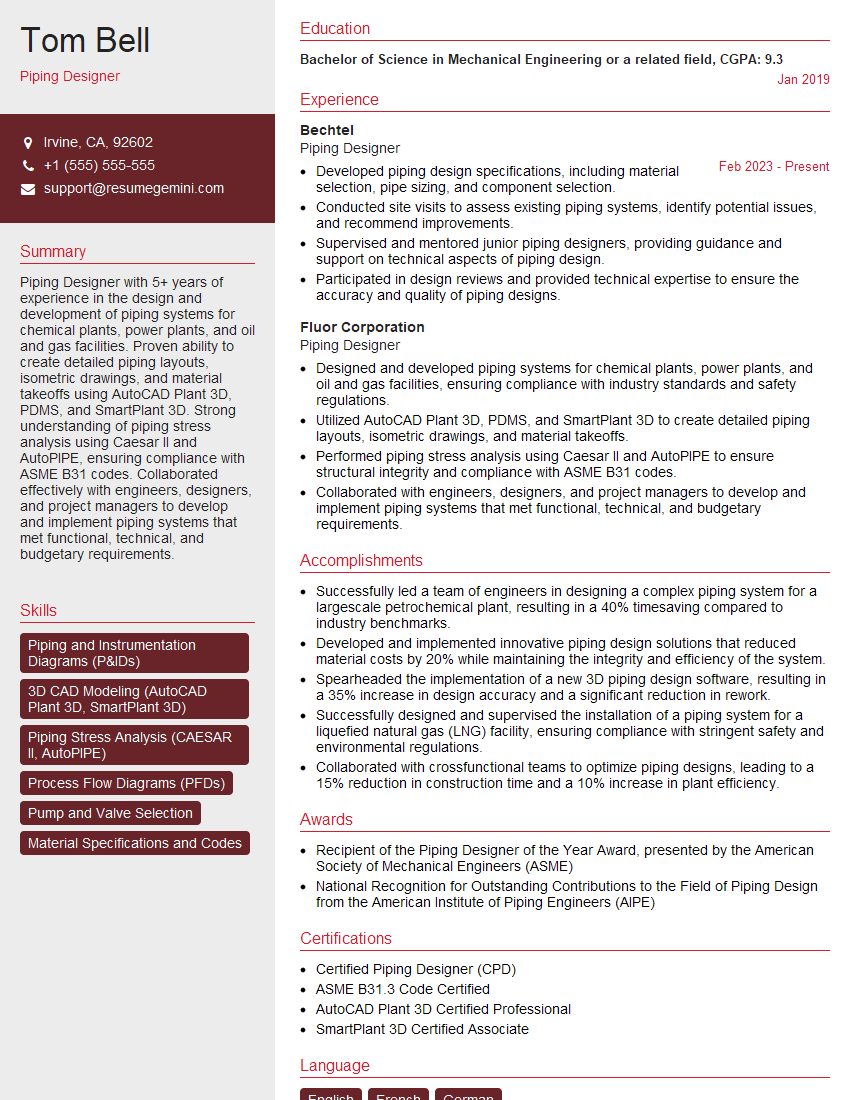
Mastering Commercial Piping opens doors to exciting career opportunities with significant growth potential in a constantly evolving industry. A strong understanding of these key concepts will significantly improve your interview performance and help you secure your dream role. To maximize your job prospects, creating a well-structured, ATS-friendly resume is crucial. ResumeGemini is a trusted resource that can help you build a professional and impactful resume, highlighting your skills and experience effectively. Examples of resumes tailored to the Commercial Piping industry are available within ResumeGemini to guide you.
Explore more articles
Users Rating of Our Blogs
Share Your Experience
We value your feedback! Please rate our content and share your thoughts (optional).
What Readers Say About Our Blog
Very informative content, great job.
good