Interviews are opportunities to demonstrate your expertise, and this guide is here to help you shine. Explore the essential Composite Sketching interview questions that employers frequently ask, paired with strategies for crafting responses that set you apart from the competition.
Questions Asked in Composite Sketching Interview
Q 1. Explain the process of creating a composite sketch from eyewitness testimony.
Creating a composite sketch begins with a thorough interview of the eyewitness. I establish rapport to encourage open communication and minimize stress. The interview focuses on eliciting specific details about the suspect’s facial features, focusing on one feature at a time – starting with the overall shape of the face (oval, round, square, etc.), then moving to the eyes (shape, color, distance apart), nose (width, length, bridge), mouth (size, shape of lips), ears (shape, size, attachment), and hairline. I might use prompts like, “Describe the eyes as if you were writing a description for a detective novel.” I’ll use a variety of questioning techniques, including open-ended questions and clarifying questions to uncover even the subtlest details, such as the presence of scars, tattoos, or unusual features. This detailed description forms the foundation of the sketch.
Then, I translate that verbal description into a visual representation. This might involve starting with a basic outline of the face and gradually refining details based on the witness’s responses. Throughout, I show the witness progress and actively seek feedback to ensure the sketch accurately reflects their memory.
Q 2. Describe different techniques used in composite sketching (e.g., photo-fitting, freehand sketching).
Composite sketching employs several techniques, each with its strengths and weaknesses. Photo-fitting involves selecting individual facial features from a large library of photographs and arranging them to create a composite image. This method is relatively quick and can be efficient, particularly when dealing with a witness who struggles with detailed descriptions. Freehand sketching, on the other hand, relies on the artist’s skill to translate the eyewitness’s description directly onto paper. This allows for more flexibility and the ability to capture subtle nuances. Its accuracy depends heavily on the artist’s skill and the witness’s ability to communicate effectively. Some newer techniques employ computer-assisted software that combines aspects of both, offering a library of features that can be manipulated and adjusted alongside freehand sketching capabilities. For example, a software might allow the artist to adjust the shape of an eyebrow very precisely by dragging points on a curve.
Q 3. How do you handle inconsistencies or conflicting descriptions from multiple eyewitnesses?
Inconsistencies between eyewitness accounts are common. I address these by carefully comparing and contrasting descriptions, identifying common elements and areas of divergence. I prioritize consistent features, using them as the foundation of the sketch. For features with conflicting descriptions, I might create multiple versions of the sketch, highlighting variations in those features. I then show the different sketches to each witness and seek clarification, often focusing on which details they remember more vividly. The goal isn’t necessarily to achieve a single definitive sketch, but to generate a range of possibilities that are consistent with the available evidence. This process highlights areas where the witness’ memory may be less clear, giving the investigators a more nuanced understanding of the possible suspect.
Q 4. What software or tools are you proficient in for digital composite sketching?
I’m proficient in several software programs for digital composite sketching, including Identi-Kit, FACES, and Sketchpad Pro. These programs provide a range of features, from extensive photo libraries to powerful tools for freehand drawing and image manipulation. The software assists in creating accurate representations of facial features and allows for quick revisions and adjustments based on eyewitness feedback. The ease and speed of revision provided by these digital tools significantly improves efficiency and the quality of the composite.
Q 5. How do you ensure accuracy and detail in your sketches?
Accuracy and detail are paramount. I achieve these by meticulously following the eyewitness’s description, paying close attention to subtle details like asymmetry in facial features, eye spacing, and the nuances of the hairline. I use reference materials – photographs and anatomical charts – to ensure accuracy in proportion and realism. Continuous feedback from the witness helps to refine the sketch and ensure it reflects their memories as accurately as possible. Regular practice, along with a keen eye for detail and understanding of human anatomy are critical factors in delivering high-quality composite sketches.
Q 6. Describe your experience with different facial features and their variations.
My experience encompasses a wide range of facial features and their variations. I understand that features like eye shape, nose width, lip thickness, and earlobe size can vary significantly, and these variations can be crucial for identification. I’ve encountered numerous cases involving unique facial characteristics – scars, birthmarks, tattoos, etc. Understanding these variations, along with their subtle differences, aids in creating realistic and accurate representations in the composite sketches. For instance, the subtle difference between a straight nose and a slightly hooked nose can dramatically change the overall impression. Maintaining a library of images and studying facial anatomy helps me stay abreast of the wide spectrum of facial variations.
Q 7. Explain your approach to dealing with an eyewitness who has difficulty describing facial features.
When an eyewitness struggles with description, I employ a patient and empathetic approach. I might use techniques like showing them photos of different facial features, asking them to point out what elements are most similar to those they remember. I might also try indirect methods, like asking about the overall impression the individual made or focusing on non-facial characteristics like clothing or build. I break down the task into smaller, more manageable parts, focusing on one feature at a time. For example, instead of asking “Describe the suspect’s face,” I might ask “What was the shape of the suspect’s jawline?” A collaborative and non-judgmental environment encourages the witness to share even the fragments of memory they have. Often, these fragments, when carefully pieced together, can provide surprising levels of detail.
Q 8. How do you handle pressure and time constraints during a sketch session?
Pressure and time constraints are inherent in composite sketching, especially in urgent cases. My approach is multifaceted. First, I establish a calm and collaborative environment with the witness. This helps them relax and focus, which is crucial for accurate recall. Second, I prioritize gathering core features – the most distinctive aspects of the suspect’s face – first. This ensures we have a solid foundation even if we run short on time. Finally, I utilize efficient sketching techniques, focusing on quick, accurate strokes rather than painstaking detail in the initial stages. If time is truly critical, I might create a preliminary sketch highlighting key features and then refine it later based on further details or witness refinement. Think of it like building a house – you need the foundation (core features) first before adding the details (eyes, nose, finer features).
Q 9. What is your understanding of the legal implications and limitations of composite sketches?
Composite sketches are not foolproof identification tools; they are aids to investigation. Legally, they must be presented as such. It’s crucial to understand that a composite sketch is not evidence itself, but rather a tool to help narrow down a suspect pool. Overreliance on a sketch as definitive proof can lead to misidentification and wrongful accusations. The limitations stem from the subjective nature of memory and the potential for witness error. For example, stress, lighting conditions, and the duration of exposure to the suspect can all significantly impact a witness’s recollection. It’s vital to always emphasize the sketch’s limitations to law enforcement to prevent misinterpretations and potential miscarriages of justice. The sketch should always be accompanied by a clear statement of the witness’s confidence level and any other relevant details.
Q 10. How do you maintain objectivity and avoid imposing your own biases on the sketch?
Maintaining objectivity is paramount. I consciously avoid leading questions and actively encourage the witness to describe the suspect in their own words. I use neutral language and focus on factual descriptions rather than interpretations. For instance, instead of asking, “Did the suspect look angry?”, I might ask, “What was the expression on the suspect’s face?” The use of standardized feature sets and multiple independent references (if possible) helps reduce bias. Also, regular self-reflection on my own potential biases—conscious and unconscious—is part of my practice. It’s like being a sculptor working with clay; the clay is the witness’s description, and my role is to shape it carefully, not to impose my own artistic vision.
Q 11. How do you incorporate feedback from law enforcement officers during the sketch creation process?
Feedback from law enforcement is integral to the process. Throughout the sketch creation, I regularly update officers on my progress and invite their input. Their experience and knowledge of the case context help identify crucial details that may have been missed or are considered less significant by a witness. They can suggest adjustments to ensure the sketch aligns with broader investigative findings. This iterative process, incorporating their input, ensures the final sketch is both accurate and relevant within the parameters of the investigation. Open communication is key; it’s a collaborative process, not a solitary undertaking.
Q 12. Describe your experience with creating sketches from memory or partial descriptions.
Creating sketches from memory or partial descriptions is challenging but possible with a structured approach. I begin by carefully listening to the witness’s recollection, prompting them with questions about key features like facial structure, hair, eyes, and distinguishing marks. I then use my understanding of facial anatomy and proportions to construct a basic framework. Even incomplete details can be suggestive; for instance, a witness might remember only a particular scar or unusual hairstyle. This partial information is still valuable and helps narrow the range of possibilities. In cases with memory gaps, I might explore using different techniques like photo-fit systems to build the image incrementally, working collaboratively with the witness to refine the details until we achieve a likeness. It’s like solving a puzzle—piece by piece.
Q 13. Explain your process for revising a composite sketch based on new information or feedback.
Revising a composite sketch based on new information is a standard procedure. The process involves carefully analyzing the new information provided, determining its reliability, and then making the appropriate modifications to the sketch. This might involve adjusting features, adding details, or even making significant alterations depending on the nature and credibility of the new input. It’s vital to document all revisions, including the source and rationale for the changes. This maintains transparency and accountability. This revisiting and refinement process ensures the sketch continues to reflect the best available information throughout the investigation.
Q 14. How do you manage expectations with witnesses regarding the limitations of composite sketches?
Managing witness expectations is crucial. I clearly explain the limitations of composite sketches from the outset. I emphasize that it’s a reconstruction based on memory, which can be imperfect, and that the sketch may not perfectly represent the suspect. I explain that the sketch serves as a tool to assist the investigation, not a guaranteed identification. This transparent approach helps avoid unrealistic expectations and potential disappointment if the sketch doesn’t result in an immediate arrest. Building trust and open communication are key here; setting realistic expectations prevents disillusionment and maintains the collaborative nature of the process.
Q 15. What are the key differences between traditional and digital composite sketching methods?
Traditional composite sketching relies on hand-drawn techniques using pencils, charcoal, or pastels on paper. The artist works directly with the witness, iteratively refining the sketch based on their descriptions. Digital composite sketching, on the other hand, utilizes software programs like FACES or Identi-Kit. These programs offer a library of pre-drawn features (eyes, noses, mouths, etc.) that the artist can combine and manipulate to create the composite.
- Traditional: More artistic skill required, allows for greater nuance and subtle details, but is time-consuming and less easily reproducible.
- Digital: Requires less artistic skill, quicker and easier to reproduce and share, but can lack the subtle realism achieved through traditional methods. It’s also heavily dependent on the quality of the software’s feature library.
For example, a witness might describe a subtle scar near the suspect’s eyebrow. A traditional artist could easily render this, whereas a digital artist might struggle to find a matching pre-drawn element and may need significant manipulation to create it accurately.
Career Expert Tips:
- Ace those interviews! Prepare effectively by reviewing the Top 50 Most Common Interview Questions on ResumeGemini.
- Navigate your job search with confidence! Explore a wide range of Career Tips on ResumeGemini. Learn about common challenges and recommendations to overcome them.
- Craft the perfect resume! Master the Art of Resume Writing with ResumeGemini’s guide. Showcase your unique qualifications and achievements effectively.
- Don’t miss out on holiday savings! Build your dream resume with ResumeGemini’s ATS optimized templates.
Q 16. What are the ethical considerations involved in creating composite sketches?
Ethical considerations in composite sketching center around accuracy, fairness, and witness welfare. It’s crucial to avoid leading the witness and to accurately reflect their description, even if the resulting sketch isn’t aesthetically pleasing or doesn’t match preconceived notions. Misrepresenting a witness’s account can lead to misidentification and wrongful accusations. Furthermore, the sketch should not be released prematurely to the public as this could compromise ongoing investigations or endanger witnesses. We must also be mindful of potential biases and stereotypes that might influence our interpretation of the witness’s description, particularly regarding race or ethnicity. Finally, it’s important to treat all witness information with the utmost confidentiality and to be respectful of their experience.
Q 17. Describe your experience with different types of sketching materials and techniques.
My experience encompasses both traditional and digital methods. In traditional sketching, I’m proficient with graphite pencils (various grades for shading and detail), charcoal for creating strong contrasts, and pastels for achieving softer, more blended features. I’ve employed techniques like blending, layering, and smudging to create realistic textures and tones. Digitally, I’m experienced with various software packages, including FACES and Identi-Kit, understanding their strengths and limitations in recreating facial features. For instance, I find that using different grades of pencils in traditional sketching allows me to capture the subtle variations in skin tone and texture much more effectively than some digital tools, particularly in the portrayal of aging features like wrinkles.
Q 18. How do you maintain the confidentiality of witness information and sketch data?
Confidentiality is paramount. Witness statements and sketch data are treated as highly sensitive information. I never disclose witness information to unauthorized individuals. Sketches are often kept in secure files, and digital sketches are password-protected. In some cases, sketches might only be shared with authorized law enforcement personnel involved in the investigation. The use of anonymizing techniques such as removing identifying markers from backgrounds also helps to maintain confidentiality.
Q 19. How familiar are you with different ethnic features and variations?
Familiarity with ethnic features and variations is critical to creating accurate composite sketches. My training included extensive study of anatomical features and their variations across different ethnic groups. I understand that facial features are not uniformly distributed across populations. It’s important to avoid making assumptions based on stereotypes, and to carefully consider the individual characteristics described by the witness, rather than relying on generalizations. I utilize resources such as anthropological databases and photographic references to expand my understanding and ensure accurate representation.
Q 20. How would you approach creating a composite sketch of a suspect based on a video recording?
Creating a composite from a video recording involves a different approach. I would first carefully analyze the video, paying close attention to the suspect’s facial features, posture, and any distinctive characteristics. Frame-by-frame analysis can be incredibly helpful in capturing subtle details that might be missed during a live viewing. I’d then use screenshots as a reference, and possibly even enhance the image quality using image-editing software to improve clarity and detail. This detailed analysis would be crucial in accurately reflecting the suspect’s features, accounting for the lighting, camera angle, and any possible distortions. The process would then resemble creating a sketch from a witness’s description, albeit with the benefit of a visual record.
Q 21. Explain the importance of proper lighting and perspective in composite sketching.
Lighting and perspective are paramount in creating a believable and accurate composite sketch. Poor lighting in the original encounter can affect a witness’s perception of features, leading to inaccuracies in the sketch. Similarly, perspective, the angle from which the witness viewed the suspect, impacts the shape and proportions of the features as they appear in the sketch. For example, a side profile will significantly differ from a frontal view. Therefore, I always try to understand the lighting conditions and the witness’s viewpoint during the original event to ensure that my sketch correctly reflects the features as they were observed. Proper consideration of these factors enhances the sketch’s accuracy and increases the likelihood of successful identification.
Q 22. How do you handle situations where the witness is emotionally distressed or traumatized?
When working with a witness who is emotionally distressed or traumatized, my priority is their well-being. I begin by creating a calm and safe environment. This might involve offering water, allowing breaks, and speaking in a quiet, reassuring tone. I avoid pressuring them and let them dictate the pace of the session. I use active listening techniques, focusing not just on the words but also on their body language and emotional cues. For example, if a witness is struggling to recall details, I might ask open-ended questions like, “Tell me what you remember about the person’s face,” instead of leading questions that might inadvertently introduce bias. If the distress is severe, I might suggest a short break or recommend seeking support from a counselor or other support professional before continuing the session. The goal is to gather information effectively while respecting the witness’s vulnerability and emotional state.
Q 23. Describe your experience working under pressure and tight deadlines.
I thrive under pressure. In my experience, many composite sketch sessions are time-sensitive, particularly when dealing with ongoing investigations. I’ve developed a system for efficiently managing time and prioritizing information. This includes quickly establishing rapport with the witness, focusing on key features first (eyes, nose, mouth), and utilizing my sketch software effectively to make quick adjustments and refinements. One instance I recall involved a robbery suspect. The witness was only available for a 30-minute window. By prioritizing and focusing on the critical features, we managed to create a sketch that provided valuable leads, leading to an arrest within 24 hours.
Q 24. How would you handle a situation where the witness is unable to provide sufficient detail for a sketch?
If a witness struggles to provide sufficient detail, my approach is to be patient and persistent. I start by using various techniques to aid their recall. This includes showing them pictures of common facial features (eyes, noses, mouths, etc.) and asking them to identify features that are most similar to what they remember. I might use prompts like, “Was the nose wide or narrow? Was it straight or hooked?” I also utilize my knowledge of facial anatomy to fill in gaps, ensuring that the sketch remains anatomically plausible, even when certain details are missing. The goal is to create a composite that shows a likeness without falsely suggesting details that the witness didn’t actually recall. Remember, a partially completed sketch that guides the investigation is better than no sketch at all.
Q 25. How do you ensure the quality and accuracy of your sketches are consistently high?
Maintaining consistent quality and accuracy involves continuous learning and refinement of my skills. I regularly practice my drawing and sketching techniques to improve my skill, and I regularly update my knowledge on new facial recognition software and techniques. I rely on a structured approach, using established techniques like the anatomical approach or the feature-by-feature method, which helps to ensure consistency and reduce errors. After completing each sketch, I review it carefully to check the consistency and plausibility of the features. Seeking feedback from peers or supervisors also assists in improving overall quality.
Q 26. Describe your approach to maintaining detailed records of your work.
Detailed record-keeping is crucial. For each composite sketch, I maintain a comprehensive file that includes the date and time of the session, the witness’s statement, a written description of the features, any photographs or other evidence provided by the witness, the final sketch itself, and any changes or revisions made during the process. All information is meticulously documented to ensure accuracy and accountability. I use digital systems to securely store my records and allow easy accessibility for law enforcement agencies.
Q 27. How would you handle criticism or feedback on a completed composite sketch?
I view criticism and feedback as an opportunity to improve. I listen carefully to the feedback, seeking to understand the perspectives and concerns raised. Depending on the nature of the feedback, I might review the original witness statements and the sketches to see if corrections or refinements are possible. For instance, if feedback points to an inconsistency with a particular facial feature, I may carefully re-examine the witness’s description and make the necessary adjustments. Constructive criticism allows me to learn and enhance my skillset.
Q 28. What are some common challenges you have encountered while creating composite sketches, and how did you overcome them?
One common challenge is dealing with witnesses who have difficulty describing facial features accurately or who have different perceptions of the same features. I overcome this by using a combination of techniques, including showing them photographs of facial features and asking them to compare these to what they remember. Another challenge is time constraints. To overcome this, I prioritize features and use efficient sketching techniques. For instance, I might start with the most distinctive features first, such as the eyes or nose, before moving to less distinctive ones. Finally, technology can sometimes hinder efficiency or create a barrier to a natural conversational flow. To mitigate this, I ensure I am proficient with the software and prioritize creating a comfortable atmosphere for the witness to allow for clear communication.
Key Topics to Learn for Composite Sketching Interview
- Facial Anatomy and Feature Recognition: Understanding the underlying structure of the face and how individual features contribute to overall identity is crucial. This includes recognizing variations in bone structure, muscle definition, and soft tissue.
- Sketching Techniques and Materials: Mastering various sketching techniques, from basic line work to shading and texture, is essential for creating accurate and lifelike composites. Familiarity with different materials (pencils, charcoal, digital tools) is also important.
- Witness Interaction and Communication: Effectively communicating with witnesses to gather accurate and detailed descriptions is paramount. This involves active listening, clarifying ambiguous details, and managing witness anxiety.
- Software Proficiency (if applicable): If the role involves digital composite sketching, proficiency in relevant software (e.g., forensic sketching software) will be key. Demonstrate your understanding of the software’s capabilities and limitations.
- Observation and Memory Recall: Sharpening your skills in observation and memory recall will directly impact your ability to accurately capture facial features and details from witness descriptions.
- Composite Sketch Interpretation and Refinement: Knowing how to interpret feedback on your sketches and iteratively refine them based on witness input is vital for producing accurate representations.
- Legal and Ethical Considerations: Understanding the legal and ethical implications of composite sketching, including bias avoidance and the limitations of the process, is crucial for responsible practice.
- Problem-Solving and Adaptability: The ability to handle incomplete or conflicting information, adapt to various witness personalities, and solve problems creatively is essential in this field.
Next Steps
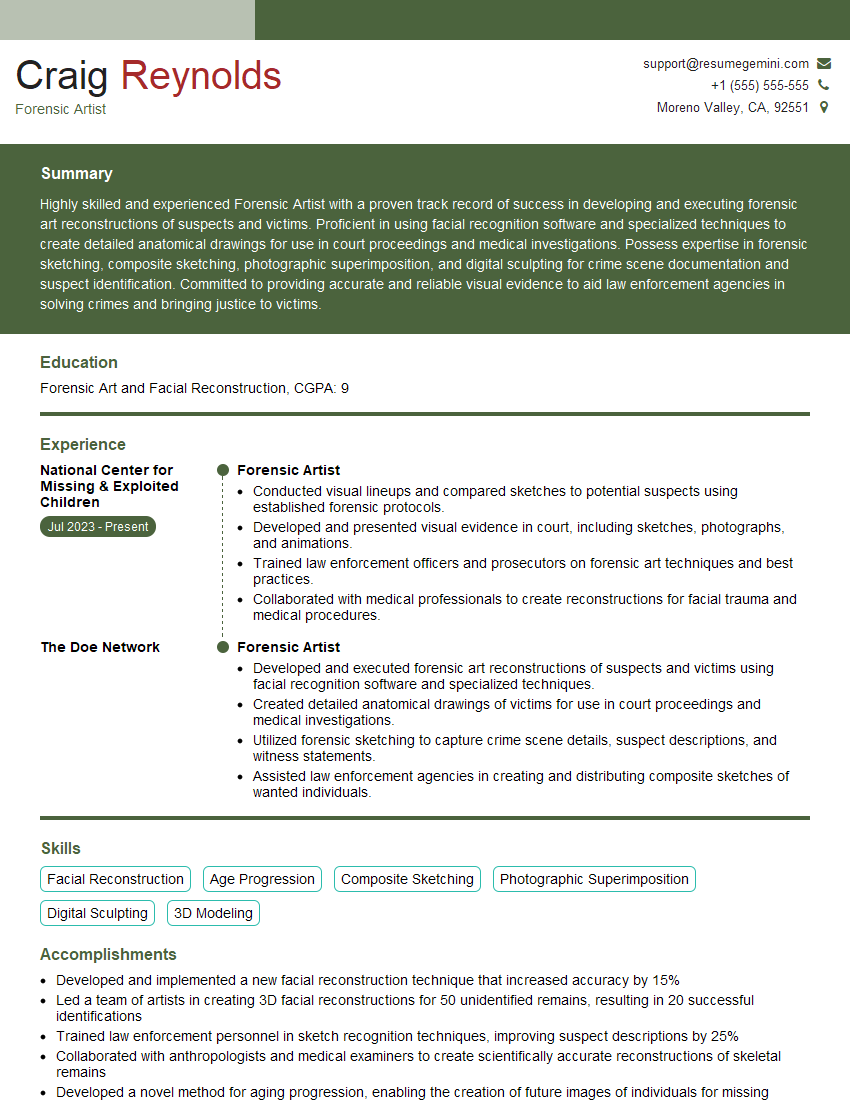
Mastering composite sketching opens doors to a rewarding career in law enforcement, forensic science, or related fields. To maximize your job prospects, create an ATS-friendly resume that showcases your skills and experience effectively. ResumeGemini is a trusted resource for building professional resumes, and we offer examples of resumes tailored to composite sketching to help you get started. Investing time in crafting a strong resume will significantly increase your chances of landing your dream job.
Explore more articles
Users Rating of Our Blogs
Share Your Experience
We value your feedback! Please rate our content and share your thoughts (optional).
What Readers Say About Our Blog
Very informative content, great job.
good