The right preparation can turn an interview into an opportunity to showcase your expertise. This guide to Computer Aided Design (CAD) Software interview questions is your ultimate resource, providing key insights and tips to help you ace your responses and stand out as a top candidate.
Questions Asked in Computer Aided Design (CAD) Software Interview
Q 1. What CAD software are you proficient in?
I’m proficient in several industry-standard CAD software packages. My core expertise lies in Autodesk AutoCAD, both 2D and 3D versions, and I also have significant experience with SolidWorks for 3D modeling and assembly design. I’ve also worked with Inventor for more complex mechanical designs and Fusion 360 for its ease of use and cloud-based collaboration features. My proficiency extends beyond basic functionality; I’m adept at utilizing advanced features like parametric modeling, scripting (AutoLISP and VBA), and rendering techniques in each of these programs.
Q 2. Explain your experience with 2D drafting and 3D modeling.
My experience in 2D drafting encompasses creating detailed technical drawings, including floor plans, elevations, sections, and detailed parts. I’m comfortable working with layers, annotation, and various drawing standards (like ANSI and ISO). Think of it like drawing a blueprint for a house – precise measurements and clear labeling are paramount. In 3D modeling, I use software like SolidWorks and Inventor to create realistic digital representations of parts, assemblies, and entire products. This involves designing individual components, assembling them virtually, and analyzing their functionality and performance, much like building a virtual LEGO model, but with far greater detail and precision.
For example, I recently used AutoCAD to create detailed floor plans for a new office building, ensuring accurate dimensions and clear labeling of all features. In SolidWorks, I’ve designed and simulated the functionality of a complex mechanical assembly, identifying potential design flaws early in the process, saving both time and resources.
Q 3. Describe your process for creating detailed technical drawings.
Creating detailed technical drawings involves a structured process. It begins with a thorough understanding of the design requirements and specifications. Next, I create a sketch or conceptual model to establish the overall layout. After that, I utilize the chosen CAD software to create the drawing itself, meticulously adding details such as dimensions, tolerances, materials, and surface finishes. I employ layers to organize elements and utilize annotation tools to provide clear and concise information. Finally, I perform a thorough quality check to ensure accuracy, consistency, and compliance with relevant standards before saving and exporting the drawing in the appropriate format. Imagine building a house: a detailed blueprint guides the construction process. Similarly, my technical drawings serve as precise guides for manufacturing and assembly.
Q 4. How do you manage large CAD files efficiently?
Managing large CAD files requires a multi-pronged approach. First, I use techniques like purging unused layers and blocks to reduce file size. Second, I utilize external referencing (xrefs) to link related drawings instead of embedding them, keeping the primary file more manageable. Third, I work in a well-organized file structure, saving frequently and employing version control through the software’s features or dedicated systems. Finally, for extremely large assemblies, I might utilize techniques like model simplification or component suppression to improve performance during manipulation and rendering. Think of it like organizing a large digital library – efficient filing and indexing are key to easy retrieval and management.
Q 5. What are your preferred methods for dimensioning and tolerancing?
My preferred methods for dimensioning and tolerancing adhere to relevant standards, such as ASME Y14.5M (for US-based projects) or ISO standards. I use geometric dimensioning and tolerancing (GD&T) symbols and callouts to precisely define dimensions and acceptable variations. This includes utilizing linear, angular, and positional tolerances, specifying surface finish, and clearly indicating datum references. The goal is to clearly communicate manufacturing requirements to ensure that parts fit together correctly and function as intended. Think of it as providing detailed instructions to a machinist – precision is essential to avoid errors and ensure quality.
Q 6. Explain your understanding of different file formats used in CAD (e.g., DWG, DXF, STEP).
Understanding different CAD file formats is crucial for interoperability. .DWG is Autodesk’s native format, offering flexibility and the preservation of drawing details. .DXF (Drawing Exchange Format) is a more universally compatible format, suitable for sharing files between different CAD software. .STEP (Standard for the Exchange of Product data) is a neutral format commonly used for sharing 3D models between different CAD systems, ensuring data integrity during transfers between different engineering and manufacturing software. Choosing the correct format ensures seamless data exchange across different platforms and programs.
Q 7. How do you ensure accuracy and precision in your CAD work?
Ensuring accuracy and precision in CAD work requires attention to detail at every step. This begins with using precise measurements and tolerances in the design process. I employ various methods to verify accuracy, including checking dimensions, analyzing model geometry, and performing interference checks in assemblies. I also regularly calibrate my tools and hardware to maintain accuracy and consistency. Finally, I conduct rigorous quality checks, peer reviews, and simulations before finalizing designs. Think of it like building a bridge: the safety of the bridge depends on the accuracy and precision of its design and construction.
Q 8. Describe your experience with CAD layers and templates.
CAD layers and templates are fundamental for organizing and streamlining the design process. Think of layers as transparent sheets stacked on top of each other, each containing specific elements of your design. Templates, on the other hand, are pre-configured files that provide a starting point for new projects, including pre-defined layers, styles, and settings.
In my experience, I’ve extensively used layers to separate different aspects of a design, such as architectural elements (walls, doors, windows), mechanical components (gears, shafts, bearings), or electrical systems (wiring, conduits, panels). For example, in a building design, I might have separate layers for structural elements, MEP (Mechanical, Electrical, Plumbing) systems, and architectural finishes. This allows me to easily turn layers on and off, edit individual components without affecting others, and improve overall design clarity.
Templates are invaluable for maintaining consistency across multiple projects. I usually create custom templates with standardized layers, line styles, text fonts, and drawing units, ensuring all projects follow the same conventions. This saves significant time and ensures uniformity in design presentation.
- Example: A typical template for a mechanical design might include layers for parts, assemblies, and annotations, each with specific line weights and colors.
- Practical Application: By effectively utilizing layers and templates, I can manage complex designs efficiently, reduce errors, and ensure consistent deliverables across various projects.
Q 9. How familiar are you with CAD standards and best practices?
Familiarity with CAD standards and best practices is crucial for producing high-quality, error-free, and easily-collaborated-upon designs. I’m proficient in industry-standard practices such as ISO and ANSI standards, including layer naming conventions, drawing annotation, and file management.
I understand the importance of adhering to a consistent naming structure for layers and files to ensure clarity and avoid confusion. Furthermore, I’m well-versed in using appropriate annotation styles, including dimensions, tolerances, and notes, to ensure clear and unambiguous communication of design intent. My experience includes working with clients and teams that have specific standards, and I’m adept at adapting my workflow accordingly.
Best practices I consistently employ include:
- Regular data backups
- Version control using a CAD data management system
- Clear and concise design documentation
- Utilizing design review processes to catch potential errors early
Example: In one project, adapting to the client’s specific standards, which utilized a unique layer naming convention, saved the team significant time and effort during design review and final documentation.
Q 10. Explain your experience with parametric modeling.
Parametric modeling is a powerful technique that allows designers to create models using parameters or variables. Changes to one parameter automatically update related parts of the model, enhancing design flexibility and efficiency. It’s like building with LEGOs, but instead of individual bricks, you’re using relationships between dimensions and features.
My experience with parametric modeling spans several CAD software packages, including SolidWorks and Inventor. I’ve used it extensively to create complex geometries, perform design optimization, and automate repetitive tasks. For instance, I’ve designed a family of parts that vary in size based on a single input parameter. Changing this parameter instantly adjusts all related dimensions and features, ensuring consistency and saving hours of manual work.
Example: Imagine designing a series of pipes with varying diameters. With parametric modeling, I can create a single model with a diameter as a parameter. Changing this parameter automatically updates the pipe’s dimensions, without manually adjusting each dimension individually. This is particularly useful for creating design variations or exploring ‘what-if’ scenarios.
Practical Application: Parametric modeling significantly streamlines the design process, facilitates design exploration, and ensures design consistency, making it indispensable for complex projects.
Q 11. How do you handle revisions and updates in a CAD project?
Handling revisions and updates in a CAD project is a critical aspect of design management. It requires a systematic approach to ensure accuracy, traceability, and efficient collaboration. I employ a version control system, often integrated with a CAD data management system (PDM), to manage revisions.
My workflow typically involves creating new revisions of the design file, each with a clear revision number and a description of the changes made. This allows easy tracking of design evolution. I meticulously document all changes, using revision clouds or other annotations to highlight modifications. For larger projects with teams, I leverage the PDM system to manage revisions collaboratively, ensuring everyone has access to the latest version and a history of all changes.
Example: A client requested a design change for a component. I created a new revision of the file, documented the modifications in the revision notes, and updated the drawings accordingly. The previous revision remains available for reference, providing complete traceability of all design changes.
Practical Application: This approach ensures consistency, prevents confusion, and facilitates collaboration while maintaining a complete history of the design’s evolution.
Q 12. Describe your experience with CAD data management systems.
CAD data management systems (PDM) are essential for managing the vast amounts of data generated during complex CAD projects. These systems provide centralized storage, version control, and workflow management functionalities. My experience includes working with various PDM systems, such as Autodesk Vault and SolidWorks PDM.
I’m proficient in using these systems to manage design files, revisions, and metadata. I leverage PDM features to control access to design data, enforce design standards, and automate workflows. This ensures a streamlined and collaborative design process, minimizing potential errors and facilitating design reuse across multiple projects.
Example: Using a PDM system in a large-scale project, I helped streamline the design review process by automating notifications to team members and creating a centralized repository for all relevant documentation and revisions, significantly improving team coordination.
Practical Application: PDM systems are invaluable for large-scale projects, allowing for efficient collaboration, easy data access, and robust version control, contributing to a more efficient and error-free design process.
Q 13. How do you troubleshoot CAD software errors and issues?
Troubleshooting CAD software errors and issues is a routine part of my work. My approach is systematic, starting with identifying the problem’s nature and then progressively investigating potential causes.
My troubleshooting strategy includes:
- Identifying the error: I carefully analyze the error message, if any, to understand the nature of the problem.
- Checking the model: I examine the CAD model for potential issues such as corrupted files, geometric errors, or conflicting constraints.
- Testing basic operations: I verify that basic CAD functions are working correctly.
- Reinstalling drivers and software: As a last resort, I reinstall graphics drivers and CAD software if other methods fail.
- Seeking online resources and community support: I consult online forums, documentation, and the software’s support community.
Example: Once, I encountered a rendering error. I systematically investigated, starting with checking the system requirements, then analyzing the rendering settings, and finally, troubleshooting the graphics drivers. This process allowed me to pinpoint the problem and resolve the issue efficiently.
Practical Application: A systematic troubleshooting approach helps ensure efficient issue resolution, minimizing downtime and project delays.
Q 14. How familiar are you with rendering and visualization techniques?
Rendering and visualization techniques are crucial for presenting designs effectively and conveying design intent. My experience encompasses various rendering techniques, from simple wireframe visualizations to photorealistic renderings. I’m proficient in using rendering software and plugins within CAD platforms to create high-quality visuals.
I’m familiar with different rendering engines and their strengths, choosing the most appropriate technique based on the project’s needs and the desired level of realism. For instance, I’ve used ray tracing for photorealistic images, and simpler techniques like shaded views for quick visualizations during the design phase. I understand lighting, materials, and post-processing techniques to enhance the visual impact of the renderings.
Example: I once created photorealistic renderings of a building design using a ray-tracing engine, showcasing the architectural details and the surrounding environment to impress potential clients. For internal reviews, however, I used faster, less detailed shaded views to quickly iterate on the design.
Practical Application: High-quality visualizations are invaluable tools for communicating design effectively to clients, colleagues, and stakeholders. They significantly improve design presentations and support effective decision-making.
Q 15. What is your experience with CAD automation and scripting?
CAD automation and scripting are crucial for boosting efficiency and productivity. My experience encompasses leveraging various scripting languages like Python and VBA (Visual Basic for Applications) within popular CAD platforms such as SolidWorks, Autodesk Inventor, and AutoCAD. I’ve used these skills to automate repetitive tasks, such as creating families of parts with varying dimensions, generating complex assemblies from parameterized inputs, and extracting data for analysis. For instance, I developed a Python script to automatically generate hundreds of different bracket designs based on user-specified parameters, significantly reducing design time and minimizing human error. This involved utilizing the CAD software’s API (Application Programming Interface) to control the model creation process programmatically. Another project involved using VBA to automate the process of generating detailed manufacturing drawings from complex 3D models, saving countless hours of manual effort.
Beyond automating individual tasks, I’ve worked on larger-scale automation projects. One involved building a custom workflow using a combination of Python, CAD software APIs, and a database to manage a large library of standardized components and automatically generate bills of materials (BOMs) based on design selections. This greatly improved the accuracy and speed of our BOM creation process.
Career Expert Tips:
- Ace those interviews! Prepare effectively by reviewing the Top 50 Most Common Interview Questions on ResumeGemini.
- Navigate your job search with confidence! Explore a wide range of Career Tips on ResumeGemini. Learn about common challenges and recommendations to overcome them.
- Craft the perfect resume! Master the Art of Resume Writing with ResumeGemini’s guide. Showcase your unique qualifications and achievements effectively.
- Don’t miss out on holiday savings! Build your dream resume with ResumeGemini’s ATS optimized templates.
Q 16. Describe your workflow for collaborating on CAD projects.
My collaborative workflow for CAD projects is highly structured and relies heavily on version control, cloud-based data management, and clear communication. We typically utilize a platform like Autodesk Vault or similar cloud-based systems to manage project files. This ensures that everyone has access to the most up-to-date version of the design, prevents accidental overwrites, and allows for easy tracking of revisions. Before beginning any collaborative project, we establish a clear project scope, define roles and responsibilities, and establish a communication plan, frequently using tools like Slack or Microsoft Teams. We use a structured naming convention for files to maintain organization, and I advocate for the use of design reviews at key milestones. These reviews provide opportunities to discuss progress, identify potential issues early on, and ensure everyone is aligned on the design direction. For complex projects, we often employ a modular design approach, breaking down the project into smaller, manageable sub-assemblies that can be worked on concurrently by different team members.
Q 17. Explain your understanding of geometric constraints and relations.
Geometric constraints and relations are the backbone of parametric modeling in CAD. They define the relationships between different geometric elements (points, lines, surfaces) within a model. These relationships, once defined, automatically update the model when parameters are changed. For example, a constraint might specify that two lines must be parallel, or that a point must lie on a particular curve. These constraints are crucial because they ensure consistency and accuracy throughout the design process. Imagine trying to design a complex assembly manually, constantly adjusting dimensions and angles to maintain the correct relationships. With geometric constraints, the software manages these relationships automatically, preventing errors and ensuring design intent is maintained.
Understanding these constraints allows for efficient design modification. If a dimension needs to be changed, the software automatically updates all related elements. This makes it easy to explore different design options and quickly iterate on designs. Furthermore, the use of under-constrained, well-constrained and over-constrained models needs careful consideration to avoid errors and maintain design integrity.
Q 18. How do you create and manage design libraries in CAD software?
Creating and managing design libraries is essential for reusing components and standardizing design practices. In most CAD software, this is achieved through the creation of part libraries or families of parts. These libraries contain standardized components, such as bolts, nuts, screws, and custom parts specific to your company or project. Organizing these libraries is crucial; I typically use a hierarchical structure based on part type, material, and size. Metadata, including dimensions, material properties, and manufacturing information, should be associated with each part for easy searching and retrieval. This can be easily managed within the CAD software’s library tools or integrated into a database system for more sophisticated management.
Using design libraries significantly reduces design time, improves consistency, and ensures quality. It’s also essential for managing revisions, ensuring everyone uses the most up-to-date version of a component. Regular auditing and updating of these libraries is critical to maintain their accuracy and usefulness. Failing to maintain accurate libraries can lead to inconsistencies in design, errors, and increased manufacturing costs.
Q 19. What are your methods for creating detailed assembly models?
Creating detailed assembly models requires a systematic approach. I typically start by defining the overall assembly structure, identifying the major components and their relationships. I then create individual parts, ensuring each part is fully detailed and constrained appropriately. Next, I assemble the parts into sub-assemblies, using constraints to define the relationships between components. This modular approach makes it easier to manage complexity. Once the sub-assemblies are complete, I integrate them into the final assembly. Throughout the process, I regularly perform design reviews to check for interferences and ensure the assembly meets the design requirements. Using top-down assembly modeling approaches, combined with utilizing design libraries, further speeds up this process and ensures design integrity. It’s also important to add necessary features like fasteners and welds for completeness and to support downstream analysis.
Q 20. Describe your experience with Finite Element Analysis (FEA) integration with CAD.
My experience with Finite Element Analysis (FEA) integration with CAD involves utilizing CAD models as the basis for FEA simulations. The process generally begins with exporting the CAD model in a suitable format (like STEP or IGES) compatible with FEA software such as ANSYS, Abaqus, or COMSOL. The FEA software then meshes the CAD model, creating a finite element representation for analysis. This mesh defines the elements used to approximate the behavior of the model. Different mesh types and element densities will have different levels of accuracy. Boundary conditions and loads are then applied to the model to simulate real-world conditions. This can be anything from simple static loads to complex dynamic simulations. The FEA software performs the analysis, providing insights into stress, strain, displacement, and other relevant parameters. The results can then be visualized and interpreted to identify potential design weaknesses or areas for improvement. This iterative process allows for design optimization and validation.
Accurate FEA results depend heavily on the quality of the CAD model. Therefore, ensuring the model’s accuracy and proper geometry is extremely important before exporting it for analysis.
Q 21. How do you ensure the compatibility of your CAD models with other software applications?
Ensuring CAD model compatibility with other software applications is crucial for efficient data exchange. I utilize standard neutral file formats such as STEP (Standard for the Exchange of Product model data), IGES (Initial Graphics Exchange Specification), and STL (Stereolithography) for exporting models. These formats are widely supported by a range of CAD and other engineering software. When exchanging data between different CAD software packages, understanding the capabilities and limitations of each system is important, as minor data loss or discrepancies can sometimes occur. Therefore it’s essential to thoroughly review models after importing them into a new system to verify accuracy. When exporting files for manufacturing purposes, the file format and its level of detail are critically important. For example, STL files are usually best suited for 3D printing, while STEP or IGES files are preferred for CNC machining. In certain cases, using application-specific translators or plugins can aid in smooth data transfer and maintain the design integrity. Adopting standardized practices for file naming, version control, and data management is essential for ensuring long-term compatibility and easy access.
Q 22. What is your experience with creating and using custom tools or macros in your CAD software?
Creating custom tools and macros in CAD software significantly boosts efficiency and streamlines repetitive tasks. Think of it like creating your own specialized keyboard shortcuts, but for complex design operations. I’ve extensively used both parametric and non-parametric approaches depending on the need. For instance, in SolidWorks, I’ve developed macros using VBA (Visual Basic for Applications) to automate the creation of complex assemblies with repeated components. This involved writing code to generate specific part features, place them accurately, and apply constraints, saving hours of manual work. In Autodesk Inventor, I’ve leveraged iLogic, a rule-based system, to create parametric tools. This lets me define relationships between design parameters, so changing one dimension automatically updates others, ensuring consistent and accurate designs. For example, I built an iLogic tool to automatically adjust the thickness of a component based on the selected material and load requirements. This reduced design iteration time and ensured compliance with engineering standards.
Another example involved creating a macro in AutoCAD to automate the creation of detailed drawings for electrical schematics. This macro streamlined the process of adding title blocks, dimensions, and other annotations consistently across multiple drawings.
Q 23. How do you manage data integrity and avoid model corruption in large projects?
Maintaining data integrity in large CAD projects is crucial to avoid costly errors and project delays. It’s like building a house—you wouldn’t want a critical structural element to suddenly disappear! My approach is multi-faceted. First, I religiously follow a version control system, such as Autodesk Vault or similar, to track all changes and revert to previous versions if necessary. This allows for easy collaboration and prevents accidental overwrites. Second, I employ a rigorous file-naming and folder structure convention for organized project management, making it simple to locate specific files quickly. I prefer a hierarchical system with clear naming (e.g., ProjectName_PartNumber_Revision). Third, regular data backups are non-negotiable. I schedule automated backups daily and ensure offsite storage as an added layer of protection. Finally, I adhere to strict modeling practices, avoiding unnecessary complexity and regularly purging unused data to keep file sizes manageable. I ensure regular file checks for consistency and errors and use tools provided by the CAD software (like SolidWorks’ ‘Repair’ functionality) to address potential issues before they escalate.
Q 24. Describe your experience with CAD for specific industries (e.g., manufacturing, architecture).
My CAD experience spans diverse industries, most notably manufacturing and architecture. In manufacturing, I’ve worked extensively with SolidWorks and Autodesk Inventor on projects ranging from designing intricate mechanical assemblies for robotic systems to creating detailed models for injection-molded plastic parts. I’m proficient in generating manufacturing drawings with proper GD&T (Geometric Dimensioning and Tolerancing) annotations, critical for ensuring consistent product quality. In architecture, I’ve utilized Revit to create Building Information Models (BIMs) for various projects, including residential and commercial buildings. This included working with other disciplines through collaboration tools, such as Navisworks, to coordinate designs effectively. My experience in this field involved not just creating the models but also coordinating the design elements with structural, MEP (Mechanical, Electrical, and Plumbing), and other architectural aspects, ensuring successful project delivery.
Q 25. Explain your experience with using CAD software to generate manufacturing documentation.
Generating manufacturing documentation is a core competency in my CAD workflow. I utilize CAD software’s capabilities to produce detailed and accurate drawings that clearly communicate design intent to manufacturing teams. This includes creating 2D orthographic projections, section views, detailed part drawings, assembly drawings, and bill of materials (BOMs). I’m meticulous about applying industry-standard annotations such as dimensions, tolerances, surface finishes, material specifications, and relevant notes. I understand the importance of clear and unambiguous communication to prevent manufacturing errors. For example, I’ve used SolidWorks to create detailed assembly drawings for a complex aerospace component, including exploded views to aid assembly and maintenance instructions. Furthermore, I leverage the software’s BOM capabilities to automatically generate and manage material lists, reducing manual effort and potential errors.
Q 26. What is your proficiency with annotation and detailing techniques in CAD?
Annotation and detailing are critical for producing clear and comprehensive CAD documentation. I’m highly proficient in applying various annotation techniques, including dimensioning, tolerancing (GD&T), layering, and adding detailed notes and specifications. I understand the importance of using consistent annotation styles to maintain clarity and professionalism. For example, when detailing a mechanical part, I’ll use precise dimensions and tolerances to ensure accurate manufacturing. I’ll also include notes specifying surface finishes, material selections, and any special processing requirements. I’m skilled in using layers to organize different aspects of the drawing, ensuring a clean and manageable workflow. Furthermore, I use styles and templates to ensure consistency in fonts, dimensions, and overall drawing appearance. This contributes to professionalism and simplifies the review process.
Q 27. How do you use CAD software to analyze and optimize designs?
CAD software provides powerful tools for design analysis and optimization. I routinely use features like finite element analysis (FEA) integration to simulate stress, strain, and deflection under various load conditions, ensuring designs meet strength and durability requirements. For example, in designing a bicycle frame, I used FEA within SolidWorks to analyze the stress distribution under various riding loads. This allowed me to optimize the frame geometry for maximum strength and minimum weight. Further, I use simulation tools to test design parameters like material selection, geometry changes and tolerance adjustments before physical prototyping. This saves time and resources, significantly reducing costs associated with physical iteration and testing.
Q 28. Describe a challenging CAD project you worked on and how you overcame the challenges.
One particularly challenging project involved designing a complex automated assembly system for a medical device manufacturer. The system required precise coordination of multiple robotic arms, conveyor belts, and vision systems, all within a very constrained space. The initial design was extremely complex and prone to interference issues. To overcome this, I implemented a modular design approach, breaking down the system into smaller, manageable subsystems. I used assembly constraints and simulation tools within SolidWorks to thoroughly check for collisions and interferences at each stage. Iterative simulations and adjustments were crucial. We further utilized a collaborative project management platform to track progress, assign tasks, and identify potential issues early in the development phase. Through careful planning, modular design, and rigorous testing, we successfully delivered a functional and efficient automated system that met all client requirements on time and within budget.
Key Topics to Learn for Computer Aided Design (CAD) Software Interview
- Fundamentals of CAD Software: Understanding the user interface, navigation tools, and basic drawing commands across different software platforms (AutoCAD, SolidWorks, Revit etc.). This includes proficiency in creating 2D and 3D models.
- Geometric Modeling Techniques: Mastering techniques like sketching, extrusion, revolution, sweeping, and boolean operations. Understand the differences and applications of wireframe, surface, and solid modeling.
- Dimensioning and Annotation: Proficiency in applying accurate dimensions, tolerances, and annotations to drawings, adhering to industry standards and best practices.
- Working with Drawings and Data: Importing and exporting files in various formats (DXF, DWG, STEP etc.), managing layers, and utilizing templates. Practical experience with data management within CAD software is crucial.
- CAD Software Specific Features: Deep dive into features relevant to the specific CAD software you’re applying for. For example, parametric modeling in SolidWorks, or family creation in Revit. This showcases specialized knowledge and initiative.
- Design for Manufacturing (DFM): Understanding the principles of DFM and how to apply them during the design process. This demonstrates awareness of real-world manufacturing constraints.
- Problem-Solving and Troubleshooting: Be prepared to discuss your approach to resolving common CAD-related issues, such as model errors, file corruption, or performance problems.
- Collaboration and Teamwork: Discuss your experience working on team projects using CAD software, emphasizing effective communication and version control.
Next Steps
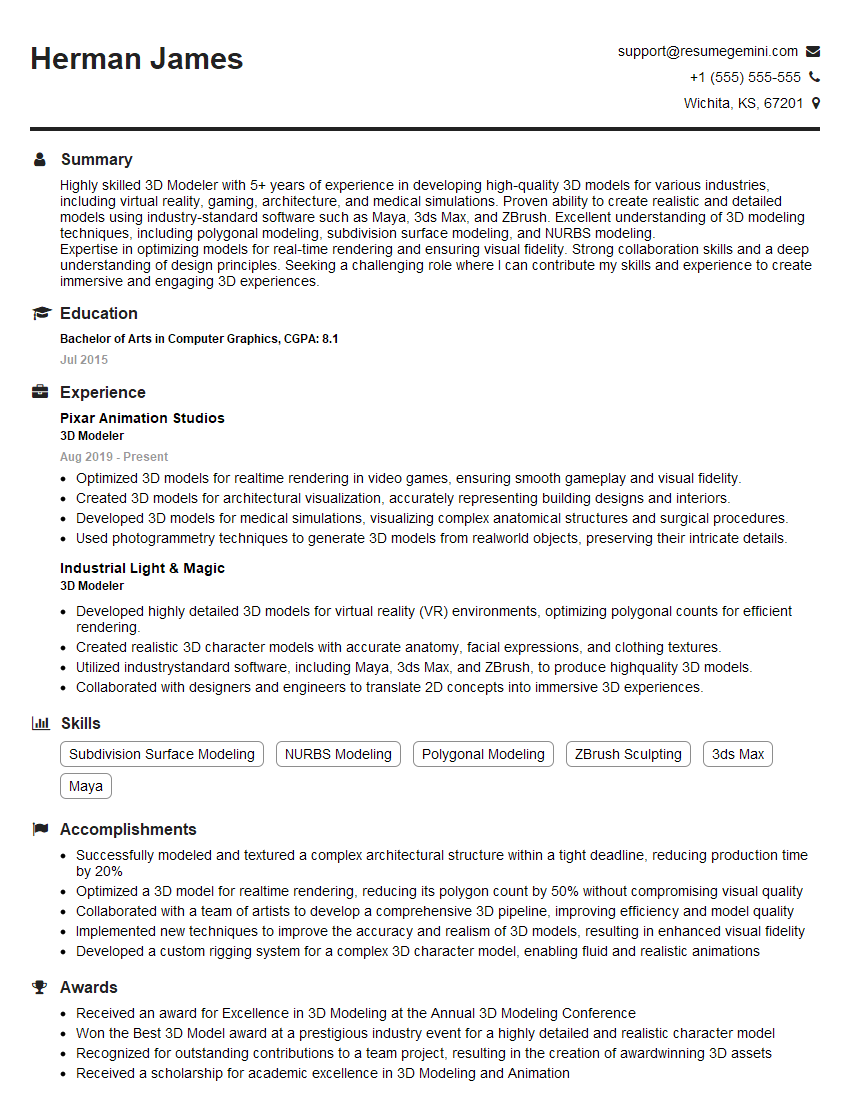
Mastering Computer Aided Design (CAD) software is vital for a successful and rewarding career in engineering, architecture, and many other related fields. It opens doors to exciting projects and career advancement opportunities. To maximize your chances of landing your dream job, it’s crucial to present yourself effectively. Crafting an ATS-friendly resume that highlights your skills and experience is paramount. ResumeGemini is a trusted resource to help you build a professional and impactful resume that gets noticed. They provide examples of resumes tailored to Computer Aided Design (CAD) Software professionals, helping you create a document that showcases your abilities to potential employers.
Explore more articles
Users Rating of Our Blogs
Share Your Experience
We value your feedback! Please rate our content and share your thoughts (optional).
What Readers Say About Our Blog
Very informative content, great job.
good