The thought of an interview can be nerve-wracking, but the right preparation can make all the difference. Explore this comprehensive guide to Conducting Technique interview questions and gain the confidence you need to showcase your abilities and secure the role.
Questions Asked in Conducting Technique Interview
Q 1. Explain the importance of baton technique in conveying musical phrasing.
Baton technique is far more than just visually appealing choreography; it’s a crucial tool for sculpting musical phrasing and conveying the composer’s intent. The conductor’s gestures, their shape, size, and speed, directly influence the orchestra’s dynamics, articulation, and tempo. Think of the baton as an extension of the conductor’s musical thought, translating inner feeling into tangible physical expression for the musicians. A broad, sweeping gesture might indicate a flowing legato phrase, while short, precise strokes could emphasize staccato notes. The subtle nuances – the weight of the downbeat, the anticipation in a crescendo – are all conveyed through refined baton technique.
For instance, a gradual increase in the size of a crescendo gesture, mirroring the growing intensity of the music, is far more effective than simply shouting louder. The visual cue helps the musicians anticipate and build the dynamic organically. Similarly, a subtle change in the direction and weight of the baton can help musicians shape the phrasing even within a single musical line, allowing them to breathe and articulate naturally within a phrase. A lack of precision in baton technique can lead to a lack of clarity and cohesion in the performance, resulting in an inconsistent and less compelling musical experience.
Q 2. Describe different techniques for cueing various sections of an orchestra.
Cueing different sections requires a diverse toolkit of techniques. The most fundamental aspect is eye contact. Before initiating a cue, I make sure to establish visual contact with the principal player of the section I’m about to cue. This ensures they understand when the cue is meant to occur, avoiding confusion. For cues preceding a quiet entry, I’ll often use a smaller, more subtle gesture, while a loud, forceful entrance might require a more expansive movement. The timing and style of the cue should always match the context of the music.
- Preparatory Cues: These are subtle anticipatory gestures, often a slight lifting of the baton or a change in posture, to alert a section before their entrance. This is particularly useful for quiet entries or passages requiring precise timing.
- Direct Cues: These are clear and unambiguous gestures directly indicating the start of a section’s entry. For example, a downbeat on the first beat of a measure, or a precise gesture for an off-beat entry.
- Expressive Cues: These add nuance, focusing on the character and style of the entry. For example, a soft, gentle gesture for a delicate passage, and a bold, decisive movement for a powerful entrance.
The method depends heavily on the orchestra’s familiarity with the piece and the individual musicians’ tendencies. Experience allows for adapting the cueing method to optimize communication for a specific performance and the nature of the piece.
Q 3. How do you manage tempo fluctuations during a performance?
Managing tempo fluctuations is a balancing act between maintaining a cohesive pulse and allowing for expressive rubato. The key is anticipation. I work diligently during rehearsal to establish a clear pulse that the musicians understand implicitly. This becomes our foundation. From there, I employ subtle adjustments to tempo during performance, using the baton and body language to guide the orchestra.
A common mistake is reacting to tempo fluctuations rather than anticipating them. Instead of chasing after tempo variations, I aim to subtly steer the ensemble towards the desired pacing, ensuring a natural ebb and flow. Think of it as gently shaping a flowing river, rather than damming it up or forcing it into a rigid channel. This anticipatory approach allows for greater control and ensures that tempo changes feel natural and musically motivated, rather than erratic or disruptive.
I also constantly monitor the orchestra’s response and adjust my conducting accordingly. A skilled conductor isn’t just dictating the tempo; they’re engaging in a dynamic conversation with the musicians, responding to subtle shifts in energy and momentum. It’s a constant dialogue between conductor and ensemble.
Q 4. Discuss your approach to interpreting a score and communicating your interpretation to the musicians.
Interpreting a score goes beyond simply reading the notes; it’s about understanding the composer’s intentions, the historical context, and the emotional arc of the piece. I start by deeply immersing myself in the score, analyzing its structure, harmonies, and melodic lines. I might listen to various recordings to understand different interpretations, but ultimately, my goal is to arrive at my own unique understanding. This personal interpretation informs my conducting choices—the shaping of phrases, the dynamics, the articulation, and ultimately, the overall character of the performance.
Communicating this interpretation to the musicians is a process of careful coaching and demonstration. I’ll share my insights during rehearsals, explaining my vision for the piece and demonstrating specific musical ideas through my conducting. I encourage dialogue and discussion; musicians’ input is invaluable. I might focus on certain aspects during rehearsals—such as a specific passage or a particular emotional expression—to make sure the whole ensemble interprets the score similarly, and to help clarify doubts.
Rehearsals are opportunities for collaborative exploration, not simply dictation. It’s about sharing the composer’s vision with the musicians in a way that inspires them to embrace it.
Q 5. How do you handle difficult or unresponsive musicians during rehearsals?
Handling difficult or unresponsive musicians requires diplomacy and a strategic approach. The first step is to identify the root cause of the problem. Is it a technical issue, a misunderstanding of the music, or a personality conflict? Once the cause is identified, I can tailor my response.
- Individual Coaching: For technical issues, I might spend extra time working individually with the musician, offering personalized suggestions and feedback.
- Clear Communication: If there’s a misunderstanding, I’ll explain the passage more clearly, potentially offering a different perspective or demonstrating it myself.
- Collaboration: Involving other musicians in the problem-solving process can sometimes be helpful, offering peer-to-peer support and a sense of shared responsibility.
- Positive Reinforcement: Focusing on the positive aspects of the musician’s playing can build confidence and encourage them to improve.
- Professional Boundaries: If the behavior is disruptive, I maintain professional boundaries, addressing issues directly, perhaps with the help of management or a trusted mentor.
It’s important to remember that each musician is an individual, and a tailored approach, prioritizing mutual respect and understanding is essential.
Q 6. Explain your rehearsal strategies for achieving a cohesive and expressive performance.
My rehearsal strategies prioritize building a cohesive and expressive performance through a combination of focused sectional work, full ensemble rehearsals, and mindful attention to detail. It’s a step-by-step process:
- Sectional Rehearsals: I start by focusing on individual sections, addressing specific technical challenges and interpretive nuances. This allows for detailed work and helps each section find its voice within the larger ensemble.
- Full Ensemble Rehearsals: Once the sections are sufficiently prepared, I bring them together, focusing on balance, blend, and overall phrasing. I might use various techniques such as conducting various passages with different phrasing and dynamics to help the ensemble find a common approach.
- Addressing Balance and Blend: Careful attention is given to achieving an optimal balance between sections, ensuring that each instrument group can be heard clearly without overpowering others.
- Phrasing and Articulation: I emphasize precise articulation and expressive phrasing, ensuring that the musicians understand the emotional arc of the piece.
- Dynamic Shaping: Careful attention to dynamic contrasts and gradual crescendos and diminuendos help to add depth and expression to the music.
- Regular Feedback: Providing constructive feedback and encouraging a collaborative approach helps the musicians to understand my vision.
The ultimate goal is not just a technically proficient performance, but a musically compelling and emotionally resonant one. This requires consistent attention to detail and a willingness to adapt to the specific needs of the ensemble.
Q 7. Describe your method for preparing a new piece of music for performance.
Preparing a new piece for performance is a multi-stage process that begins long before the first rehearsal. I start by thoroughly studying the score, analyzing its structure, harmony, and melodic lines. I’ll also research the composer’s background and intent for the piece. I might listen to recordings of other conductors’ interpretations, but I avoid imitating them; my goal is to understand the piece deeply enough to form my own unique interpretation.
Next, I plan my rehearsal schedule, breaking down the piece into manageable sections and identifying potential challenges. I create detailed rehearsal plans outlining specific goals for each session. I consider the technical difficulties present within the score, and identify sections that will require extra time or attention. I always try to schedule a few ‘dress rehearsals’ – full run-throughs, ideally in the performance venue, to simulate the performance environment.
Finally, I engage with the musicians, sharing my understanding of the piece and encouraging open discussion. I adapt my rehearsal strategies based on the orchestra’s strengths and weaknesses, ensuring that every musician is engaged and contributing to a unified and compelling performance. This collaborative process is vital to creating a truly memorable performance.
Q 8. How do you maintain energy and focus during a long rehearsal or performance?
Maintaining energy and focus during a long rehearsal or performance is crucial for effective conducting. It’s a marathon, not a sprint! My approach involves a combination of physical and mental strategies. Physically, I ensure I’m well-rested and hydrated before rehearsals. I also incorporate short, mindful breaks to stretch and re-center myself. Mentally, I visualize the musical outcome, focusing on the emotional arc of the piece and the connection I want to create with the musicians. This keeps me engaged and prevents mental fatigue. I also actively listen to the orchestra, adapting my conducting as needed, which keeps me alert and present. Think of it like a conversation – I need to be fully present to understand and respond effectively.
For example, during a particularly demanding Mahler symphony, I might take a 5-minute break after the first movement to mentally review the score and re-energize before tackling the next. This structured break prevents burnout and maintains a consistently high level of performance throughout the entire piece.
Q 9. What is your approach to working with soloists?
Working with soloists requires a delicate balance of collaboration and clear direction. I begin by establishing a strong rapport, taking time to understand their interpretation and technical strengths. It’s crucial to listen to their input and build a shared understanding of the musical goals. I encourage open communication; rehearsals with soloists become a conversation, allowing for creative exploration while maintaining a sense of shared direction. The focus is on providing support and guidance, not imposing a rigid interpretation.
For instance, when working with a violinist on a particularly challenging cadenza, I wouldn’t dictate every note, but instead offer suggestions on phrasing, dynamics, and articulation, enabling them to showcase their artistic individuality within the overall context of the piece. The goal is to create a performance that feels both powerful and natural.
Q 10. How do you incorporate dynamic contrasts effectively in your conducting?
Effective dynamic contrast is about more than just loud and soft; it’s about shaping the emotional landscape of the music. I achieve this through a combination of clear gestures and precise body language. A gradual crescendo is conveyed through a subtle widening of my arms, a gradual increase in the amplitude of my beat, and a corresponding change in my body weight. Conversely, a diminuendo is shown by a narrowing of my gestures, a softening of the beat, and a slight relaxation of my posture. I also focus on the nuances within dynamics, utilizing subtle changes in tempo and articulation to create depth and interest.
Consider the difference between a ‘piano’ and a ‘pianissimo.’ A simple ‘piano’ might be indicated with a moderately reduced gesture, while a ‘pianissimo’ requires an almost imperceptible movement, emphasizing the delicate nature of the passage. The key is consistency and precision in your physical communication to clearly convey the desired dynamic range.
Q 11. How do you use your body to communicate musical ideas effectively?
My body is an extension of the musical phrase. Each gesture, from the beat itself to subtle shifts in weight and posture, should reflect the music’s emotion and character. Large, sweeping gestures might convey the grandeur of a symphony, while smaller, more delicate movements could underscore the intimacy of a chamber piece. My head, torso, and hands all work together, creating a unified message. Maintaining an engaged posture communicates energy and enthusiasm to the orchestra.
For example, during a dramatic climax, my entire body might lean forward, increasing tension and excitement. Then, during a quiet passage, I might subtly soften my posture, allowing my movements to mirror the music’s tranquility. The body becomes a conduit for the emotional journey of the music, translating internal feelings into powerful visual cues for the ensemble.
Q 12. Explain the importance of clear and concise communication during rehearsals.
Clear and concise communication during rehearsals is paramount for efficiency and musical success. Ambiguity breeds confusion, leading to wasted time and frustration. I prioritize specific, targeted feedback, focusing on one or two key aspects at a time. I utilize clear, precise language avoiding jargon whenever possible and providing constructive criticism focusing on solutions rather than dwelling on errors. This approach fosters a collaborative environment, encouraging active listening and mutual understanding.
For example, instead of saying ‘Play it better,’ I might say, ‘Let’s try focusing on the legato phrasing between measures 5 and 8; let’s aim for a smoother connection between the notes.’ This targeted feedback empowers musicians to understand and improve their playing, creating a more productive and collaborative rehearsal process.
Q 13. Describe your experience with different conducting styles and techniques.
My conducting is informed by a wide range of styles and techniques. I’ve studied the precise, almost mathematical approach of conductors like Karajan, appreciating their emphasis on clarity and structure. I also draw inspiration from the expressive, emotionally charged style of Bernstein, understanding the importance of conveying a compelling narrative through musical interpretation. My own style incorporates elements from both traditions, blending technical precision with expressive freedom. The goal is to find a balance that suits the particular piece and the orchestra I’m working with.
This means adapting my technique and approach depending on the repertoire: a minimalist piece will necessitate a different approach from a Romantic symphony. I adjust my baton technique, body language and communication style to match the music’s demands while always aiming for clarity and conviction.
Q 14. How do you balance artistic vision with technical precision?
Balancing artistic vision with technical precision is the essence of effective conducting. Artistic vision provides the emotional core, driving the interpretation; while technical precision ensures that this vision is communicated clearly and effectively to the orchestra. It’s not an either/or situation but a synergistic relationship. A compelling artistic vision without technical clarity can result in a muddled performance, while technical precision without artistic vision creates a sterile, uninspired product.
I achieve this balance through meticulous preparation, studying the score deeply to understand its structure, harmony, and emotional arc. This informs my artistic interpretation, guiding my choices regarding tempo, dynamics, and phrasing. Simultaneously, I refine my technical skills through practice, ensuring my gestures are clear, precise, and consistent, communicating my artistic vision flawlessly to the orchestra. It is a constant process of refinement and adjustment.
Q 15. How do you address technical challenges faced by individual musicians?
Addressing technical challenges for individual musicians requires a multifaceted approach combining careful listening, targeted instruction, and a collaborative problem-solving spirit. It starts with identifying the specific issue – is it intonation, articulation, rhythmic precision, or something else? I begin by listening attentively to the musician’s performance, pinpointing areas needing improvement. Then, I use a combination of techniques. For example, if the issue is intonation, I might suggest exercises focused on ear training and interval recognition, perhaps using a tuner or recording to provide immediate feedback. If rhythmic precision is the problem, I’ll likely incorporate rhythmic exercises, using a metronome and focusing on subdivisions. Crucially, the process is collaborative; I encourage open communication, discussing the musician’s perspectives and incorporating their learning styles. I find that breaking down complex technical issues into smaller, manageable steps, coupled with positive reinforcement, greatly aids progress. For instance, working on a particularly challenging passage might involve practicing short segments in isolation before combining them. Finally, regular check-ins and adjustments based on the musician’s progress are vital to ensuring long-term success.
Career Expert Tips:
- Ace those interviews! Prepare effectively by reviewing the Top 50 Most Common Interview Questions on ResumeGemini.
- Navigate your job search with confidence! Explore a wide range of Career Tips on ResumeGemini. Learn about common challenges and recommendations to overcome them.
- Craft the perfect resume! Master the Art of Resume Writing with ResumeGemini’s guide. Showcase your unique qualifications and achievements effectively.
- Don’t miss out on holiday savings! Build your dream resume with ResumeGemini’s ATS optimized templates.
Q 16. What is your experience with score study and preparation?
Score study and preparation are fundamental to my approach. It begins with a thorough reading of the score, not just for the notes but also for the composer’s intentions – dynamics, phrasing, articulation markings, and overall structure. I analyze the harmonic and melodic content, identifying key relationships and structural elements. This helps me understand the piece’s emotional arc and interpretative possibilities. For example, if a passage is marked ‘agitato,’ I consider what emotional and physical qualities might reflect that. Beyond analysis, I create detailed performance plans, often including fingering, bowing, and articulation choices. These aren’t fixed, though; I might adjust them based on rehearsals and performance experience. I frequently use notation software to annotate the score with helpful reminders or alternative interpretations. Then, I engage in focused practice – not just playing through the piece, but breaking down challenging sections, practicing scales and arpeggios relevant to the passage, and honing specific technical skills. The level of detail in my preparation depends on the complexity of the piece and the performers’ experience level, but a thorough, analytical approach is always crucial.
Q 17. Describe your approach to managing different rehearsal tempos.
Managing different rehearsal tempos is crucial for efficient and effective rehearsals. I usually start with a tempo slightly slower than the performance tempo, allowing the musicians to focus on accuracy and details without the pressure of speed. Gradually, as the piece becomes more secure, I incrementally increase the tempo. This approach minimizes errors and allows musicians to build a solid foundation. However, it’s not a rigid formula. Sometimes, I might focus on problem areas at a slower tempo while maintaining a faster tempo for other sections. Communication is key; I regularly check with the musicians, making sure they’re comfortable with the tempo and addressing any concerns they might have. The goal is to find a tempo that balances accuracy and musical expression. I might also utilize rhythmic exercises such as subdivisions of the beat to build rhythmic precision, particularly when addressing challenges in tempo changes within the piece itself.
Q 18. How do you maintain control over a large ensemble?
Maintaining control over a large ensemble requires a combination of strong leadership, clear communication, and well-structured rehearsals. I employ several strategies. Firstly, I establish clear expectations from the outset, outlining rehearsal procedures and performance goals. I ensure everyone understands their roles and responsibilities. Secondly, I use a variety of rehearsal techniques: sectionals, full ensemble rehearsals, and focused work on individual challenges. Sectionals allow me to address specific issues within smaller groups before integrating those improvements into the full ensemble. Thirdly, I provide consistent and constructive feedback, focusing both on individual and collective performance. I encourage open communication among musicians, creating an atmosphere of mutual respect and collaboration. I might use visual cues in addition to verbal instructions. Finally, during performance, maintaining visual contact with various sections helps to ensure balance and cohesion. Building trust and rapport with the musicians is equally crucial for effective leadership and control.
Q 19. Discuss your approach to working with diverse musical styles.
Working with diverse musical styles requires adaptability and a deep understanding of different musical languages. My approach focuses on thorough research into the historical context and stylistic conventions of each genre. I immerse myself in recordings and scholarly analyses to understand the nuances of the style, such as rhythmic characteristics, melodic structures, and harmonic progressions. For instance, when working on a Baroque piece, I emphasize articulation and ornamentation according to period practice. Conversely, a contemporary piece might necessitate a more improvisational approach. Crucially, I tailor my communication and instruction to the specific needs and understanding of the musicians, ensuring everyone is comfortable and confident in their interpretation. The goal is not to impose a single interpretation, but rather to guide the musicians in finding their own expressive voice within the boundaries of the style. Understanding the musical context and stylistic conventions enables me to translate my knowledge into effective coaching and guidance, leading to a powerful and authentic musical outcome.
Q 20. How do you handle unexpected situations during a performance?
Unexpected situations during a performance require quick thinking and adaptability. My approach centers around preparedness and proactive problem-solving. This includes having backup plans for potential issues – for example, having a copy of the score readily available in case of a mishap. During the performance, I maintain a calm demeanor and communicate clearly and confidently with the musicians. If an individual musician makes a mistake, I might use nonverbal cues, such as a slight head nod or eye contact, to guide them back on track. For more significant errors, I might subtly adjust the tempo or phrasing to help the ensemble recover smoothly. The key is to maintain the flow and momentum of the performance while addressing the issue effectively and discreetly. After the performance, I use the experience as a learning opportunity, reviewing what went well and areas for improvement in future rehearsals and preparations.
Q 21. Describe your experience with different types of musical notation.
My experience encompasses various types of musical notation, from traditional staff notation to contemporary systems and even tablature. Proficiency in traditional staff notation, including understanding key signatures, time signatures, and rhythmic complexities, forms the basis of my skills. This foundation allows me to interpret scores effectively and communicate effectively with musicians. Beyond traditional notation, I’m familiar with various forms of tablature, particularly for instruments like guitar and lute. I also have experience reading and interpreting modern notation systems that incorporate graphic or symbolic elements alongside traditional notation. Understanding these different systems allows me to work effectively with diverse repertoire and musical styles. This understanding extends to interpreting composer-specific markings and understanding how to translate those markings into effective performance practice.
Q 22. How do you adapt your conducting style to different ensembles and repertoire?
Adapting my conducting style hinges on understanding the unique characteristics of each ensemble and the demands of the specific repertoire. It’s not a ‘one-size-fits-all’ approach. Think of it like tailoring a suit – you wouldn’t use the same pattern for a tuxedo and a pair of jeans.
- Ensemble Dynamics: A professional orchestra requires a different level of precision and subtlety compared to a community orchestra. With professionals, I can utilize more nuanced gestures and expect a higher level of immediate response. With a community ensemble, more explicit cues and detailed explanations might be necessary.
- Repertoire Style: The style of music dictates the approach. A Baroque piece requires a lighter, more articulate baton technique, often with a focus on articulation and ornamentation. A Romantic symphony might demand broader, more sweeping gestures to capture the emotional depth and power of the music.
- Individual Musicians: I always consider the individual strengths and weaknesses of the musicians within the group. A particularly skilled section might require less direction, while others might benefit from more specific instructions and encouragement. I strive to create a balance, fostering both individual excellence and cohesive ensemble playing.
For example, when conducting a highly skilled string quartet playing a Beethoven string quartet, my gestures will be precise, emphasizing phrasing and dynamics through subtle shifts in my body language and baton technique. In contrast, conducting a beginner’s choir singing a simple hymn would involve clearer, more pronounced cues and perhaps more verbal instruction. The goal is always clarity, precision, and inspiring musicality, tailored specifically to the unique context.
Q 23. Explain your experience with conducting choral ensembles.
My experience with choral ensembles spans over fifteen years, encompassing a wide range of musical styles and ensemble sizes, from small chamber choirs to large university choruses. I’ve worked with diverse vocal ranges, from sopranos to basses, demanding precise intonation, blend, and expressive phrasing. I’ve successfully prepared choirs for major concerts, competitions, and recordings.
One particularly memorable experience involved preparing a university choir for a performance of Bach’s Mass in B Minor. This required meticulous attention to detail in terms of vocal technique, diction, and phrasing, as well as coordinating the large ensemble across multiple sections. Success relied heavily on building trust and a strong sense of ensemble cohesion through effective communication and detailed rehearsal strategies, including sectional work, individual coaching and careful balancing of the various vocal parts. The resulting performance was not only technically proficient but emotionally resonant.
My approach with choral ensembles focuses on developing a strong sense of vocal blend and intonation. I emphasize clear diction and expressive phrasing, encouraging singers to understand the emotional depth of the music. I also prioritize building a positive and supportive rehearsal environment where singers feel comfortable taking risks and pushing their vocal and musical boundaries.
Q 24. How do you prepare for auditions and competitions?
Preparing for auditions and competitions requires a multifaceted approach, blending meticulous musical preparation with strategic performance planning. It’s about presenting your best, most confident self.
- Thorough Repertoire Knowledge: I begin by thoroughly analyzing the chosen pieces, understanding their historical context, stylistic nuances, and compositional intent. This understanding informs my interpretive choices and allows me to communicate the music’s essence effectively.
- Targeted Rehearsal Strategies: I plan targeted rehearsals focusing on problem areas, honing both technical skills and musical expression. This includes individual coaching, sectional rehearsals, and full ensemble run-throughs. I use recordings to analyze performance details and refine my interpretations.
- Performance Practice: A crucial aspect involves simulating the performance environment through mock auditions and dress rehearsals. This helps reduce performance anxiety and strengthens both physical and mental preparedness for the actual event. I focus on stage presence and the ability to connect with both the ensemble and the audience.
- Mental Preparation: Managing performance anxiety is key. I practice mindfulness and visualization techniques to enhance focus and confidence. I also ensure adequate rest and nutrition to optimize physical and mental energy levels.
For example, before a major conducting competition, I’ll spend weeks meticulously studying the scores, creating detailed rehearsal plans, and engaging in regular practice sessions with a mock orchestra. This methodical approach ensures that I am not just musically prepared but also mentally and physically ready to deliver a compelling and confident performance.
Q 25. What is your philosophy on musical interpretation?
My philosophy on musical interpretation is rooted in a deep respect for the composer’s intentions while embracing personal artistic expression. It’s a delicate balance. Think of it as a conversation between the composer’s original vision and the conductor’s interpretation.
I believe that a thorough understanding of the historical context, the composer’s life and other works, and the stylistic conventions of the period is essential for responsible interpretation. However, I also believe that there is space for creative exploration and personal expression. The conductor’s job is not simply to replicate what’s on the page but to bring the music to life in a way that resonates with both the performers and the audience. This involves understanding the nuances of the score and translating them into powerful and evocative musical experiences.
I approach each piece with an open mind, seeking to discover its unique essence and communicate it with honesty and integrity. I strive for authenticity, seeking to convey the composer’s vision while allowing for personal stylistic choices that enhance, rather than detract from, the original intent.
Q 26. How do you foster a positive and productive rehearsal environment?
Creating a positive and productive rehearsal environment is paramount. It’s about fostering a collaborative spirit where musicians feel valued, respected, and empowered to contribute their best.
- Clear Communication: I prioritize clear and concise communication, providing specific instructions and constructive feedback. I encourage questions and open dialogue to ensure everyone is on the same page.
- Positive Reinforcement: I celebrate successes, no matter how small. Positive reinforcement strengthens confidence and fosters a sense of accomplishment, motivating the musicians to continually strive for excellence.
- Respectful Atmosphere: I create a respectful and inclusive atmosphere where every musician feels comfortable contributing their ideas and sharing their perspectives.
- Problem-Solving: When challenges arise, I approach them collaboratively. This allows musicians to be actively involved in finding solutions, thereby promoting ownership and engagement.
For example, if a section is struggling with a particular passage, I’ll work with them individually and then bring the section together to analyze and address challenges collaboratively. It’s less about ‘fixing’ the issue and more about fostering their collective problem solving skills. I find this fosters a sense of shared success and ownership, which contributes greatly to a more productive and positive rehearsal.
Q 27. Describe your experience with working with composers.
Working with composers is a privilege that offers invaluable insights into the creative process. It’s a collaborative partnership where the conductor acts as a conduit, translating the composer’s vision into a tangible musical reality.
My experiences have ranged from collaborating with established composers on premieres of new works to assisting emerging composers in refining their scores. This involves open discussions about their compositional intentions, exploring various interpretive approaches, and providing feedback on the practical aspects of realizing their musical ideas. One particularly enriching experience involved collaborating with a young composer on the premiere of their orchestral work. Through multiple rehearsals and revisions, we refined the score together, ensuring that the piece was both technically playable and artistically compelling. The composer’s enthusiasm and their trust in my suggestions made the entire process incredibly rewarding. This collaboration extended beyond technical aspects, delving into the deeper meaning and emotional core of the piece which enriched the final outcome.
I believe this collaboration ensures a profound and nuanced understanding of the work, enabling a more authentic and compelling performance. The resulting performance is not just a mechanical interpretation of notes, but a reflection of a true collaborative creative journey.
Q 28. How do you incorporate audience engagement into your performances?
Audience engagement is crucial for a truly fulfilling performance. It’s about creating a shared experience that transcends the purely musical, fostering a connection between the performers and the listeners.
- Pre-concert Activities: Introducing the program with insightful commentary provides context and enriches the listening experience. I believe in sharing the ‘story’ behind the music, its history, and the composer’s intentions.
- Dynamic Performances: A dynamic and expressive performance naturally captivates the audience. It is essential to project energy and passion, making the music feel relatable and engaging.
- Visual Connection: Using my body language and facial expressions can create a visual connection with the audience, enhancing emotional connection. My movements should reflect the music’s dynamics and emotional arc.
- Post-concert Interaction: Opportunities for post-concert Q&A or meet-and-greets allow for direct interaction, enriching the overall experience and creating lasting memories.
For instance, before a performance of a contemporary piece, I might share some background information about the composer and their creative process, relating the music to current social or political themes. This context can significantly enhance the audience’s appreciation and engagement with the work. The goal is not merely to entertain, but to create a meaningful and memorable experience for all involved.
Key Topics to Learn for Conducting Technique Interview
- Beat and Meter: Understanding different time signatures, rhythmic complexities, and their accurate representation through baton technique.
- Dynamic Control: Mastering the nuanced communication of dynamic levels (pianissimo to fortissimo) and subtle gradations using precise baton movements and body language.
- Phrasing and Shaping: Developing the ability to articulate musical phrases effectively, conveying expressive nuances through expressive gestures and body posture.
- Score Interpretation: Demonstrating a deep understanding of musical scores and translating the composer’s intentions into clear and compelling conducting gestures.
- Ensemble Management: Articulating clear entrances, maintaining balance between sections, and responding effectively to the musical needs of the ensemble.
- Baton Technique: Practicing various baton grips, precise movements, and clear visual cues for different musical contexts. Refining the balance between visual clarity and natural expressiveness.
- Rehearsal Techniques: Understanding different rehearsal methodologies, effective communication strategies, problem-solving approaches during rehearsals, and addressing technical or interpretative challenges within the ensemble.
- Communication and Collaboration: Effectively communicating musical intentions to musicians, fostering a collaborative environment, and adapting conducting style based on the ensemble’s needs.
- Historical Context and Styles: Demonstrating knowledge of different conducting styles across various historical periods and musical genres, and adapting technique accordingly.
- Problem-Solving & Adaptation: Preparing for scenarios requiring on-the-spot adjustments, solutions to unexpected musical challenges, and managing diverse personalities within an ensemble.
Next Steps
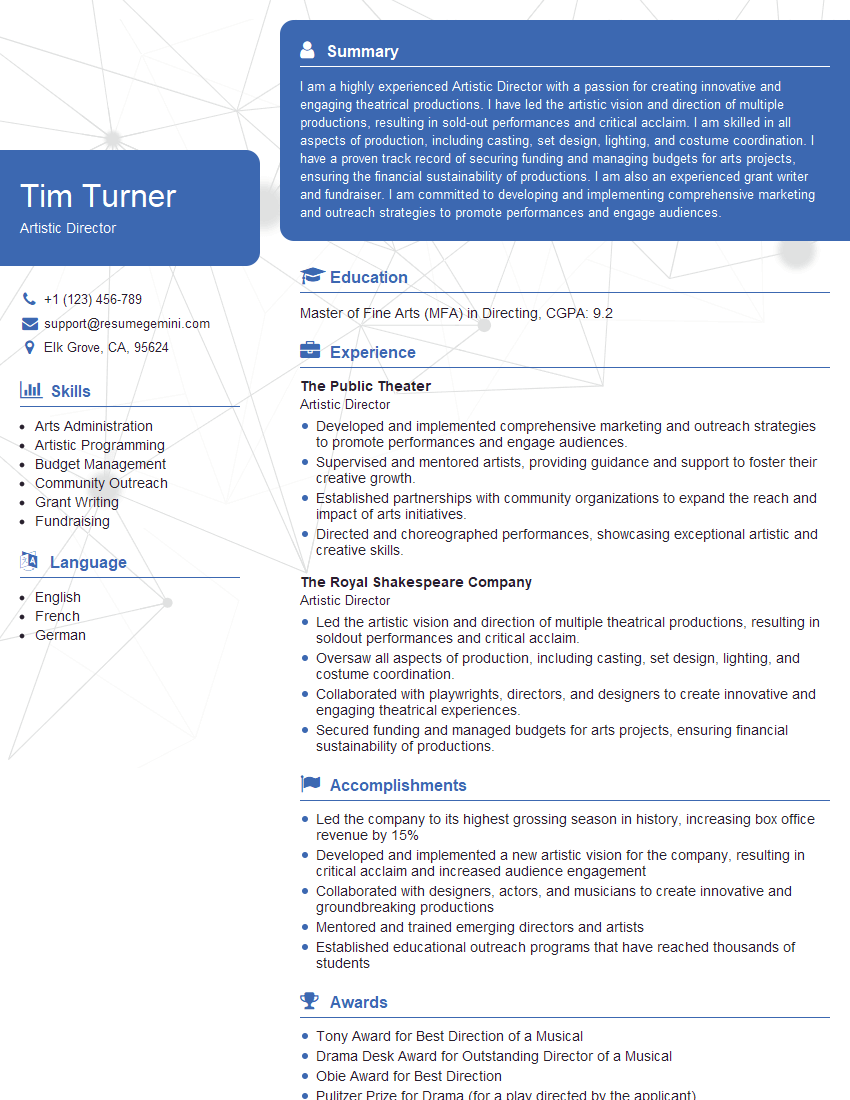
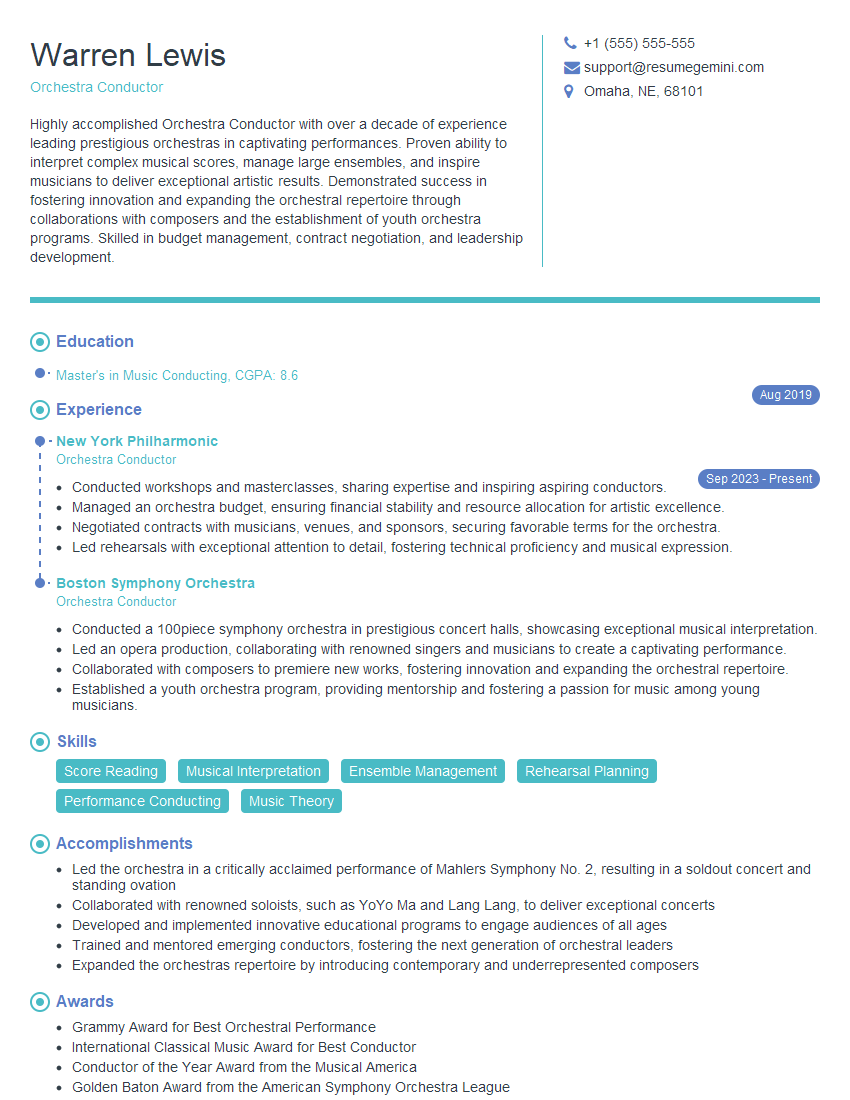
Mastering conducting technique is crucial for a successful career in orchestral music, opera, or choral conducting. A strong command of these skills opens doors to exciting opportunities and allows you to effectively lead and inspire musicians. To maximize your job prospects, it’s essential to present your qualifications clearly and effectively. Creating an ATS-friendly resume is key. We recommend using ResumeGemini to build a professional resume that showcases your skills and experience. ResumeGemini offers tools and examples tailored to the specific needs of Conducting Technique professionals, helping you stand out from the competition. Examples of resumes tailored to Conducting Technique are available.
Explore more articles
Users Rating of Our Blogs
Share Your Experience
We value your feedback! Please rate our content and share your thoughts (optional).
What Readers Say About Our Blog
Very informative content, great job.
good