Interviews are more than just a Q&A session—they’re a chance to prove your worth. This blog dives into essential Construction Code Interpretation interview questions and expert tips to help you align your answers with what hiring managers are looking for. Start preparing to shine!
Questions Asked in Construction Code Interpretation Interview
Q 1. Explain the difference between the International Building Code (IBC) and local amendments.
The International Building Code (IBC) is a model code, a comprehensive document providing baseline building safety and construction requirements. Think of it as a national template. However, local jurisdictions—cities, counties, states—often adopt the IBC but then amend it to reflect their specific needs, climate conditions, or local regulations. These amendments can be additions, subtractions, or modifications to the IBC’s provisions.
For example, the IBC might specify minimum insulation requirements for walls. A coastal city might amend the code to require even higher levels of insulation to better withstand hurricane-force winds and protect against potential flooding damage. Or a region prone to earthquakes might mandate stricter seismic design standards beyond what’s in the base IBC. These local amendments are crucial because they tailor the general guidelines of the IBC to a specific area’s unique circumstances.
Q 2. Describe your experience interpreting complex code provisions.
I have extensive experience interpreting complex code provisions, particularly those related to structural design, fire protection, and accessibility. One memorable project involved a historic building renovation. The building’s unique design and age presented several challenges in meeting current code requirements. This included navigating conflicting requirements between the historic preservation guidelines and the current building codes. The key was a meticulous review of the relevant code sections, including historical references and related commentary, as well as consultations with specialists in historic preservation and structural engineering. We successfully resolved the conflicts by creating a solution that maintained the building’s historical integrity while meeting contemporary safety standards.
Another instance involved interpreting complex calculations concerning structural load-bearing capacity in a high-rise construction. The code required careful consideration of various factors like wind load, seismic activity, and material properties. Using engineering software and detailed hand calculations, I cross-checked the structural engineer’s analysis against the code requirements, ensuring the final design was safe and code compliant.
Q 3. How do you handle conflicting code requirements?
Conflicting code requirements can arise, often due to amendments or multiple codes applying simultaneously. My approach involves a systematic process:
- Identify the conflicting requirements: Pinpoint the exact sections in the code that are in conflict. Note down each provision’s specific requirements and the relevant code references.
- Determine the hierarchy: Establish which code takes precedence. Generally, more specific provisions override more general ones. Local amendments typically supercede the base IBC. A written building permit, if available and legally valid, might specify the requirements to follow.
- Consult relevant resources: If there’s ambiguity, I would review code commentary, relevant case laws, and consult with other code experts or building officials for clarification.
- Document the resolution: Thoroughly document the conflict, the resolution process, and the final decision. This is essential for transparency and to avoid future disputes.
For instance, if the IBC’s fire-resistance rating for a wall conflicts with a stricter local amendment, the local amendment governs the project.
Q 4. What resources do you utilize to stay current on code changes?
Staying current with code changes is critical. I utilize several key resources:
- Subscription to code publishing services: I regularly access online resources and databases that provide up-to-date code versions and amendments.
- Professional organizations: Active participation in organizations like the International Code Council (ICC) provides access to training, webinars, and the latest code updates.
- Industry publications and journals: I review relevant publications for articles discussing code interpretations, changes, and case studies.
- Networking with colleagues: Regular interactions with other professionals in the field help to share information on recent code changes and interpretations.
Attending continuing education courses is crucial to earning professional certifications and maintaining a current understanding of building code best practices.
Q 5. Explain the process of reviewing construction plans for code compliance.
Reviewing construction plans for code compliance is a thorough process. It involves a detailed examination of the submitted documents against the applicable codes. My process includes:
- Identifying the applicable codes: Determining which codes and local amendments apply to the project based on its location, type, and occupancy.
- Checking for completeness: Verifying the plans are complete and provide sufficient information for code review, such as sufficient details, calculations, and specifications.
- Systematic review of drawings and specifications: Carefully reviewing each drawing and specification to ensure they meet all code requirements regarding structural integrity, fire safety, means of egress, accessibility, and other relevant aspects.
- Calculation verification: Verifying load calculations and other engineering calculations provided in the plans.
- Identification and resolution of discrepancies: Flagging any discrepancies or potential non-compliances and working with the design team to resolve them.
- Issuing a code compliance report: Creating a formal report summarizing the review findings, listing any identified violations or areas needing further clarification.
Q 6. How do you identify and address code violations during inspections?
During inspections, identifying and addressing code violations requires a keen eye for detail and a thorough understanding of the code. I typically follow these steps:
- Visual inspection: Conducting a thorough visual examination of the work, checking for adherence to the approved plans and the relevant codes.
- Documentation: Taking detailed notes, photos, and measurements of any observed violations. Precise documentation is crucial for any subsequent discussions with contractors and building owners.
- Severity assessment: Categorizing violations by their severity (minor, major, critical), prioritizing those posing immediate safety hazards.
- Communication with the contractor: Discussing violations with the contractor, explaining the code requirements, and assisting in finding solutions to bring the construction into compliance.
- Issuance of correction notices: Issuing formal notices specifying the violations and outlining the required corrective actions and deadlines.
- Follow-up inspections: Conducting follow-up inspections to verify that the violations have been corrected satisfactorily.
For example, if an improperly installed electrical outlet is discovered, the violation is documented, and the contractor is required to rectify the situation before proceeding with further work.
Q 7. What is your experience with accessibility codes (ADA, etc.)?
I possess considerable experience with accessibility codes, primarily the Americans with Disabilities Act (ADA) Standards for Accessible Design and related local ordinances. This experience includes reviewing plans for accessibility features, conducting inspections to ensure compliance, and resolving disputes regarding accessibility issues. My understanding extends to various aspects of accessibility, including:
- Ramp slopes and landings: Ensuring ramps meet the required slope and landing dimensions.
- Accessible routes: Verifying that accessible routes are provided throughout the building, free from obstructions.
- Accessible restrooms: Confirming that restrooms comply with the required dimensions and features.
- Accessible parking: Checking the provision of adequate accessible parking spaces with appropriate signage.
- Signage and wayfinding: Ensuring that signs are clear, legible, and compliant with ADA standards.
I’m familiar with the complexities of interpreting accessibility requirements, especially in existing buildings where compliance may require adaptive reuse techniques or creative solutions. I have successfully worked on numerous projects to ensure they met the requirements of both the ADA and local ordinances, including navigating the complexities of historical buildings with accessibility constraints.
Q 8. Describe your process for resolving code disputes.
Resolving code disputes involves a systematic approach prioritizing communication and collaboration. First, I thoroughly review all documentation: the plans, the code in question, any inspection reports, and any communication between the involved parties. This helps me establish a clear understanding of the points of contention. Then, I analyze the conflicting interpretations, referring to the specific code sections and referencing authoritative interpretations like those from the International Code Council (ICC). If the dispute involves ambiguities, I explore alternative interpretations while emphasizing safety and compliance. If the issue can’t be resolved through interpretation, I might suggest alternative solutions that meet the code’s intent while addressing the practical constraints of the project. Finally, I document the entire process and resolution clearly to ensure transparency and prevent future misunderstandings. For instance, a dispute over allowable setbacks might be resolved by demonstrating that a proposed alternative design, while technically different from the initial plan, still meets the spirit and intent of the setback requirements and doesn’t compromise safety or neighborhood aesthetics.
Q 9. How familiar are you with fire codes and life safety requirements?
My familiarity with fire codes and life safety requirements is extensive. I’ve worked extensively with codes like the International Fire Code (IFC) and the Life Safety Code (LSC), understanding everything from egress planning and fire suppression systems to smoke control and alarm systems. I understand the importance of compartmentalization, the different types of fire-rated assemblies and their applications, and the specific requirements for different occupancy types. I also have practical experience in interpreting complex scenarios, such as those involving mixed-use buildings or buildings with unique designs. For example, I recently helped a client navigate the complexities of installing a sprinkler system in a historic building, balancing code compliance with the preservation of the building’s architectural integrity.
Q 10. Explain your understanding of structural design requirements within building codes.
Building codes contain detailed requirements for structural design, ensuring safety and stability. This encompasses aspects like load calculations, material specifications, and construction methods. I understand the significance of factors like dead loads (permanent weights), live loads (occupancy loads), and environmental loads (wind, snow, seismic). I’m proficient in reviewing structural drawings and calculations, ensuring they comply with relevant standards. For example, I have experience using accepted engineering principles and the provisions of building codes such as ASCE 7 to determine the required strength and design of structural elements in various locations. I’m also familiar with different structural systems, like steel frames, reinforced concrete, and wood framing, and how their design needs to conform to the code’s requirements. Understanding soil conditions and foundation design based on engineering reports and local geological data is crucial for ensuring a safe structure.
Q 11. How do you ensure code compliance throughout the construction process?
Ensuring code compliance requires proactive measures throughout the entire construction process. This starts with a thorough review of the design documents before construction begins to identify and address potential issues early on. During construction, regular inspections are essential – both self-inspections by the contractor and inspections by authorized building officials. I utilize checklists and detailed documentation of all inspections. Any discrepancies or violations are immediately addressed with corrective actions documented in writing. This includes maintaining a complete record of all submitted plans, approvals, inspections, and any modifications to the original design. Throughout the entire process, I rely on clear communication with all stakeholders – architects, engineers, contractors, and building officials – to ensure everyone is working toward the same goal of compliant construction. For example, if a non-compliant condition is found during framing, a stop-work order might be issued until the issue is corrected with an updated plan and a re-inspection.
Q 12. Describe your experience with energy codes and sustainable building practices.
Energy codes and sustainable building practices are increasingly important in construction. I’m familiar with codes like the International Energy Conservation Code (IECC) and various state-level supplements. My understanding extends to energy efficiency measures, such as proper insulation, high-performance windows, and efficient HVAC systems. I also have experience incorporating sustainable materials, reducing waste through proper construction management techniques, and evaluating the embodied carbon of building materials. In recent projects, for example, I helped clients select building materials with lower carbon footprints and implemented strategies for optimizing building orientation and shading to minimize energy consumption. Further, I helped incorporate renewable energy systems such as solar panels, and the proper integration of these systems with the overall building design while complying with all relevant electrical and building codes.
Q 13. What are the key differences between various building code editions (e.g., 2018 vs. 2021)?
Different editions of building codes, such as the 2018 and 2021 International Building Codes (IBC), often incorporate updates based on new research, technological advancements, and improved safety standards. The differences can range from minor clarifications to significant changes in requirements. For example, the 2021 IBC often includes strengthened requirements for seismic design in high-risk areas and updated provisions for accessibility, reflecting evolving societal needs and technological advancements. Specific changes could involve alterations to allowable spans for certain lumber sizes, updated fire-resistance ratings for certain assemblies, stricter energy efficiency requirements, or new regulations concerning certain materials or construction methods. It’s crucial to carefully compare the specific code sections between different editions to understand the implications for a particular project. Often a project will be designed and permitted under one code edition, so maintaining consistency throughout the project is critical to avoid costly and time-consuming revisions.
Q 14. How do you prioritize code violations based on severity and risk?
Prioritizing code violations involves assessing their severity and potential risk. Life safety violations, such as inadequate egress paths or faulty fire protection systems, are always top priority due to the immediate danger they pose. Structural violations also hold high priority due to their potential to compromise building stability and safety. Less severe violations, such as minor discrepancies in finishes or minor accessibility issues, while still needing correction, are given lower priority. I use a risk-based approach, considering factors like the potential for injury or property damage, the likelihood of the violation causing harm, and the urgency of corrective action. This prioritization allows me to focus resources effectively on the most critical safety concerns while ensuring overall compliance with all building codes.
Q 15. Describe your experience with code enforcement procedures.
My experience with code enforcement procedures spans over ten years, encompassing various roles from plan review to field inspection. I’m proficient in navigating the entire process, from initial plan submission and review to issuing permits, conducting inspections, and addressing violations. This includes understanding the specific requirements of different codes, such as the International Building Code (IBC), International Residential Code (IRC), and local amendments. I’m adept at identifying discrepancies between submitted plans and actual construction, and communicating these findings clearly and professionally to contractors and developers. I’m also experienced in documenting all findings, creating detailed reports, and issuing notices of violation when necessary, ensuring all actions are compliant with due process.
For example, I recently worked on a project where a contractor failed to properly install fire-rated assemblies. My inspection uncovered this violation. I then documented the issue with photographic evidence, detailed the code violation citing the relevant section of the IBC, and issued a stop-work order until the necessary corrections were made. This approach ensured the safety and compliance of the project.
Career Expert Tips:
- Ace those interviews! Prepare effectively by reviewing the Top 50 Most Common Interview Questions on ResumeGemini.
- Navigate your job search with confidence! Explore a wide range of Career Tips on ResumeGemini. Learn about common challenges and recommendations to overcome them.
- Craft the perfect resume! Master the Art of Resume Writing with ResumeGemini’s guide. Showcase your unique qualifications and achievements effectively.
- Don’t miss out on holiday savings! Build your dream resume with ResumeGemini’s ATS optimized templates.
Q 16. Explain your understanding of the appeals process for code decisions.
The appeals process for code decisions typically involves several steps, designed to ensure fairness and transparency. First, a formal appeal must be submitted within a specified timeframe, outlining the grounds for the appeal. This usually involves providing evidence that contradicts the initial decision. The appeal is then reviewed by a designated appeals board or higher authority. This board examines the evidence, considers the relevant code sections, and makes a final decision. The process is often documented thoroughly, with written decisions explaining the rationale behind the outcome. Understanding this process is critical for both building professionals and code officials, ensuring disputes are resolved efficiently and fairly.
In one instance, a developer appealed a decision regarding the allowable height of a structure. They argued that a specific interpretation of the code allowed for an additional floor. After reviewing the relevant section of the code and hearing testimony from both sides, the appeals board agreed with the developer’s interpretation, resulting in a modification of the original permit.
Q 17. How do you interpret ambiguous language within building codes?
Interpreting ambiguous language in building codes requires a systematic approach. I start by thoroughly examining the context of the ambiguous phrase, considering its placement within the overall code structure. I then look for clarifying definitions within the same code or related codes. Industry standards, recognized handbooks (like the latest IBC commentary), and case law can also provide valuable insights. If ambiguity persists after this investigation, I consult with experienced colleagues or seek guidance from recognized experts in the field. The goal is always to reach a reasonable and consistent interpretation that ensures public safety and aligns with the overall intent of the code.
For instance, if a code section mentions ‘adequate ventilation’ without specific quantifiable requirements, I’d refer to other sections within the code addressing ventilation rates for various occupancies or consult recognized industry standards like ASHRAE to determine a suitable interpretation.
Q 18. What software or tools do you use to assist with code interpretation?
Several software and tools significantly aid in code interpretation. I regularly utilize electronic versions of building codes, often integrated into searchable databases that allow for quick cross-referencing of sections. Software like plan review platforms enable efficient analysis of construction plans and identification of code discrepancies. These platforms often integrate with code databases, automatically flagging potential code violations. I also use specialized software for calculating things such as structural loads, fire protection requirements, and accessibility compliance. Staying up-to-date with technological advancements in this area is crucial for efficiency and accuracy.
Q 19. Describe a situation where you had to interpret a complex code section and the outcome.
I once faced a complex situation involving the interpretation of the IBC’s requirements for egress in a multi-story mixed-use building. A specific section was unclear regarding the allowable distance between fire-rated stairwells in a building with multiple occupancy types (residential and commercial). My approach involved a thorough review of the entire chapter related to egress, consulting the IBC’s commentary, and researching similar case studies. I also contacted experts familiar with this type of situation and consulted relevant industry standards. Ultimately, I determined the safest interpretation, ensuring compliance while minimizing disruption to the project. The result was a slightly modified egress plan that satisfied all relevant code requirements, while maintaining the project’s functionality.
Q 20. How do you ensure that your code interpretations are consistent with industry best practices?
Ensuring consistency with industry best practices in code interpretation is paramount. I achieve this by staying actively involved in professional organizations, attending continuing education courses and workshops, and actively reading industry publications and journals. This keeps my knowledge current with evolving best practices and emerging technologies. Regular participation in peer reviews and discussions with other code officials helps ensure my interpretations are aligned with common understanding and industry consensus. This collaborative approach is critical for maintaining consistency and avoiding potentially conflicting interpretations.
Q 21. Explain your experience working with different construction materials and their code implications.
My experience encompasses a wide range of construction materials, each with its specific code implications. For instance, I’m well-versed in the fire-resistance ratings of different materials (concrete, steel, wood, composites), understanding how these ratings affect building design and separation requirements. I’m also familiar with the code requirements related to moisture control in various materials, especially in exterior walls and roofing systems. Furthermore, I’m knowledgeable about the structural properties and code implications of various materials, ensuring designs meet load requirements and comply with structural code provisions. Proper understanding of material properties and associated codes is fundamental for efficient and safe building practices.
For example, the use of certain types of engineered wood products might require specific detailing and calculations to ensure compliance with allowable spans and load requirements, differing from traditional lumber. This necessitates a thorough understanding of the material properties and relevant code provisions.
Q 22. How do you handle situations where code requirements conflict with project design?
Resolving conflicts between code requirements and project design requires a strategic approach that prioritizes safety and compliance. It’s not a matter of choosing one over the other, but finding a solution that meets both.
My process begins with a thorough review of the design and a meticulous comparison against all applicable codes. I identify areas of conflict and then explore several options. These may include:
- Variance Requests: If the conflict is minor and there’s a justifiable reason for deviating from the code, I’ll help prepare a formal variance request to the building authority. This involves providing detailed justification, alternative designs that meet the spirit of the code, and potentially engineering calculations demonstrating equivalent safety.
- Design Modifications: Often, minor adjustments to the design can easily resolve code conflicts. This might involve changing the location of a wall, adjusting the size of a window, or using alternative materials. This requires close collaboration with the architects and engineers.
- Alternative Methods of Compliance: Building codes sometimes allow for equivalent solutions. For instance, a more robust fire-resistant material may allow for a reduction in wall thickness compared to standard code requirements. Finding such alternatives often involves a thorough understanding of the code’s intent and engineering principles.
- Appeal Process: In rare instances, where a variance is denied and the conflict significantly impacts the project, an appeal may be necessary. This requires a comprehensive understanding of the code and local regulatory processes.
For example, if a design calls for a large window in a fire-rated wall that violates code, we might propose a smaller window, a fire-rated glazing system, or even explore a different wall layout to meet the fire-safety requirements without sacrificing the overall aesthetics.
Q 23. What is your approach to educating contractors and developers about code compliance?
Educating contractors and developers on code compliance is crucial for a successful project and building a culture of safety. I utilize a multi-pronged approach:
- Pre-Construction Workshops: I conduct interactive workshops covering key code sections relevant to the specific project. This includes practical examples and hands-on exercises to reinforce understanding.
- One-on-One Consultations: I provide personalized guidance to address specific questions or concerns. This allows for focused clarification and addresses any ambiguities.
- Digital Resources: I provide access to digital resources like code summaries, checklists, and relevant reference materials. This ensures continuous access to information and allows for self-paced learning.
- Regular Site Visits: On-site walkthroughs throughout the construction process help monitor compliance and resolve issues early. This also promotes an open dialogue between myself and the construction team.
- Code Compliance Training Programs: I recommend and sometimes facilitate more extensive code compliance training programs for contractors, particularly those working on complex projects.
For example, during a workshop, I would explain the difference between the ‘intent’ and the ‘letter’ of the code, illustrating how understanding the intent often helps find practical compliance solutions, even if a literal interpretation might seem initially problematic.
Q 24. Describe your understanding of the legal implications of code violations.
Code violations have serious legal implications, ranging from minor fines to significant legal action. The severity of the consequences depends on the nature of the violation and its potential impact on safety and public welfare.
- Fines and Penalties: Building departments typically impose fines for code violations. The amount of the fine varies depending on the severity and number of violations. Repeated or serious violations can result in escalating fines.
- Stop Work Orders: Construction may be halted until violations are addressed. This can lead to significant delays and increased project costs.
- Legal Action: In cases of egregious violations or those resulting in injury or damage, legal action from individuals or government agencies may be taken. This can include lawsuits, injunctions, and even criminal charges in extreme situations.
- Insurance Issues: Uncorrected code violations can void or invalidate insurance policies, leaving the owner responsible for any losses or damages.
- Demolition: In extreme cases involving structural safety or public health concerns, portions of a building or even the whole structure might be ordered for demolition.
It’s vital to remember that a focus on proactive compliance prevents these serious consequences and safeguards all stakeholders.
Q 25. How familiar are you with different building types and their specific code requirements?
My expertise spans various building types, including residential, commercial, industrial, and institutional structures. Each type has unique code requirements based on occupancy, construction materials, and intended use.
- Residential: I’m proficient in codes related to single-family homes, multi-family dwellings, and accessory structures, including energy efficiency standards and accessibility requirements.
- Commercial: My knowledge includes codes governing office buildings, retail spaces, restaurants, and hotels, emphasizing aspects like fire protection, egress strategies, and accessibility for people with disabilities.
- Industrial: I’m familiar with codes related to manufacturing facilities, warehouses, and storage areas, with an emphasis on hazardous materials handling, structural integrity, and environmental considerations.
- Institutional: My expertise extends to schools, hospitals, and other public facilities, focusing on life safety systems, accessibility, and specialized equipment requirements.
I understand how these requirements differ, for example, the stringent fire safety codes for high-rise buildings compared to those for single-family homes. This detailed knowledge allows me to offer tailored advice and ensure compliance across different project types.
Q 26. How do you balance the need for code compliance with the project budget and timeline?
Balancing code compliance with budget and timeline demands careful planning and prioritization. It’s about finding cost-effective solutions without compromising safety. My approach involves:
- Value Engineering: This is a collaborative process where we explore cost-effective alternatives that maintain code compliance. For example, exploring less expensive but equally compliant materials or construction methods.
- Early Code Consultation: Involving me early in the design phase helps integrate code compliance from the outset, minimizing costly modifications later on.
- Phased Construction: In large projects, sometimes phased construction can reduce upfront costs. This requires careful planning to ensure that each phase meets code requirements before the next phase begins.
- Prioritization: Identifying and addressing critical code requirements first ensures that the most important safety aspects are covered within the budget.
- Accurate Cost Estimation: A detailed understanding of materials and labor costs associated with different code requirements provides realistic budgeting.
For instance, selecting a different type of insulation might meet energy efficiency codes while being more cost-effective than the initially proposed option, without compromising the building’s performance.
Q 27. Describe your experience with plan review software and digital plan submission processes.
I have extensive experience with various plan review software, including both cloud-based and desktop applications. My proficiency extends to digital plan submission processes, ensuring seamless interaction with building departments.
My skills include:
- Software Proficiency: I’m adept at using industry-standard software for plan review, such as PlanGrid, Bluebeam Revu, and Autodesk BIM 360. This allows me to efficiently review and annotate digital plans, improving accuracy and communication.
- Digital Submission: I’m familiar with the diverse online portals and systems used by various building departments for plan submission and review, allowing efficient management and tracking of submissions.
- Data Management: I can effectively organize and manage large digital plan sets, using metadata and tagging systems to facilitate efficient retrieval and review.
- Collaboration Tools: I utilize collaboration tools integrated into plan review software to communicate efficiently with design teams, contractors, and building officials.
This ensures smoother and faster plan reviews, improving the overall efficiency of the project.
Q 28. How do you stay updated on the latest changes and interpretations of relevant building codes?
Staying updated on building code changes is crucial for maintaining my expertise. I utilize a multi-faceted approach:
- Professional Organizations: I’m an active member of relevant professional organizations like the International Code Council (ICC) which provides access to the latest code updates, training, and publications.
- Code Subscription Services: I subscribe to online resources that provide up-to-date code information, including amendments, interpretations, and case studies.
- Continuing Education: I participate regularly in continuing education programs and workshops to stay abreast of new technologies and code interpretations.
- Networking: I actively network with other code professionals to share knowledge and stay informed about current trends and issues.
- Local Building Department Updates: I directly engage with local building departments to understand any local amendments or interpretations of the model codes.
For instance, monitoring the ICC’s website keeps me informed about newly released code versions and any significant changes to existing requirements. This ensures my work remains current and aligns with the latest safety standards.
Key Topics to Learn for Construction Code Interpretation Interview
- Building Codes & Standards: Understanding the hierarchy of codes (e.g., IBC, NFPA), their scope, and how they interact with local ordinances. This includes familiarity with code amendments and updates.
- Plan Review & Interpretation: Analyzing construction drawings and specifications to identify code compliance issues. Practical application involves identifying potential hazards and non-compliant designs.
- Code Enforcement & Inspection: Understanding the inspection process, common violations, and the appropriate responses to non-compliance. This includes familiarity with reporting procedures and documentation.
- Accessibility & Life Safety: Thorough knowledge of accessibility requirements (ADA) and life safety codes (fire protection, egress). Practical application requires recognizing and interpreting these requirements in plans and on-site.
- Material & Construction Methods: Understanding the implications of material selection and construction methods on code compliance. This involves practical knowledge of different building materials and their properties.
- Problem-Solving & Critical Thinking: Applying code requirements to complex scenarios and developing solutions to address code violations. This involves the ability to analyze issues and propose practical, compliant solutions.
- Emerging Technologies & Sustainable Design: Familiarity with new technologies and sustainable building practices and how they affect code interpretation. This involves understanding the evolving nature of building codes.
Next Steps
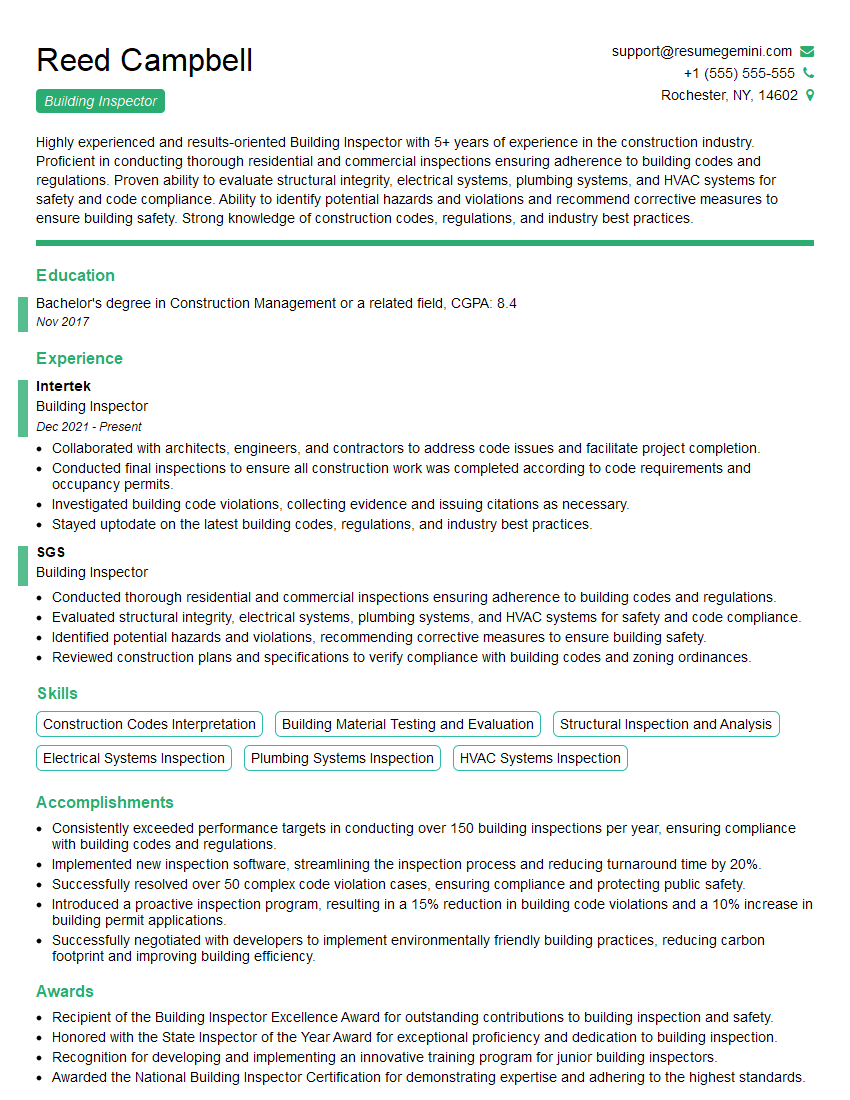
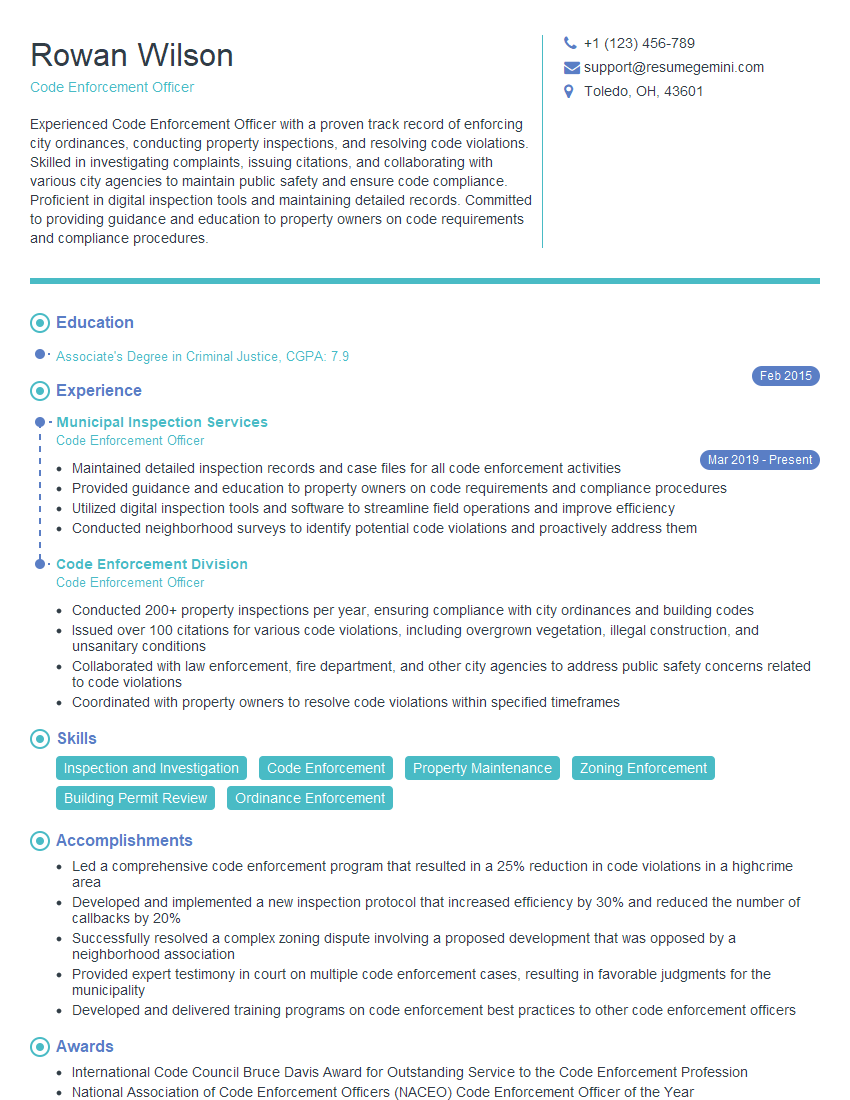
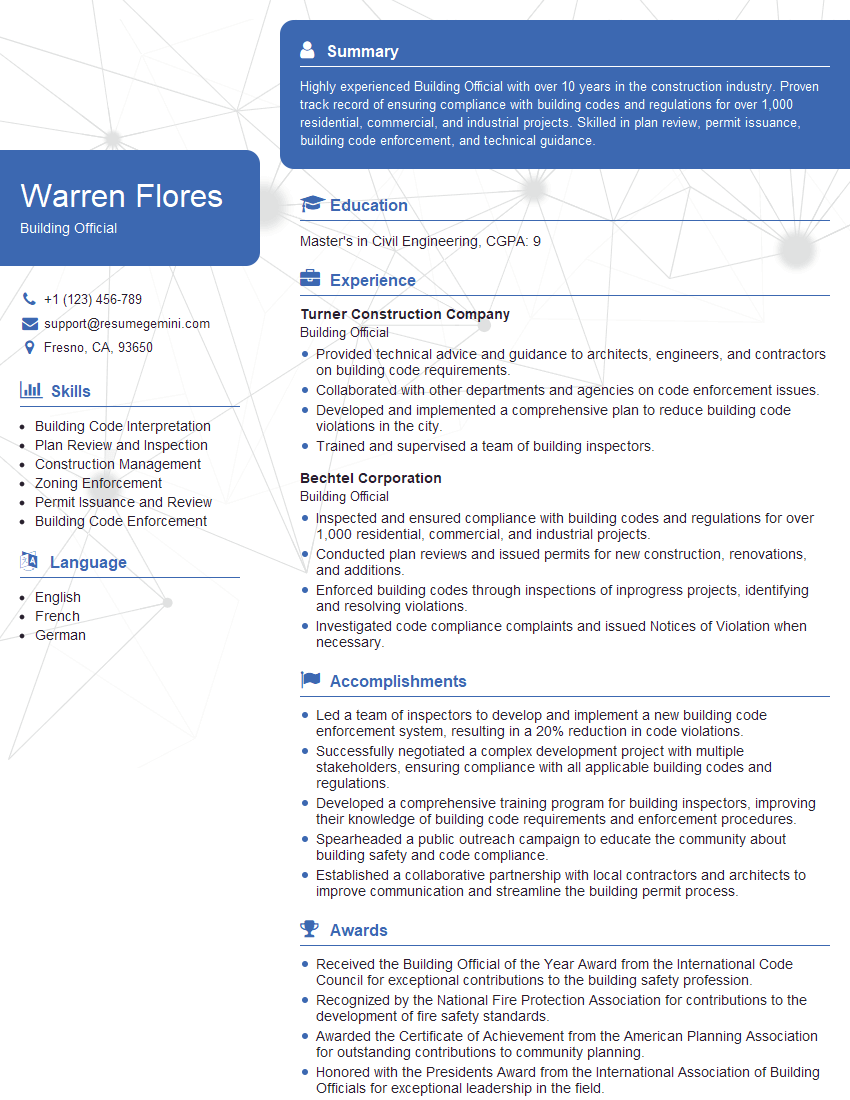
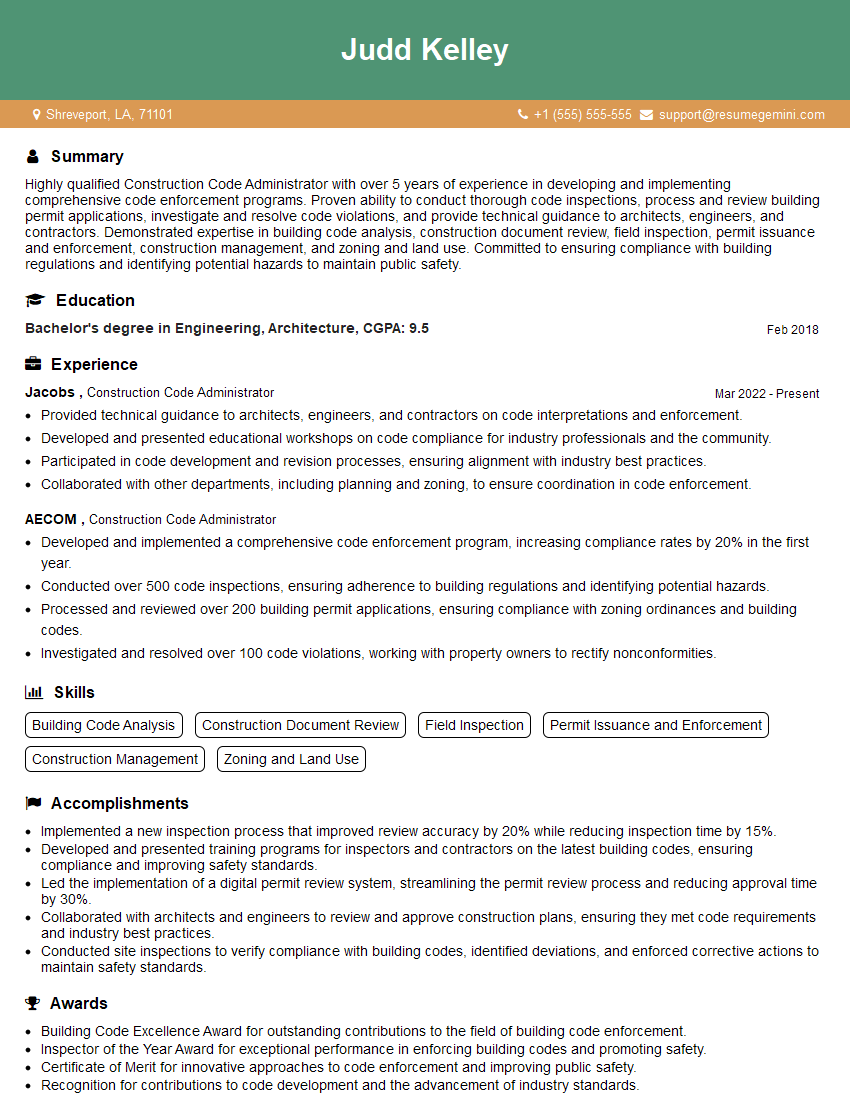
Mastering Construction Code Interpretation is crucial for career advancement in the construction industry. It demonstrates a commitment to safety, quality, and legal compliance, opening doors to senior roles and increased earning potential. To significantly boost your job prospects, create an ATS-friendly resume that highlights your skills and experience effectively. ResumeGemini is a trusted resource for building professional resumes, and we offer examples of resumes tailored to Construction Code Interpretation to help you showcase your expertise. Invest the time in crafting a strong resume – it’s your first impression with potential employers.
Explore more articles
Users Rating of Our Blogs
Share Your Experience
We value your feedback! Please rate our content and share your thoughts (optional).
What Readers Say About Our Blog
Very informative content, great job.
good