Interviews are opportunities to demonstrate your expertise, and this guide is here to help you shine. Explore the essential Cornering Skills interview questions that employers frequently ask, paired with strategies for crafting responses that set you apart from the competition.
Questions Asked in Cornering Skills Interview
Q 1. Explain the physics behind cornering forces.
Cornering forces are governed by physics principles, primarily Newton’s Laws of Motion. As a vehicle turns, several forces come into play. Centrifugal force pushes the vehicle outwards, away from the center of the turn. This is countered by the centripetal force, generated by the tires gripping the road surface. This grip is a combination of friction and the tires’ ability to generate lateral force. The greater the friction (dependent on tire compound, road surface, and tire pressure), the higher the centripetal force, allowing for tighter turns at higher speeds. Other forces at play include gravity, which affects weight transfer, and aerodynamic forces (downforce and drag), which become significant at higher speeds.
Imagine a ball on a string being swung in a circle. The string provides the centripetal force, preventing the ball from flying off. Similarly, the tires provide the centripetal force for a vehicle in a turn.
Q 2. Describe the relationship between tire pressure and cornering performance.
Tire pressure significantly impacts cornering performance. Proper inflation ensures the tire’s contact patch with the road is optimized. Underinflation leads to a larger contact patch, but the tire deforms excessively, reducing the stiffness and responsiveness, resulting in poor handling and reduced grip. Overinflation creates a smaller contact patch, providing less grip and making the tire more susceptible to skidding. The ideal tire pressure is usually specified by the vehicle manufacturer and should be checked regularly, taking into account factors such as temperature and load.
Think of it like a balloon. Under-inflated, it’s soft and doesn’t hold its shape well. Over-inflated, it’s hard and prone to bursting. Similarly, your tires need the right pressure for optimal performance.
Q 3. How does vehicle weight distribution affect cornering stability?
Vehicle weight distribution greatly influences cornering stability. An even weight distribution (50/50 front/rear) generally provides the best balance and predictability. However, many vehicles have a slight bias towards the front or rear. A rear-heavy distribution can lead to oversteer (the rear end stepping out), while a front-heavy distribution can cause understeer (the front end pushing wide). Weight transfer during cornering also plays a role; braking shifts weight to the front, while accelerating shifts it to the rear. This weight shift can exacerbate existing handling imbalances.
Imagine a seesaw. If most of the weight is on one side, it’s difficult to balance. Similarly, uneven weight distribution affects a vehicle’s stability and cornering ability.
Q 4. What is the concept of ‘apex’ in cornering, and why is it important?
The apex is the point where the vehicle is closest to the inside of a turn. Selecting and hitting the apex correctly is crucial for maximizing speed and efficiency through a corner. Early apexing (hitting the apex too soon) results in a wider turning radius and reduces speed. Late apexing leads to a tighter radius and potentially exceeding the vehicle’s grip limits. The ideal apex depends on the corner’s characteristics (radius, banking, surface conditions), and the driver’s skill and the vehicle’s capabilities.
Think of it as the ‘sweet spot’ of the turn – finding the ideal path to minimize the time and distance taken to navigate the turn.
Q 5. Explain the difference between understeer and oversteer.
Understeer and oversteer are two common forms of vehicle handling loss. Understeer is when the front wheels lose grip and the vehicle continues to travel in a straighter line than the steering input indicates; the front end ‘pushes wide’. Oversteer is when the rear wheels lose grip and the vehicle rotates around its vertical axis; the rear end ‘steps out’. Understeer is generally considered safer than oversteer, as it’s easier to correct. Oversteer can be more abrupt and challenging to recover from, potentially resulting in a spin.
Imagine pushing a shopping cart around a corner. If the front wheels slip, it’s understeer. If the back wheels slip, it’s oversteer.
Q 6. How do you correct for understeer and oversteer?
Correcting for understeer and oversteer requires quick, smooth, and precise actions. For understeer, ease off the throttle, straighten the steering wheel slightly, and then gently steer back into the turn once grip is regained. Avoid jerky inputs. For oversteer, ease off the throttle or brake (depending on the severity), steer in the direction of the skid, and smoothly counter steer as the vehicle stabilizes. Proper vehicle setup (tire pressures, alignment) and driving techniques significantly improve your ability to manage these situations.
Remember, smooth and controlled inputs are key to maintaining control in both understeer and oversteer situations. Panic often exacerbates the problem.
Q 7. Describe different cornering techniques (e.g., trail braking, weight transfer).
Several cornering techniques aim to optimize speed and control. Trail braking involves gently applying the brakes while turning into a corner, transferring weight to the front and aiding in turn-in. Weight transfer is a natural phenomenon where forces shift the car’s weight during acceleration, braking, and cornering. Understanding weight transfer is crucial for optimizing cornering performance; for example, braking before entering a turn shifts weight to the front, improving front-end grip. Smooth inputs and precise steering are essential. Other techniques include late apexing (for tighter turns), early apexing (for wider turns), and using the accelerator progressively to power out of the corner.
These techniques, combined with understanding the vehicle’s limits, help drivers maintain control and speed throughout a corner. It’s like a dance – a harmonious balance of steering, braking, and acceleration.
Q 8. How does suspension setup influence cornering performance?
Suspension setup is crucial for cornering performance because it dictates how the vehicle interacts with the road surface during turns. A well-tuned suspension allows for optimal tire contact, maximizing grip and minimizing body roll. Think of it like this: the suspension is the shock absorber, controlling the vehicle’s movements.
- Spring Rates: Stiffer springs reduce body roll but can make the ride harsher and less comfortable. Softer springs provide a smoother ride but can lead to excessive body roll, reducing cornering stability. The ideal spring rate depends on the vehicle, driving style, and track conditions.
- Dampers (Shocks): Dampers control the rebound and compression of the suspension, preventing excessive bouncing and oscillations. Properly adjusted dampers help maintain tire contact and consistent handling during cornering, preventing the tires from losing grip.
- Anti-roll bars (explained further in the next question): These affect the balance between front and rear suspension, influencing how much the vehicle leans during cornering.
- Ride Height: Lowering the ride height generally improves handling by lowering the center of gravity and reducing body roll. However, it can also reduce ground clearance and negatively impact ride comfort.
For example, a race car might have extremely stiff springs and highly tuned dampers to minimize body roll and maximize grip during high-speed cornering, whereas a family sedan prioritizes ride comfort over extreme handling.
Q 9. Explain the role of anti-roll bars in cornering.
Anti-roll bars, also known as sway bars, connect the suspension on opposite sides of the vehicle. Their primary function is to reduce body roll during cornering. Imagine them as a physical link that resists the tilting of the vehicle.
When cornering, the suspension on the outside of the turn compresses, while the suspension on the inside extends. The anti-roll bar resists this difference in suspension travel, reducing body roll and thus maintaining better tire contact and improving cornering grip. A stiffer anti-roll bar reduces roll more effectively but can make the ride less compliant.
The stiffness of the anti-roll bar is adjustable in many vehicles, allowing for tuning to suit different driving styles and track conditions. For instance, a stiffer front anti-roll bar can improve front-end grip during cornering, while a softer rear anti-roll bar can improve rear-end stability.
Q 10. What is the effect of tire camber on cornering grip?
Tire camber refers to the angle of the tire relative to the vertical axis when viewed from the front or rear of the vehicle. Positive camber means the top of the tire is tilted outwards, while negative camber means the top is tilted inwards.
Negative camber is generally preferred for cornering because it increases the contact patch of the tire during cornering, particularly in high-speed turns. As the car leans into a turn, the negative camber helps keep the tire more perpendicular to the road surface. This increased contact area leads to greater grip and improved cornering ability.
However, too much negative camber can lead to uneven tire wear and reduced straight-line stability. The optimal camber angle is a compromise between cornering grip and tire wear, and it often depends on the vehicle’s design and intended use.
Q 11. How does tire tread pattern influence cornering performance?
Tire tread pattern significantly influences cornering performance by affecting water drainage, grip, and stability. Different patterns are optimized for different conditions.
- Water Drainage: Wider circumferential grooves provide better water drainage, reducing the risk of hydroplaning, especially important during wet cornering.
- Grip: The design and number of sipes (small grooves) in the tread blocks impact grip levels. More sipes generally mean increased grip on dry surfaces, while fewer can offer better durability.
- Stability: Tread pattern can influence the consistency of grip across the tire’s contact patch, affecting cornering stability and predictability.
For example, a high-performance summer tire might have a directional tread pattern with many sipes for maximum grip in dry conditions, while an all-season tire might prioritize water drainage with wider circumferential grooves.
Q 12. Explain the concept of yaw, pitch, and roll in relation to cornering.
Yaw, pitch, and roll are rotational movements of a vehicle, significantly impacting cornering.
- Yaw: This is rotation around a vertical axis. In cornering, yaw refers to the car’s rotation around its center of gravity as it turns. Excessive yaw can lead to oversteer or understeer.
- Pitch: This is rotation around a lateral axis (side-to-side). Pitch primarily happens during acceleration or braking, affecting weight transfer and potentially influencing cornering stability.
- Roll: This is rotation around a longitudinal axis (front to back). Roll is the tilting of the vehicle during cornering, caused by centrifugal force. Excessive roll reduces tire contact and grip, negatively impacting cornering ability.
Understanding these movements helps drivers anticipate vehicle behavior and adjust their inputs (steering, throttle, brakes) accordingly to maintain control during cornering. For example, excessive yaw might require counter-steering to correct the trajectory.
Q 13. Describe the importance of driver vision in cornering.
Driver vision is paramount for safe and effective cornering. It allows the driver to anticipate upcoming hazards, plan their line through the turn, and accurately judge the car’s position and speed. Poor visibility dramatically reduces a driver’s reaction time and ability to control the car safely.
Looking far ahead allows for early recognition of upcoming turns, obstacles, and changing road conditions. Maintaining a clear view of the apex (the point of the turn closest to the inside) helps determine the optimal racing line and allows for smoother transitions.
Effective scanning, including checking mirrors and blind spots, is also critical for anticipating the actions of other vehicles, preventing collisions, and making informed decisions during cornering maneuvers. For example, a driver who fails to see another car approaching quickly might have insufficient time to adjust their cornering speed and path, increasing the risk of an accident.
Q 14. How does braking affect cornering stability?
Braking significantly affects cornering stability, primarily through weight transfer and its effect on tire grip. Hard braking during a turn shifts weight heavily to the front wheels, reducing grip on the rear wheels. This can lead to oversteer (the rear of the car sliding out).
Conversely, braking too heavily in a high-speed corner can lock up the front wheels, resulting in loss of steering control and a potentially dangerous situation. The ideal braking technique in a corner is to brake firmly *before* the turn to maximize the available grip throughout the corner. Progressive braking throughout the turn, if necessary, should also be done smoothly to minimize disturbances and maintain optimal tire contact.
The technique of trail braking, where a small amount of braking is maintained during the turn, is often used by experienced drivers to fine-tune the car’s entry and balance the weight distribution for better turn-in and tighter cornering.
Q 15. What is the effect of throttle application during cornering?
Throttle application during cornering significantly impacts vehicle stability and cornering speed. Applying throttle too aggressively can cause wheelspin, especially in lower-grip situations, leading to loss of control and a wider turning radius. Conversely, lifting off the throttle completely can transfer weight to the front wheels, improving steering response but potentially causing understeer (where the car continues straight despite steering input). The optimal throttle application depends on several factors including vehicle dynamics, tire grip, road surface, and corner speed. A smooth and progressive application of throttle is generally preferred to maintain control and optimal trajectory.
For example, imagine navigating a fast corner in a rear-wheel-drive car. Aggressive throttle application can cause the rear wheels to lose traction, leading to a potentially dangerous oversteer situation (where the rear of the car slides out). A more controlled approach, gradually applying throttle as the car exits the corner, will ensure better stability and faster overall lap times.
Career Expert Tips:
- Ace those interviews! Prepare effectively by reviewing the Top 50 Most Common Interview Questions on ResumeGemini.
- Navigate your job search with confidence! Explore a wide range of Career Tips on ResumeGemini. Learn about common challenges and recommendations to overcome them.
- Craft the perfect resume! Master the Art of Resume Writing with ResumeGemini’s guide. Showcase your unique qualifications and achievements effectively.
- Don’t miss out on holiday savings! Build your dream resume with ResumeGemini’s ATS optimized templates.
Q 16. Explain the concept of centrifugal force in cornering.
Centrifugal force is the apparent outward force that acts on a body moving in a circular path. In cornering, as a vehicle navigates a bend, it experiences this outward force pulling it away from the center of the turn. It’s crucial to understand that centrifugal force isn’t a real force in the same way gravity is; it’s a result of inertia – the tendency of an object to resist changes in its state of motion. The car wants to continue in a straight line, but the steering and tires force it to change direction. This resistance manifests as the sensation of being pushed outwards.
Think of spinning a ball on a string. The string provides the centripetal force (inward force) that keeps the ball moving in a circle. The outward force you feel is the centrifugal force, a consequence of the ball’s inertia trying to continue in a straight line. In a car, the tires provide the centripetal force, gripping the road and overcoming the centrifugal force to maintain the turn.
Q 17. How do you analyze cornering data (e.g., telemetry)?
Analyzing cornering data from telemetry involves a systematic approach. I typically start by examining key parameters such as:
- Speed: Identifying speed fluctuations before, during, and after the corner helps assess braking, cornering, and acceleration performance.
- Steering Angle: This reveals the driver’s steering inputs and can highlight inconsistencies or areas for improvement.
- Lateral Acceleration (g-force): This is a measure of how hard the car is being pushed sideways during the corner. High g-forces indicate a high cornering speed and close proximity to the grip limit.
- Longitudinal Acceleration: This helps assess throttle and braking application effectiveness.
- Yaw Rate: This is the rate at which the car is rotating around its vertical axis. Sudden changes in yaw rate often indicate instability or errors in driver input.
By overlaying these parameters on a track map, I can identify specific areas where improvements can be made. For instance, if a driver is braking too late into a corner, it will be evident in the speed and braking data. Furthermore, the analysis helps in optimizing the car’s setup to improve its handling characteristics in specific sections of the track.
Q 18. Describe your experience with different cornering scenarios (e.g., high-speed, low-speed).
My experience encompasses a wide range of cornering scenarios. In high-speed corners, precision in braking, steering, and throttle control is paramount. The focus is on maintaining vehicle stability at high lateral g-forces while maximizing speed. This often involves precise weight transfer and smooth inputs to avoid exceeding the grip limits. I’ve worked extensively with race cars in high-speed corners, learning to anticipate the car’s behaviour and adjust driving inputs according to the track’s characteristics.
Low-speed cornering presents different challenges. Here, accuracy and precision in steering inputs are vital for navigating tight turns and avoiding obstacles. Smoothness remains critical; jerky inputs can lead to instability, especially in cars with limited steering response. I have experience driving in various challenging conditions, such as navigating tight chicanes in rally events and precise low-speed maneuvers in congested city environments. These experiences have honed my ability to adapt to diverse scenarios.
Q 19. How do you assess the limits of grip during cornering?
Assessing grip limits is crucial for safe and fast cornering. This involves paying close attention to the car’s behavior. Several indicators point towards approaching the grip limits:
- Tire Slip Angle: Increased tire slip angle is a major indicator. This means the tires are starting to lose grip and the car is sliding. This can be felt by loss of steering responsiveness and a feeling of the vehicle becoming looser.
- Loss of Steering Responsiveness: The car’s responsiveness to steering inputs decreases as grip limits are approached.
- Wheelspin or Lockup: These are clear signs of exceeding the limits of grip under acceleration or braking respectively.
- Body Roll/Pitch: Excessive body roll and pitch demonstrate nearing the car’s limit of grip.
Experienced drivers learn to read these subtle cues and adjust their driving style accordingly to prevent losing control. Techniques like progressive braking, trail braking, and controlled throttle application help maintain control even near the grip limit. Regular practice and feedback are essential in refining the ability to discern this critical threshold.
Q 20. Explain the importance of smooth steering inputs in cornering.
Smooth steering inputs are fundamental for efficient and safe cornering. Abrupt steering movements can upset the car’s balance, causing oversteer or understeer, potentially leading to loss of control. Smooth inputs allow the car to respond progressively, making it easier to maintain the intended trajectory and maximizing grip. This applies to both entry and exit of corners.
Imagine turning a large ship versus a small motorboat. A small, jerky turn in the motorboat would be manageable, but the same jerky motion in the large ship could cause significant instability and loss of control. In the same way, smooth steering in a car allows for predictable and controlled behavior, even near the grip limits.
Q 21. How do you adapt your cornering technique to varying road conditions?
Adapting to varying road conditions is essential for safe and effective cornering. The approach changes based on surface type and condition:
- Wet Roads: Reduced grip necessitates slower cornering speeds, smoother steering inputs, and a more progressive application of both throttle and brakes. Early braking and reduced speed are crucial.
- Dry Roads: High grip allows for faster cornering speeds, and more aggressive driving styles can be employed (while remaining within safety limits).
- Uneven Surfaces: Varying road conditions such as bumps, potholes and gravel require careful adjustment of car control. This usually means reduced speed and smoother inputs to maintain vehicle stability and avoid losing control.
- Low Grip Surfaces (Gravel, Snow, Ice): Cornering strategies here prioritize maintaining control above speed. Smooth, progressive inputs are vital, and anticipating traction changes is crucial.
Experienced drivers constantly assess road conditions and adjust their driving style accordingly. This involves proactive adjustments to braking, acceleration, and steering techniques to maintain safety and efficiency.
Q 22. What are the safety considerations when cornering at high speeds?
High-speed cornering demands meticulous attention to safety. The primary risks are loss of control leading to skidding or a rollover, and collision with obstacles or other vehicles. Several factors contribute to these risks.
- Speed: Exceeding the safe speed limit for a given corner drastically increases the centrifugal force, making it much harder to maintain control. Think of it like spinning a weight on a string – the faster you spin it, the harder you have to pull to keep it from flying off.
- Road Conditions: Wet, icy, or loose surfaces significantly reduce tire grip, making it easier to lose traction and control. This is especially true in corners where lateral forces are already high.
- Vehicle Condition: Properly inflated tires, well-maintained suspension, and effective brakes are critical. Worn tires or faulty suspension components will dramatically reduce your ability to control the vehicle’s trajectory and stability during high-speed cornering.
- Driver Factors: Fatigue, distraction, and impairment drastically reduce reaction time and decision-making abilities, which are crucial in emergency situations during high-speed cornering.
Mitigating these risks requires careful planning, appropriate speed selection, and proactive driving. Always assess the corner before approaching it, checking for visibility, surface conditions, and potential hazards.
Q 23. How do you adjust cornering techniques for different vehicles?
Cornering techniques need to be adapted based on several vehicle characteristics. The key differences lie in factors like weight distribution, center of gravity, tire characteristics, and steering responsiveness.
- Weight and Center of Gravity: Heavier vehicles, or those with a higher center of gravity (like SUVs), require smoother, more gradual inputs to avoid inducing excessive body roll and loss of control. Lighter, lower vehicles can generally handle sharper turns with more aggressive steering.
- Tire Characteristics: Wider tires provide more grip, allowing for faster cornering speeds. However, even with wide tires, exceeding the limits of adhesion will lead to understeer or oversteer. Different tire compounds also affect grip levels.
- Steering Responsiveness: Some vehicles have quicker, more sensitive steering, requiring more precise inputs. Others may require more steering wheel movement to achieve the same turning radius. Understanding this characteristic is vital for smooth, controlled cornering.
- Suspension: Different suspension designs impact the vehicle’s handling characteristics. A stiffer suspension will allow for more aggressive cornering, but it will also be harsher and less comfortable on rough surfaces. A softer suspension will provide a smoother ride but compromises handling at high speeds.
Experience with different types of vehicles, from nimble sports cars to larger trucks, builds the adaptability necessary to adjust techniques effectively. I’ve driven everything from a nimble Miata to a heavy-duty pickup truck, and each requires a distinct approach to ensure safe and efficient cornering.
Q 24. Describe your experience with advanced driver-assistance systems related to cornering.
My experience with advanced driver-assistance systems (ADAS) related to cornering has been largely positive, though it’s critical to remember they are aids, not replacements for driver skill. Systems like Electronic Stability Control (ESC) and traction control are invaluable in preventing skids and maintaining stability, particularly in challenging conditions. They intervene subtly, often without the driver even noticing, by applying brakes selectively or reducing engine power. I’ve personally witnessed ESC preventing a potentially dangerous spin-out on a wet road during a high-speed turn.
Lane keeping assist can be helpful in alerting drivers of unintentional lane drifting during corners, providing an extra layer of safety especially during long, monotonous drives. However, it is vital to understand the limitations of such systems. They are not designed to handle extreme cornering situations, and over-reliance can be dangerous. It’s crucial to maintain situational awareness and not become complacent.
Q 25. Explain the role of aerodynamics in high-speed cornering.
Aerodynamics play a significant role in high-speed cornering, particularly for high-performance vehicles. Downforce, generated by aerodynamic elements like spoilers and diffusers, increases the grip of the tires by pressing the car down onto the road surface. This is essential for maintaining control at high speeds, especially when dealing with the substantial lateral forces generated during cornering. Think of it as adding extra weight to keep the car glued to the road.
Conversely, lift, which is the upward force generated by air flowing under the vehicle, can reduce grip and destabilize the car. Careful aerodynamic design minimizes lift and maximizes downforce to improve cornering performance and high-speed stability. This is evident in the design of racing cars, where aerodynamics are meticulously optimized to achieve maximum downforce.
Q 26. How do you prioritize safety and speed when cornering?
Prioritizing safety and speed in cornering is a delicate balance. Safety should always be paramount. While speed contributes to the thrill of driving, pushing beyond the limits of safe cornering is reckless and can have severe consequences.
My approach prioritizes a proactive and defensive driving style. This involves careful pre-corner assessment, selecting an appropriate speed well below the theoretical maximum for the conditions, smooth steering and braking inputs, and maintaining constant awareness of surrounding vehicles and environmental factors. It’s about optimizing speed within the boundaries of safety, not sacrificing safety for speed. Speed is a byproduct of safe cornering techniques, not the goal itself.
Q 27. Describe your experience with simulating cornering performance.
I have extensive experience simulating cornering performance using various software packages, including vehicle dynamics simulation tools. These tools allow me to model the behavior of vehicles under various conditions, testing different parameters like tire characteristics, suspension tuning, and aerodynamic configurations to optimize cornering performance. This involves building detailed mathematical models of the vehicle’s behavior and using them to predict how it will perform in different scenarios.
Example: A typical simulation might involve inputting parameters such as vehicle mass, center of gravity, tire stiffness, and aerodynamic coefficients. The simulation would then calculate the forces acting on the vehicle during cornering and predict its trajectory, speed, and tire slip angles. This data is invaluable for improving vehicle design and driver training.
Q 28. How would you train a novice driver in safe cornering techniques?
Training a novice driver in safe cornering techniques starts with foundational principles, emphasizing progressive skill development. I would begin with:
- Classroom Instruction: Covering theoretical concepts like centrifugal force, friction, and tire grip, explaining how these factors influence cornering behavior.
- Controlled Environment Practice: Starting with low-speed practice in a large, empty parking lot. This allows the learner to get comfortable with steering inputs, braking, and vehicle response at a low-risk setting.
- Progressive Speed Increase: Gradually increasing speeds as the learner demonstrates competency and control. Regular feedback and adjustments to techniques based on observed performance are crucial.
- Different Corner Types: Introducing different types of corners (e.g., constant radius, decreasing radius, banked corners) to develop adaptability.
- Emergency Maneuvers: Practice avoiding obstacles at various speeds, simulating unexpected scenarios to hone reaction time and control.
- Real-World Application: Guiding supervised practice on low-traffic roads, gradually progressing to more challenging environments only after demonstrating competence and adherence to safety protocols.
Emphasis throughout the training is placed on smooth, controlled inputs, maintaining awareness of surroundings, and respecting speed limits. Regular feedback and reinforcement of correct techniques are vital for building confidence and competency.
Key Topics to Learn for Cornering Skills Interview
- Understanding Cornering Dynamics: Grasping the physics behind cornering, including forces like friction, centripetal force, and gravity’s influence.
- Vehicle Dynamics and Control: Analyzing how steering, braking, and throttle input affect a vehicle’s trajectory during cornering. This includes understanding concepts like oversteer and understeer.
- Line Selection and Trajectory Planning: Developing strategies for choosing optimal racing lines and predicting vehicle behavior throughout a turn.
- Advanced Techniques: Exploring advanced cornering techniques like trail braking, weight transfer management, and apexing for optimal speed and control.
- Practical Application: Discussing real-world scenarios where precise cornering skills are crucial, such as emergency maneuvers or performance driving.
- Problem-Solving in Cornering: Analyzing situations where unexpected events (e.g., adverse weather, track irregularities) impact cornering and outlining effective solutions.
- Data Analysis and Optimization: Understanding how telemetry data can be used to analyze cornering performance and identify areas for improvement.
Next Steps
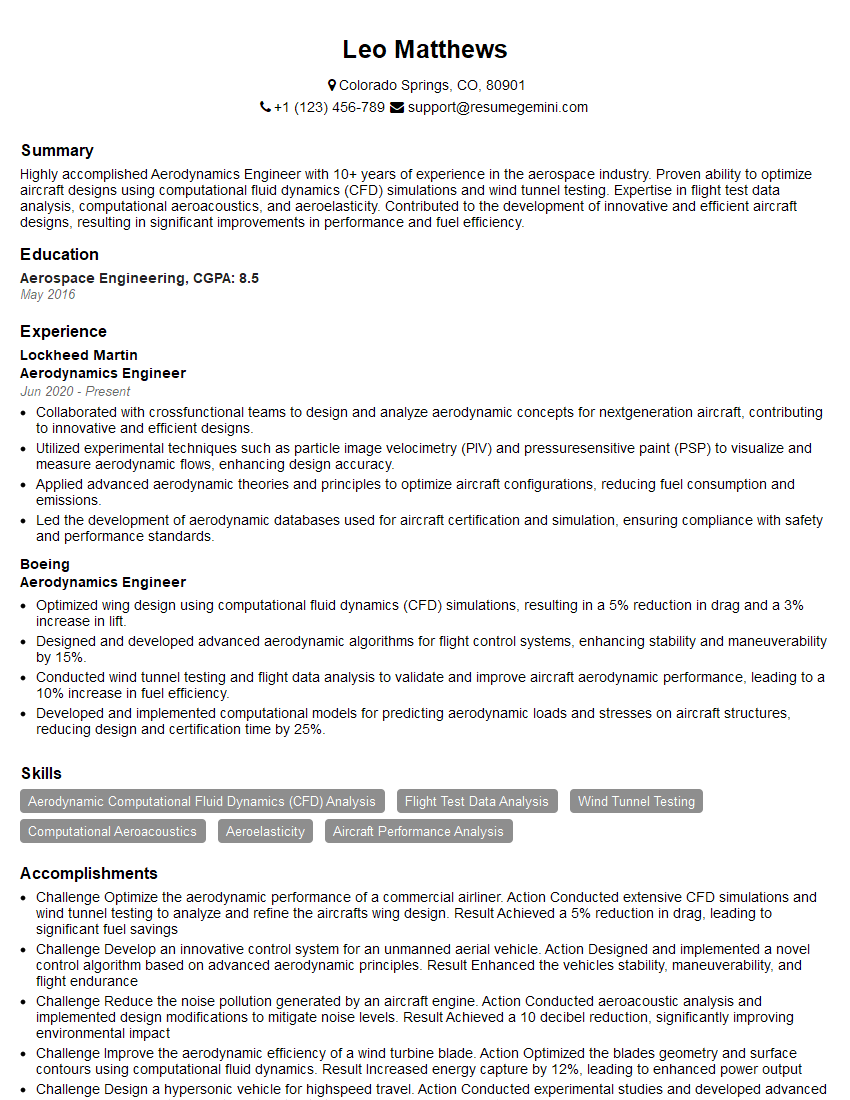
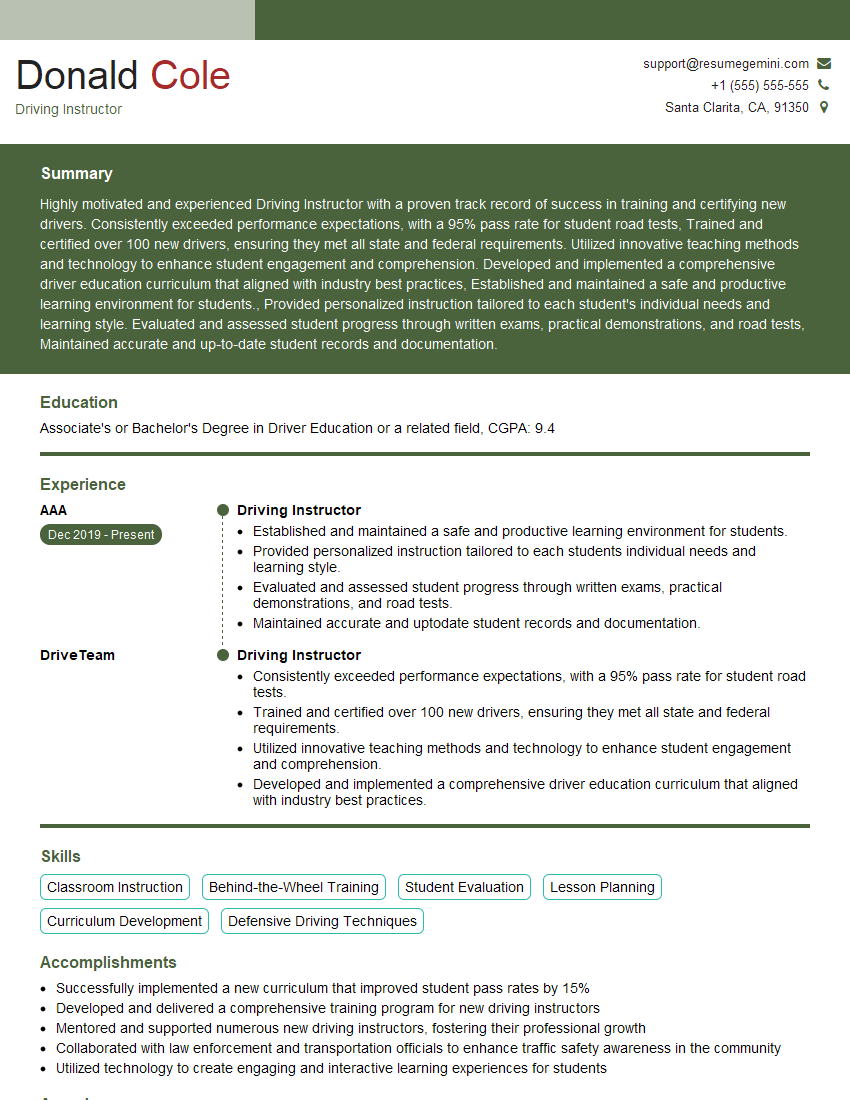
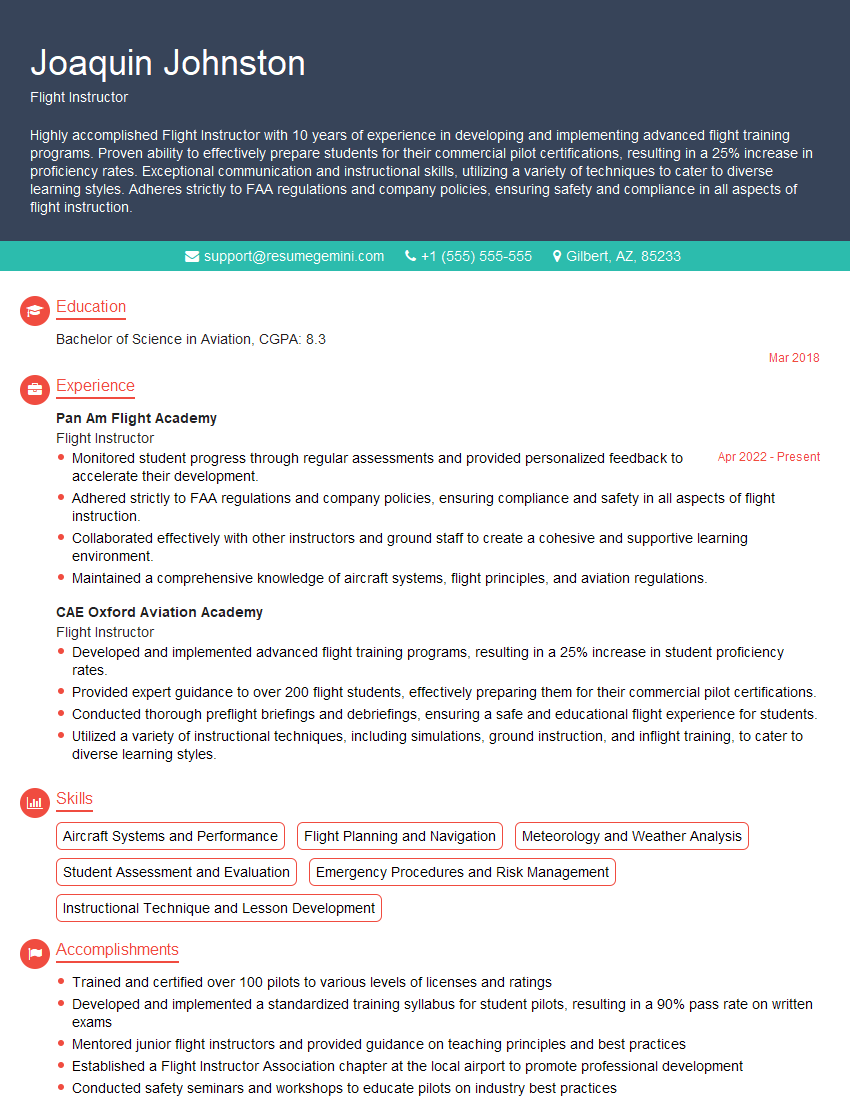
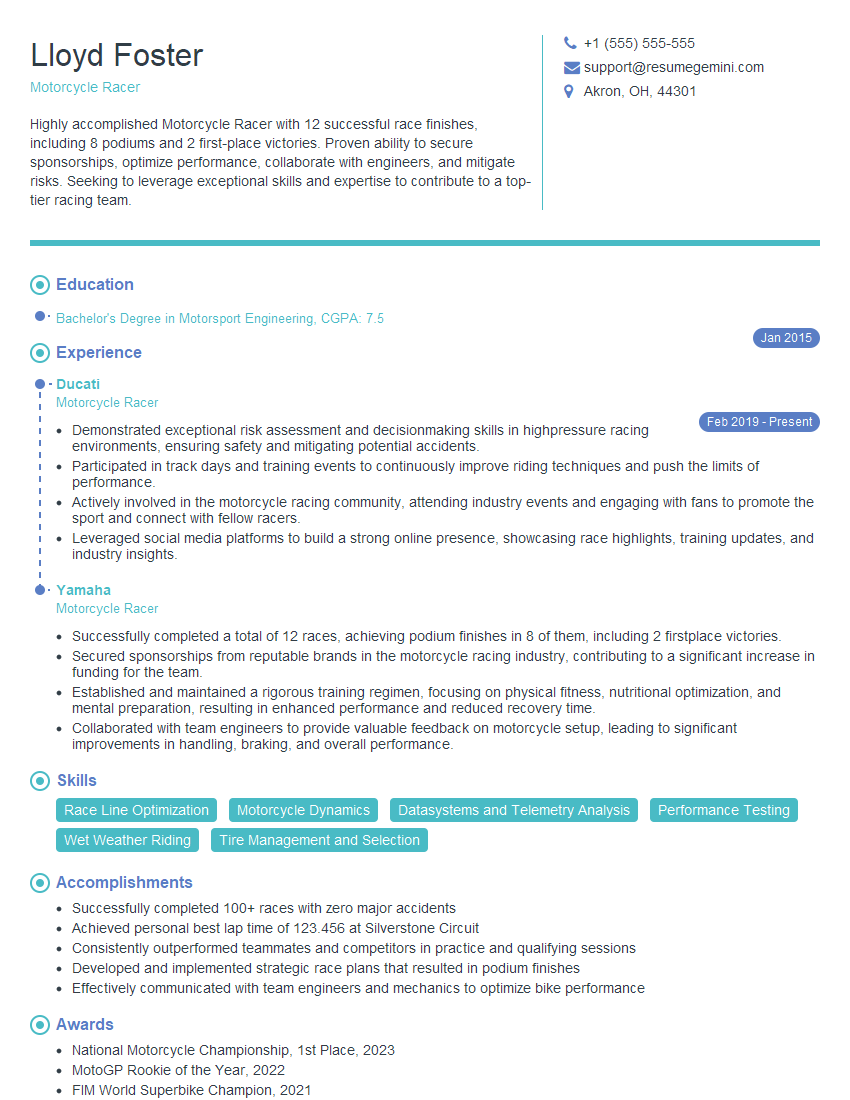
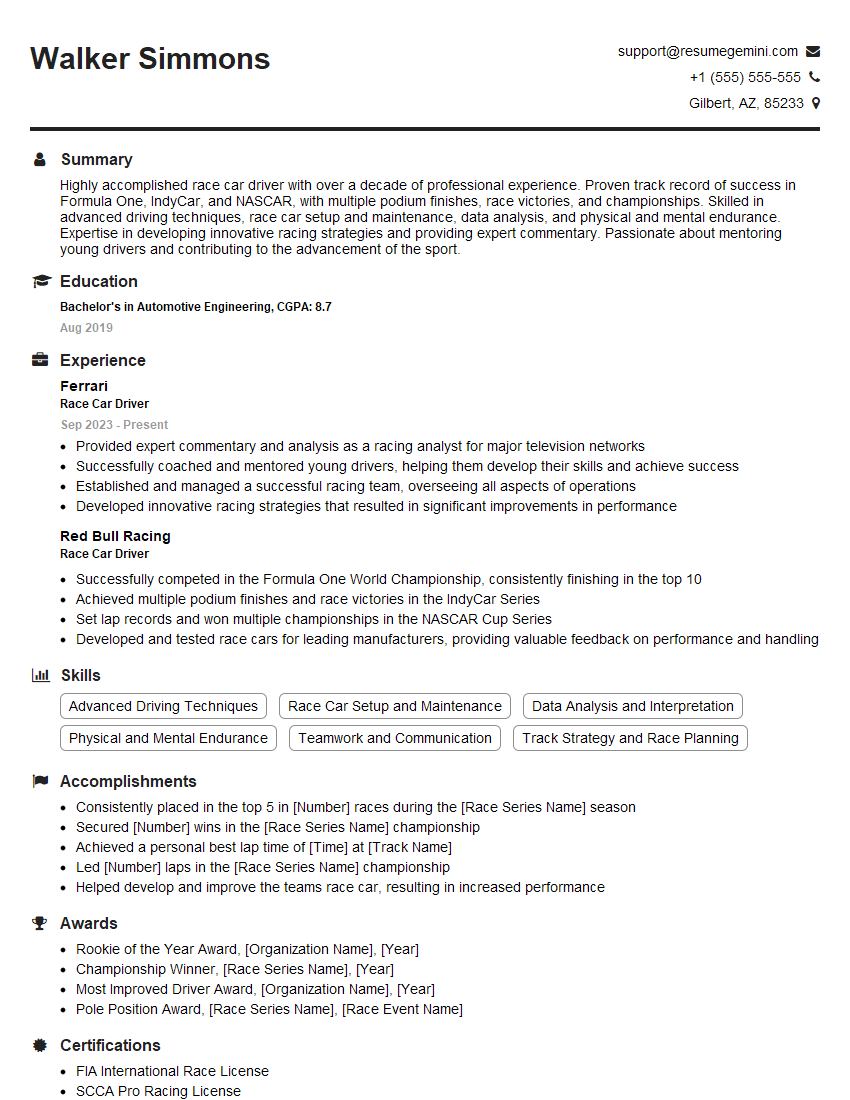
Mastering cornering skills is paramount for career advancement in fields demanding precision and control, from motorsports engineering to advanced driver-assistance systems development. A strong understanding of these principles demonstrates your technical expertise and problem-solving abilities. To significantly boost your job prospects, it’s crucial to craft an ATS-friendly resume that showcases your skills effectively. ResumeGemini is a trusted resource to help you build a professional and impactful resume that highlights your expertise in Cornering Skills. Examples of resumes tailored to Cornering Skills are available to provide you with a practical guide. Take the next step towards your dream career by investing in your resume presentation.

Explore more articles
Users Rating of Our Blogs
Share Your Experience
We value your feedback! Please rate our content and share your thoughts (optional).
What Readers Say About Our Blog
Very informative content, great job.
good