Feeling uncertain about what to expect in your upcoming interview? We’ve got you covered! This blog highlights the most important Cornice Installation interview questions and provides actionable advice to help you stand out as the ideal candidate. Let’s pave the way for your success.
Questions Asked in Cornice Installation Interview
Q 1. What types of materials are commonly used for cornice installation?
Cornices come in a variety of materials, each offering unique aesthetic and practical qualities. The most common include:
- Polyurethane: Lightweight, durable, and easy to work with, polyurethane is a popular choice for its affordability and resistance to moisture. It’s perfect for intricate designs.
- Polystyrene (or Styrofoam): Another lightweight option, polystyrene is less expensive than polyurethane but can be more fragile. It’s best suited for simpler designs.
- Wood: Offers a classic, luxurious look and feel. Wood cornices are more expensive and require more skill to install, but they can last for decades with proper care. Different wood types, like pine or oak, will impact cost and durability.
- Plaster: Traditional and elegant, plaster cornices are highly durable but require skilled craftsmanship for both creation and installation. They are heavier and more prone to damage than lighter materials.
- Wood Composites: Engineered materials combine wood fibers with resins or polymers, providing a balance between strength, workability, and cost.
The choice of material often depends on the budget, desired aesthetic, and the complexity of the design.
Q 2. Describe your experience with different cornice installation methods.
My experience encompasses various cornice installation methods, from simple adhesive applications to more complex techniques involving mechanical fixings.
- Adhesive Installation: This is the most common method for lightweight materials like polyurethane and polystyrene. I’m adept at selecting the right adhesive for the substrate (e.g., drywall, plaster) and the cornice material, ensuring a strong and lasting bond. Proper surface preparation is crucial for success.
- Mechanical Fixing: For heavier cornices, particularly wood or plaster, mechanical fixings – such as screws, nails, or specialized cornice clips – are essential for secure installation. This method requires precision and careful planning to avoid damaging the cornice or the wall.
- Combination Methods: Often, a combination of adhesive and mechanical fixing provides the best results, especially for larger or more intricate designs. The adhesive provides initial support while the mechanical fixings offer long-term stability and prevent sagging.
I’ve worked with various adhesive types, from construction adhesive to specialized cornices adhesives formulated for optimal adhesion and drying time. Experience has taught me the importance of meticulous surface preparation to achieve optimal results. I always consider the specific characteristics of each material and its weight when selecting the installation method.
Q 3. How do you measure and cut cornice accurately?
Accurate measurement and cutting are fundamental to a successful cornice installation. My approach involves a systematic process:
- Thorough Measurement: I use a measuring tape to carefully measure the length of the wall or ceiling section where the cornice will be installed, accounting for any irregularities or angles.
- Marking and Transferring Measurements: I accurately mark the measurements on the cornice material, using a pencil and a straight edge. For complex designs, I might create templates from cardboard to ensure accurate cutting.
- Precise Cutting: I employ a miter saw for precise cuts, particularly for achieving accurate 45-degree angles at corners. A sharp blade is critical for clean cuts. For intricate designs or curves, I may use a coping saw or jigsaw. I always double-check the angles before making final cuts.
- Test Fitting: Before installing, I always perform a test fit to verify the accuracy of the cuts and the overall fit of the cornice. This step saves time and prevents costly mistakes.
I find that taking extra time with measuring and cutting minimizes errors and ultimately leads to a superior finished product. The quality of the cuts directly influences the final aesthetic appeal and the overall success of the installation.
Q 4. What tools and equipment are essential for cornice installation?
The right tools significantly impact the efficiency and quality of cornice installation. Essential tools include:
- Measuring Tape: Accurate measurements are critical.
- Pencil and Straight Edge: For marking and transferring measurements.
- Miter Saw: For precise angled cuts.
- Coping Saw or Jigsaw: For intricate cuts and curves.
- Utility Knife or Cutting Mat: For trimming and adjustments.
- Caulk Gun: For applying adhesive.
- Putty Knife or Spatula: For smoothing adhesive.
- Level: To ensure even installation.
- Safety Glasses and Gloves: For personal protection.
- Drill (with appropriate bits): For mechanical fixing.
- Measuring Square: To ensure accurate angles.
In addition to these, specialized tools like cornice clips or adhesive applicators can improve efficiency and precision. Maintaining sharp blades and clean tools is essential for maintaining accuracy and producing clean cuts.
Q 5. Explain the process of installing a complex cornice design.
Installing a complex cornice design requires meticulous planning and execution. The process usually involves:
- Detailed Design Review: Carefully study the design to understand its intricacies, including curves, angles, and any decorative elements.
- Template Creation: If necessary, create precise templates from cardboard or other suitable material to guide cutting and ensure accurate fitting.
- Strategic Sectioning: Break down the complex design into smaller, manageable sections for easier handling and installation.
- Precise Cutting and Fitting: Use appropriate cutting tools and techniques to achieve accurate cuts and perfect alignment of all sections.
- Sequential Installation: Install the sections in a logical order, starting with the central pieces and then working towards the ends.
- Adhesive Application: Apply a generous, even bead of adhesive to the back of each section, ensuring complete contact with the wall or ceiling.
- Temporary Support: Use supports (e.g., wedges or clamps) to hold the sections in place until the adhesive fully sets.
- Finishing: Once the adhesive has cured, apply caulk to fill any gaps or seams, and then paint or finish as needed.
Experience is vital in managing the intricacies of complex cornice designs. Planning and preparation are key to success in these installations.
Q 6. How do you ensure proper adhesion and stability of cornice?
Proper adhesion and stability are paramount for a long-lasting cornice installation. Several strategies ensure this:
- Surface Preparation: Thoroughly clean the surface to remove dust, debris, and any loose material. This creates optimal adhesion. For porous surfaces, a primer may be necessary.
- Appropriate Adhesive: Select a high-quality adhesive suitable for both the cornice material and the substrate. Follow the manufacturer’s instructions carefully.
- Even Adhesive Application: Apply a generous but even layer of adhesive to the back of the cornice. Avoid excessive adhesive, which can cause drips or mess.
- Firm Pressure and Support: Apply firm, even pressure to the cornice, holding it in place until the adhesive begins to set. Use supports or clamps if needed, especially for longer or heavier pieces.
- Mechanical Fasteners (if needed): For larger or heavier cornices, supplementing with mechanical fasteners (screws, nails, clips) provides additional stability and security.
- Proper Curing Time: Allow sufficient time for the adhesive to fully cure before applying any further finishing touches.
A well-installed cornice should be firmly secured and exhibit no signs of sagging or instability.
Q 7. What are the common challenges faced during cornice installation?
Several challenges can arise during cornice installation. These include:
- Uneven Walls or Ceilings: Irregular surfaces can make achieving a smooth, even installation difficult. Careful planning and the use of shims or other fillers may be required.
- Incorrect Measurements or Cuts: Inaccurate measurements or poorly executed cuts can lead to gaps or misalignment. Precision and attention to detail are critical.
- Adhesive Failure: Inadequate surface preparation or improper adhesive selection can result in weak adhesion. Always clean surfaces thoroughly and use the correct adhesive for the specific materials.
- Sagging or Warping: Heavy cornices or inadequate support can lead to sagging or warping. Use mechanical fasteners if necessary and ensure sufficient support during the adhesive curing process.
- Difficult Angles or Curves: Intricate designs can present challenges in cutting and fitting. Use appropriate tools and techniques (coping saw, jigsaw) and create templates if necessary.
Experience and problem-solving skills are essential in overcoming these challenges. Thorough planning and attention to detail can mitigate many of these issues.
Q 8. How do you handle damaged or imperfect cornice pieces?
Damaged or imperfect cornice pieces are unacceptable for a professional finish. My approach is threefold: prevention, repair, and replacement. Prevention starts with careful handling and storage of materials from the outset, minimizing the risk of damage during transport and on-site. If damage does occur, I assess the extent of the imperfection. Minor chips or scratches can often be repaired using appropriate fillers and paints matched precisely to the cornice’s finish. This involves carefully cleaning the area, applying the filler, sanding it smooth, and then applying several thin coats of paint to ensure a seamless blend. However, if the damage is significant – a large crack, a broken section – replacement is the only option. This requires careful measurement to cut a matching replacement piece, ensuring a perfect fit and seamless integration with the existing installation. I always keep extra material on hand to account for unforeseen circumstances.
For example, I once had a cornice piece sustain a small crack during transportation. Rather than discarding it, I carefully cleaned the crack, applied a high-quality wood filler, allowed it to dry completely, and then sanded it meticulously. After several coats of paint precisely matched to the existing color, the repair was practically invisible.
Q 9. Describe your experience working with different types of wall and ceiling surfaces.
My experience encompasses a wide range of wall and ceiling surfaces. I’ve worked with plasterboard (drywall), plaster, brick, concrete, and even various types of wood paneling. Each surface requires a slightly different approach. For example, plasterboard is relatively soft and requires careful application of adhesive to avoid damaging the surface. Conversely, concrete is much denser and requires a stronger adhesive and possibly mechanical fasteners for added security. Brick requires careful consideration of the mortar joints and surface irregularities. Understanding the properties of each surface is crucial for selecting the appropriate adhesive and installation method to guarantee a secure and lasting installation. I always conduct a thorough surface assessment before commencing any project to determine the best course of action. This might involve testing the adhesion properties of the surface or checking for any underlying issues that could impact installation.
Q 10. How do you maintain safety standards during cornice installation?
Safety is paramount in all my work. This starts with a thorough risk assessment before beginning any project. I always use appropriate personal protective equipment (PPE), including safety glasses, gloves, and dust masks, to protect myself from potential hazards like falling debris or dust inhalation. When working at heights, I employ proper scaffolding or other elevated work platforms, following all relevant safety regulations and ensuring they are securely erected and inspected before use. Tools are always maintained in good working order and used according to manufacturer instructions. I also maintain a clean and organized workspace to minimize tripping hazards and ensure a safe working environment for both myself and others.
Furthermore, I always communicate clearly with clients and other workers on-site regarding safety procedures. A recent project involved installing cornice in a high-ceilinged room. I ensured that I used a properly secured scaffold, regularly checked its stability, and had a colleague assist with the heavier pieces to prevent potential accidents.
Q 11. What are your preferred methods for securing cornice to the wall or ceiling?
My preferred methods for securing cornice depend on the material of the cornice, the surface it’s being affixed to, and the weight of the cornice itself. For lightweight cornices on plasterboard, a high-quality adhesive, such as a specifically formulated cornice adhesive, is usually sufficient. I apply the adhesive evenly along the back of the cornice, ensuring full contact with the wall or ceiling. For heavier cornices or those installed on less secure surfaces (like concrete or brick), I might supplement the adhesive with mechanical fasteners, such as specialized cornice screws or nails. These are carefully positioned to provide extra support without compromising the aesthetic appeal of the installation. I always pre-drill pilot holes to prevent cracking or splitting of the cornice material. In some situations, construction adhesive used in conjunction with mechanical fasteners provides the strongest and most reliable bond.
Q 12. How do you calculate the required amount of cornice material for a project?
Calculating the required amount of cornice material involves several steps. First, I meticulously measure the perimeter of the area where the cornice will be installed. This often involves using a measuring tape and noting down measurements of each wall section. Second, I account for any corners or angles, as these will require additional material. Third, I add a percentage for waste. This accounts for cuts, errors, and the inherent need to have extra material in case of mistakes. Typically, I add around 10-15%, but this might be adjusted depending on the complexity of the design and the experience level of the installer. For example, intricate designs require more precise cuts and may lead to slightly higher waste. Finally, I add a safety margin; It’s better to have a little extra than to run short during the project. This detailed calculation ensures I always have enough materials to complete the job efficiently and avoid costly delays or re-orders.
Q 13. Explain your experience with using different types of adhesives and fasteners.
My experience extends to various adhesives and fasteners suitable for cornice installation. Adhesives range from water-based formulas ideal for lighter cornices and plasterboard to stronger, solvent-based options for heavier materials and denser surfaces. I select the adhesive based on the specific requirements of the job. For fasteners, I use specialized cornice screws or nails, ensuring they are the appropriate size and material for the cornice and wall type. For example, using stainless steel fasteners prevents rusting in damp environments. I’m also familiar with using construction adhesive in combination with mechanical fasteners for heavier cornices and locations demanding enhanced durability. Each product’s application instructions are carefully followed to guarantee optimal adhesion and longevity. I also regularly test the adhesive’s bonding strength on a small, inconspicuous area before proceeding with the installation to avoid unforeseen problems.
Q 14. How do you ensure the proper alignment and level of installed cornice?
Ensuring proper alignment and level is critical for a professional cornice installation. I use a combination of tools and techniques. Before commencing the installation, I establish a consistent reference line along the wall or ceiling using a laser level or a spirit level combined with a chalk line. This ensures that the first piece is perfectly aligned. Subsequent pieces are carefully aligned with the first, using the reference line as a guide. I regularly check the levelness of each piece using a level, making small adjustments as needed. For complex designs or curved cornices, I might use a template to ensure accuracy and consistency throughout the installation. Careful attention to detail during each step is essential to maintain uniformity and achieve a flawless finish. A perfectly aligned and level cornice creates a visually appealing and professional result, demonstrating the quality of workmanship.
Q 15. Describe your experience working from ladders, scaffolding, or lifts.
Working at heights is a significant part of cornice installation. My experience encompasses safe and efficient work from various heights using ladders, scaffolding, and lifts. I’m fully certified in the safe use and inspection of all three. For instance, when using ladders, I always ensure they are on a stable, level surface, extend at least three feet above the landing point, and are properly secured. Scaffolding requires a more thorough setup, including ensuring proper bracing and weight distribution. With lifts, I prioritize a thorough pre-operation inspection and adherence to all manufacturer’s safety guidelines. My experience includes working on projects requiring all three methods, adapting my approach based on the specific job site constraints and the cornice’s size and weight.
On one particular project, we were installing intricate cornice work in a high-ceilinged Victorian home. A mobile elevating work platform (MEWP) or ‘cherry picker’ was the most suitable solution for reaching the upper sections safely and efficiently. The scaffolding would have been too cumbersome, and ladders would have been impractical and unsafe. Proper planning and risk assessment ensured the project’s completion without incident.
Career Expert Tips:
- Ace those interviews! Prepare effectively by reviewing the Top 50 Most Common Interview Questions on ResumeGemini.
- Navigate your job search with confidence! Explore a wide range of Career Tips on ResumeGemini. Learn about common challenges and recommendations to overcome them.
- Craft the perfect resume! Master the Art of Resume Writing with ResumeGemini’s guide. Showcase your unique qualifications and achievements effectively.
- Don’t miss out on holiday savings! Build your dream resume with ResumeGemini’s ATS optimized templates.
Q 16. How do you troubleshoot common installation problems like gaps or misalignment?
Troubleshooting gaps or misalignment during cornice installation involves careful observation and systematic problem-solving. Gaps often stem from inconsistent surface preparation, improper measuring, or incorrect miter cuts. Misalignment can result from inaccurate marking or inadequate support during installation. My approach involves a multi-step process:
- Identify the Problem: Precisely locate and measure the gap or misalignment.
- Analyze the Cause: Determine the root cause: Was the surface uneven? Was the miter cut inaccurate? Was the adhesive improperly applied?
- Develop a Solution: For small gaps, I might use paintable caulk. Larger gaps may require refitting the section or carefully making adjustments.
- Implement the Solution: Carefully apply the solution, ensuring it’s smooth and blends seamlessly.
- Inspect the Result: Step back and assess whether the gap or misalignment has been successfully addressed.
For instance, if a gap appears due to an uneven wall, I might use shims to create a consistent support surface before reinstalling the cornice section. If the misalignment is due to an incorrect miter cut, I might carefully adjust the cut and reapply adhesive, ensuring precise alignment before the adhesive sets.
Q 17. What is your experience with installing coving or other decorative molding?
I have extensive experience installing coving and other decorative moldings, including various styles and materials. This work requires precision and attention to detail to achieve a seamless and aesthetically pleasing finish. My experience ranges from simple, straightforward profiles to more intricate designs. I’m proficient in using various techniques such as miter cutting, coping, and joining to achieve precise fits. My skills extend to different materials including plaster, polyurethane, and wood. I understand the importance of proper adhesive selection to ensure a secure and long-lasting installation.
One project involved installing intricate plaster coving in a period property. The detailed design required painstaking precision in cutting and fitting. The process involved accurately measuring, meticulously cutting the miters, and applying the adhesive carefully to achieve a perfect, seamless joint. The final result was a stunning and perfectly integrated feature.
Q 18. How do you prepare a surface for cornice installation?
Surface preparation is crucial for a successful cornice installation. A poorly prepared surface can lead to adhesion problems, gaps, and an uneven final look. My approach to surface preparation is as follows:
- Clean the surface: Remove any dust, dirt, loose paint, or other debris using a brush, scraper, or vacuum.
- Fill any cracks or holes: Use appropriate filler, allowing ample time to dry and sand smooth for a seamless surface.
- Prime the surface: Apply a suitable primer to improve adhesion and create a uniform base for the adhesive.
- Ensure the surface is level: Use a spirit level to check for any inconsistencies and address any significant unevenness before proceeding.
Using a primer is especially important, as it creates a good bonding surface between the wall and the adhesive. Ignoring this step can lead to the cornice falling down over time.
Q 19. What safety precautions do you take when working with power tools?
Safety is paramount when working with power tools. I always adhere to the following safety precautions:
- Wear appropriate PPE (Personal Protective Equipment): This includes safety glasses, hearing protection, and a dust mask.
- Inspect tools before use: Check for any damage or defects and ensure all guards are in place.
- Use the correct tool for the job: Using the wrong tool can be dangerous and may not achieve the desired result.
- Maintain a firm grip: Avoid distractions and maintain control of the tool at all times.
- Be aware of surroundings: Ensure the work area is clear of obstructions and other hazards.
- Disconnect power when not in use or servicing: This prevents accidental starts and injuries.
I always treat power tools with respect and remember that a momentary lapse in concentration can lead to serious injury. Regular maintenance of my tools is also crucial for their safe operation.
Q 20. How do you clean up after completing a cornice installation project?
Cleaning up after a cornice installation project involves meticulous attention to detail to leave the work area clean, tidy, and safe. My process includes:
- Remove excess adhesive: Clean any excess adhesive immediately with a damp cloth or appropriate solvent before it dries.
- Dispose of waste materials: Properly dispose of any waste materials, such as offcuts, packaging, and used protective equipment.
- Sweep and vacuum the area: Thoroughly clean the area to remove any dust, debris, or small pieces of material.
- Inspect for completeness: Check all areas to ensure nothing has been overlooked.
Maintaining a clean workspace promotes both safety and professionalism. It also shows respect for the client’s property.
Q 21. Describe your experience working independently and as part of a team.
I’m comfortable working both independently and as part of a team. When working independently, I’m highly organized and self-motivated, capable of managing my time and resources effectively to meet project deadlines. I thrive on the autonomy and responsibility that comes with independent work. However, I also value the collaboration and knowledge sharing that occurs within a team environment. Working as part of a team allows for more efficient task allocation, enhanced problem-solving through diverse perspectives, and quicker project completion.
For example, on a large-scale commercial project involving the installation of numerous cornice sections, teamwork was essential. Each team member had specific roles: measuring, cutting, fitting, and finishing. This collaborative approach allowed us to complete the project on time and to a high standard. On smaller projects, my ability to work independently allows for flexibility and efficient completion.
Q 22. How do you manage your time effectively on a cornice installation project?
Effective time management on a cornice installation project hinges on meticulous planning and efficient execution. I begin by thoroughly reviewing the project blueprints, noting the quantity and type of cornice, the complexity of the design, and any potential challenges. This allows me to create a realistic timeline, factoring in potential delays.
Next, I carefully sequence the tasks. For instance, I’ll prioritize measuring and cutting the cornice pieces before proceeding with installation to avoid unnecessary downtime. I also allocate specific time blocks for each phase – preparation, installation, finishing, and cleanup – ensuring a smooth workflow. Finally, consistent communication with the client regarding progress and any unforeseen issues is vital to manage expectations and avoid delays.
For example, on a recent project involving intricate Victorian-style cornices, I meticulously planned each cut, pre-assembling sections where possible, which significantly reduced installation time and improved accuracy. This proactive approach helps me consistently deliver projects on schedule and within budget.
Q 23. What is your experience with different architectural styles and cornice designs?
My experience encompasses a wide range of architectural styles and cornice designs. I’ve worked extensively with classic designs like Victorian, Georgian, and Edwardian styles, which involve intricate detailing and require precise measurements and installation. I’m also proficient in contemporary designs, which often feature simpler lines and clean aesthetics. This experience extends to various materials, including plaster, polyurethane, wood, and even composite materials.
For instance, I recently completed a project involving the restoration of ornate Victorian cornices in a historic building. This required careful handling of fragile existing pieces and meticulous matching of new sections to ensure seamless integration. In contrast, I’ve also installed sleek, minimalist cornices in modern homes using lightweight polyurethane, which demanded speed and precision in cutting and fitting.
Q 24. How do you handle customer requests or changes during the installation process?
Handling customer requests or changes during installation is a critical aspect of project success. My approach centers on open communication and collaboration. I always ensure the client is aware of potential implications of any changes, including time and cost adjustments. I’ll discuss alternative solutions if necessary, offering suggestions based on my expertise and knowledge of the materials. Transparency is key.
For example, if a client decides to change the cornice profile mid-installation, I’ll first assess the impact on the existing work, discuss the necessary adjustments with the client, obtain their approval, and then adjust the timeline and quote accordingly. This collaborative approach ensures client satisfaction and avoids misunderstandings.
Q 25. What are your strengths and weaknesses as a cornice installer?
My strengths lie in my meticulous attention to detail, problem-solving abilities, and effective communication skills. I’m adept at reading blueprints, measuring accurately, and ensuring precise cuts and installations. I take pride in delivering high-quality work that meets or exceeds client expectations. My ability to remain calm under pressure and find creative solutions to unforeseen challenges is also a significant asset.
My area for improvement is time estimation on particularly complex projects. While I strive for accuracy, I sometimes underestimate the time required for intricate designs. I’m actively working on refining my estimation process by breaking down complex projects into smaller, more manageable tasks and consistently tracking my progress on similar projects.
Q 26. How do you stay up-to-date with industry best practices and new materials?
Staying current in the cornice installation field involves continuous learning. I regularly attend industry workshops and seminars to learn about new materials, techniques, and best practices. I subscribe to relevant trade publications and online resources, keeping abreast of advancements in tools and technologies. I also actively network with other professionals in the industry, exchanging experiences and knowledge.
For example, I recently attended a workshop focusing on the installation of eco-friendly cornice materials, learning about sustainable alternatives and their unique application techniques. This knowledge allows me to offer clients a wider range of options while remaining environmentally conscious.
Q 27. Describe a time you had to solve a challenging problem during a cornice installation.
On a recent project, I encountered a significant challenge when installing intricate plaster cornices in a building with uneven walls. The variations in the wall surfaces made it difficult to ensure a consistent gap between the cornice and the wall, and the pre-cut sections didn’t fit perfectly. I initially tried shimming, but it resulted in an uneven appearance.
To solve this, I implemented a two-step approach. First, I used a flexible adhesive to attach the cornice pieces, allowing for slight adjustments to account for the wall imperfections. Second, I carefully filled any gaps with a high-quality filler, ensuring a seamless finish after sanding and painting. The final result was a perfect installation, showcasing my adaptability and problem-solving skills.
Q 28. What are your salary expectations for this role?
My salary expectations for this role are in the range of [Insert Salary Range] per year, commensurate with my experience and skills. I am confident that my expertise and proven track record make me a valuable asset to your team, and I am open to discussing this further.
Key Topics to Learn for Cornice Installation Interview
- Measuring and Planning: Understanding how to accurately measure spaces, account for angles and curves, and create detailed installation plans. This includes familiarity with different measuring tools and techniques.
- Material Selection and Handling: Knowledge of various cornice materials (wood, plaster, polyurethane, etc.), their properties, and appropriate handling techniques to prevent damage during installation.
- Cutting and Shaping: Proficiency in using hand and power tools to accurately cut and shape cornice pieces to fit specific architectural details and spaces. This includes understanding different jointing methods.
- Installation Techniques: Mastering various installation methods, including adhesive application, nailing, screwing, and the use of specialized fasteners for different materials and situations. Understanding proper support and reinforcement techniques is crucial.
- Finishing and Detailing: Knowledge of filling, sanding, priming, and painting techniques to achieve a seamless and professional finish. This includes understanding how to address imperfections and ensure a clean, consistent look.
- Safety Procedures: Familiarity with and adherence to all relevant safety regulations and best practices related to power tools, working at heights, and handling materials.
- Troubleshooting and Problem-Solving: Ability to identify and resolve common installation challenges, such as uneven surfaces, material defects, and fitting issues. This includes creative problem-solving and adaptability to unexpected situations.
- Understanding Building Codes and Regulations: Awareness of relevant building codes and regulations pertaining to cornice installation in your area. This demonstrates a commitment to safe and compliant practices.
Next Steps
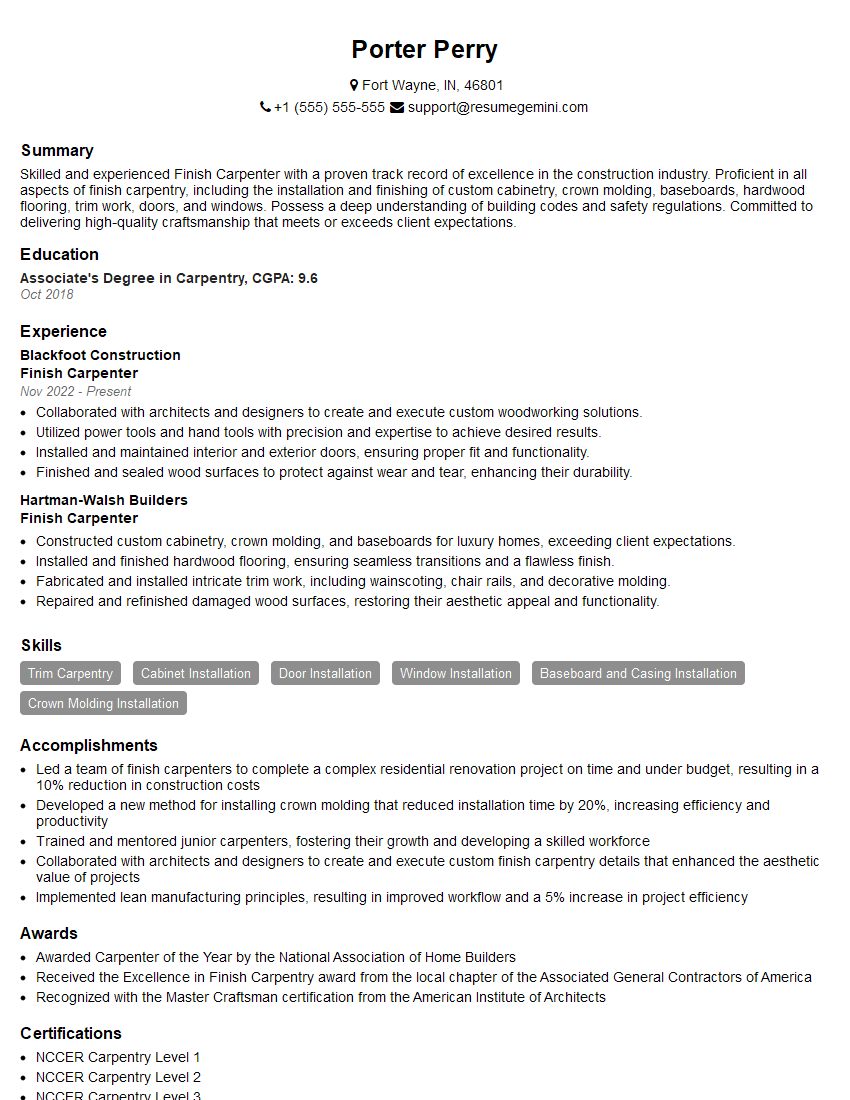
Mastering cornice installation opens doors to a rewarding career with diverse opportunities for growth, from residential projects to large-scale commercial installations. To maximize your job prospects, creating a strong, ATS-friendly resume is crucial. ResumeGemini is a trusted resource that can help you build a professional resume that highlights your skills and experience effectively. Examples of resumes tailored specifically to cornice installation are available to help you craft a compelling application that stands out.
Explore more articles
Users Rating of Our Blogs
Share Your Experience
We value your feedback! Please rate our content and share your thoughts (optional).
What Readers Say About Our Blog
Very informative content, great job.
good