Cracking a skill-specific interview, like one for Corsage and Boutonniere Assembly, requires understanding the nuances of the role. In this blog, we present the questions you’re most likely to encounter, along with insights into how to answer them effectively. Let’s ensure you’re ready to make a strong impression.
Questions Asked in Corsage and Boutonniere Assembly Interview
Q 1. What are the essential tools and materials required for corsage and boutonniere assembly?
Creating stunning corsages and boutonnieres requires a careful selection of tools and materials. Think of it like assembling a miniature floral masterpiece – each element plays a crucial role.
- Floral Supplies: Fresh, high-quality flowers (roses, lilies, orchids, etc.) and foliage (greenery like ferns, eucalyptus, or leatherleaf) are paramount. Consider the season and event when choosing blooms.
- Floral Tape: This essential tool allows you to securely bind stems together and create a strong base for your design. Different colours are available for camouflage.
- Floral Wire: Various gauges are needed for supporting heavier blooms and adding structural support. Floral wire is used to create a framework that keeps the design intact.
- Scissors or Floral Shears: Sharp, clean cuts are essential to avoid damaging stems and to create clean lines in your design.
- Ribbon: Satin, silk, or other decorative ribbons add the finishing touch, enhancing the elegance of your creation. Choose colours and textures that complement the flowers.
- Embellishments (Optional): Pearls, rhinestones, or small decorative elements can elevate your design, adding a touch of sparkle or sophistication.
- Work Surface: A clean, flat surface is crucial for easy manipulation of delicate floral materials.
For example, when working with delicate orchids, I always ensure I have extra thin floral wire to avoid damaging the petals. Using the right tools is key to precision and creating a truly professional finish.
Q 2. Describe the different types of corsage and boutonniere designs.
Corsage and boutonniere designs are incredibly diverse, reflecting individual style and the occasion. Think of them as personalized floral jewels.
- Classic Corsage: Typically featuring a cluster of roses or other elegant flowers, often accented with delicate foliage and a simple satin ribbon. A timeless choice for proms or formal events.
- Modern Corsage: Might incorporate more unique flower varieties, unusual colours, or textural elements like succulents or air plants. This option suits more contemporary styles.
- Wrist Corsage: Designed to be worn around the wrist, often featuring a more compact arrangement for comfort and practicality.
- Boutonniere with Single Bloom: A simple yet elegant design, usually consisting of a single, striking flower like a calla lily or a rosebud.
- Layered Boutonniere: Features several flowers or buds of varying sizes and textures, offering depth and visual interest.
- Cascade Boutonniere: A more elaborate design with flowers cascading down in a flowing arrangement. This style adds a dramatic flair.
For instance, I once created a modern corsage featuring vibrant orange lilies, purple orchids, and deep green leatherleaf, creating a bold and artistic statement. Each design is unique and should suit the event and wearer’s personality.
Q 3. How do you select appropriate flowers and foliage for corsages and boutonnieres?
Selecting the right flowers and foliage is critical to success. The key is to consider the occasion, the wearer’s style, and the overall aesthetic. It’s about creating a harmonious blend.
- Flower Type & Colour: Consider the symbolism and meaning behind different flowers. Roses represent romance, lilies symbolize purity, and orchids convey luxury. Colours should complement the event (e.g., pastel shades for a wedding, bold colours for a prom).
- Flower Condition: Choose flowers that are fresh, firm, and fully opened (or appropriately budded for longevity). Avoid blooms with wilting or damage.
- Foliage Selection: Foliage adds texture and visual interest. Choose greens that complement the flower colours, avoiding overpowering the main blooms. Textural contrast is often key.
- Seasonal Availability: Using seasonal flowers ensures freshness and affordability. In-season flowers also tend to be at their peak colour and quality.
For example, for a spring wedding, I might select pastel-colored roses and delicate baby’s breath, creating a soft and romantic feel. For a winter event, deeper colours and perhaps some pine or cedar might be appropriate.
Q 4. Explain the process of wiring and taping flowers for corsage and boutonniere construction.
Wiring and taping are fundamental skills. Think of them as the structural backbone of your design, ensuring that the arrangement stays beautiful throughout the event.
- Wiring: Use floral wire to secure individual flower heads or to create a stronger stem for weak or delicate flowers. Insert the wire at the base of the stem and gently twist to secure. Sometimes, I use two pieces of wire in a crisscross pattern for heavier flowers.
- Taping: Use floral tape to securely bind stems together. Start at the bottom of the stems, wrapping the tape tightly in a spiral upwards. The tape will adhere to itself and blend with the stems’ colour.
- Placement: Place the tape tightly around the stems to create a strong base. Ensure that your taping process doesn’t obstruct the water flow to the blooms.
- Angle: Create your design on a slightly upward angle. The arrangement should have a natural curve rather than pointing straight down.
For instance, when wiring a heavy rose, I often use thicker gauge wire and add several wraps to the base, ensuring it doesn’t bend under the weight of the blossom. The taping ensures everything stays in place.
Q 5. What techniques do you use to create a balanced and aesthetically pleasing design?
Achieving balance and aesthetic appeal requires understanding floral design principles. It’s about creating a visual harmony.
- Visual Weight: Distribute the size and colour of the flowers evenly. Larger blooms might need to be balanced by smaller ones or clusters of foliage.
- Colour Harmony: Use a colour wheel to guide your choices, creating complementary, analogous, or contrasting colour schemes. Monochromatic colour schemes (using different shades of one colour) can be very elegant.
- Texture and Form: Combine different textures (smooth petals, rough foliage) to create visual interest. Incorporate flowers with varying shapes and sizes to prevent a monotonous look.
- Negative Space: Don’t overcrowd the arrangement. Allow for some negative space to prevent a cluttered look and allow each element to breathe. Too much greenery or too many small flowers can create this problem.
For example, when creating a corsage, I often place the largest flower in the center, surrounded by smaller blooms and foliage, creating a sense of visual balance. The overall shape should feel natural, avoiding a rigid or forced appearance.
Q 6. How do you handle different types of flower stems and their varying textures?
Different flower stems present unique challenges. Understanding their properties is crucial for successful assembly. Think of it as working with different building materials; each requires a unique approach.
- Woody Stems (Roses, Carnations): These stems can be difficult to manipulate. Use sharp shears to make clean cuts. Wiring is often needed for support and can improve the flexibility of placement.
- Soft Stems (Lilies, Daisies): These stems are usually easier to work with, requiring less wiring. Floral tape is often sufficient to bind them together. Be careful not to crush the stems.
- Thick Stems: You may need to cut these stems in half or trim them considerably to fit your desired overall design size and shape.
- Hollow Stems: Some stems require more care as they can easily crush or break. Use wire carefully and avoid extreme bending or twisting.
For instance, when working with roses, I always make sure to cut the stems at an angle to allow for better water absorption. I’ll use thick wire to add a solid foundation and avoid any breakage.
Q 7. Describe your experience working with different types of ribbons and embellishments.
Ribbons and embellishments add the finishing touch, transforming a good design into a truly exceptional one. They’re the jewellery of floral design.
- Ribbon Types: Satin ribbons are classic and elegant. Silk ribbons offer a luxurious feel. Organza or other textured ribbons can add visual interest. Consider the colour and width of the ribbon; it needs to complement, not compete with the floral arrangement.
- Embellishment Selection: Pearls add a touch of sophistication. Rhinestones offer sparkle. Small charms or beads can enhance the overall design, depending on the theme and occasion.
- Attachment Techniques: Secure the ribbon neatly with floral tape or pins. Embellishments can be glued or wired onto the arrangement. Always ensure that these are well-attached to avoid any damage or loss of the item during transport or handling.
- Coordination: Choose ribbons and embellishments that complement the flowers and the overall style of the corsage or boutonniere. They shouldn’t distract from the main floral display.
For example, I might use a champagne-coloured satin ribbon with small pearl accents for a wedding boutonniere, creating a sophisticated and elegant look. The choice always depends on the occasion and the overall aesthetic that we’re going for.
Q 8. How do you maintain the freshness of flowers during the corsage and boutonniere assembly process?
Maintaining the freshness of flowers during corsage and boutonniere assembly is paramount to ensuring a beautiful and long-lasting final product. Think of it like caring for a delicate living organism – they need the right conditions to thrive.
- Proper Hydration: Before starting, I always recut the stems of all flowers at a 45-degree angle underwater. This prevents air bubbles from blocking water uptake. I also use flower food, a solution that provides essential nutrients and helps extend vase life, whenever possible.
- Temperature Control: I work in a cool environment to slow down the natural wilting process. Direct sunlight or excessive heat will rapidly dehydrate the flowers.
- Careful Handling: Gentle handling is key. Rough treatment damages delicate petals and stems, reducing their lifespan. I always support the flowers with my hand when working with them.
- Pre-Treatment: Certain flowers, like roses or lilies, benefit from pre-treatment techniques. This might include gently hydrating the flowers in a water bath or lightly misting them to improve their hydration and resilience.
- Strategic Placement: When constructing the corsage or boutonniere, I consider the placement of each flower. More delicate blooms will be positioned to minimize potential damage.
For example, once I’ve prepared the flowers, I work quickly and efficiently to avoid prolonged exposure to room temperature.
Q 9. What are some common challenges faced during corsage and boutonniere assembly, and how do you address them?
Challenges in corsage and boutonniere assembly are common, but manageable with experience and preparation. Think of it as a delicate balancing act between artistry and practicality.
- Flower fragility: Some blooms bruise easily. I use techniques like supporting the flowers with floral tape or wire as I build the piece. If a flower is damaged, I might replace it with a similar bloom from my reserve.
- Stem length and placement: Getting the stems to lay naturally and be secured without compromising the design is a common hurdle. I use my experience to select the right length and use techniques like manipulating stems, using wire, or adding padding for a smooth look and feel.
- Ribbon and embellishment coordination: The visual appeal hinges on the correct coordination of ribbon, pins, and other embellishments. I prepare a selection of options before starting, taking client preference into account.
- Time Management: Large orders require efficient work. I optimize my workflow using pre-cut materials and a designated workspace to increase speed and ensure quality in each piece.
For example, if I encounter a particularly fragile flower, I might use extra floral tape to secure it without causing damage.
Q 10. Explain your process for measuring and adjusting corsage and boutonniere sizes for clients.
Measuring and adjusting sizes are crucial to ensure a perfect fit. It’s about understanding the nuances of individual styles and preferences.
- Client Consultation: I begin with a thorough consultation to discuss the occasion, outfit, and client preferences. This includes gathering information about the garment’s style and placement of the corsage or boutonniere.
- Wrist Measurement (Corsages): For corsages, I measure the client’s wrist circumference using a soft tape measure to ensure the band fits comfortably. This is adjusted during the design process.
- Boutonniere Placement: For boutonnieres, I consider the lapel or location of placement to ensure it isn’t too large or small for the garment. I’ll often ask if they prefer a specific orientation of the design.
- Design Adjustments: Based on the measurements, I will adjust the size and shape of the design. This might include using more or less foliage, adjusting the number of flowers, or altering the length of stems.
For instance, for a petite bride with a slender wrist, I would create a corsage with a smaller diameter and fewer flowers to avoid an overwhelming look.
Q 11. How do you maintain hygiene and sanitation standards when handling flowers?
Maintaining hygiene is non-negotiable. It’s about protecting both the flowers and the client.
- Hand Washing: I wash my hands thoroughly before and after handling each order, using a mild soap to prevent the transfer of dirt or oils.
- Clean Tools: All my tools – scissors, floral wire cutters, and floral tape dispensers – are cleaned and disinfected regularly. I use alcohol wipes for quick disinfection between orders.
- Clean Work Surface: I always work on a clean, disinfected surface, avoiding cross-contamination between different orders. I usually use a dedicated workspace with fresh paper or a clean mat.
- Protective Gear: When handling potentially allergenic flowers, I wear gloves to protect my skin and prevent allergic reactions.
- Waste Disposal: All floral waste, like discarded stems and leaves, is disposed of promptly and hygienically.
Imagine working with a fresh bouquet for someone’s wedding – you wouldn’t want to risk cross-contamination that could negatively impact the flowers or cause an allergic reaction.
Q 12. How do you store assembled corsages and boutonnieres to ensure longevity?
Proper storage is crucial for extending the life of assembled corsages and boutonnieres. This requires attention to detail and understanding flower needs.
- Cool, Dark Place: I store the completed pieces in a cool, dark, and well-ventilated location. This slows down wilting and helps maintain freshness.
- Plastic Wrap (Short-Term): For short-term storage (less than a day), I might lightly wrap the corsages and boutonnieres in clear plastic wrap to maintain humidity and minimize water loss.
- Refrigeration (Long-Term): For longer storage (more than a day), refrigeration at a slightly above-freezing temperature (34-38°F or 1-3°C) is optimal. I might use a humidity-controlled storage container.
- Vertical Storage: I always store the pieces vertically to prevent crushing or damage. For example, corsages might hang from hooks, and boutonnieres can be upright in a container.
- Avoid Direct Contact: I avoid placing pieces directly on top of each other to prevent damage.
The goal is to create an environment similar to the cool, dark conditions where flowers would naturally thrive.
Q 13. Describe your experience using floral foam and other support materials.
Floral foam and other support materials are essential for constructing stable and beautiful designs. It’s like the foundation of a building.
- Floral Foam: I use floral foam primarily to create a base for corsages and larger, more complex boutonnieres. I ensure it’s properly soaked in water with flower food before insertion of flowers and stems to maintain their hydration.
- Wire: Floral wire is invaluable for supporting stems, creating curves, or adding stability to delicate flowers. I use different gauges of wire depending on the weight and texture of the flower.
- Floral Tape: I use floral tape extensively to secure stems to the foam, wire, or other elements of the design. It blends seamlessly with most floral materials.
- Pins: Pins are crucial for assembling and attaching the boutonniere to the garment or securing elements of a corsage. I prioritize pins that are both secure and aesthetically pleasing.
- Other Supporting Materials: Depending on the design, I might use other materials like ribbon, glue (floral-grade), or decorative elements to enhance the aesthetics and create stability.
For example, when making a cascading bridal bouquet, I will use floral foam as a central support structure, with wire and tape to secure the stems and maintain its shape.
Q 14. How do you adapt your designs to suit different occasions and client preferences?
Adapting designs is key to providing truly personalized service. It’s about translating the client’s vision into a tangible creation.
- Occasion-Specific Designs: I understand the symbolism and expectations associated with various occasions. A wedding boutonniere differs significantly in style and formality compared to a prom corsage. I select flower types, colors, and design elements accordingly.
- Color Palettes: I work closely with clients to select color schemes that complement their attire and reflect the mood or theme of the event. I keep a large variety of flowers available in a wide range of colors.
- Flower Selection: Different flowers communicate different messages. Roses signify romance, lilies convey elegance, and sunflowers represent joy. I guide clients in flower selection to achieve the desired effect.
- Personalization: I incorporate personal details or preferences into the design whenever possible. This could involve using a client’s favorite flower, a particular ribbon color, or incorporating small, meaningful accessories.
- Style Preferences: I am familiar with various floral styles – from classic and elegant to modern and rustic. I can adapt designs to suit a wide range of styles.
For instance, for a rustic wedding, I might incorporate wildflowers, burlap ribbon, and natural-looking embellishments, while for a formal black-tie event, I would choose more sophisticated flowers and elegant materials.
Q 15. What is your preferred method for attaching corsages to garments?
My preferred method for attaching corsages to garments depends on the fabric and the style of the corsage. For delicate fabrics like silk or lace, I use a combination of strong, but discreet, floral pins and delicate ribbons. The pins secure the corsage firmly, while the ribbons can be tied around the wrist or arm, adding an extra element of elegance and support. This approach minimizes any damage to the garment. For sturdier fabrics like wool or cotton, I can utilize a combination of pins and fabric-safe adhesive for extra security, particularly for larger, heavier corsages. Always, I prioritize the preservation of the garment while ensuring the corsage is securely attached and visually appealing.
For example, a delicate wrist corsage for a bridesmaid would be best secured with pins and a satin ribbon tied in a bow, while a larger, more substantial corsage for a prom queen could utilize additional adhesive along with pins to ensure it stays put throughout the event. I always test the adhesive on an inconspicuous area of the garment first.
Career Expert Tips:
- Ace those interviews! Prepare effectively by reviewing the Top 50 Most Common Interview Questions on ResumeGemini.
- Navigate your job search with confidence! Explore a wide range of Career Tips on ResumeGemini. Learn about common challenges and recommendations to overcome them.
- Craft the perfect resume! Master the Art of Resume Writing with ResumeGemini’s guide. Showcase your unique qualifications and achievements effectively.
- Don’t miss out on holiday savings! Build your dream resume with ResumeGemini’s ATS optimized templates.
Q 16. How do you assess the condition of flowers and choose the most suitable ones for assembly?
Assessing flower condition is crucial for creating long-lasting and beautiful corsages and boutonnieres. I look for several key factors: hydration, stem strength, petal condition, and overall freshness. Flowers should feel firm and not wilted or limp. The stems should be strong and capable of supporting the arrangement. Petals should be vibrant in color, free from blemishes, browning, or damage. I prefer to use flowers that have just opened, or are about to open—this ensures optimal longevity and beauty.
I usually reject flowers that show signs of disease, insect damage, or significant dehydration. For example, petals that are browning at the edges, stems that are mushy, or flowers with dull or spotted petals are unacceptable. Choosing the right flowers is critical for guaranteeing the aesthetic appeal and durability of the final product. The visual impact and longevity depend entirely on this initial assessment.
Q 17. Describe your experience with various floral preservation techniques.
My experience with floral preservation techniques encompasses several methods, each suited to different needs. For short-term preservation (a few days), I typically use flower food dissolved in water to keep the cut flowers hydrated. For longer-term preservation, I am proficient in techniques like pressing flowers for keepsakes, creating dried arrangements using silica gel or air drying, and even exploring the use of glycerin to preserve the flower’s structure and suppleness. Each method has its own advantages and disadvantages; for example, pressing results in flat, two-dimensional specimens, suitable for keepsakes but not ideal for corsages. Air drying preserves color relatively well but can lead to more fragility. Glycerin offers better flexibility and color retention but takes longer.
The choice depends entirely on the client’s needs and expectations. For corsage work, maximizing longevity and visual appeal in the short-term is paramount, so I usually rely on flower food solutions and careful handling to maintain freshness.
Q 18. How do you estimate the time required for corsage and boutonniere assembly?
Estimating assembly time depends heavily on the complexity of the design and the number of pieces. A simple boutonniere with one or two flowers might take 10-15 minutes. A more elaborate corsage with multiple flowers, ribbons, and embellishments could take 30 minutes or more. I always factor in extra time for unexpected challenges or adjustments needed during assembly.
For large orders, I break down the assembly into smaller, manageable tasks and estimate the time needed for each. I also use project management tools to track progress and allocate time accordingly. This allows for a realistic timeline and reduces the risk of delays. I always communicate estimated completion times to my clients to manage expectations.
Q 19. How do you handle last-minute orders and urgent requests?
Handling last-minute orders and urgent requests requires efficient prioritization and resource management. I assess the complexity of the request and available resources, including time and materials. I immediately confirm if the request is feasible within the given timeframe. If so, I prioritize it by adjusting my schedule, potentially delegating other tasks or extending my working hours. Transparency with the client is key; I communicate any challenges and potential adjustments to the design or delivery time.
I’ve had several instances where a wedding corsage needed to be assembled within a few hours. In such cases, I focus on a simplified but elegant design, using readily available flowers and materials to ensure timely delivery. Client satisfaction, while maintaining quality, is always my top priority.
Q 20. Describe your experience working under pressure and meeting tight deadlines.
Working under pressure and meeting tight deadlines is an integral part of this profession, especially during peak seasons like wedding season or prom season. My experience has honed my ability to prioritize tasks, manage time effectively, and maintain a calm and focused approach. I work best under pressure, finding a sense of purpose and focus when faced with a challenge. I have developed strategies to minimize stress, such as breaking down large orders into smaller, manageable tasks, pre-preparing materials, and delegating when possible.
I recall one instance where a major floral order was delayed by a supplier, impacting a large event. We re-organized, sourced alternative flowers, and collaborated effectively to deliver all arrangements on time, ensuring a successful event.
Q 21. How do you manage inventory and order supplies effectively?
Effective inventory management is essential to avoid delays and ensure smooth operations. I maintain a detailed inventory of all floral supplies, including flowers, ribbons, pins, and embellishments. This inventory is updated regularly, after every order, using a spreadsheet system. I track minimum stock levels for each item and set reorder points to prevent shortages. This helps me forecast supply needs and place orders in advance to avoid running out of materials during peak seasons.
Furthermore, I maintain strong relationships with multiple flower suppliers to ensure reliable sourcing, particularly for less common or seasonal flowers. This redundancy helps mitigate risks caused by potential disruptions in supply chains. This proactive approach to inventory management helps streamline operations and ensures a consistent supply of high-quality materials for our customers.
Q 22. What are the key considerations when working with delicate or fragile flowers?
Handling delicate flowers requires a gentle touch and careful preparation. Think of them like precious porcelain – you wouldn’t want to drop them! Before even beginning assembly, I ensure my workspace is clean and free of sharp objects. I also pre-prepare my floral tape and wire, making sure they’re readily available and won’t cause snags.
For particularly fragile blooms like orchids or lilies, I might use a special floral adhesive instead of wire to minimize damage. I also work quickly but methodically, avoiding unnecessary handling. For instance, if a petal is slightly damaged, I might strategically place it near the center of the corsage or boutonniere where it’s less noticeable. Pre-hydrating the stems before assembly is crucial, keeping the flowers plump and vibrant throughout the process.
- Hydration is key: Using a floral preservative solution before assembly significantly improves the flowers’ longevity and helps prevent wilting.
- Strategic placement: Less-than-perfect blooms can be cleverly hidden by strategic placement within the design.
- Gentle handling: Always support the flower’s stem and blooms when moving and assembling.
Q 23. How do you ensure the safety and security of your materials and tools?
Safety and security are paramount in my workshop. My tools – floral wire cutters, scissors, floral tape, glue gun – are always stored in designated areas, away from reach of children or pets. For expensive or rare flowers, I keep them refrigerated in specialized containers that maintain optimal humidity and temperature, much like a florist would maintain their cold storage units. This prevents wilting and damage before use. I regularly clean and disinfect my tools to maintain hygiene and prevent the spread of disease between flower batches.
I keep a detailed inventory of my supplies, regularly checking stock and ordering replacements to ensure I never run out of essential materials mid-project. Think of it like a well-stocked artist’s palette – you need the right colors (flowers) and tools at your fingertips. Proper storage prevents loss and keeps everything organized.
Q 24. What is your understanding of color theory and how does it apply to floral design?
Color theory is fundamental to floral design. It’s about understanding the relationships between colors and how they interact to create a specific mood or effect. I use the color wheel constantly. For example, complementary colors (colors opposite each other on the wheel, like blue and orange) create a vibrant contrast, ideal for a bold, eye-catching boutonniere. Analogous colors (colors next to each other, like blue, blue-green, and green) provide a more harmonious and subtle look, often preferred for a corsage.
I might choose a warm color palette (reds, oranges, yellows) for a vibrant, energetic design, or cool colors (blues, greens, purples) for a calming and elegant feel. The color also needs to match the occasion, the attire of the wearer, and the overall theme.
For a wedding, for instance, the bride’s bouquet, corsages and boutonnieres might follow a harmonious color scheme, coordinating with the bridesmaid dresses and the overall wedding palette.
Q 25. How do you incorporate different textures and shapes into your corsage and boutonniere designs?
Texture and shape are crucial for visual interest in corsages and boutonnieres. I utilize a variety of flowers, foliage, and embellishments to achieve depth and dimension. Think of it like painting a picture – you don’t want everything to be flat. Smooth, silky petals like those of a rose can be complemented by the rough texture of seeded eucalyptus, adding intrigue and contrast.
Shapes also play a significant role. I might combine round blooms like carnations with long, linear elements such as statice or even ribbon to balance the design. The shape of the finished piece will often be dictated by the occasion, the recipient, and the chosen flowers. A simple, elegant round corsage might be appropriate for a prom, while a more elaborate cascade style might suit a wedding.
Example: A boutonniere might feature a round rose bud, a few linear sprigs of rosemary, and a textured piece of fern for a balanced, visually appealing design.
Q 26. Explain your knowledge of different flower types and their characteristics.
My knowledge of flower types is extensive. I understand each flower’s characteristics – its durability, its ability to hold water, its tendency to wilt, and its overall aesthetic qualities. Roses, for example, are known for their classic beauty and wide range of colors, but they require careful handling to prevent petal damage. Lilies are elegant, but their pollen can stain clothing, so I might remove the anthers before incorporating them into a design.
More delicate flowers such as orchids or freesias require specialized techniques and careful handling. I might use specific wiring techniques for better support and to avoid damaging the petals. Knowing which flowers complement each other in terms of color, texture, and longevity is vital for creating a design that will last. For instance, I wouldn’t combine a very short-lasting flower with one that holds up much longer, as the final product might look unbalanced by the time the event is over.
Q 27. How do you handle client feedback and adjust your work accordingly?
Client feedback is essential. I always encourage open communication. After presenting the initial designs, I actively listen to their feedback regarding color preferences, flower choices, or any adjustments they might want. A simple ‘What do you think?’ can open up a conversation. It’s crucial to approach feedback with a positive and receptive attitude, even if it means making adjustments.
Sometimes, a client might request a change that’s technically challenging. In these cases, I explain the implications and offer alternative suggestions to achieve a similar look while maintaining the integrity of the design. It’s all about finding a creative solution that satisfies both the client’s vision and the technical requirements of the arrangement.
Example: A client might initially choose a very delicate flower that wouldn’t hold up for the duration of the event. I would suggest a similar-looking but more durable alternative, showcasing its suitability and explaining my reasoning.
Q 28. What are your strategies for maintaining a professional and efficient workflow?
Maintaining an efficient workflow involves careful planning and organization. Before starting a project, I gather all necessary materials, review the client’s specifications, and sketch out the design. This helps prevent delays and ensures I have everything I need readily available. I prioritize tasks based on deadlines, ensuring that urgent orders are addressed first. I also utilize efficient techniques, like pre-cutting my wires and prepping my flowers before assembly, to streamline the process.
I stay updated on current floral trends, experimenting with new techniques and materials to improve both my speed and the quality of my creations. Continuing education through workshops and online resources keeps me at the forefront of the floral design world. Proper time management and a well-organized workspace are my cornerstones of a smooth and productive workflow.
Key Topics to Learn for Corsage and Boutonniere Assembly Interview
- Floral Selection and Preparation: Understanding flower types, their durability, and appropriate handling techniques for corsages and boutonnieres. This includes assessing freshness and identifying potential issues.
- Wiring and Taping Techniques: Mastering various wiring methods for different flower types and stems. Understanding the purpose and application of different tapes for secure and aesthetically pleasing assembly.
- Design Principles and Aesthetics: Applying principles of color theory, balance, and visual appeal to create elegant and harmonious corsages and boutonnieres. Understanding different design styles and trends.
- Assembly Techniques for Corsages: Practical application of different assembly methods, including wrist corsages, nosegays, and other variations. Understanding the importance of secure fastening and comfortable wear.
- Assembly Techniques for Boutonnieres: Practical application of different assembly methods, including techniques for different lapel types and flower combinations. Understanding how to create a balanced and secure boutonniere.
- Troubleshooting and Problem Solving: Identifying and resolving common issues encountered during assembly, such as wilting flowers, broken stems, or tape malfunctions. Developing effective problem-solving strategies for maintaining quality and efficiency.
- Health and Safety Procedures: Understanding and adhering to safety protocols when handling floral materials and tools, including proper hygiene and waste disposal.
- Time Management and Efficiency: Optimizing workflow for efficient assembly, particularly in high-volume situations. Understanding the importance of meeting deadlines and managing time effectively.
Next Steps
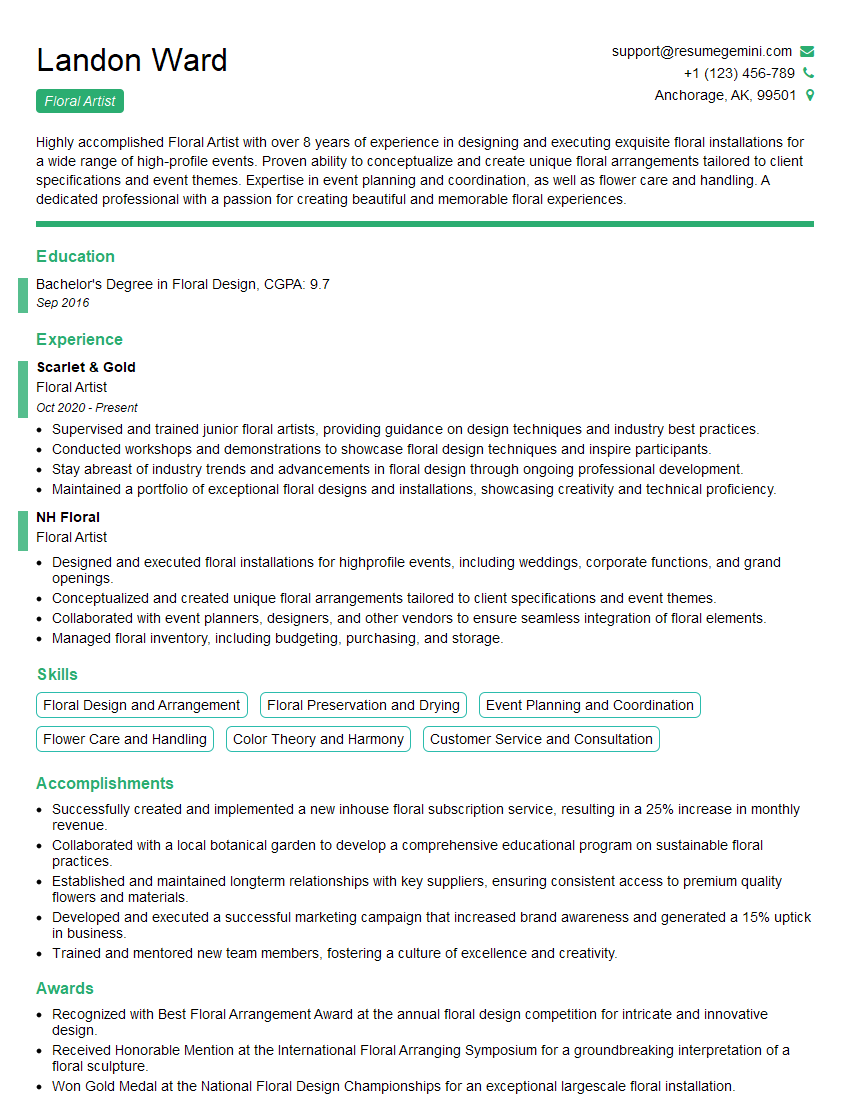
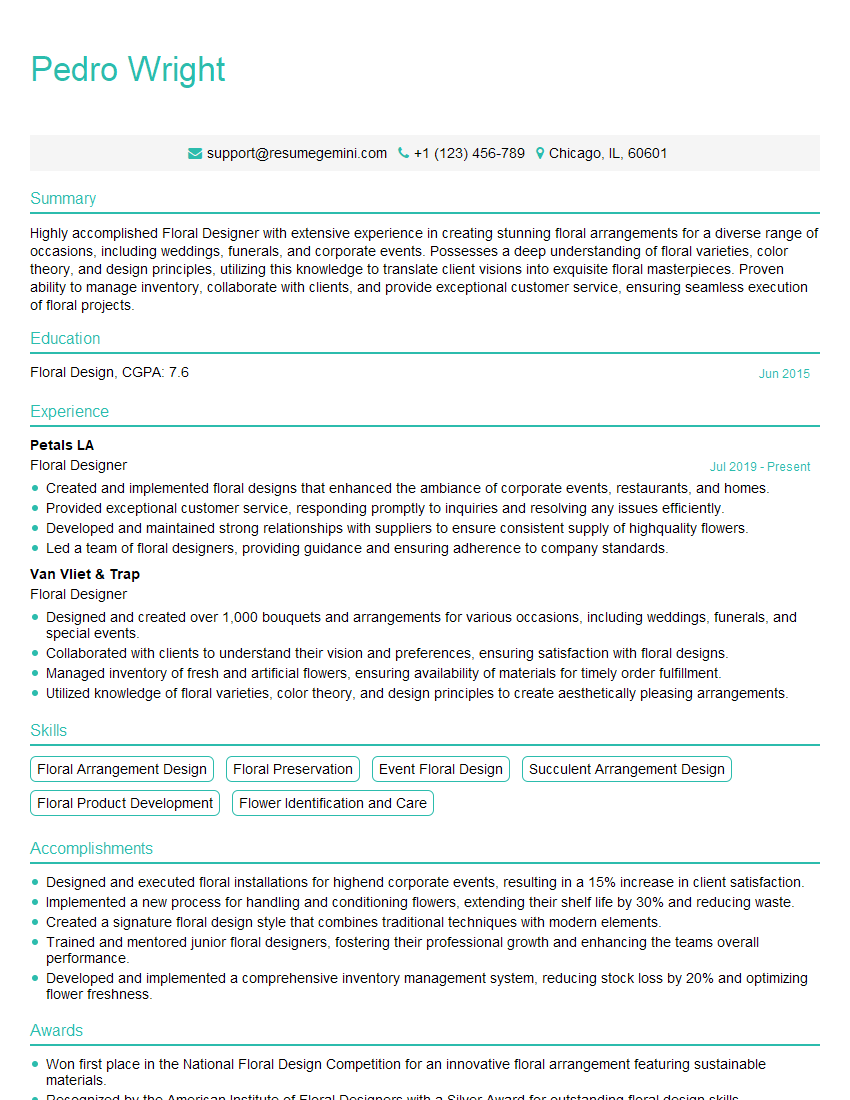
Mastering Corsage and Boutonniere Assembly opens doors to exciting opportunities in the floral design industry, offering diverse roles with potential for growth and specialization. A strong resume is crucial for showcasing your skills and experience to potential employers. Creating an ATS-friendly resume will significantly increase your chances of getting noticed by recruiters. We strongly encourage you to use ResumeGemini to build a professional and impactful resume tailored to the specifics of your Corsage and Boutonniere Assembly experience. Examples of resumes tailored to this field are available to guide you. Invest the time to craft a compelling resume – it’s your first impression and a key to unlocking your career potential.
Explore more articles
Users Rating of Our Blogs
Share Your Experience
We value your feedback! Please rate our content and share your thoughts (optional).
What Readers Say About Our Blog
Very informative content, great job.
good