Cracking a skill-specific interview, like one for Cost Estimating and Value Engineering, requires understanding the nuances of the role. In this blog, we present the questions you’re most likely to encounter, along with insights into how to answer them effectively. Let’s ensure you’re ready to make a strong impression.
Questions Asked in Cost Estimating and Value Engineering Interview
Q 1. Explain the difference between parametric estimating and bottom-up estimating.
Parametric and bottom-up estimating are two fundamentally different approaches to cost estimation. Parametric estimating uses statistical relationships, historical data, and project characteristics (parameters) to predict costs. Think of it like using a formula: you plug in the known variables, and the formula spits out an estimated cost. This is faster and less labor-intensive but relies heavily on the accuracy of the historical data and the chosen model. For example, estimating the cost of a building based on its square footage and location using a previously established cost per square foot for similar projects in that area.
Bottom-up estimating, on the other hand, is a much more detailed and granular approach. It involves breaking down the project into its smallest work components, estimating the cost of each individual component, and then summing these costs to get the total project estimate. Imagine meticulously listing every single item needed to build a house – bricks, lumber, nails, labor for each task – and pricing each one before totaling them. This is more accurate but extremely time-consuming and resource-intensive. The best approach often involves a combination of both methods, using parametric estimating for high-level overview and bottom-up for critical or high-risk components.
Q 2. Describe your experience with Earned Value Management (EVM).
Earned Value Management (EVM) is a project management technique that integrates scope, schedule, and cost to provide a comprehensive view of project performance. My experience with EVM involves its application across various projects, from small-scale renovations to large-scale infrastructure developments. I’m proficient in calculating the Earned Value (EV), Planned Value (PV), and Actual Cost (AC), and utilizing these metrics to derive key performance indicators like the Schedule Variance (SV), Cost Variance (CV), Schedule Performance Index (SPI), and Cost Performance Index (CPI). I’ve used EVM not only to track progress but also to proactively identify and mitigate potential cost overruns or schedule delays. For instance, on a recent highway construction project, we utilized EVM to detect a potential cost overrun early on due to unforeseen geological challenges. This early warning enabled us to adjust our budget and schedule, ultimately delivering the project successfully.
Furthermore, I’m experienced in presenting EVM reports to stakeholders, clearly communicating the project’s health and potential risks. This involves explaining the metrics in plain terms and translating technical data into actionable insights for decision-making. I believe EVM is critical for effective project control and provides valuable data for future project planning.
Q 3. How do you identify and quantify risks in a cost estimate?
Identifying and quantifying risks in a cost estimate requires a systematic approach. I typically employ a risk assessment matrix, combining qualitative and quantitative techniques. First, I brainstorm potential risks through workshops and interviews with stakeholders, including factors like material price fluctuations, labor shortages, regulatory changes, and unforeseen site conditions. Then, for each risk, I assess its likelihood (probability of occurrence) and its impact (potential cost increase if the risk materializes). This is often visualized using a probability and impact matrix.
Quantification involves assigning monetary values to these risks. For instance, if a risk (e.g., a potential delay due to inclement weather) has a 30% probability of occurrence and a potential cost impact of $100,000, its expected monetary value would be $30,000 (0.3 * $100,000). This process is not precise, but it helps prioritize risk mitigation strategies and create a contingency reserve to absorb potential cost overruns. Sensitivity analysis is also employed to explore the impact of variations in key parameters on the overall project cost.
Q 4. What software tools are you proficient in for cost estimating and value engineering?
I am proficient in several software tools commonly used in cost estimating and value engineering. These include:
- Microsoft Excel: For data analysis, developing cost models, creating spreadsheets, and generating reports.
- Primavera P6: For scheduling and resource allocation, providing valuable input for cost estimating and helping to identify potential cost-saving opportunities.
- CostWorks: A specialized software for parametric cost estimating, particularly useful for large-scale projects.
- BIM software (Revit, ArchiCAD): For integration with design models and quantity takeoff, enabling more accurate bottom-up estimating.
My proficiency in these tools allows me to efficiently analyze data, build robust cost models, and generate comprehensive reports. I am also adept at customizing these tools to suit specific project requirements.
Q 5. How do you handle changes in project scope and their impact on the cost estimate?
Changes in project scope are inevitable, and managing their impact on the cost estimate is crucial. My approach involves a structured change management process. First, I ensure any proposed changes are documented formally, including a clear description of the change, its impact on the scope, schedule, and cost. Then, a thorough cost impact assessment is conducted using either parametric or bottom-up techniques, depending on the nature and scale of the change. This assessment should include not only direct costs but also any indirect consequences, such as potential schedule delays and resource reallocation.
This assessment is presented to stakeholders for review and approval. Once approved, the cost estimate is revised to reflect the changes. To minimize disruptions, I advocate for implementing change controls and using a robust change request system. Regular monitoring of the revised budget and schedule is essential to catch any further deviations early.
Q 6. Explain your understanding of contingency reserves and management reserves.
Contingency reserves are funds allocated to account for known unknowns – risks and uncertainties that are identified during the planning phase. For example, potential material price increases or unexpected site conditions. These are specific to identified risks. The amount of contingency reserve is determined by the assessed risk probability and impact, as discussed earlier. They are used to cover costs related to these identified risks.
Management reserves, on the other hand, are allocated to cover unforeseen risks and uncertainties, the unknown unknowns – things that we don’t even know we don’t know about at the project outset. They act as a buffer for unexpected events or changes outside the scope of the original plan. They are typically controlled at a higher management level and are only used for approved changes impacting the original scope. The size of management reserves is usually a percentage of the total project cost and reflects the overall uncertainty associated with the project.
Q 7. Describe your experience with life cycle costing.
Life cycle costing (LCC) is a holistic approach to cost estimation that considers all costs associated with a project or asset over its entire life, from design and construction to operation, maintenance, and eventual disposal. My experience with LCC involves integrating it into the decision-making process for various projects, ensuring that upfront cost savings don’t translate to higher long-term operational or maintenance expenses. This often involves using specialized software and collaborating with subject matter experts in operations and maintenance to accurately predict future costs.
For instance, in a recent project involving the selection of building materials, LCC analysis showed that a more expensive, durable material resulted in lower long-term maintenance costs, making it the more economically viable option compared to cheaper alternatives requiring frequent repairs. LCC is not just about minimizing initial investment, but optimizing the total cost of ownership over the asset’s lifespan, resulting in a more informed and sustainable investment decision.
Q 8. How do you perform a value engineering study?
Performing a value engineering study involves a systematic process aimed at enhancing the value of a project while minimizing its cost. It’s not simply about cutting costs, but rather about optimizing the relationship between function and cost. Think of it like baking a cake – you can reduce the cost of ingredients without sacrificing taste (or even improving it!).
The process typically follows these steps:
- Define the Project Scope and Objectives: Clearly articulate the project’s goals, functionalities, and performance requirements.
- Assemble a Value Engineering Team: Gather individuals with diverse expertise – engineers, architects, cost estimators, and even end-users – to bring different perspectives to the table.
- Information Gathering and Functional Analysis: Thoroughly research existing designs, materials, and processes. Analyze each component’s function and its contribution to the overall project objectives.
- Idea Generation (Brainstorming): Employ creative techniques to generate a wide range of alternative solutions. This could involve brainstorming sessions, SWOT analysis, or even reverse brainstorming (identifying what shouldn’t be done).
- Evaluation and Selection: Evaluate the generated ideas based on criteria like cost, functionality, reliability, and maintainability. Use tools like cost-benefit analysis and decision matrices to make informed choices.
- Develop and Document Recommendations: Clearly present the chosen recommendations, highlighting the potential cost savings and functional improvements.
- Implementation and Monitoring: Implement the selected recommendations and track their impact throughout the project lifecycle.
For example, in a building project, a value engineering study might explore using prefabricated components instead of on-site construction, significantly reducing labor costs and construction time.
Q 9. What are some common value engineering techniques you use?
Several value engineering techniques prove particularly effective. These often work in tandem:
- Function Analysis System Technique (FAST): This systematically breaks down a product or system into its basic functions, identifying the essential ones from the less crucial. This helps pinpoint areas where cost reduction is possible without sacrificing functionality.
- Value Analysis (VA): This technique focuses on analyzing the cost and performance of each component to identify areas where cost can be reduced without compromising quality or performance. We’ll delve deeper into this in the next answer.
- Brainstorming: A classic technique to generate creative solutions, often used in conjunction with other techniques to uncover innovative cost-saving ideas.
- Benchmarking: Comparing the project’s costs and performance to similar projects to identify areas for improvement and cost optimization. This helps establish industry best practices.
- Life Cycle Costing (LCC): Considering the total cost of ownership over the entire life of a project, encompassing initial costs, maintenance, and eventual disposal. This allows for long-term cost optimization.
In one project involving a bridge design, using FAST, we identified that certain aesthetic features added significant costs without substantially impacting the bridge’s functionality. By eliminating non-essential elements, we achieved significant cost savings without compromising safety or structural integrity.
Q 10. Explain the concept of value analysis.
Value analysis is a systematic approach to identifying and eliminating unnecessary costs without sacrificing essential functions. It’s a crucial component of value engineering. Think of it as a magnifying glass applied to each aspect of a project, scrutinizing its necessity and cost-effectiveness.
Value analysis focuses on answering key questions:
- What is the function of this component? (Understanding the purpose)
- What is the cost of this component? (Assessing the expense)
- Can we achieve the same function at a lower cost? (Seeking alternative solutions)
The process often involves examining alternative materials, processes, and designs. For instance, if a project uses expensive stainless steel where less costly galvanized steel would suffice, value analysis would identify this discrepancy and propose a more cost-effective alternative.
Value analysis is not about cheapening the product but about maximizing the value proposition by optimizing the relationship between cost and function.
Q 11. How do you present cost estimates and value engineering recommendations to stakeholders?
Presenting cost estimates and value engineering recommendations requires clarity, visual aids, and a compelling narrative. Stakeholders need to understand both the ‘what’ and the ‘why’.
My approach typically involves:
- Executive Summary: A concise overview of the key findings, recommendations, and projected cost savings.
- Detailed Cost Estimates: Clearly presenting initial costs, value engineering savings, and the revised total cost. This often includes tables and charts for easy understanding.
- Visual Aids: Using diagrams, charts, and even 3D models to illustrate the proposed changes and their impact.
- Risk Assessment: Addressing potential risks associated with the recommendations and outlining mitigation strategies.
- Return on Investment (ROI): Demonstrating the financial benefits of the value engineering initiatives.
- Interactive Presentation: Engaging the stakeholders through a discussion, addressing their questions and concerns.
For example, I would use a bar chart to visually compare the initial project cost with the revised cost after implementing value engineering recommendations, clearly showcasing the significant cost savings achieved.
Q 12. Describe a time you had to defend a cost estimate.
During a large-scale infrastructure project, my initial cost estimate was challenged by senior management who believed it was overly optimistic. They questioned the feasibility of several key assumptions. To defend the estimate, I prepared a comprehensive document.
My defense included:
- Detailed Breakdown: I provided a detailed breakdown of each cost element, justifying every assumption with supporting data such as market research, historical data, and expert consultations.
- Sensitivity Analysis: I conducted a sensitivity analysis to demonstrate the impact of potential variations in key cost drivers, illustrating that even with potential cost increases in certain areas, the overall estimate remained viable.
- Risk Mitigation Plan: I presented a robust risk mitigation plan, outlining the strategies to address potential uncertainties and minimizing their impact on the project’s overall cost.
- Transparency and Communication: I maintained open communication throughout the process, addressing their concerns promptly and providing clear and concise explanations.
Ultimately, my detailed justification and proactive approach convinced senior management of the accuracy and reliability of my estimate. The project was delivered on time and within the projected budget.
Q 13. How do you prioritize value engineering opportunities?
Prioritizing value engineering opportunities requires a structured approach. I typically use a multi-criteria decision analysis (MCDA) framework considering several factors:
- Potential Cost Savings: The magnitude of potential cost reductions is a primary driver.
- Feasibility: How easily and realistically can the recommendation be implemented?
- Risk: What are the potential risks associated with the implementation, and how can they be mitigated?
- Impact on Project Schedule: How will the implementation affect the project timeline?
- Impact on Functionality and Performance: Will the proposed changes negatively impact the project’s performance or functionality?
I often use a weighted scoring system, assigning weights to each criterion based on the project’s specific priorities. This ensures that the most impactful and feasible opportunities are addressed first. For example, a high potential cost savings with low risk and minimal impact on schedule would rank higher.
Q 14. How do you measure the success of a value engineering initiative?
Measuring the success of a value engineering initiative goes beyond simply tracking cost savings. It also includes assessing the impact on project schedule, quality, and overall value.
Key metrics include:
- Actual vs. Projected Cost Savings: Comparing the actual cost savings realized against the projected savings from the value engineering study.
- Project Schedule Impact: Assessing whether the value engineering initiatives resulted in delays or accelerations to the project timeline.
- Quality and Performance: Evaluating the impact of the value engineering recommendations on the project’s quality, functionality, and performance.
- Stakeholder Satisfaction: Gathering feedback from stakeholders on their perception of the value engineering efforts.
- Return on Investment (ROI): Calculating the ROI by comparing the cost savings to the resources invested in the value engineering study.
A comprehensive post-implementation review, comparing the pre- and post-value engineering project performance against established metrics, is crucial for assessing the overall success and identifying lessons learned for future projects.
Q 15. What are some common challenges in cost estimating and value engineering?
Cost estimating and value engineering, while crucial for project success, present several common challenges. One major hurdle is the inherent uncertainty involved. Future prices of materials, labor rates, and unforeseen circumstances can significantly impact initial estimates. Another challenge is the complexity of projects. Large-scale endeavors involve numerous interconnected components and stakeholders, making accurate cost aggregation difficult. Data availability and quality is also a consistent issue. Insufficient or inaccurate historical data can lead to flawed estimations. Finally, communication breakdowns and differing perspectives among stakeholders (e.g., clients, engineers, contractors) can lead to misunderstandings and conflicts affecting both cost and value considerations.
- Example: In a construction project, unexpected geological conditions uncovered during excavation can drastically inflate costs beyond the initial estimate.
- Example: Lack of clear communication between the design team and the construction team may lead to design changes during the construction phase causing cost overruns.
Career Expert Tips:
- Ace those interviews! Prepare effectively by reviewing the Top 50 Most Common Interview Questions on ResumeGemini.
- Navigate your job search with confidence! Explore a wide range of Career Tips on ResumeGemini. Learn about common challenges and recommendations to overcome them.
- Craft the perfect resume! Master the Art of Resume Writing with ResumeGemini’s guide. Showcase your unique qualifications and achievements effectively.
- Don’t miss out on holiday savings! Build your dream resume with ResumeGemini’s ATS optimized templates.
Q 16. How do you handle conflicting priorities between cost, schedule, and scope?
Balancing cost, schedule, and scope requires a systematic approach. It’s rarely a case of simply picking one over the others; it’s about finding the optimal balance. I typically use a prioritization matrix, involving stakeholder input, to weigh the relative importance of each constraint for the specific project. This might involve analyzing the impact of minor scope reductions to maintain the schedule and budget. Alternatively, a minor schedule extension might be acceptable to achieve cost savings without impacting crucial scope elements. Trade-off analysis using tools like Earned Value Management (EVM) can also quantify the impact of changes to one constraint on the others. Transparency is crucial; all stakeholders need to understand the trade-offs involved in each decision.
Example: In a software development project, we might decide to postpone less critical features (scope reduction) to meet a tight deadline (schedule) and stay within budget (cost).
Q 17. Describe your experience with different estimating methodologies (e.g., three-point estimating).
I have extensive experience with various estimating methodologies. Three-point estimating, a probabilistic approach, is particularly useful when uncertainty is high. It involves defining three cost estimates: optimistic (O), most likely (M), and pessimistic (P). These are combined to calculate a weighted average, often using the formula: (O + 4M + P) / 6. This provides a more realistic estimate than a single-point estimate, incorporating risk and uncertainty. I also utilize other methods such as parametric estimating (using historical data and relevant parameters to predict costs), bottom-up estimating (detailed breakdown of individual components), and analogous estimating (comparing to similar past projects).
Example: For a highway construction project, I might use parametric estimating based on historical data of similar projects, factoring in variables like length, terrain, and material costs. I would also use bottom-up estimating to detail the individual costs of earthwork, paving, and bridge construction.
Q 18. How do you ensure the accuracy of cost estimates?
Ensuring accuracy requires a multi-pronged approach. First, I meticulously collect and analyze data from reliable sources. This includes reviewing historical project data, market research on material and labor costs, and supplier quotes. Second, I utilize multiple estimating methods and compare the results to identify discrepancies and outliers. Third, I incorporate contingency reserves to account for unforeseen risks and uncertainties. This is crucial, as it acknowledges that perfect foresight is impossible. Finally, regular reviews and updates throughout the project lifecycle are necessary to track actual costs against the estimates and adjust as needed. Transparency and communication with stakeholders are paramount to building trust and accountability.
Example: A 10% contingency reserve might be added to account for potential price increases of materials due to inflation or supply chain disruptions.
Q 19. What is your experience with cost benchmarking?
Cost benchmarking involves comparing the cost of a project or process against industry standards or best practices. I’ve extensively used benchmarking to identify areas for cost optimization. This involves researching similar projects in the past, identifying efficient practices, and adapting them to our current project. Databases of past projects, industry publications, and consulting firms often provide valuable benchmarking data. By comparing our planned costs to industry norms, we can quickly identify potential cost overruns and strategize effective cost-saving measures.
Example: Comparing our estimated cost per square foot for a building project to similar projects in the same region helps assess the competitiveness and reasonableness of our estimates.
Q 20. How do you incorporate sustainability considerations into cost estimates?
Incorporating sustainability considerations into cost estimates is becoming increasingly critical. It’s not just about adding “green” features; it’s about understanding the long-term cost implications of various choices. For example, using sustainable materials might have a higher initial cost but result in lower maintenance costs over the life cycle of the project. Similarly, energy-efficient design might lead to higher upfront costs but significant long-term savings on energy bills. Life cycle costing (LCC) analysis is a valuable tool to evaluate the total cost of ownership, factoring in both initial investment and ongoing operational expenses. This enables informed decision-making that balances initial costs with long-term savings and environmental impact.
Example: Using recycled materials might initially cost more but reduce landfill waste and associated disposal costs, contributing to a lower overall LCC.
Q 21. Describe your experience with constructability reviews.
Constructability reviews are crucial for identifying potential issues and inefficiencies early in the design process. I’ve participated in numerous constructability reviews, working with design engineers, construction managers, and subcontractors to assess the buildability of designs. This often involves site visits, analyzing drawings, and simulating construction sequences. The goal is to identify potential conflicts, challenges, and design modifications that could lead to cost overruns or delays. By proactively addressing these issues during design, significant cost savings and schedule improvements can be realized. Constructability reviews are invaluable for ensuring the design is feasible and efficient from a construction standpoint.
Example: Identifying a clash between MEP (mechanical, electrical, and plumbing) systems during the design phase and suggesting design changes to avoid costly rework during construction.
Q 22. How do you use data analytics in cost estimating and value engineering?
Data analytics is revolutionizing cost estimating and value engineering. We leverage it to move beyond simple averages and develop more accurate, data-driven predictions. For instance, in cost estimating, I use regression analysis to model the relationship between project features (size, complexity, location) and their associated costs, based on historical project data. This allows us to predict costs for new projects with greater precision than traditional methods. In value engineering, data analytics helps identify cost drivers and areas for potential savings. For example, analyzing historical material costs can reveal trends and fluctuations that inform better material sourcing decisions. We also use predictive modeling to simulate various design scenarios, helping us optimize designs for cost-effectiveness while maintaining project objectives. Data visualization tools like dashboards provide a clear, concise view of cost trends and potential risks, fostering better decision-making at every stage.
For example, consider a large-scale construction project. By analyzing historical data on labor costs, material prices, and weather delays in the specific region, we can build a predictive model that offers a more accurate cost estimate than simply relying on industry averages. This data-driven approach allows for proactive risk mitigation and informed decision-making about potential cost overruns.
Q 23. Explain your understanding of different types of costs (direct, indirect, etc.).
Understanding different cost types is crucial for effective cost management. Direct costs are directly attributable to a specific project or product. Think of materials, labor directly involved in production, and equipment specifically rented for the project. For example, in building a house, the cost of lumber, the wages of the framing crew, and the rental of the crane are all direct costs. Indirect costs, also known as overhead costs, are not directly tied to a specific project but are necessary for the overall operation. These include administrative salaries, rent for the office space, utilities, and insurance. Semi-variable costs change with production volume but not proportionally, such as maintenance costs which increase with production but not linearly. Finally, fixed costs remain constant regardless of production volume, like rent or loan payments.
Clearly defining these cost categories is essential for accurate budgeting and tracking project expenses. Misclassifying costs can lead to inaccurate project costing and flawed decision-making.
Q 24. How do you deal with incomplete or unreliable data when estimating costs?
Dealing with incomplete or unreliable data is a common challenge in cost estimating. My approach involves a multi-pronged strategy: Firstly, I thoroughly investigate the reasons for data gaps or inconsistencies. Are there missing records? Are the data collection methods flawed? Is there bias in the available information? Addressing these root causes is the first step. Secondly, I employ various techniques to fill data gaps. This might involve using expert judgment, referencing similar projects, benchmarking against industry averages, or using statistical methods like regression analysis to estimate missing values. For unreliable data, I may employ sensitivity analysis to test how variations in the unreliable data points affect the overall estimate, providing a range of potential outcomes instead of a single point estimate. Finally, clearly documenting all assumptions and uncertainties associated with the cost estimates ensures transparency and promotes informed decision-making.
Imagine estimating the cost of a specialized piece of equipment with limited historical data. By combining expert knowledge on similar equipment, market research to understand current pricing trends, and sensitivity analysis to account for price fluctuations, we arrive at a robust cost estimate that acknowledges inherent uncertainties.
Q 25. Describe your approach to cost risk management.
Cost risk management is a proactive approach to identifying, assessing, and mitigating potential cost overruns and delays. My approach starts with a comprehensive risk assessment. We identify potential risks (e.g., material price increases, labor shortages, regulatory changes) and analyze their likelihood and potential impact on project costs. Next, we develop mitigation strategies for each risk. This could involve securing fixed-price contracts with suppliers, building contingency buffers into the budget, implementing robust change management processes, or using insurance to cover unforeseen circumstances. Throughout the project lifecycle, we continuously monitor progress, track actual costs against the budget, and adjust mitigation strategies as needed. Regular reporting and communication with stakeholders are essential to ensure everyone is informed of potential risks and the actions taken to address them.
Consider a software development project. A key risk is scope creep – adding features after the initial planning stage. Mitigation involves a rigorous change management process, requiring formal approval for any scope changes and incorporating cost implications into the revised budget.
Q 26. How familiar are you with regulatory compliance related to cost reporting?
I’m very familiar with regulatory compliance related to cost reporting. This varies depending on the industry and the specific project. In construction, for instance, we adhere to regulations around prevailing wage rates, public bidding requirements, and reporting to government agencies. In government contracts, compliance often involves strict cost accounting standards and audits. I understand the importance of meticulous record-keeping, accurate cost classification, and adherence to specific reporting formats to ensure compliance. Staying up-to-date on relevant regulations and engaging with legal counsel when necessary are key aspects of this responsibility.
Non-compliance can result in significant penalties, legal issues, and damage to reputation, highlighting the need for careful adherence to the relevant regulations.
Q 27. Explain how you would approach value engineering for a complex project.
Approaching value engineering for a complex project requires a structured and collaborative approach. I would start by assembling a multidisciplinary team with expertise across various project aspects. We would then conduct a thorough value analysis, examining every component of the project to identify areas where costs can be reduced without compromising functionality or quality. This involves brainstorming alternative solutions, analyzing the cost-benefit ratio of each option, and documenting the findings. Techniques like function analysis, which focuses on the essential functions of the project components, are employed to pinpoint opportunities for improvement. Throughout the process, strong communication and collaboration are crucial to ensure buy-in from all stakeholders. Once cost-effective alternatives are identified, we would perform a thorough cost-benefit analysis to select the best options, considering both short-term and long-term impacts. The final step is documenting the value engineering process, highlighting the changes made, the cost savings achieved, and any potential risks associated with the implemented changes.
For example, in designing a skyscraper, value engineering might involve exploring alternative materials, optimizing building systems, or streamlining construction processes without affecting structural integrity or occupant comfort.
Q 28. What is your experience with using different types of cost models?
My experience encompasses several cost models, each with its strengths and limitations. I’m proficient with parametric models, which use statistical relationships between project parameters (size, complexity) and costs. These are valuable for early-stage estimating when detailed designs are unavailable. Bottom-up estimating, which involves detailed cost breakdowns of individual components, is used for greater accuracy, particularly in later stages of the project. Analogous estimating, comparing the project to similar past projects, is useful when limited information is available. Finally, I’m experienced in using Activity-Based Costing (ABC) and Earned Value Management (EVM) for projects with high complexity, where precise cost tracking and performance monitoring are critical. The choice of cost model depends on the project phase, the available data, and the required level of accuracy. In practice, I often use a combination of these models for a more robust and comprehensive cost estimate.
For instance, in the initial phases of a highway project, a parametric model might be used to provide a preliminary cost estimate. As the project develops and designs are finalized, a bottom-up estimate becomes more appropriate, providing a greater level of detail and accuracy.
Key Topics to Learn for Cost Estimating and Value Engineering Interview
- Cost Estimating Fundamentals: Understanding different estimating methods (parametric, bottom-up, analogy), accuracy levels, and the impact of uncertainty.
- Practical Application: Developing cost estimates for various project phases, analyzing cost variances, and preparing cost reports for stakeholders. Experience with specific software (e.g., estimating software) is a plus.
- Value Engineering Principles: Identifying opportunities to enhance project value while reducing costs, understanding value analysis techniques, and justifying cost-saving proposals.
- Practical Application: Conducting value engineering workshops, documenting value engineering studies, and presenting cost-saving recommendations to project teams.
- Risk Management in Cost Estimating: Identifying and quantifying cost risks, developing contingency plans, and incorporating risk analysis into cost estimates.
- Life Cycle Costing (LCC): Understanding the long-term cost implications of project decisions and incorporating LCC analysis into project planning.
- Data Analysis & Visualization: Using data to support cost estimates, presenting findings effectively through charts and graphs, and interpreting cost trends.
- Communication & Negotiation: Effectively communicating cost estimates and value engineering proposals to both technical and non-technical audiences; negotiating project budgets.
- Software Proficiency: Demonstrate familiarity with relevant software tools used in cost estimating and value engineering (mention specific software if applicable to your experience).
Next Steps
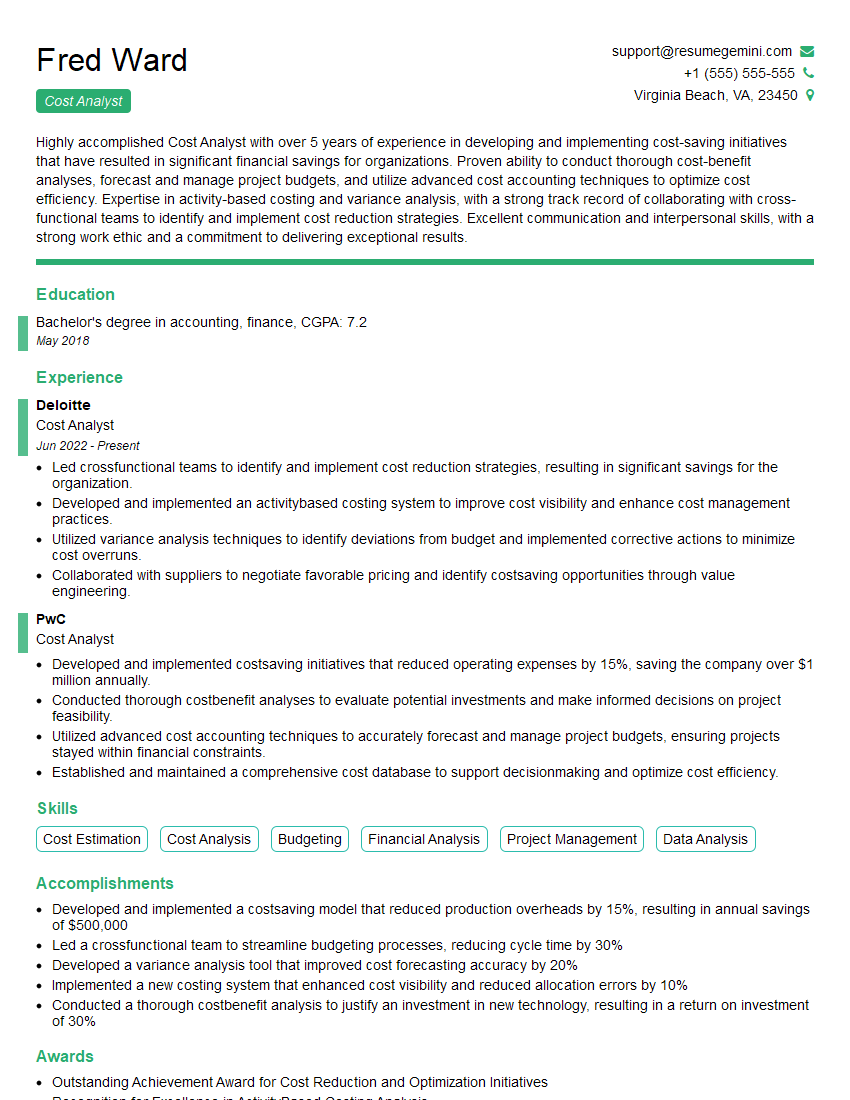
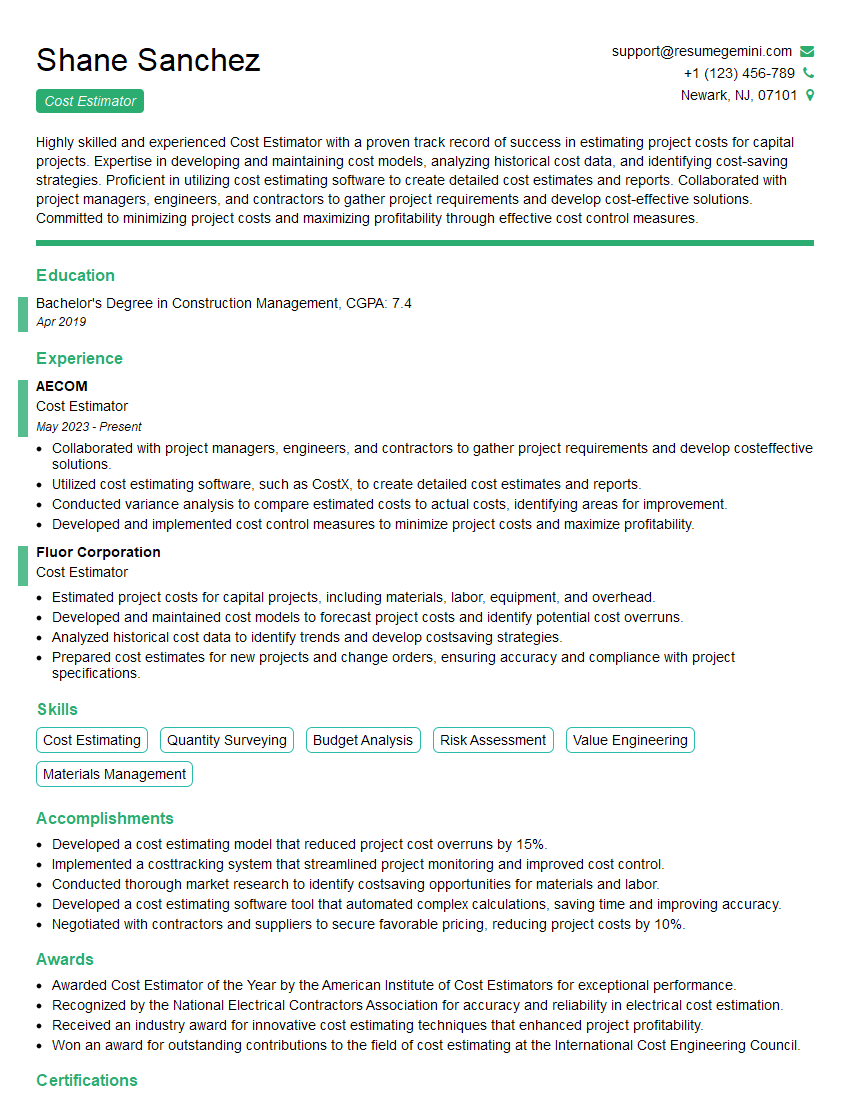
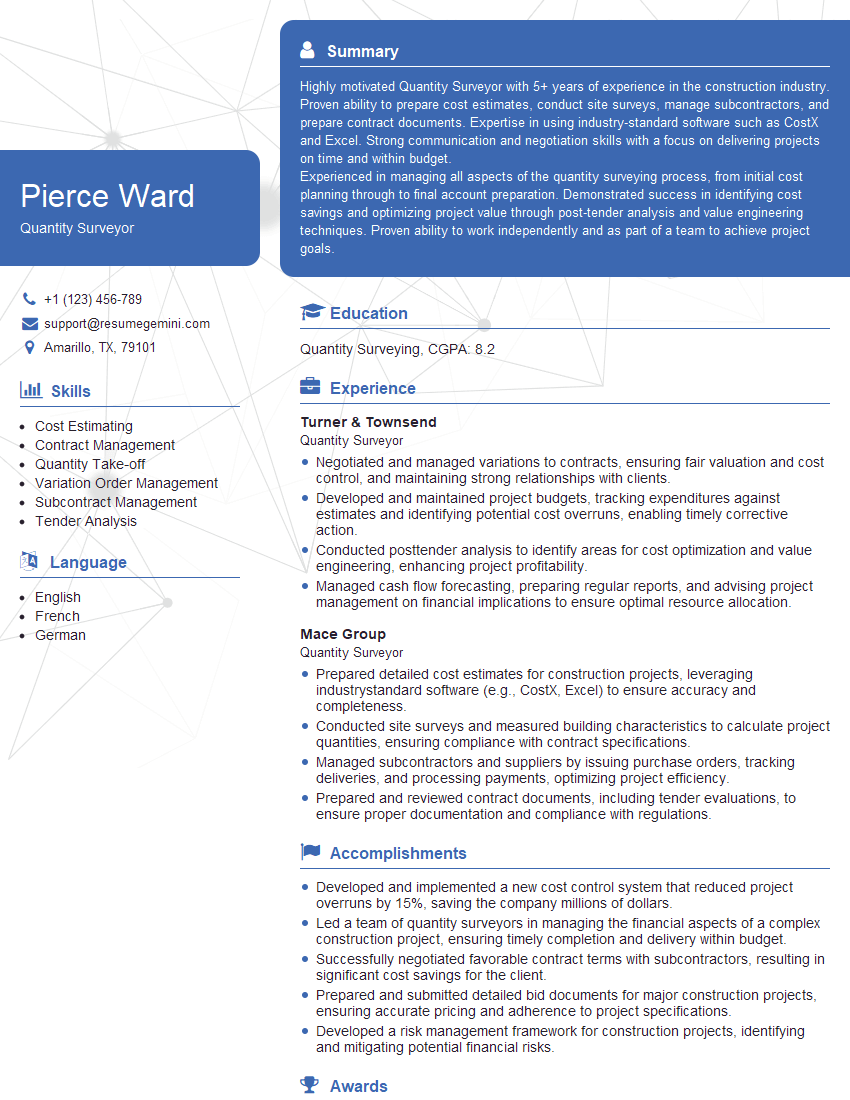
Mastering Cost Estimating and Value Engineering opens doors to exciting career advancements, offering opportunities for increased responsibility, higher earning potential, and leadership roles within the construction, engineering, or project management fields. A strong resume is crucial to showcasing your skills and experience effectively. To maximize your job prospects, create an ATS-friendly resume that highlights your accomplishments and keywords relevant to the industry. ResumeGemini is a trusted resource to help you build a professional and impactful resume. We provide examples of resumes tailored to Cost Estimating and Value Engineering roles to help you get started.
Explore more articles
Users Rating of Our Blogs
Share Your Experience
We value your feedback! Please rate our content and share your thoughts (optional).
What Readers Say About Our Blog
Very informative content, great job.
good