Feeling uncertain about what to expect in your upcoming interview? We’ve got you covered! This blog highlights the most important Costume Design for Museums interview questions and provides actionable advice to help you stand out as the ideal candidate. Let’s pave the way for your success.
Questions Asked in Costume Design for Museums Interview
Q 1. Describe your experience with the conservation of delicate textiles.
Conserving delicate textiles requires a meticulous approach, combining scientific understanding with artistic sensitivity. It’s like restoring a precious painting – every brushstroke, in this case, every thread, needs careful consideration.
My experience encompasses a wide range of techniques, from basic cleaning methods like vacuuming with specialized equipment to more complex treatments addressing issues like pest infestation, discoloration, and structural weaknesses. For instance, I’ve successfully treated a 19th-century silk gown affected by moth damage using a combination of careful hand-mending and minimal patching using archival-quality materials. This involved stabilizing the existing fabric before gently filling the holes with silk threads of a closely matching color and texture. I always prioritize minimal intervention, aiming to preserve the original fabric as much as possible. Documentation of every step is crucial, creating a record for future conservators.
- Surface Cleaning: Using soft brushes and appropriate solvents to remove loose dirt and grime.
- Pest Control: Employing integrated pest management strategies to prevent further damage and eliminate existing infestations.
- Stabilization: Using appropriate supports and techniques to prevent further deterioration and improve the structural integrity of fragile areas.
- Repair: Mending tears and holes using archival-quality materials and techniques that are reversible.
Q 2. Explain your process for researching historical costume for an exhibition.
Researching historical costume for an exhibition is akin to detective work – piecing together clues to create a compelling narrative. My process involves a multifaceted approach:
- Primary Sources: I begin by exploring primary sources such as original garments, photographs, paintings, and personal letters from the period. For example, when preparing an exhibition on Victorian mourning attire, I studied surviving mourning dresses, examined period photographs depicting mourning customs, and consulted diaries and letters revealing contemporary attitudes towards death and bereavement. This helps me understand the construction techniques and social significance of clothing.
- Secondary Sources: Scholarly articles, books, and museum catalogs provide crucial background information. These help to understand cultural contexts, evolving fashion trends, and manufacturing processes. This is critical to providing accurate historical context.
- Museum Collections: Visiting museum collections and archives is crucial for hands-on examination of objects. This allows me to assess the materials, construction methods, and condition of similar garments.
- Expert Consultation: Collaborating with historians, conservators, and textile experts is vital to ensuring accuracy and avoiding potential misinterpretations.
The end goal is not simply to recreate costumes but to use them to tell a convincing story about the people who wore them, the social and economic forces which shaped them, and their enduring cultural relevance.
Q 3. How would you handle a damaged costume requiring urgent repair?
Handling a damaged costume requiring urgent repair requires quick decision-making and a structured approach. Think of it like a medical emergency – you need to stabilize the situation before you can treat it.
- Assessment: Immediately assess the extent and nature of the damage. Photography and detailed documentation are crucial at this stage. For example, if a seam has ripped, I’d note its location, length, and the type of fabric involved.
- Emergency Stabilization: Take immediate steps to prevent further damage. This might involve supporting torn areas with temporary tissue paper supports or carefully pinning loose sections to prevent further unraveling.
- Consultation: Consult with conservators and other specialists as needed to determine the best course of action. A second pair of eyes can be very helpful in devising a conservative repair plan.
- Repair: Execute repairs using reversible techniques and archival-quality materials. The repair should be minimally invasive and easily documented for future review. This might involve using fine needles and thread closely matching the original material to mend a tear.
- Post-Repair Assessment: Once the repair is complete, conduct a thorough assessment to ensure the structural integrity of the costume and to document the repair process.
Q 4. What methods do you employ to document and catalog costume collections?
Documentation and cataloging are paramount for effective collection management. It’s like creating a detailed blueprint of your inventory that ensures easy access and understanding of each item. My methods include:
- Detailed Inventory Records: Each costume receives a unique identification number and comprehensive records including its acquisition details, maker, date, materials, construction techniques, condition, and any known provenance. This provides a clear picture of each item’s history and allows effective tracking.
- Visual Documentation: High-resolution photographs and digital scans capture the costume’s overall appearance, detailing, and condition from multiple angles. This allows examination of individual components and provides a permanent record.
- Textile Analysis: Fiber content and dye composition are documented through tests, helping to understand the materials and techniques used in manufacturing. This is important in identifying potential conservation issues.
- Database Management: All documentation is entered into a database management system, which enables efficient searching, sorting, and analysis of the collection. This system should ideally allow for cross-referencing between multiple data points.
- Conservation Records: All conservation treatments are meticulously documented, including the techniques employed, materials used, and the results of the treatment. This creates a valuable audit trail for future reference.
Q 5. Describe your experience with creating display mounts for costumes.
Creating display mounts for costumes requires a balance of aesthetics and conservation. It’s like designing a custom cradle for a precious baby – both supportive and attractive. My approach incorporates:
- Material Selection: I use archival-quality materials that won’t damage the costume over time. This includes acid-free foam, cotton batting, and inert supports. Materials must be selected to complement the exhibit’s theme and the costume’s aesthetic.
- Support Structure Design: The mount must provide adequate support without putting undue stress on delicate fabrics or seams. This might involve carefully draping the garment on a custom form or suspending it from strategically placed points.
- Climate Control: Considerations are given to proper environmental conditions, preventing light degradation, keeping temperature and humidity within specified tolerances, minimizing dust exposure.
- Aesthetics: The mount should be visually appealing and enhance the presentation of the costume without distracting from the object itself. The mount should be designed to not only support the garment but also complement its design.
- Reversibility: The mount should be designed to be easily removable without damaging the costume. This allows for future access and minimizes damage to the historical artifacts.
Q 6. How familiar are you with different textile fibers and their conservation needs?
Understanding textile fibers and their conservation needs is fundamental to my work. It’s like being a doctor who understands the individual needs of each patient. Each fiber has unique properties that dictate how it should be handled. I have extensive knowledge of:
- Natural Fibers: Silk, linen, wool, cotton – each reacts differently to light, humidity, and pests. For example, silk is notoriously delicate and prone to damage from light exposure, while wool can be susceptible to moth damage.
- Synthetic Fibers: Rayon, nylon, polyester – these have their own set of challenges related to degradation and potential chemical interactions. For example, some synthetic dyes can be unstable over time and prone to fading or bleeding.
- Fiber Identification: I utilize microscopic analysis and other analytical methods to identify the fiber composition of garments. This knowledge helps me select appropriate conservation techniques.
- Dye Analysis: Understanding the types of dyes used can help predict the potential for color fading or bleeding. This informs decisions on light exposure and handling.
This understanding helps me develop targeted preservation strategies for each costume, ensuring its long-term survival.
Q 7. Explain your understanding of ethical considerations in handling historical costumes.
Ethical considerations in handling historical costumes are paramount. It’s about respecting the past and ensuring that we act as responsible stewards of cultural heritage. My work is guided by principles of:
- Minimal Intervention: I prioritize preservation over restoration, intervening only when absolutely necessary and using reversible techniques. This ensures that future generations have the option of undoing any interventions if new technologies or knowledge emerge.
- Transparency and Documentation: All conservation treatments are meticulously documented, including the rationale behind each decision. This allows for scrutiny and provides transparency for future researchers and conservators.
- Respect for Cultural Significance: I am mindful of the cultural and social context of each costume and ensure its handling reflects its importance. This includes respecting any cultural sensitivities or religious beliefs associated with certain garments.
- Accessibility and Inclusivity: I strive to ensure that the collection is accessible to the widest possible audience, while respecting the object’s vulnerabilities. This includes careful display and documentation, and educational efforts to ensure appropriate understanding of the artifacts.
By adhering to these ethical guidelines, I ensure that historical costumes are treated with the respect they deserve, contributing to their long-term preservation and understanding for future generations.
Q 8. What software programs are you proficient in for managing costume collections?
Managing a museum’s costume collection requires robust software. My proficiency lies in several key programs. I utilize Collections Management Software such as PastPerfect or TMS (The Museum System) for cataloging, tracking condition reports, and managing provenance (the history of ownership). These systems allow for detailed descriptions of each garment, including materials, construction techniques, and any associated documentation. I also rely heavily on Digital Asset Management (DAM) systems, like Canto or Adobe Experience Manager, to organize and manage high-resolution images and digital files related to the costumes. This ensures easy access for researchers and staff, prevents loss of data, and facilitates collaboration. Finally, spreadsheet software like Microsoft Excel remains invaluable for creating custom reports, analyzing data trends regarding conservation needs or popular exhibition pieces, and tracking budgets.
For example, using PastPerfect, I can quickly generate a report of all silk garments requiring special environmental controls, helping me prioritize conservation efforts. The DAM system allows me to easily share high-quality images with researchers around the world without compromising the original artifacts.
Q 9. Describe a time you had to solve a challenging problem related to costume preservation.
One particularly challenging case involved a delicate 18th-century silk gown heavily damaged by light exposure and previous improper storage. The silk was brittle and faded, with several tears and significant moth damage. My initial assessment revealed the need for a multi-stage approach. First, we carefully cleaned the garment using specialized techniques to remove surface dirt and stabilize loose fibers. This involved using a low-pressure vacuum and soft brushes. Next, we meticulously repaired the tears using conservation-grade silk threads and Japanese tissue, matching the original weave as closely as possible. This painstaking work took several months. Finally, we created a custom-made archival storage box with acid-free materials and controlled environmental conditions (temperature and humidity) to prevent further deterioration. The success of this project hinged on careful planning, precise execution, and meticulous attention to detail. The gown is now safely preserved and available for study and exhibition.
Q 10. How would you approach the design and layout of a costume exhibition?
Designing a costume exhibition requires a thoughtful approach. It begins with defining a clear narrative or theme, then selecting artifacts that effectively tell that story. I usually start by creating a detailed floor plan, considering the flow of the exhibition, ensuring sufficient space for each garment, and providing clear signage. The layout should be both aesthetically pleasing and accessible to all visitors. Then, I carefully consider the presentation of each costume, including appropriate lighting (to minimize light damage), mounts (to support the garment without causing stress), and environmental controls. Interactive elements, such as touchscreens or audio guides, can enrich the visitor experience while providing additional context. The overall design should balance the aesthetic appeal of the costumes with the educational goals of the exhibition. For instance, a chronological display can highlight the evolution of a particular style, while a thematic exhibition could showcase costumes associated with a historical event or a specific artist’s work.
Q 11. What are your preferred methods for photographing and documenting costumes for archival purposes?
High-quality photographic documentation is crucial for archival purposes. I prefer using a high-resolution digital SLR camera with macro lenses, allowing for close-up shots that capture intricate details of the fabric, construction, and any embellishments. For lighting, I use diffused natural or artificial light to minimize harsh shadows and reflections. I employ a systematic approach, photographing each garment from multiple angles (front, back, sides, and details) with consistent lighting and scale. Metadata, including the garment’s ID number, date of photography, and any relevant notes, is meticulously recorded and attached to each image. Images are stored in a well-organized digital asset management system, ensuring easy retrieval and sharing. Additionally, 3D scanning technology can be invaluable in creating detailed digital records, enabling researchers to study garments in a non-destructive way.
Q 12. Describe your experience with working with diverse teams on museum projects.
I thrive in collaborative environments. Museum projects inherently involve diverse teams, including conservators, curators, educators, designers, and installation crews. Effective communication and mutual respect are paramount. I actively participate in team meetings, clearly articulating my vision and actively listening to the contributions of others. I also focus on building strong working relationships based on trust and understanding. My experience has taught me the value of compromise and finding creative solutions that accommodate everyone’s needs while maintaining the integrity of the project. For example, working on a recent exhibition about 20th-century fashion, I collaborated closely with the curator to align the design with the exhibition narrative, and with the conservators to ensure the safe handling and display of fragile garments.
Q 13. How do you ensure the long-term preservation of costumes under varying environmental conditions?
Long-term preservation demands a proactive approach to environmental control. This involves maintaining stable temperature and relative humidity levels within the storage and display areas. Fluctuations in temperature and humidity can cause significant damage to textiles, leading to weakening fibers, color fading, and pest infestations. Appropriate storage materials are crucial, utilizing acid-free boxes, tissue paper, and supports to minimize stress on the garments. Regular monitoring of environmental conditions and the condition of the costumes is essential through scheduled inspections and detailed documentation. Proper pest control measures, including regular inspections and preventative treatments, are also implemented. In addition to climate control, minimizing light exposure through UV filtering and controlled lighting schedules is key to slowing down light-induced deterioration.
Q 14. What are your strategies for managing budgets and resources related to costume conservation?
Budget management is a crucial aspect of costume conservation. I create detailed budgets that outline all anticipated expenses, including materials, labor, storage, and equipment. This requires careful research and sourcing of materials to balance quality with cost-effectiveness. Prioritization of projects based on the condition of the garments and their significance is essential. This involves creating a ranked list of conservation needs, focusing on the most vulnerable items first. Regular tracking of expenditures and reporting allows for proactive adjustments and ensures funds are used efficiently and effectively. Securing grants and fundraising are other strategies used to supplement existing budgets. For example, we recently successfully secured a grant to fund the conservation of a historically significant wedding dress, enabling us to address its significant deterioration and preserve it for future generations.
Q 15. Explain your understanding of different types of costume storage and their suitability.
Costume storage is crucial for preserving these delicate artifacts. The method chosen depends heavily on the garment’s material, construction, and the museum’s resources. Broadly, we categorize storage into three main types:
- Acid-free archival boxes and storage containers: These are essential for individual garments, particularly those made from delicate materials like silk or lace. The acid-free environment prevents degradation and discoloration. For example, a finely embroidered 18th-century gown would be individually boxed, ideally with acid-free tissue paper separating layers to prevent abrasion.
- Climate-controlled storage rooms: These rooms maintain consistent temperature and humidity levels, crucial for preventing mold, mildew, and insect infestations. They’re ideal for larger collections or for storing costumes in their entirety, potentially on mannequins. Think of a large collection of Victorian-era dresses, best stored in a climate-controlled room to minimize changes in material properties.
- Environmental chambers: For extremely sensitive or valuable items, environmental chambers offer precise control over temperature, humidity, and even light exposure. They are expensive and best suited for irreplaceable pieces, maybe a historically significant royal robe needing extreme protection.
Suitability is determined by a risk assessment of the garment, and the available budget and facilities. A smaller museum might rely heavily on archival boxes and a climate-controlled room, whereas a larger institution might have dedicated environmental chambers.
Career Expert Tips:
- Ace those interviews! Prepare effectively by reviewing the Top 50 Most Common Interview Questions on ResumeGemini.
- Navigate your job search with confidence! Explore a wide range of Career Tips on ResumeGemini. Learn about common challenges and recommendations to overcome them.
- Craft the perfect resume! Master the Art of Resume Writing with ResumeGemini’s guide. Showcase your unique qualifications and achievements effectively.
- Don’t miss out on holiday savings! Build your dream resume with ResumeGemini’s ATS optimized templates.
Q 16. How familiar are you with pest control and prevention methods in costume storage?
Pest control is paramount in costume storage. We utilize a multi-pronged approach focused on prevention and early detection. This includes:
- Regular inspections: Visual checks for signs of infestation (e.g., insect frass, webbing) are carried out frequently. Early detection is key.
- Environmental control: Maintaining low humidity and temperature levels helps deter many pests. Climate-controlled storage is vital.
- Vacuum sealing: Packing high-risk items in vacuum-sealed bags can significantly reduce pest access. This is particularly useful for seasonal storage or transferring items.
- Freezing: For smaller, isolated infestations, freezing can kill pests. The time and temperature needed depend on the pest.
- Professional pest control: In cases of major infestations, certified pest control professionals using approved museum-safe treatments are essential. This involves careful selection of methods to avoid damaging the costumes.
Prevention is always more cost-effective than treatment. Therefore, we prioritize strict hygiene protocols, thorough cleaning of storage spaces, and vigilant monitoring.
Q 17. Describe your experience with preparing costumes for display, including mounting and lighting.
Preparing costumes for display requires meticulous planning and execution. It’s a balance between showcasing the garments beautifully and protecting them from further damage.
- Mounting: We utilize acid-free mannequins or custom-made supports tailored to the garment’s shape and structure. Methods vary from simple padded hangers for lighter items to intricate custom supports that cradle delicate embroidery and prevent strain on seams. Sometimes, we use invisible threads to gently secure parts to the support. For example, a heavy brocade dress would need a more robust support system than a lightweight linen shirt.
- Lighting: Lighting is crucial, yet it can also degrade fabrics. We use low-intensity, UV-filtered lighting, often LED, to minimize light damage. The placement of lights also prevents shadows and highlights the garment’s features. Think of how strategically placed lighting can enhance the richness of a velvet fabric or the delicate lace patterns on a sleeve.
- Environmental monitoring: Throughout the exhibition, we continuously monitor temperature and humidity levels within the display case to ensure the garment’s well-being.
Each costume’s preparation is unique, dictated by its material, condition, and the exhibition’s narrative. Safety and preservation always come first.
Q 18. Explain your familiarity with various display techniques for enhancing the presentation of costumes.
Display techniques significantly enhance a costume’s impact. They tell a story and enhance the visitor experience.
- Thematic displays: Grouping costumes around a specific theme (e.g., ‘Women’s Suffrage,’ ‘Hollywood Glamour’) provides context and narrative.
- Interactive elements: Incorporating interactive elements like touch screens, videos, or audio recordings engages visitors and deeper understanding.
- Environmental storytelling: Careful attention to background colors, lighting, and display cases creates the right atmosphere to complement the costumes. A dark, moody background might enhance a gothic-era gown, while a bright background might suit a cheerful Victorian-era dress.
- Detailed labels and descriptions: Clear, concise labels provide essential information about the garment’s history, maker, and material.
- 3D scanning and digital reproductions: For highly fragile garments, digital representations can minimize handling while still allowing full appreciation.
The goal is to create an immersive and educational experience without compromising the safety or integrity of the artifacts. Balance is crucial.
Q 19. How would you handle a conflict between preservation needs and exhibition demands?
Balancing preservation and exhibition demands is a constant challenge. I prioritize a collaborative approach, involving conservators, curators, and exhibition designers to create a solution that minimizes risk. This might involve:
- Rotating displays: Showcasing only a portion of the collection at any given time limits exposure and allows for periodic rest and conservation.
- Limited handling: Using alternative display methods (like high-quality reproductions) to reduce direct handling of fragile items.
- Short exhibition runs: Minimizing the exhibition duration minimizes exposure to environmental factors like light and fluctuating temperature.
- Specialized display cases: Employing cases with climate control, UV filtration, and other environmental protections.
- Condition assessments: Pre and post-exhibition condition assessments provide critical data on the garment’s response to display.
The decision-making process is always guided by the principle of ‘do no harm.’ Prevention is key, and any potential risk needs to be carefully weighed against the educational and cultural value of the exhibition.
Q 20. Describe your experience with writing grant proposals or fundraising for costume-related projects.
I have extensive experience writing grant proposals and fundraising for costume-related projects. This involves:
- Identifying funding opportunities: Researching and applying for grants from foundations, government agencies, and corporations that support cultural heritage initiatives.
- Developing compelling proposals: Clearly articulating the project’s goals, methods, budget, and impact, highlighting the significance of the project in preserving cultural heritage.
- Building relationships with funders: Cultivating relationships with potential funders to enhance the proposal’s success.
- Budget management: Developing a detailed, realistic budget and monitoring expenditures.
- Reporting: Providing regular reports to funders to demonstrate progress and accountability.
I’ve successfully secured funding for projects involving costume conservation, digitization, and exhibition development. Strong narratives, detailed budgets, and a clear demonstration of impact are critical for successful grant applications.
Q 21. What are your strategies for engaging the public in learning about costume history and conservation?
Engaging the public is crucial for promoting costume history and conservation. My strategies include:
- Interactive exhibits: Creating hands-on exhibits allows visitors to engage directly with costumes, perhaps through touch screens or virtual reality.
- Educational programs: Developing workshops, lectures, and guided tours that highlight the history and significance of costumes. Consider a workshop where visitors learn basic textile repair techniques.
- Public lectures and talks: Inviting leading experts in costume history and conservation to share their knowledge.
- Social media and online resources: Using social media platforms and creating online resources to reach a wider audience. Think of Instagram posts showcasing behind-the-scenes conservation work.
- Community partnerships: Collaborating with schools, local organizations, and community groups to foster interest in costume history.
By making the subject accessible, engaging, and relevant, we can cultivate appreciation for our cultural heritage and the vital role of conservation in protecting it. Storytelling is key.
Q 22. How would you approach the creation of interpretive labels for a costume exhibition?
Creating interpretive labels for a costume exhibition requires a multi-faceted approach, balancing scholarly accuracy with engaging storytelling. I begin by thoroughly researching the costume’s historical context, including its maker, wearer, the period it represents, and its social significance. This research informs the narrative of the label.
My labels avoid overly technical jargon and instead focus on conveying information accessibly. For example, instead of saying “the garment exhibits characteristics of the Rococo style,” I might write, “This elegant dress showcases the flowing lines and ornate embellishments typical of the 18th-century Rococo style, reflecting a period of lavish court life.”
I also consider the target audience. Labels for children will differ significantly in tone and complexity from those aimed at adult scholars. Visual elements such as high-quality images and detailed close-ups of unique details are crucial. Finally, I always aim for concise and impactful language; a well-crafted label can convey rich information within a limited space.
- Example: For a Victorian mourning dress, the label might highlight the symbolism of the colors (black, purple), fabrics (crepe, bombazine), and accessories (jet jewelry) in relation to Victorian mourning rituals.
Q 23. Describe your experience with collaborating with other museum departments (e.g., education, marketing).
Collaboration is integral to successful museum work. I’ve extensively collaborated with education and marketing departments on numerous exhibitions. With the education department, I’ve worked to develop hands-on activities and educational materials that complement the costume displays. For example, I helped design a tactile recreation of a 19th-century textile for a visually impaired program.
My collaboration with marketing often involves creating visually appealing images of the costumes for promotional materials, website content, and social media. I ensure that the images accurately represent the costumes while adhering to museum guidelines regarding photographic techniques and copyright issues. I’ve even been involved in choosing titles for exhibitions, ensuring that titles are historically accurate, engaging, and accessible to a wide audience. For example, we shifted from a dry title like “Textiles of the Georgian Era” to the more public-friendly “Fashioning Georgian Society.”
Q 24. How would you assess the condition of a historical costume and determine the appropriate conservation treatment?
Assessing the condition of a historical costume involves a careful and systematic approach. I begin with a visual inspection, documenting any visible damage like tears, stains, holes, or areas of significant weakening. Then, I use specialized tools like magnifying glasses to examine the fibers and construction techniques. This helps to understand the garment’s material composition, construction methods, and potential weaknesses.
I often employ non-destructive testing methods like ultraviolet (UV) light to reveal stains or repairs that aren’t visible to the naked eye. Based on this assessment, I determine the appropriate conservation treatment, which might range from simple cleaning and stabilization to complex repairs using historically accurate materials and techniques. Decisions are made in consultation with a conservator, considering the garment’s fragility, historical value, and the long-term preservation goals.
Example: A silk gown with significant fading might require specialized cleaning and environmental control, whereas a heavily damaged garment could require more invasive techniques, including patching with compatible materials. Documentation of each step is crucial.
Q 25. What are the key factors to consider when selecting materials for costume repairs or mounts?
Selecting materials for costume repairs or mounts requires careful consideration. The primary goal is to use materials that are compatible with the original garment’s materials and will not cause further damage. Reversibility is another key factor; any repairs or mounts should be easily removable without harming the original artifact.
I prioritize using materials that are chemically inert, archival-quality, and have a proven track record of longevity. Examples include high-quality linen thread, silk ribbons (matching original), and acid-free cotton support fabrics. For mounts, I prefer acid-free foam core and archival-quality display materials. Modern synthetic materials are carefully evaluated for their potential to cause harm over time.
Example: When repairing a silk dress, I would avoid using synthetic adhesives that may migrate and damage the silk fibers over time. I’d opt for a consolidant or adhesive that is specifically formulated for textile conservation.
Q 26. Describe your experience in assessing the authenticity and provenance of historical costumes.
Assessing authenticity and provenance is fundamental to the work. This involves a thorough investigation of the costume’s history, using a variety of methods. I examine the construction techniques, materials, and embellishments, comparing them to known examples from the relevant period and region.
I carefully review any existing documentation, such as labels, photographs, letters, or bills of sale. I may consult with textile experts, historians, and other specialists. Physical examination helps identify inconsistencies – for instance, the use of modern threads in a supposed 18th-century garment would raise a red flag. Provenance research requires examining records of ownership, inheritance, sales, and any other information tracing the costume’s journey through time.
Example: I once examined a purported 19th-century ball gown. Through meticulous examination, I found that the buttons were made of a type of plastic that wasn’t invented until the 20th century, indicating a later date of manufacture than claimed.
Q 27. How would you respond to damage or theft of a valuable costume from the collection?
Responding to damage or theft requires immediate action. My first step is to secure the remaining collection, and if theft, involve museum security and local law enforcement. Detailed documentation of the damage or missing item is essential, including photographs, detailed descriptions, and inventory numbers. I’d collaborate with the museum’s registrar to update the collection records and insurance claims.
Depending on the nature of the damage, we might need to conduct a thorough investigation to determine the cause and implement preventative measures for the future. Depending on the value and significance of the affected item, conservation treatments might be necessary to preserve what remains. In cases of theft, recovery efforts would be pursued, while working with law enforcement to bring the culprits to justice. The incident would be fully documented for insurance and for future preventive security upgrades.
Q 28. What are your methods for ensuring the accurate and complete documentation of costume restoration work?
Accurate and complete documentation of costume restoration is crucial for transparency, reproducibility, and the preservation of knowledge. I employ a multi-stage process. Before any work begins, I create a detailed condition report with photographs and drawings of the costume’s current state.
During the restoration process, I meticulously document every step using digital photography, written notes, and potentially video recordings. This includes the materials used, the techniques employed, and any challenges encountered. The completed documentation is compiled into a comprehensive report, including images before, during, and after treatment. This information is stored in the museum’s archives and can be referenced for future conservation or research purposes. It aids in tracking the history of the garment and its treatments, ensuring its long-term preservation.
Key Topics to Learn for Your Costume Design for Museums Interview
- Historical Accuracy & Research: Understanding the nuances of different historical periods and their sartorial styles. This includes researching primary sources like paintings, photographs, and written accounts.
- Material Selection & Sourcing: Knowing the properties of various fabrics and their appropriate use for different eras and purposes. This includes considering cost, durability, and authenticity of materials.
- Conservation & Preservation Techniques: Familiarity with proper handling, storage, and display methods for delicate costumes. Understanding the ethical considerations involved in costume restoration and repair.
- Museum Display & Exhibition Design: How to effectively showcase costumes within a museum setting, considering lighting, mannequins, and environmental factors. Understanding the narrative impact of costume presentation.
- Budgeting & Project Management: Experience in managing budgets, timelines, and collaborations with other museum professionals (conservators, curators).
- Costume Construction & Fabrication: Demonstrating a strong understanding of various sewing techniques, pattern making, and construction methods relevant to historical costumes. Being able to discuss different levels of replica accuracy.
- Interpretation & Contextualization: The ability to understand and communicate the cultural, social, and historical significance of the costumes you design and display.
Next Steps: Unlock Your Museum Career
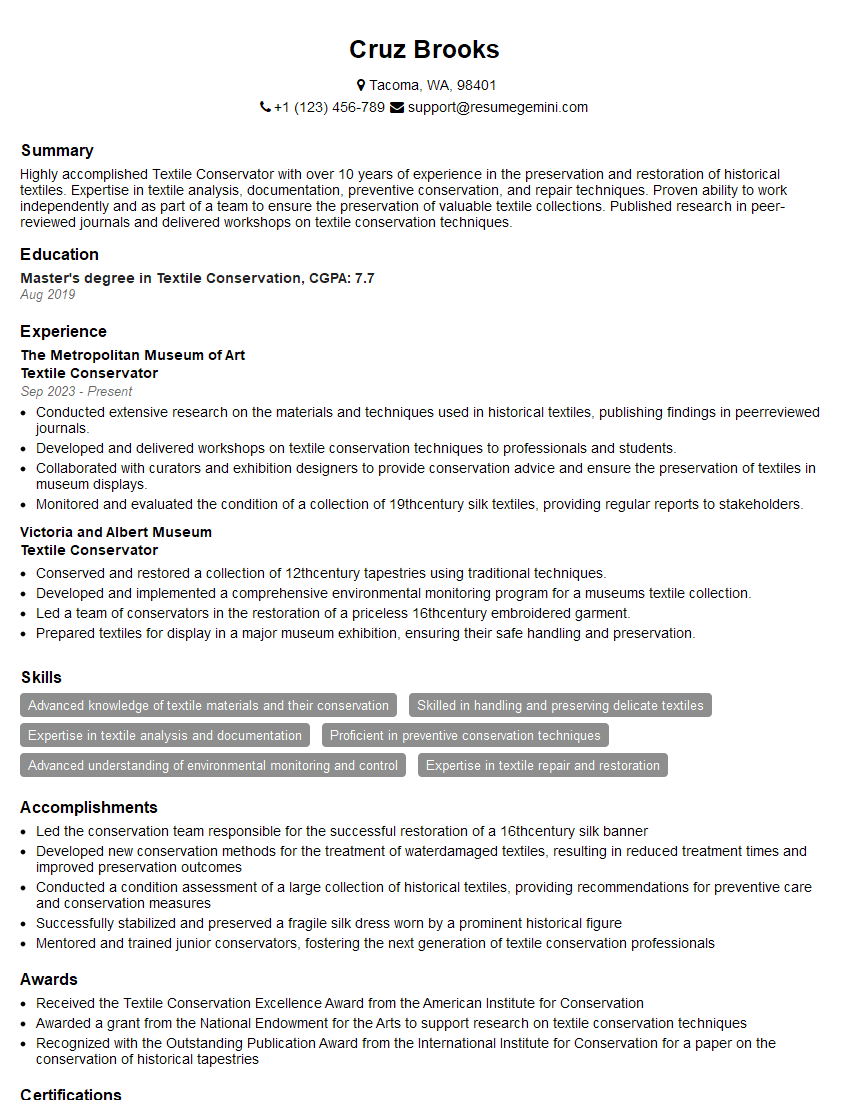
Mastering Costume Design for Museums opens doors to a fulfilling career working with history, art, and culture. It allows you to contribute meaningfully to preserving our shared heritage and sharing it with the public. To maximize your job prospects, creating an ATS-friendly resume is crucial. An effective resume will highlight your skills and experience, making it easier for recruiters to find you. We recommend using ResumeGemini, a trusted resource for building professional resumes that stand out. ResumeGemini provides examples of resumes specifically tailored to Costume Design for Museums to help you get started.
Explore more articles
Users Rating of Our Blogs
Share Your Experience
We value your feedback! Please rate our content and share your thoughts (optional).
What Readers Say About Our Blog
Very informative content, great job.
good