Unlock your full potential by mastering the most common Court Reporting Skills interview questions. This blog offers a deep dive into the critical topics, ensuring you’re not only prepared to answer but to excel. With these insights, you’ll approach your interview with clarity and confidence.
Questions Asked in Court Reporting Skills Interview
Q 1. What is your typing speed and accuracy rate?
My typing speed consistently averages 225 words per minute with a 99% accuracy rate. This speed and accuracy are crucial for capturing testimony accurately and efficiently, even during fast-paced proceedings. I regularly practice to maintain and improve these metrics, using timed typing tests and focusing on maintaining proper posture and technique to prevent fatigue and errors.
For example, during a recent deposition, the witness spoke rapidly, delivering complex technical information. My high typing speed allowed me to capture every word without sacrificing accuracy, ensuring a complete and reliable record.
Q 2. Describe your experience with different court reporting software.
I’m proficient in several leading court reporting software packages, including Case CATalyst, Stenograph’s CaseView, and Eclipse. My experience extends beyond basic transcription; I’m comfortable managing case files, utilizing the software’s features for indexing, searching, and producing transcripts in various formats (e.g., PDF, Word). I understand the intricacies of each software’s features, such as different styles of formatting and export options. I can adapt quickly to new software as needed.
For instance, I utilized Case CATalyst’s advanced search capabilities to quickly locate specific testimony in a lengthy deposition, saving significant time for the attorneys involved. My proficiency in multiple software packages ensures flexibility and adaptability to different client needs and preferences.
Q 3. Explain the difference between realtime and transcript reporting.
Realtime reporting and transcript reporting represent distinct phases in the court reporting process. Realtime reporting involves simultaneously typing the spoken words as they are being spoken, providing a near-instantaneous text output. This is typically displayed on a monitor and used during the proceedings. Transcript reporting refers to the subsequent creation of a polished, edited, and formatted document from the realtime feed or audio recordings. It involves reviewing, correcting, and finalizing the transcript for accuracy and readability.
Think of it like this: Realtime reporting is like a live news broadcast, providing immediate information, while transcript reporting is like the meticulously edited news story appearing in the newspaper the next day. The realtime feed provides a preliminary record, while the final transcript is the official, legally binding record.
Q 4. How do you handle difficult or challenging speakers?
Handling difficult or challenging speakers requires a combination of skills. Firstly, I focus intensely on listening and observing. I utilize active listening techniques, focusing on the speaker’s message, rather than getting distracted by speech impediments, accents, or mumbling. I pay close attention to their nonverbal cues, which sometimes help clarify ambiguous statements. If necessary, I’ll politely request clarification without interrupting the flow of the proceedings too much. This might involve a simple ‘Excuse me, could you repeat that please?’
I remember a case where a witness spoke with a very thick accent. By focusing on the core meaning of their words and carefully studying their pronunciation patterns, I was able to create a highly accurate transcript.
Q 5. What strategies do you use to maintain accuracy during fast-paced proceedings?
Maintaining accuracy during fast-paced proceedings requires a proactive approach. I utilize several strategies: I employ efficient shorthand techniques to capture rapid speech, focusing on key words and phrases. I use my knowledge of legal terminology and context to anticipate the speaker’s words and fill in any gaps in my notes. I maintain a consistent typing rhythm, avoiding unnecessary pauses or rushed strokes. Finally, I prioritize accuracy over speed if a choice needs to be made; a perfectly accurate, slightly slower transcript is far preferable to a fast but inaccurate one.
In high-pressure situations, I maintain focus through deep breathing and mindfulness techniques. This keeps me calm and centered, enhancing my concentration and precision.
Q 6. How do you manage transcription errors and corrections?
Managing transcription errors and corrections is an integral part of the process. I utilize a multi-step approach: During realtime reporting, I flag potential errors using specific notations (such as using parentheses or question marks). Following the proceedings, I meticulously review the entire transcript, listening back to the audio recording for accuracy verification. Corrections are made, ensuring consistency in terminology, punctuation, and formatting. Finally, the corrected transcript is proofread carefully before submission to meet the highest standards of accuracy and professionalism.
My workflow employs a quality control check, involving a second review and/or proofread by another qualified professional when needed, especially for highly complex or sensitive cases.
Q 7. Explain your familiarity with legal terminology and procedures.
My familiarity with legal terminology and procedures is extensive. Years of experience in court reporting have provided me with a strong understanding of legal jargon, procedural rules, and courtroom etiquette. I’m comfortable with terms like voir dire, deposition, subpoena, and numerous other legal phrases. Furthermore, I understand the different phases of legal proceedings and the specific requirements for each stage, enabling me to adapt my reporting accordingly. I’m also adept at understanding complex legal concepts and translating them accurately into written form.
I regularly update my legal knowledge through continuing education and professional development programs, ensuring I stay current on evolving legal terminology and procedures. This continuous learning is vital for providing the highest quality service to my clients.
Q 8. How do you manage multiple assignments and deadlines?
Managing multiple assignments and deadlines as a court reporter requires meticulous organization and prioritization. Think of it like a conductor leading an orchestra – each musician (assignment) has their own part, and the conductor needs to ensure they all play in harmony and at the right time.
- Prioritization: I use a project management system to list all my assignments, noting deadlines and urgency. I prioritize tasks based on deadlines and the potential impact of delays. For example, a high-profile trial takes precedence over a less time-sensitive deposition.
- Time Blocking: I allocate specific time slots for each task, factoring in transcription time, proofing, and client communication. This prevents tasks from overlapping and ensures I meet all my deadlines.
- Communication: Proactive communication with clients about potential delays or scheduling conflicts is crucial. Transparency is key to managing expectations and maintaining positive professional relationships.
For instance, I once had three simultaneous deadlines: a large deposition transcript due the following day, a trial transcript needing final proofing, and a new deposition scheduled for the same day. By prioritizing the urgent deposition transcript, allocating specific time blocks for each, and proactively communicating a potential slight delay with the trial transcript client, I successfully met all deadlines without compromising quality.
Q 9. Describe your experience with different types of legal proceedings (e.g., depositions, trials).
My experience encompasses a wide range of legal proceedings. I’ve worked on everything from straightforward depositions to complex multi-day trials, and even arbitrations and mediations. Each proceeding has its own unique rhythm and demands different reporting skills.
- Depositions: These are usually less formal, focusing on witness testimony. The key here is accuracy in capturing nuanced language and subtle shifts in tone, ensuring all objections and sidebar discussions are recorded accurately.
- Trials: Trials are far more dynamic, involving multiple speakers, rapid-fire exchanges, and often complex legal arguments. In trials, maintaining speed and accuracy under pressure is crucial. I focus on capturing every word, every objection, every ruling, accurately capturing the essence of what is happening.
- Arbitrations and Mediations: These proceedings often require a different approach, focusing on concise recording of key points of negotiation and agreements. Confidentiality is paramount in these settings.
The difference between a deposition and a trial is analogous to a quiet conversation versus a lively debate. Both require precise listening, but the latter necessitates a higher level of speed and multitasking.
Q 10. How familiar are you with different reporting technologies?
I’m proficient in a variety of reporting technologies, including both stenographic machines and digital recording systems. My familiarity spans both traditional methods and cutting-edge software.
- Stenotype Machine: I’m highly skilled in using a stenotype machine, a specialized keyboard for rapid transcription. This offers unparalleled speed and accuracy, especially in fast-paced settings.
- Digital Recording Systems: I’m experienced with various digital audio recording equipment, which serves as a backup and provides audio files for review. This ensures a complete record, even if the stenotype machine encounters a problem.
- CAT Software (Computer-Assisted Transcription): I utilize CAT software to enhance transcription speed and efficiency. This software allows me to listen to the audio recording and type simultaneously, enhancing speed and accuracy.
My experience with various technologies makes me adaptable to different court settings and technological preferences. I can seamlessly transition between different systems, ensuring a consistent and high-quality output.
Q 11. Explain your experience with voice recognition software.
My experience with voice recognition software is extensive, and I utilize it as a supplementary tool, not a replacement for my stenographic skills. It’s a valuable tool for certain tasks, but human oversight and quality control are essential.
- Accuracy and Editing: Voice recognition software is prone to errors, especially with legal jargon or multiple speakers. I meticulously review and edit the output to ensure accuracy and proper formatting.
- Integration with other tools: I often integrate voice recognition software with my CAT software for a more efficient workflow. This allows for faster initial transcription, which I then thoroughly review and edit for accuracy.
- Limitations: It’s important to recognize the limitations of voice recognition; complex legal terms, background noise, and variations in speech patterns can significantly impact accuracy. Human intervention is therefore critical.
For example, I used voice recognition software to create a rough draft of a deposition transcript, which I then meticulously edited, ensuring the accuracy and proper formatting needed for legal proceedings. The software helped to save time, but human verification and refinement were essential to meet professional standards.
Q 12. How do you ensure the confidentiality of your work?
Confidentiality is paramount in court reporting. I understand and adhere to strict ethical guidelines regarding the handling of sensitive information. My commitment to confidentiality is unwavering.
- Secure Data Storage: I utilize encrypted hard drives and cloud storage with robust security protocols to protect all data. Access is restricted, and backups are regularly performed.
- Confidentiality Agreements: I readily sign confidentiality agreements to protect sensitive client data and uphold professional standards.
- Secure Workspaces: I maintain secure workspaces to prevent unauthorized access to documents. This includes password protection for all devices and data.
- Data Destruction: Upon completion of a project and after the retention period stipulated by law, I securely erase all data according to established procedures.
My commitment to confidentiality extends beyond simply following protocols; it’s a core value that guides my professional conduct. I understand that breaches of confidentiality can have serious consequences and am vigilant in preventing them.
Q 13. What is your experience with proofreading and editing?
Proofreading and editing are critical aspects of court reporting. Accuracy is non-negotiable, and I’m meticulous in ensuring the final transcript is free of errors.
- Multiple Proofreading Passes: I typically conduct multiple proofreading passes, using different techniques to catch different types of errors. This includes checking grammar, spelling, punctuation, and the accuracy of legal terms.
- Consistency: I pay close attention to consistency in formatting, spelling, and terminology throughout the transcript.
- Quality Control Measures: I use spell-checking and grammar-checking software, but I don’t solely rely on them. Human review is necessary to ensure that the meaning is accurately captured.
Think of proofreading like a sculptor refining a masterpiece. It’s a painstaking process that demands attention to detail, but the result is a polished, accurate, and reliable legal document.
Q 14. How would you handle a situation where technology fails mid-proceeding?
Technology failure during a proceeding is a serious issue that demands immediate action. My experience has equipped me to handle such situations effectively and minimize disruption.
- Backup Systems: I always have backup systems in place. This includes a digital recorder and backup batteries for my stenotype machine. This ensures I don’t lose any information in the event of a failure.
- Quick Thinking: In the event of a technology failure, I will immediately inform the judge and attorneys, explaining the situation clearly. I’ll suggest alternative solutions, such as using the backup digital recording or attempting to restart the stenotype machine.
- Communication and Collaboration: Clear, concise communication with the courtroom personnel is critical. I’ll work with the attorneys to reconstruct any lost information from notes and memory, if necessary.
One time, my stenotype machine malfunctioned mid-deposition. I immediately switched to my digital audio recorder and calmly explained the situation. We were able to proceed with the deposition, with a slightly delayed transcript delivery. The backup plan mitigated the situation, ensuring minimal disruption.
Q 15. Describe your experience with legal record keeping and file management.
Legal record-keeping and file management are crucial for accuracy and efficiency in court reporting. My experience encompasses meticulous organization of digital and physical files, ensuring easy retrieval of transcripts, exhibits, and supporting documentation. This includes utilizing robust file naming conventions (e.g., using case numbers, dates, and descriptive keywords), maintaining detailed metadata, and implementing a secure backup system to prevent data loss. For example, I’ve used cloud-based storage solutions like Dropbox or dedicated legal case management software to securely store and manage hundreds of cases simultaneously, ensuring quick access to any file needed during a trial or for post-trial review.
Furthermore, I understand the importance of maintaining chain of custody for evidence, meticulously documenting all access and changes made to files. This is especially crucial when dealing with sensitive information. My commitment to accurate record-keeping extends to complying with all relevant data privacy regulations and ensuring that all information is properly secured and handled confidentially.
Career Expert Tips:
- Ace those interviews! Prepare effectively by reviewing the Top 50 Most Common Interview Questions on ResumeGemini.
- Navigate your job search with confidence! Explore a wide range of Career Tips on ResumeGemini. Learn about common challenges and recommendations to overcome them.
- Craft the perfect resume! Master the Art of Resume Writing with ResumeGemini’s guide. Showcase your unique qualifications and achievements effectively.
- Don’t miss out on holiday savings! Build your dream resume with ResumeGemini’s ATS optimized templates.
Q 16. How do you prioritize tasks in a fast-paced environment?
Prioritizing in a fast-paced court reporting environment demands a structured approach. I use a combination of techniques including:
- Time Management Matrix: Categorizing tasks by urgency and importance (urgent/important, important/not urgent, etc.) allows me to focus on high-priority tasks first. For example, preparing a transcript for an immediate appeal takes precedence over a less urgent transcription project.
- Task Batching: Grouping similar tasks together (e.g., reviewing all audio files before transcribing) improves efficiency and reduces context switching.
- Delegation (where applicable): Identifying tasks that can be delegated to support staff frees up time for crucial tasks needing my expertise.
- Regular Breaks: Short, scheduled breaks help to maintain focus and prevent burnout, ultimately improving overall productivity.
This multifaceted approach allows me to adapt to changing priorities and ensure timely completion of all tasks, even under pressure.
Q 17. What is your experience with different types of legal documents?
My experience encompasses a wide range of legal documents, including but not limited to:
- Transcripts: From depositions and hearings to trials, I’m proficient in producing accurate and timely transcripts, adhering to all formatting and style guidelines.
- Pleadings: I am familiar with various pleadings such as complaints, answers, motions, and briefs. Understanding their structure and content enhances my ability to understand the context of the proceedings I’m reporting.
- Contracts: My experience extends to working with contracts, which helps me understand the business context and disputes around agreements, making my transcriptions more informative.
- Court Orders and Judgments: I can accurately transcribe and handle court orders and judgments, ensuring their proper formatting and ensuring accuracy in critical legal details.
- Exhibits: I can accurately identify and manage the referencing of various types of exhibits presented during proceedings.
This broad exposure allows me to handle various document types with accuracy and efficiency, providing comprehensive support to legal professionals.
Q 18. How do you handle stressful situations and maintain composure?
Stressful situations are inherent in court reporting. My approach to handling them focuses on maintaining composure and accuracy:
- Deep Breathing Exercises: Taking slow, deep breaths helps to calm my nerves and center my focus when faced with high-pressure situations.
- Mindfulness Techniques: Practicing mindfulness allows me to remain present and focused on the task at hand, rather than getting overwhelmed by external pressures.
- Prioritization: Returning to my task prioritization strategy ensures that I’m focusing my efforts on the most critical tasks first.
- Seeking Support: When needed, I don’t hesitate to seek support from colleagues or supervisors, fostering a supportive team environment.
By combining these techniques, I consistently deliver accurate work even under significant pressure.
Q 19. How would you address a discrepancy between audio and visual evidence?
Discrepancies between audio and visual evidence require careful investigation and documentation. My approach involves:
- Verification: First, I would meticulously review both the audio and video recordings to confirm the discrepancy. This might involve slowing down the playback to identify the point of disagreement.
- Identification of Potential Causes: I’d investigate possible causes: audio recording quality, video synchronization issues, or even a simple error in transcription.
- Documentation: I would create a detailed record of the discrepancy, including timestamps and descriptions of the conflicting information. This documentation would be added to the transcript.
- Resolution: If possible, I’d attempt to resolve the discrepancy based on available evidence. If resolution is impossible, I’d flag it clearly in the transcript for the judge or attorneys to consider.
- Communication: I would communicate the discrepancy and my findings to the relevant parties, ensuring transparency and accountability.
This systematic approach ensures that all relevant information is presented clearly and accurately, allowing the legal professionals to make informed decisions.
Q 20. How do you stay up-to-date with changes in court reporting technology and procedures?
Staying current with court reporting technology and procedures is vital. I achieve this through a multi-pronged strategy:
- Continuing Education: I regularly attend workshops, webinars, and conferences focused on advancements in court reporting technology and best practices.
- Professional Organizations: Active membership in professional organizations like the National Court Reporters Association (NCRA) provides access to resources, training, and networking opportunities.
- Industry Publications: I regularly read industry publications and journals to keep abreast of the latest trends and technologies.
- Online Resources: I utilize online resources and tutorials to learn about new software and techniques.
This ongoing commitment ensures I remain proficient in the latest technology and procedures, delivering high-quality services.
Q 21. Explain your experience with working independently and as part of a team.
I’m comfortable working both independently and collaboratively. Independent work involves managing my own workload effectively, prioritizing tasks, and maintaining accuracy. For instance, I routinely transcribe depositions independently, ensuring timely delivery of accurate transcripts. This requires strong self-discipline and organization.
Teamwork is also a significant aspect of my role. I collaborate effectively with attorneys, paralegals, and other court reporters, working together to ensure the smooth and efficient running of legal proceedings. For example, I’ve worked as part of a team supporting a high-profile trial, coordinating with other reporters to cover different sessions, and combining our work to create a comprehensive transcript. I am adept at communicating effectively, sharing information, and working towards common goals.
Q 22. What measures do you take to ensure the accuracy of your transcripts?
Accuracy is paramount in court reporting. My approach is multi-faceted, starting with meticulous attention during the recording itself. I focus on clear listening, anticipating speakers’ patterns, and actively managing any audio challenges.
Post-recording, I employ several techniques. First, I conduct a thorough review of the audio recording, identifying and flagging any problematic sections (e.g., overlapping speech, background noise, unclear pronunciations). Then, I utilize advanced transcription software with features like speaker diarization and auto-correction, but I meticulously verify each word, relying on my knowledge of legal terminology and contextual understanding to ensure semantic accuracy. This includes careful consideration of proper nouns, technical terms, and the nuanced meaning in a given legal argument. Finally, I conduct a final proofread, often with a fresh set of eyes or after a break, to catch any missed errors. Think of it like a skilled editor polishing a manuscript multiple times. It’s this layered approach— from attentive listening to rigorous verification – that minimizes errors and ensures the highest level of transcript accuracy.
Q 23. How do you handle client communication and feedback?
Client communication is a crucial aspect of my work. I establish clear communication channels from the outset, usually email and phone, to discuss deadlines, specific requirements (e.g., formatting, delivery method), and any unique aspects of the case. I proactively provide updates on progress and promptly address any concerns. For example, if a client requests a change or clarification, I ensure that it’s handled promptly and explained thoroughly. Feedback is welcomed and valued; it’s an opportunity to learn and improve my services. Constructive criticism is incorporated to refine my process, ensuring client satisfaction and continual improvement.
Q 24. What are your career goals in court reporting?
My career goals in court reporting center on continuous professional development and advancement. I aim to become a highly skilled, sought-after reporter proficient in various reporting modalities, including realtime reporting for live captioning and depositions. I also aspire to pursue certification in specialized areas like medical or legal transcription to enhance my expertise and marketability. Long-term, I hope to leverage my skills in training and mentoring new court reporters, contributing to the growth and excellence of the profession.
Q 25. Describe your experience with different transcription software.
I have extensive experience with several leading transcription software packages, including Case CATalyst, Stenograph, and Express Scribe. Each platform offers distinct advantages; for example, Case CATalyst excels in its robust features for legal transcription, while Express Scribe is excellent for audio enhancement and playback management. My proficiency extends beyond basic functionalities; I’m comfortable customizing settings, optimizing workflow, and troubleshooting issues. I readily adapt my skills to meet the specific demands of different projects and client preferences. The selection of software depends heavily on the context – the nature of the audio, the desired turnaround time, and client-specific needs.
Q 26. How do you handle interruptions during reporting?
Interruptions are inevitable in court reporting. My approach is to maintain focus and adapt swiftly. If the interruption is minor (e.g., a brief cough), I usually incorporate it seamlessly into my workflow. For significant interruptions (e.g., sidebar conferences, extended breaks), I clearly mark the interruption in my transcript with notations such as [Sidebar Conference – 10 minutes] or [Recess – 15 minutes]. I always aim to maintain context and avoid losing my place. I might jot down brief notes or use the software’s pause function, ensuring a smooth transition back to the proceedings. Practice helps build proficiency in these situations; it’s about maintaining concentration, adapting quickly, and meticulously documenting any breaks or interruptions.
Q 27. What’s your experience with different types of audio recording equipment?
My experience encompasses a range of audio recording equipment, including digital recorders from manufacturers like Olympus and digital voice recorders (DVRS). I am familiar with the nuances of different recording formats, microphones (e.g., lavalier, directional), and audio input/output configurations. I understand the importance of proper microphone placement and audio settings to achieve optimal recording quality. For example, the use of a directional microphone will reduce background noise in a noisy environment. Knowledge of the equipment’s limitations and capabilities allows me to prepare appropriately for a recording session. Understanding these nuances is crucial to producing a high-quality transcript.
Q 28. Explain your knowledge of legal ethics and professional responsibility.
Legal ethics and professional responsibility are fundamental to my practice. This includes maintaining confidentiality regarding all proceedings, adhering to strict accuracy standards in my transcripts, and avoiding any conflicts of interest. I understand the importance of impartiality and objectivity, ensuring that my transcripts faithfully reflect the proceedings without bias or personal interpretation. Meeting deadlines, providing clear and concise documentation, and always acting professionally are all part of upholding the highest ethical standards of the court reporting profession. This also includes being aware of relevant laws and regulations concerning data privacy and handling sensitive information. It’s about being a trusted professional who upholds the integrity of the legal process.
Key Topics to Learn for Your Court Reporting Skills Interview
- Stenotype Machine Mastery: Understanding the mechanics, speed and accuracy expectations, and common troubleshooting techniques. Consider practicing different types of dictation.
- Transcription Accuracy and Speed: Discuss strategies for maintaining accuracy under pressure, including techniques for identifying and correcting errors. Be prepared to discuss your current WPM (words per minute) and accuracy rate.
- Legal Terminology and Procedures: Demonstrate your familiarity with common legal terms, courtroom procedures, and the nuances of legal language. Practice transcribing legal documents and audio.
- Software Proficiency: Showcase your skills in court reporting software (e.g., CaseClerk, Eclipse, stenotype software). Highlight your experience with different software and your ability to adapt quickly.
- Real-time Reporting Techniques: Explain your understanding of real-time reporting and your ability to accurately capture and transcribe information in a fast-paced environment. Discuss strategies for managing challenging speakers or audio.
- Proofreading and Editing: Highlight your skills in proofreading and editing transcripts for accuracy, grammar, spelling, and punctuation. Emphasize your attention to detail.
- Professionalism and Ethics: Be ready to discuss your understanding of professional conduct, confidentiality, and ethical considerations within the court reporting profession.
- Problem-Solving and Adaptability: Interviewers want to know how you handle unexpected situations, technical difficulties, or challenging speakers. Prepare examples demonstrating your problem-solving skills.
Next Steps
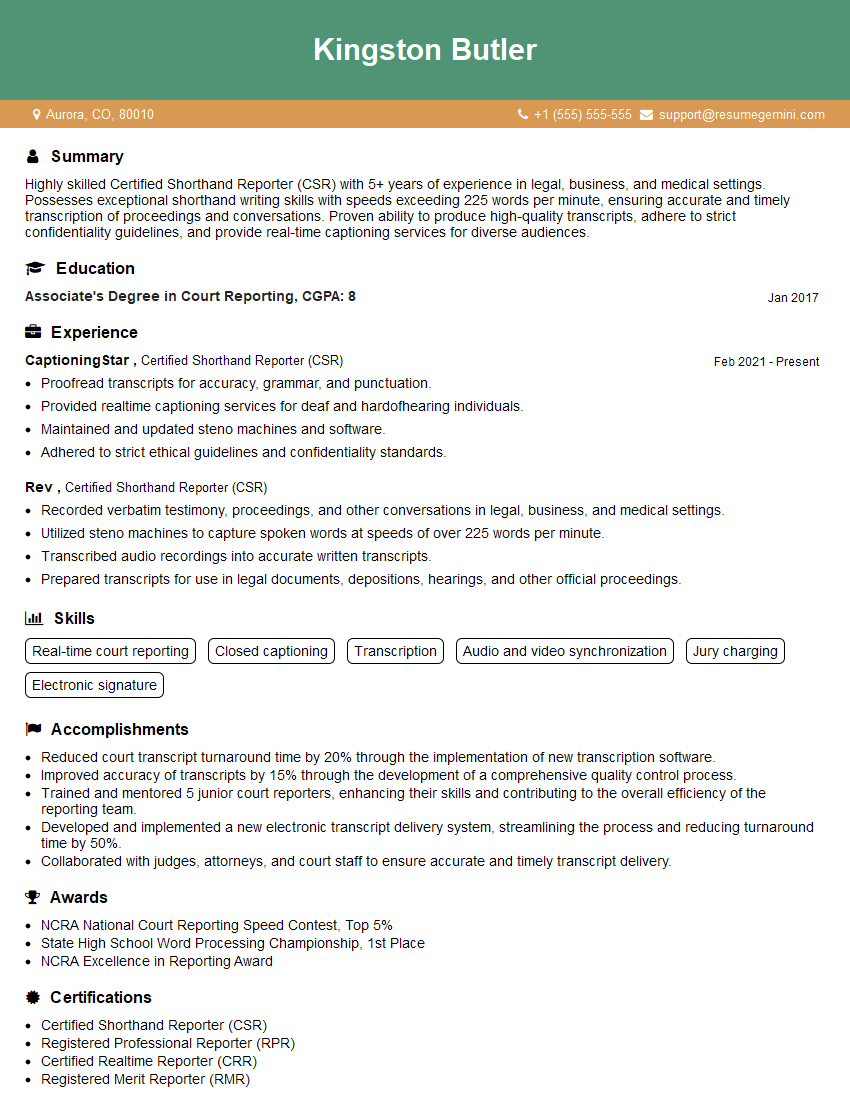
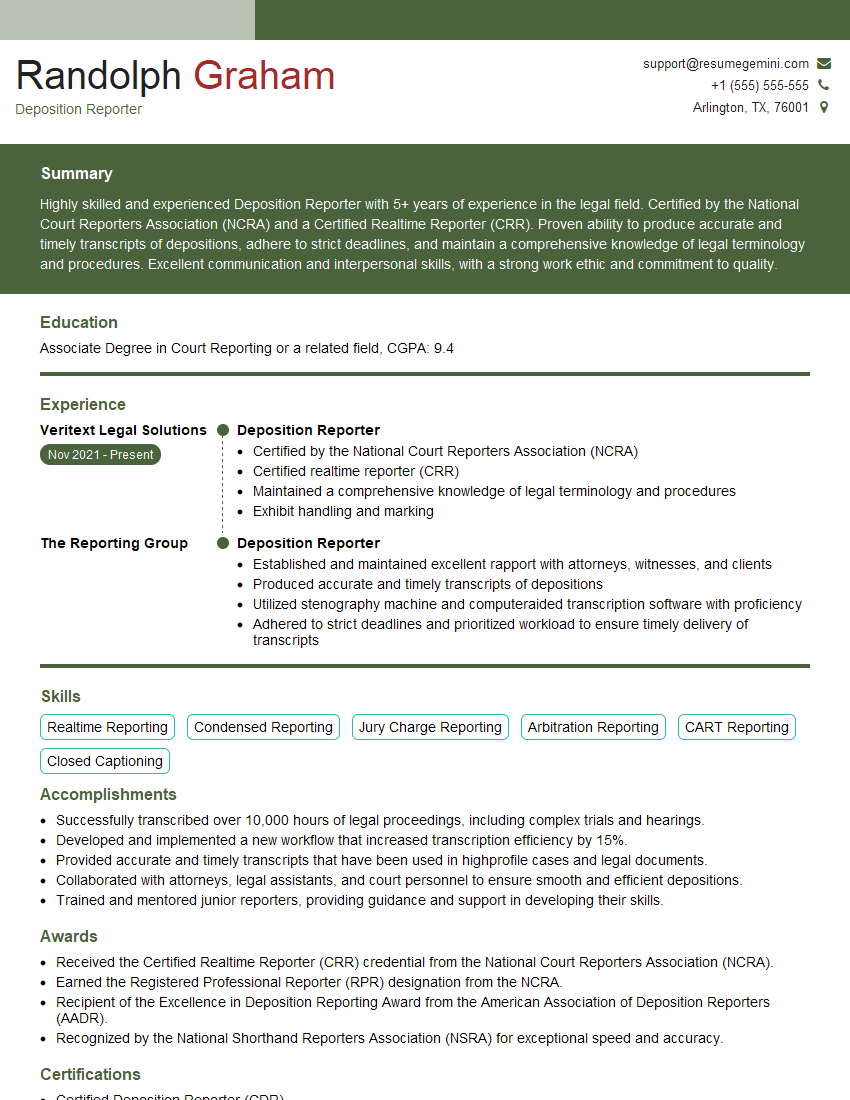
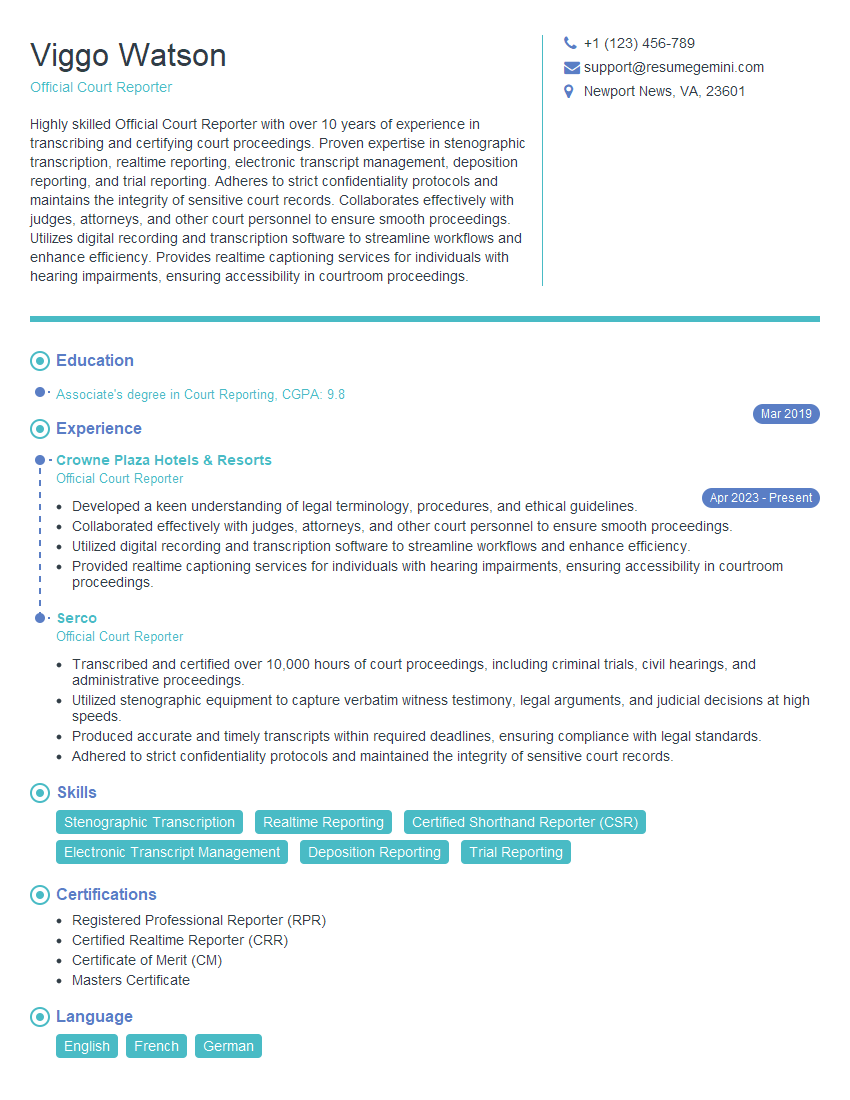
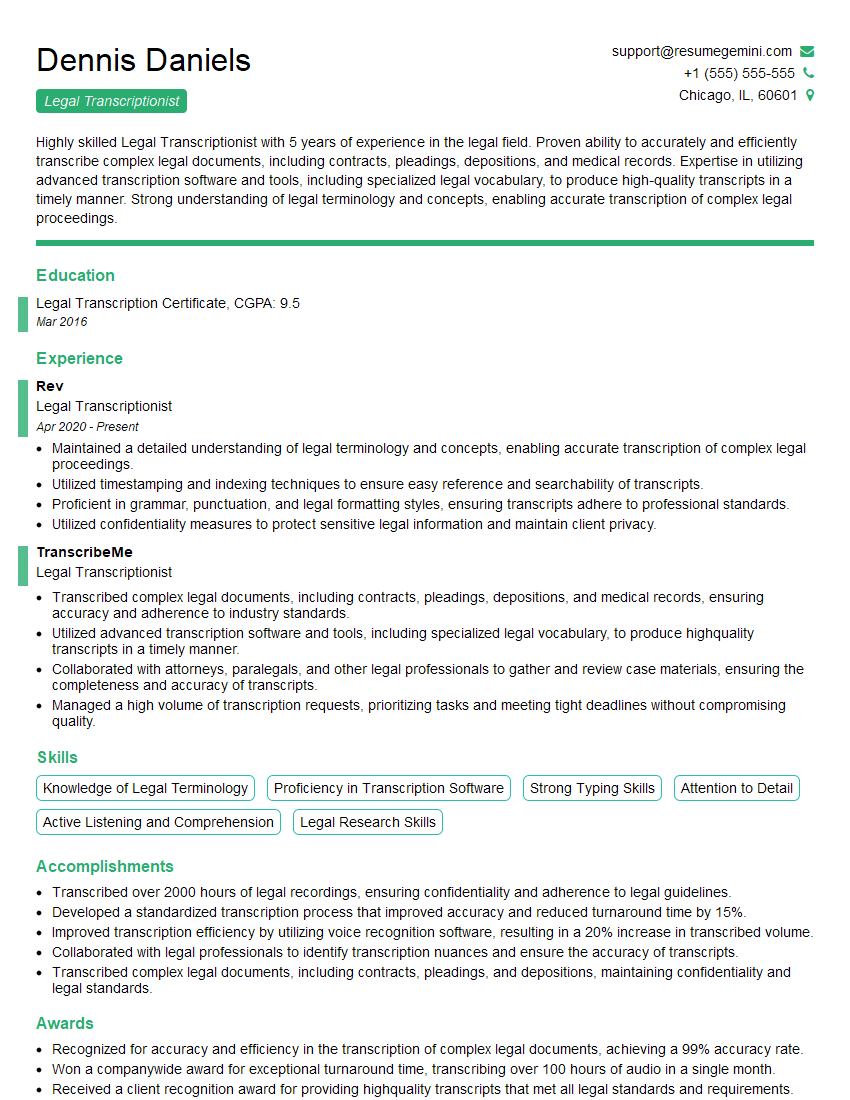
Mastering court reporting skills opens doors to a rewarding and in-demand career, offering opportunities for growth and specialization. To maximize your job prospects, create an ATS-friendly resume that highlights your key skills and experience. ResumeGemini is a trusted resource that can help you build a professional resume that gets noticed. We provide examples of resumes tailored to court reporting skills to guide you. Take the next step toward your dream career – craft a compelling resume that showcases your abilities and sets you apart from the competition.

Explore more articles
Users Rating of Our Blogs
Share Your Experience
We value your feedback! Please rate our content and share your thoughts (optional).
What Readers Say About Our Blog
Very informative content, great job.
good