Preparation is the key to success in any interview. In this post, we’ll explore crucial Court Vision interview questions and equip you with strategies to craft impactful answers. Whether you’re a beginner or a pro, these tips will elevate your preparation.
Questions Asked in Court Vision Interview
Q 1. Define ‘court vision’ in the context of basketball.
Court vision in basketball refers to a player’s ability to perceive and understand the entire court’s dynamics—the positions of teammates and opponents, their movements, and potential scoring opportunities—almost instantaneously. It’s not just about seeing; it’s about processing that visual information rapidly and making insightful decisions based on it. Think of it as a ‘sixth sense’ on the court, allowing players to anticipate plays before they unfold and make the best possible decisions for their team.
A player with excellent court vision can identify open teammates even when tightly guarded, anticipate defensive rotations, and execute precise passes to create high-percentage scoring chances. It’s a crucial skill for both playmakers and off-ball players, contributing significantly to a team’s offensive efficiency.
Q 2. Describe a situation where you demonstrated exceptional court vision.
During a crucial playoff game, we were down by one point with 10 seconds left on the clock. I had the ball at the top of the key, heavily guarded. Instead of forcing a difficult shot, I quickly scanned the court. I noticed my point guard cutting towards the basket, completely unguarded, while the defense was focused on me. With a split second left, I delivered a pinpoint chest pass, setting up the game-winning layup. That play wasn’t just about making a pass; it was about reading the defense, anticipating their reaction, and seeing the opportunity before it even presented itself. The ability to recognize the open man under pressure is paramount to court vision.
Q 3. How does court vision impact offensive play design?
Court vision is fundamental to offensive play design. Coaches design plays that exploit spaces and mismatches, relying on players to identify and execute those opportunities. Plays like pick-and-rolls, high-low actions, and off-ball movement are all significantly enhanced by players possessing good court vision. Without it, even well-designed plays can falter.
- Spacing: Players with great court vision understand how to create space for themselves and their teammates, leading to better passing lanes and scoring opportunities.
- Timing: Precise passes rely on a keen understanding of timing, which stems from excellent court vision. Anticipating a teammate’s movement allows for perfect pass execution.
- Decision-Making: The ability to rapidly evaluate various options and choose the best course of action – whether it’s a pass, shot, or drive – directly correlates to superior court vision.
Q 4. How does court vision influence defensive strategies?
Court vision isn’t limited to offense; it’s crucial defensively as well. Defensive players with exceptional court vision can anticipate opponents’ moves, intercept passes, and provide help defense effectively. They can see developing plays before they fully materialize, allowing them to disrupt passing lanes, contest shots, and effectively rotate defensively.
For instance, a defender with good court vision will notice a teammate struggling to guard a player and will anticipate the pass to that player, positioning themselves to intercept or disrupt the play. They’ll also be better at reading the offense’s sets and anticipating their next moves.
Q 5. Explain the role of anticipation in developing court vision.
Anticipation is the cornerstone of developing court vision. It’s the ability to predict where players will be and what they’ll do based on their past actions, tendencies, and the current game situation. This goes beyond simply watching; it requires studying opponents’ tendencies, recognizing patterns in their movements, and understanding the rhythm of the game.
Imagine a chess player—they don’t just look at the board; they anticipate their opponent’s moves several steps ahead. Similarly, players with great court vision anticipate their teammates’ and opponents’ actions, allowing them to make proactive, rather than reactive, decisions.
Q 6. How can court vision be improved through practice and training?
Improving court vision requires dedicated practice and training. Here’s a structured approach:
- Film Study: Analyze game footage, focusing on the movement and positioning of players on both offense and defense. Identify passing lanes, open spaces, and potential scoring opportunities.
- Court Drills: Practice passing drills that emphasize accuracy and speed, focusing on delivering the ball to different positions on the court. Include drills that simulate game situations with pressure.
- Mental Rehearsal: Visualize game scenarios and mentally rehearse making the right decisions based on different situations. This improves decision-making speed and accuracy under pressure.
- Reactive Drills: Drills that require players to react quickly to changing situations. These improve the speed of processing visual information on the court.
Consistent practice and deliberate effort in these areas will greatly enhance a player’s court vision over time.
Q 7. How do you assess a player’s court vision during scouting?
When scouting, I assess a player’s court vision by observing several key aspects:
- Pass Accuracy and Timing: Do their passes consistently find their targets? Are the passes timely and anticipate the receiver’s movement?
- Decision-Making Under Pressure: How do they perform under pressure? Do they make quick, smart decisions, or do they panic and force bad shots or turnovers?
- Awareness of Teammates: Do they consistently look for and find open teammates, even when guarded themselves?
- Anticipation of Defensive Movements: Do they anticipate defensive rotations and adjust their play accordingly?
- Game Film Analysis: Observing game footage is critical. We look for patterns in their decision-making and their ability to read the court and anticipate plays.
By combining these observations, we can build a comprehensive understanding of a player’s court vision and its impact on their overall game.
Q 8. What are some common indicators of poor court vision in a player?
Poor court vision manifests in several ways. Fundamentally, it’s about a player’s inability to consistently process information on the court – where teammates are, where defenders are, and what offensive opportunities exist. Common indicators include:
- Tunnel Vision: The player only focuses on the basket or their immediate dribble, neglecting passing opportunities.
- Late Passes: Passes are often made after the teammate has already moved past their optimal scoring position or is closely guarded.
- Forced Shots: Taking low-percentage shots because the player doesn’t see a better option.
- Poor Decision-Making: Making turnovers due to an inability to anticipate defensive pressure or read the floor effectively.
- Lack of Awareness: Not reacting to open teammates, even when they are clearly in good scoring positions.
- Inability to anticipate cuts: The player fails to see teammates making offensive cuts, missing easy assist opportunities.
Essentially, a player with poor court vision plays reactively instead of proactively, limiting the team’s offensive efficiency.
Q 9. How can you utilize technology (e.g., film analysis) to improve court vision?
Film analysis is invaluable for improving court vision. By reviewing game footage, players and coaches can identify areas for improvement. Here’s how technology helps:
- Identifying Missed Opportunities: Slowing down the film allows for a detailed examination of each possession, highlighting times when open teammates were not passed to.
- Analyzing Defensive Schemes: Film study reveals defensive rotations and tendencies, teaching players to anticipate movements and exploit gaps.
- Visualizing Passing Lanes: Coaches can use drawing tools on video software to highlight passing lanes the player missed, emphasizing angles and timing.
- Tracking Eye Movement (Advanced Techniques): Some advanced analysis tools can track a player’s eye movements during gameplay, providing insights into where they are focusing their attention.
For example, a coach might show a player a clip where a teammate cut to the basket, but the player never saw them. The coach can then explain the importance of peripheral vision and emphasize scanning the court regularly. This targeted feedback, backed by visual evidence, is much more effective than general instruction.
Q 10. Explain how court vision differs between different positions on the court (e.g., point guard vs. center).
Court vision requirements vary significantly depending on the player’s position:
- Point Guard: Point guards need exceptional court vision. They are the primary playmakers, needing to read the entire floor, anticipate teammates’ movements, and make quick decisions under pressure. Their vision needs to encompass the whole court, recognizing offensive and defensive positioning of all players.
- Shooting Guard/Small Forward: These positions require strong vision to identify open spots for their own shot while also being aware of teammates’ positioning for potential assists. They need to ‘read’ the defense and see passing lanes that can develop from their actions.
- Power Forward/Center: While not expected to be primary playmakers like point guards, these players still require adequate court vision to recognize cuts from teammates, understand defensive rotations, and make timely passes close to the basket. Their court vision needs to be more localized but still effective within their area.
The difference lies in the scope and frequency of vision usage. Point guards constantly scan the court, while other positions may prioritize their immediate area while remaining aware of broader court dynamics.
Q 11. How do you teach court vision to young players?
Teaching court vision to young players involves a multi-faceted approach:
- Drills: Drills focusing on passing, including ‘live’ passing drills in game-like situations, help develop visual awareness and quick decision-making under pressure.
- Visual Cues: Teach players to look for specific visual cues, such as a defender’s body language or a teammate’s subtle movement to signal an opportunity. These cues indicate a passing lane opening up.
- Verbal Communication: Encourage players to communicate verbally with their teammates – calling for the ball, letting others know their intentions, and adjusting according to the game’s flow. Effective communication enhances court vision.
- Progressive Drills: Start with simple drills and gradually increase complexity. Introduce defenders and more players to simulate game conditions.
- Positive Reinforcement: Encourage and praise players for making good passes, even if the shots don’t go in. Focus on their ability to read the floor, building confidence and improving their vision.
- Film Study: Use simple film clips and have them watch professional players known for their excellent court vision, pointing out what they are doing.
It’s crucial to make learning fun and engaging, keeping the drills challenging but achievable, fostering a positive learning experience.
Q 12. Describe a situation where a player’s court vision changed the outcome of a game.
In a crucial playoff game, with seconds remaining and the score tied, a point guard with exceptional court vision saw his teammate being double-teamed near the baseline. While most players would have attempted a contested shot, he saw a cutting center completely unguarded. With a perfectly timed pass that threaded through the defense, he assisted his center for a game-winning dunk. Without his advanced court vision and understanding of the defensive positioning, the outcome would have likely been different. This highlights how excellent court vision can be the difference between a win and a loss in high-pressure situations.
Q 13. What are the key differences between recognizing open teammates and creating open opportunities for teammates?
Recognizing open teammates and creating open opportunities are distinct yet interconnected aspects of court vision:
- Recognizing Open Teammates: This involves seeing the immediate situation – where your teammates are positioned relative to the defense and whether they have an advantage. It’s about processing the existing options and seeing a player who has a good shot opportunity.
- Creating Open Opportunities: This is a more proactive approach, involving manipulating the defense through actions such as a pump fake, a drive to the basket to draw defenders, or using screens. The goal is to make the passing lane available and to generate space for open teammates.
While both skills are important, creating open opportunities requires a higher level of anticipation and understanding of defensive strategies. A player who can both recognize and create opportunities possesses superior court vision and is a valuable asset to any team.
Q 14. How can a coach improve their team’s overall court vision?
A coach can improve their team’s overall court vision through a variety of methods:
- Structured Practices: Incorporate drills that explicitly target court awareness and passing skills. This should range from simple passing drills to more complex ones involving screens and movement.
- Film Sessions: Regularly review game footage to identify missed opportunities and highlight positive plays showcasing good court vision. Use this as a teaching moment to demonstrate effective decision-making.
- Encourage Communication: Create an environment where players feel comfortable communicating with each other on the court. This helps them anticipate each other’s movements and improve overall team coordination.
- Player-Specific Instruction: Provide tailored feedback to each player based on their individual strengths and weaknesses regarding court vision. Some players might need more work on peripheral vision, while others may need to improve their anticipation of defensive strategies.
- Position-Specific Drills: Design drills that are tailored to the specific roles of each player. For instance, point guards could participate in drills that emphasize their role as a primary ball-handler and playmaker.
Ultimately, improving court vision requires a consistent and dedicated approach involving drills, feedback, and a coaching philosophy that emphasizes teamwork and passing.
Q 15. How can a player improve their peripheral vision to enhance their court vision?
Improving peripheral vision, a crucial component of court vision, requires dedicated training. Think of it like expanding your field of view in a video game – the wider your view, the more you see.
Drills Focused on Head Movement: Practice drills that require you to constantly scan the court without turning your body. This could involve stationary ball handling while tracking teammates and opponents.
Cone Drills with Peripheral Focus: Set up cones and dribble around them, focusing on seeing objects or teammates positioned outside your immediate line of sight. Gradually increase the number of cones and the complexity of the drill.
Reactive Drills: Practice drills that simulate game situations where you must react quickly to changing events. This forces you to utilize your peripheral vision to anticipate movements and make informed decisions.
Visualisation Exercises: Spend time mentally rehearsing game scenarios, focusing on what you would see in your peripheral vision. This helps train your brain to process information more efficiently.
For example, imagine LeBron James – he’s renowned for his ability to see plays developing before they happen. This is a direct result of his exceptional peripheral vision and years of dedicated training.
Career Expert Tips:
- Ace those interviews! Prepare effectively by reviewing the Top 50 Most Common Interview Questions on ResumeGemini.
- Navigate your job search with confidence! Explore a wide range of Career Tips on ResumeGemini. Learn about common challenges and recommendations to overcome them.
- Craft the perfect resume! Master the Art of Resume Writing with ResumeGemini’s guide. Showcase your unique qualifications and achievements effectively.
- Don’t miss out on holiday savings! Build your dream resume with ResumeGemini’s ATS optimized templates.
Q 16. Discuss the importance of communication in facilitating good court vision.
Communication is the unsung hero of good court vision. It’s the bridge that connects what you see to your teammates’ actions. Without clear communication, even the best court vision is rendered ineffective. Think of it as having a high-definition map but not being able to tell your teammates where the treasure is.
Verbal cues: Clear and concise calls like “Screen!” or “Cut!” help direct teammates and ensure everyone is on the same page.
Nonverbal cues: Eye contact, hand signals, and subtle movements can also effectively communicate intentions and open opportunities.
Team Huddles: Discussing offensive strategies and individual roles helps build awareness and synergy on the court.
Consider a pick-and-roll situation. If the ball handler doesn’t communicate their intentions to the screener, the play might fail. Effective communication ensures a seamless connection between vision and execution.
Q 17. How does the pace of play influence the utilization of court vision?
Pace of play significantly impacts how court vision is utilized. In a fast-paced game, you need to process information rapidly and make quick decisions. In a slower game, there’s more time for thoughtful analysis and strategic maneuvering.
Fast-paced: Court vision becomes crucial for anticipating opponent’s movements and quickly identifying passing lanes. Players need sharper visual acuity and quicker decision-making skills.
Slow-paced: Players have more time to assess the court and set up plays meticulously. This allows for more complex passing sequences and more considered offensive strategies.
Imagine a transition situation. In a fast break, court vision enables players to quickly locate open teammates for a swift score. In a half-court setting, more deliberate scanning helps find the best scoring opportunity.
Q 18. How does pressure defense impact court vision?
Pressure defense significantly impairs court vision. When defenders are close, it becomes difficult to maintain a wide field of vision and accurately assess the court. It’s like trying to read a map while someone is constantly shaking it.
Reduced peripheral vision: The close proximity of defenders limits the player’s ability to see the entire court.
Increased decision-making pressure: Players must make quick decisions under pressure, potentially leading to rushed passes or poor shot selections.
Impact on passing lanes: Pressure defense often closes or restricts passing lanes, making it harder to execute plays efficiently.
For example, a player under intense full-court pressure may struggle to see a teammate cutting to the basket, resulting in a turnover or forced shot.
Q 19. Explain the link between court vision and decision-making.
Court vision and decision-making are inextricably linked. Court vision provides the information; decision-making determines the action. It’s like having a detailed map (court vision) and deciding the best route to your destination (decision-making).
Identifying opportunities: Court vision helps players identify scoring opportunities for themselves and their teammates.
Selecting the best option: Based on the information gathered through court vision, players choose the most effective play.
Risk assessment: Court vision also helps assess risks associated with different play options, such as turnovers or poor shot selection.
A player with excellent court vision might see a defender momentarily out of position and make a quick, decisive pass to a cutting teammate for an easy score.
Q 20. How does court vision contribute to offensive efficiency?
Court vision directly contributes to offensive efficiency by maximizing scoring opportunities and minimizing turnovers. It’s the key to unlocking a team’s full offensive potential.
Increased scoring efficiency: By identifying open teammates and creating better passing lanes, court vision leads to higher-percentage shots and improved scoring efficiency.
Reduced turnovers: Players with good court vision make better decisions, which reduces risky passes and minimizes turnovers.
Improved ball movement: Excellent court vision facilitates smoother and more effective ball movement, keeping the defense guessing.
A team that excels in court vision will often exhibit a high assist-to-turnover ratio, demonstrating the direct link between court awareness and offensive efficiency.
Q 21. How does court vision affect a team’s transition game?
Court vision is paramount in a team’s transition game. It allows players to quickly assess the situation and make informed decisions, leading to quick scores or efficient offensive set-ups.
Quick outlet passes: Players with good court vision can quickly identify open teammates down the court, leading to fast break opportunities.
Efficient transition offense: By understanding the positioning of teammates and opponents, players can dictate the pace and direction of the transition offense.
Balanced attack: Court vision prevents the team from becoming overly reliant on one player in transition, leading to a more balanced and versatile attack.
A great example is a fast break where the defensive player secures a rebound and uses court vision to quickly pass the ball to a teammate sprinting towards the basket for an easy score.
Q 22. How does advanced statistical analysis inform the assessment of court vision?
Advanced statistical analysis plays a crucial role in objectively assessing court vision, a skill often difficult to quantify solely through observation. We move beyond simple assist numbers by utilizing metrics that capture the potential for assists and the decision-making process leading to them.
Potential Assists: This metric tracks passes that should have resulted in a score had the teammate made the shot. It gives a clearer picture of a player’s ability to create scoring opportunities, regardless of the teammate’s execution.
Pass Completion Percentage: While a high completion rate is desirable, it’s vital to consider the context. A high completion rate with only short, safe passes indicates limited vision. We look for a balance: high completion rate *with* a variety of pass types and distances.
Time of Pass: Analyzing the timing of passes reveals game awareness. A pass made just before a defender closes in showcases exceptional anticipation and vision.
Pass Location and Type: Advanced tracking systems can classify passes by type (chest pass, bounce pass, overhead pass, etc.) and location on the court, giving insight into a player’s adaptability and ability to exploit defensive weaknesses. A player frequently making pinpoint passes to open teammates in crucial game situations demonstrates superior court vision.
By combining these metrics and analyzing their correlation with game outcomes, we gain a far more nuanced understanding of a player’s court vision than simply relying on traditional box score statistics.
Q 23. How can you identify players with high court vision potential?
Identifying players with high court vision potential requires a multifaceted approach combining film study with on-court observations and statistical analysis. We look for a combination of factors:
Early Recognition of Open Teammates: Players with exceptional court vision quickly identify open teammates even amidst chaotic defensive schemes. They seem to ‘see’ plays develop before they fully unfold.
Quick Decision-Making: Hesitation is the enemy of good court vision. Players with high potential make decisive passes quickly, capitalizing on fleeting opportunities.
Accurate Passing: Consistent pass accuracy, particularly under pressure, is a hallmark of good court vision. This shows an understanding of angles, teammate positioning, and the timing of the pass.
Varied Pass Types: Mastering a wide range of passing techniques shows adaptability and an understanding of different game situations. A player who can execute a variety of passes, adjusting based on the defense, possesses superior vision.
High Basketball IQ: Understanding game strategy, defensive schemes, and teammate tendencies is fundamental to good court vision. Players with a good grasp of basketball strategies tend to make better reads on the court.
Think of LeBron James; his ability to anticipate a teammate’s cut before it even happens is a prime example of exceptional court vision potential identified early in his career.
Q 24. Describe the role of IQ in court vision.
IQ is intrinsically linked to court vision. It’s not merely about seeing the court; it’s about understanding what you see. A high basketball IQ allows a player to:
Anticipate Opponent’s Moves: A player with high IQ can predict defensive rotations and exploit them with timely passes.
Recognize Patterns and Trends: They notice repetitive defensive strategies and adjust their passing accordingly.
Utilize Teammates’ Strengths: They know which teammates excel in specific situations and tailor their passes to their individual capabilities.
Read the Game’s Flow: They can assess the momentum of the game, understand timing and choose the appropriate pass based on the current situation.
Consider a point guard who understands the opposing team’s defensive tendencies. They might anticipate a double-team on the post player and make a quick pass to the open three-point shooter – that’s basketball IQ enhancing court vision.
Q 25. How do you use film study to analyze court vision?
Film study is indispensable in analyzing court vision. It allows for detailed, repeated observation of game situations that are impossible to capture in real-time. Here’s how we approach it:
Slow-Motion Analysis: Watching game footage in slow motion reveals subtle details like player positioning, defensive rotations, and the timing of passes. This helps identify missed opportunities and pinpoint precise moments of exceptional vision.
Multiple Angle Views: Utilizing multiple camera angles offers a comprehensive view of the court, giving a clearer picture of player movement and passing lanes.
Tracking Specific Plays: Focusing on specific offensive possessions allows us to isolate and analyze decision-making processes, pass accuracy, and the impact of passes on the offensive flow.
Comparative Analysis: Comparing a player’s performance across multiple games highlights consistency, reveals areas for improvement, and helps identify strengths and weaknesses in their court vision.
For example, by slowing down film of a game, we might observe a player consistently anticipating a double-team and making a split-second decision to pass to a cutting teammate before the help defense arrives, revealing an advanced level of court vision.
Q 26. What are some drills to improve court vision?
Improving court vision is a continuous process requiring dedicated practice. Here are some effective drills:
Cone Drills: Setting up cones on the court to represent teammates simulates game scenarios and encourages players to make quick decisions under pressure. Passing to cones simulates passing to open teammates.
Fast-paced Passing Drills: High-pressure passing drills, such as 3-on-0 or 4-on-0 scenarios, force quick thinking and rapid decision-making, improving the speed of visual processing.
Blindfold Drills (with a partner): Drills with a blindfold, guided by a partner’s verbal cues, forces players to develop better peripheral awareness and anticipate movement based solely on hearing.
Scrimmages and Game Simulation: Playing in scrimmages and game-like situations provides the most realistic test of court vision. It allows players to apply their skills under realistic game pressure, adapting and making quick decisions in response to the situation.
These drills are designed to enhance peripheral vision, decision-making speed, and the ability to anticipate plays, all key elements in improving court vision.
Q 27. Explain the relationship between court vision and basketball IQ.
Court vision and basketball IQ are inextricably linked; they’re two sides of the same coin. Court vision is the ability to ‘see’ the court and assess player positioning, while basketball IQ is the understanding of how to use that information effectively.
High basketball IQ informs court vision by allowing players to:
Anticipate opponent actions and create passing opportunities before they arise.
Utilize teammates’ skills and positioning to maximize the chances of successful passes.
Recognize and respond to defensive schemes, adjusting their passing strategy as needed.
Read the game flow and make decisions based on the pace, score, and time remaining.
In essence, basketball IQ provides the strategic framework within which court vision operates. A player can ‘see’ the court (court vision), but without the understanding of how to use this information (basketball IQ), that vision is less effective.
Q 28. How would you evaluate the court vision of a player in a live game setting?
Evaluating court vision in a live game setting requires keen observation and an understanding of the context. We don’t just count assists; we assess the quality of decisions and the impact on the team’s offensive flow.
Pass Selection: Does the player consistently make smart passes that exploit defensive weaknesses? Are they able to adapt their passes based on the defensive scheme?
Timing and Accuracy: Are passes made at the optimal time, considering the position of defenders and teammates? Are passes consistently on target, reducing turnovers?
Impact on Offense: Do the player’s passes lead to high-percentage scoring opportunities? Do they create offensive rhythm and flow?
Decision-Making Under Pressure: Does the player make quick, decisive decisions even when facing pressure from defenders? Does their vision falter under duress?
Missed Opportunities: Does the player fail to see or take advantage of open teammates? This highlights potential areas for improvement in their vision and decision-making process.
For instance, observing a point guard consistently finding open shooters in the corner even with a double team on the post would highlight excellent court vision in a live game setting. Conversely, a player who repeatedly forces passes into double-teamed players showcases a deficiency in this crucial skill.
Key Topics to Learn for Court Vision Interview
- Courtroom Technology & Systems: Understanding the various technologies used in modern courtrooms, including case management systems, video conferencing, and digital evidence presentation.
- Data Analysis & Reporting: Practical application of data analysis techniques to extract meaningful insights from courtroom data, creating reports for legal professionals.
- Legal Processes & Procedures: Familiarity with common legal procedures and how Court Vision technology supports and streamlines these processes. This includes understanding different phases of a trial and the data flow involved.
- Security & Compliance: Understanding data security protocols and legal compliance requirements within the context of Court Vision’s functionalities.
- Project Management & Implementation: How Court Vision projects are managed, from initial planning to deployment and ongoing support. Consider project lifecycle methodologies and their application.
- Problem-Solving & Troubleshooting: Develop your approach to identifying and resolving technical issues within the Court Vision platform, including troubleshooting and debugging strategies.
- Client Interaction & Communication: Understanding how to effectively communicate technical information to legal professionals with varying levels of technical expertise. Emphasize clear, concise communication skills.
Next Steps
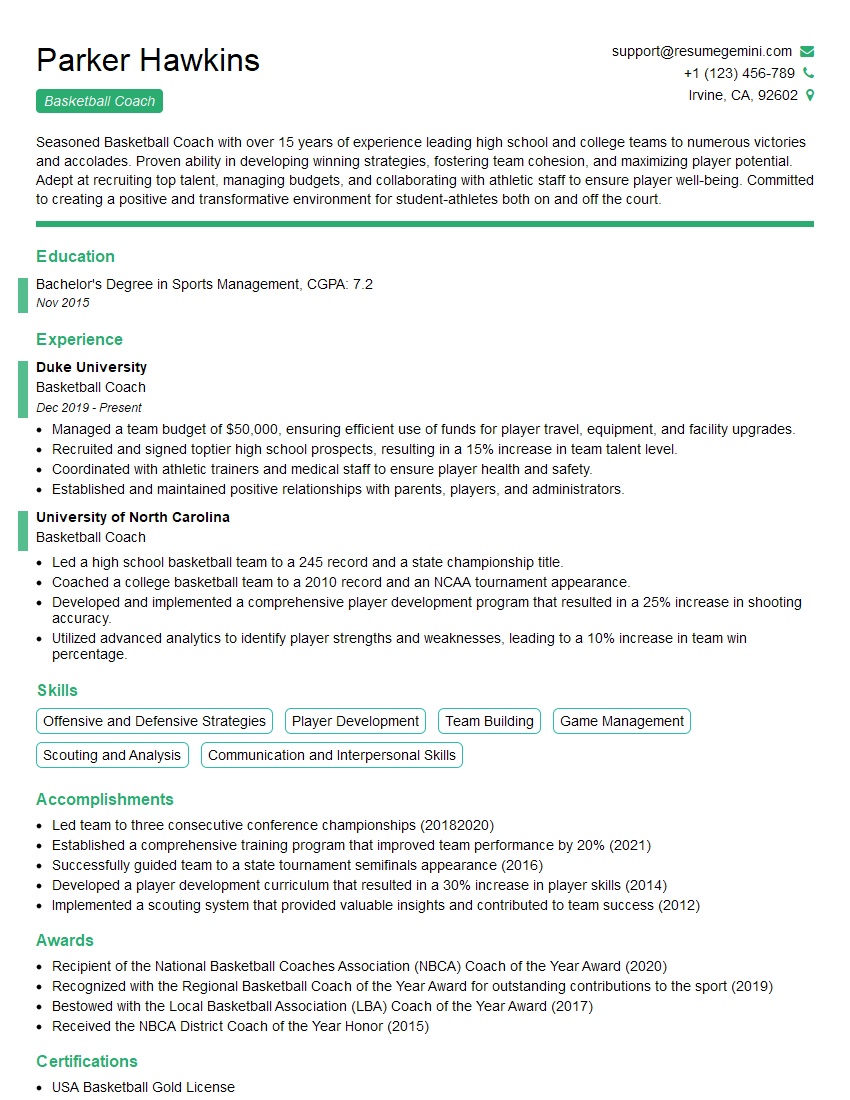
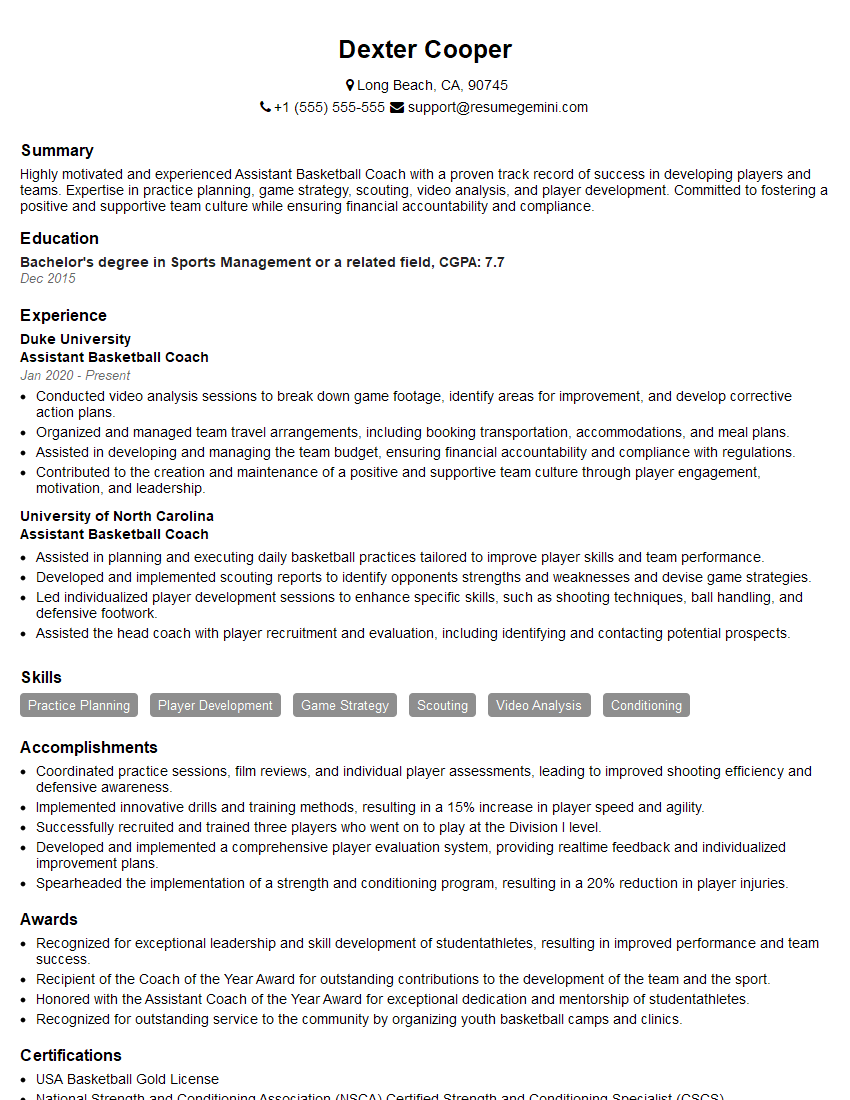
Mastering Court Vision’s functionalities significantly enhances your career prospects in the legal technology sector. Proficiency in this system demonstrates valuable technical skills and a strong understanding of the legal landscape. To maximize your chances of success, focus on building an ATS-friendly resume that effectively showcases your relevant skills and experience. ResumeGemini is a trusted resource that can help you craft a compelling and professional resume. We provide examples of resumes tailored to Court Vision to further guide your preparation. Take advantage of these resources and confidently present yourself as a strong candidate.
Explore more articles
Users Rating of Our Blogs
Share Your Experience
We value your feedback! Please rate our content and share your thoughts (optional).
What Readers Say About Our Blog
Very informative content, great job.
good