Interviews are opportunities to demonstrate your expertise, and this guide is here to help you shine. Explore the essential Crane Load Calculations and Planning interview questions that employers frequently ask, paired with strategies for crafting responses that set you apart from the competition.
Questions Asked in Crane Load Calculations and Planning Interview
Q 1. Explain the process of calculating the load capacity of a crane.
Calculating a crane’s load capacity isn’t a simple matter of looking at a single number. It’s a complex process involving several factors and requires a thorough understanding of the crane’s specifications and the operational environment. It begins with consulting the crane’s manufacturer’s data plate, which provides the basic rated capacity – the maximum load the crane can lift under ideal conditions. However, this is rarely the actual limit in real-world scenarios.
The next step is to consider the crane’s configuration. The load capacity varies based on the boom length, boom angle, and the radius (the horizontal distance from the crane’s center to the load). Longer booms and greater radii significantly reduce the crane’s capacity because they increase the load moment (discussed later). Crane manufacturers provide load charts (discussed in the next answer) that visually represent this relationship. These charts consider the structural limitations of the crane’s components such as the boom, the hoist mechanism, and the slew bearings. Finally, we must account for environmental factors such as wind speed, which can drastically reduce the safe working load.
In essence, determining load capacity involves a process of checking the manufacturer’s data, consulting load charts for the specific configuration, and applying safety factors to account for environmental and operational conditions. Never exceed the calculated safe working load.
Q 2. Describe different types of crane load charts and their applications.
Crane load charts are indispensable tools for safe crane operation. They graphically display the crane’s safe working load (SWL) for various boom lengths, radii, and sometimes boom angles. Different types of charts exist to accommodate different crane designs and levels of detail:
- Standard Load Charts: These are the most common type and depict the SWL as a function of radius and boom length. They usually are presented as a series of curves, each representing a different boom angle or configuration. Imagine a topographic map, but instead of elevation, it shows the maximum allowable load.
- Capacity Charts with Multiple Parameters: Some charts include additional factors like wind speed corrections, which provide a more refined estimation of the SWL under specific conditions.
- 3D Load Moment Diagrams: These advanced charts use three-dimensional representations to show the relationship between load, radius, and boom angle. These are incredibly useful for complex lifts where precise load moment control is crucial.
- Software-Based Load Charts: Many modern cranes use integrated software systems that provide real-time load calculations, considering the crane’s current position, boom configuration, and environmental conditions. These provide a dynamic SWL calculation.
The application depends on the complexity of the lift. Simple lifts may only require the standard chart, while more complex lifts may necessitate 3D diagrams or software solutions. Always ensure you’re using the correct chart for the specific crane model and configuration.
Q 3. How do you account for wind speed and other environmental factors in crane load calculations?
Wind speed is a critical factor in crane load calculations because it creates significant forces on the load and the crane structure itself. These forces can easily exceed the crane’s structural capacity. Wind speeds can significantly decrease the safe working load.
To account for wind, several methods are used. The most common is to consult a wind correction chart, often included with the crane’s load charts. These charts provide a reduction factor applied to the base SWL, depending on the wind speed and the height of the load. For instance, a 20 mph wind might reduce the crane’s allowable load by 50% or more. Another method involves using specialized software, which takes into account the geometry of the load and the crane to calculate wind forces directly.
Other environmental factors like temperature extremes (which can affect material strength) and precipitation (which can increase load weight and affect traction) should also be considered, although they are usually less impactful than wind. These factors are often addressed via safety factors or through detailed structural analyses for critical projects.
Q 4. What are the safety regulations and standards related to crane load calculations?
Safety regulations and standards surrounding crane load calculations are stringent and crucial for preventing accidents. They vary slightly depending on geographical location but generally align with international standards like those from OSHA (Occupational Safety and Health Administration), ANSI (American National Standards Institute), or ISO (International Organization for Standardization). Key regulations often mandate:
- Regular crane inspections: To ensure the crane is in good working order and its components are not degraded.
- Qualified crane operators: Operators must possess the necessary training and certification to safely operate the crane and perform load calculations.
- Adherence to load charts: Operators must never exceed the SWL specified in the relevant load charts for the given conditions.
- Detailed lift plans: For complex lifts, detailed lift plans must be developed which include comprehensive load calculations and risk assessments.
- Proper rigging and signaling: Safe rigging techniques and clear communication between the operator and the riggers are essential.
- Emergency procedures: Procedures for dealing with emergencies such as unexpected wind gusts or equipment malfunctions must be in place.
Failure to adhere to these regulations can result in severe penalties, including fines and even criminal charges, in the case of accidents resulting in injuries or fatalities. Safety should always be the paramount concern in any crane operation.
Q 5. How do you determine the appropriate rigging equipment for a specific load?
Selecting the right rigging equipment is paramount to a safe lift. The process involves considering several factors:
- Load weight and dimensions: The rigging equipment must have a SWL that significantly exceeds the weight of the load, allowing for safety factors. The dimensions of the load determine the type and size of slings, shackles, and other components needed.
- Load center of gravity: The center of gravity must be correctly identified to ensure the load is balanced and stable during lifting. An improperly balanced load can lead to tilting or swinging, causing instability and potentially resulting in accidents.
- Lifting environment: The environment (e.g., presence of obstacles, confined spaces, harsh weather) influences the type of rigging equipment that is best suited. For example, in a corrosive environment, stainless steel rigging hardware might be necessary.
- Crane’s capacity and limitations: The chosen rigging must be compatible with the crane’s lifting capacity and hook configuration.
- Material compatibility: Rigging components must be compatible with the material of the load to avoid damage or reactions. For example, using synthetic slings on sharp-edged loads may damage the slings.
Once these factors are assessed, the appropriate slings, shackles, hooks, and other equipment can be chosen. Inspecting rigging components for wear, damage, or defects before each lift is absolutely critical. Never use damaged rigging equipment.
Q 6. Explain the concept of load moment and its significance in crane operations.
Load moment is the force that tends to tip a crane over. It’s calculated by multiplying the load weight by the radius (the horizontal distance from the crane’s center of rotation to the load). Think of it as a lever: the greater the distance from the pivot point (the crane’s center), the greater the force needed to prevent tipping.
Load Moment = Load Weight x Radius
The significance of load moment is that it sets the ultimate limit on a crane’s capacity. Exceeding the crane’s maximum allowable load moment, even if the load weight is within the crane’s rated capacity, is extremely dangerous and could cause the crane to overturn. This is why load charts often display load capacity in terms of load moment instead of only load weight.
Managing load moment effectively requires careful planning of the lift. This involves choosing appropriate boom length, radius, and boom angle to keep the load moment within safe limits. Always refer to the load chart to ensure the load moment during operation is well below the crane’s maximum allowable load moment.
Q 7. Describe different types of crane failures and their causes.
Crane failures can have catastrophic consequences. Understanding the causes is vital for prevention. These failures can be categorized as structural, mechanical, or human-related.
- Structural Failures: These involve the failure of crane components due to fatigue, overloading, corrosion, or manufacturing defects. For instance, a boom could fail due to excessive stress from an overload or a cracked weld.
- Mechanical Failures: These involve failures in the crane’s mechanical systems, such as the hoist, slew drive, or braking system. Examples include broken cables, malfunctioning brakes, or hydraulic fluid leaks.
- Human-Related Failures: These are often the most common cause of crane accidents, including operator errors, inadequate training, improper rigging, insufficient planning, and poor communication. Overloading the crane beyond its rated capacity, neglecting regular maintenance, and using improper lifting techniques are all examples of human-related errors.
Preventing crane failures requires a combination of regular maintenance, thorough inspections, adherence to safety regulations, qualified operators, and a strong emphasis on safety culture. Regular checks of the crane’s condition, documentation of inspection reports, and operator training are vital for minimizing the risk of crane failure.
Q 8. How do you assess the stability of a crane during lifting operations?
Assessing crane stability during lifting operations is paramount for safety. It involves considering several factors that can affect the crane’s ability to remain upright and prevent tipping. Think of it like balancing a seesaw – if the weight is unevenly distributed, it tips. Similarly, an imbalanced load on a crane can cause it to topple.
- Center of Gravity: The load’s center of gravity must be carefully calculated and kept within the crane’s stability limits. We use specialized software and calculations to determine this. For instance, a long, oddly shaped load needs more careful consideration than a compact, uniform one.
- Ground Conditions: The ground supporting the crane must be firm and level. Soft ground or uneven terrain can significantly reduce stability. We always conduct a thorough site inspection before any lift to identify potential issues like unstable ground or underground utilities.
- Wind Speed and Direction: High winds can exert considerable force on the crane and load, impacting stability. Crane specifications include wind speed limitations, and we always check weather forecasts before and during lifting operations. If the wind exceeds the safe limit, we postpone the lift.
- Crane’s Load Chart: Every crane has a load chart that specifies the maximum allowable load capacity at different radii (distances from the crane’s center). Exceeding these limits is extremely dangerous and strictly prohibited. We always verify the load is within the chart’s specified limits before any lift commences.
- Outriggers (if applicable): For mobile cranes, proper extension and stabilization of outriggers are crucial for stability. Uneven or insufficient outrigger extension can significantly compromise stability. We follow manufacturer’s guidelines precisely for outrigger deployment and ensure the ground is adequately supported.
Failure to account for these factors can lead to crane overturning, resulting in serious injury or fatality. Therefore, a rigorous and methodical approach is essential.
Q 9. What are the steps involved in creating a safe lifting plan?
Creating a safe lifting plan is a critical step that prevents accidents. It’s a systematic process, much like creating a detailed recipe for a complex dish. Each step is crucial for the final outcome – a successful and safe lift.
- Site Survey: Thorough assessment of the site, including ground conditions, access routes, obstructions, and nearby power lines.
- Load Assessment: Determining the weight, dimensions, center of gravity, and any special handling requirements of the load.
- Crane Selection: Choosing the appropriate crane based on the load’s characteristics and site conditions. It’s important to choose a crane with sufficient lifting capacity and reach.
- Lifting Method: Developing a step-by-step procedure for the lift, including rigging details (sling selection, attachment points), lift path, and personnel responsibilities.
- Risk Assessment: Identifying potential hazards and implementing control measures to mitigate risks. This might include things like traffic management, emergency procedures, and communication protocols.
- Communication Plan: Establishing clear communication channels between the crane operator, riggers, spotters, and other personnel involved.
- Documentation: Preparing a comprehensive lifting plan document that details all aspects of the lift. This document serves as a reference throughout the operation and for post-lift analysis.
A well-defined lifting plan reduces risks significantly, ensuring the safety of personnel and equipment.
Q 10. How do you handle unexpected situations during a lift?
Unexpected situations during a lift require swift, decisive action based on a pre-planned emergency procedure. It’s like having a backup plan for your recipe – if an ingredient is missing, you know what to substitute.
- Immediate Stop: If anything unexpected occurs (e.g., equipment malfunction, unstable load, sudden wind gust), the lift should be immediately stopped.
- Assess the Situation: Quickly determine the cause of the problem and the extent of any damage or risk.
- Implement Contingency Plans: Follow the pre-defined emergency procedures outlined in the lifting plan. This might include contacting emergency services or implementing alternative lifting techniques.
- Communicate Effectively: Maintain clear communication with all team members to ensure everyone is aware of the situation and the actions being taken.
- Post-Incident Review: Following the resolution of the incident, conduct a thorough review to understand what happened, identify contributing factors, and implement corrective actions to prevent recurrence.
Regular training and drills help the team react effectively during emergencies. The key is to remain calm, assess the situation, and follow established protocols.
Q 11. What are the responsibilities of a crane operator regarding load calculations?
The crane operator plays a vital role in ensuring safe lifting operations. Their responsibilities regarding load calculations extend beyond simply operating the controls; they’re a key part of the safety chain.
- Verify Load Details: The operator must verify the weight and dimensions of the load against the crane’s load chart. They shouldn’t rely solely on others’ calculations.
- Understand Load Chart: The operator needs a thorough understanding of the crane’s load chart, including its limitations and safety factors. Misinterpreting the chart can lead to serious consequences.
- Monitor Stability: Throughout the lift, the operator must constantly monitor the crane’s stability, watching for any signs of instability. They should be alert to any changes in ground conditions or wind speed.
- Communicate Effectively: The operator must maintain clear communication with the riggers, spotters, and other team members. Effective communication is critical for coordinating the lift safely.
- Refuse Unsafe Lifts: The operator has the authority to refuse any lift they deem unsafe, regardless of pressure from others. Safety should always be the top priority.
The operator’s expertise and vigilance are essential for safe crane operations.
Q 12. Explain the importance of pre-lift inspections.
Pre-lift inspections are fundamental to ensuring safe crane operations. They are analogous to a pre-flight check for an airplane – vital for ensuring everything is in working order before commencing the operation.
- Visual Inspection: A thorough visual check of the crane’s structure, including boom, wires, and other components. This involves looking for any signs of damage, wear and tear, or corrosion.
- Mechanical Inspection: Checking the functionality of the crane’s mechanisms, such as brakes, hydraulics, and electrical systems. This could involve operational checks and pressure tests.
- Load-Bearing Components: Careful inspection of slings, hooks, shackles, and other load-bearing equipment for signs of damage or wear. Worn equipment should be immediately replaced.
- Certification and Documentation: Verification of the crane’s certification, maintenance logs, and operator’s qualifications.
- Site Conditions: A re-assessment of the site conditions to ensure they haven’t changed since the lifting plan was created.
Pre-lift inspections help identify potential hazards before they can lead to accidents, preventing downtime and ensuring the safety of personnel and equipment. A signed-off checklist is crucial to demonstrate due diligence.
Q 13. Describe your experience with different types of cranes (e.g., tower, mobile, overhead).
My experience encompasses a wide range of crane types, each with its own unique characteristics and operational considerations. It’s like knowing different types of cooking techniques – each is appropriate for different dishes.
- Tower Cranes: I’ve worked extensively with tower cranes on large construction projects, understanding their erection, dismantling, and operation, including their specific stability considerations at different heights and with varying load configurations. These are primarily for stationary applications, requiring careful planning of their positioning and potential impact on the surrounding environment.
- Mobile Cranes: My experience includes working with various mobile cranes, from smaller all-terrain cranes to larger rough-terrain and crawler cranes. I’m adept at assessing ground conditions and understanding the limitations of these cranes’ mobility and stability, particularly in challenging terrains.
- Overhead Cranes: I have experience with various overhead crane systems in industrial settings, including gantry and bridge cranes. This involves understanding their hoisting mechanisms, trolley movements, and safety interlocks, paying special attention to weight distribution and the structural integrity of the crane system itself.
My experience with these diverse crane types provides a broad understanding of crane operation and safety, allowing me to adapt to various lifting challenges.
Q 14. How do you communicate effectively with the crane operator and other team members?
Effective communication is the cornerstone of safe crane operations. Think of it as the conductor of an orchestra – each instrument (team member) needs clear instructions and coordination to create harmonious results.
- Clear and Concise Language: Using precise terminology to avoid any misunderstandings. Jargon should be explained clearly if used.
- Visual Signals: Employing hand signals or other visual cues to reinforce verbal instructions, particularly in noisy environments.
- Two-Way Communication: Ensuring a feedback loop where the operator and other team members can confirm their understanding of instructions.
- Pre-Lift Briefing: Conducting a briefing before each lift to review the plan, discuss potential hazards, and assign roles and responsibilities.
- Emergency Communication: Establishing clear communication procedures for emergency situations. A designated emergency contact person or channel should be identified.
My experience emphasizes the importance of actively listening and building trust among team members, which builds a safety culture.
Q 15. What software or tools do you use for crane load calculations?
Crane load calculations require specialized software to ensure accuracy and efficiency. I regularly utilize several tools, depending on the complexity of the lift. For simpler calculations, I might use spreadsheet software like Microsoft Excel, incorporating formulas for calculating center of gravity, stresses, and safe working loads (SWL). However, for more intricate projects involving multiple crane configurations or unusual load characteristics, I rely on dedicated crane analysis software packages. These programs typically offer 3D modeling capabilities, allowing for a visual representation of the lift plan, and incorporate various safety factors and regulatory standards directly into the calculation process. Examples include CAD programs with structural analysis add-ons and dedicated software designed specifically for crane load calculations. One specific program I often use is [Software Name – replace with a real or fictional but plausible name], which allows for detailed analysis of rigging configurations and provides comprehensive reports.
Career Expert Tips:
- Ace those interviews! Prepare effectively by reviewing the Top 50 Most Common Interview Questions on ResumeGemini.
- Navigate your job search with confidence! Explore a wide range of Career Tips on ResumeGemini. Learn about common challenges and recommendations to overcome them.
- Craft the perfect resume! Master the Art of Resume Writing with ResumeGemini’s guide. Showcase your unique qualifications and achievements effectively.
- Don’t miss out on holiday savings! Build your dream resume with ResumeGemini’s ATS optimized templates.
Q 16. How do you ensure compliance with relevant safety regulations and standards?
Compliance with safety regulations is paramount in crane operations. I ensure compliance through several key practices. Firstly, I meticulously review all relevant local, national, and international standards (e.g., OSHA, ASME, EN standards) applicable to the specific crane, load, and work environment. Secondly, I conduct thorough pre-lift inspections of all equipment, including the crane itself, rigging gear (slings, shackles, hooks etc.), and the load. This ensures everything is in optimal condition and within its SWL. Thirdly, I develop comprehensive lift plans that account for all foreseeable hazards and incorporate risk mitigation strategies. These plans are reviewed and approved by a qualified supervisor before the lift commences. Finally, I maintain detailed records of all calculations, inspections, and lift operations for auditing and traceability purposes. Regular training and certification in crane safety regulations and best practices are also crucial to maintain my compliance knowledge and skills. For example, I recently underwent refresher training on the updated OSHA regulations for crane safety.
Q 17. Explain the concept of load center and its impact on crane stability.
The load center is the point at which the total weight of the load is considered to be concentrated. Imagine trying to balance a seesaw; the load center is like the point where you’d place the pivot. Its impact on crane stability is significant because it affects the moment acting on the crane. The moment is the force tending to rotate the crane. A load with its center of gravity offset from the crane’s hook point creates a greater moment, increasing the stress on the crane structure and increasing the risk of tipping. For instance, a long, slender object lifted with its center of gravity significantly off-center will exert a larger moment than the same object lifted with its center of gravity directly below the hook. Accurate determination of the load center through careful measurement and calculation is crucial to select the appropriate crane and ensure safe operation. Incorrectly calculating the load center can lead to severe accidents.
Q 18. How do you handle lifting operations in confined spaces?
Lifting in confined spaces presents unique challenges, demanding careful planning and specialized techniques. First, a thorough site assessment is critical to identify potential obstructions and limitations. This involves measuring clearances, assessing ground conditions, and identifying any structural weaknesses in the vicinity. Next, I select a crane with appropriate reach and lifting capacity suitable for the confined space, often preferring smaller, more maneuverable cranes. Special rigging techniques might be necessary, such as using shorter slings or employing specialized attachments to ensure the load doesn’t collide with surrounding structures. Detailed lift simulations are frequently performed using software to visually confirm clearance and ensure safe maneuvering of the load. Communication and coordination between crane operators, riggers, and site personnel are crucial to avoid accidents. For example, I recently managed a lift inside a narrow ship’s hold where careful choreography was required to avoid damaging the ship’s structure.
Q 19. How do you manage risks associated with crane operations?
Risk management in crane operations is a systematic process. It begins with a comprehensive risk assessment, identifying potential hazards such as crane malfunction, load instability, environmental factors (wind, rain), and human error. Following the identification of potential risks, we determine the probability and severity of each hazard. Then, we develop and implement mitigation strategies such as implementing a robust pre-lift inspection program, using appropriate safety devices (e.g., load monitors, outriggers), providing comprehensive operator training, and enforcing strict safety protocols on site. The effectiveness of these measures is continuously monitored and evaluated, and the risk assessment is updated as needed. This might involve conducting regular safety meetings with the crew and documenting all safety incidents or near misses for analysis and improvement. A detailed risk assessment matrix is usually part of the lift plan documentation.
Q 20. Describe your experience with different types of loads (e.g., oversized, delicate).
My experience encompasses a wide range of load types. I’ve handled everything from standard palletized goods to oversized and delicate components. Oversized loads, like large machinery or prefabricated building sections, require specialized rigging techniques, including multiple lifting points and careful consideration of load distribution to prevent deformation or damage. Delicate loads, such as intricate equipment or historical artifacts, necessitate customized slings and lifting methods to minimize stress and prevent breakage. For example, I once oversaw the lift of a massive transformer requiring a customized lifting frame and a sophisticated load-monitoring system. In another project, I coordinated the lifting of a priceless antique clock, demanding meticulous planning and specialized rigging to ensure its safe transport.
Q 21. How do you determine the appropriate lifting angle for a specific load?
The appropriate lifting angle depends on several factors, primarily the load’s characteristics and the crane’s capabilities. Lifting at an angle introduces additional stresses on the crane and the load. A steep angle can increase the load’s tendency to swing or rotate. Ideally, vertical lifting is preferred, minimizing stress and maximizing safety. However, this is not always feasible due to space constraints or the load’s geometry. When an angled lift is unavoidable, I carefully calculate the resultant forces and stresses on the crane and load using software or manual calculations, considering factors like the load’s center of gravity, the sling angle, and the crane’s capacity. Choosing the optimal lifting angle is a balance between ensuring stability and avoiding excessive stress. A detailed analysis of the forces and the use of appropriate rigging equipment is crucial to ensure a safe operation. The choice of lifting angle is documented in the lift plan, detailing the justification for the chosen angle and the associated calculations.
Q 22. Explain the importance of regular maintenance and inspections of cranes.
Regular maintenance and inspections are paramount to safe and efficient crane operation. Think of it like a car – regular servicing prevents major breakdowns. Neglecting maintenance can lead to catastrophic failures, injuries, and even fatalities. These inspections aren’t just about spotting obvious damage; they delve into the intricacies of the crane’s mechanical components, electrical systems, and safety features.
- Preventative Maintenance: This involves scheduled lubrication, bolt tightening, and visual inspections of all moving parts, wires, and load-bearing structures. This proactive approach catches small issues before they escalate.
- Inspections: Thorough inspections, often conducted by certified inspectors, involve detailed examinations, load testing (discussed further in the next answer), and checks for wear and tear. Documentation of these inspections is critical.
- Frequency: The frequency of maintenance and inspections depends on usage, environmental factors, and local regulations. High-usage cranes in harsh environments require more frequent checks than those in controlled settings. For example, a crane operating in a coastal environment is susceptible to corrosion and requires more frequent inspections than an indoor crane.
Failing to adhere to a robust maintenance schedule risks significant downtime, potential accidents, and legal repercussions.
Q 23. How do you conduct a load test on a crane?
A load test is a crucial safety procedure that verifies a crane’s capacity to lift its rated load safely. It’s not just about lifting the maximum weight; it ensures the entire system – including the crane structure, hoist mechanism, and rigging – performs as designed under stress. It’s similar to a stress test for your heart, but for a crane!
The process typically involves:
- Planning: We meticulously plan the test, considering the crane’s specifications, the test load weight (usually 110-125% of the rated capacity), and environmental conditions. The type of load (e.g., a pre-weighed concrete block) and method of lifting are also defined.
- Setup: The test load is securely attached to the crane’s hook using properly inspected slings and shackles. All safety protocols, including emergency stops and spotters, are confirmed.
- Execution: The load is carefully lifted to a designated height and held for a specific duration. We monitor the crane’s behavior, observing for any unusual noises, vibrations, or deviations from normal operation. Strain gauges or other monitoring equipment might be utilized for precision data collection.
- Inspection: Post-lifting, a thorough visual inspection of the entire crane and rigging equipment is conducted. We check for any signs of damage, deformation, or wear and tear. Detailed records are documented.
- Reporting: A comprehensive report detailing the test procedures, observations, and findings is created and submitted to the relevant authorities.
A successful load test gives us confidence that the crane can operate safely within its rated capacity, minimizing the risks involved in lifting heavy loads.
Q 24. Describe your experience with developing and implementing lifting procedures.
Throughout my career, I’ve been involved in developing and implementing numerous lifting procedures, from small-scale projects to large-scale construction endeavors. My approach is always based on a three-pronged strategy: Safety, Efficiency, and Compliance.
- Detailed Risk Assessment: Each procedure begins with a comprehensive risk assessment identifying all potential hazards related to the lift, including environmental factors, load characteristics, and crane capabilities. This involves considering factors like wind speed, ground conditions, and proximity to obstacles.
- Clear Procedures: We create detailed, step-by-step procedures that clearly outline the lift plan, including the type of crane, rigging equipment, load weight, lift path, and safety measures. These are often diagrammatically represented for clarity.
- Training and Communication: All personnel involved in the lift are thoroughly trained on the specific procedure and receive clear instructions. Effective communication during the lift is paramount. This includes pre-lift briefings and clear hand signals.
- Emergency Protocols: Each procedure includes a detailed plan for handling emergencies, including equipment failure, unexpected events, and accident response. The use of emergency stops and communication channels are crucial elements.
For instance, on a recent project involving the installation of heavy HVAC equipment, I developed a detailed lifting plan that incorporated wind speed restrictions, precise load placement, and multiple spotters. This ensured that the installation was completed safely and efficiently. Documentation, of course, is always paramount.
Q 25. How do you handle conflicts between project deadlines and safety requirements?
Safety is non-negotiable; it always trumps deadlines. While project deadlines are important, compromising safety to meet them is unacceptable. The potential cost of an accident – in terms of injuries, damages, and legal repercussions – far outweighs any perceived gain from rushing the job. Think of it like a surgeon; they take the time required for a successful operation, not compromising safety for speed.
My approach to managing conflicts involves:
- Open Communication: Clearly communicate the safety requirements and potential risks associated with accelerating the project. Explain the potential repercussions, including delays caused by accidents.
- Alternative Solutions: Explore alternative solutions that allow for efficient progress without compromising safety. This could involve adjusting the work schedule, optimizing lifting plans, or utilizing additional resources.
- Prioritization: Prioritize safety-critical tasks and allocate adequate time for thorough planning, execution, and supervision. Even minor adjustments to timelines can significantly improve safety.
- Documentation: All decisions and risk mitigation strategies are carefully documented, including discussions with project management and any waivers obtained. This ensures transparency and helps prevent future conflicts.
By proactively addressing potential conflicts and prioritizing safety, we ensure the project is completed efficiently and safely, mitigating risks and maintaining high standards.
Q 26. Explain your understanding of different types of slings and their limitations.
Various types of slings exist, each with its own strengths and limitations, and selecting the appropriate sling for a given task is crucial. Choosing the wrong sling can compromise safety and even lead to equipment failure.
- Wire Rope Slings: These are strong and durable, suitable for heavy loads, but can be prone to kinking and damage if not handled carefully. They are resistant to abrasion but susceptible to corrosion, requiring regular inspection.
- Chain Slings: These offer excellent strength and durability but can stretch and weaken over time. Regular inspection for elongation or damage is essential. Sharp bends should be avoided.
- Synthetic Webbing Slings: These are lightweight, easy to handle, and less likely to damage delicate loads. However, they are susceptible to UV damage, abrasion, and chemical exposure. Regular inspection for cuts or fraying is necessary.
Limitations: Each sling type has a Working Load Limit (WLL), which must never be exceeded. Factors like sling angle, the number of legs, and the type of load influence the effective capacity of a sling. Using slings beyond their WLL significantly increases the risk of failure. Also, certain slings are unsuitable for specific materials or environments – for instance, a synthetic webbing sling is inappropriate for handling hot loads. A thorough understanding of sling types, their limitations, and proper usage is essential for safe lifting operations.
Q 27. How do you identify and mitigate potential hazards during crane operations?
Identifying and mitigating potential hazards in crane operations requires a proactive and multi-faceted approach. It’s about anticipating potential problems before they happen – a bit like being a detective before a crime occurs.
- Pre-Lift Inspections: Thorough pre-lift inspections of the crane, rigging, and load are fundamental. We check for any damage, wear and tear, or other anomalies that could compromise safety.
- Environmental Factors: Environmental conditions, such as wind speed, rain, and ground stability, are carefully assessed and factored into the lift plan. Excessive wind, for example, can significantly impact stability, while soft ground can limit the crane’s load capacity.
- Load Characteristics: The weight, dimensions, and center of gravity of the load are accurately determined. Improperly balanced loads can lead to instability during lifting. The load must be properly secured to avoid shifting.
- Safe Operating Procedures: Adherence to safe operating procedures, including clear communication between crane operators and ground personnel, is crucial. This often includes hand signals and a designated signal person.
- Exclusion Zones: Establishing clear exclusion zones around the crane operation to keep personnel out of harm’s way is vital. This prevents accidental injuries from falling objects or crane movement.
By systematically identifying and mitigating potential hazards, we create a safer working environment and minimize the risk of accidents. This proactive approach is far more effective than simply reacting to incidents after they have occurred.
Q 28. Describe your experience with investigating crane accidents and near misses.
Investigating crane accidents and near misses is a crucial part of my role. It’s not just about assigning blame; it’s about learning from mistakes to prevent future incidents. The goal is to identify root causes, not just symptoms.
My approach involves:
- Data Collection: We gather all available information, including witness statements, crane logs, maintenance records, and photographs. We meticulously document the scene before any alterations are made. This may include detailed measurements of structural integrity.
- Analysis: We systematically analyze the collected data, identifying contributing factors that led to the incident. This can involve using technical expertise, such as structural analysis or load capacity calculations, to determine the exact cause.
- Root Cause Identification: A critical step is to identify the root cause of the incident, rather than just addressing the immediate symptoms. For instance, a near miss might be attributed to human error, but the root cause may be inadequate training or unclear procedures.
- Corrective Actions: Based on the findings, we develop and implement corrective actions to prevent similar incidents in the future. This may involve changes to procedures, operator training, equipment upgrades, or even changes in management practices.
- Reporting and Documentation: A comprehensive report documenting the findings and recommended corrective actions is prepared and shared with all stakeholders. This information is valuable for informing future safety practices.
A thorough investigation not only addresses the immediate issue but also strengthens the overall safety culture and prevents future occurrences, thus creating a safer work environment for everyone.
Key Topics to Learn for Crane Load Calculations and Planning Interview
- Fundamental Physics Principles: Understanding forces, moments, and center of gravity is crucial for accurate load calculations. This includes applying principles of statics and dynamics to crane operations.
- Crane Capacity and Stability: Learn to determine the safe working load (SWL) of different crane types under varying conditions, considering factors like boom length, radius, and wind speed. Practical application involves calculating load charts and understanding stability diagrams.
- Load Chart Interpretation and Application: Master the ability to read and interpret load charts for various cranes. Practice applying these charts to real-world lifting scenarios, ensuring safe and efficient operations.
- Rigging and Slinging Techniques: Understanding appropriate rigging techniques and sling selection is vital for preventing accidents. Explore the influence of sling angles and their impact on load distribution and stress on the crane and lifting equipment.
- Load Planning and Sequencing: Develop skills in planning complex lifting operations, considering factors such as lifting sequence, potential obstructions, and required manpower. This includes understanding critical path method (CPM) and similar project management techniques.
- Safety Regulations and Standards: Familiarize yourself with relevant safety regulations and industry best practices for crane operations. This will showcase your commitment to safe and responsible work habits.
- Software and Technological Tools: Explore the use of software and technological tools used in crane load calculations and planning. Demonstrating familiarity with such tools shows adaptability and proficiency.
- Problem-solving and Decision-Making: Develop the ability to analyze complex lifting scenarios, identify potential hazards, and propose effective solutions. This is a highly valued skill in this field.
Next Steps
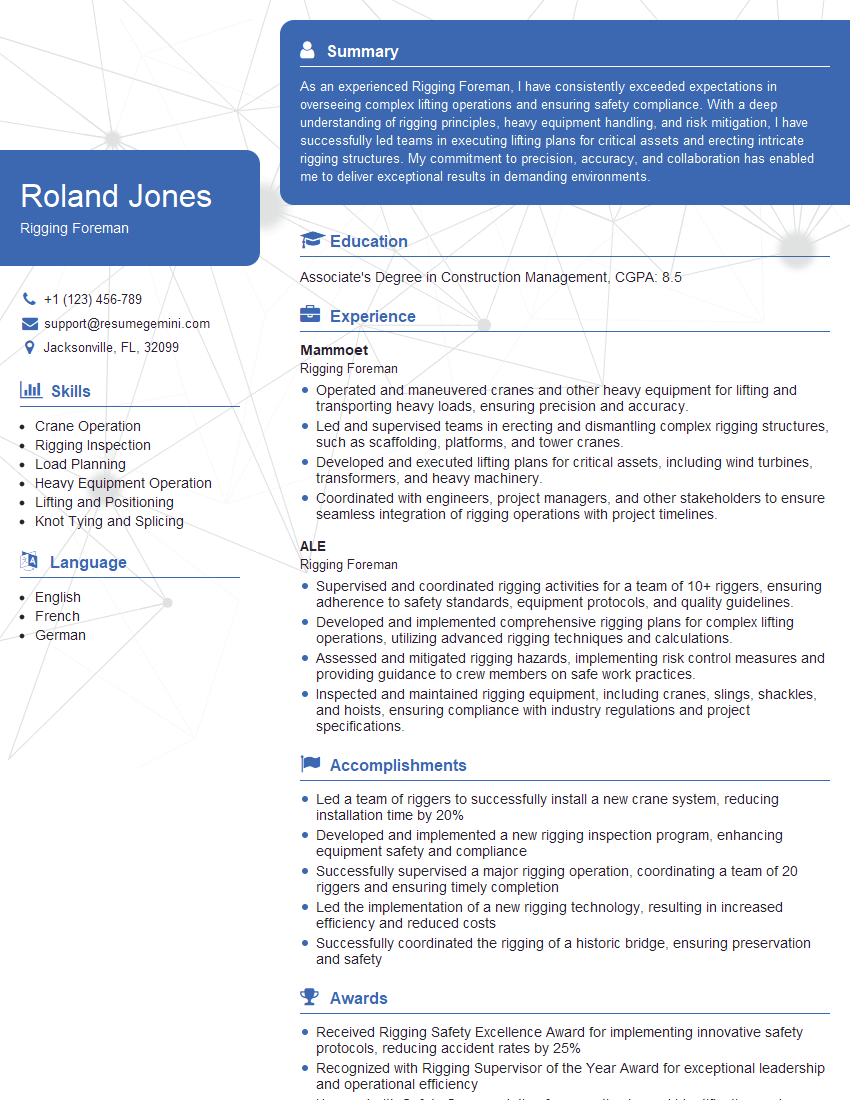
Mastering Crane Load Calculations and Planning opens doors to exciting career opportunities with significant growth potential. A strong understanding of these concepts demonstrates competence and commitment to safety, making you a highly desirable candidate. To maximize your job prospects, invest time in creating an ATS-friendly resume that effectively highlights your skills and experience. ResumeGemini is a trusted resource that can help you build a professional and impactful resume. We provide examples of resumes tailored to Crane Load Calculations and Planning to guide you in creating a document that truly showcases your qualifications. Take the next step toward your dream career today!


Explore more articles
Users Rating of Our Blogs
Share Your Experience
We value your feedback! Please rate our content and share your thoughts (optional).
What Readers Say About Our Blog
Very informative content, great job.
good