Interviews are opportunities to demonstrate your expertise, and this guide is here to help you shine. Explore the essential Creative Storytelling interview questions that employers frequently ask, paired with strategies for crafting responses that set you apart from the competition.
Questions Asked in Creative Storytelling Interview
Q 1. Explain the three-act structure and its application in creative storytelling.
The three-act structure is a fundamental framework in storytelling, dividing a narrative into three distinct parts: Setup, Confrontation, and Resolution. Think of it like a classic hero’s journey.
- Act I: Setup introduces the protagonist, their world, and the inciting incident that disrupts the status quo. This establishes the central conflict and sets the stage for the story. For example, in Star Wars: A New Hope, Act I introduces Luke Skywalker, his mundane life on Tatooine, and the arrival of the droids carrying Princess Leia’s message – the inciting incident that thrusts Luke into a larger conflict.
- Act II: Confrontation is where the protagonist faces obstacles, develops their skills, and experiences escalating conflict. This is often the longest act, filled with twists, turns, and rising stakes. In Star Wars, this would be Luke’s training with Obi-Wan, his escape from the Death Star, and the growing threat of the Empire.
- Act III: Resolution sees the climax of the conflict, followed by the resolution and denouement. The protagonist confronts the antagonist, resulting in victory or defeat, and the narrative threads are tied up, offering closure. The final battle on the Death Star and the subsequent celebration mark the resolution in Star Wars.
This structure is widely applicable, providing a clear roadmap for structuring narratives across various media, from novels and films to video games and plays. It ensures a compelling narrative arc with clear beginnings, middles, and ends.
Q 2. Describe your approach to developing a compelling narrative arc.
Developing a compelling narrative arc involves crafting a journey for the protagonist, one filled with both internal and external transformations. I begin by defining a clear central conflict – the core problem or challenge the protagonist must overcome. Then, I map out the protagonist’s journey, identifying key plot points and turning points that will escalate tension and force them to evolve.
I use a combination of techniques: establishing clear goals for the protagonist, introducing obstacles that test their limits, and creating moments of self-discovery that deepen their character. This arc isn’t just about external events; it’s also about the internal change the protagonist undergoes as a result of their experiences. A successful arc leaves the audience feeling satisfied, having witnessed a meaningful transformation.
For example, in developing a story about a shy artist overcoming their fear of public speaking to exhibit their work, the narrative arc would map their progression from initial anxiety, to small victories, to finally exhibiting their art and finding self-acceptance. Each step, each hurdle overcome, contributes to the overall compelling nature of the journey.
Q 3. How do you identify and incorporate a unique voice into your storytelling?
A unique voice in storytelling is more than just a distinctive writing style; it’s the personality, perspective, and worldview that shine through the narrative. I identify a unique voice by deeply considering my protagonist’s background, values, and experiences. How do they perceive the world? What kind of language do they use? What are their biases and perspectives?
I use various methods to incorporate this unique voice: carefully selecting vocabulary and sentence structure, focusing on the details of sensory experience (how the character sees, hears, smells, tastes, and feels their environment), and ensuring consistent characterization throughout the narrative. Dialogue is especially crucial; it’s a direct reflection of the character’s personality and voice.
For instance, a gritty detective story might use stark, direct language, while a whimsical children’s story would employ playful word choices and imaginative descriptions. The voice should be authentic to the character and consistent, creating a memorable and engaging reading or viewing experience.
Q 4. What strategies do you use to build suspense and anticipation in a narrative?
Building suspense and anticipation is all about carefully controlling information and raising the stakes. I employ several strategies:
- Ticking Clock: Introducing a time constraint adds urgency and pressure, forcing the protagonist (and the audience) to act quickly. This could be a deadline, a countdown, or a looming threat.
- Cliffhangers: Ending chapters or scenes on a dramatic note, leaving the audience wanting more, is a classic suspense-building technique. This creates anticipation for what will happen next.
- Red Herrings: Introducing misleading clues or suspects can create confusion and uncertainty, keeping the audience guessing. This builds suspense by making them question their assumptions.
- Foreshadowing: Hints of future events, subtly woven into the narrative, can create a sense of impending doom or excitement, building anticipation for the payoff.
- Raising the Stakes: Gradually increasing the consequences of failure increases tension and makes the protagonist’s struggle more compelling.
The key is to find a balance; too much suspense can be overwhelming, while too little can leave the audience unengaged. The goal is to keep the audience on the edge of their seats, eager to see how the story unfolds.
Q 5. Discuss the importance of character development in effective storytelling.
Character development is the cornerstone of effective storytelling. Without well-developed characters, the narrative lacks depth and emotional resonance. Characters should be more than just plot devices; they should be complex, relatable individuals with their own motivations, flaws, and aspirations.
I develop characters by considering their:
- Backstory: Their past experiences shape who they are and influence their actions.
- Motivations: What drives them? What are their goals and desires?
- Flaws and Strengths: No one is perfect. Characters with both strengths and weaknesses are more believable and engaging.
- Relationships: How do they interact with other characters? What kind of dynamics exist?
- Arcs: How do they change and grow throughout the story?
By carefully crafting these aspects, I create characters that are believable, memorable, and drive the narrative forward. A story with compelling characters will stay with the audience long after they’ve finished reading or watching.
Q 6. How do you craft memorable and impactful dialogue?
Memorable and impactful dialogue serves multiple purposes: it advances the plot, reveals character, and creates emotional resonance. I craft dialogue by focusing on:
- Authenticity: Dialogue should sound natural and believable, reflecting the character’s personality and background. Avoid overly formal or stilted language.
- Subtext: What’s unsaid can be just as important as what’s said. Subtext allows for layers of meaning and complexity.
- Purpose: Each line of dialogue should serve a purpose, whether it’s moving the plot forward, revealing character, or creating tension.
- Variety: Mix up the style and rhythm of the dialogue to avoid monotony. Some characters might be verbose, others concise; some might use slang, others formal language.
- Action: Dialogue should feel active; it should reveal actions as well as words.
Effective dialogue is a dance between characters; it reveals their relationships, conflicts, and inner lives, making the story more engaging and human.
Q 7. Explain your process for creating a believable and engaging setting.
Creating a believable and engaging setting involves more than simply describing the location; it’s about bringing it to life through sensory details and atmosphere. I approach this by:
- Research: If the setting is real or based on reality, thorough research is essential to ensure accuracy and authenticity.
- Sensory Details: Engage all five senses – sight, sound, smell, taste, and touch – to create a vivid and immersive experience for the reader or viewer. Describe the sights, sounds, smells, tastes, and textures of the environment.
- Atmosphere: The mood and atmosphere of the setting should reflect the story’s tone and themes. A dark and mysterious setting might use shadows and silence, while a lively and bustling city might be filled with noise and movement.
- Significance: The setting shouldn’t be just a backdrop; it should actively contribute to the story, influencing the characters and events.
- Consistency: Maintain consistency in the description of the setting throughout the story to avoid confusion.
A well-crafted setting becomes more than just a location; it becomes a character in its own right, enriching the narrative and contributing to the overall impact of the story.
Q 8. Describe how you would adapt a story for different mediums (e.g., written, visual, audio).
Adapting a story across mediums requires understanding the unique strengths and limitations of each. Think of it like translating a song – the core message remains, but the delivery changes. A written story relies heavily on descriptive language and internal monologue, while a visual medium like film uses imagery and visual storytelling. Audio, like a podcast, prioritizes voice acting, sound design, and pacing.
- Written: Focus on vivid descriptions, strong character development through internal thoughts and actions, and a compelling narrative arc. For example, a fantasy novel might delve into intricate world-building through detailed descriptions of landscapes and cultures.
- Visual (Film/Animation): Prioritize visual metaphors, strong cinematography, and impactful scenes. Consider a scene in a film where a character’s loneliness is visually represented by a vast, empty landscape. The same loneliness could be described extensively in a novel but needs visual equivalents in film.
- Audio (Podcast/Radio Drama): Reliance on dialogue, sound effects, and music to create atmosphere and convey emotion. For instance, the tension in a chase scene in a radio drama would be built through sound design – the pounding of footsteps, accelerating car engines, and a rising musical score – rather than visual description.
The key is to identify the core emotional beats and plot points of your story and then translate them into the appropriate language and techniques for each medium. It’s about finding the most effective way to convey the story’s essence, regardless of the form.
Q 9. How do you ensure your storytelling resonates with the target audience?
Resonating with your target audience involves deep understanding of their demographics, psychographics, and cultural context. It’s about crafting a story that speaks directly to their experiences, values, and aspirations.
- Demographics: Age, gender, location, socioeconomic status directly influence preferences. A young adult novel will differ vastly from a story targeting senior citizens.
- Psychographics: Values, interests, lifestyle, and attitudes are crucial. A story centered on environmental conservation would resonate better with audiences who prioritize sustainability.
- Cultural Context: Understanding cultural norms, beliefs, and traditions is vital to avoid misinterpretations or causing offense. A story about family dynamics will have different nuances depending on the cultural background it portrays.
Thorough market research, audience surveys, and even engaging in discussions with your target group can greatly help in achieving this resonance. For example, testing different versions of your story with focus groups helps identify what works best.
Q 10. How do you incorporate conflict and resolution effectively in your storytelling?
Conflict is the engine of any story; it drives the narrative and compels the audience to follow along. Resolution provides catharsis and meaning. Effective use of both involves careful planning and execution.
- Internal Conflict: Character struggles with internal dilemmas, moral choices, or personal demons. Example: A protagonist grappling with a difficult decision that compromises their moral code.
- External Conflict: Character faces challenges from the external world, such as antagonists, natural disasters, or societal pressures. Example: A hero battling a villain to save the world.
Resolution should feel earned, not contrived. It must flow logically from the preceding conflict and provide a sense of closure, however bittersweet. Avoiding a simplistic ‘happily ever after’ in favor of a realistic and meaningful conclusion often makes for a more memorable and impactful story. For instance, a character might overcome their fear but still struggle with its lingering effects.
Q 11. What are some common pitfalls to avoid in creative storytelling?
Many pitfalls can derail a good story. Here are a few common ones:
- Unclear narrative: A muddled plot, confusing characters, or a lack of direction leaves the audience lost and disengaged. Careful outlining and plot structuring are crucial.
- Weak character development: Flat, unconvincing characters fail to connect with the audience. Characters need compelling motivations, flaws, and arcs of change.
- Info-dumping: Overwhelming the audience with excessive exposition all at once. Information should be woven organically into the narrative.
- Unrealistic pacing: A story that drags or rushes creates a disjointed and unengaging experience. A well-paced story keeps the audience hooked.
- Unsatisfying resolution: A resolution that feels forced, illogical, or leaves major plot points unresolved frustrates the audience.
Regular feedback, self-editing, and seeking critiques from others can help identify and address these pitfalls before they damage the story.
Q 12. Explain how you use symbolism and metaphor to enrich your storytelling.
Symbolism and metaphor enrich storytelling by adding layers of meaning and depth. They allow for subtle communication of ideas and emotions, making the story more engaging and memorable.
- Symbolism: Using objects, characters, or events to represent abstract ideas or concepts. A recurring motif of a wilting flower could symbolize the decay of a relationship.
- Metaphor: A direct comparison between two dissimilar things to highlight a shared quality. Describing a character as a ‘raging bull’ suggests their aggressive and powerful nature.
Effective use of symbolism and metaphor requires careful consideration of their impact on the narrative. They should enhance, not distract from the story. For example, in ‘The Great Gatsby’, the green light across the bay serves as a potent symbol of Gatsby’s unattainable dream.
Q 13. How do you incorporate foreshadowing and flashbacks into your narratives?
Foreshadowing and flashbacks are powerful narrative techniques that can build suspense and enhance character development.
- Foreshadowing: Hints or clues about future events. This can build anticipation and create a sense of suspense. Example: A seemingly insignificant detail early in a story might have larger significance later, creating a satisfying ‘aha’ moment.
- Flashback: Interruptions to the present narrative to show past events. These can offer context, develop characters, or provide crucial backstory. Example: A character’s childhood trauma might be revealed through a flashback, explaining their present actions and motivations.
Both techniques should be used judiciously. Overusing foreshadowing can make the story predictable, while excessive flashbacks can disrupt the flow and pacing. They should serve a purpose within the narrative, adding depth and insight without being gratuitous.
Q 14. How do you ensure the pacing of your story is engaging and effective?
Pacing refers to the speed and rhythm of the narrative. It’s crucial for maintaining audience engagement. A well-paced story keeps the reader or viewer hooked, while a poorly paced one can lead to boredom or confusion.
- Varying Sentence Length and Structure: Short sentences create a sense of urgency, while longer, more descriptive sentences slow the pace and create atmosphere.
- Strategic Use of Action and Dialogue: Action scenes can accelerate the pace, whereas quieter, reflective moments allow for a slower tempo.
- Chapter/Scene Breaks: Using chapter breaks or scene changes strategically can manipulate pacing and create dramatic tension.
- Building Tension and Suspense: Gradually increasing tension and anticipation will keep the audience eager to know what happens next.
Think of pacing like music – it needs variation to be interesting. A constant, unchanging rhythm becomes monotonous. By skillfully controlling the pace, you can guide your audience through the emotional journey of your story.
Q 15. Describe your experience with different storytelling techniques (e.g., linear, non-linear).
Storytelling techniques are the methods used to construct and deliver a narrative. Linear storytelling follows a chronological order, moving from beginning to end in a straightforward manner. Think of a classic fairy tale, where events unfold sequentially. Non-linear storytelling, conversely, jumps around in time, using flashbacks, flash-forwards, or multiple perspectives to create a more complex and engaging narrative. This is common in novels like Cloud Atlas by David Mitchell, where storylines intertwine across different eras.
My experience spans both. I’ve crafted numerous linear narratives for marketing campaigns, needing clear, concise messaging. In contrast, for a recent interactive museum exhibit, I employed a non-linear approach, allowing visitors to explore the story at their own pace and from various angles, creating a more immersive experience. This required careful consideration of narrative structure to maintain coherence and impact despite the unconventional timeline.
- Linear: Effective for straightforward messages, clear progression, easy audience understanding.
- Non-linear: Creates intrigue, allows for deeper exploration of themes, better reflects the complexities of life, but demands greater narrative skill to maintain clarity.
Career Expert Tips:
- Ace those interviews! Prepare effectively by reviewing the Top 50 Most Common Interview Questions on ResumeGemini.
- Navigate your job search with confidence! Explore a wide range of Career Tips on ResumeGemini. Learn about common challenges and recommendations to overcome them.
- Craft the perfect resume! Master the Art of Resume Writing with ResumeGemini’s guide. Showcase your unique qualifications and achievements effectively.
- Don’t miss out on holiday savings! Build your dream resume with ResumeGemini’s ATS optimized templates.
Q 16. How do you evaluate the success of your storytelling efforts?
Evaluating storytelling success is multifaceted and depends heavily on the project’s goals. I consider several key metrics:
- Audience Engagement: Did the story capture and maintain the audience’s attention? This can be measured through things like viewership numbers, social media interaction, and audience feedback surveys.
- Emotional Impact: Did the story evoke the intended emotions (e.g., empathy, joy, fear)? This can be assessed through qualitative feedback and observation of audience reactions.
- Achieving Objectives: Did the story achieve its intended purpose? For example, did a marketing campaign increase sales? Did an educational story increase knowledge retention? These require measurable, pre-determined goals.
- Narrative Coherence: Did the story hold together logically and emotionally? Was the pacing effective? Did the ending feel satisfying and impactful?
I often combine quantitative data (e.g., website analytics) with qualitative data (e.g., focus groups, user interviews) for a comprehensive evaluation. For instance, a high viewership number is meaningless without understanding if the audience actually connected with the story’s message.
Q 17. How do you handle feedback and criticism on your storytelling work?
Feedback is crucial for improvement. I approach criticism constructively, viewing it as an opportunity to refine my work rather than a personal attack. My process involves:
- Active Listening: I carefully listen to the feedback, ensuring I understand the concerns before formulating a response.
- Identifying Valid Points: I separate constructive criticism from subjective opinions. I ask myself: Is this criticism valid in terms of storytelling principles or audience understanding? Does it relate to my original goals?
- Considering the Source: The credibility and expertise of the feedback provider impacts how I weigh their comments. A seasoned editor’s feedback holds more weight than a random internet comment.
- Implementing Changes (or Not): Based on my analysis, I decide whether to incorporate the suggestions. Not all feedback is equally valuable, and sometimes maintaining my artistic vision is more important.
- Open Dialogue: I maintain open communication with stakeholders, explaining my decisions regarding incorporating or rejecting specific feedback.
For example, if feedback suggests a scene is confusing, I might revise it for clarity, adding exposition or changing the narrative structure. If the feedback is about personal preference (e.g., ‘I didn’t like the character’), I might acknowledge it but not necessarily alter the story based solely on that.
Q 18. Describe a time you had to overcome a creative challenge in a storytelling project.
In a recent project creating a short animated film about climate change for children, I faced a major challenge: making a potentially depressing topic engaging and age-appropriate without being overly simplistic or preachy. Initially, my approach was too didactic, focusing heavily on scientific facts. This resulted in a film that felt dry and lacked emotional resonance for the target audience.
To overcome this, I shifted my focus to storytelling through character-driven narrative. I created relatable animal characters who faced the consequences of climate change, allowing children to connect emotionally with the story. I used humor and visually appealing animation to keep the narrative engaging. Instead of directly lecturing about climate change, the film showcased the consequences through the characters’ experiences, leaving a more lasting impact. The revised version received significantly more positive feedback, demonstrating the importance of balancing educational content with compelling narrative.
Q 19. Explain how you stay updated on current trends and best practices in storytelling.
Staying current in the dynamic field of storytelling necessitates continuous learning. My methods include:
- Reading Widely: I regularly read books, articles, and blogs on storytelling, screenwriting, and narrative design. This includes both academic works and practical guides.
- Attending Workshops and Conferences: Engaging in industry events allows me to learn from leading storytellers, network with professionals, and discover emerging trends.
- Analyzing Successful Stories: I dissect successful stories across various mediums (films, video games, novels, advertisements) to understand their narrative structures, character development, and overall impact.
- Experimentation: I constantly experiment with new techniques and approaches, pushing the boundaries of my storytelling skills and exploring innovative narrative forms. I’m particularly interested in the use of interactive storytelling and emerging technologies in this context.
- Following Industry Influencers: I follow leading storytellers, writers, and filmmakers on social media and other platforms to keep abreast of their insights and analyses.
Q 20. Describe your understanding of the Hero’s Journey archetype.
The Hero’s Journey, a narrative archetype popularized by Joseph Campbell, outlines a common structure found in many stories across cultures and time periods. It’s a cyclical model detailing the transformative journey of a protagonist. The core stages include:
- The Ordinary World: The hero’s normal life before the adventure.
- The Call to Adventure: An event that disrupts the hero’s ordinary life and calls them to action.
- Refusal of the Call: The hero initially hesitates or refuses the call.
- Meeting the Mentor: The hero encounters a wise figure who guides and supports them.
- Crossing the Threshold: The hero commits to the adventure and enters a new, unfamiliar world.
- Tests, Allies, and Enemies: The hero faces challenges, gains allies, and confronts enemies.
- Approaching the Inmost Cave: The hero prepares for the ultimate confrontation.
- The Ordeal: The hero faces a major crisis, often a near-death experience.
- Reward (Seizing the Sword): The hero emerges victorious, often gaining a valuable prize or insight.
- The Road Back: The hero begins the journey back to their ordinary world.
- Resurrection: The hero faces a final challenge that tests their newfound skills and wisdom.
- Return with the Elixir: The hero returns to their ordinary world transformed, bringing back a gift or lesson learned.
Understanding this archetype allows storytellers to create compelling narratives with predictable yet emotionally resonant arcs. However, it’s important to remember that it’s a framework, not a rigid formula. Successful stories often deviate from or subvert the traditional Hero’s Journey, creating unique and engaging experiences.
Q 21. How do you balance creativity with strategic goals in your storytelling projects?
Balancing creativity with strategic goals is essential for successful storytelling projects. It’s about marrying artistic vision with practical objectives. My approach involves:
- Clear Definition of Goals: Before starting, I work closely with stakeholders to clearly define the project’s objectives. What message needs to be conveyed? What action do we want the audience to take? What are the key performance indicators (KPIs)?
- Brainstorming & Ideation: I encourage creative brainstorming sessions to generate numerous ideas, allowing for exploration of different approaches within the strategic boundaries.
- Storyboarding & Prototyping: I create storyboards or prototypes to visualize the narrative and test different elements before full-scale production. This allows for early feedback and adjustments to ensure alignment with both creative vision and strategic goals.
- Iterative Process: I embrace an iterative approach, constantly refining the story based on feedback, analytics, and ongoing evaluation of the project’s progress toward its goals.
- Prioritization: Sometimes compromises are necessary. I prioritize the most impactful aspects of the story, ensuring the core message remains strong while creative flourishes support, rather than detract from, the overall goal.
For instance, in a corporate video, the creative goal might be to craft a compelling narrative, while the strategic goal is to improve brand awareness. Balancing these means creating a story that is both engaging and effectively communicates the brand’s message.
Q 22. Discuss your familiarity with different narrative structures (e.g., Freytag’s pyramid).
Narrative structure provides the skeletal framework upon which a story is built. Freytag’s Pyramid, a classic model, outlines a five-part structure: Exposition (introducing the setting and characters), Rising Action (building suspense and conflict), Climax (the peak of the conflict), Falling Action (the aftermath of the climax), and Resolution (the conclusion). However, many stories deviate from this, and other structures exist, such as the In Media Res (starting in the middle of the action), Circular Structure (ending where it begins), and the Anti-Structure (deliberately defying conventional narrative form). Understanding these different structures allows for creative flexibility, tailoring the narrative to best suit the story’s specific needs and desired impact. For instance, a thriller might benefit from a fast-paced, In Media Res approach, whereas a character-driven drama might utilize a more traditional Freytagian structure to explore character development fully. Choosing the right structure isn’t about following a rigid formula, but rather understanding how different shapes can affect the pacing, tension, and overall resonance of the story.
Q 23. How do you incorporate audience engagement strategies into your narratives?
Audience engagement is crucial for a successful story. It’s about creating a connection between the narrative and the reader or viewer, making them actively invested in the outcome. This can be achieved through several strategies. Firstly, creating relatable characters with compelling motivations and flaws immediately draws the audience in. We feel empathy for their struggles and root for their successes. Secondly, building suspense and mystery keeps the audience guessing and eagerly anticipating what will happen next. This is achieved through clever pacing, foreshadowing, and withholding crucial information. Thirdly, incorporating interactive elements, where appropriate, can further boost engagement. For example, in interactive fiction or games, the audience makes choices that directly shape the narrative. Finally, utilizing strong sensory language vividly paints a picture in the audience’s mind, allowing them to experience the story more fully. Think of the difference between ‘the sun set’ and ‘the sun dipped below the horizon, painting the sky in fiery hues of orange and crimson’. The latter engages the audience’s imagination far more effectively.
Q 24. Explain the difference between plot and story.
While often used interchangeably, ‘plot’ and ‘story’ are distinct concepts. The story is the chronological sequence of events that make up the narrative. It’s the ‘what’ – what happened to the characters. The plot, however, is the *order* in which those events are presented to the audience. It is the ‘how’ – how the story is told. Consider a detective novel: The story might be the detective’s investigation, chronologically detailing every lead, interview, and clue. The plot, however, could choose to start with the climax (the solving of the mystery), then flashback to reveal how the detective arrived at the solution. The plot manipulates the story’s timeline to create dramatic impact, suspense, or reveal information strategically. The difference is akin to a recipe (story) and the way a chef prepares a dish (plot) – the final result is the same, but the presentation is entirely different.
Q 25. Discuss the importance of theme in effective storytelling.
Theme acts as the underlying message or idea explored in a story. It’s the central concept that gives the narrative depth and meaning, resonating with the audience on an intellectual and emotional level. A story without a strong theme can feel superficial or lacking in purpose. Effective storytelling uses the plot, characters, and setting to explore and illuminate the theme. For example, a story might seemingly be about a young woman’s quest for a lost artifact, but the underlying theme could be perseverance, the importance of self-discovery, or the corrupting influence of power. A well-defined theme provides a sense of unity and coherence to the narrative, making it more memorable and impactful. It allows the audience to extract deeper meaning beyond the surface level events. Themes can be explicit, directly stated within the narrative, or implicit, subtly conveyed through character actions and symbolism.
Q 26. How do you incorporate emotional impact into your storytelling?
Emotional impact is paramount in creating a memorable and engaging story. It’s about evoking feelings within the audience—joy, sadness, fear, anger, hope—that connect them to the characters and their journey. This can be achieved through several techniques. Firstly, developing well-rounded characters with believable motivations and vulnerabilities allows the audience to empathize with their experiences. Secondly, using vivid descriptions and imagery paints a picture in the reader’s mind, creating a deeper sensory experience. Thirdly, crafting scenes with high stakes and emotional consequences creates tension and suspense, keeping the audience on the edge of their seats. Finally, utilizing carefully chosen words to create specific emotional responses is crucial. For example, using words like ‘whispered’ vs ‘bellowed’ immediately conjures different emotional responses. Mastering the art of emotional impact transforms a simple narrative into a profoundly affecting experience.
Q 27. How do you leverage different narrative perspectives to enrich your story?
Narrative perspective, or point of view, significantly impacts a story’s impact and reader experience. Choosing between first-person (I), second-person (you), and third-person (he/she/they) perspectives dramatically changes how the story unfolds and what information the reader receives. First-person offers intimacy and immediacy, allowing readers direct access to a character’s thoughts and feelings; however, it limits the scope to the narrator’s perspective. Second-person is less common but can create a sense of immediacy and immersion, often used in interactive narratives. Third-person offers more flexibility; third-person omniscient allows the narrator to access the thoughts and feelings of multiple characters, whereas a limited third-person perspective focuses on a single character’s experience. Shifting between perspectives within a single story can also enrich the narrative, offering different facets of the same event. For example, alternating between the perspectives of two opposing characters in a conflict can provide a nuanced understanding of their motivations and actions, creating a more complex and engaging story. The key is to select a perspective that best serves the story’s purpose and desired emotional effect.
Key Topics to Learn for Your Creative Storytelling Interview
- Narrative Structure & Arc: Understanding the foundational elements of storytelling, including plot, character development, setting, and theme. Practical application: Analyze successful narratives across different media (film, games, advertising).
- Audience Engagement & Empathy: Crafting compelling narratives that resonate with specific target audiences and evoke emotional responses. Practical application: Discuss strategies for building audience connection and understanding diverse perspectives.
- Visual Storytelling: Utilizing visual elements (images, video, animation) to enhance narrative impact. Practical application: Analyze the use of visuals in effective storytelling examples. Consider how visual elements contribute to narrative meaning and emotional resonance.
- Worldbuilding & Immersive Experiences: Creating believable and engaging fictional worlds, environments, and characters. Practical application: Discuss how to develop consistent and rich world details, enriching audience engagement.
- Storytelling Across Media: Adapting storytelling techniques for different platforms (e.g., film, video games, interactive narratives, advertising). Practical application: Analyze case studies of successful cross-media storytelling strategies.
- Conflict & Resolution: Crafting compelling narratives with well-defined conflicts and satisfying resolutions. Practical application: Analyze how different narrative structures handle conflict and resolution.
- Storytelling Principles & Theory: Understanding key theoretical frameworks of narrative, including genre conventions, archetypes, and narrative devices. Practical application: Apply theoretical knowledge to analyze and critique existing narratives.
Next Steps
Mastering creative storytelling is crucial for career advancement in today’s dynamic media landscape. It opens doors to diverse opportunities, demanding creative problem-solving and impactful communication skills. To maximize your job prospects, create an ATS-friendly resume that highlights your unique skills and experiences. We strongly recommend using ResumeGemini to build a professional and compelling resume that showcases your abilities effectively. ResumeGemini offers examples of resumes tailored specifically to Creative Storytelling roles, guiding you through the process of crafting a document that truly reflects your expertise.

Creative Director Resume Sample

Communications Manager Resume Sample

Social Media Manager Resume Sample

Content Strategist Resume Sample
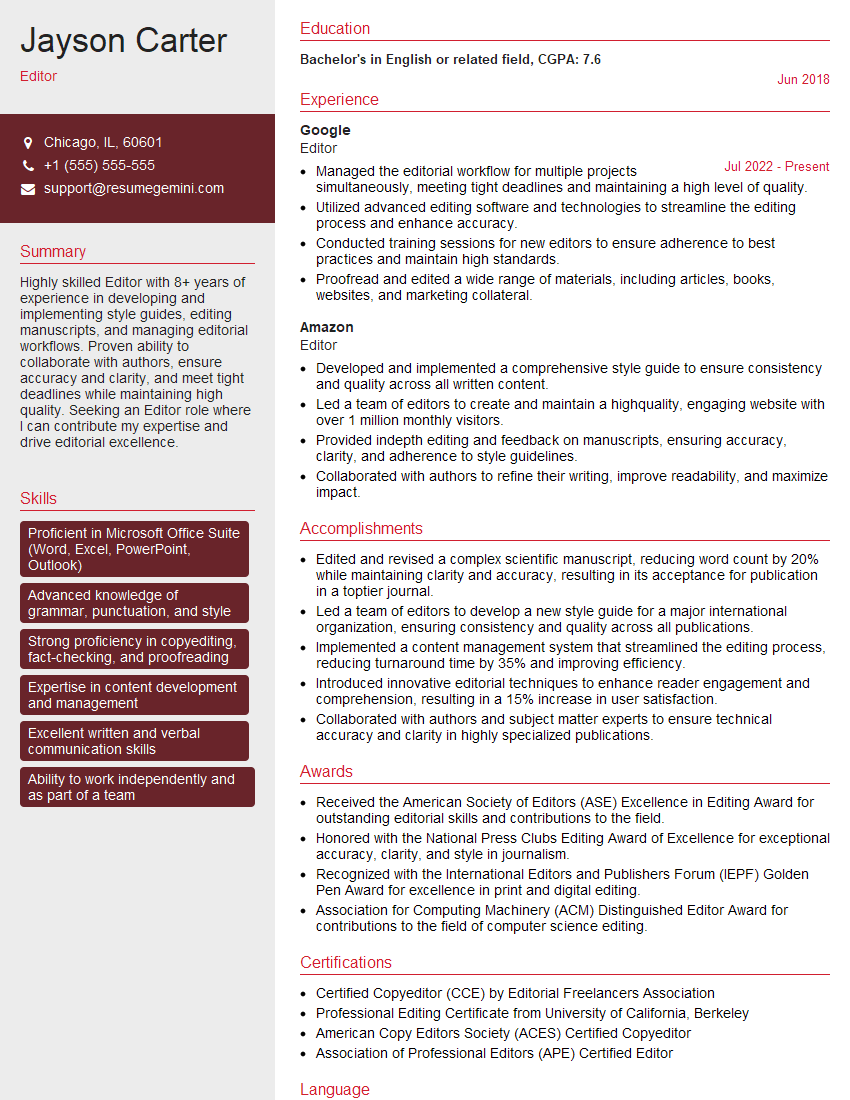
Editor Resume Sample
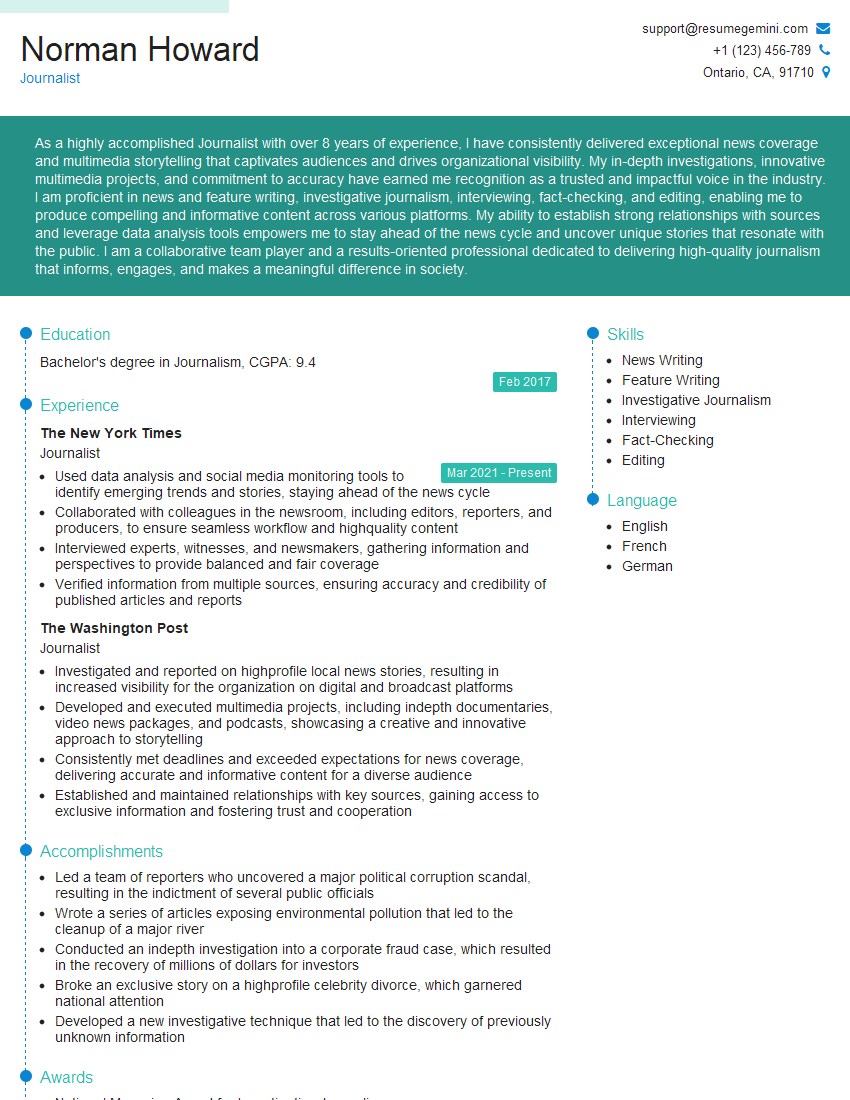
Journalist Resume Sample

Technical Writer Resume Sample

Copywriter Resume Sample
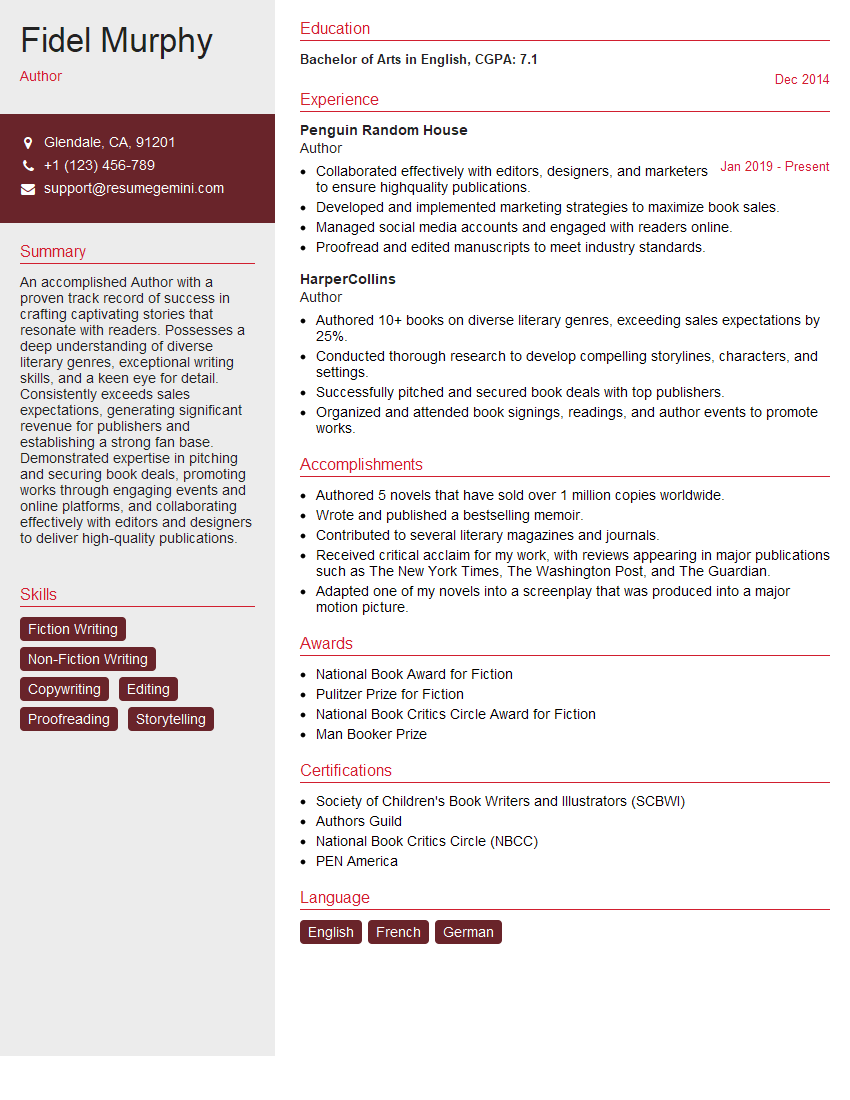
Author Resume Sample
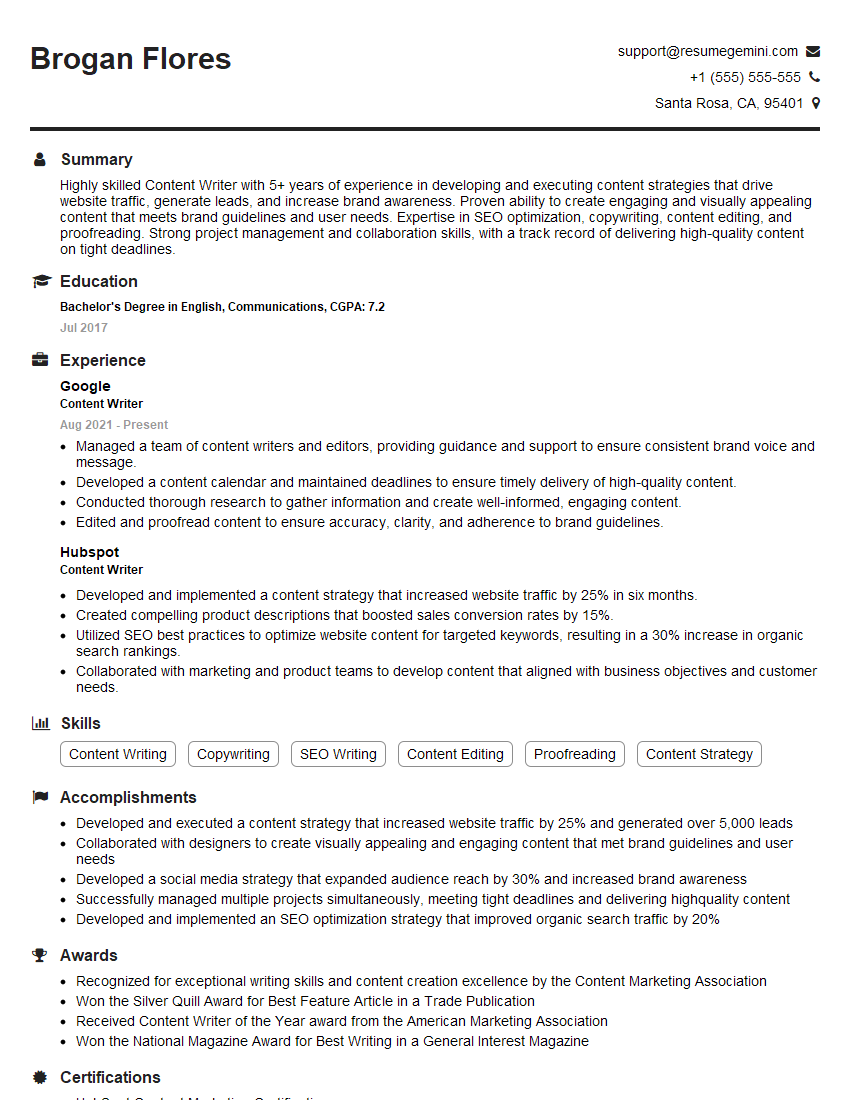
Content Writer Resume Sample
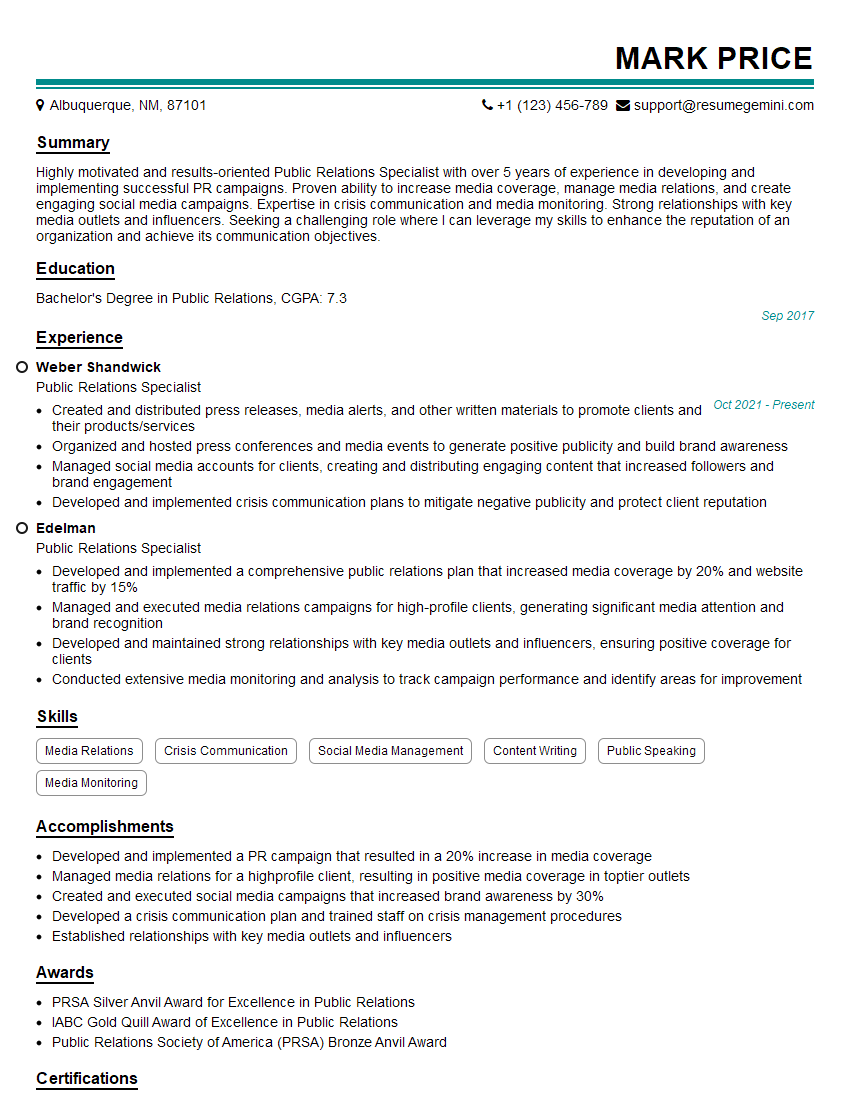
Public Relations Specialist Resume Sample
Explore more articles
Users Rating of Our Blogs
Share Your Experience
We value your feedback! Please rate our content and share your thoughts (optional).
What Readers Say About Our Blog
Very informative content, great job.
good