The thought of an interview can be nerve-wracking, but the right preparation can make all the difference. Explore this comprehensive guide to Custom Stitching and Repairs interview questions and gain the confidence you need to showcase your abilities and secure the role.
Questions Asked in Custom Stitching and Repairs Interview
Q 1. What types of sewing machines are you proficient with?
My proficiency extends across a range of sewing machines, from basic domestic models to industrial machines. I’m highly skilled in operating both mechanical and computerized sewing machines. This includes experience with straight stitch, zig-zag stitch, and specialized stitch machines used for things like buttonholes and embroidery. For example, I’m adept at adjusting the tension, stitch length, and pressure foot on different machines to achieve optimal results with various fabrics. My experience also encompasses troubleshooting and maintaining various makes and models, ensuring they are always in peak working condition.
- Domestic Sewing Machines: Singer, Brother, Janome – these are excellent for everyday alterations and smaller projects. I’m comfortable adjusting their settings for various tasks.
- Industrial Sewing Machines: I have experience with single-needle and double-needle industrial machines, often used for high-volume tasks such as hemming or creating durable seams in heavier fabrics. These machines offer greater speed and durability.
Q 2. Describe your experience with different fabric types and their sewing requirements.
Working with diverse fabric types requires a nuanced understanding of their properties. Each fabric demands a unique approach to cutting, sewing, and finishing. For instance, delicate fabrics like silk or chiffon require a delicate touch and fine needles to avoid snags or damage. Heavier fabrics like denim or canvas necessitate stronger needles and a more robust stitch.
- Lightweight Fabrics (Silk, Chiffon): Require fine needles, low tension, and potentially a walking foot to prevent slippage. I often use a delicate press cloth to prevent scorching.
- Medium-Weight Fabrics (Cotton, Linen): More versatile, but still require attention to needle and tension settings. A standard press is generally sufficient.
- Heavy-Weight Fabrics (Denim, Canvas): Stronger needles, higher tension, and potentially a special heavy-duty sewing machine are needed. I often use a denim needle or a leather needle to ensure the fabric doesn’t tear.
My experience allows me to choose the right needle, thread, stitch type, and machine settings for optimal results, regardless of the fabric.
Q 3. How do you diagnose and repair common sewing machine problems?
Diagnosing sewing machine problems involves a systematic approach. I begin by listening for unusual sounds (like grinding or clicking), checking the tension, examining the needle and bobbin for damage, and verifying that the machine is properly threaded.
Common problems and solutions:
- Skipped Stitches: Often caused by a bent or dull needle, incorrect tension, or lint buildup. I’ll replace the needle, adjust the tension, and clean the machine.
- Broken Needles: Typically due to hitting pins or hard objects in the fabric. This requires replacing the needle and carefully checking the fabric for obstructions.
- Jammed Bobbin: Can result from incorrect bobbin placement or winding. I’ll carefully check the bobbin case and ensure proper winding and placement.
- Uneven Stitches: Often caused by inconsistent tension or worn parts. Adjusting the tension or replacing parts might be necessary.
My experience allows me to quickly identify the root cause and implement the appropriate solution, minimizing downtime and ensuring efficient operation.
Q 4. Explain your process for altering garments to fit different body types.
Altering garments involves precise measurements and a strong understanding of garment construction. I start by carefully measuring the client’s body to identify areas needing adjustment. Then, I assess the garment’s existing structure to determine the best approach. For example, taking in a seam is different from letting out a seam and requires different techniques.
Process:
- Measurement and Assessment: Taking accurate body measurements and comparing them to the garment’s measurements.
- Marking Alterations: Pinning the adjustments to the garment, ensuring they are even and symmetrical.
- Seam Adjustments: Sewing or removing seams to accommodate the alterations. This might involve taking in or letting out seams, adjusting darts, or adding fabric panels.
- Fitting and Adjustments: Trying on the garment to check the fit and make further adjustments as needed.
- Finishing: Pressing and finishing the garment to ensure a professional look.
I’ve altered everything from simple t-shirts to complex tailored suits, adjusting for various body types, sizes, and preferences.
Q 5. How do you handle complex repairs, such as mending tears or replacing zippers?
Complex repairs require patience, precision, and a strong understanding of fabric structure and repair techniques. Mending tears, for instance, often involves matching the fabric weave to create an almost invisible repair. Zipper replacement needs careful measuring and fitting to ensure smooth operation.
Mending Tears:
- Small Tears: Can be mended using a darning stitch or by patching from the inside. I always match thread to the garment’s color as closely as possible.
- Larger Tears: Might require patching or using a woven fabric patch on the reverse side for reinforcement. Invisible mending techniques are often preferred for delicate fabrics.
Replacing Zippers:
- Careful Measurement: I accurately measure the existing zipper to ensure a precise replacement.
- Seam Removal: Removing the old zipper carefully without damaging the surrounding fabric.
- Zipper Insertion: Inserting the new zipper, ensuring smooth operation and even stitching. The zipper should lay flat and function perfectly.
- Finishing: Pressing and cleaning up any loose threads.
I approach complex repairs strategically, choosing the most appropriate techniques for the specific fabric and the extent of the damage.
Q 6. What are your preferred methods for hand-stitching?
My preferred hand-stitching methods are chosen based on the project’s requirements and the desired aesthetic. For example, a slipstitch is practically invisible, while a running stitch is quick and functional. I always select the thread color and stitch length appropriately.
- Running Stitch: A simple and fast stitch, ideal for basting or temporary stitching.
- Backstitch: Stronger than a running stitch, used where durability is important.
- Slipstitch: Almost invisible, often used for closing seams or attaching hems invisibly.
- Blanket Stitch: A decorative stitch, often used on edges or blankets. It adds both strength and aesthetic appeal.
Hand-stitching allows for fine detail work and is invaluable for projects requiring a delicate touch.
Q 7. Describe your experience with different stitching techniques (e.g., blind stitch, backstitch).
My experience with stitching techniques is extensive, allowing me to achieve various aesthetics and levels of durability. I adapt the technique based on the fabric, the garment, and the desired result.
- Blind Stitch: Creates an almost invisible seam, perfect for hemming garments or attaching linings. It requires careful needle placement to create an undetectable stitch.
- Backstitch: A very secure stitch, stronger than a straight stitch, often used in areas needing extra durability (e.g., stress points). It involves sewing backward over the previous stitch for added security.
- Zigzag Stitch: Versatile stitch used for overlocking raw edges to prevent fraying or for decorative purposes. It can be adjusted in width and length to suit different applications.
- Overlock Stitch (Serger Stitch): A specialized stitch used on serger machines to create professional-looking seams with clean, finished edges, preventing fraying. It often involves multiple threads for extra strength.
Understanding the nuances of these and other stitching techniques allows me to create high-quality and durable garments and repairs.
Q 8. How do you determine the appropriate thread and needle for a particular fabric?
Choosing the right thread and needle is paramount for achieving a professional finish and ensuring the longevity of the garment. It’s like choosing the right tools for a job – the wrong ones will make the task harder and potentially ruin the material.
The process involves considering both the fabric type and the project’s requirements. For instance, delicate fabrics like silk or chiffon require fine needles (size 60/8 or smaller) and lightweight thread to prevent snagging or damage. Heavier fabrics like denim or canvas, on the other hand, need sturdier needles (size 90/14 or larger) and a stronger thread to withstand stress.
- Fabric Weight: Lighter fabrics call for finer needles and threads; heavier fabrics necessitate thicker ones.
- Fiber Type: Natural fibers (cotton, linen, wool) might require different needles and thread types compared to synthetics (polyester, nylon). For example, a sharp needle is better for natural fibers, while a ballpoint needle is ideal for knits to prevent skipped stitches.
- Project Type: A decorative stitch requires a needle and thread that can handle the added stress, whereas a simple repair might only need basic materials.
I always test my thread and needle combination on a scrap piece of the fabric before beginning the actual project to ensure compatibility and prevent mistakes.
Q 9. How do you manage multiple projects simultaneously and prioritize tasks?
Juggling multiple projects effectively requires a well-organized approach. I utilize a project management system combining both digital and physical methods. Think of it as a conductor leading an orchestra – each instrument (project) needs attention, but the timing and priority are key.
I use a digital calendar to schedule project deadlines and allocate specific time slots for each. This ensures I dedicate focused time to each project without feeling overwhelmed. Physically, I maintain a well-organized workspace with designated areas for ongoing projects. Each project has its own clearly labeled container with all the necessary materials. This keeps everything tidy and readily accessible.
Prioritization is based on several factors: deadline urgency, client needs, and project complexity. Urgent projects with tight deadlines naturally take precedence. Client communication is crucial; if a client needs a rush job, I adjust my schedule to accommodate their request. Complex projects are often broken down into smaller, manageable tasks, allowing for steady progress and avoiding feeling bogged down.
Q 10. Explain your experience with pattern making and adjustments.
Pattern making and adjustments are integral aspects of custom stitching. It’s like creating a bespoke suit – the pattern is the blueprint, and adjustments are the fine-tuning that makes it perfect for the individual.
My experience encompasses drafting patterns from scratch, using existing patterns as a base, and making alterations to achieve a precise fit. I’m proficient in various techniques, including drafting slopers (basic patterns), adjusting for different body types, and making alterations for specific design elements. I’ve worked with various pattern-making software, including [mention specific software if applicable], and am adept at manual pattern drafting as well.
For example, I recently adjusted a vintage dress pattern to fit a modern body type, which involved widening the shoulders, adjusting the waistline, and making alterations to the sleeve length. Another project involved creating a pattern from scratch for a uniquely designed piece, using precise measurements and a deep understanding of garment construction.
Q 11. How familiar are you with different types of seams and their applications?
My knowledge of seams is extensive. Think of seams as the bones of a garment – their type and execution significantly impact the garment’s structure, durability, and aesthetic appeal. Each seam serves a purpose.
- French Seam: This seam is incredibly durable and provides a clean, professional finish, often used in high-end garments.
- Flat-Felled Seam: A strong, durable seam ideal for jeans or other workwear, offering a clean finish on one side.
- Serged Seam: A versatile seam used for both decorative and functional purposes, especially for stretchy or knit fabrics.
- Seam Allowance: Understanding different seam allowances is critical for accurate construction. Knowing whether to use a 1/4 inch, 5/8 inch, or larger allowance changes the overall fit and look.
I select the appropriate seam based on the fabric, garment type, and desired outcome. For example, a French seam might be perfect for a delicate blouse, while a flat-felled seam is better for a sturdy pair of pants. Knowledge of seams is essential for constructing well-fitting and durable garments.
Q 12. How do you ensure accuracy and precision in your stitching?
Accuracy and precision in stitching are achieved through a combination of techniques and meticulous attention to detail. It’s like being a surgeon – precise movements are essential for a successful outcome.
I start with accurate pattern cutting and preparation. This involves checking measurements, properly marking and notching the pattern pieces, and meticulously cutting the fabric along the marked lines. Next comes careful pinning, ensuring that the fabric is aligned perfectly before stitching. Proper machine setup is vital; maintaining the correct tension and stitch length is essential for a consistent stitch.
I utilize tools like seam rippers to correct any mistakes and ensure that seams are precisely aligned. Regular maintenance of my sewing machine is also key, as a well-maintained machine is more likely to produce accurate stitching. I frequently check my work as I progress and always do a final quality check before delivering the finished product.
Q 13. How do you handle customer requests and feedback?
Effective communication is the cornerstone of handling customer requests and feedback. It’s about active listening and clear communication to ensure both client and I are on the same page.
I start by carefully listening to the client’s needs, asking clarifying questions, and discussing design options. This involves reviewing any design ideas, sketches, or images they may have. Once the project parameters are clearly defined, I provide realistic timelines and cost estimates. Regular updates are provided throughout the process, ensuring transparency and client involvement.
Feedback is welcomed and considered vital. If a client has concerns or requests revisions, I address them promptly and professionally, ensuring their satisfaction. I view feedback as an opportunity to improve and enhance the customer experience.
Q 14. What are your methods for quality control?
Quality control is an ongoing process, not just a final check. It’s like building a house – the quality of the foundation determines the quality of the entire structure.
My quality control begins with the selection of high-quality materials. I meticulously inspect fabrics for flaws and ensure that threads are strong and appropriate for the project. Throughout the stitching process, I regularly check for accurate stitching, seam alignment, and any potential inconsistencies. A final thorough inspection is always done before the project is deemed complete.
This includes checking for loose threads, uneven seams, and any other imperfections. I also ensure that the finished product meets the client’s expectations and adheres to the initially agreed-upon specifications. It’s a rigorous process ensuring the highest standards are consistently maintained.
Q 15. Describe your experience with leather repair techniques.
Leather repair demands a nuanced approach, differing significantly from working with textiles. My experience encompasses a wide range of techniques, from simple patching to intricate restorations. I’m proficient in various methods including:
- Stitching: Using specialized needles and strong, durable threads (like waxed linen or nylon) to seamlessly stitch tears and reinforce weakened areas. I adapt stitch types – saddle stitch, blind stitch, etc. – based on the leather’s thickness and the repair’s visibility. For example, a saddle stitch is ideal for strength and a clean look on thicker leathers like those found in motorcycle jackets, while a blind stitch is better for minimizing visibility on finer leathers such as handbags.
- Filling: Addressing holes and gouges using leather fillers designed to match the existing leather’s color and texture. This requires careful color matching and blending to ensure a seamless finish. I often use a combination of fillers and topcoats to achieve a natural, unnoticeable repair.
- Edge Finishing: Maintaining the integrity of the leather’s edges is crucial. I use specialized tools and techniques to clean up damaged edges, preventing further fraying and providing a professional finish. This often involves techniques like edge painting or bevelling.
- Color Matching and Refinishing: Restoring the leather’s original color and shine is often a significant part of the process. This involves careful color matching and application of leather dyes, conditioners, and finishes to maintain the leather’s suppleness and protect it from further damage.
I’ve successfully repaired everything from cracked motorcycle seats to vintage leather handbags, always prioritizing the preservation of the original piece’s character and value.
Career Expert Tips:
- Ace those interviews! Prepare effectively by reviewing the Top 50 Most Common Interview Questions on ResumeGemini.
- Navigate your job search with confidence! Explore a wide range of Career Tips on ResumeGemini. Learn about common challenges and recommendations to overcome them.
- Craft the perfect resume! Master the Art of Resume Writing with ResumeGemini’s guide. Showcase your unique qualifications and achievements effectively.
- Don’t miss out on holiday savings! Build your dream resume with ResumeGemini’s ATS optimized templates.
Q 16. How do you handle delicate fabrics and materials?
Delicate fabrics demand meticulous care and specialized handling. My approach involves understanding the fabric’s composition and structural properties before even beginning a repair.
- Fabric Identification: I first determine the fabric’s type (silk, lace, linen, etc.) and its weave structure to select the appropriate needles, thread, and stitching techniques. Using the wrong tools can easily damage the fabric.
- Stabilizing the Fabric: For particularly fragile materials, I might use a stabilizer (like lightweight fusible interfacing) to provide support during the repair process, preventing stretching or tearing.
- Gentle Handling: Using very fine needles, appropriate thread tension, and slow, deliberate stitching minimizes stress on the fabric. I might also use specialty tools like appliqué needles to prevent snags and damage.
- Specialized Stitches: I employ hand-sewing techniques – such as slip stitching or ladder stitch – to create nearly invisible repairs that maintain the fabric’s integrity and aesthetic appeal. For example, a delicate silk scarf tear might necessitate a slip stitch that allows the mending to practically disappear.
- Pressing Techniques: I use low heat and press cloths to minimize potential damage during pressing, paying close attention to any special instructions from the fabric care label.
For example, I recently repaired a vintage lace tablecloth using a combination of fine silk thread and a ladder stitch to mend a tear almost invisibly. The client was thrilled with the result and the tablecloth was restored to its former glory.
Q 17. How do you determine the appropriate pricing for your services?
Pricing my services involves a careful evaluation of several factors:
- Type and Extent of Repair: Simple repairs, like patching a small hole, will be priced differently than complex restorations involving extensive hand-stitching, color matching, or multiple materials.
- Material Costs: The cost of the materials used (thread, leather, fabric, interfacing, etc.) is factored into the overall price. High-end fabrics or specialized leather demand a higher cost.
- Time Investment: Complex repairs require more time and expertise, hence a higher price. I carefully track the time spent on each project to ensure accurate pricing.
- Skill and Expertise: My years of experience and specialized skills justify a higher price point compared to someone with less experience.
- Market Rate: I keep abreast of market rates in my area for custom stitching and repair services to ensure my pricing is competitive and fair.
I provide clients with a clear, itemized quote outlining the costs involved before undertaking any project, promoting transparency and building trust.
Q 18. What are your time management strategies for completing projects efficiently?
Efficient time management is key to successfully running my business. I use a multifaceted approach:
- Project Prioritization: I prioritize projects based on urgency and complexity, ensuring timely delivery for clients with pressing deadlines.
- Detailed Scheduling: I utilize a digital calendar to meticulously schedule projects and allocate specific time blocks for individual tasks. This prevents overbooking and ensures I meet deadlines effectively.
- Task Breakdown: I break down complex projects into smaller, manageable tasks. This makes the overall project less daunting and facilitates better tracking of progress.
- Time Tracking: I track the time spent on various project phases to identify areas for improvement in efficiency and to accurately estimate the time required for future projects.
- Organized Workspace: A well-organized workspace minimizes time wasted searching for tools and materials. This makes the workflow much smoother.
I also avoid multitasking, focusing on one project at a time to ensure high-quality work and prevent errors. This focused approach helps me deliver exceptional work without sacrificing speed.
Q 19. Describe your experience with working with different types of sewing equipment.
My experience with sewing equipment is extensive, encompassing a wide range of machines and tools for various applications:
- Domestic Sewing Machines: Proficient in using various domestic machines for lightweight to medium-weight fabrics, specializing in precise stitch control and decorative stitching.
- Sergers/Overlock Machines: I use these for professional finishing, creating clean seams and preventing fraying, especially crucial for delicate fabrics and projects requiring durability.
- Embroidery Machines: Experience with embroidery machines enables me to personalize garments and add intricate details to projects.
- Specialty Sewing Machines: I’ve also worked with quilting machines, walking-foot machines (ideal for even feed on multiple layers of fabric), and specialty sewing machines for specific materials like leather or heavy-duty canvas.
- Hand-sewing Tools: My expertise extends to a wide array of hand-sewing tools, including various needles, thimbles, seam rippers, and specialized tools for specific techniques like leather work or button attachment.
This diverse experience allows me to adapt to different projects and client needs, choosing the optimal tools for the task at hand.
Q 20. Explain your experience with using industrial sewing machines.
My experience with industrial sewing machines is significant, especially in handling large-scale projects or working with heavy-duty materials. I’m familiar with:
- Operation and Maintenance: I understand the mechanics of industrial sewing machines, including their threading systems, needle types, stitch settings, and maintenance requirements.
- Stitch Types and Applications: I can execute a variety of industrial stitches like lockstitch, chainstitch, and blindstitch, selecting the appropriate stitch type for the material and project requirements. For instance, a lockstitch offers exceptional strength and durability, while a chainstitch is better for certain decorative effects.
- Heavy-Duty Materials: I’m adept at working with heavy-duty materials like canvas, denim, and leather on industrial machines, producing durable and high-quality results.
- Speed and Efficiency: Industrial machines’ higher speed allows me to efficiently handle larger volume projects and meet tight deadlines, maintaining quality despite increased output.
For example, I’ve used industrial sewing machines to construct sturdy canvas bags and repair large-scale textile projects with excellent results, demonstrating my ability to handle high-volume work effectively.
Q 21. How do you maintain your sewing equipment?
Regular maintenance is crucial to ensure my sewing equipment functions optimally and extends its lifespan. My routine includes:
- Daily Cleaning: After each use, I clean the machine thoroughly, removing lint, thread scraps, and dust buildup. This prevents jams and ensures smooth operation.
- Regular Lubrication: I lubricate the machine’s moving parts according to the manufacturer’s recommendations, preventing wear and tear.
- Needle and Thread Changes: I change needles regularly, and use appropriate threads for the fabric and project, to prevent damage to the machine and the materials.
- Periodic Servicing: I have my industrial machines serviced professionally at least once a year to ensure they’re in peak condition. This includes a complete inspection, cleaning, and adjustment of the machine’s mechanisms.
- Proper Storage: When not in use, I store the machines in a clean, dry environment to prevent rust and damage.
By following this rigorous maintenance schedule, I ensure my equipment remains in top working order, producing high-quality results consistently and avoiding costly repairs.
Q 22. Describe your understanding of fabric construction and weave types.
Understanding fabric construction and weave types is fundamental to successful custom stitching and repairs. It dictates how a garment will drape, wear, and respond to different stitching techniques. Fabrics are constructed from yarns, which are then woven or knitted into various structures.
- Weave Types: These describe how yarns are interlaced. Common types include:
- Plain Weave: Simplest, with yarns interlacing over and under in a simple pattern (think cotton t-shirts).
- Twill Weave: Creates diagonal lines (think denim). Durable and strong.
- Satin Weave: Smooth, lustrous surface with long floats (think satin sheets). Less durable than twill.
- Knit Fabrics: Made by interlocking loops of yarn, rather than weaving. Tend to be more stretchy and less crisp than woven fabrics (think sweaters).
- Fabric Composition: Knowing the fiber content (cotton, silk, wool, polyester, etc.) is crucial, as different fibers have different properties affecting stitching and durability.
- Fabric Weight and Drape: These determine the suitability of the fabric for a particular project and the best stitch type to use.
For example, a delicate silk garment requires a finer needle and thread than a heavy canvas bag. Understanding these characteristics ensures I choose the right needle, thread, and stitch to achieve the best possible result and avoid damaging the fabric.
Q 23. How do you measure and mark fabric accurately?
Accurate measuring and marking are essential for precision in custom stitching and repairs. I use a combination of tools and techniques to ensure accuracy:
- Measuring Tools: I employ flexible measuring tapes, rulers, and tailor’s squares for precise measurements, depending on the project’s complexity. For curved surfaces, I use flexible measuring tapes to capture the shape accurately.
- Marking Tools: Tailor’s chalk, marking pencils, and disappearing ink pens are used depending on the fabric type and color. I always test any marking tool on a hidden area to check for potential staining or damage.
- Techniques: I use the ‘pin-and-measure’ method for curves and complex shapes, ensuring the fabric is flat and taut during the measuring and marking process. For straight lines, I use the ruler and marking tool precisely, always double-checking my work before cutting or stitching.
- Pattern Making (if necessary): If there’s no existing pattern, I create one using the existing garment or a template, transferring the measurements onto the pattern material.
For instance, when repairing a tear in a tailored jacket, I would carefully measure the tear’s dimensions and carefully mark the pattern pieces for accurate patching. The precision ensures a seamless and almost invisible repair.
Q 24. What safety measures do you follow when operating sewing equipment?
Safety is paramount when operating sewing equipment. I always adhere to the following safety measures:
- Proper Machine Maintenance: Regular cleaning and oiling of the sewing machine prevent malfunctions and accidents. I ensure the machine is in good working order before each use.
- Using Appropriate Tools: Selecting the right needle for the fabric type is crucial to avoid breaking needles, which can cause injury. I use appropriate sized needles and thread for each project.
- Guarding Against Needles and Pins: I use pin cushions to store needles and pins safely and never leave them lying around. I’m cautious to avoid accidental needle pricks.
- Correct Posture and Ergonomics: I maintain good posture while sewing to prevent strain and fatigue. The workspace is well-lit and arranged to reduce the risk of accidents.
- Appropriate Clothing: I avoid wearing loose clothing or jewelry that could get caught in the machine. Long hair is always tied back.
- Following Manufacturer Instructions: I carefully read and follow all instructions from the manufacturer of sewing machine and tools.
These practices not only protect me but also ensure the quality and longevity of my work.
Q 25. How do you handle difficult or challenging repair requests?
Handling challenging repair requests requires a systematic approach. I begin by carefully assessing the damage, identifying the cause, and determining the best repair strategy. This might involve:
- Consultation: Discussing the repair with the client to understand their expectations and priorities.
- Research: If I encounter an unfamiliar fabric or repair technique, I research the best approach using online resources or reference books.
- Testing: I often test different repair methods on a small, inconspicuous area of the garment before applying the chosen technique to the main damage area.
- Creative Solutions: Sometimes, I need to get creative to find solutions for unique problems, such as incorporating decorative elements to camouflage repairs or using specialized materials.
- Realistic Expectations: I communicate honestly with the client about the limitations of the repair and the expected outcome.
For example, repairing a significant tear in a vintage garment requires careful consideration of the fabric’s age and fragility. I would likely use a technique that minimizes further damage and maintains the garment’s integrity.
Q 26. Describe a time you had to troubleshoot a difficult repair problem.
I once had to repair a significant rip in a hand-woven silk scarf. The weave was very delicate, and a simple stitch would have made the repair too obvious. My initial attempts using traditional methods resulted in further damage to the delicate fibers.
My troubleshooting involved researching different mending techniques and experimenting with different types of thread and needles. Eventually, I discovered a technique called ‘invisible mending,’ which uses a fine needle and thread to weave new threads into the existing fabric structure. It was meticulous and time-consuming, but the final result was a nearly invisible repair that preserved the integrity of the scarf.
Q 27. How do you stay up-to-date with current trends and techniques in custom stitching and repairs?
Staying up-to-date is crucial in this ever-evolving field. I utilize several methods to maintain my expertise:
- Industry Publications: I regularly read trade magazines and online journals focused on sewing, textile repair, and fashion design.
- Workshops and Seminars: I participate in workshops and seminars led by experienced professionals to learn new techniques and refine existing skills.
- Online Courses: Online platforms offer a wealth of knowledge, allowing me to learn at my own pace. I frequently take advantage of these resources to further my knowledge and skillset.
- Networking: Connecting with other professionals in the field through online forums and industry events helps me share knowledge and stay informed of current trends.
- Experimentation: I regularly experiment with new materials and techniques on personal projects to stay creatively engaged and explore advanced methods.
This constant learning ensures I can provide clients with the highest quality service and innovative repair solutions.
Q 28. What are your career goals in custom stitching and repairs?
My career goals center on building a reputation as a trusted and highly skilled custom stitcher and repair specialist. I aim to:
- Expand My Expertise: Continue learning advanced techniques and specialize in repairing specific types of garments or fabrics, like vintage clothing or haute couture pieces.
- Build a Strong Client Base: Establish a network of loyal clients who appreciate my high-quality work and attention to detail.
- Offer Specialized Services: Develop niche services, such as bespoke tailoring or alterations of historically significant clothing.
- Mentorship: Eventually, I hope to mentor aspiring stitchers and repair specialists, sharing my knowledge and passion for the craft.
- Creative Exploration: Continue pushing creative boundaries by designing and creating unique pieces alongside my repair services.
My ultimate goal is to establish a thriving business that combines technical excellence with a passion for preserving and enhancing clothing and textiles.
Key Topics to Learn for Custom Stitching and Repairs Interview
- Fabric Knowledge: Understanding various fabric types (e.g., cotton, silk, leather), their properties, and appropriate stitching techniques.
- Stitching Techniques: Mastering different stitches (e.g., running stitch, backstitch, blind stitch) and their applications for various repair types and garment styles.
- Machine Operation: Demonstrating proficiency in operating industrial sewing machines, including troubleshooting minor malfunctions and maintaining machine cleanliness.
- Repair Techniques: Understanding how to diagnose and repair common garment issues such as tears, broken zippers, and loose seams; applying appropriate patching and mending techniques.
- Pattern Alterations: Knowledge of basic pattern adjustments and alterations for custom fitting and modifications.
- Customer Service: Effective communication skills for understanding customer needs, managing expectations, and providing exceptional service.
- Safety Procedures: Familiarity with and adherence to safety protocols related to machinery operation and handling of sharp tools.
- Estimating and Pricing: Ability to accurately assess repair complexity and provide fair and competitive pricing.
- Time Management: Efficiently managing workload and meeting deadlines while maintaining high-quality workmanship.
- Problem-Solving: Demonstrating the ability to creatively solve unexpected problems during repairs and alterations.
Next Steps
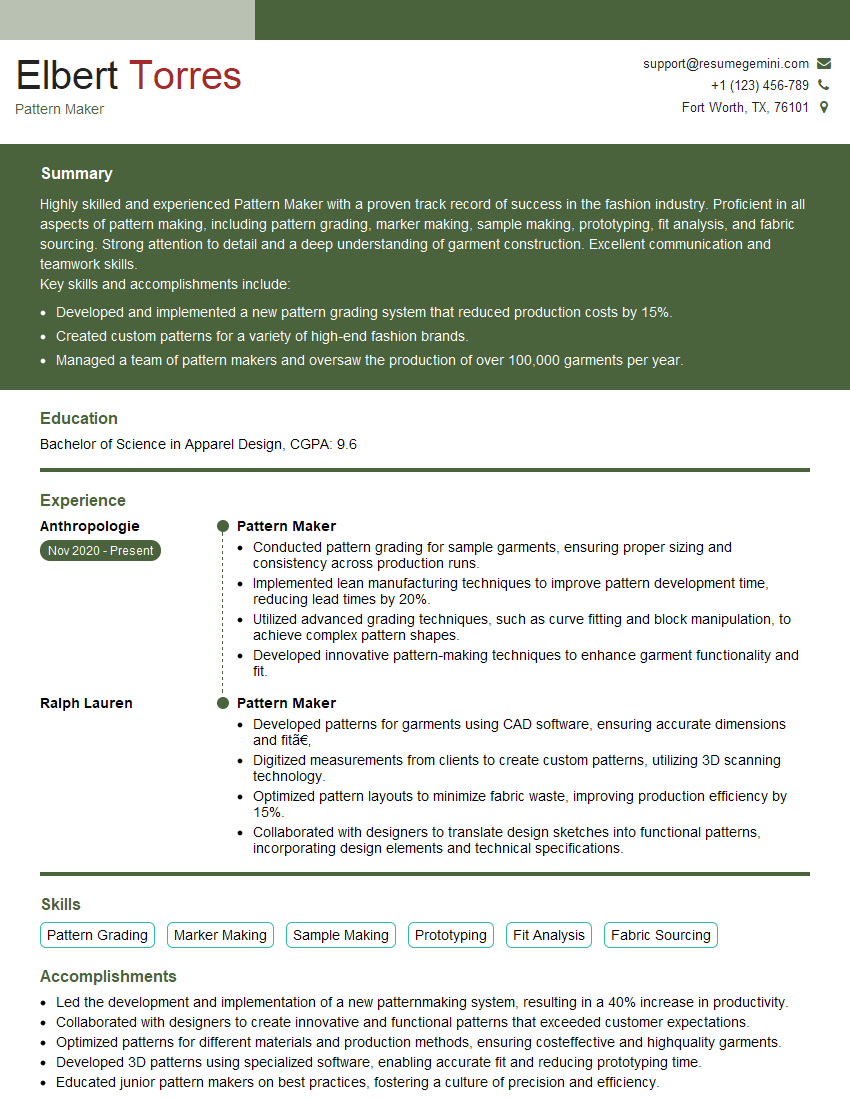
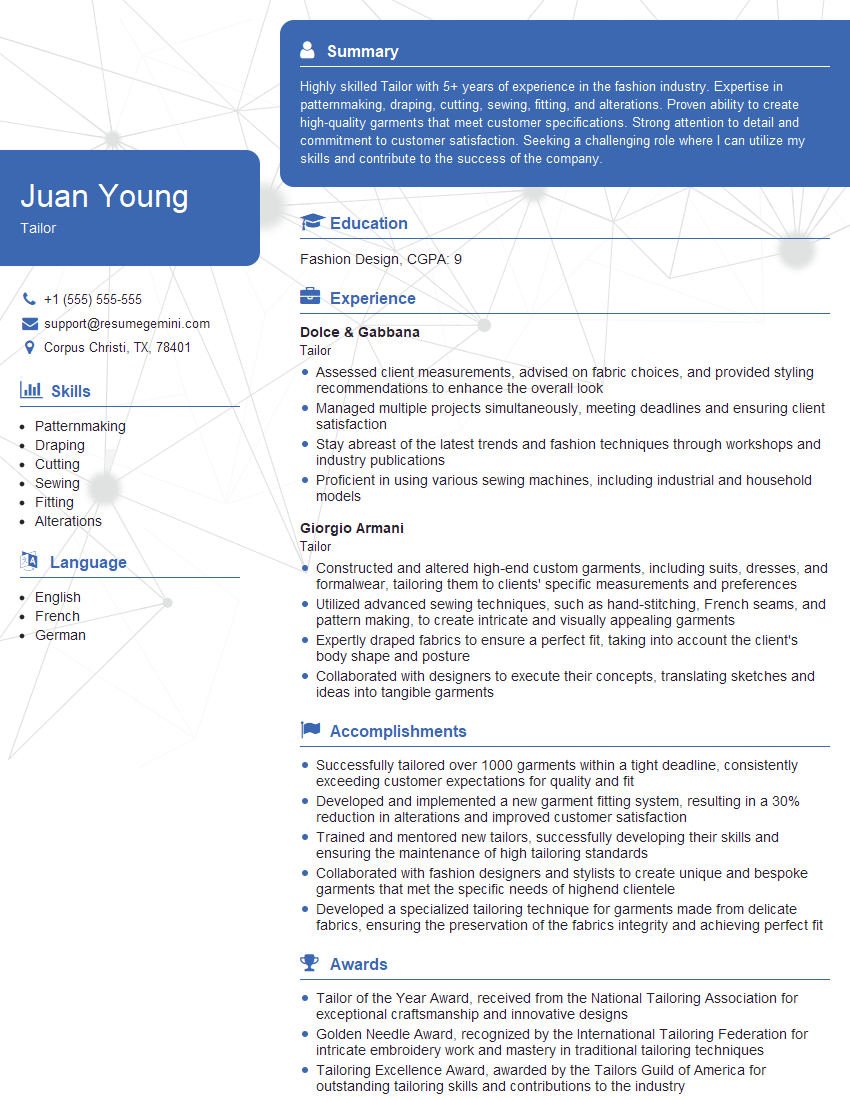
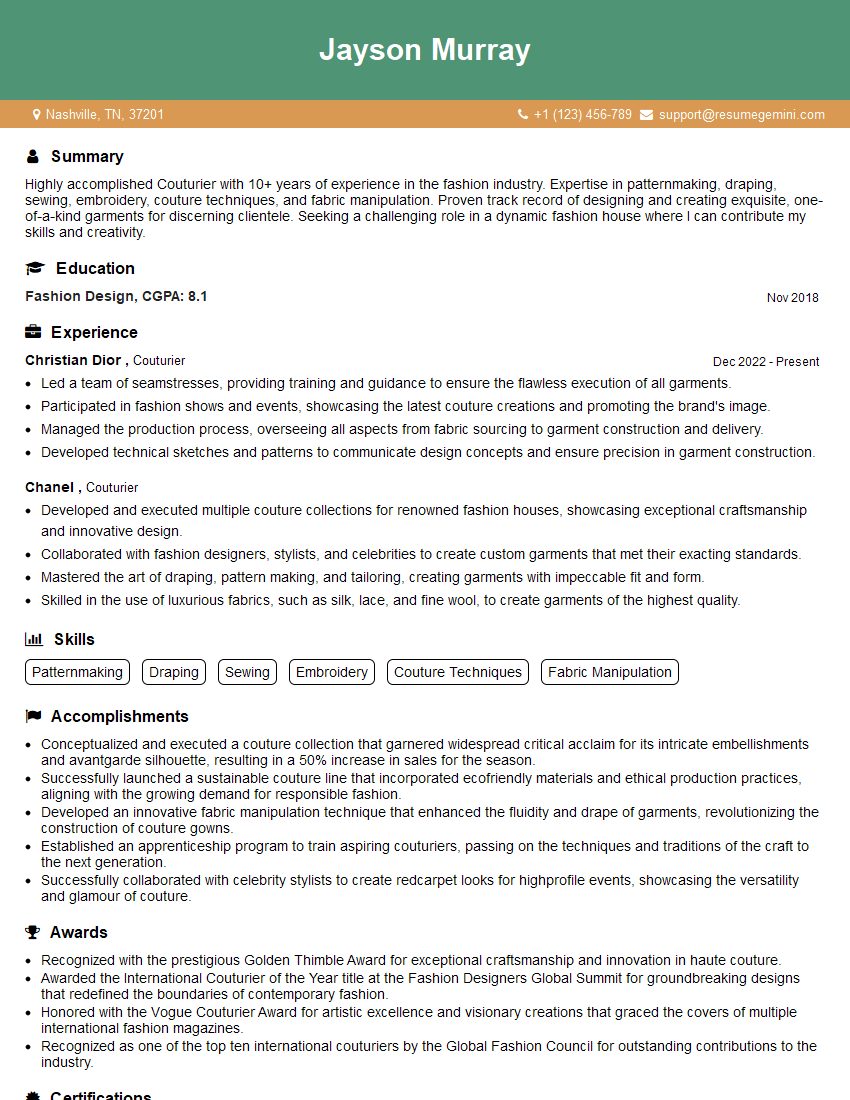
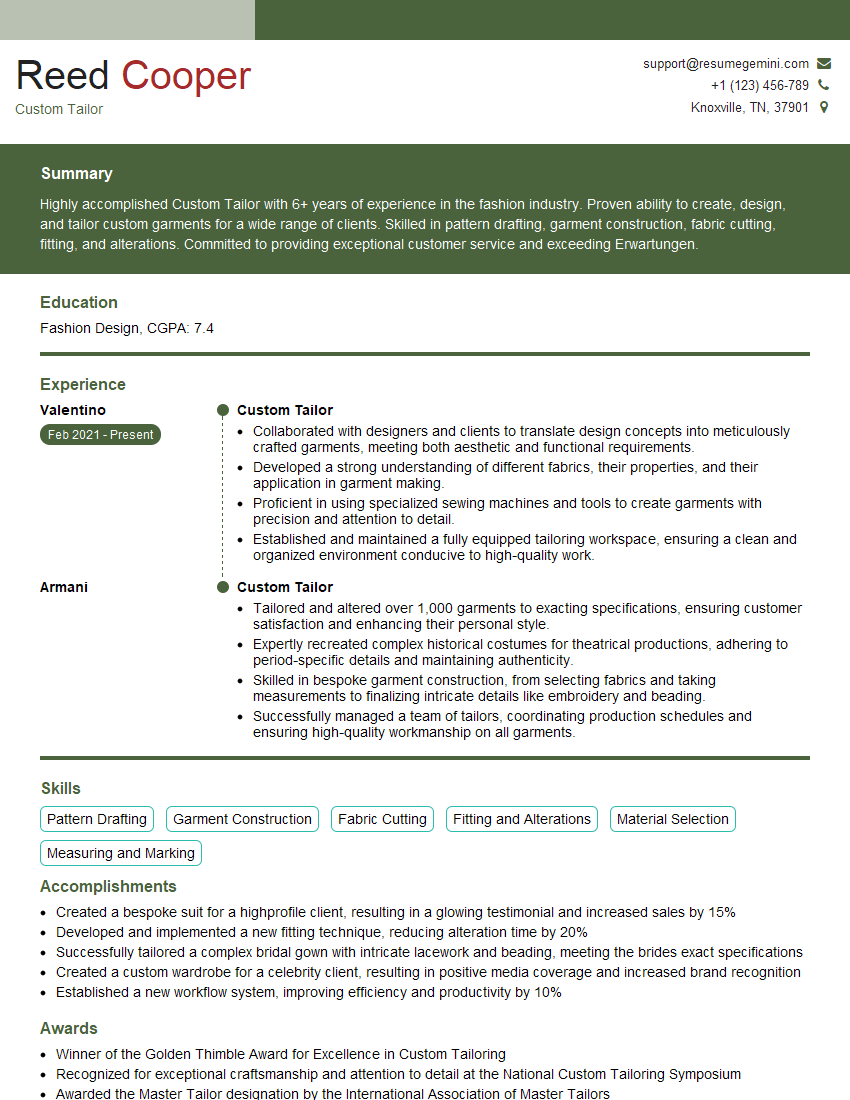
Mastering Custom Stitching and Repairs opens doors to diverse career opportunities, offering a blend of creative expression and technical skill. A strong resume is crucial for showcasing your expertise and landing your dream job. Building an ATS-friendly resume is key to getting noticed by recruiters. We strongly recommend using ResumeGemini to create a professional and effective resume that highlights your skills and experience in the most impactful way. ResumeGemini offers examples of resumes tailored specifically to the Custom Stitching and Repairs field to help guide you through the process.



Explore more articles
Users Rating of Our Blogs
Share Your Experience
We value your feedback! Please rate our content and share your thoughts (optional).
What Readers Say About Our Blog
Very informative content, great job.
good