Interviews are more than just a Q&A session—they’re a chance to prove your worth. This blog dives into essential Data Warehouse Modeling interview questions and expert tips to help you align your answers with what hiring managers are looking for. Start preparing to shine!
Questions Asked in Data Warehouse Modeling Interview
Q 1. Explain the difference between a Data Warehouse and a Data Mart.
Think of a data warehouse as a massive, centralized repository holding integrated data from various sources, designed for analytical processing and reporting. A data mart, on the other hand, is a smaller, focused subset of a data warehouse, tailored to specific business units or departments. It’s like having a comprehensive library (data warehouse) and then creating smaller, specialized collections within it (data marts) – each focusing on a particular topic or user group. For instance, a marketing data mart might only contain customer data, campaign data, and sales data relevant to marketing analysis, whereas the larger data warehouse holds all company data.
Key differences:
- Scope: Data warehouse is broad; data mart is narrow and focused.
- Complexity: Data warehouse is more complex to design and manage; data mart is simpler.
- Users: Data warehouse caters to multiple users across departments; data mart serves specific departments.
- Data Volume: Data warehouse handles significantly larger volumes of data.
Q 2. Describe the various types of data warehouse schemas (Star, Snowflake, Galaxy).
Data warehouse schemas dictate how data is organized and related. Three common types are:
- Star Schema: This is the most common and simplest. It features a central fact table surrounded by several dimension tables. The fact table contains numerical data, while dimension tables hold descriptive attributes. Imagine a star, with the fact table as the center and dimension tables as the points. For example, a fact table might contain sales figures, while dimension tables could hold information about products, customers, time, and locations.
- Snowflake Schema: This is an extension of the star schema, where dimension tables are further normalized into smaller sub-dimension tables. This results in a more complex, yet potentially more efficient design. It’s like taking the points of the star and breaking them down into smaller, related points. This can improve data storage and reduce redundancy. For example, a ‘customer’ dimension table might be normalized into ‘customer details’ and ‘customer address’ tables.
- Galaxy Schema: Also known as a constellation schema, this is the most complex and flexible. It involves multiple fact tables, each related to a set of dimension tables. This is ideal for situations with multiple business processes needing different perspectives on the same data. It’s like having several stars, each with their own set of points, but with some overlapping points representing shared dimensions.
Q 3. What are the key characteristics of a good data warehouse design?
A well-designed data warehouse prioritizes several key characteristics:
- Subject-Oriented: Data is organized around specific subjects, such as customers, products, or sales, rather than operational processes.
- Integrated: Data from various sources is integrated and reconciled to provide a consistent view.
- Time-Variant: Historical data is stored and accessible, allowing for trend analysis and forecasting.
- Non-Volatile: Data is not updated or deleted once loaded, ensuring data consistency for analytical purposes. Changes are handled through new data loads.
- Scalability: The design should accommodate future data growth and increasing user demands.
- Performance: Query performance is critical, necessitating optimized schema design and indexing strategies.
- Maintainability: The design should be easy to understand, maintain, and evolve as business requirements change.
Q 4. Explain the ETL process in detail.
ETL (Extract, Transform, Load) is the process of gathering data from various sources, transforming it into a usable format, and loading it into the data warehouse. Let’s break it down:
- Extract: This phase involves extracting data from multiple sources, which can include databases, flat files, spreadsheets, and APIs. Different connectors and technologies are used to extract data in various formats.
- Transform: This is often the most complex phase. It involves cleaning, transforming, and enriching the extracted data to ensure data consistency, accuracy, and suitability for the data warehouse. This includes data cleansing (handling missing values, outliers, inconsistencies), data transformation (changing data types, formats, aggregating data), and data enrichment (adding data from external sources).
- Load: This is the final phase, where the transformed data is loaded into the data warehouse. This might involve using specific database loading tools or bulk loading utilities to optimize the loading process. Different loading strategies are used, like batch loading or real-time incremental loads.
Consider a scenario where we’re building a data warehouse for a retail company. The ETL process might involve extracting sales data from the point-of-sale system, customer data from the CRM system, and product data from the inventory system. Transformation would include standardizing data formats, resolving discrepancies, and possibly joining tables to create a unified view. Finally, the data is loaded into the data warehouse tables.
Q 5. What are the different types of ETL tools you have experience with?
I have experience with several ETL tools, including:
- Informatica PowerCenter: A robust and widely used ETL tool offering a comprehensive suite of features for data integration and transformation.
- Talend Open Studio: An open-source ETL tool providing a user-friendly interface and a broad range of connectors and transformation capabilities.
- Apache Kafka: A distributed streaming platform often used for real-time data ingestion and processing in ETL pipelines.
- AWS Glue: A serverless ETL service from Amazon Web Services offering scalability and integration with other AWS services.
- Azure Data Factory: Microsoft’s cloud-based ETL service that enables building, managing, and monitoring ETL pipelines in Azure.
The choice of tool depends heavily on factors like project size, complexity, budget, and existing infrastructure.
Q 6. How do you handle data quality issues in a data warehouse?
Handling data quality issues is crucial for a reliable data warehouse. My approach involves a multi-faceted strategy:
- Data Profiling: Before ETL, I conduct thorough data profiling to understand data characteristics, identify potential quality issues such as missing values, inconsistencies, and outliers.
- Data Cleansing: During ETL transformation, I implement data cleansing techniques to address identified issues. This can include techniques like imputation for missing values, standardization for inconsistent formats, and outlier detection and treatment.
- Data Validation: After data loading, I perform data validation using various checks (e.g., data type validation, range checks, referential integrity checks) to ensure data integrity and accuracy.
- Data Monitoring: I set up ongoing data quality monitoring processes to detect and alert on any new or recurring quality issues after the data warehouse is operational.
- Metadata Management: Maintaining comprehensive metadata about data sources, transformations, and data quality rules is essential for tracking and understanding data lineage and quality.
For instance, if customer addresses are inconsistently formatted, I might develop a transformation rule during the ETL process to standardize the address format, ensuring data consistency. Regular data quality checks would then monitor for any new inconsistencies.
Q 7. Explain different data warehouse testing methodologies.
Data warehouse testing methodologies ensure the accuracy, completeness, and consistency of the data and the functionality of the data warehouse. Common methodologies include:
- Unit Testing: Testing individual ETL processes or components to ensure they function correctly and produce expected outputs.
- Integration Testing: Verifying that different components of the ETL process work together seamlessly and data is integrated correctly.
- System Testing: Testing the entire data warehouse system to ensure it meets functional and non-functional requirements.
- User Acceptance Testing (UAT): Testing by end-users to validate that the data warehouse meets their needs and expectations. This often involves business users conducting queries and analyzing the data.
- Performance Testing: Evaluating the performance of the data warehouse under different loads and conditions to identify potential bottlenecks and ensure responsiveness.
- Data Quality Testing: Checking for data accuracy, completeness, consistency, and validity to ensure the overall quality of the data within the data warehouse.
Effective testing ensures a high-quality data warehouse that meets business needs and delivers accurate insights.
Q 8. What are some common performance challenges in data warehousing and how do you address them?
Data warehousing, while powerful, faces several performance bottlenecks. Imagine a massive library with millions of books – finding a specific book quickly can be challenging without a proper organization system. Similarly, slow query responses, high resource consumption, and inadequate scalability are common issues.
- Slow Query Performance: Complex queries against large datasets can take an excruciatingly long time. This is often due to poorly optimized queries, inefficient indexing, or inadequate hardware.
- High Resource Consumption: Processing and storing massive amounts of data demands significant computational power, memory, and storage. Inefficient data structures or poorly designed ETL (Extract, Transform, Load) processes exacerbate this.
- Scalability Issues: As the volume of data grows, the system may struggle to handle the increased load. This could lead to performance degradation or even system crashes.
Addressing these challenges requires a multi-pronged approach:
- Query Optimization: Analyze query execution plans, create appropriate indexes, and use efficient query writing techniques. Tools like query profilers are invaluable here.
- Data Partitioning and Clustering: Divide large tables into smaller, manageable chunks based on relevant criteria. This improves query performance and allows for parallel processing.
- Materialized Views: Pre-compute frequently accessed aggregations to significantly reduce query response times. Think of it as creating a summary book of the library’s most frequently requested chapters.
- Data Compression: Reduce storage space and improve I/O performance by compressing the data. This is especially beneficial for large fact tables.
- Hardware Upgrades: Sometimes, investing in more powerful hardware (faster processors, more RAM, SSDs) is the most effective solution.
- ETL Optimization: Streamlining the ETL process through efficient data transformation and loading techniques significantly impacts overall performance.
For example, imagine a retail data warehouse. By partitioning the fact table by date, queries focusing on a specific month can access only a fraction of the data, significantly speeding up the process.
Q 9. How do you design a dimensional model for a given business scenario?
Designing a dimensional model involves identifying the key business processes and translating them into a star or snowflake schema. Let’s say we’re designing a data warehouse for an e-commerce platform. The first step is to define the core business process: online sales.
1. Fact Table: This table will store the quantitative measures, like SalesOrderFacts. It will contain things like:
Order_ID(Primary Key)Order_DateCustomer_ID(Foreign Key referencing theCustomersdimension)Product_ID(Foreign Key referencing theProductsdimension)Sales_AmountQuantity_SoldDiscount_Amount
2. Dimension Tables: These tables provide contextual information for the fact table. For our e-commerce example, we might have:
Customers:Customer_ID(Primary Key),Customer_Name,Address,City,Countryetc.Products:Product_ID(Primary Key),Product_Name,Category,Priceetc.Time:Order_Date(Primary Key),Year,Month,Day,Quarteretc. (For easier date-based analysis).SalesChannels:Channel_ID(Primary Key),Channel_Name(e.g., Website, Mobile App).
The relationships are established through foreign keys linking the fact table to each dimension table. This structure enables efficient querying and reporting of online sales data across different dimensions.
Q 10. Describe your experience with dimensional modeling techniques (fact tables, dimension tables).
My experience with dimensional modeling is extensive, encompassing both star and snowflake schemas. I’ve worked on numerous projects involving the design, implementation, and optimization of data warehouses using fact and dimension tables. I’m proficient in identifying grain (level of detail) and designing appropriate key structures.
For instance, in a project for a telecom company, we used a star schema to track customer call records. The CallFacts table (fact table) contained call duration, call type, and timestamps. Dimension tables included Customers, CallTypes, and Time. This allowed for granular analysis of call patterns, identifying peak hours, popular call types, and customer-specific usage trends.
In another project, a snowflake schema was preferred due to its enhanced normalization and space efficiency for a large retail chain’s inventory management. This involved splitting dimensions into smaller, more manageable tables, leading to better query performance for specific analytical requirements.
Throughout my experience, I’ve consistently prioritized designing models that are intuitive, easily maintainable, and optimized for the specific analytical requirements of the business.
Q 11. What is Slowly Changing Dimension (SCD) and explain its types (Type 1, 2, 3).
Slowly Changing Dimensions (SCDs) address the challenge of handling changes in dimension attributes over time. Imagine a customer changing their address; we need to maintain a historical record of both the old and new address.
Type 1: Overwrite – The simplest approach. The old value is simply overwritten with the new value. This loses historical data, making it unsuitable for trend analysis. Think of it like rewriting on top of old notes – only the latest entry is retained.
Type 2: Add a New Row – This creates a new row for each change, retaining the history. This is more complex but provides a complete historical view. It’s like adding annotations to your old notes instead of erasing them.
Type 3: Add a New Column – A new column is added to store the new value while keeping the original. This is a compromise between Type 1 and Type 2, useful for specific attributes. Think of adding a separate section for updated information next to the original notes.
For example, in our e-commerce scenario, if a customer changes their address, a Type 2 SCD would add a new row to the Customers dimension table, preserving the old address as a historical record.
Q 12. Explain the concept of data lineage in a data warehouse.
Data lineage in a data warehouse tracks the journey of data from its origin to its final destination within the warehouse. This includes understanding how the data was sourced, transformed, and loaded. It’s like a detailed map showing the entire route of every piece of information, providing crucial context for data quality and compliance.
Understanding data lineage allows us to:
- Trace Data Errors: If an error is detected, lineage helps pinpoint its source, enabling quick remediation.
- Ensure Data Quality: It facilitates the identification and correction of data quality issues at each stage.
- Meet Regulatory Requirements: In industries with stringent regulations (e.g., finance, healthcare), lineage documentation is crucial for auditing and compliance.
- Improve Data Governance: It facilitates better data management and understanding of data dependencies within the organization.
Modern data warehousing tools often provide lineage tracking capabilities. This can be in the form of automated metadata logging or through visual lineage maps.
Q 13. How do you ensure data security and access control in a data warehouse?
Data security and access control are paramount in data warehousing. We need to protect sensitive data from unauthorized access and maintain the integrity of the data warehouse. This involves a multi-layered approach:
- Access Control Lists (ACLs): Implement fine-grained access control, granting specific permissions (read, write, execute) to different users and groups based on their roles and responsibilities.
- Data Encryption: Encrypt sensitive data both at rest (on storage) and in transit (during network transmission) to protect against unauthorized access even if a breach occurs.
- Network Security: Secure the network infrastructure connecting the data warehouse to prevent unauthorized access from outside networks.
- Authentication and Authorization: Implement robust authentication mechanisms (e.g., multi-factor authentication) and authorization protocols to verify user identities and control their access to specific data.
- Data Masking and Anonymization: For sensitive data that needs to be shared for analysis, apply masking or anonymization techniques to protect privacy while still allowing meaningful analysis.
- Regular Security Audits: Conduct periodic security assessments to identify and address potential vulnerabilities.
- Data Loss Prevention (DLP): Implement measures to prevent sensitive data from leaving the controlled environment.
For example, in a healthcare data warehouse, patient data would require strict access control, with only authorized personnel (doctors, nurses) having access to sensitive information. Encryption and robust authentication mechanisms would be crucial to maintain patient privacy.
Q 14. What is the role of metadata in data warehousing?
Metadata plays a crucial role in data warehousing. It’s the ‘data about data’ – providing essential context and information about the data stored in the warehouse. Think of it as the library catalog – it describes the contents of the books (data) and where to find them. This includes information about tables, columns, data types, relationships, business rules, and data sources.
Metadata enables:
- Data Discovery and Understanding: It helps users easily locate and understand the data they need for analysis.
- Data Quality Management: Metadata helps track data quality metrics and identify potential issues.
- Data Governance: It facilitates the implementation and enforcement of data governance policies.
- Data Integration: Metadata supports the efficient integration of data from multiple sources.
- Data Lineage Tracking: As mentioned earlier, metadata is essential for tracking data lineage.
- Improved Data Warehouse Design: Metadata assists in optimizing the design of the data warehouse.
Effective metadata management is vital for a successful data warehouse, ensuring its usability, maintainability, and overall success. Proper metadata management makes a world of difference in locating and understanding the information stored, making the data warehouse an effective tool for decision-making.
Q 15. How do you handle data inconsistencies and duplicates during the ETL process?
Data inconsistencies and duplicates are common challenges during ETL (Extract, Transform, Load). Handling them effectively ensures data quality and reliability in your data warehouse. My approach involves a multi-step process focusing on prevention and remediation.
Prevention: Proactive measures are crucial. This includes implementing data validation rules at the source systems. For example, enforcing data type constraints, unique key constraints, and check constraints within the source databases before extraction. This significantly reduces the volume of bad data entering the ETL pipeline.
Detection: During the transformation phase, I employ robust data profiling techniques. This involves analyzing data characteristics such as data types, distribution, frequency of values, and identifying potential inconsistencies or anomalies. Tools like data quality profiling software can automate this process, flagging potential duplicates or outliers. For example, identifying rows with identical primary keys or suspiciously similar values in key fields.
Remediation: Once inconsistencies and duplicates are identified, various remediation strategies can be applied. For duplicates, I typically employ deduplication techniques, prioritizing one ‘master’ record based on pre-defined rules, such as choosing the most recent record, or the record with the most complete data. For inconsistencies, I might use data cleansing rules, such as standardizing date formats, handling missing values using imputation techniques (e.g., mean, median, or mode imputation), or using fuzzy matching to identify and merge similar records.
Logging and Monitoring: I always maintain detailed logs of the ETL process, documenting data quality issues, the remediation steps taken, and the results achieved. This creates an audit trail that aids in continuous improvement and troubleshooting.
For instance, in a customer data ETL process, we might detect duplicate customer records with slightly different addresses. By using fuzzy matching, we’d identify these near-duplicates, compare their attributes, and resolve discrepancies to create a single, accurate customer record. The whole process is iterative – improving data quality necessitates continuous monitoring and refinement.
Career Expert Tips:
- Ace those interviews! Prepare effectively by reviewing the Top 50 Most Common Interview Questions on ResumeGemini.
- Navigate your job search with confidence! Explore a wide range of Career Tips on ResumeGemini. Learn about common challenges and recommendations to overcome them.
- Craft the perfect resume! Master the Art of Resume Writing with ResumeGemini’s guide. Showcase your unique qualifications and achievements effectively.
- Don’t miss out on holiday savings! Build your dream resume with ResumeGemini’s ATS optimized templates.
Q 16. Explain your experience with different database systems used for data warehousing (e.g., Snowflake, BigQuery, Redshift, SQL Server).
My experience encompasses several leading data warehouse database systems. Each has its strengths and weaknesses, making the choice dependent on specific project needs.
Snowflake: I’ve used Snowflake extensively for its scalability and flexibility, particularly for handling massive datasets. Its cloud-native architecture simplifies administration and allows for easy scaling based on demand. The performance is generally excellent, and the pay-as-you-go pricing model makes it cost-effective for many projects.
BigQuery: BigQuery, Google Cloud’s offering, is another powerful cloud-based data warehouse. I’ve leveraged its SQL capabilities for complex data analysis tasks. Its integration with other Google Cloud services is a significant advantage, particularly for businesses already using the Google Cloud ecosystem.
Redshift: Amazon Redshift’s performance is known to be strong, especially when dealing with analytical queries involving large fact tables. I’ve utilized it successfully in projects requiring robust analytical capabilities, relying on its columnar storage and optimized query engine.
SQL Server: While more traditional, SQL Server is still a relevant choice for on-premise data warehousing solutions. Its mature ecosystem and extensive tooling make it a good option for businesses already using Microsoft technologies. I’ve used its features like partitioning and indexing to enhance query performance.
Choosing the right database is a strategic decision that requires careful consideration of factors such as data volume, budget, required performance, existing infrastructure, and specific analytic needs. My experience allows me to make informed recommendations and guide the selection process.
Q 17. How do you optimize query performance in a data warehouse environment?
Optimizing query performance in a data warehouse is crucial for efficient data analysis. My approach combines various techniques to achieve this:
Proper Indexing: Creating appropriate indexes on frequently queried columns dramatically reduces query execution time. The type of index (e.g., B-tree, hash index) depends on the nature of the query and the data distribution.
Data Partitioning: Partitioning large tables based on relevant criteria (e.g., date, region) allows the query engine to process only the necessary partitions, significantly improving performance.
Materialized Views: Pre-computing and storing the results of complex queries as materialized views can drastically reduce query processing time for frequently accessed analytical views. However, maintaining these views requires additional consideration.
Query Optimization Techniques: Understanding SQL query optimization techniques, such as using appropriate join types (e.g., inner join vs. outer join), filtering data early in the query, and using window functions effectively, are essential.
Columnar Storage: Data warehouses often utilize columnar storage, which optimizes the retrieval of specific columns needed for analytical queries.
Resource Management: Appropriately sizing the compute resources (CPU, memory) for the database is fundamental. Monitoring resource utilization can help identify bottlenecks and adjust the resources as needed.
For example, in a retail analytics project, I optimized queries on sales data by creating composite indexes on product ID, date, and store location. Partitioning the sales data by month further improved query performance for monthly sales reports. Monitoring query execution plans using database tools helped identify further areas for improvement.
Q 18. What are the different types of data warehouse architectures?
Data warehouse architectures vary based on factors such as data volume, complexity, and performance requirements. Here are some common architectures:
Data Mart: A smaller, subject-oriented data warehouse designed to address specific business needs. Data marts are often created from a larger data warehouse or directly from source systems. They are simpler to implement and maintain compared to a full-fledged data warehouse.
Enterprise Data Warehouse (EDW): A central repository of integrated data from various sources, designed to support enterprise-wide reporting and analysis. EDWs are usually complex and require significant investment in infrastructure and expertise.
Data Lake: A centralized repository that stores raw data in various formats (structured, semi-structured, and unstructured). Data lakes are used for exploratory data analysis and can serve as a foundation for a data warehouse.
Data Lakehouse: This architecture combines the benefits of both data lakes and data warehouses. It uses open formats for data storage like data lakes, but it introduces features like schema enforcement and ACID transactions to manage data quality better, akin to data warehouses.
Hybrid Data Warehouse: A combination of cloud and on-premise data warehousing solutions. This can provide flexibility and cost optimization depending on specific requirements and existing infrastructure.
The choice of architecture depends heavily on the organization’s size, data volume, and analytical needs. A smaller organization might opt for a data mart, whereas a large enterprise might require an EDW or a data lakehouse architecture.
Q 19. What is the difference between OLTP and OLAP systems?
OLTP (Online Transaction Processing) and OLAP (Online Analytical Processing) systems serve fundamentally different purposes:
OLTP: Designed for efficient transaction processing. These systems focus on handling individual transactions (e.g., processing a customer order, updating an inventory record) with high speed and concurrency. They typically use normalized databases, optimized for frequent updates and retrieval of individual records. Think of online banking or e-commerce systems where speed and accuracy of individual transactions are paramount.
OLAP: Designed for analytical processing of large datasets. These systems focus on querying and analyzing data to gain insights. They typically use denormalized databases (data warehouses) optimized for complex queries and aggregations. Think of analyzing sales trends, customer demographics, or market research. Speed of individual transactions is less important than the speed of complex analytical queries.
The key differences are summarized as follows:
- Data structure: OLTP uses normalized databases; OLAP uses denormalized databases.
- Purpose: OLTP handles transactions; OLAP handles analytical queries.
- Query types: OLTP performs simple, CRUD operations (Create, Read, Update, Delete); OLAP performs complex, aggregative queries.
- Data volume: OLTP deals with smaller volumes of transactional data; OLAP deals with large volumes of historical data.
In essence, OLTP systems are designed for operational efficiency, while OLAP systems are designed for strategic decision-making.
Q 20. Describe your experience with cloud-based data warehousing solutions.
I possess extensive experience with cloud-based data warehousing solutions, particularly with the major cloud providers – AWS, Azure, and Google Cloud. This experience covers the entire lifecycle, from design and implementation to maintenance and optimization.
AWS: I have worked with Amazon Redshift, Amazon S3 (for data storage), and other AWS services like Glue (ETL) and EMR (big data processing) to build and manage cloud-based data warehouses. I’m familiar with scaling resources efficiently to manage varying data loads and analytical requirements.
Azure: My experience with Azure includes working with Azure Synapse Analytics, a fully managed data warehousing service offering both SQL and Spark capabilities. I have used Azure Data Factory for ETL processes and have experience optimizing performance and managing costs within the Azure environment.
Google Cloud: I have worked with BigQuery extensively and am comfortable with its unique strengths, especially for large-scale data analysis using SQL and its integration with other Google Cloud Platform services.
In all these cloud environments, I have focused on leveraging managed services to reduce operational overhead, enhance scalability, and achieve cost-effectiveness. My expertise includes configuring security measures, designing for high availability, and monitoring system performance to ensure data warehouse reliability and performance.
Q 21. What are your preferred methods for data profiling and cleansing?
Data profiling and cleansing are critical steps to ensure data quality. My preferred methods combine automated tools with manual review for accuracy:
Automated Data Profiling: I use tools that automatically analyze data to identify data types, data distributions, missing values, outliers, and inconsistencies. These tools provide summary statistics and visual representations that pinpoint areas requiring attention.
Data Quality Rules: I define data quality rules based on business requirements to flag data that doesn’t meet the expected standards (e.g., invalid date formats, unexpected values, missing required fields). These rules can be incorporated into the ETL process for automated cleansing or used for manual review.
Data Cleansing Techniques: Depending on the nature of the data issues, I employ various cleansing techniques, including:
- Standardization: Converting data to a consistent format (e.g., date formats, address formats).
- Normalization: Addressing redundant data and improving data integrity.
- Imputation: Handling missing values using appropriate methods (e.g., mean, median, mode imputation, or more sophisticated techniques).
- Deduplication: Identifying and removing duplicate records using unique keys or fuzzy matching.
Manual Review: While automated tools are essential, I believe in a combination of automated and manual review. This ensures that complex data quality issues are not missed. For example, reviewing the results of automated deduplication might require manual intervention to resolve any ambiguities.
Data Validation: After cleansing, data validation ensures that the data meets the defined quality standards. This involves checking data consistency and completeness against pre-defined rules and business requirements.
For instance, in a customer database, I might use automated profiling to identify inconsistencies in customer addresses. Then, I might use standardization to ensure consistency in address formats and potentially fuzzy matching to resolve duplicate addresses before loading into the data warehouse. This combination of automated and manual review helps to produce reliable and clean data for analysis.
Q 22. How do you handle data volume and velocity in a data warehouse?
Handling high data volume and velocity in a data warehouse requires a multi-pronged approach focusing on efficient data ingestion, storage, and processing. Think of it like building a highway system for your data: you need efficient on-ramps (ingestion), wide lanes (storage), and smooth traffic flow (processing) to handle the increased traffic (data volume and velocity).
Data Partitioning: We divide large tables into smaller, manageable chunks based on time (e.g., monthly partitions) or other relevant attributes. This allows for faster query processing as the database only needs to scan the relevant partition.
Data Compression: Techniques like columnar storage (e.g., using technologies like Parquet or ORC) significantly reduce storage space and improve query performance. Imagine compressing a large file before sending it – it takes less space and time to transfer.
Data Sampling and Aggregation: For certain analytical tasks, working with a representative sample of the data or pre-aggregated data can drastically reduce processing time. This is similar to surveying a small group of people instead of the whole population to understand general opinions.
Scalable Infrastructure: Utilizing cloud-based solutions or distributed database systems (like Hadoop or Snowflake) allows for horizontal scaling, enabling the system to handle growing data volumes efficiently. This is like adding more lanes to your highway to accommodate increasing traffic.
Data Streaming Technologies: Employing real-time data ingestion pipelines (e.g., Apache Kafka, Apache Flink) allows for immediate processing of incoming data streams, ensuring near real-time analytics. This is like having dedicated express lanes for the most time-sensitive data.
Q 23. Explain your experience with data warehouse automation tools.
My experience with data warehouse automation tools spans various platforms. I’ve extensively used tools like Informatica PowerCenter, Matillion, and dbt (data build tool) for ETL (Extract, Transform, Load) processes. Automation is crucial for efficiency and accuracy. For example, using Informatica PowerCenter, I’ve automated the entire ETL process for a large e-commerce client, reducing manual intervention and significantly improving data loading times.
Informatica PowerCenter: This enterprise-grade tool allows for the design, development, and deployment of complex ETL processes with robust error handling and monitoring capabilities. I’ve used it to create reusable transformations and mappings, improving maintainability and consistency.
Matillion: This cloud-based ETL solution is highly effective for cloud data warehouses like Snowflake and Amazon Redshift. I’ve used it for its user-friendly interface and integration with cloud services, accelerating development and deployment.
dbt (data build tool): This is a modern tool for managing data transformations using SQL. I’ve leveraged dbt’s version control and testing capabilities to improve code quality and collaboration within the team.
In each case, automation resulted in reduced operational costs, improved data quality, and faster time-to-insight.
Q 24. How do you ensure data integrity in a data warehouse?
Data integrity in a data warehouse is paramount. Think of it as the foundation of a building; if the foundation is weak, the entire structure is at risk. Ensuring data integrity involves a combination of proactive measures and reactive checks.
Data Validation: Implementing data validation rules at the source and during the ETL process is critical. This includes checks for data types, ranges, and referential integrity. For instance, ensuring a customer ID exists in the customer table before linking it to an order.
Data Cleansing: Handling missing values, inconsistencies, and outliers is crucial. This could involve imputation techniques for missing data or using outlier detection algorithms to identify and correct erroneous values.
Data Lineage: Tracking the origin and transformations of data is essential for understanding potential errors. Tools like Informatica Data Quality or dedicated data lineage platforms provide this functionality.
Data Governance: Establishing clear policies and procedures for data quality, access control, and change management is vital. This includes regular data audits and quality checks.
ETL Monitoring: Monitoring the ETL process for errors and performance issues is critical. This ensures that data is loaded correctly and efficiently.
Employing these techniques helps ensure that the data warehouse contains accurate, consistent, and reliable data, enabling trusted decision-making.
Q 25. How do you measure the success of a data warehouse implementation?
Measuring the success of a data warehouse implementation goes beyond just completing the project. It’s about demonstrating the value it delivers to the organization. Key metrics include:
Data Quality: Assessing the accuracy, completeness, and consistency of the data using metrics like data accuracy rate and completeness rate.
User Adoption: Measuring the number of users accessing and utilizing the data warehouse, along with their satisfaction level.
Business Impact: Quantifying the improvements in decision-making, operational efficiency, or revenue generation attributable to the data warehouse. Examples include improved sales forecasting accuracy or reduced customer churn.
Performance Metrics: Evaluating query response times, data load times, and resource utilization to ensure optimal system performance.
Return on Investment (ROI): Calculating the return on investment by comparing the cost of the implementation with the benefits achieved.
A successful data warehouse is one that consistently provides accurate, timely, and relevant data that empowers informed decision-making and contributes to the organization’s strategic goals.
Q 26. What is your experience with Agile methodologies in data warehouse projects?
I’ve embraced Agile methodologies in several data warehouse projects, finding them particularly valuable for their iterative approach and flexibility. The traditional waterfall approach can be rigid, especially with large and complex data warehouse projects. Agile allows for greater responsiveness to changing business requirements and faster delivery of value.
Iterative Development: We break down the project into smaller, manageable sprints, delivering working increments of the data warehouse at regular intervals. This allows for continuous feedback and adjustments throughout the project lifecycle.
Collaboration and Communication: Agile emphasizes close collaboration between the development team, business users, and stakeholders. Daily stand-up meetings, sprint reviews, and retrospectives facilitate effective communication and problem-solving.
Flexibility and Adaptability: Agile allows for adapting to changing requirements and priorities throughout the project. This is crucial in data warehousing where business needs can evolve rapidly.
Continuous Integration and Continuous Delivery (CI/CD): Automating the build, testing, and deployment process helps to deliver changes quickly and reliably.
The Agile approach, coupled with robust testing and validation, ensured timely delivery and high-quality results in each of my projects. The iterative nature made it much easier to manage evolving stakeholder needs and prioritize functionalities for maximum business impact.
Q 27. Describe a challenging data warehouse project you worked on and how you overcame the challenges.
One particularly challenging project involved migrating a legacy data warehouse to a cloud-based platform. The existing system was poorly documented, contained significant data inconsistencies, and relied on outdated technologies. The challenge was not just the technical migration but also managing stakeholder expectations and minimizing disruption to business operations.
Phased Approach: We adopted a phased approach, migrating data and functionalities incrementally. This reduced the risk of major disruptions and allowed for thorough testing at each phase.
Data Cleansing and Transformation: Significant effort was dedicated to data cleansing and transformation to address data inconsistencies and ensure data quality in the new system.
Robust Testing: A rigorous testing strategy, including unit, integration, and user acceptance testing, was employed to ensure the migrated system functioned correctly and met business requirements.
Change Management: Effective communication and training were crucial to ensure smooth user adoption of the new system.
By implementing a well-defined plan and employing Agile methodologies, we successfully migrated the data warehouse to the cloud platform on time and within budget, resulting in improved performance, scalability, and reduced operational costs.
Q 28. What are your future goals in the field of data warehousing?
My future goals revolve around staying at the forefront of data warehousing and business intelligence. I aim to deepen my expertise in areas like big data technologies (Hadoop, Spark), cloud data warehousing (Snowflake, Azure Synapse), and advanced analytics techniques (machine learning, AI).
Cloud Expertise: I plan to become a certified expert in at least one major cloud data warehousing platform, deepening my understanding of cloud-native tools and services.
Big Data Analytics: I want to gain more experience in handling and analyzing large datasets using distributed computing frameworks like Hadoop and Spark.
Data Visualization and Storytelling: I aim to enhance my skills in creating compelling data visualizations and communicating insights effectively to a variety of audiences.
Leadership and Mentorship: I aspire to lead data warehouse projects and mentor junior data professionals, sharing my expertise and fostering a culture of excellence.
Ultimately, my goal is to leverage my skills and knowledge to help organizations derive maximum value from their data and make better, data-driven decisions.
Key Topics to Learn for Data Warehouse Modeling Interview
- Dimensional Modeling: Understand the core concepts of star schema, snowflake schema, and fact and dimension tables. Practice designing dimensional models for various scenarios.
- Data Modeling Techniques: Become proficient in ER diagrams, conceptual, logical, and physical data modeling. Be prepared to discuss the trade-offs between different modeling approaches.
- Data Warehousing Architectures: Familiarize yourself with different architectures like cloud-based data warehouses (Snowflake, BigQuery), on-premise solutions, and hybrid approaches. Understand their strengths and weaknesses.
- ETL Processes: Grasp the fundamentals of Extract, Transform, Load (ETL) processes. Discuss different ETL tools and their applications in data warehousing.
- Data Quality and Governance: Understand the importance of data quality in a data warehouse environment. Discuss techniques for ensuring data accuracy, consistency, and completeness.
- Performance Optimization: Learn about techniques for optimizing query performance in a data warehouse. This includes indexing, partitioning, and query optimization strategies.
- Data Security and Access Control: Understand the security considerations of data warehousing and the implementation of access control mechanisms.
- Business Intelligence (BI) Tools and Reporting: Gain familiarity with common BI tools and how they interact with data warehouses to generate reports and visualizations.
- Agile Data Warehousing: Understand the principles of Agile methodologies in data warehouse development and their application in iterative design and deployment.
- Cloud Data Warehousing Services: Explore the features and benefits of major cloud providers’ data warehousing services (e.g., AWS Redshift, Azure Synapse Analytics, Google BigQuery).
Next Steps
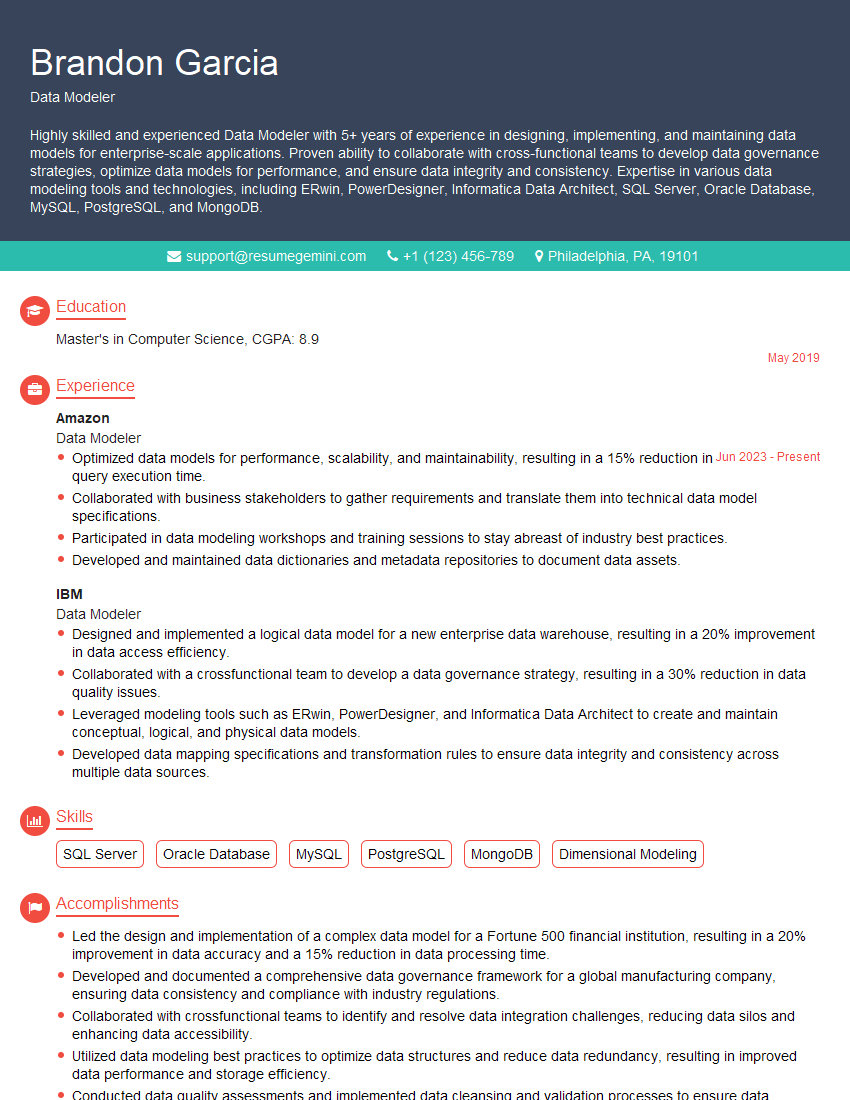
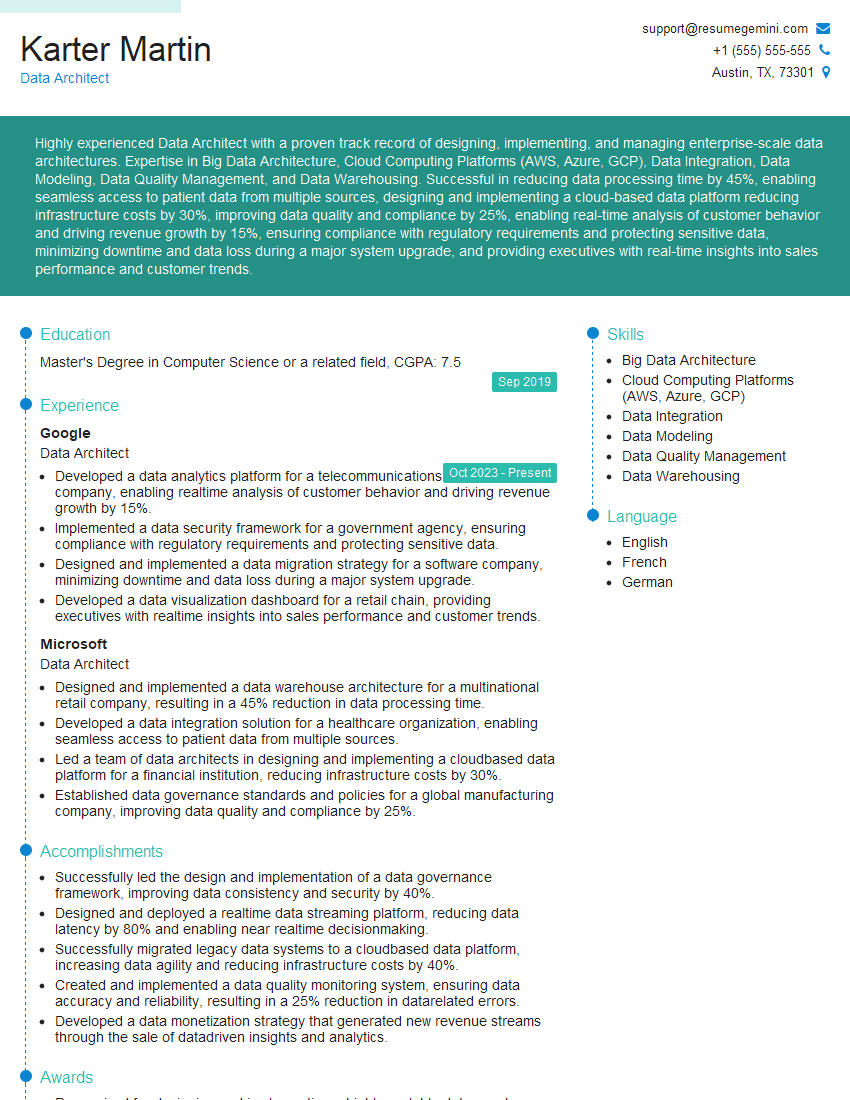
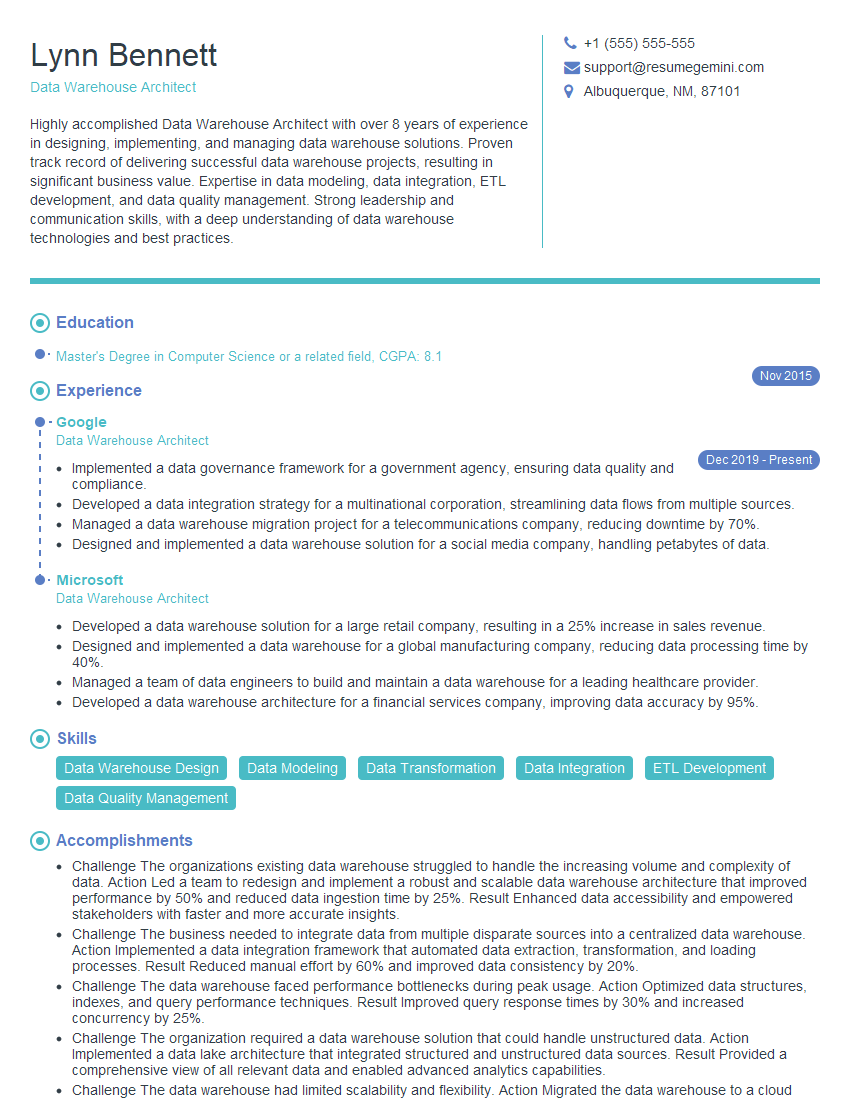
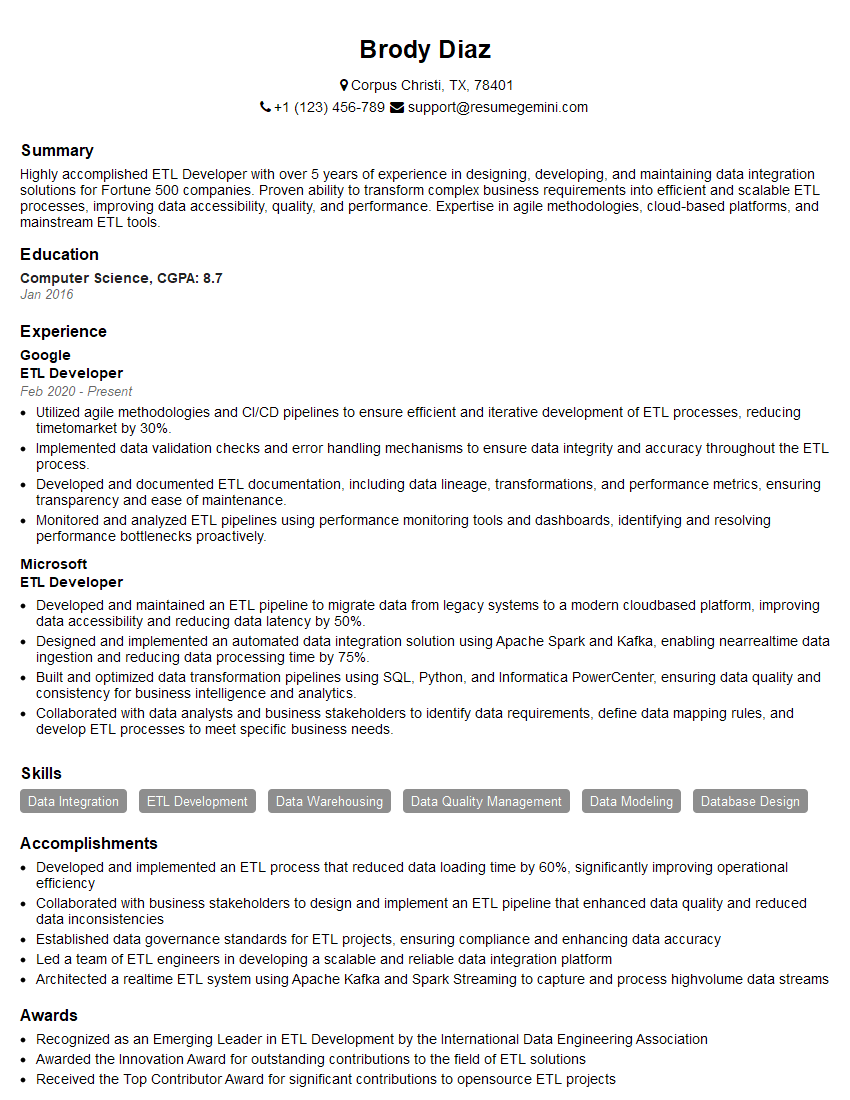
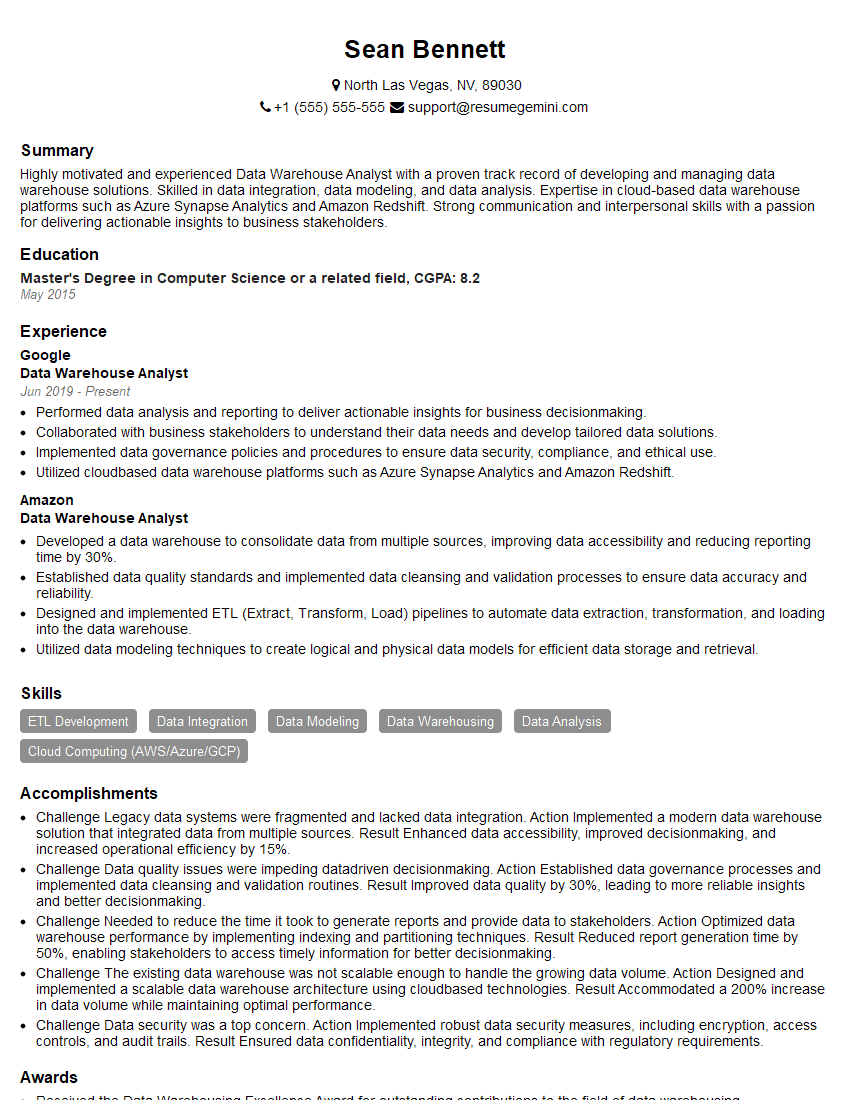
Mastering Data Warehouse Modeling is crucial for career advancement in the data analytics field, opening doors to high-demand roles with significant earning potential. To maximize your job prospects, creating a strong, ATS-friendly resume is essential. ResumeGemini can help you build a professional and impactful resume that showcases your skills and experience effectively. We provide examples of resumes tailored specifically to Data Warehouse Modeling roles to guide you. Take the next step towards your dream career – build your best resume with ResumeGemini today!

Explore more articles
Users Rating of Our Blogs
Share Your Experience
We value your feedback! Please rate our content and share your thoughts (optional).
What Readers Say About Our Blog
Very informative content, great job.
good