Preparation is the key to success in any interview. In this post, we’ll explore crucial Deep Learning Frameworks interview questions and equip you with strategies to craft impactful answers. Whether you’re a beginner or a pro, these tips will elevate your preparation.
Questions Asked in Deep Learning Frameworks Interview
Q 1. What are the key differences between TensorFlow and PyTorch?
TensorFlow and PyTorch are the two dominant deep learning frameworks, each with its strengths and weaknesses. TensorFlow, initially known for its static computational graph, provides excellent scalability and deployment capabilities, particularly in production environments. PyTorch, on the other hand, emphasizes dynamic computation graphs and a more Pythonic feel, making it easier for researchers to experiment and prototype new models.
- Computational Graph: TensorFlow traditionally uses a static computational graph, meaning the entire graph is defined before execution. PyTorch uses a dynamic computational graph, where the graph is constructed on-the-fly during execution. This makes debugging easier in PyTorch.
- Deployment: TensorFlow enjoys a mature ecosystem for deployment, with TensorFlow Serving making it relatively straightforward to deploy models to production servers. PyTorch’s deployment story is evolving rapidly but is generally considered less mature.
- Ease of Use: PyTorch often feels more intuitive to Python developers, thanks to its imperative style of programming. TensorFlow, especially with eager execution enabled, has improved its ease of use but remains comparatively more complex.
- Community and Ecosystem: Both frameworks boast large and active communities. TensorFlow has a slight edge in terms of established industry adoption and a wider range of pre-trained models readily available.
Choosing between them often depends on the project’s specific needs. If you prioritize ease of experimentation and rapid prototyping, PyTorch might be a better fit. For large-scale production deployments, TensorFlow’s robust infrastructure might be preferable. Many professionals now use both depending on the task.
Q 2. Explain the concept of computational graphs in TensorFlow.
In TensorFlow, a computational graph represents the sequence of operations needed to compute a result. Think of it like a blueprint of your calculations. Each node in the graph represents an operation (like addition, multiplication, or a neural network layer), and the edges represent the flow of data between operations.
For example, imagine calculating y = (x + 2) * 3. In TensorFlow’s computational graph, there would be a node for adding 2 to x, another node for multiplying the result by 3, and edges connecting these nodes showing the data flow.
Traditionally, TensorFlow built the entire computational graph before execution (static graph). This allowed for optimizations and parallel processing. With eager execution enabled, the graph is built and executed step-by-step, which is more intuitive but may sacrifice some performance advantages.
# TensorFlow example (using eager execution): import tensorflow as tf tf.compat.v1.enable_eager_execution() #needed for older versions of TF x = tf.constant(5) y = (x + 2) * 3 print(y) # Output: tf.Tensor(21, shape=(), dtype=int32) This makes the execution flow very clear. The static graph approach, while beneficial for optimization, can make debugging more challenging because the entire graph has to be built before you can see any results.
Q 3. Describe the advantages and disadvantages of using eager execution in TensorFlow.
Eager execution in TensorFlow allows you to execute operations immediately, as opposed to building a static graph and executing it later. This significantly improves the debugging experience because you can see the results of each operation as you go. It also makes the code easier to understand, resembling a more traditional Python program.
- Advantages: Easier debugging and prototyping, more intuitive workflow for beginners, interactive development feels more natural.
- Disadvantages: Potentially slower execution speeds compared to static graph execution (although optimizations are constantly improving this), less efficient for very large models or large-scale deployments.
In essence, eager execution is ideal during development and experimentation. For deployment to production, where optimization and performance are paramount, static graph execution may still offer advantages, though increasingly the gap is closing.
Q 4. How do you handle overfitting in deep learning models?
Overfitting occurs when a model learns the training data too well, including its noise and outliers, leading to poor generalization on unseen data. Imagine a student who memorizes the answers to the practice test but can’t apply the concepts to the actual exam – that’s overfitting.
Here’s how to combat overfitting:
- More Data: The simplest and often most effective solution is to gather more data. More data helps the model learn the underlying patterns instead of memorizing the quirks of the training set.
- Regularization: Techniques like L1 and L2 regularization add penalties to the model’s loss function, discouraging excessively large weights. This prevents the model from becoming too complex.
- Dropout: This method randomly ignores neurons during training, preventing the model from becoming overly reliant on any single neuron or group of neurons. It forces the network to learn more robust features.
- Early Stopping: Monitor the model’s performance on a validation set during training. Stop training when the validation performance starts to worsen, indicating overfitting has begun.
- Data Augmentation: Artificially increase the size of the training dataset by creating modified versions of existing data. For images, this might involve rotating, flipping, or cropping the images.
- Feature Selection/Engineering: Carefully select the most relevant features or create new features to reduce noise and improve model generalization.
The best approach often involves a combination of these techniques. The choice depends on the specific dataset and model.
Q 5. Explain the concept of backpropagation.
Backpropagation is the cornerstone algorithm for training neural networks. It’s a method for calculating the gradient of the loss function with respect to the model’s weights. The gradient indicates the direction of the steepest ascent of the loss function. By moving the weights in the opposite direction (descent), we iteratively reduce the loss and improve the model’s accuracy.
Think of it like descending a mountain: the gradient tells you the steepest direction downhill. Backpropagation efficiently computes this direction for all weights simultaneously, allowing for efficient optimization of the model.
The process involves:
- Forward Pass: The input data is fed forward through the network, calculating the output and the loss (error).
- Backward Pass: The error is propagated back through the network, computing the gradients of the loss with respect to each weight.
- Weight Update: The weights are updated using an optimization algorithm (like gradient descent) to move in the direction that reduces the loss.
This process is repeated iteratively until the model converges to a satisfactory level of performance. The chain rule of calculus is the mathematical foundation of backpropagation, allowing it to efficiently calculate gradients even in complex networks.
Q 6. What are different optimizers used in deep learning and their applications?
Many optimization algorithms are used in deep learning, each with its characteristics and best use cases. They all aim to minimize the loss function by adjusting the model’s weights. Here are some popular ones:
- Stochastic Gradient Descent (SGD): A fundamental algorithm. It updates the weights based on the gradient calculated from a single training example (or a small batch) at each iteration. It’s simple but can be noisy, leading to slower convergence.
- Mini-Batch Gradient Descent: A compromise between SGD and full batch gradient descent. It calculates the gradient from a small batch of training examples, reducing noise and improving efficiency. It’s the most widely used algorithm.
- Adam (Adaptive Moment Estimation): A very popular adaptive learning rate optimizer. It keeps track of both the first and second moments (mean and variance) of the gradients, allowing for individual learning rates for each weight. It often converges faster than SGD variants.
- RMSprop (Root Mean Square Propagation): Another adaptive learning rate algorithm that addresses the issues of fluctuating learning rates during training. It’s known for its robustness.
- Adagrad (Adaptive Gradient Algorithm): An adaptive learning rate optimizer that adjusts the learning rate inversely proportional to the square root of the sum of squared gradients. It’s useful for sparse data but can struggle with continually decreasing learning rates.
The best optimizer often depends on the specific problem and dataset. Experimentation is key; often Adam is a good starting point, but fine-tuning may be necessary for optimal performance.
Q 7. Explain the difference between Convolutional Neural Networks (CNNs) and Recurrent Neural Networks (RNNs).
Convolutional Neural Networks (CNNs) and Recurrent Neural Networks (RNNs) are both types of neural networks but are designed for different kinds of data and tasks.
- CNNs (Convolutional Neural Networks): CNNs are primarily used for processing grid-like data, such as images and videos. They use convolutional layers to extract features from the input data, exploiting the spatial relationships between pixels. A key component is the convolutional filter, which slides across the input, extracting local features. CNNs excel at tasks involving image classification, object detection, and image segmentation.
- RNNs (Recurrent Neural Networks): RNNs are designed for sequential data, such as text, time series, and speech. They have a hidden state that is updated at each time step, allowing the network to retain information about previous inputs. This makes them suitable for tasks such as machine translation, speech recognition, and natural language processing. LSTM (Long Short-Term Memory) and GRU (Gated Recurrent Unit) are popular variations of RNNs designed to address the vanishing gradient problem which can limit the ability of RNNs to learn long-range dependencies.
In short: CNNs excel at spatially structured data; RNNs excel at sequentially structured data. They can even be combined in some architectures to leverage the strengths of both.
Q 8. What is transfer learning and how can it be applied?
Transfer learning is a powerful technique in deep learning where we leverage a pre-trained model, already trained on a large dataset for a related task, as a starting point for a new task with a smaller dataset. Instead of training a model from scratch, which requires vast amounts of data and computational resources, we utilize the knowledge learned from the pre-trained model and fine-tune it for our specific needs. Think of it like learning to play the guitar after you already know how to play the ukulele – the underlying skills are transferable.
How it’s applied: Let’s say we want to build a model to classify images of cats and dogs, but we only have a limited number of images. We can use a pre-trained model like ImageNet, which has been trained on millions of images across thousands of categories. We would then take the pre-trained model, remove the final classification layer, and add a new layer specific to our cat/dog classification task. We then train only this new layer and potentially fine-tune some of the earlier layers using our smaller dataset. This significantly reduces training time and improves accuracy, even with limited data. This is commonly done with models available in frameworks like TensorFlow and PyTorch.
Example: Using a pre-trained ResNet50 model (trained on ImageNet) for a medical image classification task, where we replace the last layer with a layer suited for classifying medical scans (e.g., X-rays).
Q 9. Explain the concept of regularization in deep learning.
Regularization in deep learning is a crucial technique used to prevent overfitting. Overfitting occurs when a model learns the training data too well, including the noise and outliers, resulting in poor performance on unseen data. Regularization techniques add constraints to the model to reduce its complexity and make it generalize better.
Common methods:
- L1 and L2 Regularization (Weight Decay): These methods add a penalty term to the loss function, discouraging excessively large weights. L1 regularization uses the absolute value of the weights, while L2 regularization uses the square of the weights. L2 is more commonly used. The effect is that weights are pushed towards zero, simplifying the model.
- Dropout: This randomly ignores neurons during training. This forces the network to learn more robust features, as it cannot rely on any single neuron. During testing, dropout is typically turned off.
- Early Stopping: This involves monitoring the model’s performance on a validation set during training and stopping the training process when the validation performance starts to decrease. This prevents the model from overfitting to the training data.
Example (L2 Regularization in Keras):
model.compile(optimizer='adam', loss='categorical_crossentropy', metrics=['accuracy'], loss_weights=[1.0,0.01]) #0.01 is the regularization parameter.Q 10. How do you choose the right activation function for a given layer?
Choosing the right activation function for a layer depends heavily on the layer’s purpose and the nature of the data. The activation function introduces non-linearity, enabling the network to learn complex patterns.
- Sigmoid: Outputs values between 0 and 1, often used in binary classification for the output layer. Suffers from the vanishing gradient problem.
- ReLU (Rectified Linear Unit): Outputs the input if positive, otherwise 0. Very popular due to its computational efficiency and avoidance of the vanishing gradient problem. Can suffer from the ‘dying ReLU’ problem.
- Leaky ReLU: A variation of ReLU that allows a small, non-zero gradient for negative inputs, mitigating the dying ReLU problem.
- Tanh (Hyperbolic Tangent): Outputs values between -1 and 1, often used in hidden layers. Also suffers from the vanishing gradient problem.
- Softmax: Outputs a probability distribution over multiple classes, commonly used in the output layer for multi-class classification.
Rule of thumb: ReLU or its variants are generally a good starting point for hidden layers. Sigmoid or Softmax are used for output layers depending on the classification type (binary or multi-class). The choice often requires experimentation and depends on the specific dataset and problem.
Q 11. Describe different types of layers in CNNs (e.g., convolutional, pooling, fully connected).
Convolutional Neural Networks (CNNs) are particularly well-suited for image and video processing due to their ability to capture spatial hierarchies of features. They consist of several types of layers:
- Convolutional Layer: This is the core of a CNN. It applies filters (kernels) to the input, performing element-wise multiplication and summation to extract features. Different filters detect different patterns (edges, corners, textures).
- Pooling Layer: This reduces the spatial dimensions of the feature maps, decreasing computation and making the network more robust to small variations in the input. Common pooling types include max pooling (takes the maximum value in a region) and average pooling (takes the average value).
- Fully Connected Layer: These layers connect every neuron in the previous layer to every neuron in the current layer. They are typically used at the end of a CNN to perform classification or regression.
Example: In an image classification CNN, convolutional layers extract low-level features (edges) in early layers, followed by higher-level features (objects) in later layers. Pooling layers reduce the dimensionality. Finally, fully connected layers map the extracted features to class probabilities.
Q 12. What are different types of RNNs (e.g., LSTM, GRU) and their applications?
Recurrent Neural Networks (RNNs) are designed to handle sequential data like text and time series. Standard RNNs suffer from the vanishing gradient problem, limiting their ability to learn long-range dependencies. Therefore, variations like LSTMs and GRUs were developed.
- LSTM (Long Short-Term Memory): LSTMs utilize a sophisticated cell state and gate mechanism (input, forget, output gates) to control the flow of information, enabling them to learn long-range dependencies effectively.
- GRU (Gated Recurrent Unit): GRUs are a simplified version of LSTMs, with fewer parameters and gates. They are computationally more efficient than LSTMs but may not always capture long-range dependencies as effectively.
Applications:
- LSTM: Machine translation, speech recognition, time series forecasting (e.g., stock prices).
- GRU: Text classification, sentiment analysis, machine translation (often preferred for its efficiency).
The choice between LSTM and GRU depends on the specific application and the trade-off between accuracy and computational efficiency. Often, experimentation is needed to determine which performs better.
Q 13. Explain the concept of attention mechanisms in deep learning.
Attention mechanisms allow a model to focus on the most relevant parts of the input sequence when processing sequential data. Instead of treating all parts of the input equally, attention assigns weights to different parts, emphasizing the most important information. Think of it like reading a document – you focus on the key sentences and paragraphs, not every single word equally.
How it works: Attention mechanisms compute a set of attention weights that represent the importance of each input element. These weights are then used to create a weighted sum of the input elements, effectively focusing on the most relevant parts. Different attention mechanisms exist (e.g., self-attention, Bahdanau attention, Luong attention), each with its own method for calculating these weights.
Applications: Attention mechanisms are widely used in machine translation (focusing on the most relevant words in the source sentence when generating the target sentence), image captioning (focusing on the relevant parts of an image when generating the caption), and question answering (focusing on the relevant parts of the text when answering a question).
Q 14. How do you handle imbalanced datasets in deep learning?
Imbalanced datasets, where one class has significantly more samples than others, pose a challenge in deep learning as models tend to be biased towards the majority class. Several techniques can address this:
- Data Augmentation: Artificially increase the number of samples in the minority class by creating modified versions of existing samples (e.g., rotating, flipping, cropping images). This is particularly effective for image data.
- Resampling: This involves either oversampling the minority class (duplicating samples) or undersampling the majority class (removing samples). However, oversampling can lead to overfitting, and undersampling can lead to loss of information.
- Cost-Sensitive Learning: Assign different weights to the loss function for different classes, giving more weight to the minority class. This penalizes misclassifications of the minority class more heavily.
- Synthetic Data Generation: Techniques like SMOTE (Synthetic Minority Over-sampling Technique) create synthetic samples for the minority class by interpolating between existing samples.
- Ensemble Methods: Combining predictions from multiple models trained on different subsets of the data or with different resampling strategies can improve overall performance.
Choosing the right approach: The best method depends on the specific dataset and problem. Experimentation is crucial to find the most effective technique.
Q 15. What are different methods for evaluating the performance of a deep learning model?
Evaluating a deep learning model’s performance goes beyond simple accuracy. We need a multifaceted approach to understand its strengths and weaknesses. Common methods include:
- Accuracy/Precision/Recall/F1-score: These metrics are fundamental, particularly for classification tasks. Accuracy represents the overall correctness, while precision focuses on the correctness of positive predictions, and recall on capturing all positive instances. The F1-score balances precision and recall.
- AUC-ROC (Area Under the Receiver Operating Characteristic Curve): This curve visualizes the trade-off between the true positive rate and the false positive rate at various thresholds. A higher AUC indicates better discrimination ability.
- Confusion Matrix: This matrix provides a detailed breakdown of the model’s predictions, showing true positives, true negatives, false positives, and false negatives. It’s crucial for understanding specific error types.
- Mean Squared Error (MSE) or Mean Absolute Error (MAE): These are common regression metrics measuring the average difference between predicted and actual values. MSE penalizes larger errors more heavily.
- Log Loss: Often used for multi-class classification problems, log loss measures the uncertainty of the model’s predictions. Lower log loss indicates higher confidence.
- Cross-Validation: To avoid overfitting, we use techniques like k-fold cross-validation, splitting the data into multiple folds and training/testing on different combinations. This provides a more robust performance estimate.
Choosing the right metric depends heavily on the specific problem and business goals. For example, in medical diagnosis, prioritizing recall (minimizing false negatives) might be more important than achieving high precision.
Career Expert Tips:
- Ace those interviews! Prepare effectively by reviewing the Top 50 Most Common Interview Questions on ResumeGemini.
- Navigate your job search with confidence! Explore a wide range of Career Tips on ResumeGemini. Learn about common challenges and recommendations to overcome them.
- Craft the perfect resume! Master the Art of Resume Writing with ResumeGemini’s guide. Showcase your unique qualifications and achievements effectively.
- Don’t miss out on holiday savings! Build your dream resume with ResumeGemini’s ATS optimized templates.
Q 16. Explain the concept of dropout regularization.
Dropout regularization is a powerful technique to prevent overfitting in neural networks. Imagine a team working on a project: if everyone relies solely on a single expert, the project becomes fragile. Dropout introduces randomness by randomly ‘dropping out’ (ignoring) neurons during training. This forces the network to learn more robust features, preventing it from relying too heavily on any single neuron or group of neurons.
During training, each neuron has a probability (e.g., 0.5) of being dropped out. This means that at each iteration, a different subset of neurons is active. At test time, all neurons are used, but their weights are scaled down to compensate for the dropout during training (typically by the dropout probability).
# Example in Keras:model.add(Dropout(0.5))
This simple addition can significantly improve the generalization ability of your model, making it less prone to overfitting and performing better on unseen data.
Q 17. What are different techniques for hyperparameter tuning?
Hyperparameter tuning is the process of finding the optimal settings for parameters that control the learning process, but are not learned directly from the data (like learning rate, number of layers, batch size). Several techniques exist:
- Grid Search: This method exhaustively tries all combinations of hyperparameters within a predefined range. It’s simple but computationally expensive for a large search space.
- Random Search: Instead of trying all combinations, it randomly samples hyperparameter values from the search space. Surprisingly, often more efficient than grid search, especially for high-dimensional spaces.
- Bayesian Optimization: This sophisticated approach uses a probabilistic model to guide the search, intelligently exploring promising regions of the hyperparameter space. It’s computationally more expensive but often converges faster to optimal settings.
- Evolutionary Algorithms: Inspired by natural selection, these algorithms evolve a population of hyperparameter configurations over generations, selecting and combining the best-performing ones.
- Manual Search: This involves leveraging domain expertise and iteratively adjusting hyperparameters based on observations from experiments. Though less automated, it offers valuable insights into the model’s behavior.
For example, imagine tuning the learning rate. A too-small learning rate might lead to slow convergence, while a too-large one could prevent the model from converging at all. Hyperparameter tuning helps us find the ‘Goldilocks’ value.
Q 18. Explain the concept of gradient vanishing and exploding gradients.
Vanishing and exploding gradients are common problems encountered during training deep neural networks, particularly those with many layers. They hinder the effective learning process.
Vanishing Gradients: Imagine a long chain where each link slightly weakens the force. In deep networks, the gradients (used to update weights) can become extremely small during backpropagation, particularly in networks with sigmoid or tanh activation functions. This makes it difficult to update the weights of earlier layers, hindering learning.
Exploding Gradients: Conversely, the gradients can become extremely large, leading to unstable training and potentially NaN (Not a Number) values. This can cause the training process to diverge.
Solutions: Techniques like using ReLU activation functions (which don’t suffer from vanishing gradients as much), employing batch normalization (normalizing activations to have zero mean and unit variance), using gradient clipping (limiting the magnitude of gradients), and using residual connections (shortcuts in the network architecture) are employed to mitigate these issues.
Q 19. How do you deploy a trained deep learning model?
Deploying a trained deep learning model involves making it accessible for use in a real-world application. The method depends on the application and scale:
- Cloud Platforms (AWS, Google Cloud, Azure): These offer scalable infrastructure to deploy models as APIs or serverless functions. Tools like AWS SageMaker or Google Cloud AI Platform simplify deployment and management.
- On-Premise Servers: For applications requiring high security or low latency, deploying on dedicated servers is an option. This often involves containerization (Docker) for easier portability and management.
- Edge Devices (IoT): For real-time applications with limited connectivity, deploying the model directly onto edge devices like smartphones or embedded systems is necessary. This requires model optimization for resource constraints (see model compression).
- Mobile Apps: Integrating the model into a mobile application requires careful consideration of performance and battery life. Frameworks like TensorFlow Lite or Core ML are commonly used.
The deployment process often involves creating an API (Application Programming Interface) that allows other applications to interact with the model. This might involve packaging the model, setting up a server, and defining the input/output format.
Q 20. What are some common challenges in deploying deep learning models?
Deploying deep learning models presents several challenges:
- Model Size and Latency: Large models can be slow to execute and require significant resources. This is especially critical for real-time applications.
- Resource Constraints: Deploying on edge devices or mobile platforms necessitates model optimization to meet memory and processing power limitations.
- Data Drift: The distribution of input data may change over time, rendering the model less accurate. Regular retraining or adaptation mechanisms are often needed.
- Security and Privacy: Protecting model integrity and user data is crucial, especially when dealing with sensitive information. Secure model serving and data encryption are essential.
- Monitoring and Maintenance: Continuously monitoring model performance and addressing potential issues (e.g., accuracy degradation) is vital for maintaining reliable operation.
- Scalability: Ensuring the deployed model can handle increasing demand without performance degradation is crucial for growing applications.
Addressing these challenges requires a careful consideration of the deployment environment, model optimization techniques, and robust monitoring strategies.
Q 21. Explain the concept of model compression and quantization.
Model compression and quantization are crucial for deploying deep learning models, particularly on resource-constrained devices. They aim to reduce the model’s size and computational cost while preserving accuracy.
Model Compression: Techniques like pruning (removing less important connections), weight sharing (using the same weights for multiple connections), and low-rank approximation (representing the weight matrix with a lower-rank matrix) aim to reduce the model’s size and complexity.
Quantization: This involves reducing the precision of the model’s weights and activations. Instead of using 32-bit floating-point numbers, we might use 8-bit integers or even binary values. This significantly reduces memory footprint and computational demands. While some accuracy loss may occur, it’s often acceptable considering the gains in efficiency.
For example, deploying a large image classification model on a smartphone would significantly benefit from both compression and quantization to reduce its size and improve inference speed. Tools like TensorFlow Lite and other model optimization toolkits offer functionalities for this.
Q 22. Describe your experience with different deep learning frameworks (TensorFlow, PyTorch, Keras, etc.).
My experience with deep learning frameworks is extensive, encompassing TensorFlow, PyTorch, and Keras. I’ve used TensorFlow extensively for large-scale projects requiring its robust scalability and deployment capabilities, particularly with TensorFlow Extended (TFX) for production pipelines. I appreciate its comprehensive ecosystem of tools and libraries. PyTorch, on the other hand, I find particularly beneficial for its dynamic computation graph, making debugging and experimentation more intuitive, especially in research settings where rapid prototyping is key. I’ve leveraged its flexibility for complex models and research projects. Keras, with its user-friendly high-level API, has been invaluable for rapid prototyping and educational purposes, serving as a great entry point to more complex frameworks like TensorFlow. I’ve found it ideal for quickly experimenting with different architectures and testing out ideas before scaling up to more resource-intensive frameworks.
For instance, in a recent project involving image classification on a large dataset, TensorFlow’s distributed training capabilities were critical for handling the data volume and achieving reasonable training times. In another project focused on natural language processing, PyTorch’s dynamic computation graph and easy debugging features significantly sped up the iterative development process.
Q 23. How do you debug a deep learning model?
Debugging deep learning models is a systematic process. I typically start by checking the basics: ensuring data is loaded and preprocessed correctly, verifying the model architecture is implemented as intended, and confirming the loss function and optimizer are appropriate for the task.
Common tools in my arsenal include:
- TensorBoard/Visdom: For visualizing training metrics (loss, accuracy, etc.), model architecture, and gradients, allowing for early detection of issues like vanishing/exploding gradients.
- Print statements and logging: Strategically placed print statements can help track intermediate values and identify unexpected behavior. Logging provides a more organized and permanent record of the training process.
- Debuggers (e.g., pdb in Python): Step-through execution allows examination of variables and program flow at specific points, vital for pinpointing errors within custom layers or data processing functions.
- Gradient checking: Manually calculating and comparing gradients with those computed by the automatic differentiation engine helps to verify the correctness of the backpropagation process.
Beyond these, I often employ techniques like reducing the model complexity for easier debugging, using smaller datasets, examining the data distribution for potential biases, and checking for overfitting/underfitting. Understanding the model’s predictions through techniques like confusion matrices or class activation maps helps pinpoint where the model is making mistakes.
Q 24. What are some common performance bottlenecks in deep learning?
Performance bottlenecks in deep learning can stem from various sources. They often involve a combination of hardware and software limitations.
- I/O Bottlenecks: Slow data loading or insufficient data preprocessing can severely limit training speed. Efficient data loading techniques and parallel processing are crucial.
- Computational Bottlenecks: The model’s architecture and size directly impact computational requirements. Using less computationally intensive layers or optimizing the model architecture is crucial. GPU utilization is another key factor; insufficient GPU memory or poor code optimization can lead to significant slowdowns.
- Memory Bottlenecks: Large models and large batch sizes can exhaust GPU memory. Techniques like gradient accumulation or model parallelism can help alleviate this.
- Communication Bottlenecks (Distributed Training): In distributed training, the time spent transferring data between nodes can be a limiting factor. Choosing the right communication strategy (e.g., AllReduce vs. Parameter Server) and optimizing the communication protocols is vital.
Profiling tools, both hardware and software based, are indispensable for pinpointing these bottlenecks. For instance, NVIDIA Nsight Systems allows detailed analysis of GPU usage, while Python’s cProfile helps profile CPU-bound sections of the code.
Q 25. Explain the concept of data augmentation.
Data augmentation is a powerful technique used to artificially increase the size and diversity of a training dataset by creating modified versions of existing data. This helps to improve model robustness, generalization, and reduces overfitting.
Common augmentation techniques include:
- Image Data Augmentation: Rotation, flipping, cropping, color jittering (adjusting brightness, contrast, saturation), adding noise.
- Text Data Augmentation: Synonym replacement, back translation (translate to another language and then back), random insertion/deletion of words.
- Audio Data Augmentation: Adding noise, changing pitch, time stretching.
For example, in image classification, augmenting images by rotating them slightly or flipping them horizontally can significantly improve a model’s ability to recognize objects regardless of their orientation. In natural language processing, synonym replacement can help the model learn to generalize better to unseen words.
The key is to apply augmentation techniques that are relevant to the task and don’t introduce unrealistic or misleading data. Careful selection and parameter tuning are essential for effective data augmentation.
Q 26. What is the difference between batch normalization and layer normalization?
Both batch normalization (BN) and layer normalization (LN) are techniques to normalize the activations of a neural network layer to improve training stability and performance. However, they differ in the scope of their normalization:
- Batch Normalization (BN): Normalizes activations across the batch dimension. It computes the mean and variance of each feature across all samples within a mini-batch and normalizes the activations accordingly. This can lead to instability in small batch sizes because the statistics are less representative.
- Layer Normalization (LN): Normalizes activations across the feature dimension for a single sample. It computes the mean and variance of all features within a single sample and normalizes accordingly. This is independent of the batch size, making it more stable for small batches and recurrent neural networks.
Imagine a river. BN normalizes the water level (activations) across the entire river width (batch size) at a specific point. LN, on the other hand, normalizes the water level across the river’s depth (features) at a specific point, regardless of the river’s width.
In practice, LN often performs better in recurrent neural networks (RNNs) and other sequence models because it avoids the dependency on batch size. BN, while more common, can be more sensitive to the choice of batch size and may struggle with small batch sizes.
Q 27. Describe your experience with distributed training of deep learning models.
I have extensive experience with distributed training using both data parallelism and model parallelism. Data parallelism involves distributing the training data across multiple workers, each training a replica of the model. Model parallelism, on the other hand, splits the model itself across multiple workers, enabling training of very large models that wouldn’t fit on a single GPU.
I’m proficient in using frameworks like TensorFlow’s tf.distribute.Strategy and PyTorch’s torch.nn.parallel. These provide high-level APIs for managing the distribution process, handling communication between workers, and synchronizing gradients.
Challenges in distributed training include communication overhead and maintaining consistency between workers. Choosing the right strategy (data or model parallelism, and the specific implementation within the chosen framework) depends heavily on the model architecture, dataset size, and available hardware resources. Careful consideration of communication protocols (e.g., AllReduce, parameter server) is crucial for optimizing performance. I’ve overcome these challenges using techniques like gradient compression and asynchronous updates to minimize communication overhead.
Q 28. How would you approach a problem using a deep learning framework you’re less familiar with?
When encountering a deep learning framework I’m less familiar with, my approach is systematic and leverages the existing knowledge I have. I start by finding a comprehensive tutorial or documentation to grasp the basic concepts and API structure. I focus on understanding the framework’s core components—defining models, loading data, training loops, and evaluating performance—through well-structured examples.
I would then proceed by solving a simple problem using that framework—perhaps a simple classification task on a small dataset—to get my hands dirty and reinforce my understanding. This allows me to get a practical feel for the framework’s syntax and workflow. I’d carefully compare the code with what I’d write using a more familiar framework (like TensorFlow or PyTorch) to identify parallels and highlight key differences. Leveraging online resources such as Stack Overflow and community forums is also crucial for navigating framework-specific challenges.
Essentially, I treat it as a learning opportunity, breaking down the learning process into manageable steps. This approach has proven effective for me in quickly acquiring proficiency in new frameworks, and I’ve successfully used it to implement deep learning models in frameworks like JAX and MXNet.
Key Topics to Learn for Deep Learning Frameworks Interview
- TensorFlow/Keras Fundamentals: Understand core concepts like computational graphs, tensors, layers, and model building. Explore practical applications in image classification and natural language processing.
- PyTorch Essentials: Grasp the dynamic computation graph, autograd, and building neural networks using PyTorch. Practice with applications in computer vision and reinforcement learning.
- Model Optimization and Tuning: Learn techniques for improving model performance, including regularization, hyperparameter tuning, and optimization algorithms (e.g., Adam, SGD). Understand the practical implications of these techniques on model accuracy and efficiency.
- Deployment and Scalability: Explore methods for deploying models to production environments, including cloud platforms and edge devices. Consider the challenges of scaling deep learning models for large datasets and high-throughput applications.
- Deep Learning Architectures: Gain a solid understanding of various neural network architectures (CNNs, RNNs, Transformers) and their strengths and weaknesses. Be prepared to discuss their suitability for different tasks.
- Debugging and Troubleshooting: Develop skills in identifying and resolving common issues encountered during model training and deployment. Practice debugging strategies and understanding error messages.
- Framework Comparisons: Be able to articulate the advantages and disadvantages of different frameworks (TensorFlow vs. PyTorch, etc.) based on specific use cases and project requirements.
Next Steps
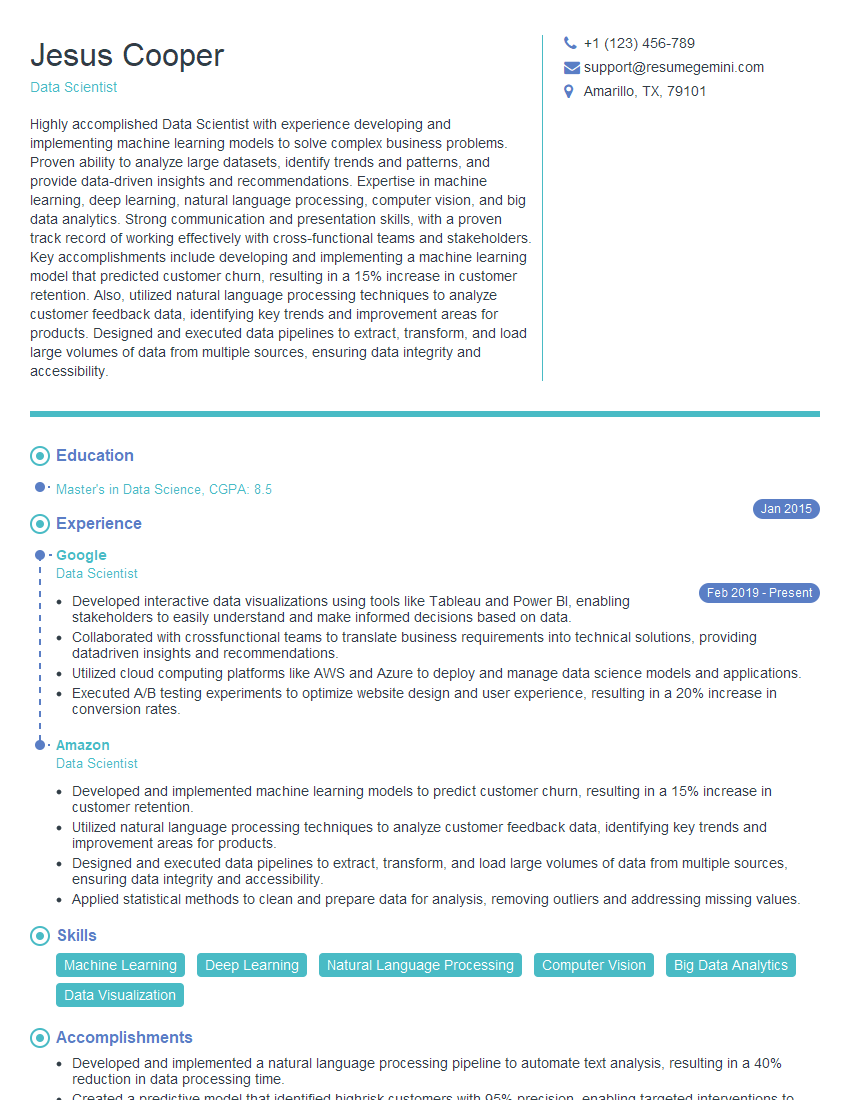
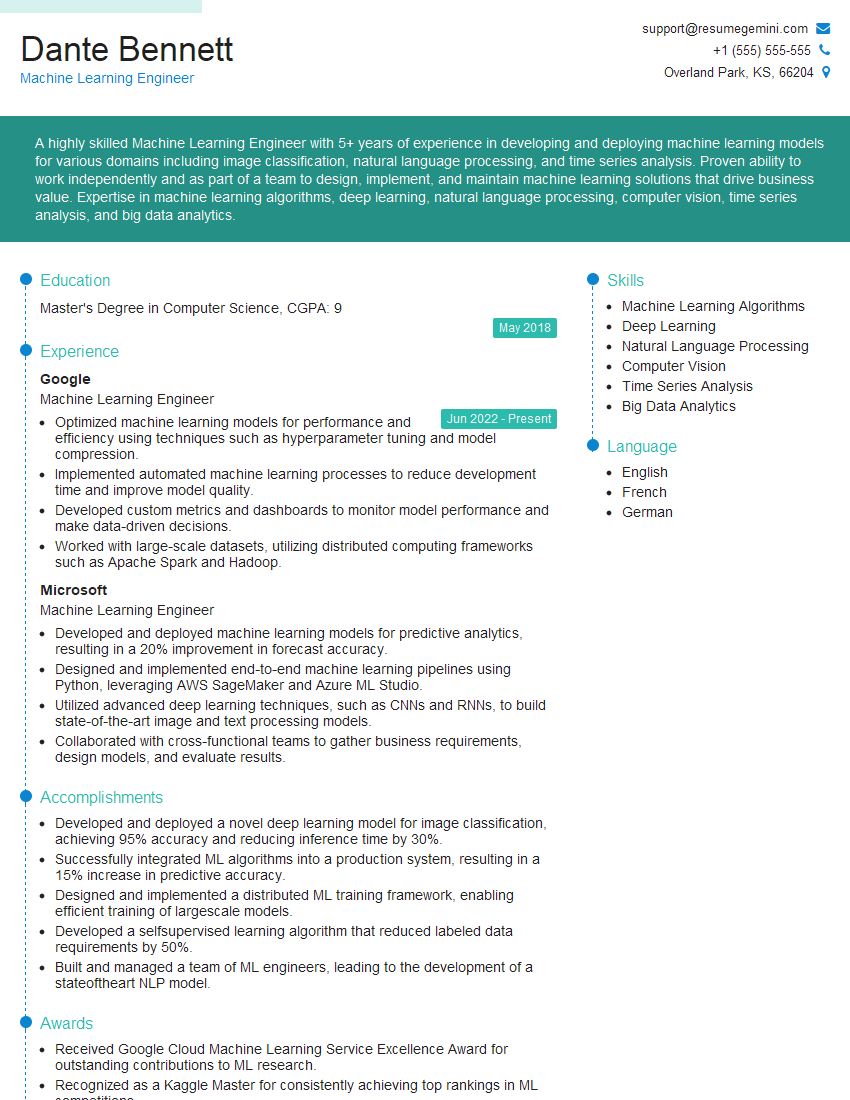
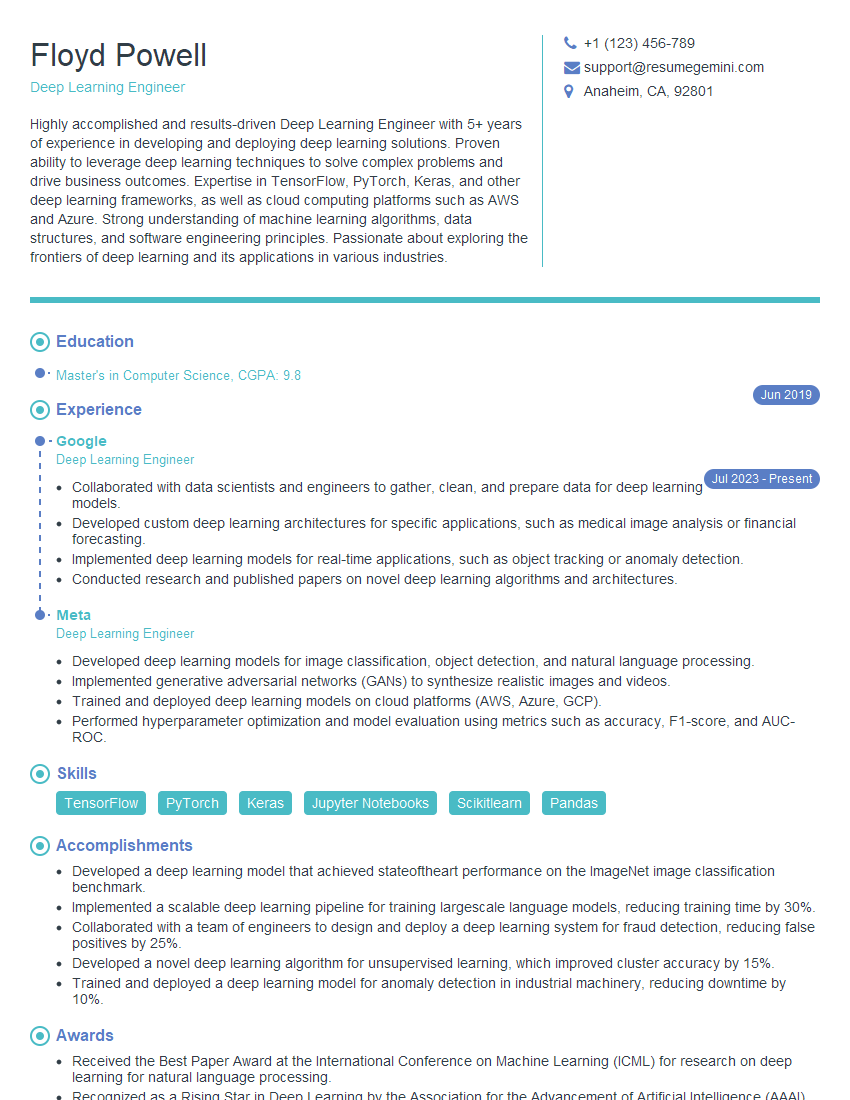
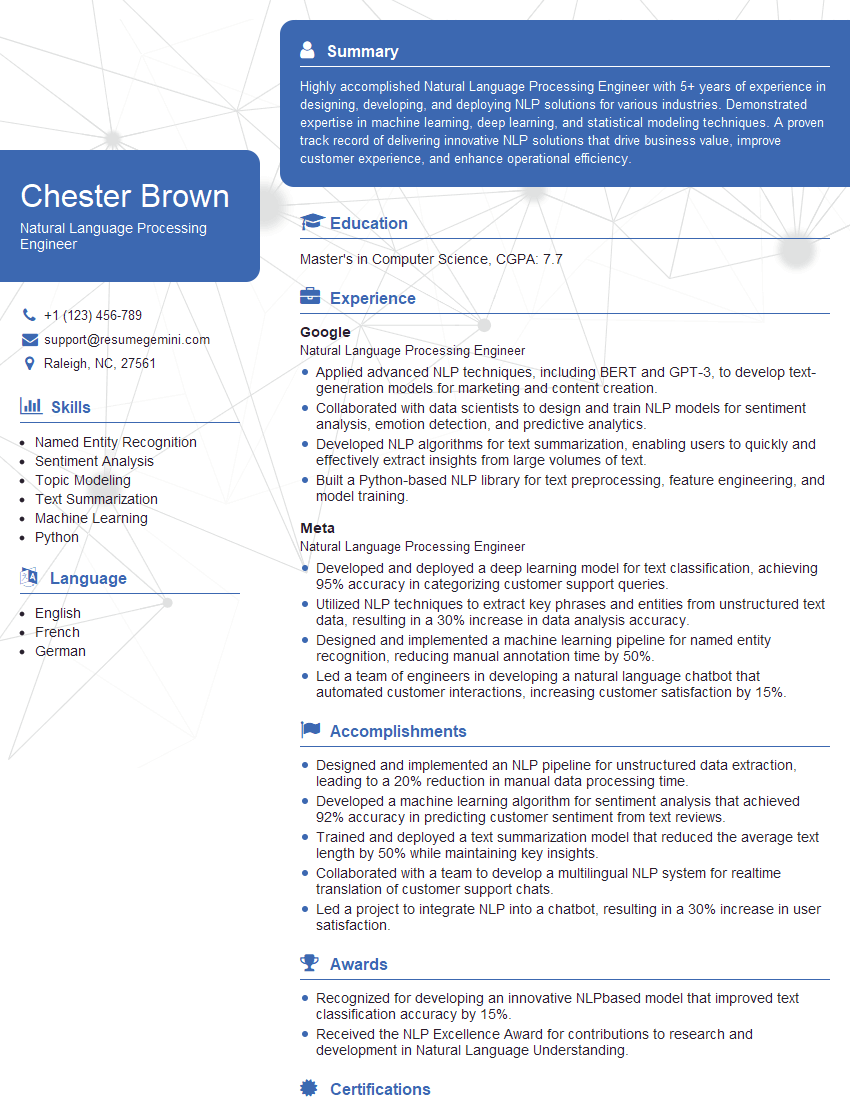
Mastering Deep Learning Frameworks is crucial for career advancement in the rapidly evolving field of AI. A strong understanding of these tools opens doors to exciting opportunities and positions you as a highly sought-after candidate. To maximize your job prospects, crafting an ATS-friendly resume is essential. This ensures your qualifications are effectively communicated to hiring managers and Applicant Tracking Systems. We highly recommend using ResumeGemini to build a professional and impactful resume. ResumeGemini provides valuable tools and resources, including examples of resumes tailored to Deep Learning Frameworks, to help you create a resume that stands out from the competition.



Explore more articles
Users Rating of Our Blogs
Share Your Experience
We value your feedback! Please rate our content and share your thoughts (optional).
What Readers Say About Our Blog
Very informative content, great job.
good