Interviews are more than just a Q&A session—they’re a chance to prove your worth. This blog dives into essential RF Spectrum Analysis interview questions and expert tips to help you align your answers with what hiring managers are looking for. Start preparing to shine!
Questions Asked in RF Spectrum Analysis Interview
Q 1. Explain the concept of RF spectrum allocation and its importance.
RF spectrum allocation is like dividing a valuable resource – the radio frequency spectrum – among various users to prevent chaos and ensure efficient communication. Imagine a busy highway; without lane markings and traffic signals, it would be a disaster. Similarly, without a regulated spectrum, different radio signals would interfere with each other, rendering communication unreliable or impossible. The importance lies in preventing interference, maximizing usage, and ensuring fair access for different services like cellular networks, Wi-Fi, satellite communications, radar, and broadcast television.
National and international organizations, such as the Federal Communications Commission (FCC) in the US and the International Telecommunication Union (ITU), are responsible for defining frequency bands and assigning them to various users. These allocations are based on factors like the propagation characteristics of different frequencies, the power levels needed, and the geographical area covered. A well-planned spectrum allocation ensures efficient use of a finite and valuable resource, promoting innovation and economic growth in communication technologies.
Q 2. Describe different types of RF spectrum analyzers and their applications.
RF spectrum analyzers are like sophisticated ‘listening devices’ for radio waves. They’re categorized by their frequency range, performance capabilities, and application. Here are some types:
- Real-time Spectrum Analyzers: These are the ‘supercars’ of spectrum analyzers, capable of capturing fast-changing signals with high fidelity, crucial for analyzing pulsed signals or transient events in radar or digital communications.
- Sweep Spectrum Analyzers: These are the workhorses, systematically scanning through a specified frequency range to detect and measure signals. They are commonly used in lab settings and for general RF testing.
- Vector Signal Analyzers (VSAs): These analyzers go beyond measuring just power levels; they also measure the phase and amplitude of modulated signals, vital in analyzing complex signals like those found in 5G cellular networks or advanced digital communication systems.
- Portable Spectrum Analyzers: Compact and battery-powered, these are invaluable for field testing, troubleshooting RF systems in diverse locations, and performing on-site interference hunting.
Applications span various fields including telecommunications (testing cellular network performance), aerospace (monitoring radar signals), broadcasting (evaluating signal quality), and electronic warfare (detecting and identifying enemy transmissions). The choice of analyzer depends on the specific requirements of the task.
Q 3. How do you calibrate an RF spectrum analyzer?
Calibrating an RF spectrum analyzer ensures its measurements are accurate and reliable. It’s like regularly servicing your car to guarantee optimal performance. Calibration involves comparing the analyzer’s readings to those of a known, precise standard. This typically involves several steps:
- Level Calibration: This ensures the analyzer accurately measures signal power using a calibrated signal generator and attenuators.
- Frequency Calibration: This verifies the accuracy of the frequency markings on the display, usually using a known frequency standard.
- Phase Calibration (if applicable): For VSAs, this step is crucial for ensuring accurate phase measurements.
- Spurious Calibration: This identifies and corrects for any internal noise or unwanted signals generated by the analyzer itself.
The procedure often involves using specialized calibration equipment and following manufacturer instructions meticulously. Regular calibration, often at set intervals, maintains the analyzer’s accuracy and provides confidence in the results.
Q 4. What are the key performance indicators (KPIs) of an RF spectrum analyzer?
Key Performance Indicators (KPIs) of an RF spectrum analyzer are critical for assessing its capabilities and suitability for specific tasks. They include:
- Frequency Range: The span of frequencies the analyzer can measure (e.g., 9 kHz to 26.5 GHz).
- Frequency Accuracy and Stability: How precisely the analyzer determines and maintains a specific frequency.
- Resolution Bandwidth (RBW): Determines the analyzer’s ability to separate closely spaced signals. A narrower RBW provides better resolution but slower sweep times.
- Dynamic Range: The difference between the largest and smallest signals the analyzer can accurately measure. A wider dynamic range is essential for analyzing weak signals in the presence of strong ones.
- Sensitivity: The smallest signal the analyzer can detect.
- Sweep Speed: How quickly the analyzer scans across its frequency range.
- Spurious Signals: The level of unwanted signals generated internally by the analyzer.
These KPIs directly affect the accuracy, reliability, and suitability of the analyzer for a given application. Understanding these indicators is vital for choosing the right instrument for your specific needs.
Q 5. Explain the difference between frequency, wavelength, and phase.
Imagine a wave in the ocean. Frequency is how often the wave crests pass a point, wavelength is the distance between successive crests, and phase describes the position of the wave at a particular time.
- Frequency: Measured in Hertz (Hz), it represents the number of cycles per second of a wave. A higher frequency means more cycles per second.
- Wavelength: Measured in meters (m), it’s the distance between two identical points on consecutive waves. A shorter wavelength indicates a higher frequency and vice-versa.
- Phase: Represents the position of a point on a waveform relative to a reference point. It’s often expressed in degrees or radians. Two waves with the same frequency can be ‘out of phase,’ resulting in constructive or destructive interference.
The relationship between frequency (f), wavelength (λ), and the speed of light (c) is given by the equation: c = fλ. This equation is fundamental in RF engineering and electromagnetism.
Q 6. What are harmonics and spurious emissions in RF systems?
Harmonics and spurious emissions are unwanted signals in RF systems that can cause interference and complicate signal analysis.
- Harmonics: These are integer multiples of the fundamental frequency of a signal. For example, if a signal has a fundamental frequency of 10 MHz, its harmonics would be 20 MHz, 30 MHz, 40 MHz, and so on. These harmonics are generated by non-linear components in the system.
- Spurious Emissions: These are unwanted signals at frequencies unrelated to the fundamental frequency or its harmonics. They can be caused by various factors, including internal noise in components, intermodulation products (mixing of different signals), and improper circuit design.
Both harmonics and spurious emissions can interfere with other communication systems, violating regulatory standards, and degrading signal quality. Filtering and careful circuit design are essential to minimize their generation and impact.
Q 7. How do you identify and mitigate RF interference?
Identifying and mitigating RF interference is like detective work. It requires a systematic approach:
- Identify the Interference: Use a spectrum analyzer to locate the frequency and characteristics of the interfering signal. This includes determining its power level, modulation type, and source if possible.
- Trace the Source: Once the frequency is identified, try to pinpoint the source of the interference. Techniques like signal tracing, direction finding, and correlation with system activity can help.
- Implement Mitigation Strategies: Mitigation strategies depend on the source and nature of the interference. Some common strategies include:
- Filtering: Use filters to attenuate the interfering signal at its specific frequency.
- Shielding: Enclose sensitive components in metal shielding to reduce electromagnetic radiation.
- Grounding: Properly grounding circuits to reduce ground loops and noise.
- Signal Isolation: Use isolators or circulators to prevent signals from traveling in unintended paths.
- Frequency Coordination: Change the operating frequency of the affected system to avoid the interfering signal.
- Verify Mitigation: After implementing mitigation measures, re-check the RF spectrum to ensure the interference has been effectively reduced.
Sometimes, resolving interference can be a complex, iterative process requiring a combination of techniques. Careful observation, systematic troubleshooting, and a thorough understanding of RF principles are crucial for successful mitigation.
Q 8. What are the different modulation techniques used in wireless communication?
Wireless communication relies on various modulation techniques to efficiently transmit information. These techniques encode data onto a carrier wave, altering either its amplitude, frequency, or phase. Common modulation schemes include:
- Amplitude Shift Keying (ASK): The amplitude of the carrier wave changes to represent data. Think of it like turning a lightbulb brighter or dimmer to signal 1 or 0.
- Frequency Shift Keying (FSK): The frequency of the carrier wave changes to represent data. Imagine using different musical notes to represent different bits.
- Phase Shift Keying (PSK): The phase of the carrier wave changes to represent data. This is like shifting the starting point of a wave to encode information.
- Quadrature Amplitude Modulation (QAM): Combines both amplitude and phase shifts for higher data rates. This is like using both brightness and the starting point of a light wave to encode more information.
- Orthogonal Frequency-Division Multiplexing (OFDM): Divides the signal into multiple orthogonal subcarriers, each carrying a small portion of the data. This is like sending multiple messages simultaneously over different independent channels.
The choice of modulation technique depends on factors like bandwidth availability, noise levels, and desired data rate. For instance, OFDM is prevalent in Wi-Fi and 4G/5G due to its robustness against multipath fading.
Q 9. Explain the concept of signal-to-noise ratio (SNR) and its significance.
Signal-to-noise ratio (SNR) is a crucial metric in RF communication representing the ratio of the desired signal power to the unwanted noise power. It’s expressed in decibels (dB).
SNR (dB) = 10 * log10(Signal Power / Noise Power)
A higher SNR indicates a stronger signal relative to the noise, leading to better signal quality and less distortion. A low SNR results in poor signal reception, potentially leading to data errors or complete signal loss. Think of it like trying to hear someone speak in a crowded, noisy room – a higher SNR would be like having a quieter room or a louder speaker.
SNR is significant because it directly impacts the bit error rate (BER) of the communication system. A higher SNR means a lower BER, ensuring reliable data transmission. In professional settings, SNR is constantly monitored to ensure optimal system performance and troubleshoot issues related to signal degradation.
Q 10. Describe different types of antennas and their radiation patterns.
Antennas are crucial components that radiate and receive electromagnetic waves. Their design significantly impacts the efficiency and coverage of wireless communication systems.
- Dipole Antenna: A simple and common antenna consisting of two conductive elements. It exhibits a figure-eight radiation pattern.
- Monopole Antenna: A single conductive element, often used with a ground plane. Its radiation pattern is a half-circle.
- Patch Antenna: A planar antenna printed on a substrate, often used in mobile devices due to its compact size. Radiation pattern is highly dependent on its design.
- Yagi-Uda Antenna: A directional antenna with high gain, commonly used in TV reception. Its radiation pattern is strongly concentrated in one direction.
- Horn Antenna: A waveguide antenna used in high-frequency applications, offering high gain and directivity. Radiation pattern is highly directional.
Radiation patterns illustrate how the antenna transmits and receives signals in different directions. Understanding antenna radiation patterns is critical for optimizing system design and minimizing interference.
Q 11. What are the challenges in measuring low-level signals using an RF spectrum analyzer?
Measuring low-level signals using an RF spectrum analyzer presents several challenges:
- Noise Floor: The inherent noise within the analyzer itself can mask weak signals. This is like trying to hear a whisper in a loud room.
- Dynamic Range Limitations: Analyzers have a limited dynamic range, meaning they cannot accurately measure both very strong and very weak signals simultaneously. It’s like trying to see both a bright sun and faint stars in the same image with a single camera.
- Interference and Spurious Signals: Unwanted signals from other sources can interfere with the measurement of low-level signals. This is similar to trying to focus on a specific instrument in an orchestra where many instruments play at the same time.
- Sensitivity Limits: Analyzers have a minimum detectable signal level. Signals weaker than this limit cannot be measured accurately.
To address these challenges, techniques like averaging, pre-selection filtering, and using low-noise amplifiers can be employed. Careful calibration and shielding are also essential to minimize interference.
Q 12. How do you interpret a spectrum analyzer display?
A spectrum analyzer display typically shows signal amplitude (in dBm or volts) versus frequency. The horizontal axis represents frequency, while the vertical axis shows the signal strength. The display provides information such as:
- Signal Frequencies: Peaks on the display indicate the frequencies at which signals are present.
- Signal Strengths: The height of each peak corresponds to the signal strength.
- Signal Bandwidth: The width of the peak represents the bandwidth occupied by the signal.
- Noise Level: The background level of the display shows the noise floor.
By analyzing the display, one can identify individual signals, measure their frequencies and power, detect interference, and assess signal quality. For example, identifying unwanted signals in the spectrum can be crucial for troubleshooting interference in a wireless network.
Q 13. Explain the concept of dynamic range in the context of RF spectrum analysis.
Dynamic range in RF spectrum analysis refers to the difference between the strongest and weakest signals that the analyzer can accurately measure. It’s usually expressed in dB.
A wide dynamic range is crucial for accurately characterizing signals with vastly different power levels. A narrow dynamic range can lead to clipping of strong signals or the masking of weak signals by strong ones. Think of the difference between a camera that can capture both bright sunlight and very dim stars versus a camera that can only handle a narrow range of brightness.
Factors like the analyzer’s sensitivity, noise floor, and the used measurement techniques influence the dynamic range. A high dynamic range analyzer is essential for applications requiring precision measurements of both strong and weak signals, such as characterizing low-level emissions or performing interference analysis.
Q 14. What is the difference between amplitude modulation (AM) and frequency modulation (FM)?
Both Amplitude Modulation (AM) and Frequency Modulation (FM) are modulation techniques that encode information onto a carrier wave, but they do so differently:
- Amplitude Modulation (AM): The amplitude of the carrier wave varies in proportion to the instantaneous amplitude of the message signal. Think of it like changing the brightness of a lightbulb according to the sound wave’s intensity.
- Frequency Modulation (FM): The frequency of the carrier wave varies in proportion to the instantaneous amplitude of the message signal. This is like changing the pitch of a musical note based on the intensity of the message.
Key differences include: AM is simpler to implement but more susceptible to noise and interference. FM offers better noise immunity and wider bandwidth but requires more complex circuitry. AM is commonly used in AM radio broadcasting, while FM finds applications in FM radio and some data transmission systems.
Q 15. Describe the process of performing a swept frequency measurement.
A swept frequency measurement, also known as a spectrum scan, systematically analyzes the power levels of signals across a range of frequencies. Imagine a radio tuner sweeping across the dial – that’s essentially what a swept frequency measurement does, but with much higher precision and a wider frequency range.
The process involves a signal generator, a device under test (DUT), and a spectrum analyzer. The spectrum analyzer’s receiver is tuned across a specified frequency range, typically from a low frequency to a high frequency. At each frequency step, the analyzer measures the power level of any signals present. This data is then displayed as a graph showing power (usually in dBm) versus frequency (usually in Hz, kHz, MHz, or GHz).
Example: Testing a wireless transmitter. The transmitter is connected to the spectrum analyzer via an appropriate cable and attenuator. The analyzer is then programmed to scan the frequency range of the transmitter, typically encompassing the center frequency and its associated bandwidth. The resulting plot shows the transmitter’s power output across its operational band, allowing for verification of compliance with regulations and identification of spurious emissions (unwanted signals at frequencies outside the intended band).
The speed of the sweep is crucial; a slower sweep offers higher resolution but takes longer, while a faster sweep is quicker but may miss fine details.
Career Expert Tips:
- Ace those interviews! Prepare effectively by reviewing the Top 50 Most Common Interview Questions on ResumeGemini.
- Navigate your job search with confidence! Explore a wide range of Career Tips on ResumeGemini. Learn about common challenges and recommendations to overcome them.
- Craft the perfect resume! Master the Art of Resume Writing with ResumeGemini’s guide. Showcase your unique qualifications and achievements effectively.
- Don’t miss out on holiday savings! Build your dream resume with ResumeGemini’s ATS optimized templates.
Q 16. What are the common errors associated with RF spectrum analysis measurements?
Several factors can introduce errors into RF spectrum analysis measurements. These can be broadly categorized into:
- Cable Losses: RF cables inevitably introduce attenuation (signal loss), causing measured power to be lower than the actual power. This is frequency-dependent, meaning the loss varies with the frequency of the signal.
- Impedance Mismatches: If the impedance of the cable, connectors, and the spectrum analyzer’s input doesn’t match the impedance of the DUT, reflected signals can distort the measurement. Think of it like trying to pour water into a bottle with a mismatched opening; you’ll get spillage and inaccuracies.
- Spurious Signals: Unwanted signals from other sources, like nearby transmitters or internal noise within the equipment, can contaminate the measurement. This is especially problematic when measuring weak signals.
- Calibration Errors: An improperly calibrated spectrum analyzer can lead to significant errors in the measurement. Regular calibration using known standards is essential.
- Dynamic Range Limitations: A spectrum analyzer has a limited dynamic range, which is the difference between the smallest and largest signal it can accurately measure. If a very strong signal is present alongside a very weak signal, the weak signal may be masked.
- Temperature Effects: Temperature changes can affect component performance, leading to drift and inaccuracies in measurements.
Q 17. How do you ensure the accuracy of RF measurements?
Ensuring accurate RF measurements requires a multi-pronged approach:
- Calibration: Regularly calibrate the spectrum analyzer using known signal sources and traceable standards. This compensates for instrument drift and inaccuracies.
- Impedance Matching: Use appropriate connectors and cables to ensure impedance matching throughout the measurement setup. Using a network analyzer to measure the impedance of the system is useful.
- Proper Shielding and Grounding: Minimize external interference by using shielded cables and proper grounding techniques. This helps isolate the measurement from electromagnetic noise.
- Signal Attenuation: Use attenuators to reduce the signal level if the input power exceeds the analyzer’s dynamic range, preventing saturation.
- Averaging: Perform multiple measurements and average the results to reduce the impact of random noise.
- Error Analysis: Carefully consider potential sources of error and estimate their impact on the overall measurement uncertainty.
- Using Traceable Standards: Use calibrated equipment and traceable standards whenever possible, ensuring the accuracy of the entire measurement chain.
Example: Before measuring the power output of a cellular base station transmitter, one would calibrate the spectrum analyzer to a known signal level using a power meter and traceable attenuation standards. The connection to the transmitter would use low-loss, correctly-impedance-matched coaxial cables to minimize signal loss and reflections. Multiple measurements would then be averaged to reduce random noise.
Q 18. Explain the concept of impedance matching and its importance in RF systems.
Impedance matching is the process of ensuring that the impedance of a source (e.g., a transmitter) is equal to the impedance of a load (e.g., an antenna or receiver). It’s analogous to fitting a hose to a faucet – a good fit ensures maximum water flow (power transfer). A mismatch leads to reflections, power loss, and distortion.
In RF systems, impedance is typically expressed in ohms (Ω). A common standard impedance is 50 Ω. When impedance is matched, maximum power is transferred from the source to the load. Mismatches cause some of the signal to be reflected back towards the source, leading to reduced efficiency, signal distortion, and potentially damaging the equipment due to the reflected power.
Importance: Impedance matching is crucial for maximizing signal strength, minimizing signal loss, improving signal quality, and preventing damage to components. In high-power systems, mismatches can lead to significant power dissipation, overheating, and component failure.
Example: An antenna with a 50 Ω impedance connected to a transmitter with a 50 Ω output impedance will achieve optimal power transfer. However, if the antenna impedance is 75 Ω, there will be a mismatch, leading to signal reflection and power loss.
Q 19. What are the different types of filters used in RF systems?
Many types of filters are used in RF systems to select desired signals while rejecting unwanted ones. Their characteristics are often defined by parameters such as center frequency, bandwidth, and attenuation.
- Low-pass filters: Allow signals below a specific cutoff frequency to pass while attenuating signals above it.
- High-pass filters: Allow signals above a specific cutoff frequency to pass while attenuating signals below it.
- Band-pass filters: Allow signals within a specific frequency band to pass while attenuating signals outside that band. These are commonly used in radio receivers to select a particular channel.
- Band-stop (notch) filters: Attenuate signals within a specific frequency band while allowing signals outside that band to pass. These are used to reject interfering signals.
- Resonant filters: Utilize resonant circuits to achieve sharp filtering characteristics, often used in narrowband applications.
- Crystal filters: Very precise filters based on piezoelectric crystals, often used in high-frequency applications requiring very sharp selectivity.
Example: A radio receiver uses a band-pass filter to select a specific radio station’s frequency from the multitude of signals received by the antenna. A notch filter might be used to remove unwanted interference from a nearby power line.
Q 20. How do you troubleshoot RF interference problems in a real-world scenario?
Troubleshooting RF interference involves a systematic approach:
- Identify the Interference: Use a spectrum analyzer to identify the frequency, power level, and characteristics of the interfering signal. This pinpoints the source of the problem.
- Locate the Source: Use direction-finding techniques (like a spectrum analyzer with directional antennas) or a field strength meter to trace the source of the interference. Systematically move the antenna or probe to pinpoint its location.
- Investigate Potential Sources: Consider potential sources of interference such as other electronic equipment, power lines, and nearby transmitters. Look for equipment operating on or near the affected frequency.
- Eliminate or Reduce the Source: This may involve:
- Shielding: Enclosing the source of interference or the susceptible equipment in a shielded enclosure.
- Grounding: Improving the grounding of equipment to reduce radiated emissions.
- Filtering: Installing filters to block the interfering signal.
- Distance: Increasing the physical separation between the source and the affected equipment.
- Signal modification: Adjusting the operating parameters of the interfering source or the receiver to minimize interference (e.g., changing frequencies or data rates).
- Verify the Solution: After implementing a solution, re-measure the signal level to verify that the interference has been reduced to an acceptable level.
Example: Imagine a wireless network experiencing intermittent dropouts. A spectrum analyzer reveals a strong signal at the same frequency as the network. Tracing the source pinpoints a nearby microwave oven. The solution might be to relocate the oven or add filtering to the network’s access point.
Q 21. Explain the concept of electromagnetic compatibility (EMC).
Electromagnetic Compatibility (EMC) is the ability of electrical equipment and systems to function satisfactorily in their electromagnetic environment without causing unacceptable electromagnetic interference (EMI) to other equipment. It’s about ensuring that devices don’t cause problems for other devices and that devices are not unduly susceptible to interference from other devices.
EMC encompasses two main aspects:
- Emissions: The electromagnetic energy radiated or conducted by a device. This energy can cause interference with other equipment.
- Susceptibility: The ability of a device to function properly in the presence of electromagnetic interference. A highly susceptible device will malfunction easily when exposed to EMI.
EMC standards and regulations dictate the acceptable levels of emissions and susceptibility for various types of equipment. Meeting these standards is crucial for ensuring that products can be legally marketed and operate reliably in the real world. Failure to meet EMC standards can lead to product recalls, regulatory fines, and reputational damage.
Example: A properly designed and tested power supply should meet EMC standards by limiting its conducted and radiated emissions to acceptable levels, ensuring it doesn’t interfere with other devices. Simultaneously, it needs to be designed to resist interference from other electronic equipment that could potentially disrupt its operation.
Q 22. Describe your experience with different spectrum analysis software packages.
My experience with spectrum analysis software spans several leading packages. I’m proficient in using Keysight’s Advanced Design System (ADS) for simulations and detailed analysis, particularly for designing and verifying RF circuits. I’m also highly familiar with Keysight’s VSA software (Vector Signal Analyzer software), which is invaluable for real-time signal analysis and demodulation. This software is crucial for tasks ranging from identifying interference sources to characterizing signal quality in complex RF environments. Furthermore, I have extensive experience with Rohde & Schwarz’s software suite, including their spectrum analyzer control and analysis tools. I find their tools particularly useful for compliance testing due to their comprehensive reporting features and adherence to international standards. Finally, I’ve also worked with MATLAB extensively for custom signal processing and algorithm development, integrating it with data acquired from various spectrum analyzers to perform more complex analysis tasks. The choice of software often depends on the specific application; ADS is best for design, VSA for real-time analysis, Rohde & Schwarz for compliance, and MATLAB for advanced customization.
Q 23. How familiar are you with regulatory compliance standards related to RF emissions?
Regulatory compliance is a critical aspect of my work. I’m deeply familiar with standards such as FCC Part 15 (for unintentional radiators), ETSI EN 300 328 (for radio equipment), and CISPR standards (for conducted and radiated emissions). Understanding these regulations isn’t just about passing tests; it’s about designing and operating RF systems responsibly, minimizing electromagnetic interference (EMI), and ensuring that they don’t cause harmful interference to other devices or systems. My experience involves interpreting these standards, identifying potential non-compliance issues, and implementing design changes or mitigation strategies to ensure regulatory compliance. For instance, I once helped a client redesign a wireless device to meet FCC Part 15B requirements by implementing appropriate filtering and reducing spurious emissions. This required a thorough understanding of the regulations, spectrum analysis techniques, and practical application of these techniques to the device.
Q 24. Explain your experience with different types of RF measurement probes and accessories.
My experience encompasses a wide range of RF measurement probes and accessories. I’ve used various types of antennas, including horn antennas for directional measurements, dipole antennas for omnidirectional measurements, and specialized antennas for specific frequency bands. The choice of antenna significantly influences the accuracy and reliability of the measurements. I also have experience with various types of cables and connectors, ensuring proper impedance matching to minimize signal loss and reflections. Furthermore, I’m adept at using preamplifiers to boost weak signals and attenuators to protect sensitive equipment from powerful signals. In addition, I’ve worked with near-field probes for accurate measurements of radiated emissions from smaller devices, where far-field measurements might be less accurate. Selecting the appropriate accessories for a specific application is crucial to achieving accurate and reliable results. For example, using the wrong antenna could lead to significant measurement errors and incorrect conclusions about signal strength or interference.
Q 25. What is your experience with performing pre-compliance testing using an RF spectrum analyzer?
Pre-compliance testing is a crucial step in the product development cycle. Using an RF spectrum analyzer, I conduct pre-compliance testing to identify potential EMI issues early on, minimizing costly redesigns later in the process. This involves setting up the spectrum analyzer according to the relevant regulatory standards, performing both conducted and radiated emission measurements, and meticulously analyzing the results. I use the spectrum analyzer’s sweep functions to examine the entire frequency range of interest, identifying any spurious emissions or out-of-band radiation. The analyzer’s marker functions are essential for accurately determining the power levels of the emissions. Any violations of the regulatory limits are documented, along with suggested mitigation techniques. For example, during pre-compliance testing for a new Bluetooth device, I identified a spurious emission just outside the permitted band, which was resolved by adding a simple LC filter to the circuit. This early identification prevented significant delays and costs later in the development process.
Q 26. Describe a challenging RF spectrum analysis problem you solved.
One particularly challenging problem involved identifying the source of intermittent interference affecting a high-speed data communication system. The interference was sporadic and difficult to pinpoint. The initial spectrum analysis showed high-level noise but didn’t reveal a clear source. My approach involved a systematic process: first, carefully documenting the timing and conditions under which the interference occurred. Next, I used time-domain analysis capabilities of the spectrum analyzer along with specialized probes to narrow down the potential sources, eliminating noise from nearby power lines and other equipment. I then employed a combination of narrowband scans and various sweep modes to examine the spectrum more closely during the interference events. Ultimately, we discovered the source was a poorly shielded power supply within the communication system itself. The solution was straightforward once we identified the source: implementing better shielding and using a different power supply. The key to solving this was patience, meticulous data collection, a thorough understanding of the system, and the systematic application of various spectrum analysis techniques.
Q 27. How do you stay current with the latest advancements in RF spectrum analysis technology?
Staying current in RF spectrum analysis requires a multi-pronged approach. I regularly attend industry conferences and webinars, such as those hosted by IEEE and other professional organizations. These events often feature presentations on the latest technologies and research in the field. I subscribe to several key journals and online publications focusing on RF engineering and electromagnetic compatibility. I also actively participate in online forums and communities, connecting with other professionals to discuss challenges and share knowledge. Further, I frequently consult the datasheets and application notes provided by manufacturers of spectrum analyzers and related equipment to stay informed about new features and capabilities. Finally, I pursue continuing education opportunities whenever possible, including relevant online courses and workshops to deepen my expertise in emerging areas.
Key Topics to Learn for RF Spectrum Analysis Interview
- Fundamental Concepts: Understanding frequency, wavelength, amplitude, power, and signal-to-noise ratio (SNR) in the context of RF signals.
- Signal Modulation Techniques: Familiarize yourself with various modulation schemes (AM, FM, ASK, FSK, PSK, etc.) and their impact on spectrum occupancy.
- Spectrum Analyzers: Master the operation and functionality of spectrum analyzers, including their various measurement capabilities (e.g., power, frequency, channel power, occupied bandwidth).
- Practical Applications: Explore real-world applications such as wireless communication systems, radar systems, and electronic warfare. Be prepared to discuss specific examples.
- Signal Interference and Noise: Understand the sources and effects of noise and interference on RF signals, and techniques for mitigation.
- Spectrum Management and Regulations: Gain a basic understanding of spectrum allocation policies and regulations relevant to your geographic region.
- Advanced Topics (depending on the role): Consider exploring concepts like vector signal analysis, cognitive radio, software-defined radio (SDR), and related signal processing techniques.
- Problem-Solving Approach: Practice analyzing scenarios involving spectrum analysis, identifying problems, and proposing solutions. Be ready to discuss your problem-solving methodology.
Next Steps
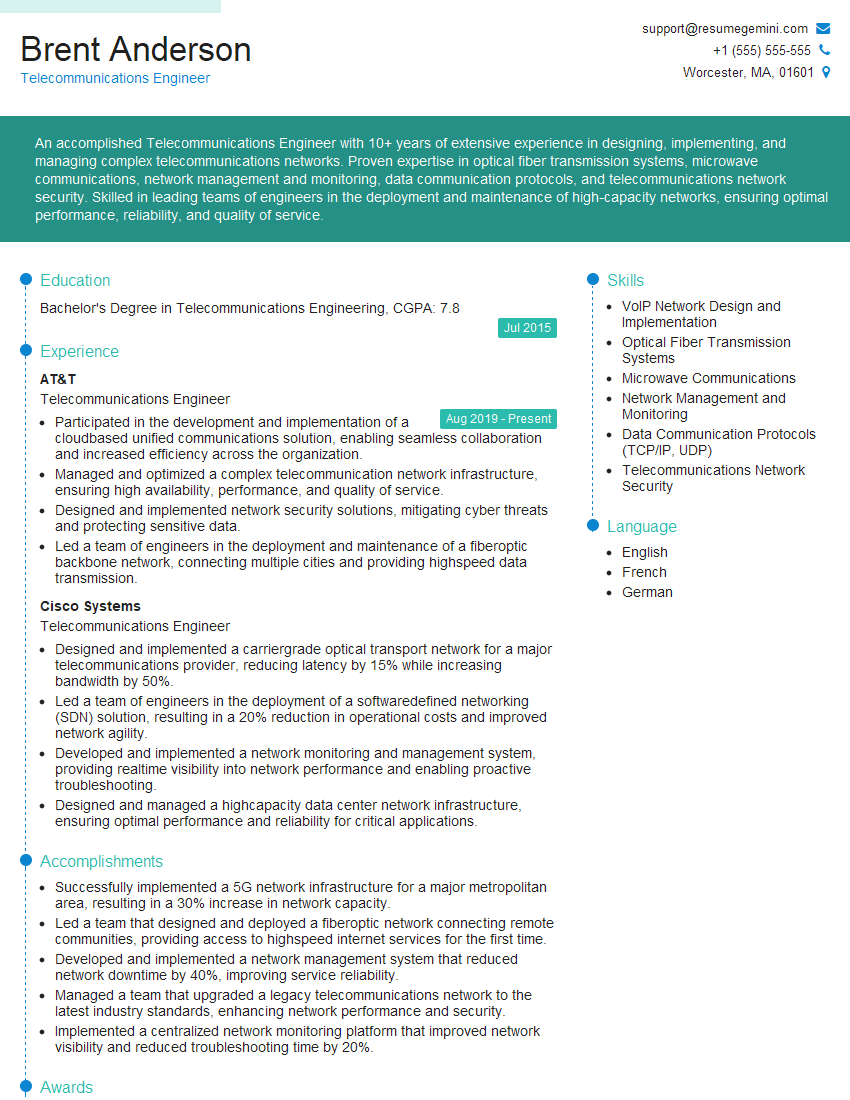
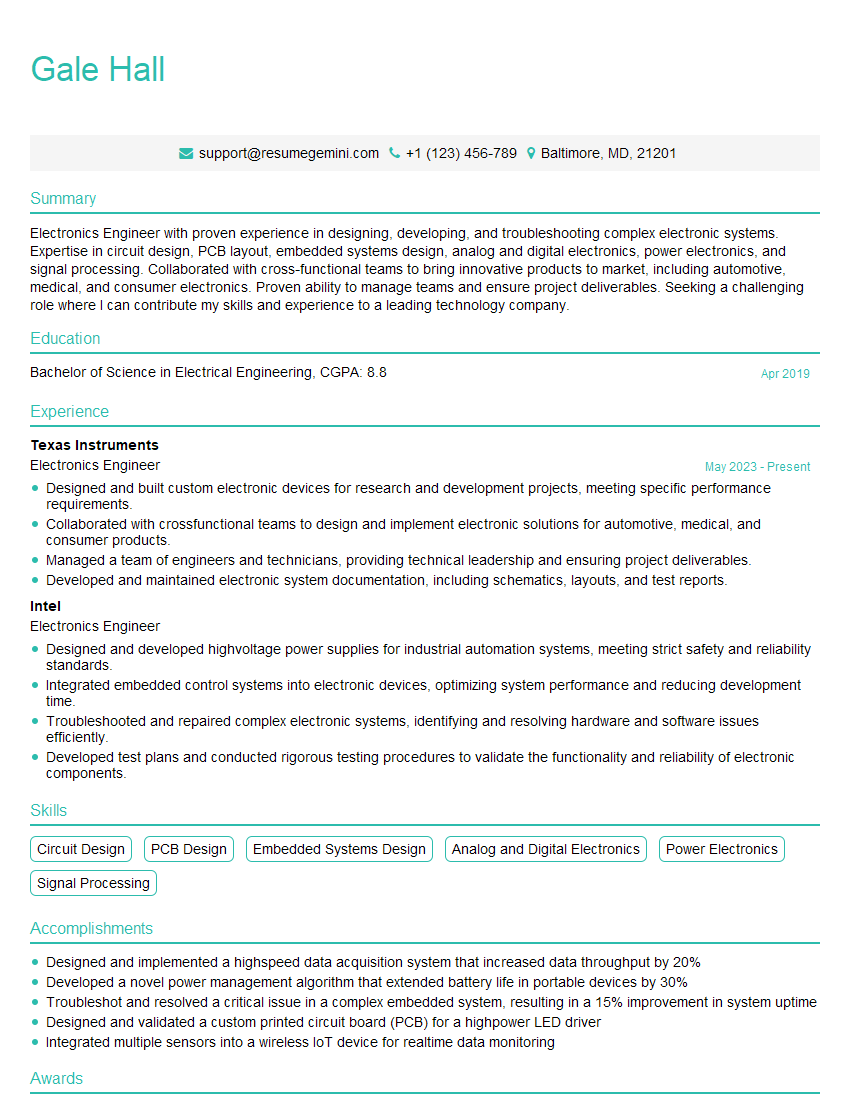
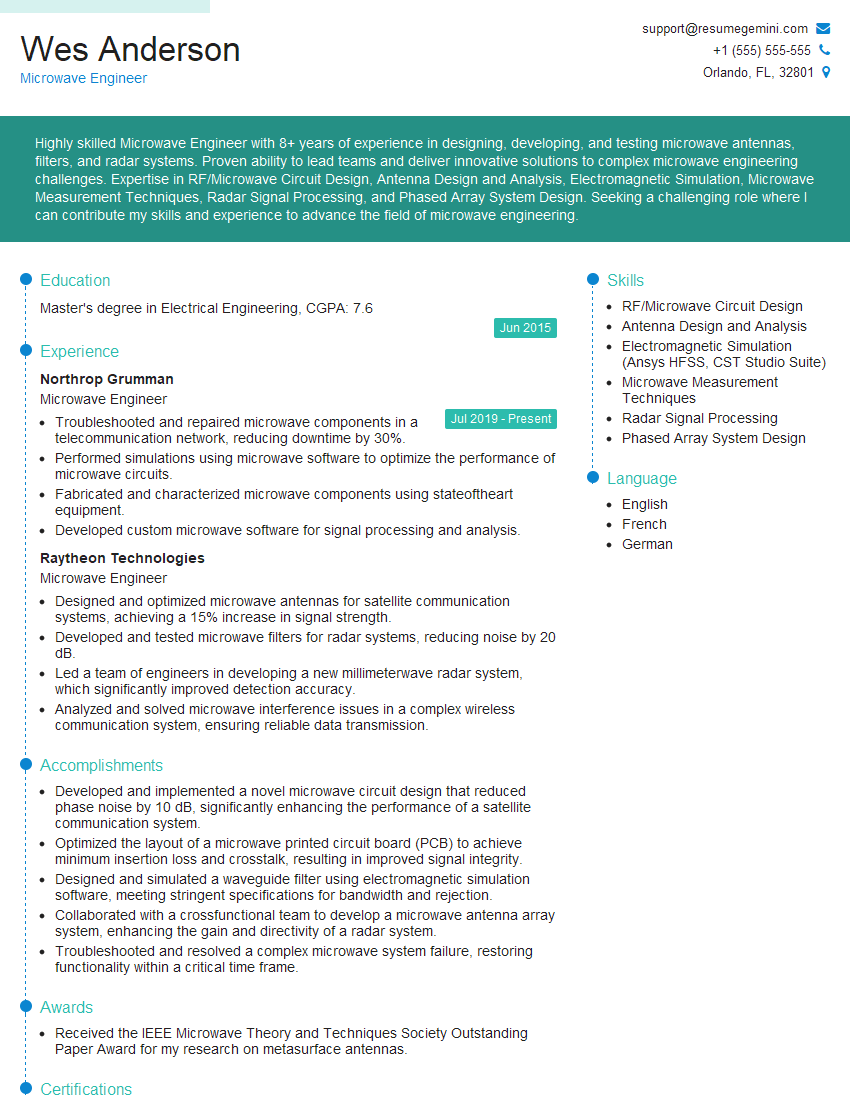
Mastering RF Spectrum Analysis opens doors to exciting and rewarding career opportunities in a rapidly evolving technological landscape. Proficiency in this area demonstrates a strong understanding of fundamental communication principles and makes you a valuable asset in numerous industries. To maximize your job prospects, it’s crucial to present your skills effectively through a well-crafted, ATS-friendly resume. ResumeGemini is a trusted resource that can help you build a professional resume that highlights your expertise in RF Spectrum Analysis. Examples of resumes tailored to this field are available to help guide you. Invest time in building a strong resume; it’s your first impression on potential employers.
Explore more articles
Users Rating of Our Blogs
Share Your Experience
We value your feedback! Please rate our content and share your thoughts (optional).
What Readers Say About Our Blog
Very informative content, great job.
good