The right preparation can turn an interview into an opportunity to showcase your expertise. This guide to Die Design and Engineering interview questions is your ultimate resource, providing key insights and tips to help you ace your responses and stand out as a top candidate.
Questions Asked in Die Design and Engineering Interview
Q 1. Explain the difference between progressive and compound dies.
Progressive and compound dies are both used in stamping operations to create complex shapes from sheet metal, but they differ significantly in their design and functionality.
A progressive die performs multiple operations on a single workpiece as it passes through a series of stations in one stroke of the press. Imagine a factory assembly line; each station adds a step to the final product. Each station performs a specific operation, such as blanking, piercing, forming, or embossing. The workpiece is progressively transformed as it advances from station to station. This is highly efficient for mass production of identical parts.
A compound die, on the other hand, performs two or more operations simultaneously within a single press stroke. Think of it as multiple chefs working on different parts of the same dish at the same time. All operations occur in one single press stroke and the part is completed in one pass. This is often chosen when the part geometry permits simultaneous operations or when the progressive die’s complexity becomes too high or impractical.
In short: Progressive dies use multiple stations for sequential operations, while compound dies perform multiple operations simultaneously in a single station. The choice between them depends on factors like part complexity, production volume, and tooling cost.
Q 2. Describe your experience with die design software (e.g., AutoCAD, SolidWorks).
I have extensive experience using both AutoCAD and SolidWorks for die design. In my previous role, I primarily used SolidWorks for 3D modeling and simulation, leveraging its powerful features for creating complex die geometries and analyzing their performance. This allowed for comprehensive stress analysis and ensured designs could withstand the rigors of high-volume production. AutoCAD was utilized primarily for 2D drawings, creating detailed manufacturing documentation including die layouts and component specifications. I’m proficient in using both softwares’ functionalities like creating and editing parts, assemblies, drawings, simulations and generating detailed reports. For example, I successfully designed a progressive die for a complex automotive part in SolidWorks, simulating various scenarios and identifying potential failure points before physical prototyping, leading to significant cost and time savings.
Q 3. How do you determine the appropriate material for a specific die application?
Selecting the right die material is crucial for die longevity and performance. The choice depends on several factors, including:
- The material being stamped: Harder materials require harder die materials to resist wear and tear. For instance, stamping hardened steel will require a die made of high-speed steel or carbide.
- The type of operation: Blanking dies typically experience higher wear than forming dies. This might influence the material selection. For heavy-duty blanking, tungsten carbide is preferred, offering superior wear resistance.
- Production volume: High-volume production may justify the use of more expensive, long-lasting materials to reduce downtime and maintenance.
- Budgetary constraints: While high-performance materials offer superior durability, they often come with a higher cost.
For example, in one project involving the stamping of aluminum sheets, we opted for a die made of tool steel due to its good balance of cost-effectiveness and wear resistance for the specific application. Conversely, when dealing with high-strength steel, we employed a tungsten carbide insert to endure the considerable forces involved.
Q 4. What are the key considerations for designing a progressive die for high-volume production?
Designing a progressive die for high-volume production requires careful consideration of several key factors:
- Minimal part movement: Efficient material flow is crucial to optimize production rate and reduce material waste. Each station should be carefully designed to minimize the movement of the workpiece.
- Robust construction: The die must be able to withstand the stress of continuous operation. This involves optimizing die component sizes and using high-strength materials.
- Die life: Maximizing die life reduces downtime and maintenance costs. This involves appropriate material selection and designing for even wear distribution.
- Ease of maintenance: Components should be designed for easy replacement or repair to minimize downtime.
- Safety: The design must incorporate features to prevent accidents or injuries during operation.
For instance, in a high-volume project involving the production of car body panels, we focused on minimizing strip width and incorporating features that promoted smooth material flow through the die, minimizing friction and wear to maximize die life.
Q 5. Explain your process for troubleshooting a faulty die.
Troubleshooting a faulty die involves a systematic approach:
- Identify the problem: Precisely determine the nature of the failure – is it dimensional inaccuracy, breakage, premature wear, or something else?
- Analyze the process: Examine the stamping process for issues such as improper lubrication, incorrect press settings, or inconsistent material properties.
- Inspect the die: Carefully inspect all components of the die for damage, wear, or misalignment. This may require microscopic examination.
- Test the die: Conduct controlled trials to isolate the problem and verify solutions. This may involve running the die with different materials or parameters.
- Implement corrective actions: Once the root cause is identified, implement appropriate corrective actions, which may involve repairing or replacing components, adjusting press settings, or improving materials.
For example, when encountering a dimensional issue in a progressive die, I systematically investigated each station, discovering a worn punch in the piercing station responsible for the dimensional inaccuracies. Replacing the punch resolved the problem.
Q 6. How do you calculate the required tonnage for a stamping press?
Calculating the required tonnage for a stamping press depends on several factors and is not a simple formula but rather a comprehensive estimation process. The primary factors include:
- Blank size and shape: Larger and more complex blanks require more force.
- Material properties: The tensile strength and yield strength of the material being stamped directly affect the required force.
- Type of operation: Blanking requires more tonnage than bending or forming operations.
- Die geometry: The geometry of the die, particularly the die radius, affects the force required.
- Friction: Friction between the material and the die adds to the force requirement. Lubrication reduces friction and decreases tonnage needs.
Various estimation methods exist, from empirical formulas based on past experience and material properties to using Finite Element Analysis (FEA) software for sophisticated simulations. FEA allows for a precise prediction of stress distribution and force requirements within the die and material. The selection of the estimation method depends on the complexity of the die and the desired accuracy.
Q 7. What are the common types of die failures and their causes?
Die failures can be broadly classified into several categories:
- Fracture: This occurs due to excessive stress exceeding the die material’s strength. Causes include overloading, improper die design, or material defects.
- Wear: Progressive erosion of the die surface due to repeated contact with the workpiece. This is more pronounced in high-volume applications. Causes include inadequate lubrication, abrasive materials, or improper material selection.
- Plastic deformation: Permanent distortion of the die material under excessive load. Causes include insufficient material strength, improper heat treatment, or impact loads.
- Crack propagation: Small cracks propagate under repeated loading, eventually leading to fracture. Causes include stress concentrations, material defects, or fatigue.
- Misalignment: Improper alignment of die components can lead to premature wear and failure. Causes include incorrect assembly or damage during operation.
Preventing these failures involves careful die design, material selection, proper maintenance, and operator training. Regular inspection and preventative maintenance greatly reduce the likelihood of die failure, ensuring a smoother and more productive stamping process.
Q 8. Describe your experience with die tryout and validation procedures.
Die tryout and validation are critical phases ensuring the die meets the required specifications and produces parts within tolerances. It’s a systematic process involving several stages, starting with a trial run on the press. We meticulously monitor the process parameters—punch speed, tonnage, lubrication—and closely examine the initial parts produced for any defects.
This includes checking for dimensional accuracy using CMM (Coordinate Measuring Machine) data, evaluating surface finish, and verifying the overall part quality against the design specifications. We then progressively fine-tune the die, making adjustments to punches, dies, and stripper plates based on the initial tryout results. This iterative process continues until we achieve consistent production of parts that conform to the required quality standards.
For instance, in a recent project producing a complex automotive part, initial tryouts revealed a slight burr on the edge of the part. By adjusting the die’s shear angle and optimizing the lubrication, we successfully eliminated the burr and achieved the desired surface finish. Comprehensive documentation of every adjustment and its effect on the final part is essential for future reference and process improvement.
Q 9. How do you ensure the dimensional accuracy of a die?
Ensuring dimensional accuracy is paramount in die design. We employ several strategies, starting with precise design using CAD software with tight tolerances. The design incorporates GD&T (Geometric Dimensioning and Tolerancing) to clearly define allowable variations. Material selection plays a crucial role; we choose materials with high dimensional stability and resistance to wear. During die construction, we utilize highly accurate machining processes like CNC machining, ensuring the die components are manufactured to the specified tolerances.
Regular inspections and quality control checks are vital throughout the manufacturing process. We use precision measuring instruments like CMMs and optical comparators to verify dimensions at different stages of construction. Furthermore, we perform regular maintenance to minimize wear and tear, ensuring the die maintains its accuracy over time. For example, a slight misalignment of a punch can lead to significant dimensional inaccuracies. Regular checks and maintenance prevent such issues from escalating.
Q 10. Explain your understanding of GD&T (Geometric Dimensioning and Tolerancing).
GD&T is a standardized symbolic language that precisely defines engineering tolerances. It goes beyond simple plus/minus tolerances by specifying the allowable variations in form, orientation, location, and runout of features. It’s essential for clear communication between designers, manufacturers, and inspectors, preventing ambiguities and ensuring everyone understands the acceptable limits.
Understanding GD&T allows us to effectively communicate design intent and manufacturing requirements. For instance, specifying a position tolerance using a positional tolerance zone ensures that a hole is located within a specific area, irrespective of its individual x and y coordinate deviations. This differs from specifying individual tolerances on x and y coordinates, which could result in a hole being outside the desired area, even if each coordinate is within the individual tolerances. We use GD&T extensively in our die designs to ensure that the final parts meet the required quality standards.
Q 11. How do you manage design changes and revisions in a die design project?
Managing design changes is crucial for maintaining project efficiency and accuracy. We use a formal change management system, typically involving a change request form that documents the reason for the change, the impact on other aspects of the design, and the required revisions. The change is reviewed and approved by a designated team before implementation.
All revisions are tracked using a revision control system and are clearly marked on the design drawings. A change log maintains a history of all modifications, including the date, author, and description of each change. This rigorous process ensures transparency and accountability, preventing errors and omissions. For instance, if a customer requests a modification to a feature’s dimensions, the change request undergoes review, impacts on other parts are assessed, the drawings are updated, and the entire team is informed of the changes.
Q 12. Describe your experience with different types of die coatings and their applications.
Die coatings are essential for enhancing die performance and lifespan. Different coatings offer distinct advantages depending on the application.
- Chromium plating: Provides excellent wear resistance and corrosion protection, commonly used for punches and dies in high-volume applications.
- Titanium nitride (TiN) coating: Offers high hardness and lubricity, reducing friction and wear, ideal for intricate die features.
- Diamond-like carbon (DLC) coating: Extremely hard and resistant to wear, suitable for high-speed stamping applications.
- Nickel plating: Offers good corrosion resistance and serves as an undercoating for other coatings.
The choice of coating depends on factors such as material properties of the stamped part, the required surface finish, production volume, and cost considerations. For example, a high-speed stamping application demanding a very long die life might warrant a DLC coating, whereas a lower-volume production might utilize chromium plating for cost-effectiveness. Understanding the properties and limitations of each coating allows for informed selection, maximizing die life and part quality.
Q 13. What are the safety considerations in die design and operation?
Safety is a primary concern throughout the entire die design and operation lifecycle. Design considerations incorporate features to prevent injuries during die installation, maintenance, and operation. This includes incorporating guarding mechanisms to prevent accidental contact with moving parts, using appropriate safety locks and interlocks, and designing dies with ergonomic considerations to prevent operator fatigue and strain.
Die materials are chosen considering their strength, impact resistance, and safety under high pressure. Regular inspections are conducted to identify and address any potential hazards. Detailed safety procedures are developed and implemented, including lockout/tagout procedures for maintenance activities. Operator training is crucial, ensuring they are aware of all potential risks and safety protocols. For example, designing the die to minimize sharp edges and incorporating ejection mechanisms prevents injuries during part removal.
Q 14. How do you optimize a die design for cost-effectiveness?
Cost optimization is an integral aspect of die design. It involves balancing performance requirements with manufacturing costs. This begins with the initial design phase, where we evaluate different design concepts and material choices to find the most cost-effective solution that still meets performance goals.
We leverage advanced simulation tools to optimize the die design for minimum material usage and reduced manufacturing time. We consider manufacturing processes that are efficient and cost-effective, such as utilizing standard components whenever possible to reduce custom machining. For instance, evaluating the necessity of complex features and streamlining the design can significantly reduce manufacturing costs. Careful consideration of factors like material selection, tooling, and manufacturing processes ensures we deliver a high-quality die without unnecessary expenses.
Q 15. Explain your understanding of material flow in a die.
Material flow in a die refers to the controlled movement of the workpiece material as it undergoes deformation during the die operation. Understanding this flow is crucial for predicting the final part geometry and ensuring consistent quality. Think of it like a river – you need to design the ‘riverbed’ (the die) to guide the material (the water) smoothly and predictably to its destination (the finished part).
The flow is influenced by several factors including the die geometry (shape and size of cavities, punches, and clearances), the material properties (strength, ductility, and friction), and the applied forces. For example, in a simple cup drawing operation, the material flows from the blank into the cup cavity, experiencing significant plastic deformation. The flow is guided by the punch and die radii, the blank holder force, and the material’s tensile strength. Properly designing the die to control this flow minimizes defects like wrinkles, tearing, and earing.
Analyzing material flow often involves Finite Element Analysis (FEA) simulations to predict flow patterns and identify potential problems before the die is even built. This allows for optimization of the die design and reduces costly trial-and-error iterations during physical prototyping.
Career Expert Tips:
- Ace those interviews! Prepare effectively by reviewing the Top 50 Most Common Interview Questions on ResumeGemini.
- Navigate your job search with confidence! Explore a wide range of Career Tips on ResumeGemini. Learn about common challenges and recommendations to overcome them.
- Craft the perfect resume! Master the Art of Resume Writing with ResumeGemini’s guide. Showcase your unique qualifications and achievements effectively.
- Don’t miss out on holiday savings! Build your dream resume with ResumeGemini’s ATS optimized templates.
Q 16. How do you select appropriate lubricants for die operations?
Lubricant selection in die operations is critical for reducing friction, wear, and surface defects on the workpiece. The choice depends on several factors, including the material being formed, the die material, the forming process, and the desired surface finish. It’s not a one-size-fits-all solution.
- Material Compatibility: The lubricant must be compatible with both the workpiece and the die material to prevent chemical reactions or corrosion. For example, a lubricant designed for aluminum may not be suitable for steel.
- Process Requirements: Different processes have different lubrication needs. Deep drawing requires lubricants that provide good film strength to prevent tearing, whereas blanking may require a lubricant that minimizes friction to reduce cutting forces.
- Environmental Concerns: Modern manufacturing emphasizes environmentally friendly lubricants that are biodegradable and non-toxic.
- Performance Characteristics: Factors like lubricity (ability to reduce friction), adhesion to the workpiece, and ability to withstand high pressures and temperatures are also crucial.
Often, a series of tests will be conducted to determine the optimal lubricant for a specific application. This may involve evaluating the surface finish, the required forming force, and the die wear rate using different lubricants.
Q 17. What are your preferred methods for validating die performance?
Validating die performance involves a multi-step process focused on verifying that the die consistently produces parts meeting the required specifications. This goes beyond just visual inspection.
- Dimensional Verification: Precise measurements of the produced parts using coordinate measuring machines (CMMs) or other high-precision instruments are essential. This ensures that the dimensions are within the specified tolerances.
- Functional Testing: Depending on the part’s application, functional tests may be required. This might involve testing the part’s strength, durability, or performance under specific conditions.
- Surface Finish Inspection: Microscopic examination of the part’s surface is carried out to check for defects like scratches, dents, or surface roughness, ensuring the surface quality is as specified.
- Data Logging and Analysis: During the die tryout, process parameters like force, stroke, and speed are carefully recorded and analyzed to identify potential issues or areas for improvement. Statistical Process Control (SPC) charts help track the process stability over time.
- Finite Element Analysis (FEA) Correlation: If FEA was used during the design phase, the simulation results are compared with the actual experimental results to validate the accuracy of the model and identify potential areas of discrepancy.
For instance, during the validation of a progressive die for producing a complex automotive part, each stage (blanking, piercing, forming) is rigorously tested, and the final part is subjected to dimensional and functional testing before mass production begins.
Q 18. Describe your experience with different die materials (e.g., steel, carbide).
Die materials significantly impact die life, cost, and the achievable surface finish. The choice depends heavily on the application and material being processed.
- Tool Steel: Various grades of tool steel (e.g., AISI D2, O1) offer a good balance of hardness, toughness, and wear resistance. They are cost-effective for many applications but may not be suitable for extremely high-volume production or when forming very hard materials. Heat treatment is crucial to achieve the desired hardness and performance.
- Carbide: Tungsten carbide (WC) dies are significantly harder and more wear-resistant than tool steel, making them ideal for high-volume production and forming difficult materials like titanium alloys. However, they are more brittle and expensive than tool steels, demanding careful handling and potentially more intricate die designs.
- Ceramic: Ceramic dies are becoming increasingly popular, particularly for high-temperature applications or when extremely smooth surfaces are required. Their high hardness and wear resistance compensate for their brittleness and higher cost.
I’ve personally worked on projects involving both tool steel and carbide dies. For instance, a project involving the production of millions of small, intricate parts used a carbide die to ensure high precision and long tool life. In contrast, a lower-volume job producing larger parts used a tool steel die due to its cost-effectiveness.
Q 19. How do you design for minimizing springback in sheet metal forming?
Springback, the elastic recovery of the sheet metal after forming, is a common challenge in sheet metal forming. Minimizing it requires careful consideration of several factors.
- Die Design Optimization: Using tighter bend radii, higher blank holder forces (in drawing), and employing special die designs (e.g., pre-bending, springback compensation) can reduce springback. A well-designed die is paramount.
- Material Selection: Choosing materials with lower elastic modulus (Young’s modulus) will exhibit less springback. However, this may compromise strength or other desired properties.
- Process Parameters: Optimizing parameters like the forming force, speed, and temperature can have a significant impact. For example, slower forming speeds can reduce springback.
- Simulation and Compensation: Finite Element Analysis (FEA) can predict springback accurately. This allows for the design of ‘compensating’ dies that account for springback to achieve the desired final geometry.
A practical example: In designing a die for a complex automotive part, we used FEA to predict the springback and then adjusted the die geometry accordingly, adding a slight overbend in the die design to compensate for the expected elastic recovery, resulting in parts that met the required specifications without significant rework.
Q 20. Explain the difference between blanking, piercing, and forming dies.
Blanking, piercing, and forming are fundamental sheet metal forming operations, each serving a distinct purpose.
- Blanking: This operation separates a sheet of metal into individual blanks of a desired shape. It’s essentially a shearing process, employing a punch and die to cut the material cleanly. Think of it like using a cookie cutter to cut out shapes from dough.
- Piercing: Piercing creates holes or cutouts in a sheet metal part. It is similar to blanking but aims to create holes rather than separate blanks. The punch pushes through the sheet, creating the hole.
- Forming: Forming involves shaping the sheet metal into a three-dimensional part using a combination of bending, drawing, or embossing. A variety of die designs are used, including progressive dies that combine multiple operations in a single die set. Forming can create complex shapes, from simple bends to deep drawn cups.
Often, these operations are combined in a single progressive die to efficiently produce a complex part. For example, in making a metal bracket, blanking would create the initial blank from a sheet, piercing would create holes for fasteners, and forming would bend the blank into the required shape.
Q 21. How do you address issues related to die wear and tear?
Die wear is inevitable, but proper design, maintenance, and operation can extend die life significantly.
- Material Selection: Choosing appropriate die materials (as discussed earlier) is critical. Harder, wear-resistant materials increase the die’s lifespan.
- Proper Lubrication: Sufficient and appropriate lubrication reduces friction and wear. Regular lubricant monitoring and replacement are key.
- Regular Inspection and Maintenance: Regular inspection for wear, cracks, or other damage allows for early detection and repair, preventing catastrophic failure. This may involve visual inspection, dimensional checks, or non-destructive testing (NDT) techniques.
- Optimized Process Parameters: Avoiding excessive forces, speeds, or temperatures extends die life. Careful process control is vital.
- Surface Treatments: Surface treatments like nitriding or chromium plating can enhance the wear resistance of the die components.
- Die Protection: Proper storage and handling of dies prevent damage and premature wear.
For example, in a high-volume stamping operation, regular monitoring of die wear using sensors to measure force, and implementing a preventative maintenance schedule with regular inspection and resurfacing or replacement of worn components, is crucial to maintain production efficiency and product quality. Ignoring die wear can lead to scrap, downtime, and costly repairs.
Q 22. What are your strategies for improving die lifespan?
Improving die lifespan is crucial for minimizing downtime and maximizing production efficiency. My strategies focus on material selection, design optimization, and preventative maintenance.
- Material Selection: I prioritize using high-strength, wear-resistant materials like tool steels with appropriate hardness and toughness. The specific choice depends on the application; for instance, a die stamping aluminum might use a different steel than one forming high-strength steel. Consideration is also given to surface treatments like nitriding or hard chrome plating to enhance wear resistance.
- Design Optimization: This involves optimizing the die’s geometry to minimize stress concentrations and wear points. Finite Element Analysis (FEA), as I’ll discuss later, plays a vital role here. For example, strategically placing reinforcing ribs or using thicker sections in high-stress areas significantly extends lifespan. Designing for proper lubrication pathways is also key.
- Preventative Maintenance: Regular inspection and maintenance are crucial. This includes checking for wear, damage, and proper lubrication. Implementing a preventative maintenance schedule with clear criteria for die replacement or refurbishment prevents catastrophic failures and maximizes the lifespan.
For example, in a recent project involving a progressive die for a complex automotive part, implementing these strategies resulted in a 30% increase in die lifespan compared to previous designs.
Q 23. Describe your experience with Finite Element Analysis (FEA) in die design.
Finite Element Analysis (FEA) is an indispensable tool in my die design process. I use it extensively to predict die performance under various operating conditions before physical prototyping.
My experience with FEA includes using software like ANSYS and Abaqus to simulate various aspects such as:
- Stress and Strain Analysis: Identifying high-stress areas prone to cracking or deformation. This allows me to optimize the die geometry, material selection, and support structures to prevent premature failure.
- Wear Prediction: Simulating wear patterns under different conditions (lubrication, material combinations, etc.) helps me select appropriate materials and design features to mitigate wear.
- Ejection System Simulation: FEA helps ensure that the ejection system effectively removes the part without damaging it or the die. I use it to optimize the ejector pin placement, force, and timing.
In a project involving a deep-drawn component, FEA helped identify a potential crack initiation point in the die that wasn’t apparent through traditional methods. This allowed us to redesign the die, preventing costly production delays and rework.
Q 24. How do you ensure the proper functioning of the die ejection system?
The die ejection system is critical for preventing part damage and ensuring smooth production. My approach to ensuring its proper functioning involves careful design and rigorous testing.
- Ejector Pin Design and Placement: Careful consideration is given to the number, size, and placement of ejector pins. FEA is used to optimize the forces and ensure consistent part removal across the entire surface.
- Ejector Pin Material Selection: Wear-resistant materials are selected to withstand repeated use. Considerations include the part material and the required ejection force.
- Spring Selection: Properly sized and rated springs are chosen to provide the necessary ejection force without causing damage to the die or part.
- Testing and Validation: Prototypes are rigorously tested to validate the ejection system’s performance. This includes evaluating the ejection force, cycle time, and the absence of part damage.
For example, in a recent project manufacturing a plastic part with intricate undercuts, we had to design a multi-stage ejection system with carefully positioned ejector pins and strategically placed air-assisted mechanisms to ensure complete and damage-free ejection. FEA helped us tune the system to perfection before proceeding with production.
Q 25. Explain your experience with different types of die structures (e.g., single-action, double-action).
I have extensive experience with various die structures, adapting my approach based on the part geometry, material, and production volume.
- Single-Action Dies: These are simpler and more cost-effective, suitable for relatively shallow draws or simple shapes. They’re often used for blanking, piercing, and shallow forming operations.
- Double-Action Dies: Offer greater forming capabilities, enabling deeper draws and more complex shapes. They employ separate punches and dies for different stages of the forming process, improving part accuracy and reducing material stress.
- Progressive Dies: Ideal for high-volume production, where multiple operations are performed sequentially as the blank travels through the die. This increases efficiency and reduces cycle time.
- Compound Dies: Combine multiple operations in a single die, reducing the number of steps in the manufacturing process.
My experience spans applications ranging from simple blanking dies for sheet metal to complex progressive dies for automotive parts. The choice of die structure is always carefully considered based on the specific requirements of the project.
Q 26. How do you incorporate ergonomic considerations into your die designs?
Ergonomic considerations are paramount in die design, influencing both operator safety and productivity. My approach involves several key elements:
- Accessibility: Designing dies with easily accessible components for maintenance, lubrication, and part removal. This minimizes strain and fatigue on operators.
- Reduced Physical Effort: Optimizing die weight and incorporating features to reduce the physical effort required for operation, such as automated loading and unloading systems.
- Safety Features: Incorporating safety guards, interlocks, and emergency stop mechanisms to prevent accidents and injuries.
- Comfortable Operating Environment: Designing dies that facilitate good posture and minimize awkward reaching or bending postures.
For instance, in a recent project, we integrated an automated part-handling system to reduce manual lifting, thereby improving operator ergonomics and decreasing the risk of musculoskeletal injuries.
Q 27. Describe your experience with designing dies for complex geometries.
Designing dies for complex geometries demands a high level of skill and creativity. My approach involves a combination of advanced modeling techniques, material selection, and rigorous testing.
Key strategies include:
- 3D Modeling and Simulation: Utilizing advanced CAD software to create accurate 3D models of the die and part, allowing for detailed analysis and simulation of the forming process.
- Specialized Die Structures: Employing multi-stage dies, progressive dies, or other specialized die structures to achieve the desired geometry.
- Innovative Forming Techniques: Utilizing techniques like hydroforming or superplastic forming to achieve complex shapes that would be difficult or impossible using traditional stamping methods.
- Iterative Prototyping and Testing: Creating and testing prototypes to identify and address any issues related to geometry, tolerances, or material flow before full-scale production.
For example, I was involved in the design of a die for a complex aerospace component with intricate curves and undercuts. We employed a combination of advanced 3D modeling, FEA, and iterative prototyping to create a successful die capable of producing parts to exacting tolerances.
Q 28. What are the key performance indicators (KPIs) you track for die performance?
Key Performance Indicators (KPIs) are essential for tracking and improving die performance. The KPIs I routinely track include:
- Die Lifespan: Measured in the number of parts produced before significant wear or failure occurs. This directly reflects the durability and cost-effectiveness of the die.
- Part Quality: Measured by parameters such as dimensional accuracy, surface finish, and defect rate. This ensures the die produces parts that meet the required specifications.
- Production Rate (Output): The number of parts produced per unit of time. This reflects the overall efficiency of the die and the production process.
- Downtime: The time the die is out of service due to maintenance, repair, or failure. This indicates the reliability and maintainability of the die.
- Cost per Part: Calculated by considering the initial die cost, maintenance costs, and production rate. This helps evaluate the economic viability of the die.
Regularly monitoring these KPIs provides valuable insights into die performance, enabling proactive maintenance and improvements to maximize production efficiency and minimize costs.
Key Topics to Learn for Die Design and Engineering Interview
- Die Casting Processes: Understand the intricacies of various die casting methods (e.g., high-pressure die casting, low-pressure die casting) including their advantages, limitations, and suitability for different materials and applications.
- Material Selection and Properties: Learn how to select appropriate materials based on design requirements, considering factors like strength, ductility, thermal conductivity, and cost. Be prepared to discuss the impact of material properties on die design and performance.
- Die Design Principles: Master the fundamentals of designing robust and efficient dies, including considerations for gating systems, venting, cooling channels, and ejector mechanisms. Practice applying these principles to solve design challenges.
- CAD/CAM Software Proficiency: Demonstrate your expertise in using industry-standard CAD/CAM software for die design, simulation, and manufacturing. Be ready to discuss your experience with specific software packages and your ability to create detailed 3D models and manufacturing drawings.
- Tolerance Analysis and Control: Understand how to analyze and control tolerances throughout the die design and manufacturing process to ensure dimensional accuracy and part quality. Be able to discuss methods for minimizing variations and defects.
- Finite Element Analysis (FEA): Familiarize yourself with FEA techniques for simulating die performance under various loading conditions. Be able to interpret results and use them to optimize die designs.
- Troubleshooting and Problem-Solving: Be prepared to discuss your experience with identifying and resolving common die design and manufacturing problems. Highlight your analytical and problem-solving skills.
- Manufacturing Processes and Techniques: Gain a strong understanding of the various manufacturing processes involved in die creation, including machining, EDM, and heat treatment. Be able to discuss the implications of these processes on die life and performance.
- Die Life and Maintenance: Understand factors that influence die life and develop strategies for preventative maintenance and repair.
Next Steps
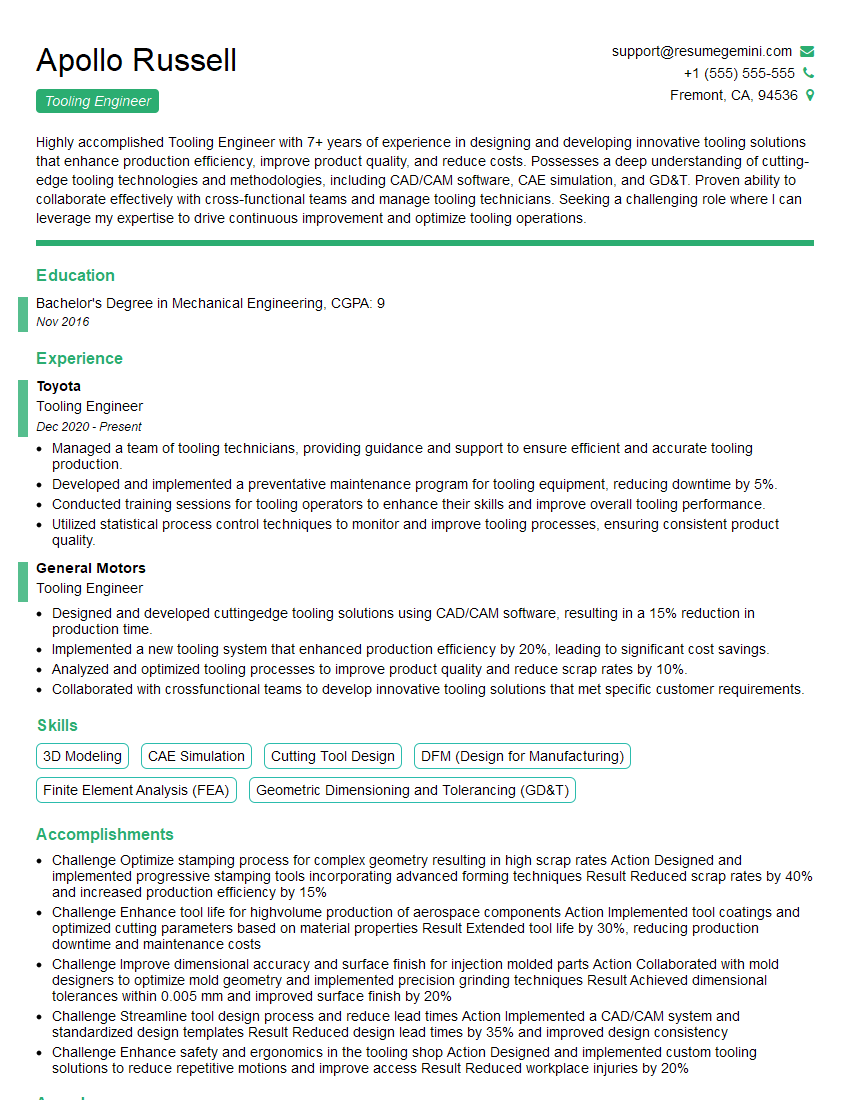
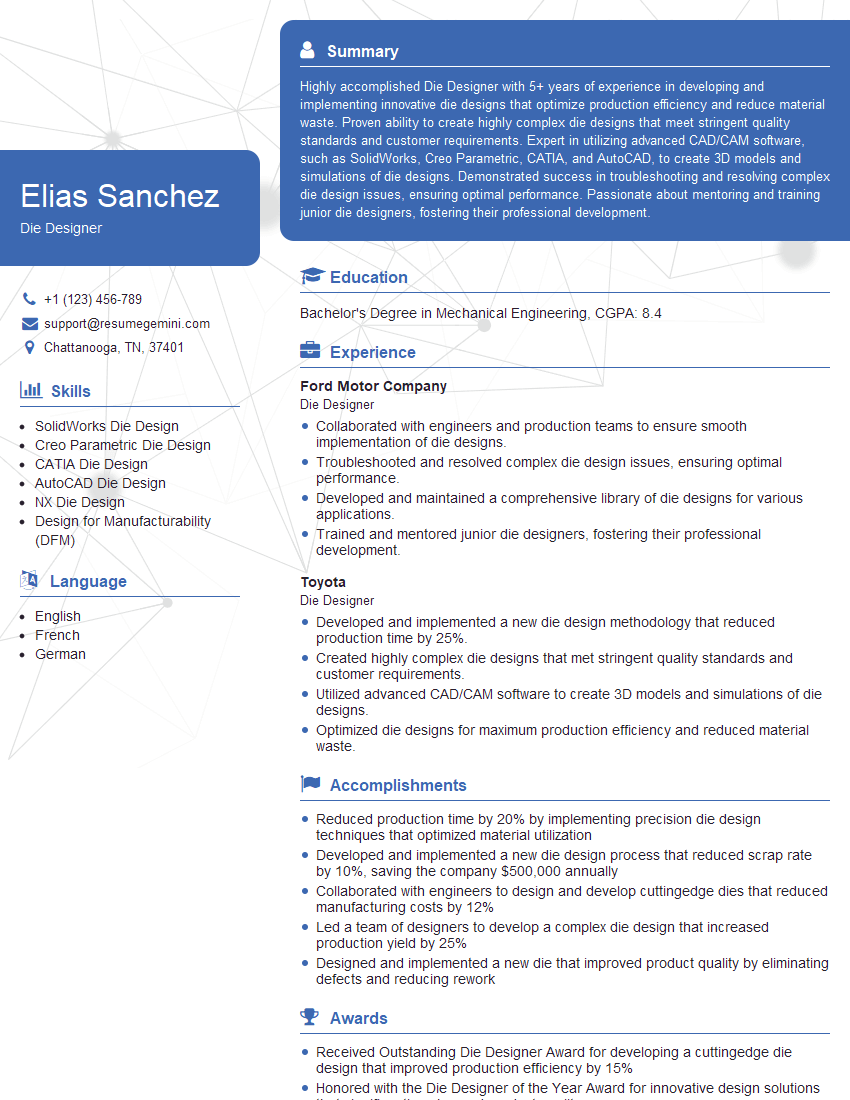
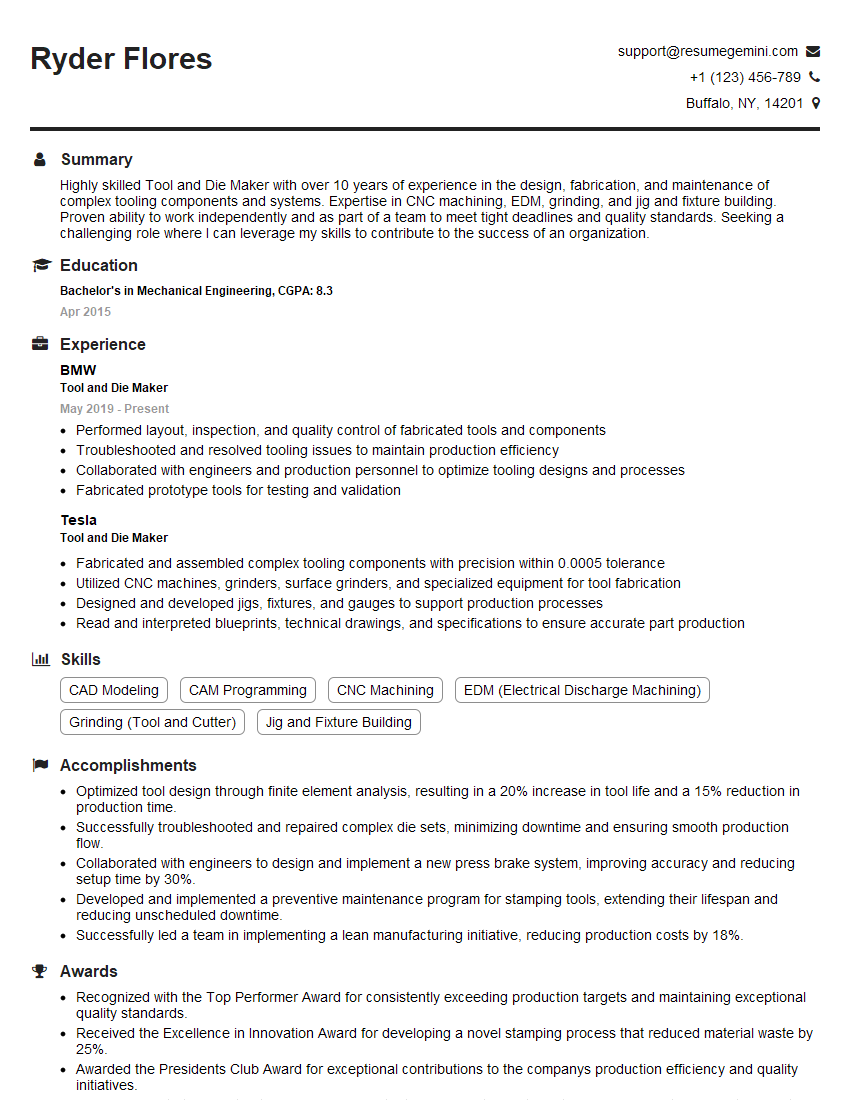
Mastering Die Design and Engineering opens doors to exciting career opportunities in a constantly evolving industry. A strong foundation in these key areas significantly boosts your employability and paves the way for professional growth and advancement. To maximize your job prospects, it’s crucial to present your skills effectively. Creating an ATS-friendly resume is essential for getting your application noticed by recruiters. We highly recommend using ResumeGemini to craft a professional and impactful resume that highlights your expertise. ResumeGemini provides examples of resumes tailored specifically to Die Design and Engineering, helping you showcase your qualifications effectively.
Explore more articles
Users Rating of Our Blogs
Share Your Experience
We value your feedback! Please rate our content and share your thoughts (optional).
What Readers Say About Our Blog
Very informative content, great job.
good