Interviews are opportunities to demonstrate your expertise, and this guide is here to help you shine. Explore the essential Digital Design (CAD) interview questions that employers frequently ask, paired with strategies for crafting responses that set you apart from the competition.
Questions Asked in Digital Design (CAD) Interview
Q 1. What CAD software are you proficient in?
I’m proficient in several leading CAD software packages, including Autodesk AutoCAD, SolidWorks, and Fusion 360. My selection depends on the specific project requirements. For example, AutoCAD excels in 2D drafting and precise detailing, while SolidWorks and Fusion 360 are powerful tools for complex 3D modeling and simulations. I also have experience with other niche software, such as Revit for BIM (Building Information Modeling) projects, showcasing my adaptability to various industry needs.
Q 2. Describe your experience with 2D and 3D modeling.
My experience encompasses both 2D and 3D modeling, and I seamlessly integrate both in my workflow. 2D modeling forms the foundation for many projects, providing accurate technical drawings and documentation. I use it extensively for creating detailed floor plans, elevations, and sections. Think of it as the blueprint – essential for visualizing the overall design and dimensions. 3D modeling, on the other hand, allows for a more comprehensive understanding of the design by providing a realistic representation. I use it to create prototypes, conduct simulations, and generate photorealistic renderings, allowing for early detection of potential design flaws and visualization of final product aesthetics. I’ve worked on projects ranging from simple product designs to complex architectural models, using both methodologies effectively.
Q 3. Explain your process for creating detailed technical drawings.
Creating detailed technical drawings is a systematic process. It starts with a thorough understanding of the design requirements and specifications. First, I meticulously gather all relevant data, including dimensions, materials, tolerances, and any relevant standards. Then, I develop a clear sketch or conceptual model, which acts as a roadmap for the detailed drawing. Next, I use the appropriate CAD software to create precise 2D drawings, utilizing layers and annotation tools for clarity. This includes incorporating standard drafting symbols and dimensions to ensure consistency and clarity. Finally, I conduct a thorough review of the drawings, checking for accuracy and completeness before releasing them. For example, on a recent project designing a custom-built cabinet, I used AutoCAD to generate detailed drawings of each component with accurate measurements and material specifications, ensuring seamless manufacturing.
Q 4. How do you manage large and complex CAD projects?
Managing large and complex CAD projects requires a structured approach. I typically employ a modular design strategy, breaking down the project into smaller, manageable components. This allows for parallel work and simplifies coordination between team members. We use a robust project management system (like Asana or Jira) to track progress, deadlines, and revisions. Furthermore, I leverage advanced CAD features such as design templates and libraries to streamline the design process and maintain consistency. Regular project reviews and progress meetings are essential to identify potential challenges early and ensure that the project stays on track. Imagine designing a large-scale building – breaking it into individual floors, rooms, and systems allows for efficient collaboration and management.
Q 5. What are your preferred methods for file management and version control in CAD?
I utilize a combination of strategies for efficient file management and version control. A well-structured folder system, utilizing a naming convention that clearly identifies the project, revision number, and date, is fundamental. This is crucial for maintaining organization and accessibility. For version control, I’m proficient in using cloud-based solutions like Autodesk Vault or similar systems that track changes, allowing for easy collaboration and rollback to previous versions if necessary. This ensures that all team members are working with the most up-to-date files and allows for a clear audit trail of modifications. Think of this as the equivalent of a meticulous document history, preventing errors and facilitating teamwork.
Q 6. How do you ensure accuracy and precision in your CAD designs?
Accuracy and precision are paramount in CAD design. I employ several strategies to ensure both: firstly, I rigorously adhere to design standards and specifications provided. Secondly, I make consistent use of constraints and parameters within the CAD software to ensure geometric accuracy and prevent errors during modifications. Thirdly, I perform regular checks and validations using the software’s built-in tools, and I also frequently utilize cross-referencing and dimension checks to verify accuracy. Finally, in complex projects, I implement simulations and analyses to verify the integrity of the design. The goal is to avoid costly errors and guarantee the design is fit for purpose. This can be compared to a surgeon’s precision during a complex procedure – accuracy is non-negotiable.
Q 7. Describe your experience with CAD rendering and visualization techniques.
I have extensive experience with CAD rendering and visualization techniques. I utilize various rendering engines and software, including those integrated within SolidWorks and Fusion 360, to create photorealistic renderings and animations. This allows for effective communication of the design to clients and stakeholders, helping them visualize the final product. I can also generate walkthroughs and virtual reality experiences for immersive design reviews. These techniques are not just aesthetically pleasing but also serve a crucial purpose in identifying potential design flaws and improving user experience. For instance, a photorealistic rendering of a product allows a client to visualize its texture, color and overall aesthetic appeal before the physical product is manufactured.
Q 8. Explain your understanding of CAD standards and conventions.
CAD standards and conventions are crucial for ensuring design consistency, clarity, and compatibility across projects and teams. They dictate aspects like layer management, naming conventions for files and objects, drawing templates, units of measurement, and annotation styles. Think of it like a shared language—everyone needs to understand the grammar and vocabulary to effectively communicate through the design.
- Layer Management: Organizing layers logically (e.g., ‘Walls,’ ‘Doors,’ ‘Plumbing’) prevents clutter and allows for easy selection and manipulation of specific design elements. Inconsistent layer usage leads to confusion and errors.
- Naming Conventions: Using a consistent system for naming files and objects (e.g., ‘Project_Name_Drawing_Number’) is essential for locating specific drawings quickly and avoiding duplication. Imagine searching for a file named ‘drawing.dwg’ among hundreds of similar files!
- Drawing Templates: These pre-configured templates establish a baseline for new drawings, ensuring consistent settings for units, text styles, line weights, and sheet sizes. It’s like having a pre-set recipe for your drawing, ensuring consistent quality from the start.
- Annotation Styles: Standards for dimensions, notes, and other annotations guarantee readability and clarity across the design, making it easy for anyone to understand the design’s specifications.
Adherence to these standards is critical for smooth collaboration, efficient project management, and error reduction. In my experience, working on large-scale projects without a standardized approach leads to significant delays and rework.
Q 9. How do you handle design changes and revisions in CAD?
Handling design changes and revisions in CAD involves a structured approach to maintain version control and avoid conflicts. We employ revision control systems, layer management, and version history features within the CAD software itself.
- Revision Control: Each revision is saved as a new version, allowing for easy tracking of changes. This prevents accidental overwriting and allows for easy rollback if necessary. Think of this like using version control software like Git, but within the CAD software.
- Layer Management: Design changes can be implemented on separate layers, allowing for comparison and easy toggling between different versions or design options without affecting other parts of the design. This helps isolate changes and prevent unintended consequences.
- Version History: Most CAD software maintains a history of changes made to a file, making it simple to revert to earlier versions if needed. It is similar to having a detailed audit trail.
- Change Orders: Formally documenting all design changes via change orders helps to ensure that everyone is informed about revisions and that the process is tracked efficiently.
For example, on a recent project involving a complex building design, implementing a change order system with clearly labeled revision levels ensured that our entire team, including contractors, were working from the most up-to-date designs, minimizing discrepancies and costly errors.
Q 10. Describe your experience with CAD data extraction and analysis.
CAD data extraction and analysis are essential for generating reports, performing simulations, and facilitating downstream processes. My experience includes extracting geometric data, material properties, and other relevant information for use in different applications.
- Geometric Data Extraction: I’ve used CAD software features to export data in various formats (e.g., DXF, DWG, STEP) for use in finite element analysis (FEA) or other simulations. This helps to quantify the structural integrity or performance of the designed components.
- Material Property Extraction: Extracting material properties from the CAD model is important for accurate simulation and analysis. I use scripts and plugins to automate this process, ensuring consistency and efficiency.
- Data Analysis: After extracting data, I utilize spreadsheet software or dedicated analysis tools to analyze and interpret the results. This allows us to identify potential weaknesses or areas for improvement in the design.
For instance, on a recent project, I extracted geometric data from a complex mechanical assembly to perform FEA. This revealed stress concentrations in a critical component, leading to design modifications that improved performance and reliability.
Q 11. What are your troubleshooting skills with CAD software issues?
Troubleshooting CAD software issues requires a methodical approach, starting with identifying the problem’s nature, followed by systematic debugging steps.
- Reproducing the Issue: First, I try to reproduce the issue consistently to understand the context of the error. What steps lead to the problem?
- Checking System Requirements: I verify that the system meets the software’s minimum requirements and that all necessary drivers and updates are installed. This ensures the software is running in an optimal environment.
- Searching Online Resources: Online forums, knowledge bases, and manufacturer support websites are valuable resources for troubleshooting common issues. Often, others have encountered and solved the same problem.
- Reinstalling Software or Drivers: As a last resort, reinstalling the software or updating drivers can resolve many persistent issues.
- Contacting Support: If all else fails, contacting the software vendor’s support team is the next step. They have access to more advanced troubleshooting tools and expertise.
For example, I once encountered a persistent rendering issue. By systematically checking system settings, drivers, and online forums, I identified a conflict with the graphics card settings, which was resolved by adjusting the driver configuration.
Q 12. How do you collaborate with other team members using CAD software?
Collaboration in CAD is streamlined through the use of version control systems, cloud-based platforms, and effective communication strategies.
- Version Control Systems: Using a central repository allows multiple team members to work on the same project simultaneously without overwriting each other’s work. This is similar to collaborative coding environments but applied to CAD.
- Cloud-Based Platforms: Cloud storage and collaboration platforms allow for real-time access and editing of CAD models by team members across different locations. This enables simultaneous work and facilitates quicker review processes.
- Regular Meetings and Communication: Regular meetings, design reviews, and clear communication channels are vital for ensuring that everyone is on the same page and that design changes are implemented efficiently.
- Model Sharing and Reviewing: Tools for model sharing and reviewing with mark-up features allow for efficient feedback and revisions.
In my previous role, we used a cloud-based platform to work on a large-scale infrastructure project. This enabled seamless collaboration between engineers in different offices, significantly accelerating the design process and minimizing potential conflicts.
Q 13. Explain your experience with BIM (Building Information Modeling).
BIM (Building Information Modeling) is a process that uses 3D modeling software to create and manage building data throughout the project lifecycle. My experience with BIM software includes model creation, data management, and collaboration within a BIM environment.
- Model Creation: I’m proficient in creating detailed 3D models of buildings, including architectural, structural, and MEP (Mechanical, Electrical, and Plumbing) systems. This includes incorporating detailed information like materials and specifications.
- Data Management: BIM involves managing vast amounts of data, including geometric information, material properties, and cost estimates. I’m adept at organizing and managing this data to ensure accuracy and consistency.
- Collaboration: BIM fosters collaboration between different disciplines (architects, engineers, contractors). I utilize BIM software’s features to facilitate this collaboration, ensuring that all stakeholders have access to the most current information.
- Clash Detection: BIM software’s clash detection feature helps identify potential conflicts between different building systems before construction begins, saving time and money.
On a recent project, using BIM software helped us identify a clash between ductwork and structural beams early in the design process, preventing costly rework during construction.
Q 14. Describe your experience with CAM (Computer-Aided Manufacturing) software.
CAM (Computer-Aided Manufacturing) software translates CAD models into instructions for manufacturing equipment. My experience includes generating CNC (Computer Numerical Control) toolpaths and optimizing manufacturing processes.
- CNC Toolpath Generation: I’m skilled at using CAM software to create toolpaths for various manufacturing processes, such as milling, turning, and 3D printing. This involves considering factors such as material properties, tool selection, and machining parameters.
- Process Optimization: Optimizing the manufacturing process involves selecting appropriate tooling, machining parameters (feed rate, speed, depth of cut), and strategies to minimize production time and maximize part quality. This reduces waste and improves efficiency.
- Simulation and Verification: Many CAM systems offer simulation capabilities that allow for verification of toolpaths before actual machining. This prevents errors and potential damage to the workpiece or equipment.
In one project, I used CAM software to generate toolpaths for a complex part requiring multiple machining operations. By carefully optimizing the toolpaths and parameters, I reduced the overall machining time by 20%, significantly improving production efficiency.
Q 15. What is your experience with parametric modeling?
Parametric modeling is a powerful approach in CAD where design elements are defined by parameters, or variables. Instead of manually adjusting dimensions, you define relationships between components. Changing a single parameter automatically updates related components, maintaining design intent and consistency. Think of it like a sophisticated formula where changing one number changes the whole equation.
For example, imagine designing a gear. Instead of specifying each tooth individually, you’d define the module (a unit of gear size), number of teeth, and pressure angle as parameters. Changing the number of teeth automatically adjusts the gear diameter and tooth profile, ensuring accurate meshing. This drastically speeds up design iteration and allows for easy exploration of different design options. My experience spans several years working with software like SolidWorks and Fusion 360, extensively utilizing parametric features to create complex assemblies and parts, ensuring design flexibility and reducing errors.
In a past project, I used parametric modeling to design a series of custom brackets for a robotic arm. By defining parameters for the arm’s dimensions and mounting points, I was able to quickly generate dozens of bracket variations to test different mounting configurations and optimize for strength and weight. This greatly reduced design time compared to traditional modeling methods.
Career Expert Tips:
- Ace those interviews! Prepare effectively by reviewing the Top 50 Most Common Interview Questions on ResumeGemini.
- Navigate your job search with confidence! Explore a wide range of Career Tips on ResumeGemini. Learn about common challenges and recommendations to overcome them.
- Craft the perfect resume! Master the Art of Resume Writing with ResumeGemini’s guide. Showcase your unique qualifications and achievements effectively.
- Don’t miss out on holiday savings! Build your dream resume with ResumeGemini’s ATS optimized templates.
Q 16. How do you stay up-to-date with the latest CAD technologies and software updates?
Staying current in the rapidly evolving world of CAD requires a multi-pronged approach. I regularly attend webinars and online courses offered by software vendors like Autodesk and Dassault Systèmes. These often cover new features and best practices. I also actively participate in online forums and communities such as those on LinkedIn and specialized CAD websites to discuss new techniques and challenges with other professionals. This peer-to-peer learning is invaluable.
Furthermore, I actively read industry publications and journals focusing on CAD/CAM/CAE trends. Trade shows are also an excellent way to see demos of cutting-edge software and hardware, and network with other professionals. This holistic approach ensures I am continuously learning and adapting my skill set to leverage the latest advancements in CAD technology.
Q 17. Explain your understanding of different CAD file formats.
Understanding CAD file formats is crucial for seamless collaboration and data exchange. Different formats offer varying levels of data preservation, compatibility, and file size. Some common formats include:
- STEP (.stp, .step): A neutral format, widely compatible, ideal for exchanging data between different CAD systems. It preserves geometry but may lose some design history or feature information.
- IGES (.igs): Another neutral format, similar to STEP but often considered less robust and potentially less compatible in certain situations.
- Native formats (e.g., .sldprt for SolidWorks, .prt for Creo): These retain all design history and features, allowing for maximum flexibility within the specific software. However, they are not universally compatible.
- STL (.stl): A widely used format for 3D printing and rapid prototyping. It represents the surface geometry as a mesh of triangles, losing internal detail.
Choosing the right format depends on the intended use. For example, I’d use STEP to share a design with a manufacturing partner using a different CAD system, but I’d maintain the native format for ongoing design work.
Q 18. Describe your process for creating detailed technical documentation.
Creating detailed technical documentation is a critical aspect of ensuring that a design is accurately understood and manufactured. My process typically involves several steps:
- Model annotations: Adding dimensions, tolerances, materials, and surface finish specifications directly onto the CAD model itself.
- Detailed drawings: Generating 2D orthographic views (front, top, side) and sectional views to clearly illustrate critical features and dimensions. These drawings will include all necessary information for manufacturing, including tolerances, material specifications, and surface finishes.
- Bill of Materials (BOM): Creating a comprehensive list of all components, including part numbers, quantities, and material specifications.
- Assembly instructions: Providing step-by-step instructions for assembling the product, including visual aids where appropriate.
- Revision control: Implementing a revision control system (e.g., using document numbering schemes) to track changes and ensure everyone is working with the latest version.
I ensure all documentation is clear, concise, and accurately reflects the design intent. This minimizes ambiguity and reduces the risk of manufacturing errors. I often utilize templates to maintain consistency across all projects.
Q 19. How do you ensure the quality and accuracy of your CAD models?
Ensuring the quality and accuracy of CAD models requires a rigorous approach involving several checks and balances:
- Design reviews: Regular peer reviews with other engineers help catch potential errors early in the design process.
- Geometric dimensioning and tolerancing (GD&T): Applying GD&T principles ensures that the design specifications are clearly communicated and meet manufacturing capabilities.
- Finite Element Analysis (FEA): Performing simulations to verify the structural integrity and performance of the design under various load conditions. This helps identify potential weaknesses and optimize the design for strength and durability.
- Model checking tools: Using built-in software tools to detect errors like gaps, intersections, and inconsistencies in the model geometry.
- Prototyping and testing: Creating physical prototypes to validate the design and identify any unforeseen issues.
This multi-layered approach helps identify and correct any errors before they become costly problems later in the product lifecycle. A thorough QA process is essential to building reliable and high-quality products.
Q 20. How do you manage deadlines and priorities on CAD projects?
Managing deadlines and priorities on CAD projects requires effective planning and prioritization. I typically start by:
- Breaking down the project: Dividing the project into smaller, manageable tasks with clear deliverables and timelines.
- Prioritizing tasks: Identifying critical path tasks and focusing on those first to avoid delays. This often uses a critical path method (CPM) or similar project management tool.
- Utilizing project management software: Using tools like MS Project or Asana to track progress, manage tasks, and identify potential bottlenecks.
- Regular communication: Maintaining open communication with stakeholders to ensure that everyone is aware of the project’s status and any potential issues.
- Contingency planning: Building buffer time into the schedule to account for unforeseen delays or issues.
Proactive planning and consistent monitoring are key to successful project completion. Adaptability is also vital; I am prepared to adjust priorities as needed based on unforeseen circumstances or changing client requirements.
Q 21. Describe your problem-solving skills in a CAD design context.
Problem-solving in a CAD design context often involves identifying and resolving issues related to geometry, functionality, or manufacturing constraints. My approach typically involves:
- Understanding the problem: Clearly defining the issue and its impact on the overall design.
- Analyzing the cause: Investigating the root cause of the problem, whether it’s a design flaw, a software limitation, or a misunderstanding of requirements.
- Exploring solutions: Brainstorming and evaluating different potential solutions, considering factors such as cost, manufacturability, and performance.
- Implementing and testing: Implementing the chosen solution and thoroughly testing it to ensure that it addresses the problem effectively and doesn’t introduce new issues.
- Documenting the solution: Recording the problem, the solution, and any lessons learned to prevent similar issues from occurring in the future.
For example, I once encountered a problem where two parts in an assembly interfered with each other. By using section views and analyzing the geometry in detail, I identified the source of the interference and adjusted the design parameters to resolve the issue. This involved iterative testing and refinement until a successful solution was achieved.
Q 22. How do you adapt to new CAD software and technologies?
Adapting to new CAD software is a crucial skill for any digital designer. My approach involves a structured learning process. First, I familiarize myself with the software’s interface and basic functionalities through tutorials and online documentation. I then move on to practical application, starting with simple projects that allow me to gradually build my proficiency. I find replicating past projects in the new software particularly helpful as it allows me to compare workflows and identify efficiencies. Finally, I actively seek out advanced training and certifications where available, focusing on features relevant to my specific design needs. For example, when transitioning from SolidWorks to Fusion 360, I started by recreating a previous engine component design, comparing the sketching, modeling, and assembly tools. This hands-on approach, coupled with targeted training on Fusion 360’s generative design capabilities, allowed me to quickly become proficient.
Q 23. Explain your experience with using CAD for design for manufacturing.
My experience with CAD for design for manufacturing (DFM) is extensive. I understand that the design process must account for manufacturability, cost, and assembly. This involves considering factors such as material selection, tolerance analysis, and part simplification. For instance, while designing a complex injection-molded plastic part, I utilized SolidWorks’ simulation tools to analyze the mold filling process and identify potential issues like sink marks or weld lines. I also incorporated design rules for moldability, such as ensuring consistent wall thicknesses and adding draft angles. This iterative process of design and simulation ensured a manufacturable and cost-effective part. Furthermore, I’m experienced in generating manufacturing drawings with detailed annotations, including GD&T (Geometric Dimensioning and Tolerancing) to ensure precise communication with manufacturers.
Q 24. How do you handle conflicting design requirements in a CAD project?
Conflicting design requirements are common in CAD projects. My approach involves a structured process to resolve these conflicts. First, I clearly document all requirements, prioritizing them based on their criticality. Then, I explore potential trade-offs and compromises, evaluating the impact of each decision. This often involves iterative design changes and simulations to assess the feasibility and functionality of different approaches. For example, if a design needs to be both lightweight and highly durable, I might explore using different materials or optimize the part geometry to minimize weight while maintaining structural integrity. Effective communication with stakeholders is crucial throughout the process, ensuring that everyone understands the compromises and their implications.
Q 25. Describe a time you had to make significant design changes in CAD.
During the development of a robotic arm for a university research project, we faced a critical design flaw late in the project. The original design, optimized for weight, lacked sufficient rigidity. This was discovered during load testing. We had to make substantial modifications, using SolidWorks to redesign key components. This involved strengthening the arm structure by increasing material in specific areas and redesigning joints for increased stability, while concurrently using finite element analysis to verify the changes. It was a challenging situation, requiring extended hours and collaboration with the engineering team. However, the revised design successfully addressed the problem, proving the importance of thorough testing and iterative design processes in CAD.
Q 26. What is your experience with design review processes using CAD?
My experience with design review processes using CAD is rooted in utilizing version control systems and collaborative platforms. I’m proficient in using platforms like Autodesk Vault or similar systems to manage design revisions and track changes. I believe in transparent and documented design reviews, where stakeholders can comment directly on the CAD models and drawings using markup tools. This facilitates clear communication and ensures all design decisions are well-considered and agreed upon. Formal presentations, utilizing annotated CAD models and simulations, are used to explain design choices and address potential concerns. This approach ensures a high level of quality and minimizes errors, resulting in smoother manufacturing and implementation processes.
Q 27. How do you ensure your CAD models are optimized for manufacturing processes?
Optimizing CAD models for manufacturing involves a deep understanding of various manufacturing processes. For example, when designing for injection molding, I ensure consistent wall thicknesses, proper draft angles, and the avoidance of undercuts. For CNC machining, I consider factors like toolpath accessibility and material removal strategies. I utilize CAD software’s capabilities to generate manufacturing-specific analyses, such as mold flow analysis for injection molding or finite element analysis for predicting stress and strain. Additionally, I’m familiar with industry-standard tolerances and incorporate GD&T to ensure precision during manufacturing. Throughout the design process, I consult with manufacturing engineers to ensure the model is manufacturable and cost-effective. Regular communication and feedback loops are crucial for optimizing the designs.
Q 28. Explain your understanding of different types of CAD modeling (e.g., solid, surface, wireframe).
CAD modeling encompasses various techniques, each suitable for different applications.
- Wireframe modeling is the simplest, representing objects with lines and curves. It’s useful for initial conceptualization and sketching, but lacks surface or volume information.
- Surface modeling creates objects by defining their surfaces. It’s ideal for aesthetically-driven designs like car bodies or consumer products where the surface quality is paramount. It doesn’t inherently define volume.
- Solid modeling defines objects by their volume, representing the full three-dimensional shape. This allows for precise analysis of mass properties, interference detection, and more advanced simulations. It’s commonly used in engineering applications where accurate representation is key.
Key Topics to Learn for Digital Design (CAD) Interview
- Software Proficiency: Mastering at least one major CAD software (AutoCAD, Revit, SolidWorks, etc.) is crucial. Focus on demonstrating proficiency in 2D and 3D modeling, drafting, and rendering techniques.
- Design Principles: Showcase your understanding of fundamental design principles like ergonomics, aesthetics, and functionality. Be prepared to discuss how these principles inform your design choices.
- Technical Drawing & Documentation: Practice creating clear and concise technical drawings, including dimensioning, annotations, and creating detailed design specifications. Understand different drawing standards.
- Modeling Techniques: Be ready to discuss various modeling techniques (e.g., parametric modeling, solid modeling, surface modeling) and their applications in different design contexts. Highlight your experience with different modeling workflows.
- Problem-solving & Design Iteration: Demonstrate your ability to identify design challenges, propose solutions, and iterate on designs based on feedback or changing requirements. Use examples from your past projects.
- Collaboration & Communication: Discuss your experience working in teams, communicating design ideas effectively, and incorporating feedback from stakeholders.
- Industry Standards & Best Practices: Familiarize yourself with industry-specific standards and best practices related to your area of specialization within Digital Design (CAD).
- Emerging Technologies: Show awareness of current trends and emerging technologies in CAD, such as BIM (Building Information Modeling) or generative design.
Next Steps
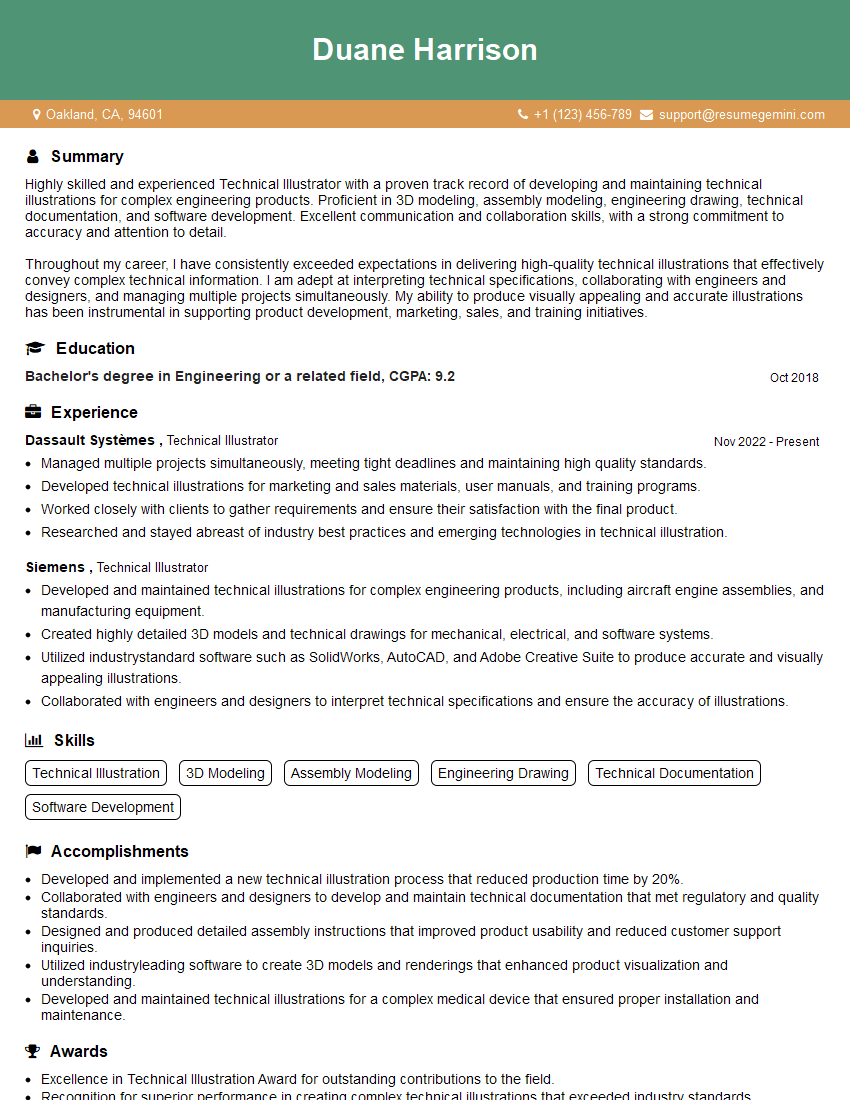
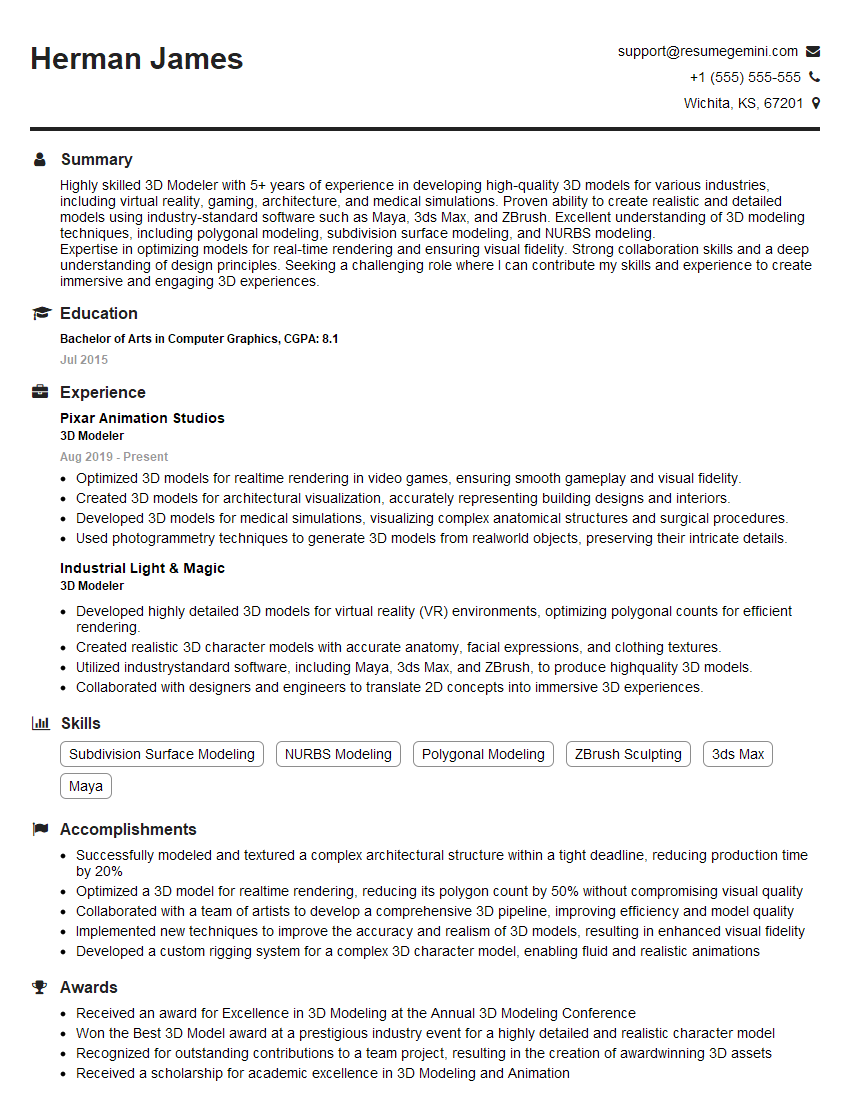
Mastering Digital Design (CAD) is essential for a thriving career in architecture, engineering, manufacturing, and many other dynamic fields. A strong command of CAD software and design principles opens doors to exciting opportunities and higher earning potential. To significantly boost your job prospects, invest time in crafting a compelling and ATS-friendly resume that highlights your skills and experience effectively. ResumeGemini is a valuable tool to help you build a professional and impactful resume. Examples of resumes tailored specifically for Digital Design (CAD) professionals are available to guide you through the process. Let ResumeGemini help you showcase your talent and land your dream job!
Explore more articles
Users Rating of Our Blogs
Share Your Experience
We value your feedback! Please rate our content and share your thoughts (optional).
What Readers Say About Our Blog
Very informative content, great job.
good